Compact words

Note: This post was originally entitled “Words and expressions that we wish English had.” Other such articles describe “untranslatable words.” Since an English gloss is provided for each term, I don’t find them untranslatable – they just carry a lot of meaning in a single lexeme, and there may not be an individual single word in other languages that carries the same signatum.


While these two are not gazing at each other, the essence of mamihlapinatapei, which I posted about earlier, is captured here.

This list of words for which there is no English equivalent popped up on the internet over at TheWeek a couple of days ago, and I’ve seen it referenced by more than one friend on Facebook:

1. Shemomedjamo (Georgian)

You know when you’re really full, but your meal is just so delicious, you can’t stop eating it? The Georgians feel your pain. This word means, “I accidentally ate the whole thing.”

2. Pelinti (Buli, Ghana)

Your friend bites into a piece of piping hot pizza, then opens his mouth and sort of tilts his head around while making an “aaaarrrahh” noise. The Ghanaians have a word for that. More specifically, it means “to move hot food around in your mouth.”

3. Layogenic (Tagalog)

Remember in Clueless when Cher describes someone as “a full-on Monet… from far away, it’s OK, but up close it’s a big old mess”? That’s exactly what this word means.

4. Rhwe (Tsonga, South Africa)

College kids, relax. There’s actually a word for “to sleep on the floor without a mat, while drunk and naked.”

5. Zeg (Georgian)

It means “the day after tomorrow.” Seriously, why don’t we have a word for that in English?

6. Pålegg (Norwegian)

Sandwich Artists unite! The Norwegians have a non-specific descriptor for anything — ham, cheese, jam, Nutella, mustard, herring, pickles, Doritos, you name it — you might consider putting into a sandwich.

7. Lagom (Swedish)

Maybe Goldilocks was Swedish? This slippery little word is hard to define, but means something like, “Not too much, and not too little, but juuuuust right.”

8. Tartle (Scots)

The nearly onomatopoeic word for that panicky hesitation just before you have to introduce someone whose name you can’t quite remember.

9. Koi No Yokan (Japanese)

The sense upon first meeting a person that the two of you are going to fall in love.

10. Mamihlapinatapei (Yaghan language of Tierra del Fuego)

This word captures that special look shared between two people, when both are wishing that the other would do something that they both want, but neither want to do.

11. Fremdschämen (German); also Myötähäpeä (Finnish)

The kinder, gentler cousins of Schadenfreude, both these words mean something akin to “vicarious embarrassment.” Or, in other words, that-feeling-you-get-when-you-watch-Meet the Parents.

12. Cafuné (Brazilian Portuguese)

Leave it to the Brazilians to come up with a word for “tenderly running your fingers through your lover’s hair.”

13. Greng-jai (Thai)

That feeling you get when you don’t want someone to do something for you because it would be a pain for them.

14. Kaelling (Danish)

You know that woman who stands on her doorstep (or in line at the supermarket, or at the park, or in a restaurant) cursing at her children? The Danes know her, too.

Such lists are quite common around the net, and I thought I’d add a few which I’ve gathered along the way.


German has quite a collection of these gems:

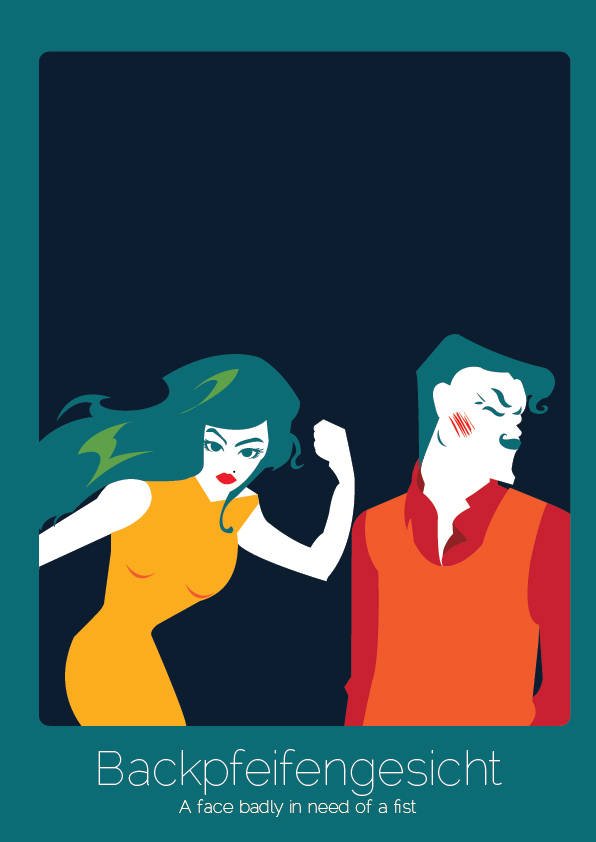
Backpfeifengesicht: A face badly in need of a fist.
0685aa700177b9e61cf99c97fa2315b7

(For more lovely illustrations of some of these terms, head over to Anjana Iyer’s “Found in Translation” page.)

Buchtrauer: the period of mourning that follows the ending of a beloved book. [Note: I made this word up recently, as I finished Lord of the Rings for the nth time. Others may have come up with it independently, but I claim it as my own.]

tumblr_macdgdaezo1rseme7o1_500

Drachenfutter: Peace offerings for wives from guilty husbands. Lit. “Dragon fodder”

Erklärungsnot: The feeling of discomfort brought on by the inability to come up with a satisfactory explanation.

Fernweh: A feeling of homesickness for a place you have never visited.

Fisselig: Flustered to the point of incompetence – a temporary state of inexactitude and sloppiness that is elicited by another person’s nagging.

Fremdschämen – agony over someone elses misfortune.

Futterneid: The feeling you get when you order something at a restaurant and you envy what someone else has ordered.

Gardinenpredigt: A verbal diatribe along the lines of “Why can’t you get off your lazy butt and get a job, oh my blessed mother was right, I could have married that fine doctor next door but no, …”. Lit. “Curtain Sermon”

Gretchenfrage (German) – A question asked for the purpose of finding out someone’s real intentions.
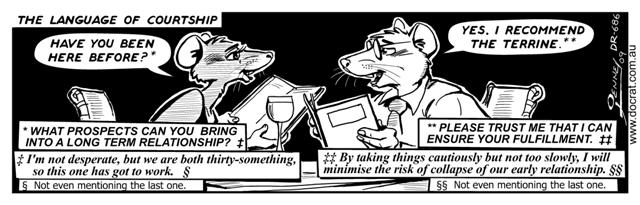
With thanks to Jenner. I sent this strip to my wife when I was interested in ramping up our relationship.

Gemütlichkeit: A German word which describes, according to Wikipedia, “a space or state of warmth, friendliness, and good cheer. Other qualities include coziness, peace of mind, belonging, well being, and social acceptance.” Imagine sitting in front of a warm fire on a frosty night, with a good book in one hand and a glass of your favorite beverage at your side…

Korinthenkacker: a person overly concerned with trivial details. Lit. “Currant crapper”

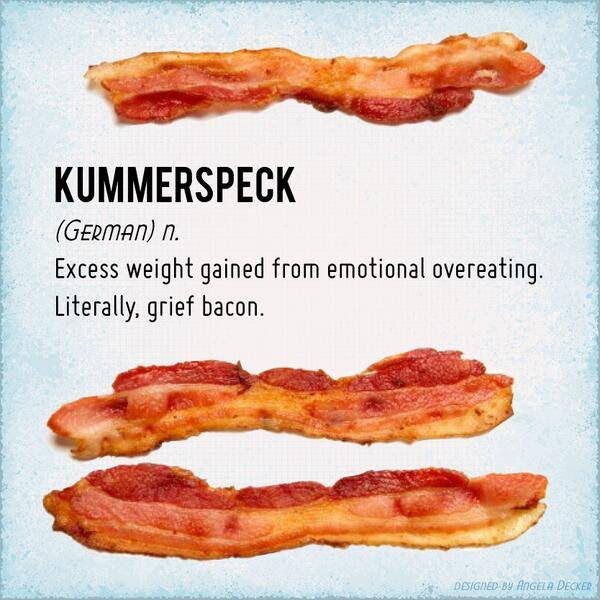
Kummerspeck: Excess weight gained from emotional overeating. Lit. “Worry bacon”. The bacon part refers not to what we eat, but to the excess pounds we put on as a result.
Luftmensch: (air person) A dreamer

Luftschloß: A castle in the air, an unattainable dream.

Neidbau: A building (often of little or no value to the proprietor) constructed with the sole purpose of harassing or inconveniencing his neighbor in some way.

Radfahrer: One who flatters superiors and browbeats subordinates

Ruinenlust: The delight that comes when contemplating ruins.

Schadenfreude: joy that one feels as a result of some one else’s misfortune.

Schadenfreude

A bad pun

Scheibenkleister: “Glazing compound,” the putty used to hold window panes in place. Used as a euphemism for “Scheiße,” which is considered very vulgar in German.

Scheißbedauern: The disappointment one feels when things turn out not nearly so badly as one had hoped (Lit. “shit regret”).

Schnapsidee (German) – Ludicrous ideas and plans conceived while drunk.

Sehnsucht: “life-longings”, an intense desire for alternative states and realisations of life, even if they are unattainable.

Seriensehnsucht: That horrible yearlong wait for the next season of a show you’ve just binged. I made this word up as well. If anyone else did simultaneously, that’s great. It’s still mine.

Torschlusspanik: the fear of diminishing opportunities as one ages. This word is most frequently applied to women who race the ‘biological clock’ to wed and bear children. Lit. “Gate Closing Panic”

Waldeinsamkeit: The feeling of being alone in the woods.

Weltschmerz: A gloomy, romanticized, world-weary sadness, experienced most often by privileged youth.

Zechpreller: Someone who leaves without paying the bill.


Here is another collection of such words; some are taken from They Have a Word for It [1]; others come from The Meaning of Tingo[2]; still others are from In Other Words[3]; some were collected by Dr. Tim Lomas; and others again are from Mogg knows where.

Ahorita (Spanish): Right this second, or now, or later, or perhaps never.

ʻAkihi (Hawaiʻian): Getting directions from someone and wandering off without paying the least attention to them. This is probably why Moses was stuck in the desert for 40 years.

Alamnaka (Ulwa, Nicaragua): to find one’s niche or meet a kindred soul.

Ariga-meiwaku (Japanese): An act someone does for you that you didn’t want them to do and tried to prevent them doing, but they went ahead anyway, determined to do you a favor, and then things went wrong and caused you a lot of trouble, yet in the end social conventions required you to express gratitude.

Aşermek (Turkish): Craving certain foods while pregnant.

Attaccabottoni (Italian): A doleful bore who buttonholes people and tells sad, pointless tales.

Aware (Japanese): The feelings engendered by ephemeral beauty.

Bakku-shan (Japanese): Seeing a woman who looks attractive from behind, but not from the front.

Baraka (Arabic): A git of spiritual energy hat can be used for mundane purposes

Bifler (French): To slap someone in the face with your penis.

Birilulo (Kiriwina, New Guinea): Comparing yams to settle disputes.

Boketto (ぼけっと) (Japanese): Gazing vacantly into the distance without thinking. The French expression for this is “dans la lune” (in the moon); my elementary school French teacher, Mme. Hopstein, would tell me I was doing this all the time. Which was true.

Bonga (Santali): Spirit of a place that must be dealt with

Cavoli riscaldati (Italian) – When you attempt to start up a failed relationship or love affair. Literally, ‘reheated cabbage.’

Cibi cere (Italian): Pronunciation of CBCR, acronym for “cresci bene che ripasso,” which means “if you look like that when you grow up, I’ll come calling.”

Commuovere (Italian): To be moved to tears in a heartwarming way. (See Buchtrauer)

Conmoción (Spanish): Emotion held in common by a group or gathering

Cúbóg (Irish) – a collection of Easter eggs.

Culaccino (Italian): The mark left on a table by a cold glass.

Dadirri (Australian aboriginal) term – a deep, spiritual act of reflective and respectful listening.

Dépaysment (French): The feeling that comes from not being in your home country

Desbundar (Portuguese) – letting it all hang out  and losing your inhibitions while having fun.

Desenrascanço (Portuguese) – to artfully disentangle oneself from a troublesome situation.

Duende (Spanish) – The mysterious power of art to deeply move a person.

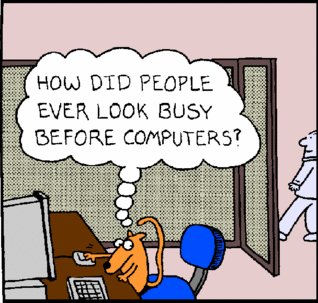
Epibreren (Dutch): A Dutch verb which was coined in 1954 by Simon Carmiggelt . It means to do unspecified work that looks very grand, but which means nothing at all. Office workers and interns do a lot of this.
busy

From Scott Adams’ “Dilbert”

Estrenar (Spanish): To wear a dress for the first time, or to try something for the first time, like a meal, skydiving, etc.

Fargin (Yiddish): To take sincere pleasure in the successes of others.

Farpotshket (Yiddish): Something that is all fouled up, especially as the result of an attempt to fix it.

Forelsket (Norwegian) – That intoxicatingly euphoric feeling you experience when you’re first falling in love.

Friluftsliv (Norwegian) – Essentially the joy of outdoor living, exploring and appreciating nature.

Friolero (Spanish) – Someone especially susceptible to cold temperatures.

Fucha (Polish): To use company time and resources for personal ends.

Gadrii Nombor Shulen Jongu (Tibetan) – Giving an answer that is unrelated to the question. Lit. – “Giving a green answer to a blue question.”

Gattara (Italian) – the Italian version of the “crazy cat lady,” an older lonely woman who devotes herself to caring for stray cats.

Gezelligheid (Dutch) – A cozy, friendly, pleasant atmosphere. Similar to German “Gemütlichkeit” or Danish “hygge.”

Gigil (Tagalog): When something is so cute you have to pinch it.

happy_mouse_flowers1

Gigil!

Glas wen (Welsh): Literally, a “blue smile” – a smile that is insincere or mocking. My favorite example of this comes from one of my beloved children’s books:
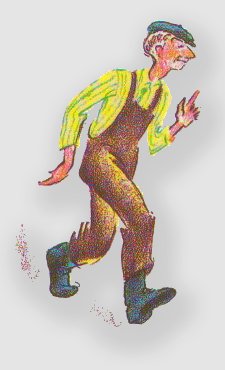
“Then Henry B. Swap said, ‘The job isn’t finished because Mary Anne isn’t out of the cellar, so Mike Mulligan won’t get paid.’ And he smiled again in a rather mean way.” (Burton, Virginia Lee, Mike Mulligan and his Steam Shovel)

Gobemouche (French) – Literally, “someone who swallows flies,” a credulous or gullible person.

Goya (Urdu): The suspension of disbelief that can occur when listening to good storytellling.

Gökotta (Swedish): Otta is Swedish for “early morning,” and “gök” means “chirp.” A Gökotta is a “chirp morning,” or a dawn picnic or outing to hear the birds sing.

Grilagem (Brazilian Portuguese) The old practice of putting a cricket in a box of newly faked documents, until the moving insect’s excrement makes the papers look old and genuine.[4]

Guanxi (Mandarin): This is one of the essential ways of getting things done in traditional Chinese society. To build up good guanxi, you do things for people such as give them gifts, take them to dinner, or grant favors. Conversely, you can also “use up” your guanxi with someone by calling in favors owed. Once a favor is done, an unspoken obligation exists. Maybe because of this, people often try to refuse gifts, because, sooner or later, they may have to repay the debt. However the bond of guanxi is rarely acquitted, because once the relationship exists, it sets up an endless process that can last a lifetime.

Gümüşservi (Turkish): Moonlight shining on the water

PHOTO_6362967_63455_4892137_main

Moonlight on the water – Freedom, NH.

Hanyauku (Rukwangali) – The act of walking on tiptoes across warm sand.

Hart ducha (Polish): Self-mastery in the face of internal and external forces

Hikikomori (Japanese) – A teenager or 20-something who has withdrawn from social life, often obsessed with TV and video games. (Note that this is often the definition applied incorrectly to the Japanese term otaku, which indicates someone passionately devoted to some aspect of society such as anime or manga. They may use geekspeak, but they have no problem communicating with others, especially those who share their passion.)

Hiraeth (Welsh) – A homesickness for a home to which you cannot return, a home which maybe never was; the nostalgia, the yearning, the grief for the lost places of your past. See Saudade.

Hygge (Danish) – the Danish equivalent of the German “Gemütlichkeit” (see above), but which permeates all aspect of Danish life and which contributes to the country’s status as one of the happiest in the world.

Hózh’q (Navajo): The beauty of life, as seen and created by a person

Iktsuarpok (Inuit): To go outside to check if an expected visitor has arrived, over and over again.

Ilunga (Tshiluba): From the south-eastern Democratic Republic of the Congo, this word has been chosen by numerous translators as the world’s most untranslatable word. It means a person who is ready to forgive any abuse the first time it occurs, to tolerate it the second time, but to neither forgive nor tolerate a third offense.

Istiqâra (Arabic): A request for spiritual or practical assistance in the form of a dream

Jayus (Indonesian): A joke so poorly told and so unfunny that one cannot help but laugh.

Jeruhuk (Malay) The act of stumbling into a hole that is concealed by long grass.

Jijivisha (Hindi) – The strong desire to live and thrive.

Jugaad (Hindi) – This means “an innovative fix” or a “repair derived from ingenuity,” as seen in images all over the internet. Just Google for “There, I fixed it.”

2d0d50e0f7d9d1dcaf39a49d58db25ae

Kaizen (Japanese) – used exclusively in business, the Japanese concept of continuous improvement involving input and suggestions from all levels, from the CEO to the janitors.

kalsarikännit: (Finnish): The picture below says it all.

pbY7SWg

Kilig (Tagalog) – The stupid-silly rush you feel immediately after something good happens, especially when it comes to love.

Kolleh (Yiddish): A beautiful bride

Komorebi (Japanese): The sunlight filtering through the leaves of trees.

Koro (Chinese): The hysterical belief that one’s penis is shrinking.

Koshatnik (Russian): A dealer in stolen cats.

Kuchisabishii (Japanese): When you’re not hungry, but you eat because your mouth is lonely.

Kula (Trobriand Islands): Sacred, endless process of gift giving

Kyoikumama (Japanese): This word refers to a mother who relentlessly pushes her children toward academic achievement.

Land nám (Icelandic): The sanctification of new land by mythologizing it

Layogenic (Tagalog): When someone looks attractive from far away, but, oh, they’re getting closer, oh, never mind.

Lieko (Finnish): The submerged trunk of a tree.

Linslus (Swedish): One who wants to be on camera all the time.

Linti (Farsi) – One who whiles away his or her life under a tree.

Masa bodoa (Javanese): Sociopolitically passive and unaware.

Maya (Sanskrit): The mistaken belief that a symbol is the same as the reality that it represents

Mbuki-mvuki (Bantu): To shuck off one’s clothes in order to dance.

Mencomot (Indonesian): Stealing insignificant items just for the fun of it.

Mencolek (Indonesian): Tapping someone on the opposite shoulder to get them to look in the wrong direction.

Meraki (Greek) – Doing something with soul, creativity, or love.

Mokita (New Guinean): Truth everybody knows but nobody speaks.

Mudita (Pāli and Sanskrit: मुदिता) – The joy one feels for the joy of others, essentially the opposite of envy or Schadenfreude (see above)

Mångata (Swedish): The roadlike reflection of the moon on the water (See Gümüşservi)

Nadi (Balinese): To temporarily inhabit another dimension

Nakhes (Yiddish): A mixture of pleasure and pride, particularly the kind that a parent receives from a child.

Natsukashii (Japanese) – a nostalgic longing for the past, with happiness for the fond memory, yet sadness that it is no longer.

Nemawashi (Japanese): Informal feeling-out and consensus gathering

Olfrygt (Viking Danish) The fear of a lack of ale, i.e. when you are out of town and have no idea where to find beer.

Ondinnonk (Iroquoian): The soul’s innermost benevolent desires.

Onsra (Boro language of India) – That bittersweet feeling of loving for the last time — in other words, that feeling you get when you know a love won’t last.

Oodal (Tamil) – The fake-sulking you do after getting into a lovers’ tiff, usually over something inconsequential.

Orenda (Huron) – the power of the human will to change the world in the face of powerful forces such as fate.

Ostranenie (Russian): Art as defamiliarization; making familiar perceptions seem strange

Outwaaien (Dutch) – Walking in the wind to clear your mind.

Paasa (Tagalog) – A person who leads someone on (intentionally or not). Appearing as if they are genuinely interested romantically when they aren’t.

Panapo’o (Hawai’ian): The act of scratching your head to help you remember something.

Papakata (Cook Islands Maori) – To have one leg shorter than the other. As in the wicked duke of Coffin Castle, but never describe him that way unless you wish to be slit from your guggle to your zatch and be fed to the geese. You must always say that one of his legs is longer than the other.

Pesamenteiro (Portuguese): one who joins groups of mourners at the home of a dead person, apparently to offer condolences but in reality is just there for the refreshments.

Pilkunnussija (Finnish): We call these “grammar Nazis” – the people who will sacrifice everything good about their lives – popularity, mental health, or social acceptance – in order to find and correct someone else’s grammar or punctuation errors. The Finnish word is very rude, and refers to having illicit carnal knowledge of commas.

Pisan zapra (Malay): The time needed to eat a banana.

Plunderbund (Dutch): Group of alliance of financial or poltical interests that exploits the public

Pochemuchka: A person who asks too many questions. College lecture rooms and Hell are both full of these. A three-hour meeting that runs overtime attracts these individuals in the same way a six-week-old wildebeest carcass attracts vultures.

Potlach (Haida): The ceremonial act of gaining social respect by giving away wealth

Prozvonit (Czech, Slovak): To call a mobile phone only to have it ring once so that the other person would call back, allowing the caller not to spend money on minutes.

Putaria (Portuguese): A crazy sex event, also used referring to politics.

Radioukacz (Polish)- Telegraphist on the Soviet side of the iron curtain, working for the resistance movement.

Rasa (Sanskrit): The mood or sentiment that is evoked be a work of art

Razbliuto (Russian): The feeling a person retains for someone he or she once loved.

Retrouvailles (French): The happiness of meeting again after a long time.

Sabi (Japanese): Beautiful patina

Sabsung (Thai): To slake an emotional or spiritual thirst to be revitalized

Saudade (Portuguese): a deep emotional state of nostalgic longing for an absent something or someone that one loves. It often carries a repressed knowledge that the object of longing will never return. A stronger form of saudade may be felt towards people and things whose whereabouts are unknown, such as a lost lover, or a family member who has gone missing.

Seigneur-terraces (French): People who sit at coffee shop tables for long periods of time but spend little money.

Sgriob (Gaelic) The itchiness that oversomes the upper lip just before taking a sip of whiskey. In more common usage, a scratch or a scrape, but this one has become entirely specialized.

Shibui (Japanese): Beauty of aging

Shih (Chinese): An insightful, elegant kind of knowledge

Shinrin-yoku (Japanese): “forest bathing.” Taking joy in healing forest walks and communion with nature.

Shitta (Farsi): Leftovers from dinner that will be eaten for breakfast.

Shlimazel: (Yiddish) – from German “schlimm” (bad) and Hebrew “mazel” (luck, fortune) – a perpetually unlucky person.

Sitike (Apache): In‑laws who are formally committed to help during crises.

Slampadato (Italian): Being addicted to the infrared glow of tanning salons

Soare cu dinti (Romanian): Literally, “sun with teeth.” Weather that looks beautiful through the window but which is in truth cold enough to freeze the nuts off a brass bridge.

Sobremesa (Spanish): The time spent after lunch or dinner, talking to the people with whom you shared the meal.

Sukha (Sanskrit) – genuine lasting happiness independent of circumstances.

Ta (Chinese): To understand things and thus take them lightly

taarradhin (Arabic): Arabic has no word for “compromise” in the sense of reaching an arrangement via struggle and disagreement. But a much happier concept, taarradhin, exists in Arabic. It implies a happy solution for everyone, a win/win situation. It’s a way of resolving a problem without anyone losing face.

tasleek (Arabic): Common in Saudi Arabia – to nod along and pretend you care what another person is saying.

tatemae (Japanese): Tatemae is what is expected by society and required according to one’s position and circumstances, and these may or may not match one’s private views, or honneHonne may be contrary to what is expected by society or what is required according to one’s position and circumstances, and they are often kept hidden, except with one’s closest friends. (Wikipedia)

Tarab (Arabic) – a musically induced state of ecstasy or enchantment.

Tingo (Pascuense , Easter Island): The act of taking objects one desires from the house of a friend by gradually borrowing all of them.

Tretår (Swedish) A second refill (patår) on a cup of coffee (tår), hence a “threefill”

Toska (Russian): “No single word in English renders all the shades of toska. At its deepest and most painful, it is a sensation of great spiritual anguish, often without any specific cause. At less morbid levels it is a dull ache of the soul, a longing with nothing to long for, a sick pining, a vague restlessness, mental throes, yearning. In particular cases it may be the desire for somebody of something specific, nostalgia, love-sickness. At the lowest level it grades into ennui, boredom.” –Vladimir Nabokov

Tsujigiri (Japanese): To test a new sword casually on a passerby. This was described in James Clavell’s Shogun,  when a samurai tested out Blackthorne’s new katana on an oil seller. See the Wikipedia entry for more history. A modern version of tsujigiri is reflected in my favorite Charles Addams cartoon of all time:

AddamsDeathRay

The caption reads, “Death ray, Fiddlesticks! Why, it doesn’t even slow them up!”

Tsundoku (Japanese) – The act of leaving a book unread after buying it, typically piling it up with other such unread books. Guilty as charged, but then again one can never have enough books.

Tuqburni (Arabic) – The literal translation is “You bury me,” referring to a love so deep you can’t imagine living life without your partner.

Ubuntu (Nguni Bantu) connectedness. “I am because we are”; a philosophy of humanity.
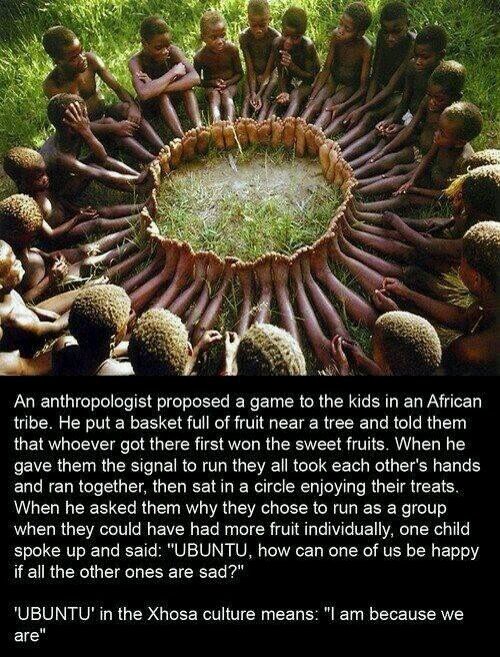
Uitwaaien (Dutch) – The invigorating feeling of taking a walk in the wind.

Utepils (Norwegian) – To sit outside on a sunny day enjoying a beer.

Verschlimmbessern (German) – the act of making something worse in a failed attempt to improve a situation.

Viraag (Hindi) – The emotional pain of being separated from a loved one.

Voorpret (Dutch) – That feeling of excitement you get even before an event actually takes place.

Vybafnout (Czech): To jump out and say “boo”

Wabi (Japanese): A flawed detail that creates an elegant whole.

Wabi-sabi (Japanese): Finding beauty in imperfections, an acceptance of the cycle of life and death.

Waq’f (Arabic): Property given to God

Won (Korean): Unwillingness to let go of an illusion

Ya’aburnee (Arabic): Literally, “You bury me,” a phrase indicating that you love someone so much that you wish to die before them that they might have long life. Written and pronounced differently depending on the dialect, it can appear as “يعبرني” with ayin or “يقبرني” with qaf, but most Americans would have to get by with the glottal stop represented by the apostrophe /yaʔaburni/ or with a ‘k’ /yakaburni/.

Yaourter (French): Literally, “to yogurt,” referring to the practice of singing along to a song for which you know neither the lyrics nor the language.

Ygen (Japanese): An awareness of the universe that trigers feelings too deep and mysterious for words

Yoin (Japanese): Experiential reverberation that continues to move one long after the initial external stimulus has ceased.

Yoko meshi (Japanese): Literally, “horizontal rice,” or a “sideways meal.” Japanese writing is typically top-to-bottom, thus this term defines the stress experienced when speaking a foreign language.

Yuan bei (Chinese) – a sense of complete and perfect accomplishment.

Yūgen (Japanese): A profound awareness of the universe which evokes feelings that are inexplicably deep and too mysterious for words. This is what I imagine Carl Sagan was trying to teach people to feel,

Zalatwic (Polish): Using acquaintances to accomplish things unofficially.

Zanshin (Japanese): A state of relaxed mental alertness in the face of danger

Zapoi (Russian): Several days of continuous drunkenness during which one withdraws from society.

Zeg (Georgian) It means “the day after tomorrow.” Seriously, why don’t we have a word for that in English?


As an addendum, for more interesting feelings that can’t be described in a single word (except made-up ones) I recommend perusing The Dictionary of Obscure Sorrows. An example:

Anecdoche: n. –  a conversation in which everyone is talking but nobody is listening, simply overlaying disconnected words like a game of Scrabble, with each player borrowing bits of other anecdotes as a way to increase their own score, until we all run out of things to say.


[1] Rheingold, Howard, They Have a Word for It, (Los Angeles: Jeremy P. Tarcher, 1988).

[2] Jacot de Boinod, Adam, The Meaning of Tingo, (New York: Penguin Press, 2006).

[3] Christopher J. Moore, In Other Words (London, Elwin Street Limited, 2004)

[4] Wonder if Mark Hoffman knew about this technique?
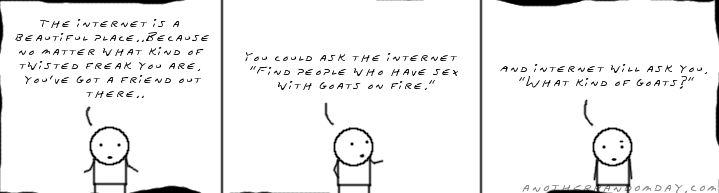
Rule 101: You haven’t seen the scariest thing on the internet

GoatsOnFire

See, that’s the way the Internet is. But even knowing that, it will often surprise you.

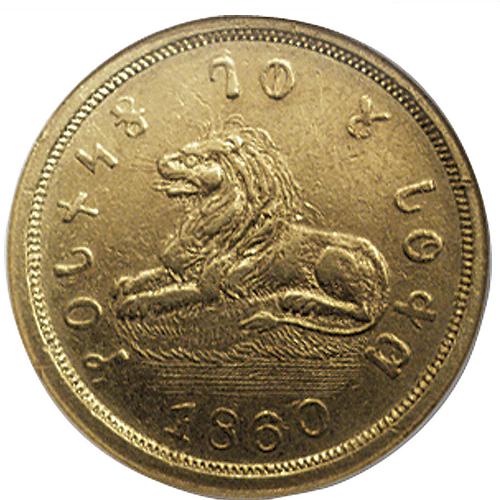
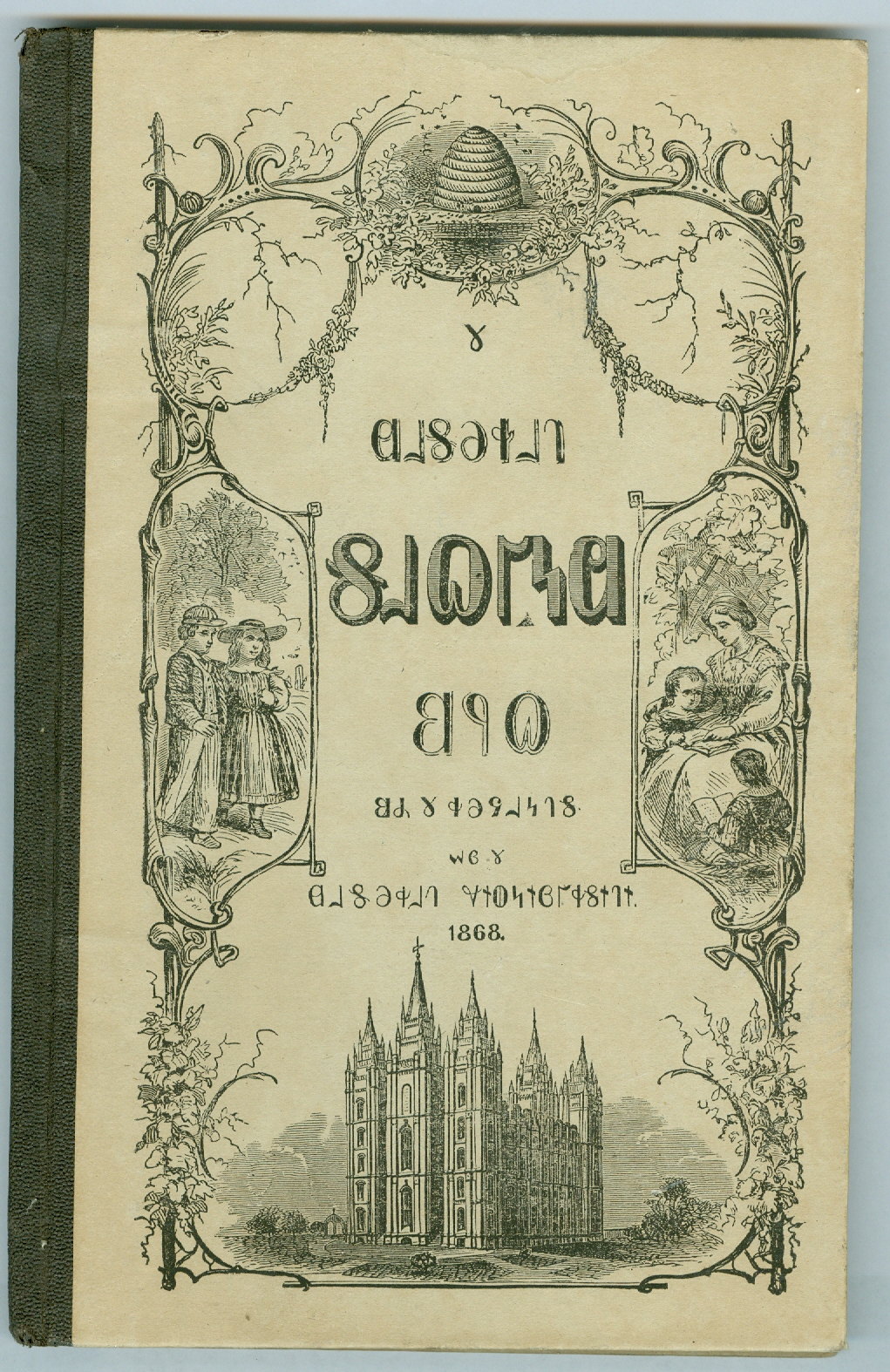
In the mid 19th century, Brigham Young came up with a new alphabet designed to help foreign-speaking immigrants to the State of Deseret (otherwise known as the Utah territory) learn to read English. Developed by the board of regents of the University of Deseret (later the University of Utah,) it was known as the Deseret Alphabet. Four volumes were published in the alphabet in 1868 – two primers (the Deseret First Book and the Deseret Second Book), extracts from the Book of Mormon and a complete volume of the latter. The Deseret News published a column printed in the new alphabet, and there are still diaries, letters, meeting minutes, coinage and one headstone in Cedar City, Utah, to attest to its brief existence.

coin

Mormon five-dollar gold piece, inscribed with “Holiness to the Lord” in Deseret Alphabet.

iron-gravestone

The gravestone in Cedar City. The inscription reads,

“In memory of John T. Morris Born Feb
14 1828 Lanfair Tahaira
Danbyshire North Wales.
Died Feb 20, 1855 Aged 27”

Deseret Alphabet Reader 1868

The Deseret Second Book.

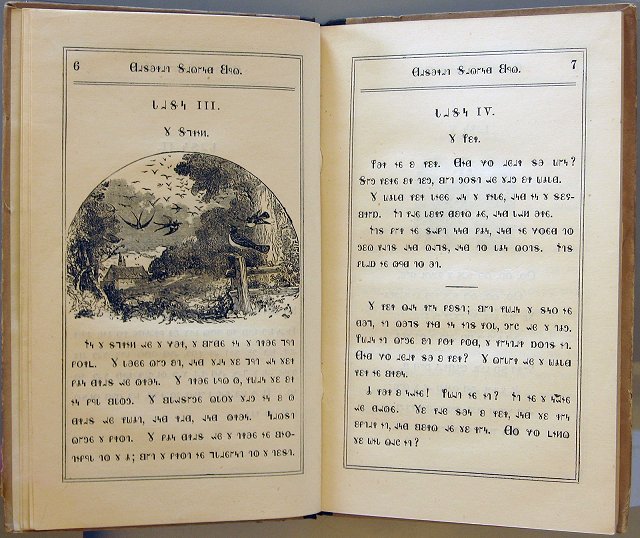
Deseret Second Book Sample

Sample from the Deseret Second Book. Lesson 3 is entitled “The Spring,” Lesson 4 is “The Hare.”

As with other spelling reforms initiated during the same period of history, it never caught on. Immigrants preferred to learn English with all its horrid spelling [1] in a script that most of them already knew than try to struggle with an entirely new alphabet, and the Deseret Alphabet quietly died.

Or so it seemed.

Searching this morning, just out of curiosity as to what the printed volumes are selling for these days (I own copies, you see,) I happened across this:

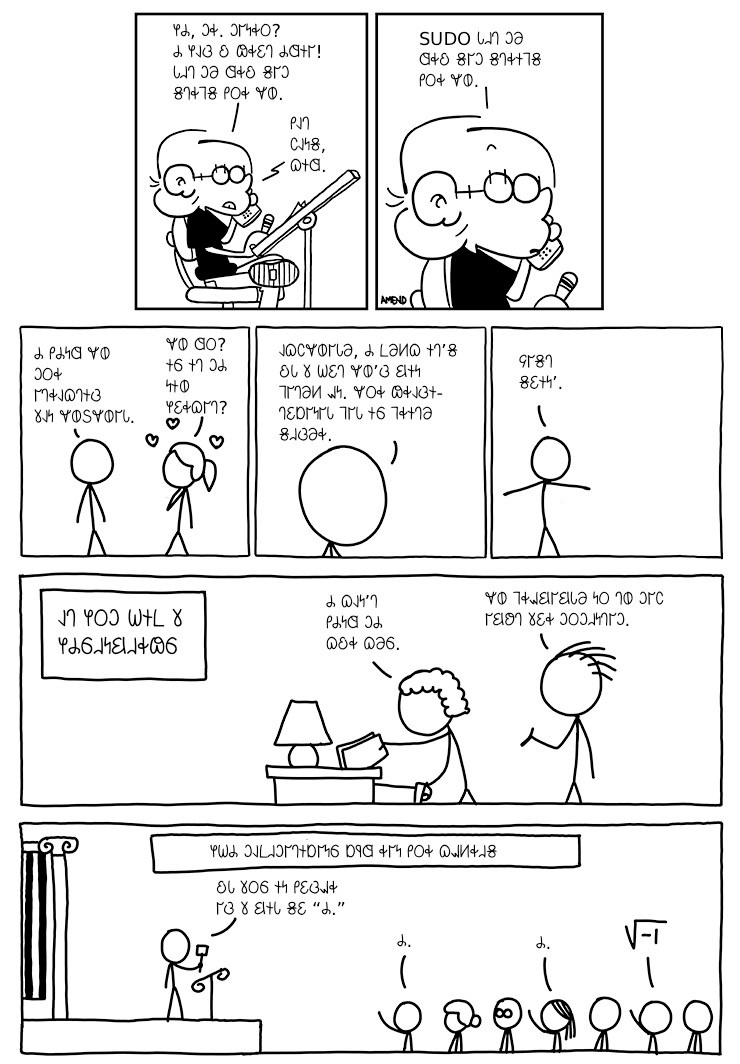
Deseret_guest_week_bill_amend_foxtrot

It seems that an afficionado of the Deseret Alphabet (as intimated above, there are afficionadi for everything, no matter how obscure) has taken the trouble to transliterate every XKCD into Deseret Alphabet. I, too, am an afficionado of the Deseret Alphabet; this dude is the linguistic equivalent of Techno Bill. The irony here is delicious – I couldn’t think of a more appropriate, edgy strip to retrogress back into a failed religious experiment. For the curious, the original page where this strip is found includes links to the English version of the comic so you can see what it says. It is of note that the Unicode Consortium took note of the Deseret Alphabet, so regardless of whether or not interest in the artifact continues, it will always have a place in history.

As obscure as it is, this delights me no end, as I made a study of the Deseret Alphabet during my days as a master’s candidate in applied linguistics. And, just in case you think that you’ve reached the bottom of strangeness with this little bit of whimsy, you may want to have a peep here, if you dare. Rule 101 has no bottom. [2]

𐐜 𐐄𐐢𐐔 𐐚𐐃𐐢𐐙 𐐐𐐈𐐞 𐐝𐐑𐐄𐐗𐐤.


[1] You’re not certain English spelling is all that bad? Try reading “The Chaos”, found at this page. I triple-dog dare you to read it through without any mistakes. Any non-native speakers who can do so win the Internet. I’m looking at you, Bjornar.

[2] I’m not even talking about the dark underbelly of the internet. Trust me, you don’t want to go there. That way lies madness.

Mamihlapinatapei

uu0

Found this lovely picture over at Frog Blog, and thought immediately of the Yaghan language of Tierra del Fuego. They have a word in their language which is classified by the Guinness Book of World Records as the most succinct and one of the most difficult to translate.

Mamihlapinatapei (or mamihlapinatapai) means “a look shared by two people, each wishing that the other will offer something that they both desire but are unwilling to suggest or offer themselves.” In other words, “we both want this like crazy, but I’m sure as hqiz not going to be the first one to make a move.”

There are many other words like this in other languages, and I’ll toss one out occasionally. I love languages and language oddities, and this one is one of my favorites.

The Old Wolf has spoken.

Symbol Poetry

(Cross-posted from my Livejournal)_

Many years ago I ran across “Waka waka bang splat”, a poem written by Fred Bremmer and Steve Kroese of Calvin College & Seminary of Grand Rapids, Michigan, which appeared in the May/June 1990 issue of Infocus magazine and has since been floating around the Internet.

< > ! * ' ' #
^ " ` $ $ -
! * = @ $ _
% * < > ~ # 4
& [ ] . . /
| { , , SYSTEM HALTED

The poem can only be appreciated by reading it aloud, to wit:

Waka waka bang splat tick tick hash,
Caret quote back-tick dollar dollar dash,
Bang splat equal at dollar under-score,
Percent splat waka waka tilde number four,
Ampersand bracket bracket dot dot slash,
Vertical-bar curly-bracket comma comma CRASH.

I was so delighted by this that I shared it with a columnist at one of Salt Lake’s papers, and it later appeared in one of his columns.

To my delight, I discovered that there is a sequel,which thing I had never before imagined.

Sung to the tune of “Twinkle Twinkle Little Star”:

^ < @ < . @ *
 } " _ #   |
- @ $ & / _ %
! ( ^ I @ | = >
 ; ` + $ ? ^ ?
 , # " ~ | ) ^ G

hat less at less point at star
backbrace double base pound space bar
dash at cash and slash base rate
wow open tab at bar is great
semi backquote plus cash huh DEL
comma pound double tilde bar close BEL

From all appearances, it seems to be a drinking (or a finance) song… and I have no idea who the creator of this little gem is.

The Old Wolf has spoken.

Charles Bukowski: So you want to be a writer

So you want to be a writer

if it doesn’t come bursting out of you
in spite of everything,
don’t do it.
unless it comes unasked out of your
heart and your mind and your mouth
and your gut,
don’t do it.
if you have to sit for hours
staring at your computer screen
or hunched over your
typewriter
searching for words,
don’t do it.
if you’re doing it for money or
fame,
don’t do it.
if you’re doing it because you want
women in your bed,
don’t do it.
if you have to sit there and
rewrite it again and again,
don’t do it.
if it’s hard work just thinking about doing it,
don’t do it.
if you’re trying to write like somebody
else,
forget about it.

if you have to wait for it to roar out of
you,
then wait patiently.
if it never does roar out of you,
do something else.

if you first have to read it to your wife
or your girlfriend or your boyfriend
or your parents or to anybody at all,
you’re not ready.

don’t be like so many writers,
don’t be like so many thousands of
people who call themselves writers,
don’t be dull and boring and
pretentious, don’t be consumed with self-
love.
the libraries of the world have
yawned themselves to
sleep
over your kind.
don’t add to that.
don’t do it.
unless it comes out of
your soul like a rocket,
unless being still would
drive you to madness or
suicide or murder,
don’t do it.
unless the sun inside you is
burning your gut,
don’t do it.

when it is truly time,
and if you have been chosen,
it will do it by
itself and it will keep on doing it
until you die or it dies in you.

there is no other way.

and there never was.

-Charles Bukowski (1920-1994)

The Noun Project

Recently happened across a video promoting The Noun Project, an effort to build a global visual language. While I love linguistic innovation and would love to see either Terran Standard or a Universal Translator à la Star Trek, based on the minimal penetration of experiments like Esperanto or even the linguistic behemoth English, I’m not certain a project like this will ever have more than a niche impact.

And I’ll tell you why.

First, let me re-iterate: It’s a lovely idea. I’m not dissing it for its own sake, nor am I wishing it failure.

To illustrate what the project is up against, let’s look at an example from one of my favorite Star Trek TNG episodes, “Darmok”.

Picard and Dathon at El-Adrel

Imagine a race of people who communicates solely by metaphor. The Tamarians were just such a race; their opening dialog with the Enterprise went like this:

“Rai and Jiri at Lungha. Rai of Lowani. Lowani under two moons. Jiri of Ubaya. Ubaya of crossed roads. At Lungha. Lungha, her sky grey.”

A headscratcher, to be sure. As the episode progresses, the Enterprise team learns in various ways that the Tamarians communicate solely via metaphor, as though “Juliet on her balcony” were being used to express the concept of love, or beauty, or desire. They realize, however, that content is valueless without context; anyone unfamiliar with Romeo and Juliet would have no idea what the metaphor referred to.

Even though Picard was able to speak to the Tamarians and deflect hostilities between the two races with the few phrases he had learned, there are some logical gaps in the premise. In Tamarian you can say,

  • Temba, his arms open: “Here, take this.”
  • Sokath, his eyes uncovered: “Understanding! He gets it!”
  • Mirab, with sails unfurled: “Let’s get out of here.”
  • The river Temarc, in winter!: “Hold your tongue!”

But how do you say something like “Move that lever to the second position from the top, and then tighten that nut one-quarter turn”? This glaring plot hole doesn’t detract from my enjoyment of the episode and the delightful linguistic idea, but it illustrates that context is everything.

Symbols like this are pretty straightforward:


But even these would have little meaning in a culture not familiar with chopsticks or the red cross. The meaning and the concept would have to be taught, and thus  would, in effect, be no more valuable as an ideograph than “อาหาร” or “食” or “manĝo”. The first thing that actually came to my mind when I saw these were a portable medkit from Duke Nukem 3D, and joss sticks. The first was close, the second, not even.

Then you get into the intricacies. What would you do with a symbol like this:

Is this a banana, or some really kinky ninja sex toy?

Presented with a bewildering array of nouns like this,

I find that my lifetime of experience in the fields of linguistics and translation give me only the barest hint of what some of these mean. Certainly, I could learn them, but each symbol would have to be learned in the same way that I am learning that “חלוץ” means “pioneer” in Hebrew or that “牛肉” means “beef” in Japanese. Both a context and a precise meaning would have to be provided.

Now, the visual hooks into things from our everyday world would indeed make the process somewhat easier.

This symbol will mean “wind farm” or “green energy” to a large part of the world’s population because they have become familiar with the idea of wind energy; in the same way, a Japanese person or advanced student of Japanese who is presented with a rare or unfamiliar character (such as 醤) will at least have a shot at guessing at the meaning because of the way Kanji are constructed – he or she will automatically recognize the bits and pieces that the character is made of, and be able to make an educated guess at its meaning. In the same way, I can read the following paragraph without much difficulty…

“Erat una fria morning de Octubre und ein low fox noyabat las benches der park. Algunos laborantes magrebinos collectabant der litter singing melanconic tunes. Aan el 200th floor des Euro Tower el Chef Inspector General del Service des Bizarre Dingen, Mr What, frapped sur the tabula y said: -Dit is kein blague. Appel rapid Cabillot!” (from Eurolingua Salad)

… but only because I have a working knowledge of Latin, English, French, German, Spanish, Catalan, Dutch, and a few others spoken in and around Europe. Without that background and context, it would be as impenetrable to me as Hungarian, of whose intricacies I am blissfully ignorant.

In the final analysis, the Noun Project is constructing another artificial language, one of many that have attracted fans and adherents but made little headway in facilitating communication across linguistic boundaries. Inherent in the project are some good ideas that will have value, but if a linguist such as myself can look at the lists of icons and say “Vaff?” I suspect that most people less steeped in the intricacies of signans and signatum will approach the idea with all the enthusiasm of a high school French student confronted with the passé surcomposé for the first time. Even French people don’t go nuts over all the glorious intricacies of the Gallic tongue.

Der viejo loup has parlat.

The Sad Death of Cromarty, 7rl

Bobby Hogg, 1920-2012

Today the Daily Mail reported the passing of Bobby Hogg, go ndéanai Día trocaire air [1], the last speaker of Cromarty, or the Scottish Black Isle fishing dialect. Bobby Hogg was 92, and last year his brother Donald left the world at age 86, leaving Bobby alone as the only speaker of the dialect.

Donald Hogg

Every fortnight, one of the seven to eight thousand languages spoken on the planet passes into history; the National Geographic maintains an intriguing interactive page of linguistic hotspots which illustrates places in the world where languages are the most threatened. Most of these tongues belong to aboriginal or minority populations, languages like Chulym or Tofa, spoken by a hunter-gatherers who also herded reindeer. Specializing in a skill often allowed a language to develop complex meanings with a single word; for example, the Tofa word döngür means “male domesticated reindeer in its third year and first mating season, but not ready for mating.” [2] But as Hogg’s death has pointed out, there are languages and dialects (dissertations have been written about the difference, and linguists love pseudo-intellectual straining at gnats) which are dying a lot closer to home.

I noticed with interest that there is no color on the Geographic’s page along the western coast of Ireland or in Scotland, yet the Gaelic languages have suffered significant losses. Dolly Pentreath who died in 1777 was the last native speaker of Cornish; Ned Maddrell, who passed away in 1974, was the last native speaker of Manx. [3]  Both tongues experienced scholarly revivals, and each language now has second language speakers and a few children who are being raised as native speakers. Scots Gaelic (Gàidhlig), Irish Gaelic (Gaeilge), Welsh (Cymraeg) and Breton (Brezhoneg) are all relatively endangered, although Welsh and Breton are the strongest, and Irish is being valiantly if ineffectively promoted and defended by the government and various groups within Ireland.

Which brings me to the “7rl” up in the title of this post.

In 1970, I had completed my second year of college and was back in New York for a few weeks before heading off to Naples, Italy for a year of work and study abroad. I stopped into a bar to use the phone and ended up talking to the bartender for a few minutes; when he found out I was studying languages, he said to me, “Well, don’t learn Irish.” That was like asking Maru not to jump in a box – I promptly went out and found a copy of Teach Yourself Irish by Myles Dillon and Donncha Ó Cróinín. Unfortunately, this book was printed before Irish spelling reform eliminated most of the silent consonants used in their hellish spelling (you will note that I said “most” – there are still plenty left!) – and without any real guide to pronunciation, I was unable to make any headway with the language, so I put the book on my shelf where it sat gathering dust.

20 years later, however, I stumbled across Linguaphone’s Cúrsa Gaeilge (Irish Course) in the West Valley City library – and it included tapes which became my Rosetta Stone; Irish is a beautiful and intriguing language which I continue to study as time permits. I’ve even attended an Irish Weekend in San Francisco, and would go back every year if resources permitted.

 Irish postal vans used to carry the logo

which stood for “Post agus Telegrafa” (Post and Telegraph); there are still some old manhole covers and other relics around bearing this logo as well. The image below shows clearly that the siglum is not a number 7, but rather a different symbol altogether.

Wikipedia reports that “the Tironian sign resembling the number seven (“7”), represents the conjunction et, and is written only to the x-height; in current Irish language usage, this siglum denotes the conjunction and.” Thus in the Irish language, “7rl” stands for either “agus rudaí eile” or “agus araile,” both of which mean “etcetera” or “and so forth.” [4]

Coming full circle, there are some great (if sparse) resources about the Cromarty dialect out there:

  • Am Baile, the Highland Council’s History and Culture website, published a pamphlet about the Cromarty dialect which includes a lexicon (2.3 MB pdf file)
  • 20 audio clips of Bobby and Donald talking about their dialect can be found here.
  • The Telegraph printed an article in 2007 about Bobby and Donald, including the following phrases:

Talking Cromarty

Thee’re no talkin’ licht You are quite right
Ut aboot a wee suppie for me Can I have a drink too?
Thee nay’te big fiya sclaafert yet me boy You are not too big for a slap, my boy
Pit oot thy fire til I light mine Please be quiet, and allow me to say something

I love this last one; while American English has some colorful dialects buried in remote pockets, our language is pretty bland when it comes to expressions like this.

The death of a language is a tragic thing, because it means the loss of so much culture and history that went along with its speakers. I support the efforts of organizations like Am Baile and Daltai na Gaeilge to encourage the use and revitalization of these beautiful and intriguing tongues.

Tá an sean-fhaolchú labhartha.


Notes:

[1] Irish for “May God have mercy on him”

[2] Astute readers will say, “Oh yeah – just like Eskimos have 23 (or 42, or 50, or 100) words for snow.” One such published list of Inuit words for snow follows:

Aiugavirnirq – very hard, compressed and frozen snow
Apijaq – snow covered by bad weather
Apigiannagaut – the first snowfall of Autumn
Apimajuq – snow-covered
Apisimajuq – snow-covered but not snowed-in
Apujjaq – snowed-in
Aput – snow
Aputiqarniq – snowfall on the ground
Aqillutaq – new snow
Auviq – snow block
Katakaqtanaq – hardcrust snow that gives way underfoot
Kavisilaq – snow roughened by snow or frost
Kiniqtaq – compact, damp snow
Mannguq – melting snow
Masak – wet, falling snow
Matsaaq – half-melted snow
Mauja – soft, deep snow footsteps sink into
Natiruvaaq – drifting snow
Pirsirlug – blowing snow
Pukajaak – sugary snow
Putak – crystalline snow that breaks into grains
Qaggitaq – snow ditch to trap caribou
Qaliriiktaq – snow layer of poor quality for an igloo
Qaniktaq – new snow on ground
Qannialaaq – light, falling snow
Qiasuqqaq – thawed snow that re-froze with an icy surface
Qimugjuk – snow drift
Qiqumaaq – snow with a frozen surface after a spring thaw
Qirsuqaktuq – crusted snow
Qukaarnartuq – light snow
Sitilluqaq – hard snow

Well, it turns out that the truth is both far more simple and far more complex. There’s a difference between packing semantic density into a single discrete lexical item, and using multiple suffixes to produce new meanings from a single root. At Language Log, Geoffrey K. Pullum, author of The Great Eskimo Vocabulary Hoax, said:

“If you wanted to say “They were wandering around gathering up lots of stuff that looked like snowflakes” (or fish, or coffee), you could do that with one word, very roughly as follows. You would take the “snowflake” root qani- (or the “fish” root or whatever); add a visual similarity postbase to get a stem meaning “looking like ____”; add a quantity postbase to get a stem meaning “stuff looking like ____”; add an augmentative postbase to get a stem meaning “lots of stuff looking like ____”; add another postbase to get a stem meaning “gathering lots of stuff looking like ____”; add yet another postbase to get a stem meaning “peripatetically gathering up lots of stuff looking like ____”; and then inflect the whole thing as a verb in the 3rd-person plural subject 3rd-person singular object past tense form; and you’re done. Astounding. One word to express a whole sentence. But even if you choose qani- as your root, what you get could hardly be called a word for snow. It’s a verb with an understood subject pronoun.”

The entire page is worth reading if you’re interested in such things.

Another example of aggressive word formation comes from the Turkish language. It is said that the single word Avrupalılaştırılamayabilenlerdenmısınız is the equivalent of an entire sentence: “Are you one of those who is not easily able to be Europeanized?” This, however, is misleading because Turkish agglutinates (i.e. crams whole bunches of stuff together); it’s not really fair to call the monstrosity above a “word.” Here’s a breakdown of how the thing is put together:

Avrupa: Europe
Avrupa-lı: European
Avrupa-lı-laş-mak: become European (mak is the infinitive ending)
Avrupa-lı-laş-tır mak: to make European
Avrupa-lı-laş-tır ı l mak: (reflexive) to be made European (with the linking consonant “l”)
Avrupa-lı-laş-tir ıl abil mek: to be capable of being Europeanized (the infinitive ending mak changes to mek because of vowel harmony)
Avrupa-lı-laş-tır ıl ama mak: not to be capable of being Europeanized
Avrupa-lı-laş-tır ıl ama y abil mek: this time the  abil is probability: that there is a probability that one may  not be capable of being Europeanized
Avrupa-lı-laş-tır ıl ama y abil en: the one that may not be capable of being Europeanized
Avrupa-lı-laş-tır ıl ama y abil en ler: the one that may not be capable of being Europeanized (-ler, -lar is the plural suffix)
Avrupa-lı-laş-tır ıl ama y abil en ler den: of or from the ones who may not be capable of being Europeanized
mı?   question tag (officially, this should be written separately, but it’s very common usage not to do so)
mısınız?  are you (Second person plural, also used for formal second person singular)

[3] At one point as I was following my passion for all things Celtic, I stumbled across a Manx Language resource page and discovered to my delight that the spoken samples by Ned Maddrell and John Kaighin were close enough to Irish to be understandable. I regret that I don’t have time to dig deeper into this language.

[4] Which reflects the nature of many of my posts here… pretty much a free-association experience. Sorry.

Use this “one weird trick” to rob consumers blind!

When I’m using my home computers, I never see ads. Ever. Browser add-ons Ad Block Plus and F.B. Purity (available for both Firefox and Chrome)  ensure that affiliate ads are a thing of the past. My Droid is not so fortunate, and this morning I happened across this one:

I smiled wryly because despite its overwhelming appearance everywhere, the “weird trick” (in this case, “sneaky linguistic secret”) meme is still generating millions of dollars from uneducated and unwary consumers.

  1. Check out this article at the Daily Kos about “one weird trick discovered by a mom.”
  2. For more about how affiliate marketing scams work, an excellent read is found at the Washington Post’s “Ubiquitous ‘tiny belly’ online ad” article; I have discussed the Açaí berry scam in detail as well.

Now that that’s out of the way, the “Pimsleur Approach” is a scam. Plain and simple, no ifs, ands, or buts.

  • Be aware: This is NOT the Pimsleur Method, (a legitimate language-learning concern) but rather a marketing scam run by a network of affiliates, some of them known criminals,  who are promoting Pimsleur products.

We’re talking about rampant spamming and deceptive marketing practices; before Comcast filtered them out, I used to get several of their spam mails each week, and the complaints boards are full of unhappy people – just have a look at the WOT (Web of Trust) feedback site for pimlseurapproach.com, or Ripoff Report’s complaint board.

  • Look at the phony endorsements: PBS, Forbes, and the Daily News. I’d bet each of these concerns have mentioned the Pimsleur Method at one point or another, but not this particular company.
  • “Doctor’s Discovery” refers to Paul M. Pimsleur, PhD, whose research focused on understanding the learning process of children, who acquire languages without understanding its formal structure. Pimsleur developed an audio language course method that is actually quite effective in acquiring a basic level of proficiency in a language, but “learn a language in 10 days” would have Dr. Pimsleur spinning in his grave.
  • Have a look at their website:

220742_1000

Most people sign up for the $9.95 offer without reading the (†) box, which states:

† Pimsleur Rapid Fluency Purchase Program:
One month after you receive your Quick & Simple you’ll begin receiving 30 day trial copies of advanced Pimsleur courses in the language you selected. Each course is yours to try for 30 days. You’ll receive a new course once every 60 days. For each course you keep we’ll bill you in four monthly payments of $64. Remember, there’s never an immediate obligation to buy any course because of the 30-day trial period provided with each shipment. And you may cancel future shipments at any time by calling 1-877-802-5283. See Key Details.

The “Key Details” spell out in greater detail your obligation to receive and be charged $256.00 for each additional course they send you, the first 30 days after you place your initial order, and every 60 days thereafter.

Yes, it’s all there on the website, but cleverly hidden in small, gray type which most people won’t read. The complaints boards are rampant with people being charged recurring fees, difficulty obtaining refunds, rude customer support agents (a hallmark of shady operators who bully unhappy customers), and of course, the unbridled spamming.

Stay far away from this company. I’ll be writing more about the actual Pimsleur Method later, but if you want to check it out, just head for your local library. It’s a good bet they have several of the beginner courses there for you to check out for free and see if you like the method. If you can’t find anything at your branch, go directly to Pimsleur’s site (they are now a subsidiary of Simon and Schuster); they offer a free lesson with each language so you can see how it works. If you decide you like the method, head over to Amazon where you can usually find the courses at a significant discount.

Just don’t have anything to do with this sleazy “Pimsleur Approach” outfit.

This has been a public service announcement from The Old Wolf.

Vowels to Bosnia – the Onion

This has been around the internet for a long time, but as far as I can determine, it was originally written by authors at the Onion.


WORLD NEWS:

CLINTON DEPLOYS VOWELS TO BOSNIA

Cities of Sjlbvdnzv, Grzny to Be First Recipients

Before an emergency joint session of Congress yesterday, President Clinton announced US plans to deploy over 75,000 vowels to the war‑torn region of Bosnia.  The deployment, the largest of its kind in American history, will provide the region with the critically needed letters A,E,I,O and U, and is hoped to render countless Bosnian names more pronounceable.

“For six years, we have stood by while names like Ygrjvslhv and Tzlynhr and Glrm have been horribly butchered by millions around the world,” Clinton said. “Today, the United States must finally stand up and say ‘Enough.’ It is time the people of Bosnia finally had some vowels in their incomprehensible words.  The US is proud to lead the crusade in this noble endeavor.”

The deployment, dubbed Operation Vowel Storm by the State Department, is set for early next week, with the Adriatic port cities of Sjlbvdnzv and Grzny slated to be the first recipients.  Two C‑130 transport planes, each carrying over 500 24‑count boxes of “E’s,” will fly from Andrews Air Force Base across the Atlantic and airdrop the letters over the cities.

Citizens of Grzny and Sjlbvdnzv eagerly await the arrival of the vowels. “Bože moj, I do not think we can last another day,” Trszg Grzdnjkln, 44, said. “I have six children and none of them has a name that is understandable to me or to anyone else.  Mr. Clinton, please send my poor,  wretched family just one ‘E.’ Please.”

Said Sjlbvdnzv resident Grg Hmphrs, 67: “With just a few key letters, I could be George Humphries.  This is my dream.”

The airdrop represents the largest deployment of any letter to a foreign country since 1984.  During the summer of that year, the US shipped 92,000 consonants to Ethiopia, providing cities like Ouaouoaua, Eaoiiuae, and Aao with vital, life‑giving supplies of L’s, S’s and T’s. The consonant‑relief effort failed, however, when vast quantities of the letters were intercepted and hoarded by violent, gun‑toting warlords.


For what it’s worth, “rhythm” and “syzygy” are the longest English words with no vowels if you don’t count archaic forms like symphysy or names like Twyndyllyngs. Slavic languages or  which use syllabic consonants can actually form sentences like “Strč prst skrz krk” (Czech for “stick a finger through your neck”).

Th Ld Wlf hs Spkn.

Translation Party

I was led to this site via a post at Glaserei, Frankfurter Zeitung’s intriguing blog about cats, the universe and everything.

Much like the old game of “telephone,” played with Bing translator (which isn’t as good as Google Translate, for what it’s worth) – but the results can be amusing.

If you need something translated, hire a professional instead of your brother-in-law. Otherwise your next ad might say that your new camera exposes itself automatically.

Frog Applause here.

Translation party here

The Old Wolf has spoken.