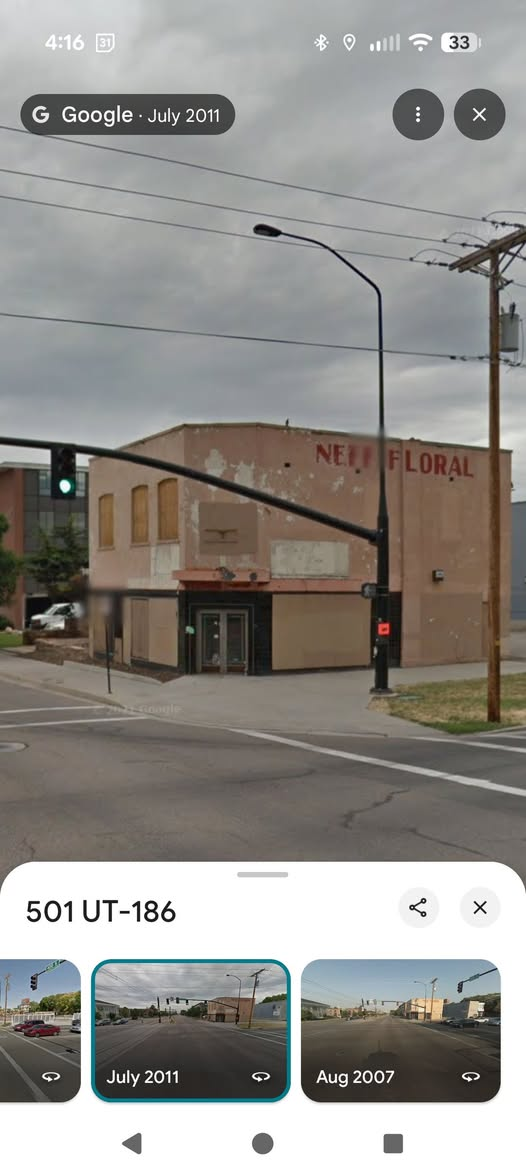
This was the Northeast corner of 500 South and 400 East in 2011. Before being taken over by Neff Floral, it was The Clock Cafe, owned and operated by Ray William Saunders for 40 years. True to its name, there was a clock right above the door. I ate there many times when I was living in the Broadway Apartments complex at 440 East 300 South with my grandmother in 1969.
I considered it the archetypical greasy spoon, but they had great food and always a warm and friendly reception. Sadly, I was unable to find any photographs of the cafe itself. The building has since been demolished and replaced by an apartment complex. Does anyone else remember The Clock Cafe? If you by chance have a photo of it, I’d love to see you post it in a comment.
This post was spawned by one of Heather Cox Richardson’s “Letters from an American” which was also posted on Facebook.
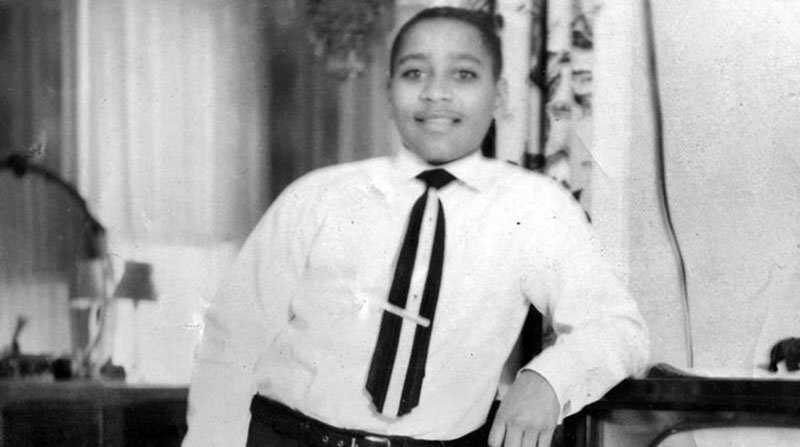
She wrote about the tragic 1955 murder of Emmett Till, an innocent 14-year-old boy, and about the hateful and unrepentant attitude of J. W. Milam, one of Till’s two killers.
Emmett Till
“What else could we do?” Milam said. “He was hopeless. I’m no bully. I never hurt a n* in my life. I like n*s, in their place (emphasis mine). I know how to work ’em. But I just decided it was time a few people got put on notice. As long as I live and can do anything about it, n*s are gonna stay in their place.”
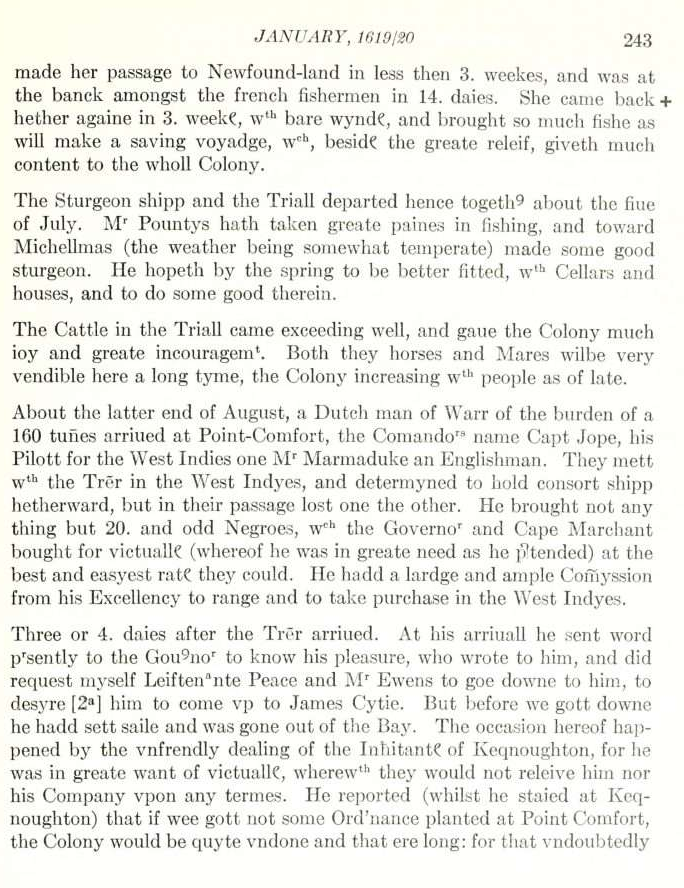
Milam’s attitude had it roots in 1620 when a Dutch man-of-war traded “20 and odd Negroes” for “victualle,” according to a letter from Virginia Colony secretary John Rolfe to Sir Edwin Sandys. From there, it evolved into a system of utter oppression and cruelty by whites, who used the principle of human bondage to treat their unfree laborers as less than cattle for their own petty satisfaction. These attitudes and the economy which arose as a result – largely the growing of cotton in the South – were officially and legally repudiated by the Civil War and subsequent amendments to the Constitution which guaranteed “life, liberty, and the pursuit of happiness” to all citizens, and not just wealthy white landowners – but the attitudes in the hearts of many in the South clearly did not die, as witnessed by the conditions that Blacks dealt with prior to the Civil Rights area, predominantly in the South.
While thinking about John Rolfe’s letter, I kept having flashbacks to elementary school, and of vague memories of learning about the arrival of the Dutch ship in Jamestown. I could have sworn that the text was recorded as “20. and odd negars,” (at that time the word was simply a corruption of the Portuguese word for “black,” and had not yet become the hateful slur of later times). So I started doing some digging, and was intrigued to find that I was not the only one who remembered things erroneously.
The following websites commemorating the 400th anniversary of the beginning of human bondage in America quote that passage from Rolfe’s letter in that manner:
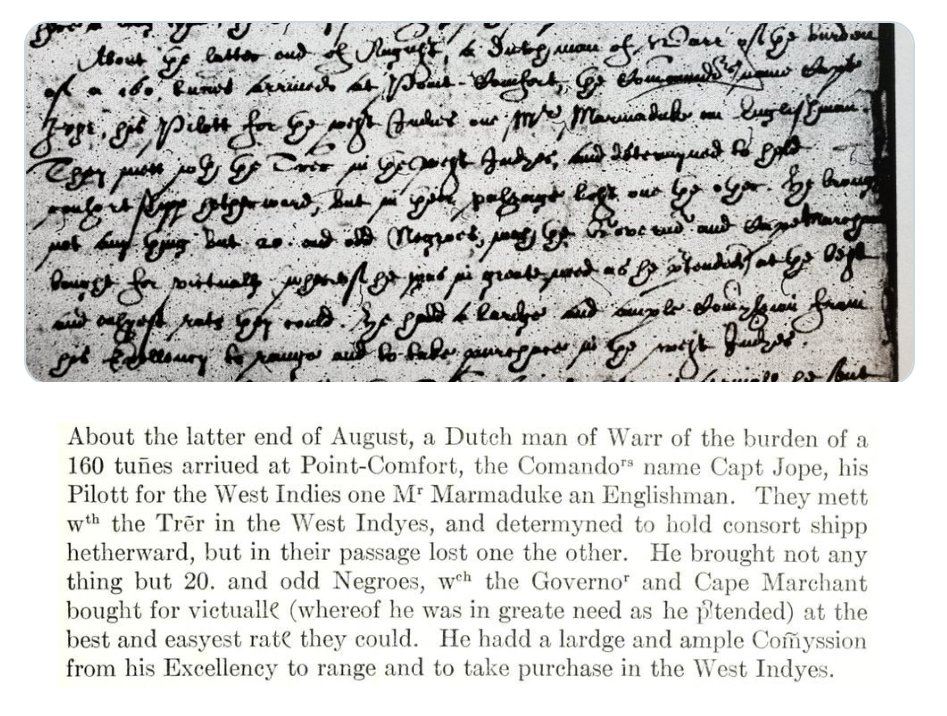
Here is plainly transcribed “20. and odd Negroes.” If you were not sure about the accuracy of the transcription, below we can see a scan of the original letter:
Having been unsuccessful in finding any explanations on the Internet for the discrepancy, I turned to Perplexity, an AI search engine which provides references with everything it is able to find. What I asked:
“The first arrival of African slaves in America is recorded in a letter by Virginia colony secretary John Rolfe, in which he recounted – according to some – that a Dutch Man o’ War traded “20 and odd Negars” for “victuals.” But a scan of the letter itself shows that the word Rolfe used was “negroes,” and the Encyclopedia of Virginia provides an accurate transcript of the letter from Rolfe to Sir Edwin Sandys. Even a report from the Congressional Black Congress in 2019 uses the phrase “20 and odd Negars.” I want to know how Rolfe’s “negroes” was changed to “negars” in some reports.”
I was not unhappy with the result [emphasis added to the salient parts]:
John Rolfe’s 1619 letter documenting the first arrival of Africans in Virginia describes the sale of “20. and odd Negroes.” This exact phrase—using “Negroes”—is confirmed by direct transcripts from reputable sources such as the Encyclopedia of Virginia and republished excerpts of the letter, all of which indicate Rolfe wrote “Negroes” and not “Negars”.
The origin of the spelling “Negars” or its substitution for “Negroes” in some later reports seems to trace to evolving English usage and to historical misreadings or reinterpretations over time. Several factors contribute to this confusion:
The early 17th-century English language was not standardized, and words referring to people of African descent included a range of spellings—such as “negroes,” “negers,” “negars,” and, later, “[n-word]” — all derived from the Spanish and Portuguese “negro” (meaning black), and ultimately from the Latin “niger”.
The spelling “negars” appears in several 18th and 19th-century works, and was sometimes used interchangeably with “negroes” or as an early variant in American English, especially in regions influenced by Dutch or non-standard English dialects.
Some secondary sources and later historical writings incorrectly retrojected¹ these variant spellings into the context of 1619, perhaps due to faulty transcription practices, unfamiliarity with the original manuscript, or confusion regarding the shifting terminology used to describe African-descended people in colonial records.
In summary, John Rolfe’s original letter used the word “Negroes,” but through later historical reinterpretations, variances in early English spelling, and repeated citation errors, the term “Negars” emerged in certain secondary sources and reports. But direct examination of Rolfe’s correspondence confirms that “Negroes” was his actual word choice in the context of the 1619 arrival.
At least, at this point, I know that my original memory from my grade-school days was not imagined up, and have a good idea of what happened between John Rolfe’s penning his letter and subsequent reporting.
The Old Wolf has spoken.
Footnotes
¹ I love the word “retrojected,” to project into the past.
This post is cobbled together from a couple of different entries at my Livejournal back in 2009
Leigh Callaway, wherever you are, I owe you dinner.¹
The year was 1965, I was 14, and it was my senior year at Camp Wildwood in Bridgton, Maine.²
In this my 4th year at camp, the pinnacle of the year was, prophetically, travel. I sucked at team sports – still do – but loved traveling, camping, the woods and individual challenges; in short, I lived for tripping. Not that kind. Shut up.
My yearbook blurb quoted, “However unorganized his body of knowledge may be, he still is a source of many bits of information and despite his mere 85 lb. bulk, was one of our most energetic and determined trippers.” By the dessicated skull of Mogg’s grandfather, how prophetic was that?
After a 5-day canoe trip to Rangeley Lake early in the summer, six of us, accompanied by several counselors, took another 5-day trip in canoes from Lobster Lake down the Penobscot River to Chesuncook Lake in Maine. It was a trip never to be forgotten.
The Rangeley Lakes complex in western Maine
What does all this have to do with Tabasco Sauce? Hush. We’ll get to that.
The year, as I mentioned, was 1965, and inland Maine was still pretty untouched in most places. It was five days of canoeing, camping, 20 miles of river, camping, 4 miles of rapids, camping, portages, camping, woods, camping, absolutely glacial pools and waterfalls which we reveled in as a test of manhood, more camping, and breathtaking scenery.
Are you starting to see a pattern?
When you camp, you cook whatever you have along. That means a lot of dehydrated chicken soup and noodles carbonara and canned stuff and interesting stuff and things you might never fix at home.
One of the counsellors that accompanied us on this trip was a young man named Leigh Callaway.
Now to a 14-year-old, all our counselors were ageless. If they were counselors, they were adults – so I can’t tell you how old he was at the time, but he was probably not much more than a kid himself. So all I can tell you about him was that he was extremely kind to me (huge points!) and had a BMW motorcycle (more huge points), and that I worshiped the ground he walked on. And he could cook.
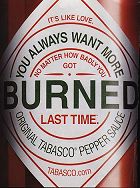
One night, whether out of inventiveness or desperation, Leigh fried up a huge cast-iron skillet full of rice until the grains were golden brown, and then filled the pan with water. When the rice was cooked soft, he threw in a can of tuna or three, sauteed it up a bit longer, and then seasoned the whole thing with Tabasco™. Lots and lots of Tabasco™.
Now my mother, bless her soul, took me to many ethnic restaurants in New York while I was young, and one of our favorites was this little Aztec-Mexican hole in the wall called Xochitl.³ They had a hot sauce there that would rival much of what Blair offers (certainly not their 16-million scoville pure capsaicin insanity, but highly effective nonetheless.) I remember that a tiny drop of this stuff on a toothpick, applied to the tongue, was enough to bring tears to the eyes. So I was no stranger to odd and savory foods. (Hm. How that I’m thinking of it, perhaps I should give Mom some credit at my Banquet from Hell.) That said, cooking at home was pretty basic meat-and-potatoes fare, and there wasn’t a lot of exotic stuff around, so I had never used Tabasco™ before.
Well, anyway. When you’ve been paddling a canoe for 12 hours, and you’re exhausted and starving, it doesn’t matter much what’s on the fire. I think if Leigh had fried up a beaver tail, I wouldn’t have batted an eyelash. As it was, we had fried rice and tuna with Tabasco™ – and I tucked in like a trencherman. Mogg’s teeth – it was so good. It would be easy to say that my enjoyment was born of famine, but given that I have prepared this concoction and many others like it many times in my life thereafter, I can discount that theory. Simply put, I was hooked on Tabasco™.
Now, I like Frank’s Original Red Hot too – it’s got a nice flavor, and I always keep a bottle of it handy, but there’s something about Tabasco™ that just can’t be matched.⁴ Yes, I’m well and truly addicted.
So Leigh, wherever you are, know that you made a huge impression on me that summer, and your influence is still being felt *mops brow* 44 years later.
And that’s all I have to say about that.
PS – I still remember the taste of black coffee sweetened with maple syrup, too…
Footnotes
¹ Leigh, bless his heart, saw this post and actually responded with a bit of information about his subsequent experiences. He recommended that since I loved Tabasco I should try Sambal Oelek, an Indonesian chili paste that apparently puts Sriracha to shame. I was grateful for the recommendation, but would have loved some hint about how to contact him. Which he did not provide, the rascal. I would have loved to renew the acquaintance and catch up in person.
² Camp Wildwood is a superb boys’ camp run – at the time – by Leo Mayer and Ed Hartman, which is still operating in Bridgton, Maine, although it has passed through other owners since then.
³ Another one was “La Fonda del Sol”, a very upscale place which I loved eating at. Now gone. *snif* But there are some memories here.
⁴ In fact, as I was typing my earlier post at Livejournal and thinking about a nice dish of fettucine with tuna and hot sauce, my ears were burning and I was experiencing all the symptoms of a good solid capsaicin flush. Which confirmed my theory. I love hot food; there’s nothing like a good capsaicin burn. The last two times I had prepared spicy foods, though, I had a very unusual experience – the flush to the face began as soon as I had opened the bottle of hot sauce – and hadn’t even eaten it yet. The first time it happened, I thought I was “imagining things.” But it happened again… as I was liberally lacing some burritos with Tabasco, I started getting the burning and vascular dilation that I always experience with certain peppers – very much like a Niacin flush, if you’ve ever experienced that. And, what’s even stranger, I experienced a repeat as I typed this. Just thinking about it was sufficient to recall the physiological response.
Now that’s just weird. Maybe if I salivate enough, I can get my doorbell to ring.
I grew up in New York City in the ’50s and ’60s. Much has gone since that time, but my memories include hings I deeply miss about New York in my early days:
The myriad small businesses instead of brass-and-glass
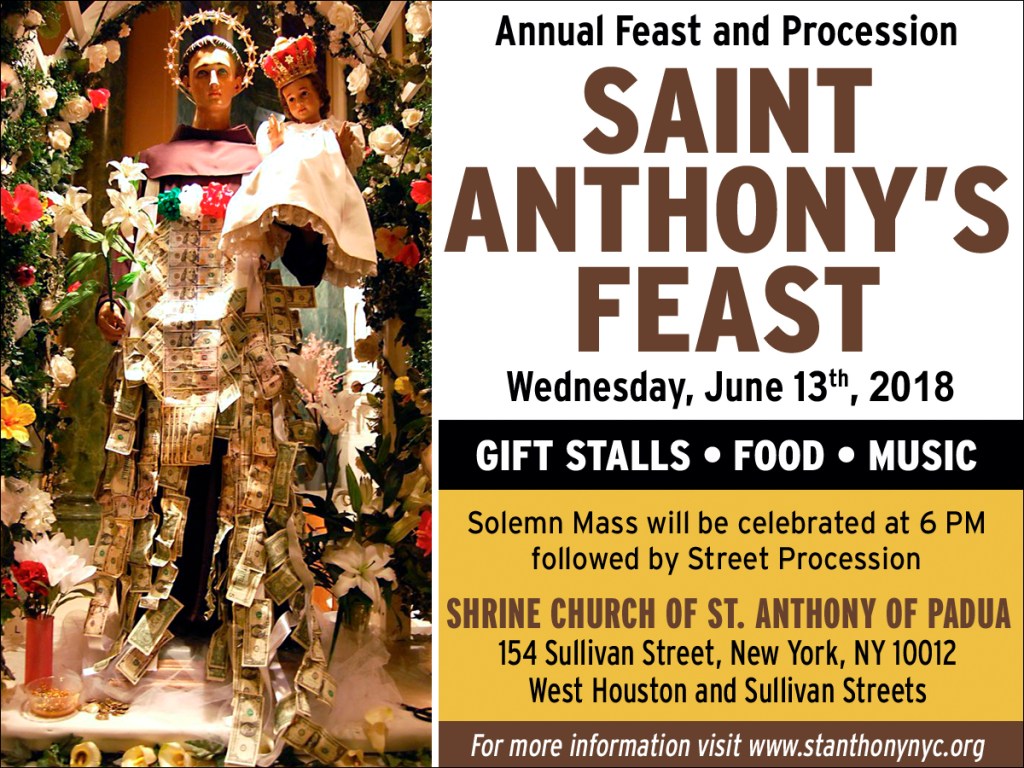
Little Italy full of Italians, and the Feasts of San Antonio and San Gennaro
Yellow Cabs with huge back seats and those little jumpseats (Yes, unsafe, but they were so fun)
Air-conditioned movie theaters with giant screens and velvet curtains where you could stay all day for 50¢ and watch a cartoon, a short subject, a newsreel, and the main feature over and over again
the 42nd Street Subway Stations with Red and Blue lights guiding you to your line of choice, IRT, BMT, or IND, or the Shuttle
Underground OJ bars and other odd little shops in the subways such as Al Stevenson’s magic store (otherwise known as the Wizard’s Workshop)
Hole-in-the-wall pizza joints where you could order pizza by the “Slice!” for 15¢.
The Staten Island ferry for a nickel
Christmas trees up and down Park Avenue, and the stars that would twinkle on the 666 building
the Lord and Taylor Christmas windows
And so many more…
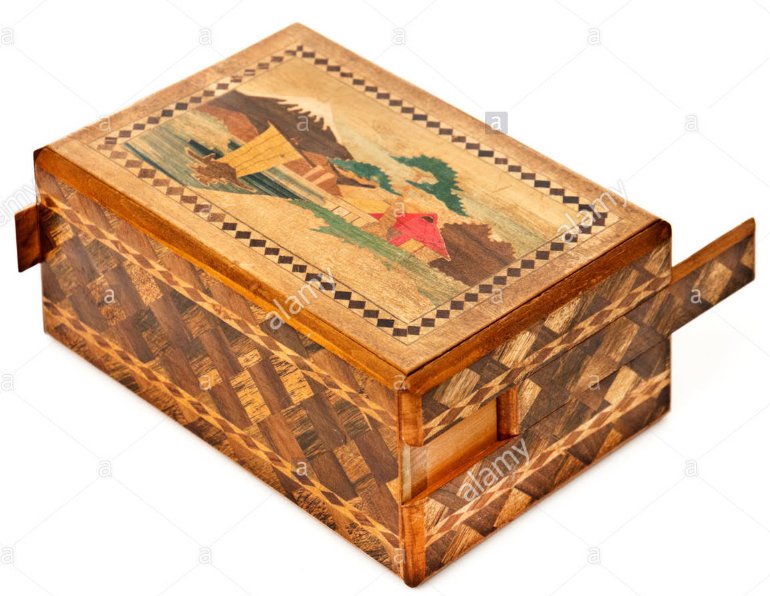
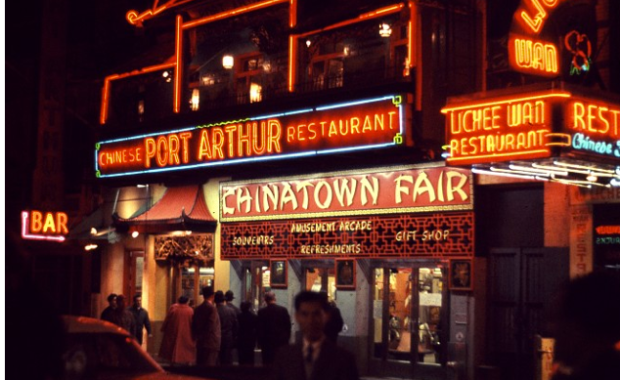
But one of my most indelible memories is from Chinatown, where my mother would take me on occasion. There were myriad stores and restaurants selling the ubiquitous Chinese back-scratchers, finger traps, and wonderful puzzle boxes, some of which I wish I still had.
Alamy stock photo of a Chinese puzzle box, very similar to one I once owned.
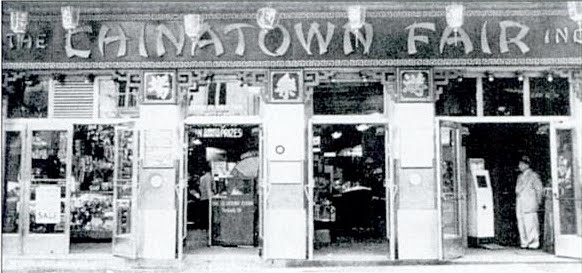
But the most wondrous thing to my young eyes was the Chinatown Fair.
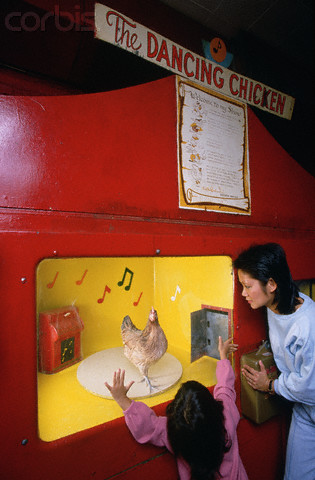
Before it became an electronic game arcade, it featured dancing chickens, tic-tac-toe chickens (you can read about these at Jeremiah’s Vanishing New York), and the amazing animatronic dragon.
Sadly, no photos of the latter wonder appear to have been saved to the Internet as of this moment, but who knows? Perhaps someone will come across a picture in their old archives and post it in the future. If you happen to stumble across this blog post and have such a photo, please let me know; I would love to feature it here.
At any rate, you would walk up to this row of little windows, each with a coin slot for quarters; drop one in and your window would open, and below you was this most amazing animated dragon which would move and roar at you. Commenter “Donald” at the website Scouting New York had this to say, which syncs with my own memories perfectly:
Yes!! The dragon peep show…. why doesn’t anybody ever mention the dragon peep show? I thought that was the most bizarre “game” I ever saw… you’d drop a quarter in and a sliding plastic window would rise, exposing a glass window underneath (similar to a peep show booth) and literally laying on the basement floor – you’d see this huge animatronic dragon moving it’s head and tail – and from a speaker would blare the soundtrack from an old Godzilla movie… that familiar Godzilla roar. Now the dragon you were looking at and the Godzilla you were hearing of course had nothing to do with each other – but that just added to the cheezy entertainment value of the whole thing. I thought it was great… but nobody ever mentions it. I ALWAYS hear about the Tic Tac Toe Chicken… but never my old dragon friend.
The Fair later became a video arcade, but closed in 2011. Some other great memories are archived at Scouting New York, The Gothamist, Ganker, and Huffpost; apparently the arcade featured in a 2015 documentary called The Lost Arcade; in its later years it “the arcade became a shelter to a community as diverse as the city surrounding it and changed lives in doing so.” (IMDB)
According to The Verge, the arcade re-opened in 2012, but the reviews were mixed. Apparently it’s still there, but without that amazing dragon it will never be the same for me.
If you happened to be a member of the Church of Jesus Christ of Latter-day Saints in the ’60s and were ever called as a Ward Clerk, or one of the assistant clerks – Historical, Financial, or Membership – you may remember the old Adler 200 typewriters.¹
Long before the advent of computers or word processors or even IBM Selectrics or Daisy-wheel typewriters, Adler was the go-to brand if you wanted a typewriter with an unusual font. I don’t know how many Adlers the Church of Jesus Christ of Latter-day Saints purchased over time, but I’d bet they kept a lot of factory workers and typewriter repair personnel in business for decades.
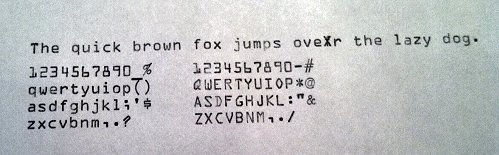
The LDS Adler had a specific keyboard layout, as well: you didn’t have to shift for numbers (because they were used mostly for entering financial records) and symbols were on additional keys.
The font that came with these machines was OCR-A, “a font created in 1968, in the early days of computer optical character recognition, when there was a need for a font that could be recognized not only by the computers of that day, but also by humans.” (Wikipedia) It looked like this:
In the case of financial donations, members would fill out donation slips (being admonished to always write their names the same way each time):
and clerks would painstakingly transcribe these slips onto a ledger sheet on the typewriter, which was then sent by snail mail to headquarters where the records were scanned and entered into mainframe databases. Other information was also recorded using these machines, which were built like Sherman tanks, and like a Timex watch they would “take a lickin’ and keep on tickin.”
Ward clerks often served for extended periods of time; whereas service callings in the Church today generally only last a few years, back in the day it was not uncommon for a clerk to serve for decades, especially if he did a good job.
The Ward Clerk
He kept the minutes, typed each note, And put them in the file. The membership he knew by rote; He labored with a smile.
The ordinations, births and deaths He faithfully recorded For forty years, until at last He went to be rewarded.
The people he had known so well Turned out to shed a tear, And pay respect to this good man, Gone to another sphere.
But as the choir rose to sing, They saw with consternation The good man from his coffin step To count the congregation!
-Author Unknown
It is said in the navy that the Captain may command the ship, but the E-7’s (Chief petty officers) keep the show running. Much the same could be said about a ward or branch of The Church of Jesus Christ of Latter-day Saints; the Bishop or Branch President may be in charge, but the ward clerks keep the wheels greased and everything running smoothly so the leaders can focus on ministering rather than administering.
The Old Wolf has spoken.
Footnotes
¹ The typewriter photos used in this post are from typewriter hunter Jake Fisher at the Typewriter Database.
The New York City I grew up in is gone. It has been replaced by a new city, different in many ways and with ongoing challenges, but not without an endless variety of vibrant neighborhoods and ethnic influences.
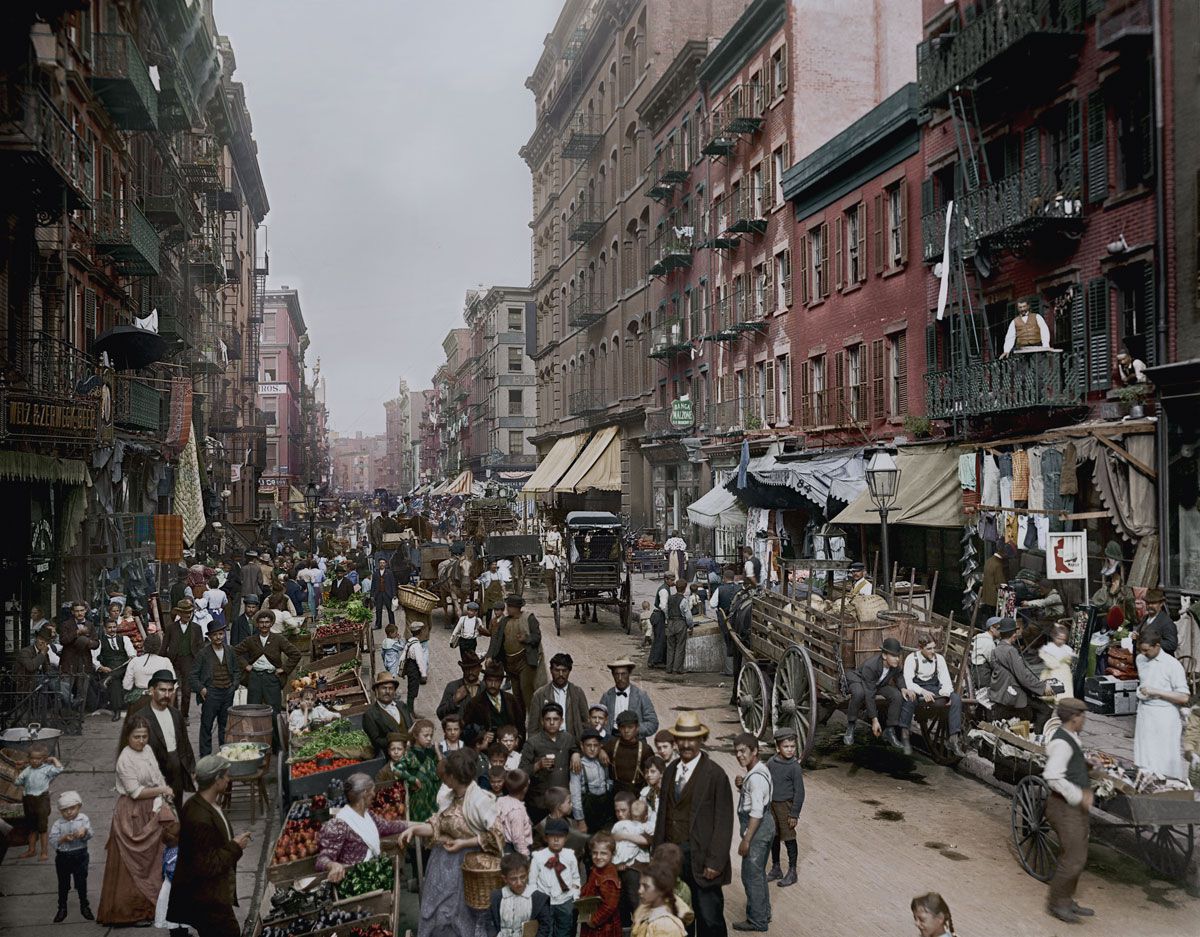
But I have to say that I deeply miss what “Little Italy” once was. It was the home of my ancestors, two wanderers from Italy who came alone from Calabria and Tuscany, met in the Big Apple, and raised a respectable family on the basis of hard work, faith, and thrift. And the Italian enclave of New York was a perfect place for them to live the American Dream.
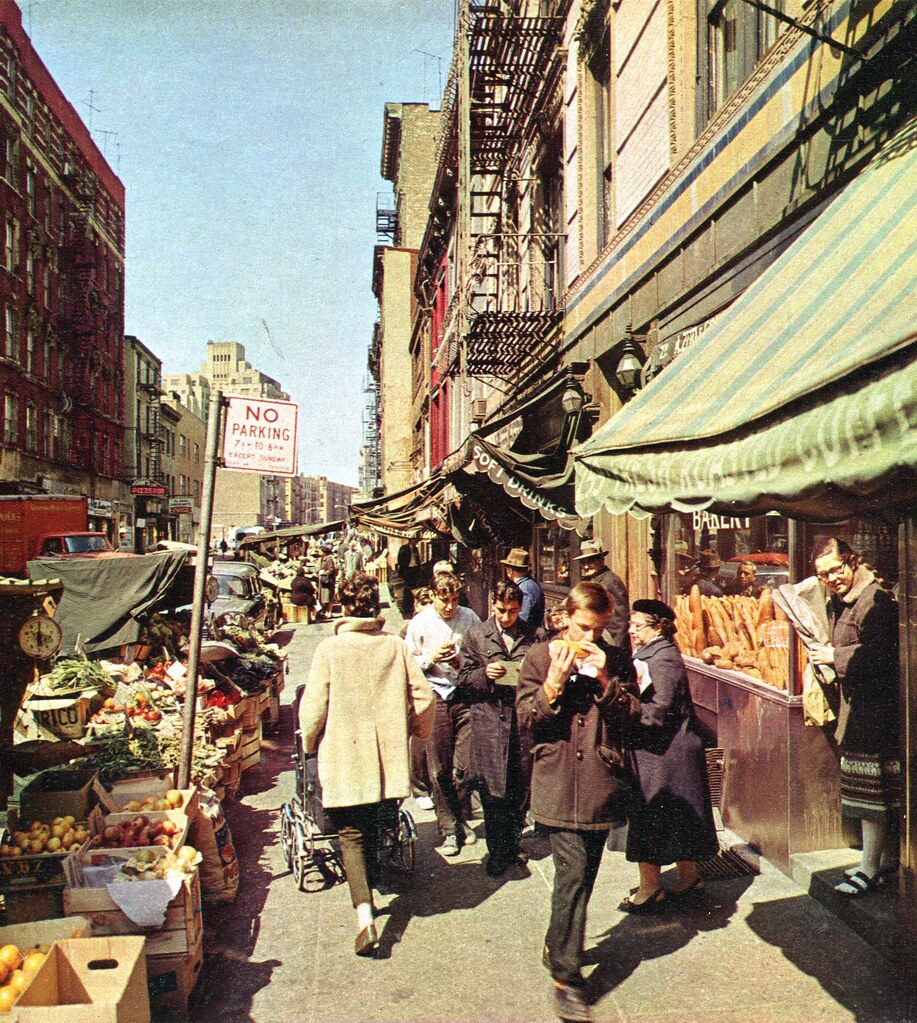
Mulberry Street in 1900, Colorized. This is about the time my grandparents arrived from Italy.Little Italy in 1962
The neighborhood as I knew it was busy and vibrant, full of local bakeries, pizzerias, streetside stalls, cigar stores, candy stores, stationery stores, butcher shops, and anything and everything a thriving community transplanted from the “old country” would need or want. But even then, the slow downward slide toward gentrification had begun.
Anyone who has seen “The Godfather, Part II” is familiar with the street festival during which Vito Corleone assassinates Don Fanucci. This is a portrayal based on the Festa di San Gennaro (The Feast of St. Januarius) which was brought to New York by immigrants from Naples in 1926 as a continuation of the celebration of their patron Saint. Originally a one-day celebration, the Festa continues to this day as an 11-day extravaganza (except in 2020, when it was cancelled due to the Covid outbreak); activities include Italian street food, sausages, zeppole (fried dessert balls otherwise known as “Italian doughnuts”), games of chance (often dishonest¹), music, cannoli-eating contests, vendors, parades, and the grand procession honoring the patron saint – the tradition of attaching money to the statue continues, with the funds designated to be used for the poor. In the past it has been a major tourist attraction, and hopefully it will be once again when the pandemic madness has passed.
The Feast of San Gennaro
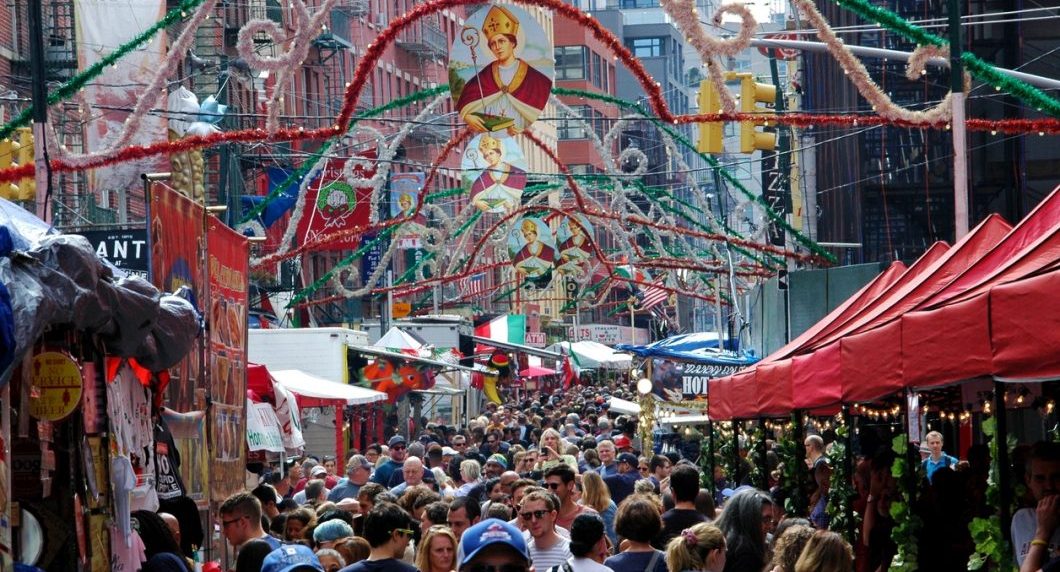
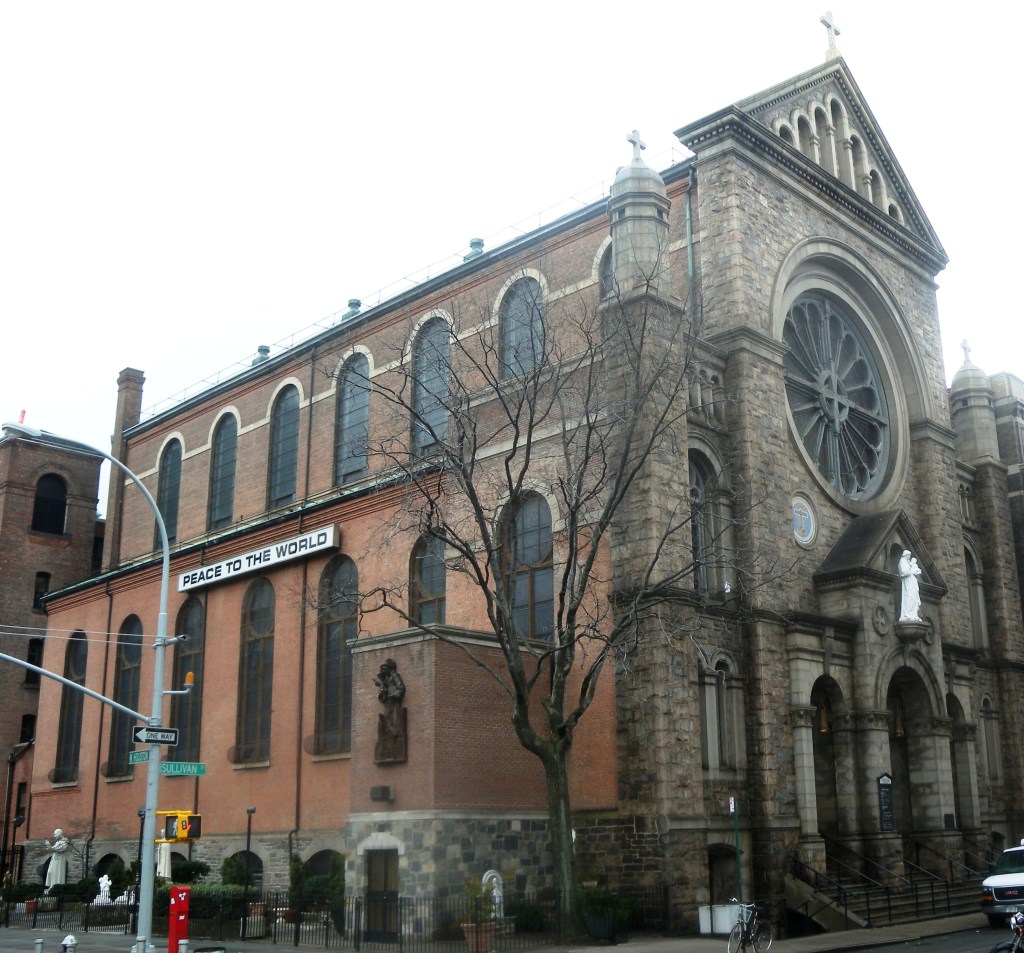
But known to fewer people is the fact that there was a second Festa which took place along Sullivan Street in Greenwich Village during the ’60s: The Feast of St. Anthony of Padua. St. Anthony’s was established in 1859 as the first parish in the United States formed specifically to serve the Italian immigrant community. (Wikipedia)
St. Anthony’s Church
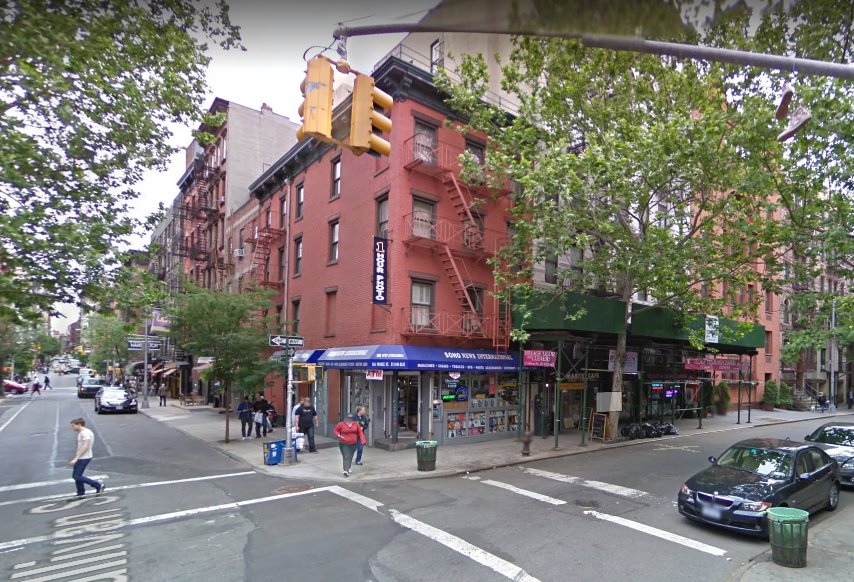
I know of this because the celebration happened right under my window when I was living right on the corner of Prince and Sullivan, at 186 Prince Street.
186 Prince Street, seen in 2009
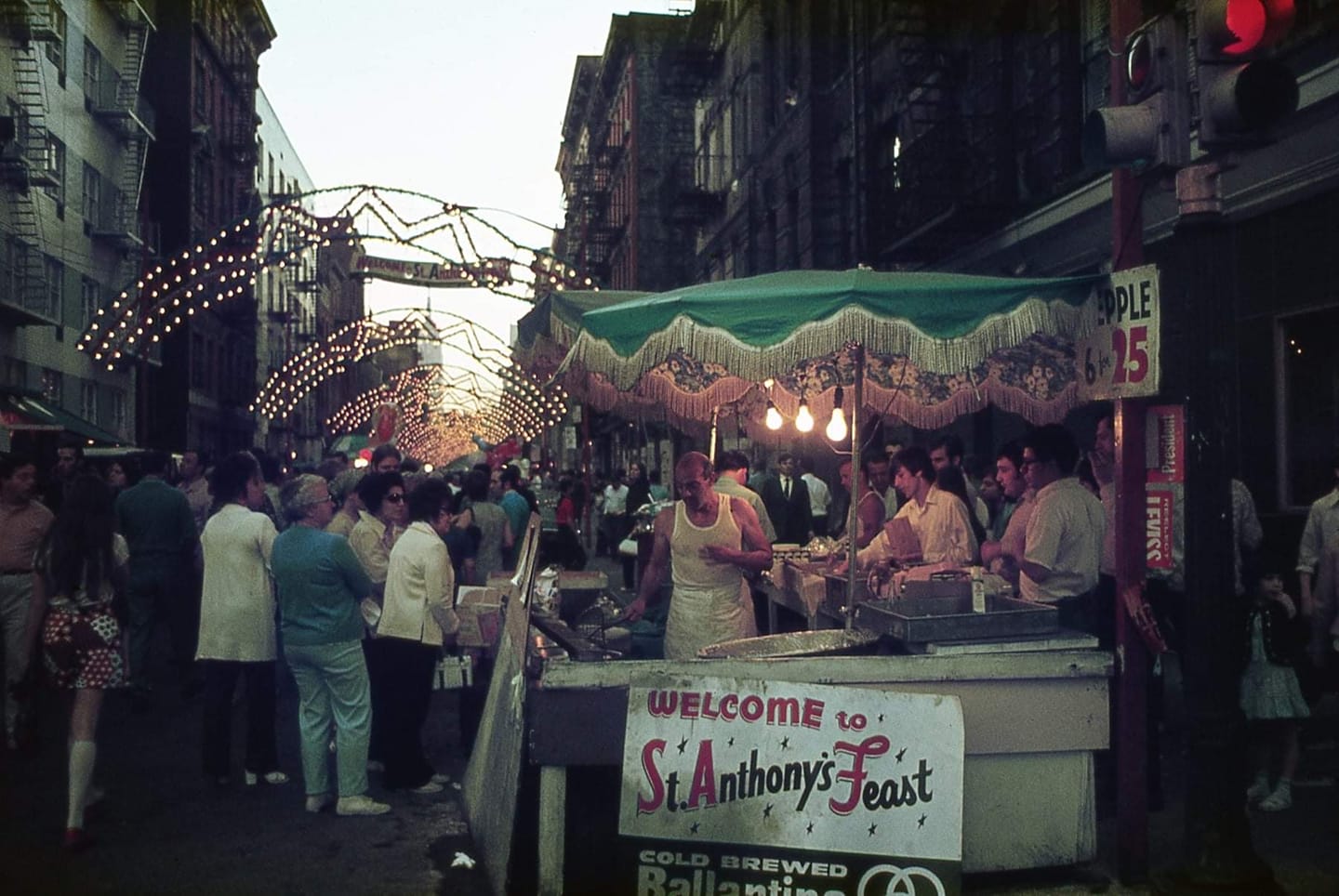
Saint Anthony’s feast was not as big and grandiose as the one for San Gennaro, but it was more intimate and more homey. The noise and the ruckus and the celebration would last far into the night, and the sounds and the smells of Italian food was tantalizing.
Feast of St. Anthony, 1960s
Even kids got into the act. It was not uncommon to see a number of boys sitting along the street inviting others to play the “shot glass” game, in which pennies were dropped into a slot at the top of a large jar of water, with the aim of getting them into a shot glass at the bottom. Winners collected 10¢; those who had the knack of holding the coin by its edge and giving it a spin straight down could usually clean out their competition in short order, while others simply watched their coins gently float down to land outside the sweet spot.
Shot Glass in the Bottle Game
Sadly the festival for St. Anthony has largely died out; efforts have been made to revive it, but due to the changing demographics of the Village and the reduction of Little Italy to a shadow of its former self, interest has waned and there has not been enough social momentum to bring it back to its former glory.
The St. Anthony Procession in 2015
From what I am told, Italian festivals continue to be a big deal in other cities such as Boston, but these were the ones that I knew, and I miss them
The Old Wolf has spoken.
Footnotes
¹ I say this from personal experience. One game involved a long track in front of the stand, in which a shiny metal car was pushed; it would bounce back and forth between springs at each end (kind of a flat variation of the “wheel of chance”) and a pointer on the car would land in a given zone when it stopped. The very small center zone was highlighted for a major prize; others were smaller prizes or nothing. I gave it a shot (probably 25¢ a play) and watched the car land dead center in the grand prize. That was before the ride operator gave it a shove with her hand, which I saw very clearly. I walked away with a set of colored glasses which I gave to my mother, but I should have won something much better – can’t remember what it would have been. I was only 12 at the time and complaining would have done no good.
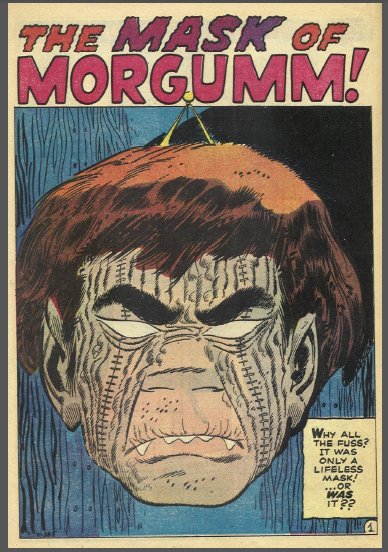
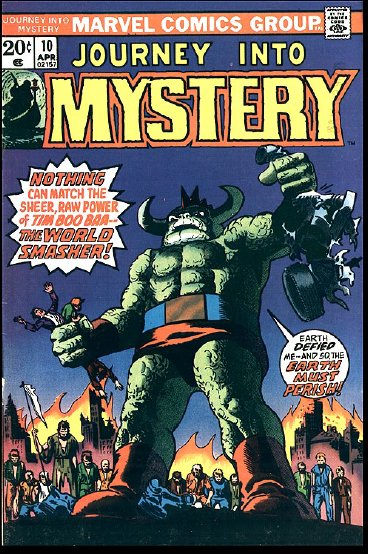
I loved comics as a kid. No shame, I learned a lot. Loved things like Strange Tales, Creepy, Weird Science, along with the standard DC and Marvel fare.¹ And over the years, some things just stuck in my mind. Tales like “Tim Boo Baa,” “The Mask of Morgumm,” or “The Lonesome Death of Jordy Verrill.” Thanks to the miracle of the Internet, I’ve been able to recover quite a few of these and revisit them in all their glory.
But there was one memory I was never able to recapture, although it popped into my mind frequently… until this week.
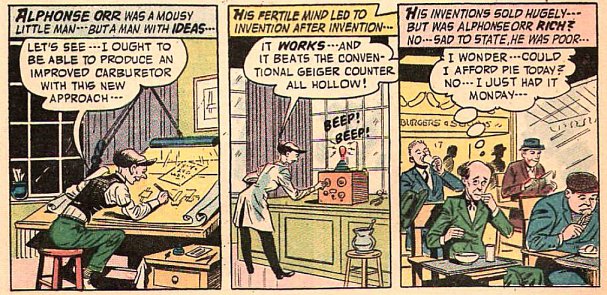
It was about this poor inventor, Alphonse Orr, who was taken advantage of by a hideous, bullying con-man of a boss. Finally his name popped up in a comic database, and I was able to score a copy of the issue that the story appeared in.
I was ten when this comic went on sale in 1961, and somehow that last panel, the image of this little man wondering if he could afford pie impacted me profoundly,² as did the idea of the injustice perpetrated upon him by his evil boss – and stuck in my mind for over half a century. Kids have an over-developed sense of injustice at that age, and I was no exception.³
So you’ll pardon me if I found the ending to the story immensely satisfying, and re-reading it after all these years I find that my feelings haven’t changed one whit.
You can read the entire story from “Forbidden Worlds, Issue #98 here as a pdf download.⁴
It’s nice to be able to put memories to rest.
The Old Wolf has spoken.
Notes:
¹ I could have put my kids through college if I had kept all the first editions I bought, but that’s another story.
² Never mind all the abject poverty and true starvation and famine in the world; at that age I was not aware of what was happening in third-world countries or even of food insecurity in America, but at that time the thought that Alphonse was so poor that he couldn’t afford pie deeply saddened me.
³ Those impressions have never left me. I have found that when it comes to the injustice and cruelty and stupidity of corporations, there’s always a relevant Dilbert.
Strips like this infuriate me. I’m not sure why I keep reading them.
⁴ Edit: If you do read this story, keep in mind that it’s the ’60s and that it’s fantasy; the Challenger Deep is 6.85 miles below the surface, whereas Edgar W. Simmons claims to have taken his new submersible 120 miles down. Just as a matter of curiosity, the pressure at that hypothetical depth would be 19,259.37 atmospheres, or 250,371 pounds per square inch, or roughly 42 Humvees stacked on your thumbnail. Science? We don’t need no steenkin’ science!
Shut up, you deviants. I mean Jack Sparrow-type booty. Arr…
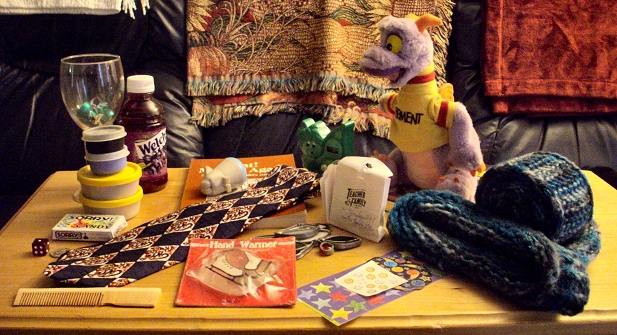
In 2010, a chest o’treasure arrived in me mailbox from a pretty wench in a far-off land. A whole bundle of silly, fun things: most useful, all appreciated.
The tie was the most interesting of all. To look at, it’s just a nice Christmas-themed cravat (since I only have one other, this will be a fine addition next Yule season.) But on closer examination, there are bits and snatches of words running through the candy canes.
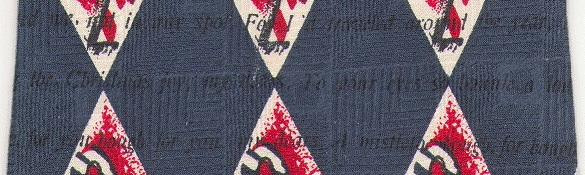
I could tell the writing extended through the candy canes onto the blue background, but it was impossible to see in normal light, especially with the reflection from the shiny silk. So I scanned it, hoping to bring out a bit of detail.
With a little contrast and gamma manipulation, I was able to get the words to come out a bit more (this is just a small section, and my working image was much larger):
What jumped out at me was “The Christmas Joy”, “around the year”, “spot”, and “frozen”. Doing a Google search on these words came up with one – and only one – hit, a poorly-scanned copy of Down Durley Lane and Other Ballads by Virginia Woodward Cloud, published in 1898(!), and illustrated by Reginald Bathurst Birch which included this poem, “Old Christmas”:
It’s a long way round the year, my dears, A long way round the year. I found the frost and flame, my dears, I found the smile and tear!
The wind blew high on the pine-topp’d hill. And cut me keen on the moor: The heart of the stream was frozen still, As I tapped at the miller’s door.
I tossed them holly in hall and cot, And bade them right good cheer, But stayed me not in any spot, For I’d traveled around the year
To bring the Christmas joy, my dears, To your eyes so bonnie and true; And a mistletoe bough for you, my dears, A mistletoe bough for you!
What a delightful, hidden, and serendipitous message!
Miraculous it was that these words were even clear in the transcription, because it was a raw optical-conversion, and much of the text came out as garbage. What’s more, Virginia Woodward Cloud is a rather obscure poet, not unlike Grace Noll Crowell, (whose works I had hunted for over a period of 40 years, only having success last year thanks to another deep internet search). So the odds of finding one of Cloud’s poems on a Christmas tie are pretty slim.
A bit more digging found a beautiful online, zoomable copy of the book – “Old Christmas” is on page 99.
And all this because I gave the wench a stale crust of bread…
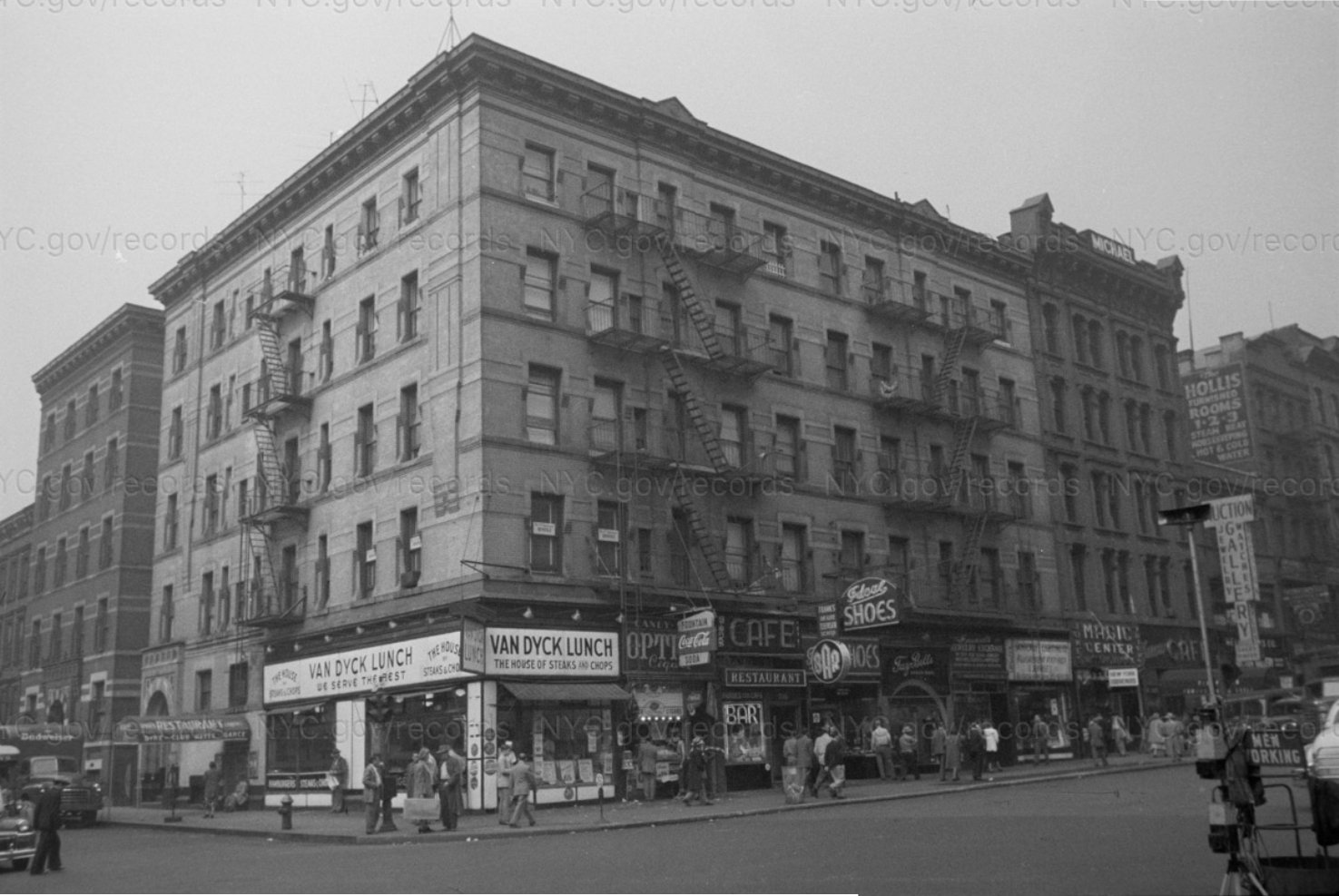
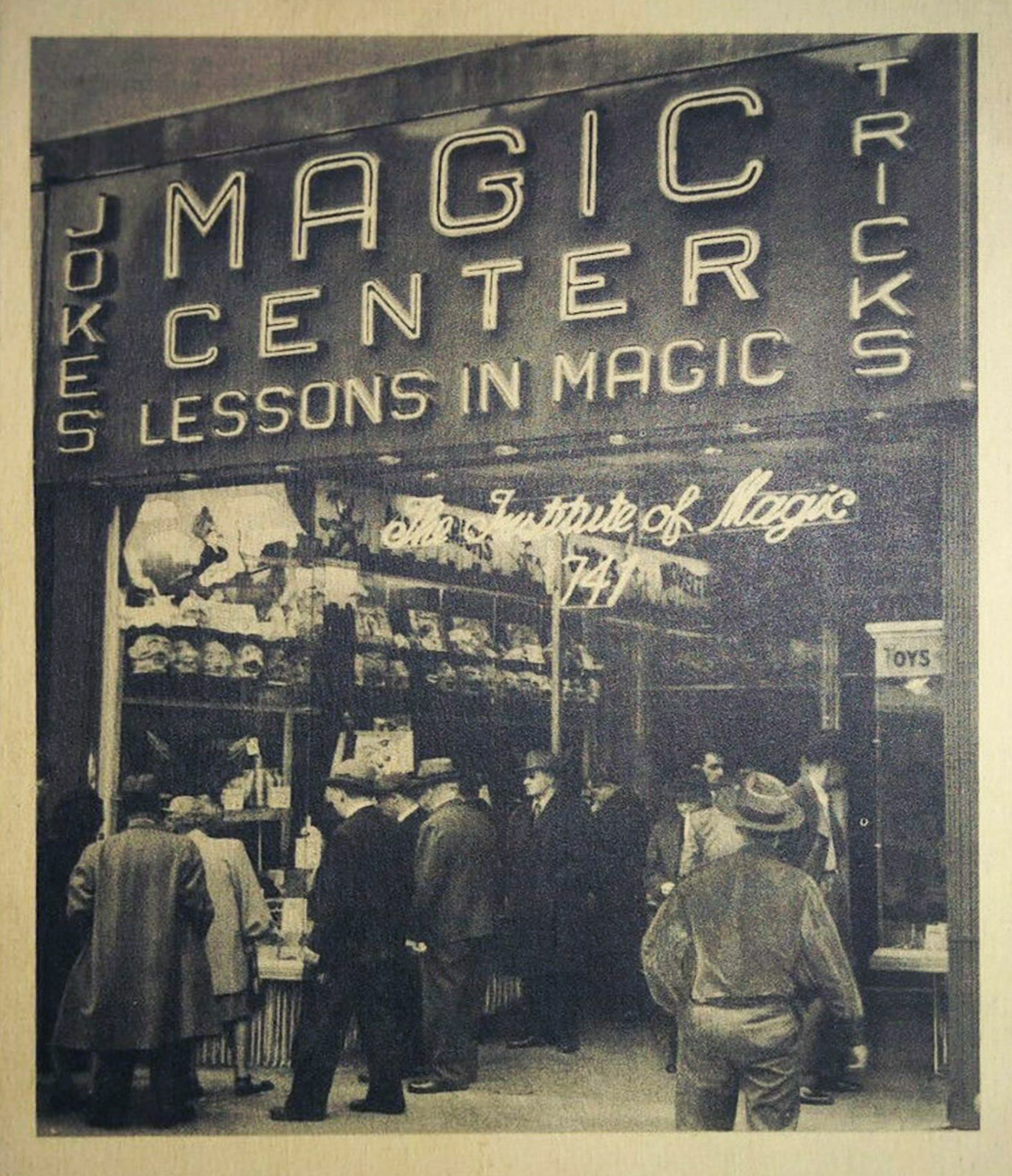
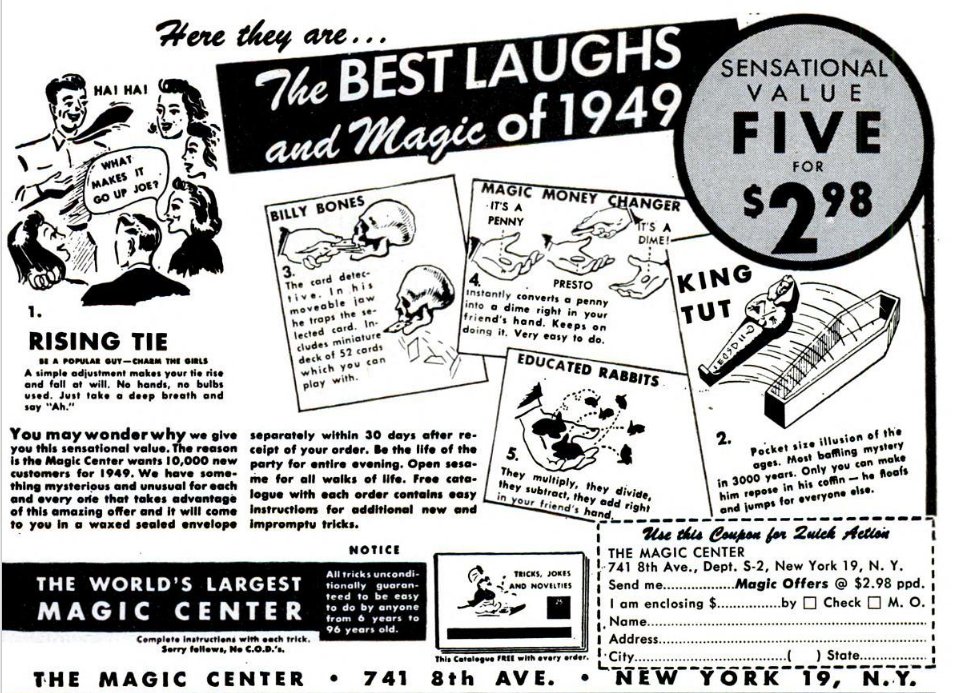
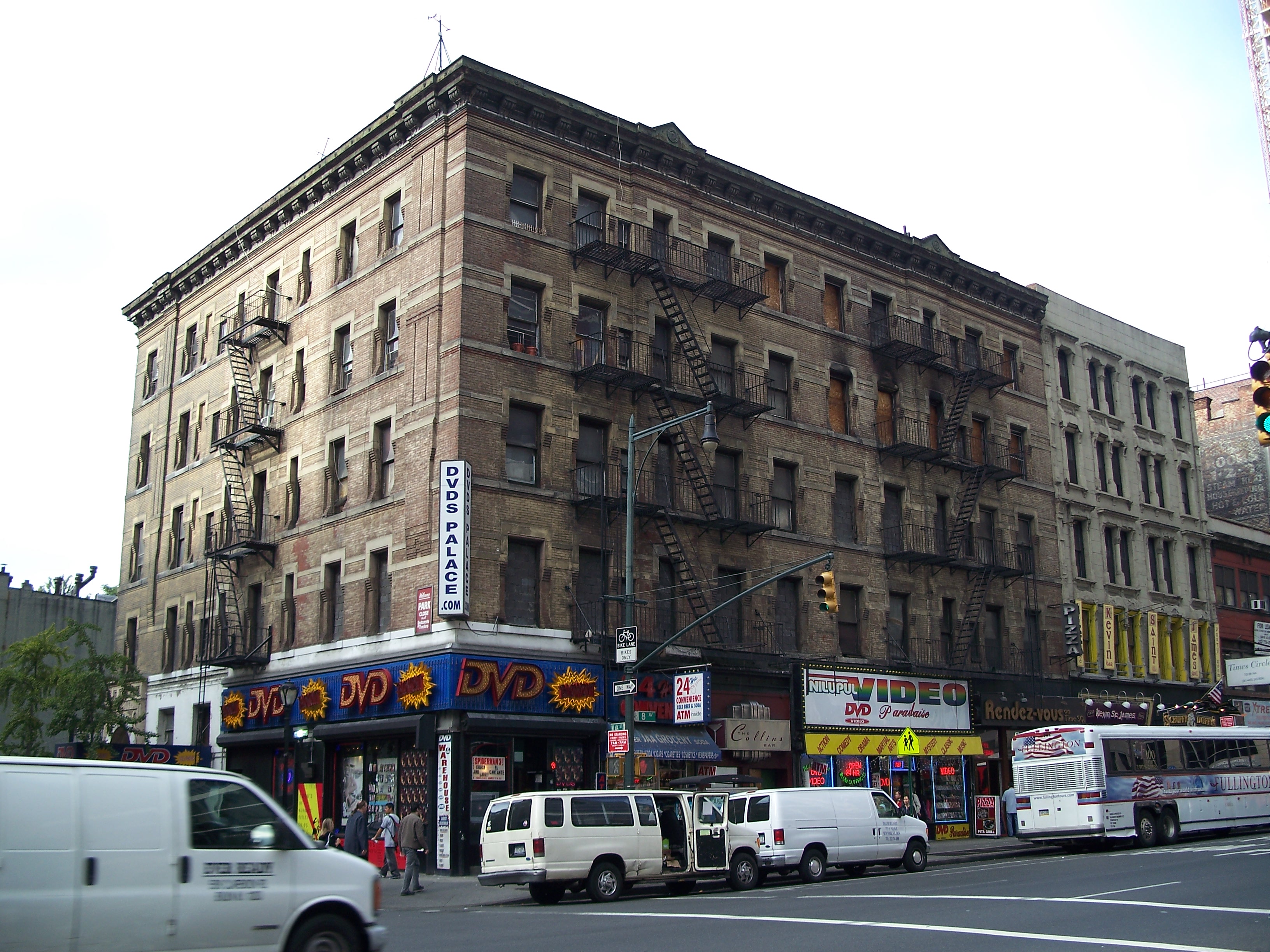
I have written about my Journey Into Magic, in which I mentioned my love of hanging around the Magic Center on 8th Avenue. I was delighted to find an old New York City tax photo from the 1940s which clearly shows the Magic Center at 741 8th Avenue (I believe Russ later moved his shop next door to 739).
Click the image to enlarge it; the Magic Center is clearly visible on the right.
Edit: Now, thanks to commenter DS below, we have a lovely photo from a Magic Cafe catalog:
This is pretty much how I remember the store.
Edit 2: Some lovely memories of Russ and his magic center were provided by reader Gary; you can read them at Judge Brown • Magic.
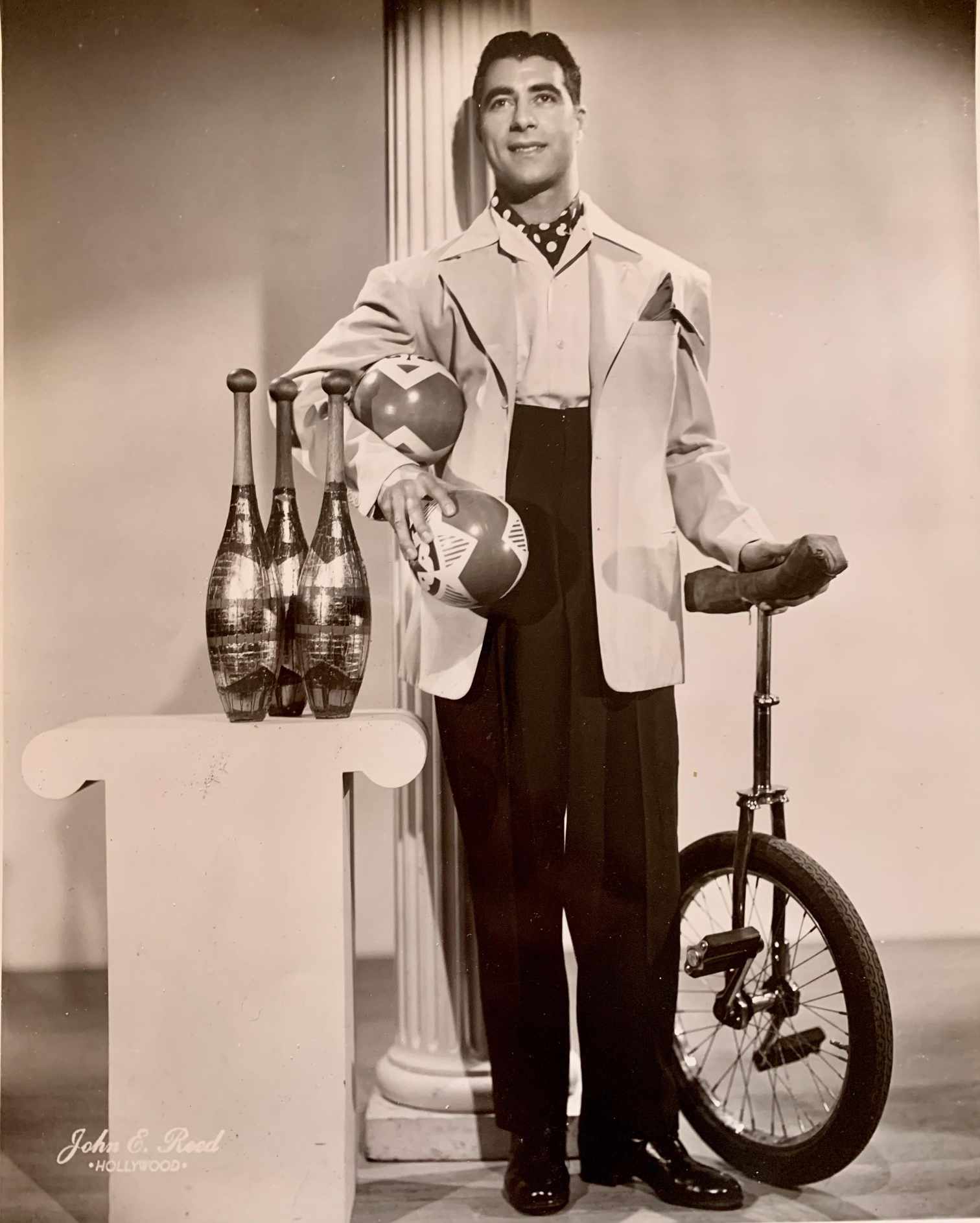
Edit 3: Finally, finally I was able to score a photo of Russ after being able to connect with one of his descendants. I can’t tell you how much this meant to me.
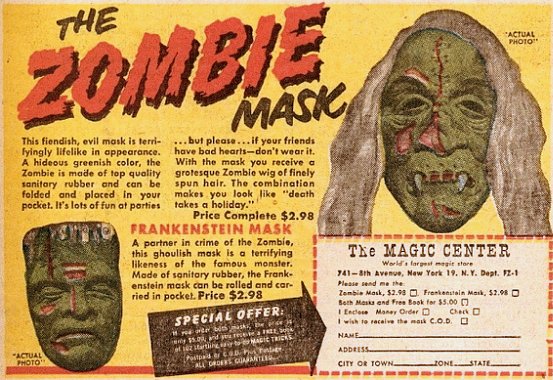
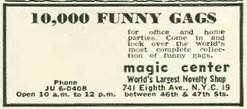
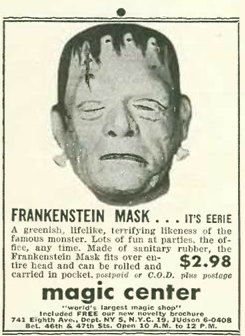
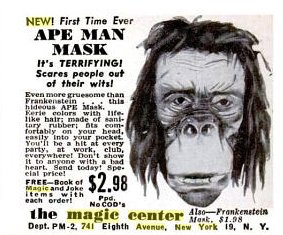
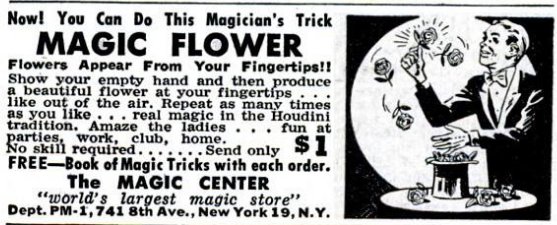
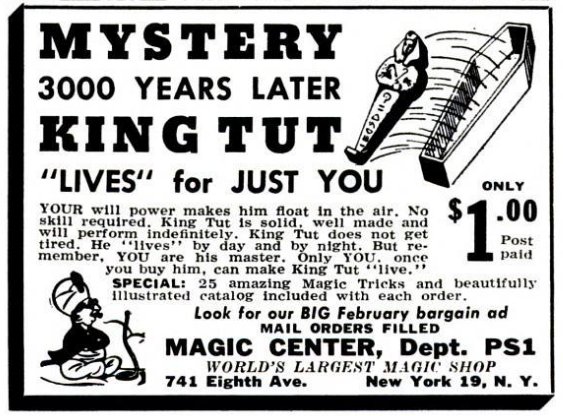
Russ used to advertise various tricks in magazines of the day, including Popular Science, Popular Mechanics, and the New Yorker:
The next thing I need is for someone out there in the wide world of the Internet to come up with a good photo of Russ himself.
Edit: A few additional pictures for history’s sake:
The 739 building awaiting demolition
The 741 building to the north is gone, and the 739 building is being torn down
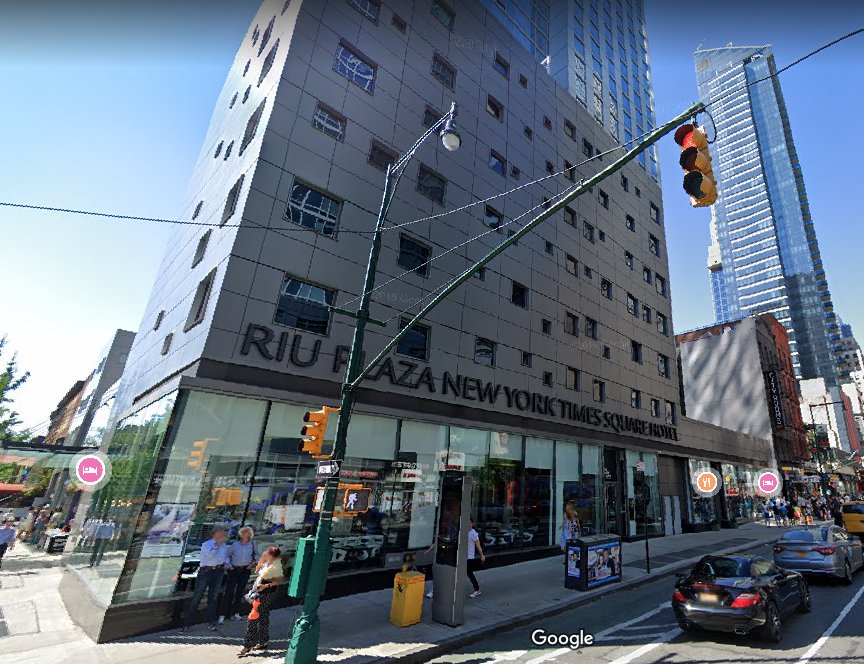
Google Street View of what replaced the old buildings. Time marches on, but memories remain.
Mad Magazine™ was wonderful back in the ’50s and ’60s. I seem to recall that as I grew older, either my sense of humor changed – I started appreciating Harvard Lampoon’s work in the late ’60s – or the quality of the writing diminished.
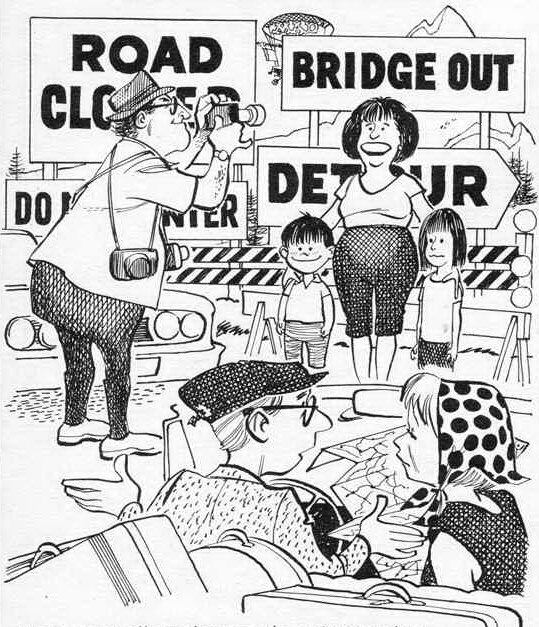
At any rate, some of the early stuff was priceless, and still relevant to today’s challenges. One example that keeps surfacing in my mind every time I hit a detour is this gem, written by Tom Koch and illustrated by Bob Clarke.
Peeved at Obstructions (Sung to the tune of “Eve of Destruction” Barry McGuire)
You save up all year long to take a nice vacation. You make a lot of plans to drive across the nation. You dream of all you’ll see with great anticipation. You’ve only got a week to reach your destination, But that seems like enough, you feel no consternation. Then they tell you over and over and over again, my friend, That you can’t get through; the road is under construction.
You’ve never been to Maine or Utah’s scenic section. You call the auto club to help make your selection. You pay to get your car a thorough trip inspection. So you can drive afar and feel you’ve got protection. Then, when you’re almost there, you seek a cop’s direction. And he tells you over and over and over again, my friend, That you must turn back; the road is under construction.
Vacation here at home, our president keeps sayin’. Don’t spend your dough abroad, he fervently is praying. So you head for New York do do your summer playing; Or maybe to the west a travel plan you’re laying, To see those snowy peaks and geysers wildly sprayin’. But the signs warn over and over and over again, my friend, That you can’t get there; the road is under construction.
“The project involved the reconstruction of 16.2 miles of interstate mainline and the addition of new general purpose and high-occupancy-vehicle (HOV) lanes through the Salt Lake City metropolitan area. The project also included the construction or reconstruction of more than 130 bridges, the reconstruction of seven urban interchanges, and the reconstruction of three major junctions with other interstate routes, including I-80 and I-215.”
While the project was sorely needed and the end result was beneficial, for four years, the commute from outlying areas to Salt Lake City was a major pain in the patoot, with commuters searching out and jealously guarding favorable and secret bypass routes.
But wait, there’s more!
In 2009, UDOT undertook the I-15 Core reconstruction project, rebuilding 24 miles of I-15 from Point of the Mountain to Payson in just 35 months. The design-build strategy meant that the entire stretch was torn up at once, instead of doing a few miles at a time. The inconvenience was so significant that I was moved to memorialize the experience in video:
In retrospect, I really shoudn’t complain at all; nowadays our nation’s crumbling infrastructure could use a bit of help, and I think subsequent generations would appreciate our putting up with some inconvenience if it means that their bridges won’t collapse underneath them. But when you’re behind the wheel and trying to get to work (or to a vacation destination), the aggravation can certainly raise one’s blood pressure.
Bonus Section
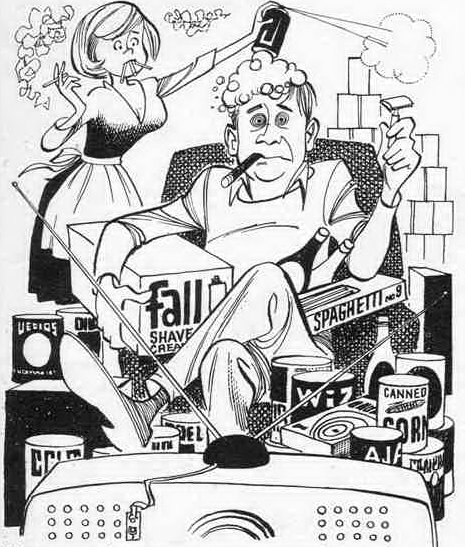
Since I happened to be on the subject of MAD Magazine, another extract from the same article is precisely the reason our family threw out all our TVs over 20 years ago (the kids were absolutely devastated, but somehow they survived):
The TV Victim’s Lament (Sung to the Tune of “Blowin’ in the Wind” by Bob Dylan)
How many times must a guy spray with Ban Before he doesn’t offend? And how many times must he gargle each day Before he can talk to a friend? How many tubes of shampoo must he buy Before his dandruff will end? The sponsors, my friend, will sell you all they can. The sponsors will sell you all they can.
How many times must a man use Gillette Before shaving won’t make him bleed? And how many cartons of Kents must he smoke Before the girls all pay him heed? How many products must one person buy Before he has all that he’ll need? The sponsors, my friend, will sell you all they can. The sponsors will sell you all they can.
How many times must a gal clean her sink Before Ajax scours that stain, And how many times must she rub in Ben-Gay Before she can rub out the pain? How many ads on TV must we watch Before we are driven insane? The sponsors, my friend, will sell you all they can. The sponsors will sell you all they can.
Full disclosure: My mother single-handedly raised me on the income from commercial advertising, so I feel a bit sheepish about this, but the onslaught of advertising, much of which has now moved from the airwaves to the internet, still rubs me the wrong way.











 Playing in the World Game