Games I Loved as a Child

Everyone plays Risk, but I had this nagging memory from early childhood that I had played a similar game that wasn’t quite the same. All I remembered about it were these little “I-beams” that were used as some sort of currency. Thanks to the Internet, I was able to refresh my memory.

Summit

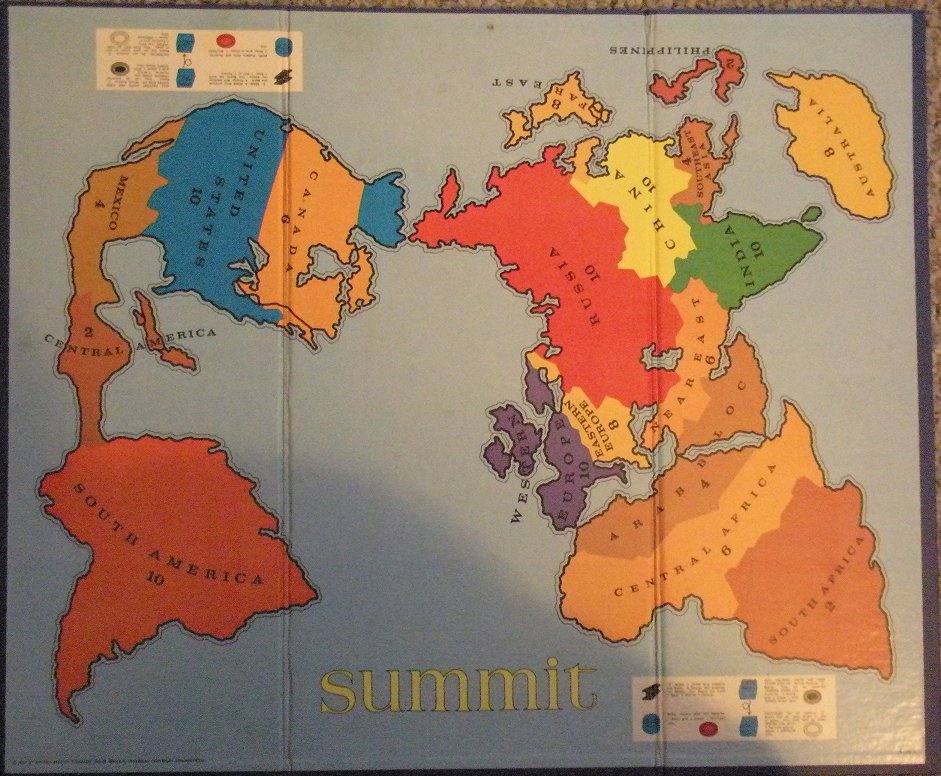
Summit is a Cold War board game introduced in 1961 by Milton Bradley as “The Top Level Game of Global Strategy,” and it was about this era that my cousin and I used to play it. I’m surprised that even at my tender age of 10 or 11, I was able to grasp the ins and outs of this purported “adult-level” game.
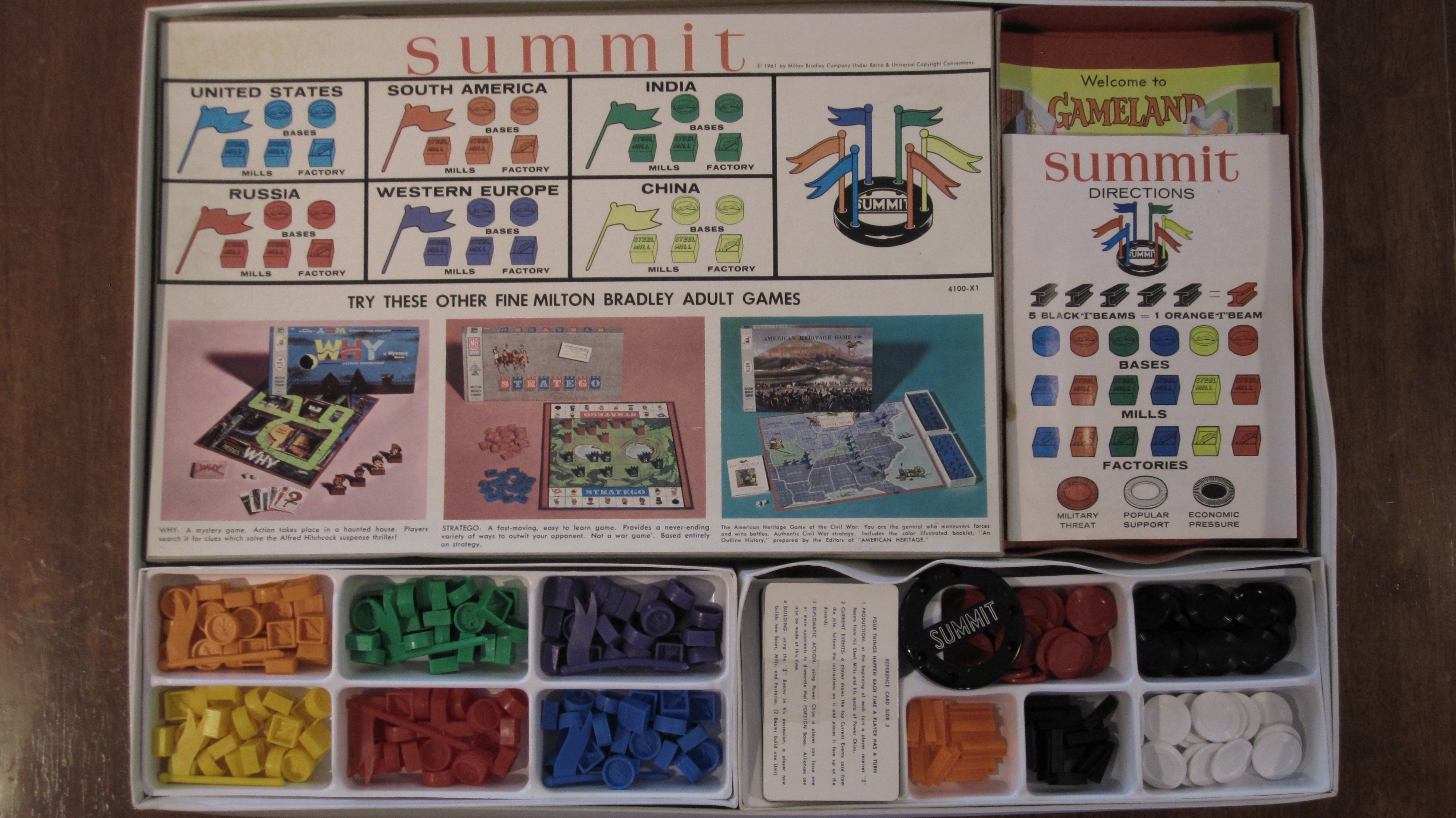
pic477110

The board

pic822975

Playing pieces

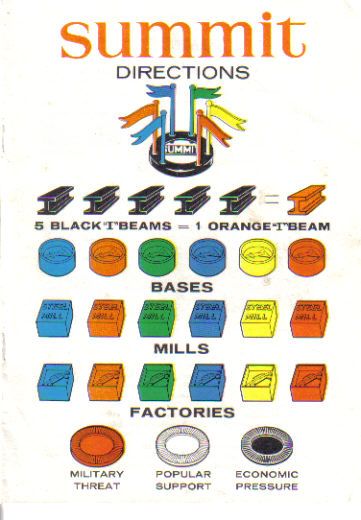
pic233010

Instruction Manual Cover

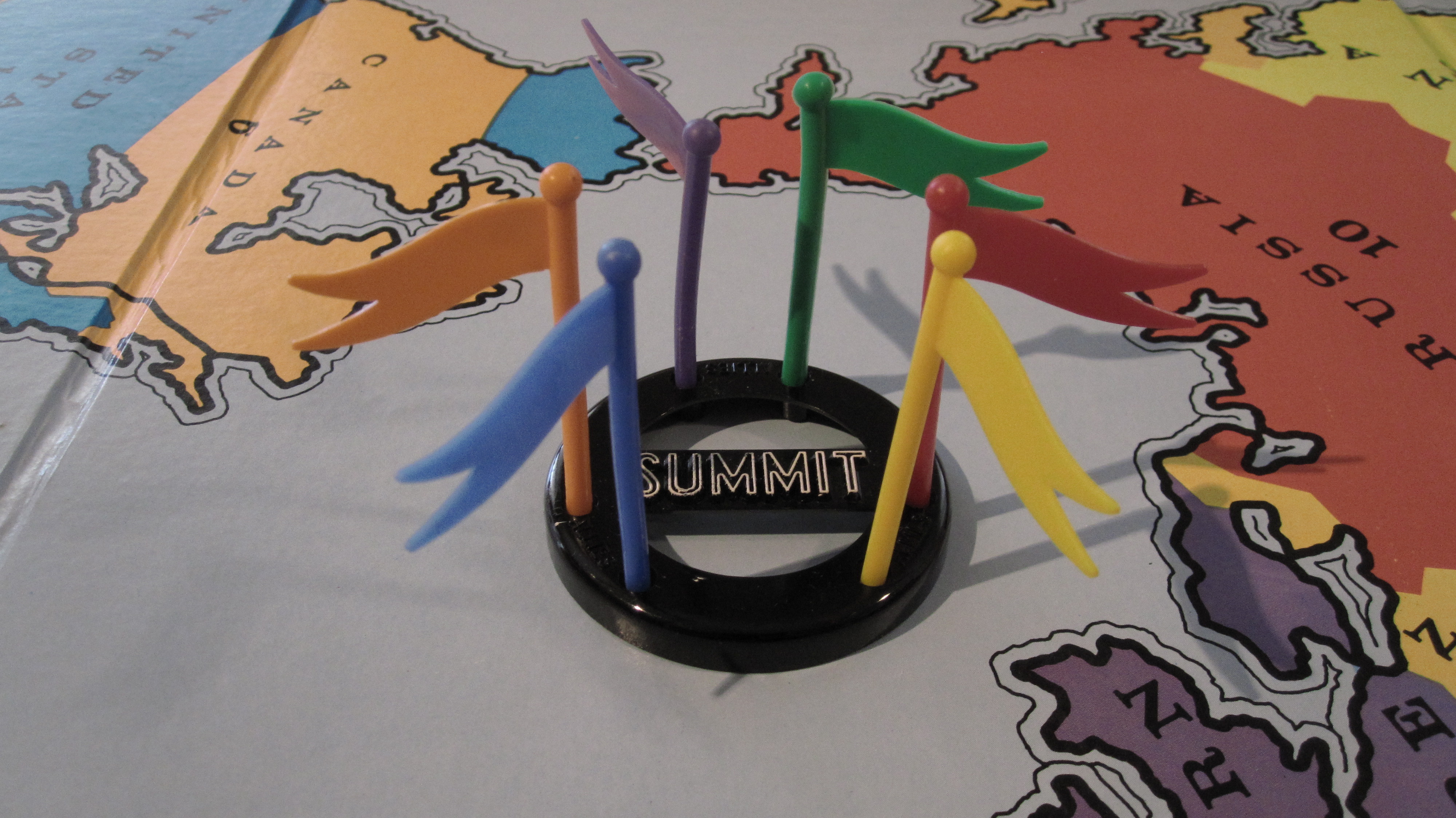
pic822971

Alliance flags

A good description of the game is found at Gamepile:

Summit is an early “war game” of the Cold War era. There is no outright conflict involved, the players try to influence their opponents through economic strength and military threat.

Each player represents one of the major powers of the world (of 1961); the United States, the Soviet Union, China, Europe, South America and India. There are three basic units; “mills”, “factories” and “bases”. Mills produce “I-Beams” which are used to build more mills, factories and bases as well as providing “Economic Pressure” chips. Factories produce consumer goods which produce “Popular Support” chips and bases protect mills and factories and produce “Military Threat” chips.

What drives the game is that mills and factories in “foreign” countries produce more than those in a player’s home country. A player can build in any foreign country in which no other player has a base. If a player builds a base in a country, all mills and factories belonging to other players in that country must be removed. So, a player must build bases in the foreign country to protect their mills and factories there.

To force another player to remove a base from a foreign country a player must play one of their chips (either Economic, Social or Military). The second player must either remove the base or counter with a chip of the same type. If they counter, the first player may play a second chip. This continues until one player or the other decides to stop playing chips. A player must be careful, because spending too many chips can leave them very vulnerable in one of the three areas.

game0803.jpg

This game is surprisingly simple yet surprisingly deep at the same time. Players can ally with each other and can use their allies chips (with their allies permission) in a challenge. The game forces the player to try to maintain a balance of economic, social and military development. A very good game and one that stands up surprisingly well even after over 40 years.

I find this actual quote from the rules book amusing…Compare some of the plays you are making with the international news of the day. Quite often it will coincide with the play of the game.

I’ve found a couple of copies of this game on eBay, but the ones I’ve seen are either incomplete or too expensive. I’ll keep my eye out, because this was one of our favorite games to play when I would visit my “country cousins.”

Now my memory is on a roll. I might as well put a few others here, some of which are no longer available.

Teeko

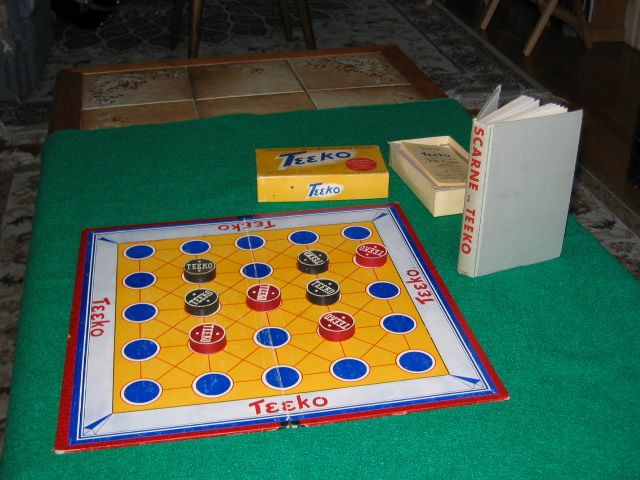
Teeko is an abstract strategy game invented by John Scarne.
pic38576

Each player had four wooden pieces; the game was played by placing one’s markers on the board, and then sliding them around with the object of being the first one to line up his or her pieces in a straight line, either horizontal, vertical, or diagonal. Notice the “Scarne on Teeko” volume in this photo.

Blue Chip

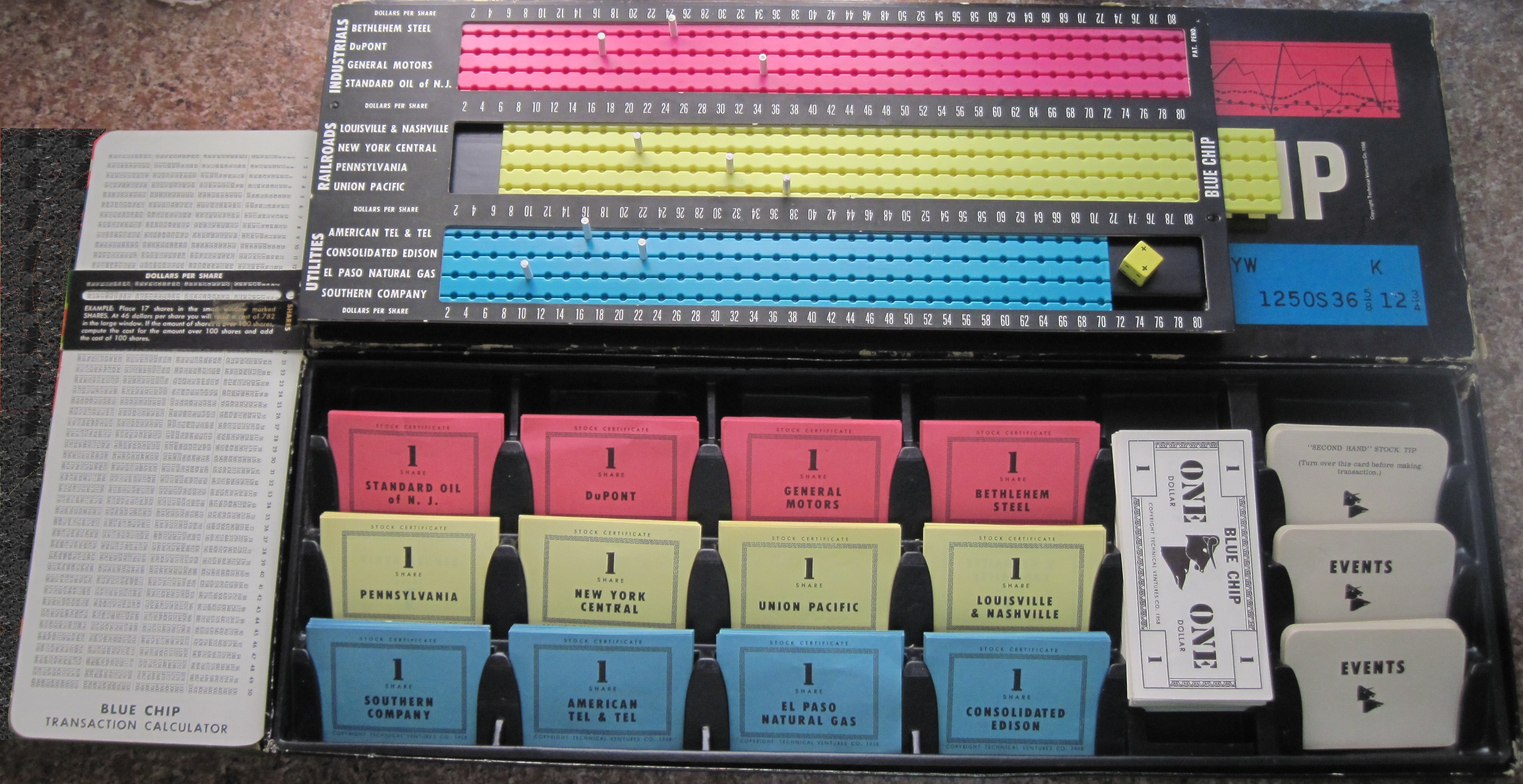
I really enjoyed this game – it predated Bookshelf Games “Stocks and Bonds”, and gave me a feel for how the stock market worked.
pic990007

A description from boardgamegeek.com:

Blue Chip (also published as Dow Jones) is a very simplistic stock market game with an interesting twist (sliding pegboards). There are 12 companies divided into Industrials (such as GM), Railroads (such as Union Pacific), and Utilities (such as AT&T). There are four of each type, and each type has a peg board of a different primary color.

On your turn you may take one and only one action. An action is either buying or selling stock in one company. (You don’t have to sell all when you sell.)

When you buy stock in a company, you move its individual peg up one, two or three spaces depending on how many shares you buy. Likewise when you sell: you move the stock price down one, two, or three spaces.

After each action, draw a card and see what happens. Many of the cards refer to the stock just transacted: a split, or all players holding the stock collect a dividend, or are assessed a fine, or the company goes bankrupt, etc. (Yes, it’s as fierce as the dot.coms a few years ago: five of the twelve companies will be bankrupt by the game’s end!)

Other cards are general and refer to the whole board. Sometimes you roll dice which affect all industrials or railroads or utilities. In that case, you slide the whole peg board for that particular color up or down as necessary. There are dice in three colors with sides of +2, +4, +6, -2, -4, -6 on them.

I was always so excited when my stock would split…

Tactics II (1958) – Avalon Hill
pic593269

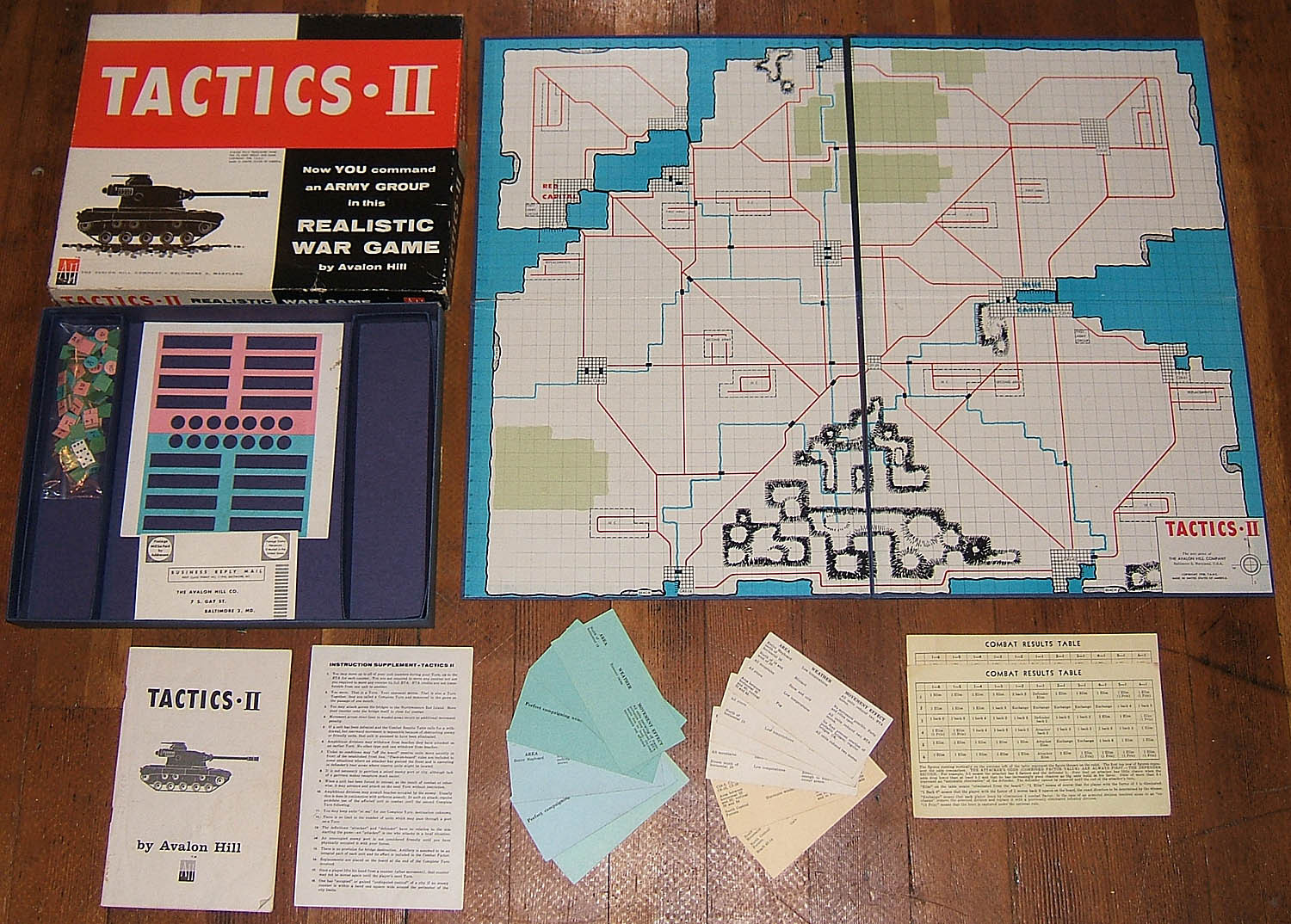
The hobby of wargaming was born in the 1950s with the publication of the game Tactics. TACTICS II is a direct descendant of this original board wargame.

TACTICS II is sort of like military chess. Different pieces, called “units” in wargames, have different capabilities just like chess pieces. The major difference is that a player can move all his pieces each turn, and after all his pieces are moved, battles are resolved against the enemy units his pieces are next to (adjacent to).

The other major difference between wargames and chess is that wargames have a mapboard, divided into squares or hexagons for movement purposes. TACTICS II has a 22″ x 28″ mapboard portraying a fictional continent with two countries, Blue and Red. Terrain includes roads, rivers, woods, mountains, beaches, and cities. The Blue Capital can only be reached over a vast plain, bordered on the left by mountains and on the right by woods. The Red Capital is on an island and can only be reached across one of several bridges or by an amphibious invasion.

Game features include special functions for headquarters units, terrain effects, invasions, airborne assaults, weather effects, replacements, isolation, and even nuclear weapons. Units represent infantry, armor, mountain, airborne, headquarters, and amphibious troops. Over 100 counters in all.

TACTICS II was almost always part of the Avalon Hill game line, primarily because it was sold as an introductory wargame for a number of reasons. The rules introduced many basic board wargaming concepts and were relatively low in complexity. The rulebook is divided into a basic game and a tournament game (advanced game). Both are balanced and relatively quick playing. As the opposing armies are identical in size and composition, victory is gained by a combination of logic, foresight, luck, common sense, and skill in military strategy and tactics. (from boardgamegeek.com)

I’m astonished that I would play this game as a child… I don’t think I’d have the patience for it now.

Careers

I still have a copy of this game, and I love it.

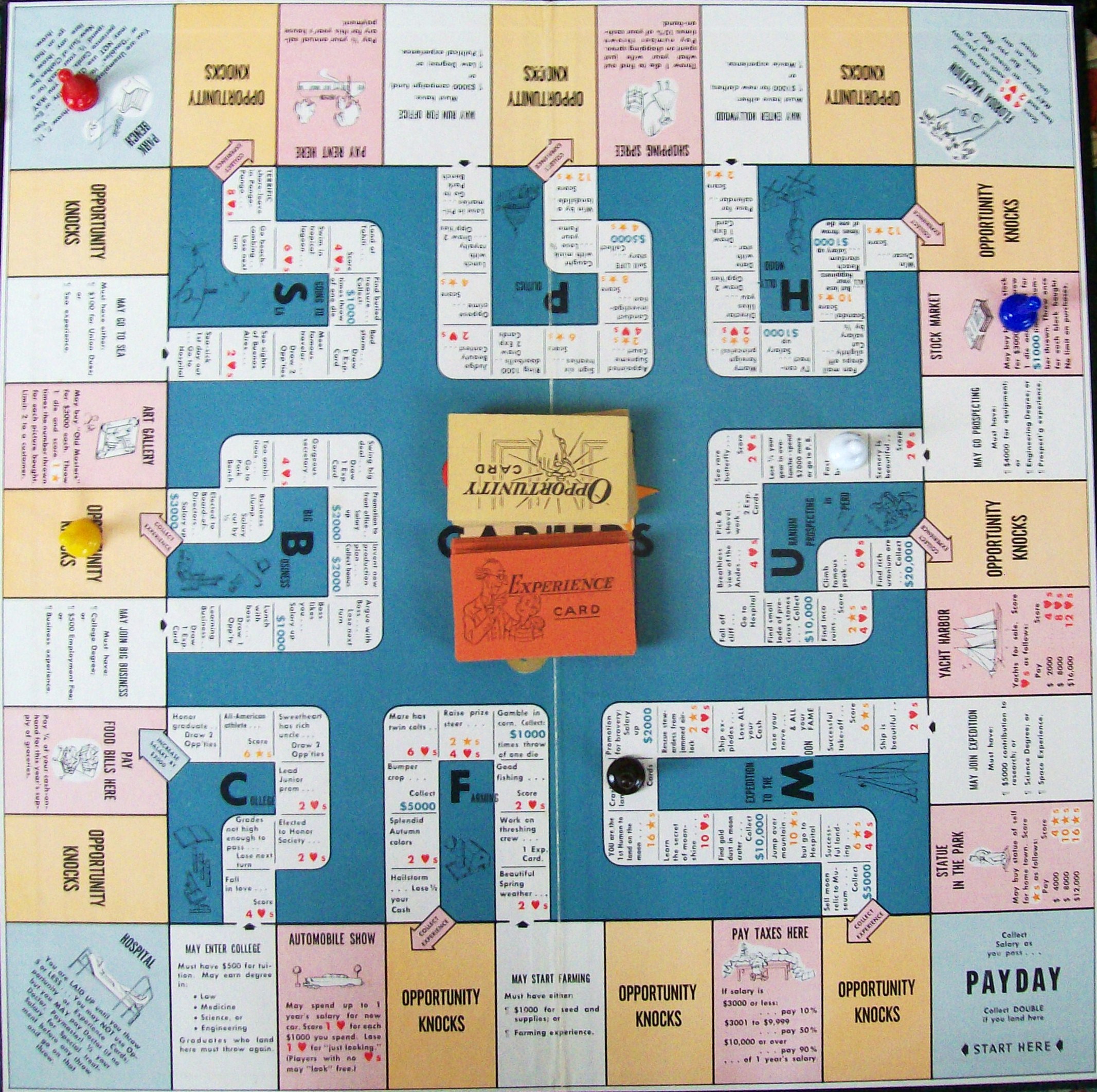
Careers is a game where the players set their own victory conditions. A player may choose to pursue Fame, Happiness, Money, or a combination of all three. The limitation being that the total number of “points” earned in the 3 categories must total 60. eg. 60 Happiness, 0 Fame, 0 Money; 20 of each; or any other combination. The players endeavor to fulfill their goal by going through any number of different “occupation paths”. All paths have some prerequisite for entry, and benefits accrue from going through any of the paths more than once. The different occupations are designed to be suited to different strategies, eg. Hollywood is good for fame points, while “Going to Sea” is good for happiness. In the end it is the player (or team of players) who gets to their pre-set goal first who will be the winner, and achieve everything they ever wanted in life. (from boardgamegeek.com)
Careers-Game-Board

Game board

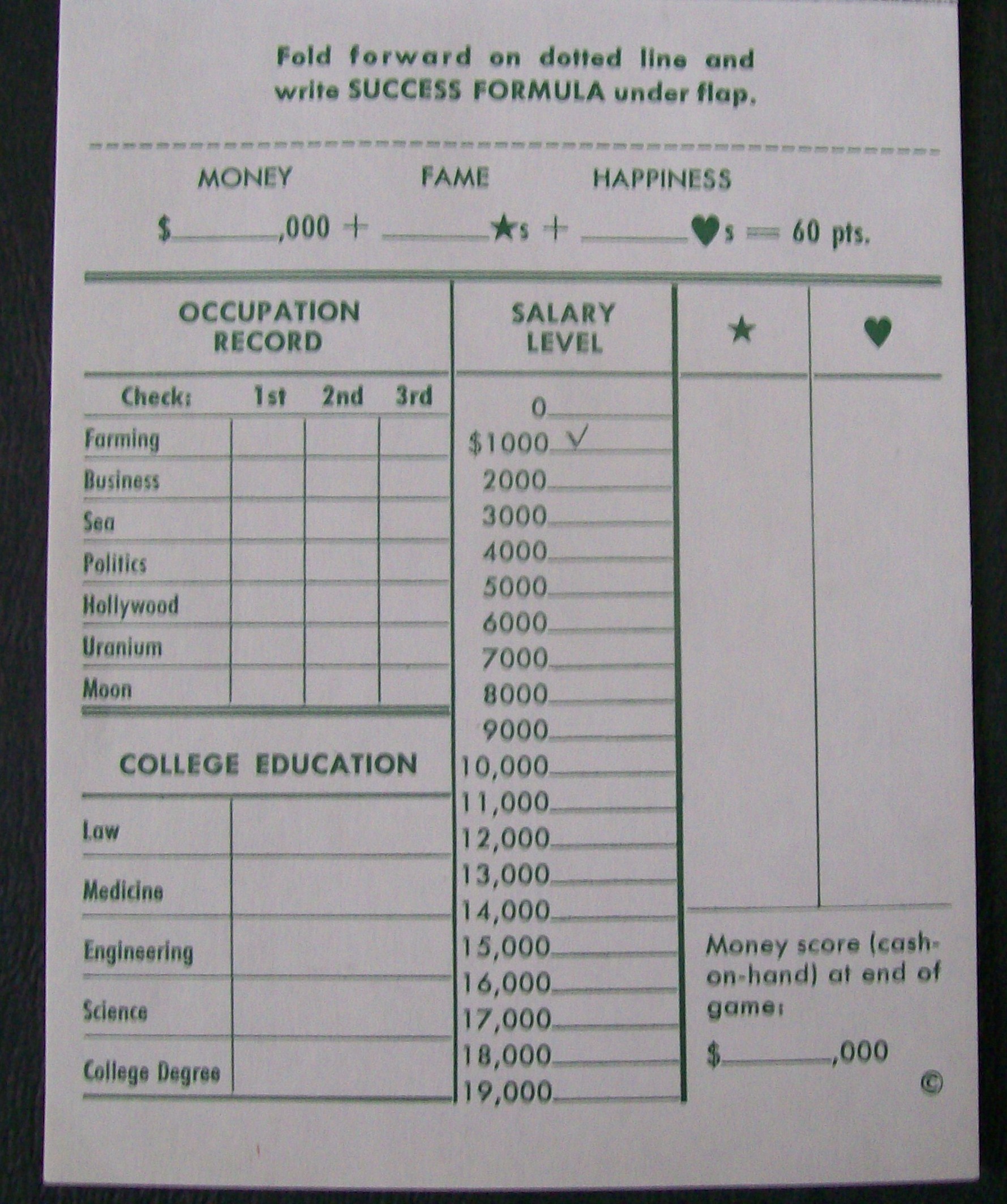
Careers-Score-Pad-1

Score pad

The early versions of the game came with those lift-to-erase re-usable score pads, but those tended to wear out after a while as the wax backing dried out.

I loved the squares you could land on… “Breathless view of the Andes… 4 ♥ s“, or “Scandal… score 10 ★ s, but lose ALL your happiness.”

This game has been re-issued in updated editions, but as with all my favorite games, I prefer the older versions best.

Monopoly, with Stock Exchange Add-on

From Wikipedia:

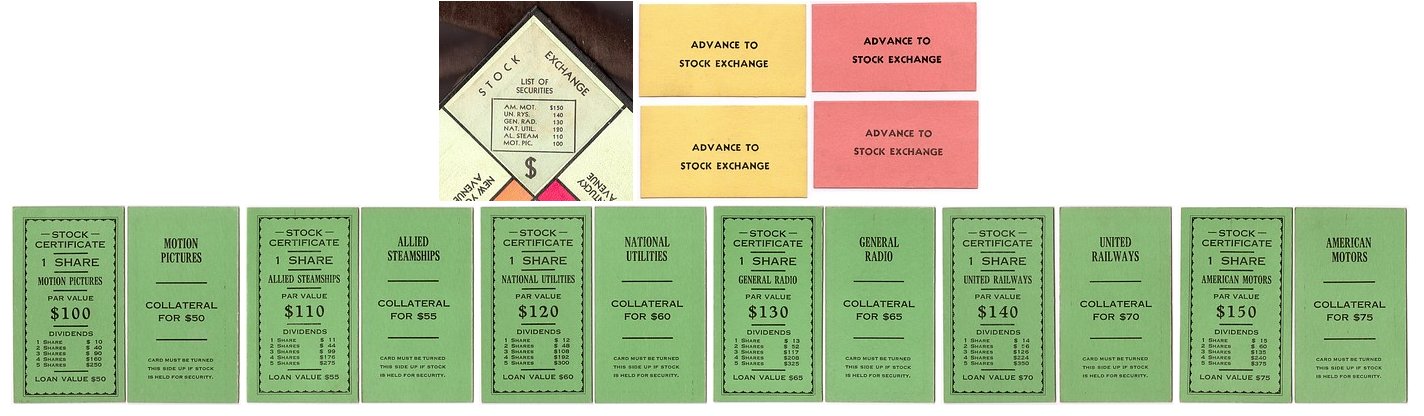
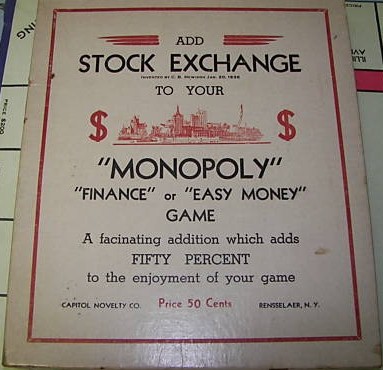
The original Stock Exchange add-on was published by Capitol Novelty Co. of Rensselaer, New York in early 1936. It was marketed as an add-on for MonopolyFinance, or Easy Money games. Shortly after Capitol Novelty introduced Stock Exchange, Parker Brothers bought it from them then marketed their own, slightly redesigned, version as an add-on specifically for their “new” Monopoly game; the Parker Brothers version was available in June 1936. The Free Parking square is covered over by a new Stock Exchange space and the add-on included three Chance and three Community Chest cards directing the player to “Advance to Stock Exchange”. The Stock Exchange add-on was later redesigned and rereleased in 1992 under license by Chessex, this time including a larger number of new Chance and Community Chest cards. This version included ten new Chance cards (five “Advance to Stock Exchange” and five other related cards) and eleven new Community Chest cards (five “Advance to Stock Exchange” and six other related cards; the regular Community Chest card “From sale of stock you get $45” is removed from play when using these cards). Many of the original rules applied to this new version (in fact, one optional play choice allows for playing in the original form by only adding the “Advance to Stock Exchange” cards to each deck).

My cousin had the original Capitol Novelty version… I wonder if someone in the family still owns it, since it’s quite a rarity.
StockExchange_BoxTop-Det02

Add-on cover

stock

Playing pieces

tn-600_StockExchange_Sticker

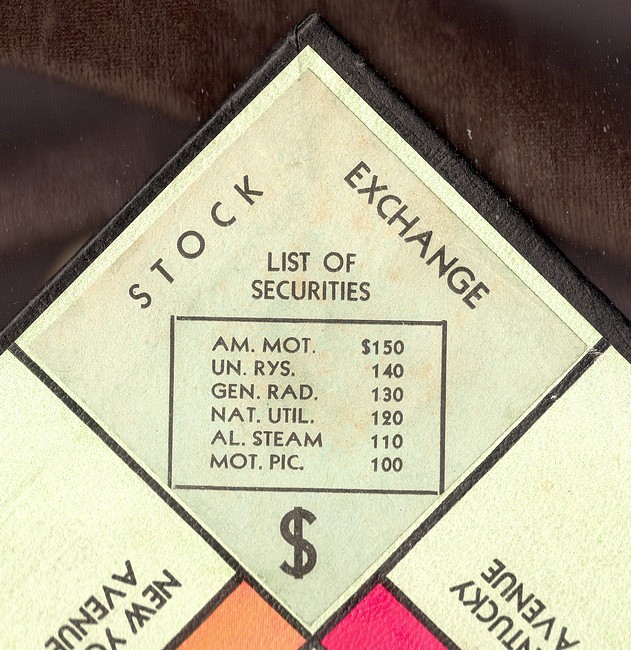
Free Parking becomes the Stock Exchange
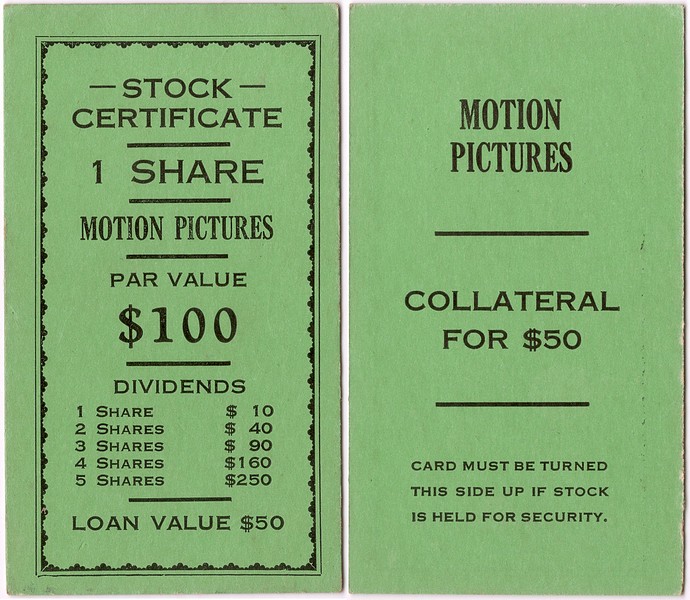
tn-600_StockExchange_100-MP_Obv-Rev

Stock cards

This add-0n brought quite a bit of additional excitement to the game, and a way to generate significant cash above and beyond passing “Go.” As a result, my cousin and I would play games that would span days, breaking the bank, having to borrow money from the game of “Life”, allowing multiple hotels on properties, and generally turning the normally peaceful game of destroying your rivals into an absolute feeding frenzy  of wealth acquisition worthy of today’s Wall Street brokerage companies and scumbag banks like BoA.

There were other games we played as well, like Stratego (wooden pieces) and Blitzkrieg (again Avalon Hill), Candy Land (hated those black dots!),  Go to the Head of the Class, and Chutes and Ladders, but the ones I mentioned above were most frequently brought out and played.

The Old Wolf has spoken.
Saltair, ca. 1900

Saltair-Pavilion-1900

The first Saltair pavilion in Utah, around 1900. Several resorts have borne the name over time.

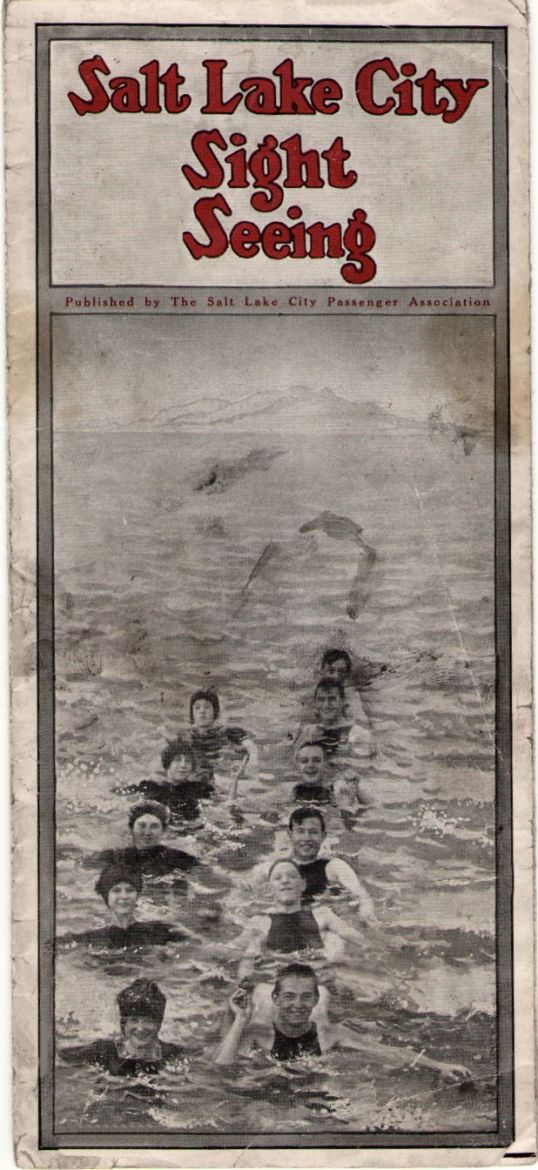
Sightseeing1

“No scenic wonder on the American continent is better known than the Great Salt Lake, “the dead sea of America,” eighty miles long and forty miles wide, lying a short distance west of the city of Salt Lake.
Here above the surface of the briny waves, on great pilings stands famous Saltair – the immense, picturesque pleasure resort, visited annually by hundreds of thousands of tourists from every country in the world.
No stop-over at Salt Lake is complete without a trip to the Dead Sea of the New World – to Saltair where you can float like a cork on the salt-laden waters of the Great Salt Lake. Sink? You can’t!
The waters of the Great Salt Lake contain 22 per cent salt, creating a buoyancy that keeps you on top of the waves without any effort on your part. No bathing anywhere in the world is more healthful, refreshing or invigorating. Every provision has been made for your comfort, pleasure and amusement. A maze of never-ending attractions! Every hour – every minute – something doing at SALTAIR!
Splendid ship cafe; city prices.

Trains every 45 minutes from Saltair depot. Fare, Round trip, 25¢

From the above brochure. Of note: third from front on the right, and fourth from front on the left, are my grandparents – Delbert M. and Frances Rogers Draper. This would date the photo above to around 1912, the date of their marriage.

Saltair

As the Wikipedia article mentions, the resort has had a checkered history, but in its heyday was one of the premier tourist wonders of the nation.

The Old Wolf has spoken.
 

Sunshine Golden Raisin Biscuits – another blast from the past

So I had another Marcel Proust moment last night.

A group of empty nesters had gathered in the home of a neighbor for our weekly Family Home Evening, and our hosts for the week were a delightful couple from the UK. They spread out a groaning board of goodies, chips, dips, cupcakes, fudge, and other treats… and something that caused a massive flashback for me.

Growing up in New York, my mother used to get these little flat biscuits filled with raisins that we simply called “raisin cookies.” I loved them – they were one of my favorite treats as a child. And then in 1969 I moved away from the city and never again thought upon them.

Until last night.

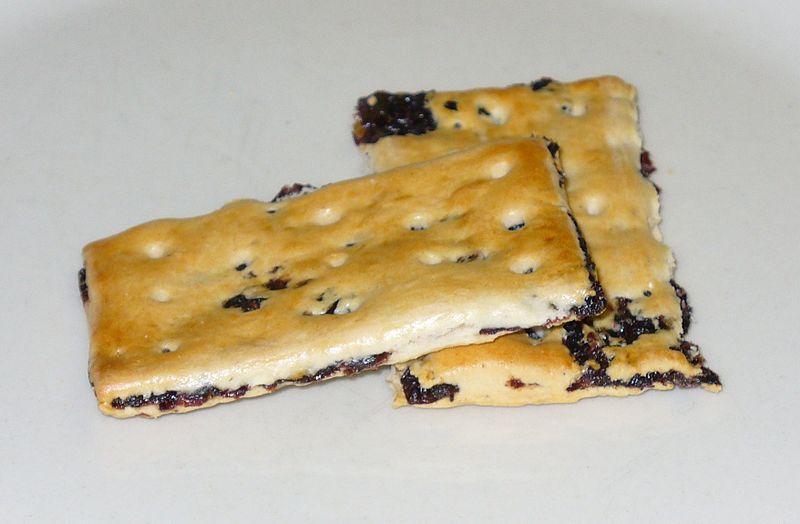
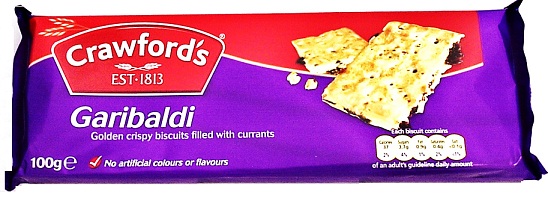
There they were, in all their glory. These were a currant version, but they were the same, the same, the same.

Our hostess graciously gave us a packet to take home, and I discovered they are called Crawford’s Garibaldi biscuits, and have long been a treat in the UK. I mean, long – with a history spanning 150 years.

After re-discovering these, I wondered why I knew of them, and it turns out that Sunshine produced a version of these which it called “Golden Raisin Biscuits.” When Sunshine was acquired by Keebler in 1996, the expanded “Golden Fruit” line was quietly discontinued, but apparently the later incarnation was nothing like the original.

Edit: Kelloggs acquired the Sunshine brand from Keebler in 2000. Pester them about bringing these back.

I’ve found several recipes that purport to be a fairly close approximation of the packaged version, and I’ll try one at some point – but for now, I’m delighted to know that these can still be had.

Now, if I can just convince Sara Lee to bring back their All Butter Frozen Brownies, (scroll down a bit) and get TGI Friday’s to resurrect Rockslide Pie. It astonishes me that there are no pictures out there – based on the number of other people who remember it fondly, I would have thought someone might have captured an image or a vintage menu.

The Old Wolf has spoken.
Reminiscing: My first job

A news article on October 11th, 2010 reported that the Coca-Cola bottling plant in Winona, Minn. filled its last-ever lot of soda bottled in returnable six-and-a-half ounce glass bottles.

Refillable bottles played a big part in my first real job.

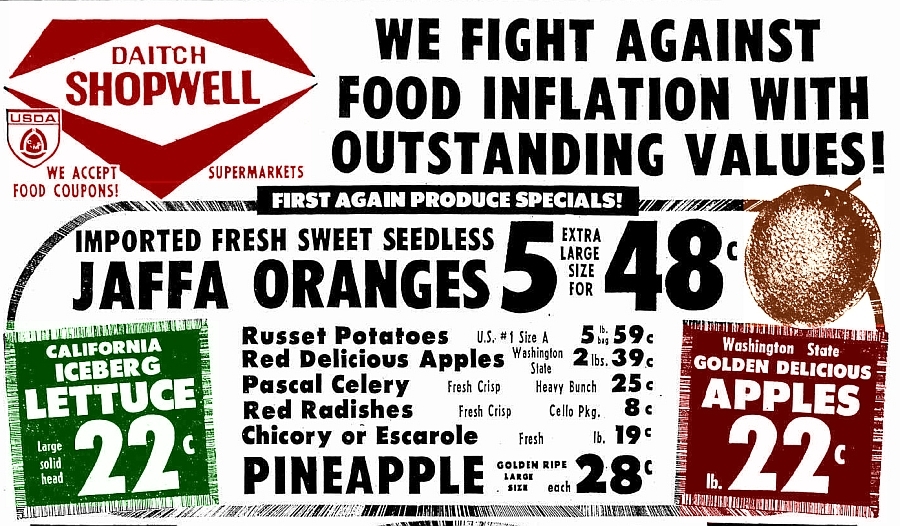
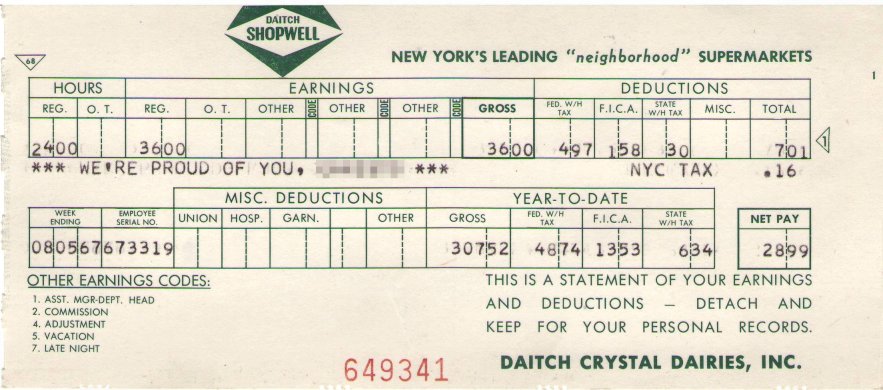
Aside from a few television and movie bit parts that my parents wangled for me (like a Kraft macaroni and cheese commercial, or episode 64 of “Twelve O’Clock High”), I wasn’t gainfully employed until I was 16. At that point, I was hired by the Daitch Shopwell grocery store on 1st Avenue and 58th Street in New York City.

Daitch advertisement from Mar. 4, 1970 – found at Soyo Sunset

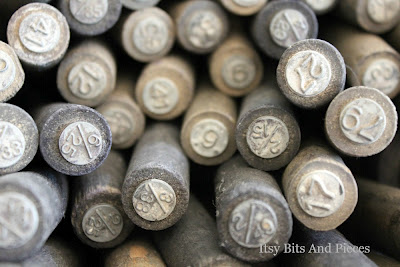
Too young to qualify for cashiering, I functioned as a stock boy on occasion, putting stuff on shelves after stamping them with the prices:


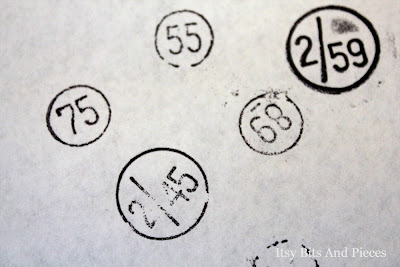
Price stamps – we’d use this purple ink to stamp the tops of cans. These photos found at Itsy Bits and Pieces.

But my main job was driving one of these all around the local vicinity delivering groceries. Mine was gray, but it was the very same beast.

I was a small kid, and these things could get heavy – fortunately, New York doesn’t have a lot of hills. But I recall enjoying the job, because finally I was earning money of my own.

In addition to my salary – a big $1.50 per hour – I’d get tips from the people whose groceries I delivered. In 1966, a quarter was average. Fifty cents was good, and there was one family named Bruff who usually bought four jillionteen gallons of milk, who would invariably tip me a dollar. I got rich that summer, and ended up with a huge jar full of change, which I would scour for additions to my coin collection. You could still find a lot of silver coins in change back then, and buffalo nickels, and the occasional Indian-head penny, so it was a win all the way round. Some folks, however, instead of tipping me in cash, would give me their empty bottles to return for a deposit. At a nickel a shot, four six-packs would net me $1.20 back at the store, so I was always happy to oblige.

Funny the things we think of for no reason. The Daitch chain was aquired by A&P, the store itself has long been something else, but the memories linger…

The Old Wolf has spoken.
Useless products from a bygone era

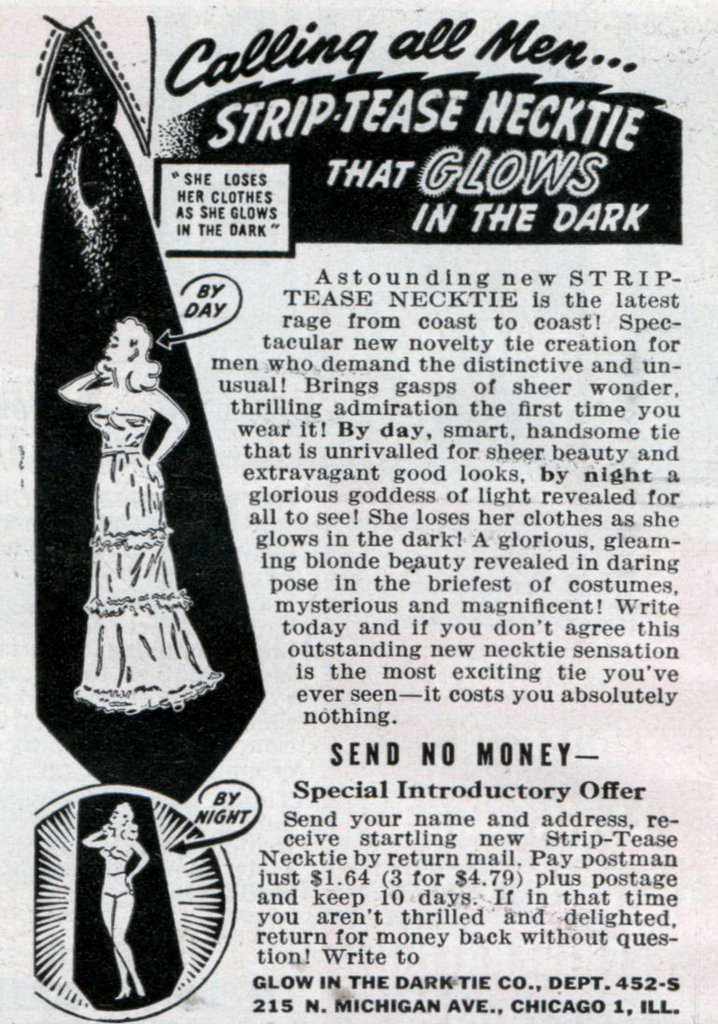
Striptease Tie

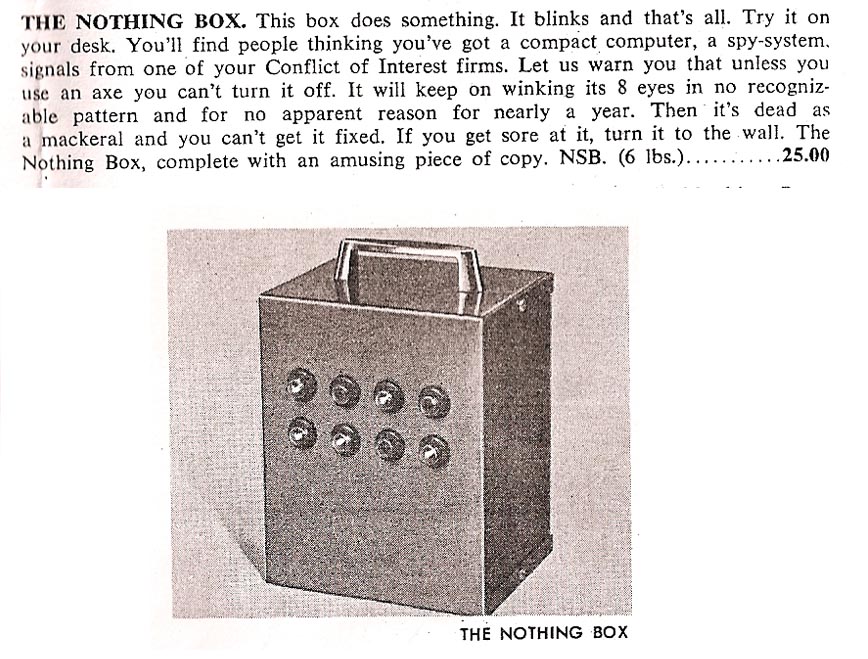
The Nothing Box. I always wanted one of these, but the fact that it died hard after a year put me off.

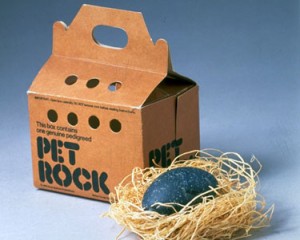
The Pet Rock

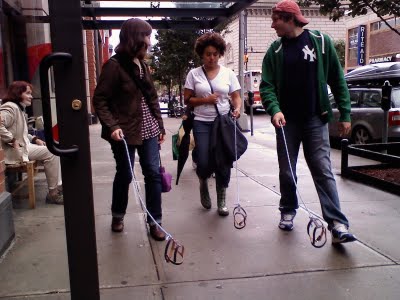
The Invisible Dog – another brilliant idea from the 70’s.

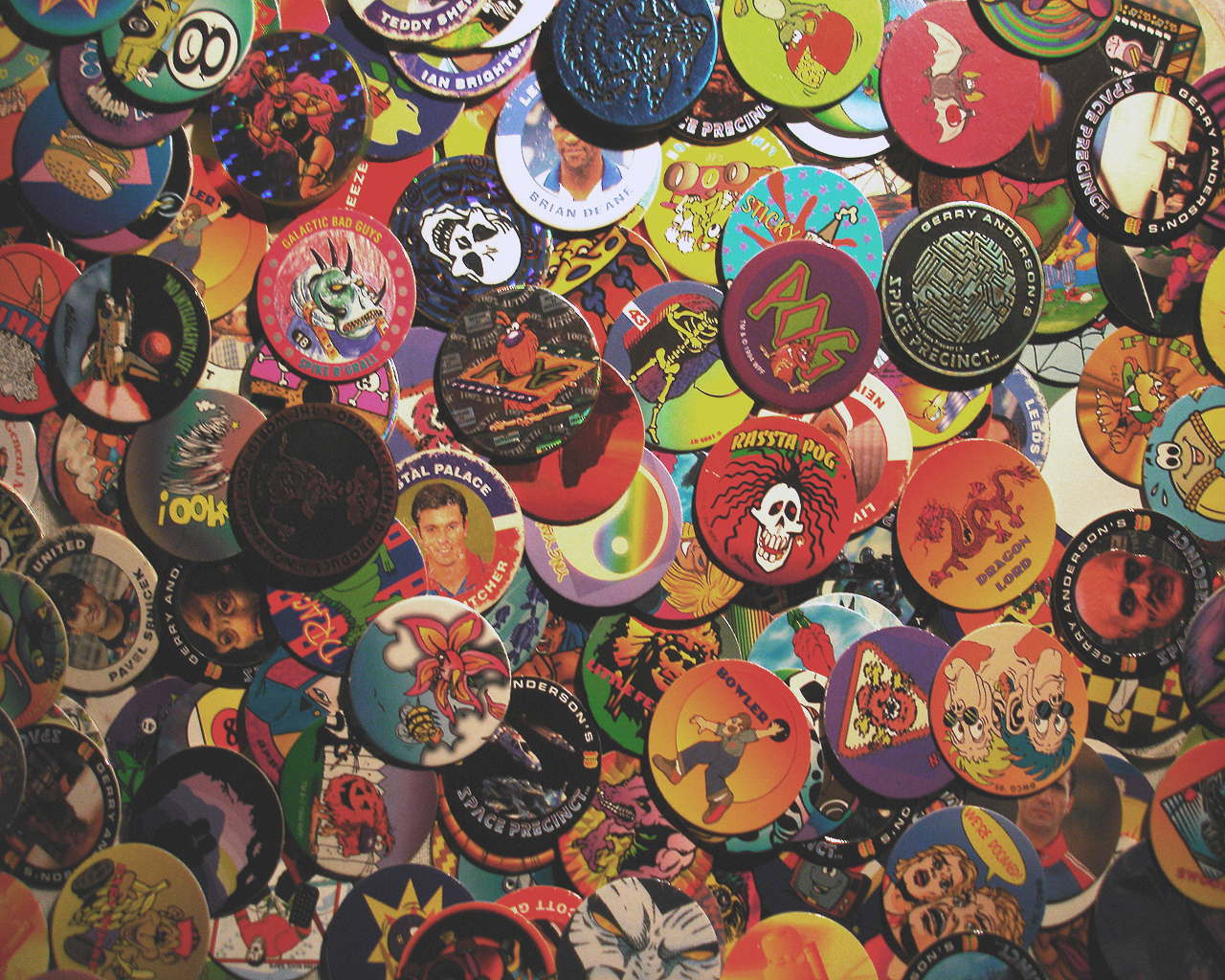
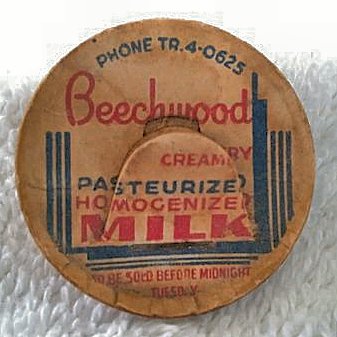
Pogs. Originally the stopper for a glass bottle of milk – today the perfect example of a collecting craze created by marketing and based on nothing. Happily, short-lived.

Original pog.

Reflections on Corn Country

1987 – (Written during a business trip to Northern Illinois University)

Drive for an hour or two west of Chicago and you are in another world; life is different in the corn belt. Corn really does grow as high as an elephant’s eye, and creeps right up to the edges of the roads in endless regiments of green, waving stalks. Stop by the roadside, get out and walk up to it like an impenetrable forest, each stalk strong, tall, with tough, gnarly roots rising up from the rich soil. No sprinklers here; God waters these crops. No fences either; they just don’t seem needed.

Here and there an oasis in reverse, a dry patch among the endless plains of verdure that stretch as far as the eye can see. Places like Malta, Illinois, Pop. 1000. Drive through the center of town and go back in time 50, 60 years. The general store with its 3-stool lunch counter looks like it hasn’t been modernized since 1943. It hasn’t, either. Some of the products on display might have last been paid for with silver dimes and quarters, old silver dimes and quarters. Three men sit playing cards in a corner. They, and the proprietor, belong to the same era. Since he is busy, one of the card players gets up to help me. I feel Gumbyesque, walking through the pages of a prewar novel. Everything here is slow, quiet, peaceful.

Malta, IL – General store, looking exactly the same as it did in 1978. Found at Flickr.

The rest of the shops on the street all seem to have been closed for years, but signs on the doors give the owner’s phone number – trade by appointment. I would have liked to go into the antique store. This whole town is an antique: what forgotten treasures might be found within? Malta’s public library is housed in a small brick cottage with a picket fence, half the size of my first home. Open Tuesdays from 1 to 6 PM, but today is not Tuesday.

The next town down the road is Creston, Pop. 500. They must go into Malta to shop.

On the campus of Northern Illinois Univerity, rabbits hop through the bushes. One of the buildings looks just like Emily Brontë could have lived in it. Where one might expect placards explaining fire escape routes, instead one is told what to do in case of a tornado, and when evening falls, the shrubbery and trees flicker with hundreds of tiny, falling stars: the fireflies which my desert children have never known. In spite of their cold luminescence they impart a warm feeling to the dusky night air.

An invitation to a private viewing of a Burmese art exhibition in the campus museum. In one corner of a room, a Burmese lady is dishing up rice and something which looks vaguely like chop suey for the guests. I have eaten, but cannot resist. Having partaken of glowing coals in sulfuric acid, I retire to my room in the on-campus hotel, wishing I could find some nice bland Szech’uan cooking to quench the fire in my entrails.

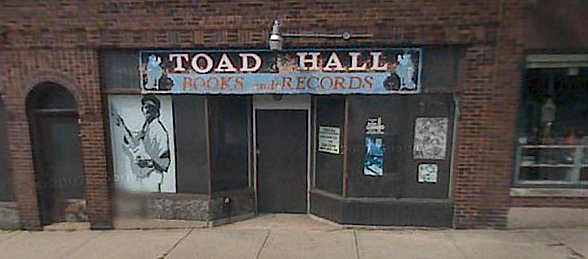
The following day found me at Toad Hall in Rockford, one of my favorite bookstores in the whole wide world. I could happily starve to death there.


I regret only that I don’t have a lifetime to explore and photograph all the beautiful nooks and crannies in this part of our nation.

The Old Wolf has spoken, for no reason.

Almond Soap, Rhapsody in Blue, Marcel Proust, United, and more.

used to fly with United. A lot. This was back in the days when their on-time record was #1, and not in the crapper; before they broke guitars; when I had earned Premier Executive status and was upgraded on a regular basis; and when even coach flyers were treated like valuable customers. I remember flying as an unaccompanied minor in the 50’s and being very well taken care of by the flight attendants.

Sigh.

Those days are gone forever, I fear me.

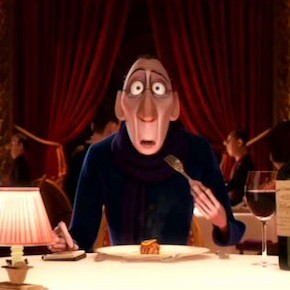
But some memories will linger forever, and come roaring back in an instant, and that’s where Marcel Proust comes in. In Remembrance of Things Past, Proust was instantly transported back to a childhood memory by the taste of a madeleine[1] soaked in tea, an experience which was charmingly riffed on in Pixar’s “Ratatouille”, when Anton Ego’s heart suddenly grew three sizes, spurred by a sudden recollection of a comforting childhood gastronomic memory.

(Brilliantly played by Peter O’Toole)

The senses of taste and smell (inextricably related) are some of the most long-lasting and evocative in terms of memory. I’d be willing to bet almost all of us have had the experience of smelling or tasting something, and instantly being taken back in memory to the time and place where that smell or taste was experienced.

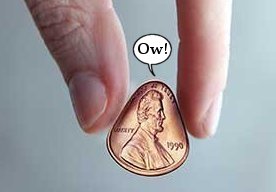
The Goodwoman of the House is a practical soul, and knows how to squeeze a penny so hard that Lincoln begs for mercy:

Some time ago, she bought a large bottle of hand soap to refill our pump dispensers at the sink. It happened to be almond scented. One whiff of that, and I was whisked aboard a United Airlines 777 headed for Frankfurt, because it’s the same scent as what one found in the jetliner lavatories. At the same time, my ears would fill with the strains of Gershwin, because United used Rhapsody in Blue as their theme music for almost the entire ten years when I was traveling around the world extensively.

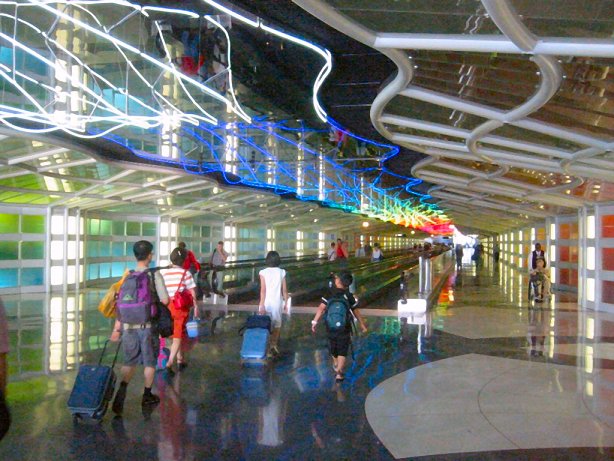
This is the underpass between United’s terminals B and C at O’Hare Airport in Chicago. The psychedelic flashing Neon lights, the tinkling interpretation of Gershwin, and the repetitive nasal voice intoning “The moving walkway is ending… please look down” all come back when I wash my hands, and by the same token I can’t ever hear Rhapsody in Blue without thinking of United. It’s a curse, I suppose, but not the worst one I could have been afflicted with since I’m quite fond of Gershwin.

But I won’t fly United again until they get their act together; I’m not holding my breath.

The Old Wolf has Spoken.


1 If you’re interested in learning how to make Proust’s famous Madeleine’s, visit Cooking with the Old Wolf.