The Old Wolf’s Banquet from Hell

I thought it was time to make another shameless plug for my Banquet from Hell, a collection of foods from around the world that people consider delicacies, but which many people would rather die than eat. A sample below – click through for the entire list.

Haggis

“Fair fa’ your honest, sonsie face,
Great Chieftan o’ the pudding-race!
Aboon them a’ ye tak your place,
Painch, tripe, or thairm:
Weel are ye worthy o’a grace
As lang’s ma airm.”
(Robert Burns)


Haggis

Haggis is the undisputed king of the Banquet from Hell. The fact that it’s composed of things that most people throw away, and cooked inside another thing that everyone throws away, tends to be off-putting.  But if you get to know this beautiful gift from heaven, you’ll thank fortune for the opportunity.Haggis is a blend of oats and sheep’s pluck – liver, heart, and – if you live in the UK – lungs, which are not legal to be used in the USA.  Plus onion, fat, spices, and salt.  While reminiscent of liverwurst in flavor (תודה רבהSol Bock!), it has a unique quality that grows on you.  In America it can be purchased in cans, in vegetarian versions (blasphemy!) or frozen, usually packed in a commercial sausage casing rather than the sheep’s stomach. I understand in the UK it’s a simple matter to get the real thing. Sigh.Wikipedia article on haggis


Take note that there are far more unspeakable things on people’s menus out there – things like Casu Marzu or Chinese Virgin Eggs – those are better left for other blogs. The line between unspeakable and delicious is a very hazy one, but this is my blog, so I get to make the distinction.

Gëzuar!

The Old Wolf has spoken.

Fire and Ice

Some say the world will end in fire,
Some say in ice.
From what I’ve tasted of desire
I hold with those who favor fire.
But if it had to perish twice,
I think I know enough of hate
To say that for destruction ice
Is also great
And would suffice.

-Robert Frost

original

In about 12 billion years, our earth will have indeed perished twice, passed through both fire and ice, and will have been reduced to a burned-out cinder, whether we extend our violence or not[1]. Click through for an intriguing description of what will happen to both earth and sun over time, and how our planet will most likely fare. Hopefully by then humanity will have evolved and migrated elsewhere.

The Old Wolf has spoken.


[1] Klaatu’s speech from “The Day the Earth Stood Still” (1951)

I am leaving soon and you will forgive me if I speak bluntly. (he pauses, studying the faces) The Universe grows smaller every day — and the threat of aggression by any group — anywhere — can no longer be tolerated.

There must be security for all — or no one is secure… This does not mean giving up any freedom except the freedom to act irresponsibly.

Your ancestors knew this when they made laws to govern themselves — and hired policemen to enforce them.

We of the other planets have long accepted this principle. We have an organization for the mutual protection of all planets — and for the complete elimination of aggression. A sort of United Nations on the Planetary level… The test of any such higher authority, of course, is the police force that supports it. For our policemen, we created a race of robots– (indicating Gort) Their function is to patrol the planets — in space ships like this one — and preserve the peace. In matters of aggression we have given them absolute power over us.

At the first sign of violence they act automatically against the aggressor. And the penalty for provoking their action is too terrible to risk.

The result is that we live in peace, without arms or armies, secure in the knowledge that we are free from aggression and war — free to pursue more profitable enterprises. (after a pause) We do not pretend to have achieved perfection — but we do have a system — and it works.

I came here to give you the facts. It is no concern of ours how you run your own planet — but if you threaten to extend your violence, this Earth of yours will be reduced to a burned- out cinder.

Your choice is simple. Join us and live in peace. Or pursue your present course — and face obliteration. We will be waiting for your answer. decision rests with you.

Debunked again: The Vaccine/Autism link

As discussed in my previous post,  once a “fact” has taken hold in the public’s mind, it will most likely live forever in some sectors of the general population.

One particularly egregious – and harmful – example is found in the Vaccination/Autism link, which has long been debunked but which continues to perpetuate itself.

Wrong


Executive Summary: There is no link between vaccinations (particularly thimerosal) and autism. The scare was created by a disreputable doctor, Andrew Wakefield, who was hired as a paid consultant by a law firm who looked to make money from suing vaccine manufacturers. The flawed study was published in Lancet, and later retracted.


It’s a shame that time and energy even needs to be spent on this nonsense.

Here are some links that are worth reading if you have any questions.

1) Journal of Pediatrics: “The Risk of Autism Is Not Increased by “Too Many Vaccines Too Soon

2) Time Magazine: Debunked

“More than any other research, it was a study published in the British medical journal the Lancet in 1998 that helped foster the persisting notion that childhood vaccines can cause autism. On Feb. 2, that flawed study, led by gastroenterologist Dr. Andrew Wakefield, was officially retracted by the journal’s editors… Among other failures, Wakefield neglected to disclose that he was a paid adviser in legal cases involving families suing vaccine manufacturers for harm to their children.”

According to the Huffington Post, Wakefield was stripped of his right to practice medicine in Britain in May of 2010.

3) British Medical Journal: How the case against the MMR vaccine was fixed

In this brilliant and painstakingly documented investigative report, Brian Deer outlines step-by-step how the fraud was perpetuated, and by whom, and for what rea$on.

Do yourself a favor – get your kids vaccinated – failure to do so is resulting in an explosion of measles cases, and as many parents continue to refuse all vaccinations, a resurgence of previously rare diseases is a real possibility.

Edit: As of 2013, the reported number of cases of whooping cough has been declining since last year, but there is still an unacceptable jump in the numbers since 1990 or thereabouts.

The Old Wolf has spoken.

Students: Beware of the FAFSA scam.

Saw this over at Reddit and thought it was worth sharing, especially with so many students filing applications.

FAFSA (http://www.fafsa.ed.gov) is a legitimate government program providing student aid. It is FREE to apply for.’

right

There is another scummy outfit (http://fafsa.com) which charges students a FEE to file an application, which could be done for FREE at the legitimate government website.

wrong

If you are a student, or know one who is applying for federal student aid, direct everyone you know AWAY from fafsa.com.

The Old Wolf has spoken.

“After reading this blog, you’ll think Shakespeare was a penny dreadful hack!”

Yup, that’s a “blurb”. We see them everywhere, but tend to notice them most on movie advertisements. We ignore them or laugh at them, but for better or for worse they influence our consumption habits.

zwei-komplette-romane

Seeing the blurb on this dime store pulp made me chuckle – “damned with faint praise” is the first thing that came to mind. You’d think they might have come up with something a bit more riveting, but what it shows is the absolute necessity in some editor’s mind that a blurb – any blurb – must grace the cover.

The word “blurb” itself was coined by American humorist Gelett Burgess, author of Goops and How to Be Them (you can see a sample here.)

FileGelett_Burgess

Burgess handed out a limited run of his book Are You a Bromide?  to a trade organization dinner, and the dust jacket included this image:

Blurbing

Blurbs are everywhere, and well-known authors are often solicited for blurbs about other books. The New York Times published “Riveting!’: The Quandary of the Book Blurb,” a series of essays on blurbing including a piece by Stephen King; the upshot is that blurbs are a necessary evil, but they can have a certain value. On the other hand, however, sometimes the writers should probably have stayed in bed.

In their famous parody Bored of the Rings, Harvard Lampoon lost no opportunity to make fun of blurbs themselves, publishing this page of blurbs in the front of their book:


“Much have I travelled in the realms of gold, and many goodly states and kingdoms seen; round many western islands have I been, which bards in fealty to Apollo hold. Oft of one wide expanse had I been told, which deep browed Homer ruled as his demesne. Yet never did I breathe its pure serene, till I heard Bored of the Rings speak out loud and bold!…”
JOHN KEATS, Manchester Nightingale

“This book… tremor… Manichean guilt… existential… pleonastic… redundancy…”
ORLANDO DI BISCUIT, Hobnob

“A slightly more liberal reading of the leash-laws would keep books like this off the stands. I don’t know how you’ll fare, but my copy insists on long walks around suppertime, bays at the moon, and has spoiled every sofa cushion in the place,”
WILMOT PROVISO, The Rocky Mountain Literary Round-Up

“0ne of the two or three books…”
FRANK O’PRUSSIA, Dublin Gazette

“Truly a tale for our times … as we hang suspended over the brink on a Ring of our own, threatened by dragons and other evil people, and, like Frito and Good­gulf, fighting a cruel Enemy who will stop at nothing to get his way,”
ANN ALAGGI, The Old Flag

“Extremely interesting from almost every point of view.”
PROFESSOR HAWLEY SMOOT, Oer Loosely Enforced Libel Law! 


Scott Adams, author of Dilbert, sponsored a reader contest to provide a blurb for his book Stick to Drawing Comics, Monkey Brain!; the grand prize winner was Nicolas Feia who came up with this gem:

“‘What a perfect companion for my afternoon milk bath,” I thought while picking up this little gem on my way home from work. Within the hour I had laughed myself into a neck-deep tomb of butter. My wife came in, sipping her eggnog, and topped me with meringue.”

The others, however, are good for a laugh as well.

Anyway,

“Keep reading this blog and you’ll soon see that Mark Twain has met his match!”
SIMPLOT Q. ANALEMMAOn the Rising Value of Badgers, Mushrooms and Snakes in the Modern Commodity Market

The Old Wolf has spoken.

Who can afford this stuff?

The Eclipse

Eclipse

The Eclipse, a yacht whose price tag could well be as high as $1.2 billion, owned by Russian “businessman” Roman Abramovich. Those scare quotes are a deliberate insertion – anyone in Russia with that much money and power, and you wonder how high the pile of skulls is upon which that fortune rests.

skulls

Annual operating costs: $50 million. Fuel cost: $600,000 per tank.

The $100 Million Penthouse

in 1993, Steven Klar paid $4.5 million for a penthouse in Manhattan’s Spire building. He’s since put $5 million into improvements for the 8,000 square foot residence. Now he wants to sell it for $100 million, giving him a modest 800% return on his investment. Who says the rich are getting richer? And greedier? Naah…

cityspire-nyc-penthouse-interior-100-million-dollar-apartment-475x318

A dining area in the penthouse, which occupies the top 3 floors of the building, with 360° views from every floor.

city-spire-nyc-penthouse-100-million-dollar-listing

The Spire Building, showing the top 3 floors which comprise the penthouse.

The Lamborghini Aventador LP700-4

2012-03-07_Motorshow_Geneva_4614-edit

Price tag: betwen  $387,000 and $445,000, depending on whom you talk to. But it comes with everything you’d expect in a car with Lamborghini on the hood. The 700hp V-12 will get you anywhere you want to go, as fast as you dare to drive it. Breaker breaker, got a picture-taker, old smokey’s at 43…

Crespi Hicks Estate

Romanovich’s Yacht makes this home look like a piece of camel ejecta in terms of price, but this property is currently listing for $135,000,000 – the most expensive residence on the market today.

2012-04-21-pic4

The Crespi Hicks Estate

2012-04-21-pic3

Library

42,500 square feet of luxury on 25 acres of wooded land in Dallas, certainly on a par with the luxury mansions of the railroad tycoons of yore. Alas, the real estate market has hit the super-rich as well as the middle class… Forbes estimated this property was worth $1.4 billion in 2008.

The Vertu TI Android Phone

pictures

This phone will run you about $10,000. Of course, it has a titanium case and a “virtually unscratchable” screen, but like the short-lived “I Am Rich” iPhone app, this phone simply screams “Lick my boots, peon!” Good for a high-powered CEO, I guess – the kind that enjoys an annual $145 million bonus for firing 37,000 people.

———-

This kind of money is being spent around the world on a daily basis by the super rich and the ultra-rich. Now, the global economy is much larger than anyone can really imagine; for example, $700 billion (an unimaginable amount of money) would only be sufficient to buy 2 cups of Starbucks every day for a year for every person in Brazil. On the other hand, how many schools would that build or equip in our own country? How much farther would that kind of money go in India, or Pakistan, or Mauritania?

Each of us will someday be held accountable for what we do with our stewardships, either by God or by history, depending on how you look at life.

Just something to think about.

The Old Wolf has spoken.

Naples: “I Bassi”

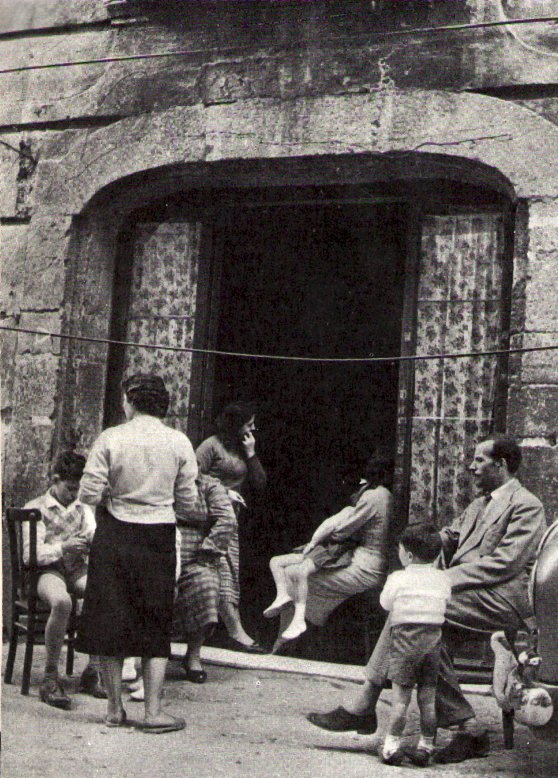
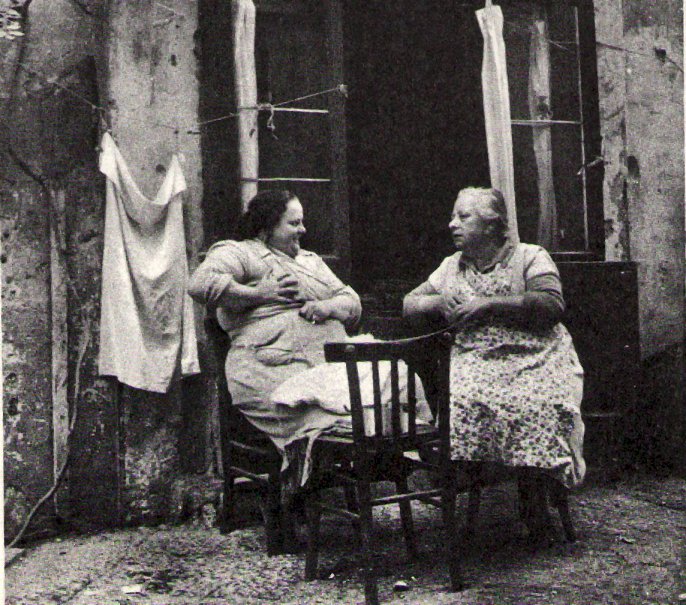
Naples is home to thousands of ground-floor apartments known as “i bassi” or “the ground floors.” They were designed to be garages, storage rooms, or workshops.

Bassi1

“Accanto all’ingresso di ognuno il Comune ha fatto scrivere col mascherino a vernice: “Terraneo non adibibile ad abitazione.” Invece si continua ad “adibire.” I bassi sono ancora migliaia, i loro abitanti decine di migliaia.” (Text and photos from “La Città Parla – Napoli” (1969, Casa Editrice A. Morano di Napoli)

[Beside the entrance of each one, the city has painted, “Ground floor not adaptable for habitation. But people continue to “adapt.” They are thousands in number, and their inhabitants tens of thousands.]

Bassi2

I found this lovely blog post describing them over at “Under the Neapolitan Son“.

I Bassi
Yesterday, I was strolling along with La Bimba in the stroller, when a broom came lunging out of a basso doorway, nearly decapitating me. The broom belongs to a greasy-haired old lady; the basso’s interior, and as far out as she can lean onto the street from her waist-high door, is her domain. The lady has a slightly deranged look in her eye, and a permanently fixed half-smile to go with her permanently fixed house dress. Her smile always broadens when she sees La Bimba. I admit to quickening my pace a bit when she reaches out to touch La Bimba with trembling hand.

Try as I may, I don’t think I can do justice to the basso phenomenon. On the one hand, it’s not so hard to describe: street level housing, ground floor apartments that open onto the street. On the other hand, you need several hands and maybe a foot or two to capture what it means to live in a ground floor apartment in Naples. In the past, I have described it thusly:“Residential in Naples means storefront-level housing called bassi. If you live in a basso, you live half your life on the street. I would say sidewalk, but there are too few sidewalks to mention in Naples. The street is where you set up your laundry rack (the bassi cannot string lines across the street like their upper floor neighbors; they would decapitate passing moped riders), your chairs to sit outside. It’s where you fight with your husband, serve your food in summer, smoke, drink, daydream. Your door is always open because you have no windows. Passers-by know what you’re having for dinner even if they’ve lost their sense of smell, know your favorite TV shows (and sometimes gather round to watch them with you), know the hour you turn down the sheets and get into bed. The bassi are what make Naples the most comic-tragic city in the western world.”
(Note that decaptitation appears twice in this short post. I sense a theme emerging).Many basso inhabitants design their entrances to appear as front doors to country villas. There is latticework replete with climbing vines, potted plants, shrines to the Madonna or Padre Pio or both, shrines to dead relatives, their color glossies curling at the corners, canopies, columns, maybe a little fence. All of this aesthetic care does not, nevertheless, change the fact that when the inhabitant of a basso shakes out her rug, the dust mites hit La Bimba in the face; that when he eats his breakfast, a passer-by can see if the coffee is macchiato or not; that the monthly payments for the giant screen television mounted in the corner of the kitchen cost more than the rent; or that this house is supposed to be a garage, a blacksmith, a print shop.

The basso, along with the motorino, gives Naples its oddness, greatness, stubbornness, Naplesness. No matter how often I complain about it, Naples without the bassi would be just another western European capital, a place that has its physical spaces in all the right places: you shop here, you live there.

Mothers stand cut off at the waist at their Dutch doors like ticket vendors at a state fair, grandmothers hang out their colourful sheets like the welcoming flags of suburban America, fathers scream at their children to not get dirty and to come in for lunch. A woman picks at the pimples on her husbands back. A man drives by on his moped with his dog at the handlebars. Most bassi sit on streets where the sun’s rays do not reach. It is always dark and damp. Still, people are known to smile, and I thank La Bimba for that.

Naples is the city of “adaptability.” People do whatever they can to survive. Creating an apartment out of a ground-floor workshop is small potatoes compared to some of the things that people do there. This phenomenon, however, lends to the city a simultaneous air of creativity, hope, and desperation. Most tourists to Naples will never experience “i bassi,” because most of them are in neighborhoods that no tourist should ever visit, if they value their wallets or their safety. They are found in the alleys.

“Each alley is a self-sufficient microcosm, a kind of clan. “I’m from Pallonetto Santa Lucia.” Or, “I live in Vico Terzo Foglia at Mount Calvary.” And that’s a different world, a different ideology than Vico Secondo Foglia at Mount Calvary.”

Vedi Napoli e poi muori – see Naples and die. This phrase originated during the reign of the Bourbons of Naples, considered by historians to have been the city’s Golden Age. Now, some sarcastically note that it has a different meaning altogether, but if you’re willing to take some normal tourist precautions, there are still beauties to be seen and food to be sampled which cannot be had anywhere else. A sample list is here.

Naples from the Bay 3

The Old Wolf has Spoken

Old_Wolf_Italy

Tipping is not optional

Anyone who has spent any amount of time eating out has encountered the Bastard Server from Hell – a good example can be seen at Not Always Working. When we’re treated poorly, human nature leads us to seek revenge (hence the proliferation of attorneys in our society), and the most obvious way to get back at a poor server is to leave them a small tip, or none at all.

Somewhere in my youth, during a long avocation as magician and prankster (most of that has been packed away in boxes for decades, largely due to lack of time) I collected this little gem:
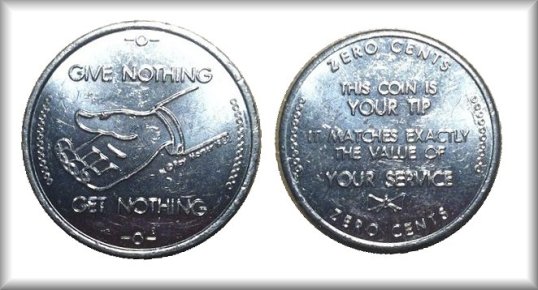
Zero Cents Tip Coin

The coin reads, “Give Nothing – Get Nothing”, and “Zero Cents: This Coin is Your Tip – It Matches Exactly the Value of Your Service”

I thought it was hilarious, and wanted a whole bag full of them. 40 years later, I’m grateful I never left one of these, because I didn’t understand the system.

In the wake of the recent media brouhaha over the sever who was fired from Applebee’s for posting a photo of a customer’s receipt, the individual in question, Chelsea Welch, has posted an essay at The Guardian, talking about her experience and underscoring the inequity of the restaurant compensation system. I repost her thoughts here in full, as they deserve to be seen as widely as possible.


I was a waitress at Applebee’s restaurant in Saint Louis. I was fired Wednesday for posting a picture on Reddit.com of a note a customer left on a bill. I posted it on the web as a light-hearted joke.

This didn’t even happen at my table. The note was left for another server, who allowed me to take a picture of it at the end of the night.

Someone had scribbled on the receipt, “I give God 10%. Why do you get 18?”

I assumed the customer’s signature was illegible, but I quickly started receiving messages containing Facebook profile links and websites, asking me to confirm the identity of the customer. I refused to confirm any of them, and all were incorrect.

I worked with the Reddit moderators to remove any personal information. I wanted to protect the identity of both my fellow server and the customer. I had no intention of starting a witch-hunt or hurting anyone.

Now I’ve been fired.

The person who wrote the note came across an article about it, called the Applebee’s location, and demanded everyone be fired — me, the server who allowed me to take the picture, the manager on duty at the time, the manager not on duty at the time, everyone. It seems I was fired not because Applebee’s was represented poorly, not because I did anything illegal or against company policy, but because I embarrassed this person.

In light of the situation, I would like to make a statement on behalf of wait staff everywhere: We make $3.50 an hour. Most of my paychecks are less than pocket change because I have to pay taxes on the tips I make.

After sharing my tips with hosts, bussers, and bartenders, I make less than $9 an hour on average, before taxes. I am expected to skip bathroom breaks if we are busy. I go hungry all day if I have several busy tables to work. I am expected to work until 1:30am and then come in again at 10:30am to open the restaurant.

I have worked 12-hour double shifts without a chance to even sit down. I am expected to portray a canned personality that has been found to be least offensive to the greatest amount of people. And I am expected to do all of this, every day, and receive change, or even nothing, in return. After all that, I can be fired for “embarrassing” someone, who directly insults his or her server on religious grounds.

In this economy, $3.50 an hour doesn’t cut it. I can’t pay half my bills. Like many, I would love to see a reasonable, non-tip-dependent wage system for service workers like they have in other countries. But the system being flawed is not an excuse for not paying for services rendered.

I need tips to pay my bills. All waiters do. We spend an hour or more of our time befriending you, making you laugh, getting to know you, and making your dining experience the best it can be. We work hard. We care. We deserve to be paid for that.

I am trying to stand up for all of us who work for just a few dollars an hour at places like Applebee’s. Whether a chain steakhouse or a black-tie establishment, tipping is not optional. It is how we get paid.

I posted a picture to make people laugh, but now I want to make a serious point: Things like this happen to servers all the time. People seem to think that the easiest way to save money on a night out is to skip the tip.

I can’t understand why I was fired over this. I was well liked and respected at Applebee’s. My sales were high, my managers had no problems with me, and I was even hoping to move up to management soon. When I posted this, I didn’t represent Applebee’s in a bad light. In fact, I didn’t represent them at all.

I did my best to protect the identity of all parties involved. I didn’t break any specific guidelines in the company handbook – I checked. But because this person got embarrassed that their selfishness was made public, Applebee’s has made it clear that they would rather lose a dedicated employee than an angry customer. That’s a policy I can’t understand.

I am equally baffled about how a religious tithe is in any way related to paying for services at a restaurant. I can understand why someone could be upset with an automatic gratuity. However, it’s a plainly stated Applebee’s policy that a tip is added automatically for parties over eight like the one this customer was part of. I cannot control that kind of tip; it’s done by the computer that the orders are put into. I’ve been stiffed on tips before, but this is the first time I’ve seen the “Big Man” used as reasoning.

Obviously the person who wrote this note wanted it seen by someone. It’s strange that now that the audience is wider than just the server, the person is ashamed.

I have no agenda here. I seek no revenge against the note writer. I have no interest in exposing their identity, and, at this point, I’m not even sure I want my job back. I was just trying to make a joke, but I came home unemployed.

I’ve been waiting tables to save up some money so I could finally go to college, so I could get an education that would qualify me for a job that doesn’t force me to sell my personality for pocket change.

(Note: The last two paragraphs were added by Ms. Welch after the original article was published.)

While this story has garnered immense media attention, my story is not uncommon. Bad tips and harsh notes are all part of the job. People get fired to keep customers happy every day.

As this story has gotten popular, I’ve received inquiries as to where people can send money to support me. As a broke kid trying to get into college, it’s certainly appealing, but I’d really rather you make a difference to your next server. I’d rather you keep that money and that generosity for the next time you eat out.


In her essay, Ms. Welch says “I can’t understand why I was fired over this.” From the perspective of a person in the trenches, one who shows up every day without fail, who puts in obscene hours, and who does their best to deal with the kind of douchebag customers (and managers, and corporations) one encounters at Not Always Right, for a pittance of a base wage and wildly fluctuating tips, it seems grossly unfair.

I reiterate: I’m really sorry Ms. Welch lost her job. In this economy (and I don’t care what the economists or the White House say, this country is still deep in recession), losing a livelihood can be catastrophic. Having put that on the table, there are two main issues here:

  1. Expectation of Privacy, which I dealt with in my previous post, and
  2. The nature of the tipping structure

As a business owner, I have not only Ms. Welch’s perspective but also the one that a corporation must have with regards to its customers. As mentioned in my first essay, the customer was wildly out of line to leave such an insulting and arrogant note for her server, and she is paying a heavy price of her own, having been roundly pilloried in the court of public opinion. But even as inappropriate as the customer was, she had a reasonable expectation of privacy, and Ms. Welch’s actionable offense was to put her company at risk for a lawsuit, not to mention the negative publicity.

The privacy issue aside, every word Ms. Welch wrote about the experience of working in a restaurant is indisputable. So your takeaway here is this:

☛ Never stiff your server! ☚

Notice the large, bold, italic, underscored, and colored text, and the exclamation point and the fists. That’s so you’ll remember: never stiff your server.

Notice what she said: “After sharing my tips with hosts, bussers, and bartenders, I make less than $9 an hour on average, before taxes.” And remember, that the IRS in its wisdom taxes tips based on an expectation that servers are receiving 18%, which is often not the case. So that couple of bucks you leave on the table, and walk out feeling like you’ve done your good deed for the day? Pennies go into your server’s pocket. All my life I’ve tried to tip generously, and I’ve taken flak for it from people along the road, but that has never deterred me. If I can afford to eat out, I can afford a decent tip, and by decent I mean 20% or more if it’s warranted.

So what’s a customer to do if they actually encounter service from Hell? The decent thing to do is leave a tip anyway, because there are a lot of people down the line who weren’t rude or lazy or incompetent, and keep in mind that anyone can have a bad day. That server may have just broken up with a loved one, or suffered a loss, or be absolutely exhausted from working two other jobs – all of which are much more likely than just being downright ignorant. The point is, you don’t know, and by stiffing your server you’re stiffing a lot of other people who worked their tails off to make your dining experience a success. If you really have a legitimate complaint, see management about it, but for the love of Mogg don’t be a douchebag yourself; stay civil. Even the manager doesn’t make enough money to be treated like something you scraped off your shoe.

There’s another essay waiting in the wings about the ethicality of the entire system and the responsibilities of restaurant owners, but that will have to wait – I’ve been teaching for most of the night, and I need to go back to bed for a while.

EDIT: I recently encountered a great article about tipping with some intriguing statistics. Click through to visit Wait But Why.

The Old Wolf has spoken.

PS: Never stiff your server.

Der Rise und Fall of German Publications in the USA (und some odder schtuff too).

According to the Bill Lane Center for the American West at Stanford University, the first German-language publication appeared in the USA in 1732. This number fluctuated at levels under 10 until 1797, when the Pennsylvania Dutch population began to increase, peaking at 626 German-language newspapers available in 1894. Other than Pennsylvania, the largest German populations were centered around New York, Chicago and Milwaukee.

German1

I was born and raised in New York, and spent 9 years living in the heart of Yorkville, Manhattan’s German enclave in the 50’s.

l
136790

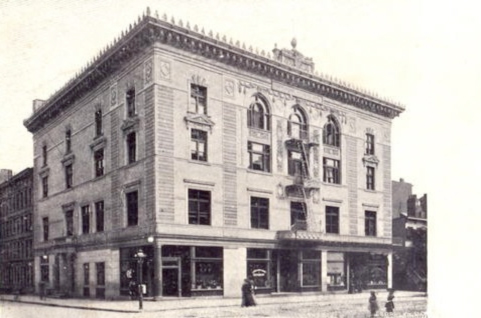
I often remember my mother speaking of Kleine Konditorei, although I have no memory of  ever going there, but there was a Turnverein (gym club) right across the street from our apartment where I went for some gymnastics classes.

turn

The Manhatten Turn Verein building on the corner of 85th and Lexington.

Turn2

I’m not certain if this is the New York location, but the interior looked a lot like this – I remember the rings hanging from the ceiling everywhere.

street

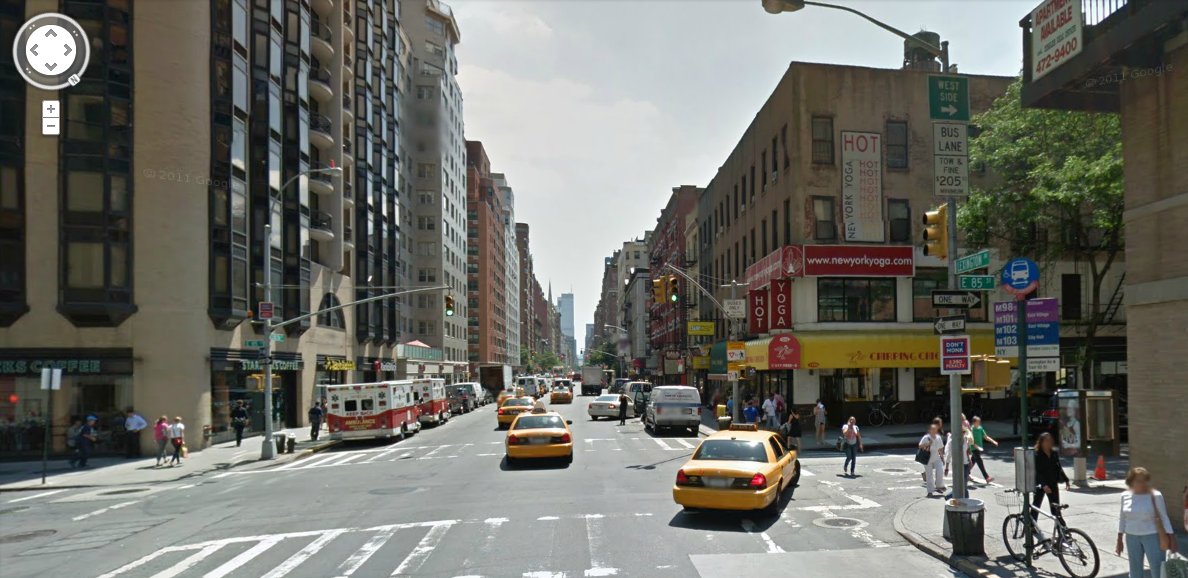
Street view showing my apartment building on the right (my bedroom window is just to the left of the word “Hot”) and the former location of the Turn Verein on the left.

A video recounting the history of the Turn Verein in the United States

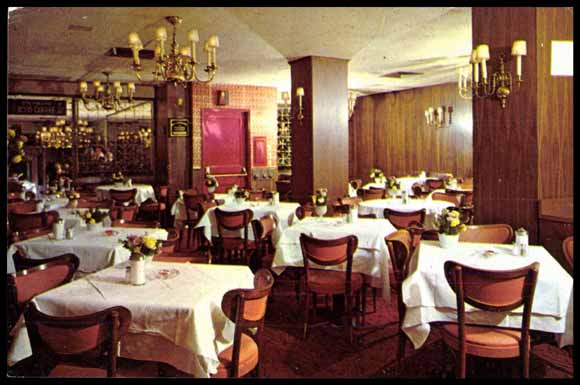
There were also several German shops that I recall, including a deliciously stinky cheese shop. Sadly, rising rents and changing immigration laws tolled the death knell for Germantown, and little is left besides the Schaller and Weber grocery and the Heidelberg restaurant.

Aside from a small, anomalous tick upward in 1945 (not surprising, given world events), the number of German publications declined steadily; in 2011, only 42 publications remained, and surprisingly do not even show up on the 2011 map in the Pennsylvania region.

German2

An animated version of the data created by Dan Chang, Krissy Clark, Yuankai Ge, Geoff McGhee, Yinfeng Qin and Jason Wang shows the rise and fall over time.

http://youtu.be/R-HsTm5ELz0

Edit: As a result of a discussion at a historical New York Facebook page, I gathered up some links that are relevant to the history of the German community in NYC:

https://youtu.be/RJgZCmW2mOghttps://www.6sqft.com/germantown-uncovering-the-german…/

https://www.6sqft.com/kleindeutschland-the-history-of…/

(I still have a book of matches from the Kleine Konditorei).

This website is gone, but it was captured by the Wayback machine – it’s a lovely addition to the history of the area:

https://web.archive.org/…//www.uppereast.com/germantown

A video of memories of 86th street, some modern and some vintage. (Some of the pictures are kind of fuzzy, but it’s a nice look back.)

Der alte Wolf hat gesprochen.

A Hungry Man is At My Door

Cross-posted from Livejournal

Back in 2009, I posted over at Livejournal an entry about Grace Noll Crowell and mentioned that my interest in her had been spurred by a poem that I first read in my high school hymnal, “A Hungry Man is At My Door.”

I had been wanting to find that poem for decades. The advent of the Internet led me to a reference in the index of World Call Magazine, the international magazine for Disciples of Christ – it was published in that periodical in September of 1933.

More digging led me to the Disciples of Christ Historical Society, who – as it turns out – had an archive of that magazine. A phone call led me to a most pleasant archivist who promised to seek out the issue I needed and send me a copy of the poem, and today in my mailbox I found not only the poem, but an extra copy of the entire September 1933 issue.

Miracle! Treasure! Gold-pressed Latinum! All praise to the dedicated archivists who preserve such things, and who are so generous with a casual seeker. I can’t afford a subscription to their membership drive at the moment, but as soon as it becomes possible, it is my intention to show my gratitude in a more substantial manner.

So here, after lo, these many years, is the poem that drove me on my journey of discovery:

A Hungry Man is At My Door
Grace Noll Crowell, in The Christian Advocate

A hungry man is at my door,
What shall I do?
My fire is warm, my loaf is sweet,
And I have you,
Sufficient for my needs… but oh,
The wind is cold.
A hungry man is at my door,
And he is old;
And he is weary, waiting to be fed.
I cannot dine
Until I break in three this loaf
I thought was mine.
I cannot rest beside my fire
Unless I share
Its warmth with him, and find a cloak
That he can wear.
This done — and he upon his way
Along the street —
I find a warmer fire — my loaf
Grown doubly sweet.

It’s no small miracle to me that I remembered as much of the poem as I did, albeit imperfectly. All I can say is that even at that tender and tumultuous age, this simple verse spoke to my heart, and whispered to me of my ultimate purpose, to serve God’s children by raising the human condition.

The poem came more forcefully to mind and prompted me to cross-post this here, because I find myself on the horns of a dilemma at the moment: A hungry child is at my door.

The problem is, the child is an adult – one who has basically been living rough for the last 14 years, ever since leaving home in a ferocious rejection of every value her parents ever espoused.

This young lady is gifted and talented and loves deeply and wants to see good in the world, but lacks the emotional stability to hold down any sort of a job. She wanders the world, sometimes making a bare living with some really kick-ass art skills, other times living on the generosity of friends, or strangers, or just living homeless. I keep thinking she’s hit bottom, but somehow she manages to keep finding new sub-basements, all without having that “aha” moment that spurs other people to clean up their act. In an earlier age, she might have been gathered up and placed in the care of the state – which I wouldn’t object to, because it would mean she’d at least be warm and fed – but our society in its wisdom put a stop to that.

She’s currently in Hawaiʻi (thank God for warm weather!), and apparently gets some assistance from the state down there, but she’s hungry, dammit – and nothing drives a parent crazier than to see a child suffer, even an adult one, even because of lousy choices. Worse, despite having been repeatedly bailed out, she feels lonely and unloved and unwanted, and the sadness around that is unfathomable. Money could be sent, even though I have precious little to send – but it would only be a band-aid, and nothing would change. It’s tearing me apart, and I just don’t know what to do.

Hqiz.