Driving from the Great Salt Lake valley to the Bay Area last year, I chanced to look left as I passed Imlay, Nevada and something I had seen several times out of the corner of my eye on previous trips caught my attention. This time I decided to stop. What I found both shocked and astonished me.
There in the middle of the Nevada desert, at 40° 39’36.35″ N, 118° 07’56.13″ W, sits the Thunder Mountain Monument, a testament to the bizarre vision of David Van Zant, who self-identified as a Creek Indian and began calling himself Chief Rolling Mountain Thunder.

The Thunder Mountain Main House

Main House, Rear Side

Images on the Compound
There is an official Thunder Mountain Website which has a wealth of pictures and information about Chief Rolling Mountain Thunder and his son, Dan Van Zant, who is now the owner and official steward for the monument, but what it lacks is an information sheet which was posted near the entrance. I took the liberty of scanning this and converting it to text, and I present it below, because to me it says more about the spirit behind the monument than anything else I have seen. With the exception of a few spelling corrections, the document is exactly as I first saw it at the monument.
Thunder Mountain Indian Monument
1. What is it?
The most frequently asked question travelers stopped by the sheer oddity of this conglomeration of junk secured by cement is: “What is this?”
This is a very good question as Thunder Mountain is odd and strange looking. This question is the best question anyone could ask, as the answer is the reason for its existence. Why would anyone spend their retirement years working from daylight to dark seven days a week to build what many view as blight on the landscape?
This is a Monument to the suffering and plight of the American Indians. The next question is usually:
2. Why Did He Build It? (Thunder Mountain Monument)
The answer that I give everyone who asks this question is probably incomplete in that it can only be partially understood after gaining insight into the passion and motivation behind the artist who built this Monument.
Thunder Mountain Indian Monument was built by Chief Rolling Mountain Thunder as a Monument to the suffering and the plight of the American Indian at the hand of the White invaders. (Note: I emphasize invader and not settler). The Monument was built to be a reminder to all who visit of the price that was paid by a race of people who were marked for genocide in the name of ”Manifest Destiny.” Close inspection of the Monument will reveal over 200 sculptures that will depict Indians of all tribes, age, status and sex. You will see in side the double walls a sculpture of a settler that is shooting an Indian woman. You will see the cumulative years of agony and despair on the faces of the old Indian Chiefs. You will see the misery in the faces of the Indian little children. You will experience the arrogance on the part of the White Invader that they were a superior race predestined by their God to kill and destroy another race of human beings. Many of the invaders as in the days of the great crusades in Europe justified their indiscriminate murders in the name of their God. The predominate justification for this wholesale genocide was “If these savages can’t be converted to Christianity then they need to die.”
White Man’s Trash:
The Monument is build from a collage of cast off items that would be described by white society as junk. This “junk” was collected in a radius of 50 miles of the Monument. In the Indian culture they utilized everything that was provide to them by the Great Spirit. What the Great Spirit provided Chief Rolling Thunder in building the Monument was “White Man’s Trash.” It should be noted that Chief Rolling Thunder didn’t have the money to buy materials so he used what he could find. The only material that was purchased was cement. Thunder is also making a strong ecological statement in that we are polluting our planet with cast away items. I find it ironic that the same people who would like to see Thunder Mountain destroyed, claiming that it is an eyesore, are the same people who polluted the landscape with their junk and trash. (White Man’s Trash)
- Old car parts
- Bottles
- Windows made from car windows
- Discarded typewriter
- Much more
These critics were around when Thunder was building the Monument and they are still around today. These are also the same people who, instead of appreciating the powerful statement and the artwork, would vandalize and destroy.
More White Man’s Trash:
The Monument to the American Indians is intended to tell a story of their suffering in the wake of 400 years of persecution and genocide. The attitude of the white European invaders is also evidence of “White Man’s Trash.” This could also be described in a biblical manner as “The human condition” which, it is obvious, the early Christian invaders failed to recognize in themselves.
- Hate
- Attitude of superior intellect
- Disrespect for human life
- Arrogance
It is obvious that the White invaders’ attitude was that their religion was better and that they were doing the will of God. This is justification for their evil? (Read the book Manifest Destiny). This land that was provided to them by God and it was their right to take it by any means possible.
Genocide is White Man’s Trash:
I realize there are many people who will say “come on now, maybe the Indians got a raw deal but it wasn’t genocide.”
The definition of genocide is the systematic extermination of a race of people.
Just look at the similarities between Nazi and the White European invaders and judge for yourself.
- Both felt they were justified as superior human beings
- 6 Million Jew exterminated 12 Million Indians exterminated .
- Both had concentration camps ( What would you call a Indian reservation)
- Jews and Indians were de-humanized
- Poison food was used on the Jew and the Indians
- Starvation was used to control
- Jews had their property confiscated as did the Indians
- Sterilization of Indian women
- Germ warfare was used on the Jews and the Indians (Indians were given blankets with smallpox which killed millions.) A quote from Colonel Henry Bouquet at Fort Pitt is: “You will do well to try to inoculate the Indians with smallpox by means of blanket, as well as to try every other method, that can serve to extirpate this execrable race!“
- Both the Nazis and the European invaders had slogans as justification for murder:
- Nazis – “Nits Make Lice.”
- European invader – “The only good injun is a dead injun.”
To call what was done to the American Indians anything less than genocide is like the Germans trying to deny the holocaust.
Indian Genocide Reminders:
All anyone needs to do is to read the account of just a few of the massacres:
- Sand Creek Colorado 1864
- Wounded Knee
3. How long did it take to build the Monument?
This is a frequently asked question and when my Father (Rolling Mountain Thunder) was asked this, he would often reply “It will never be finished. It is an ongoing work and after I’m gone someone else may finish it.” However, the work on the Monument started in 1968 and continued for 7 years until 1975. Work on the other buildings would continue from 1975 until 1983.
4. What happened in 1983 that made him stop building?
There was an arson fire that burned the 3 story Hostel and Indian school to the ground. This fire also destroyed two cabins, a 40′ by 60′ work shop, a visitor’s center bath house and an underground sweat house. The buildings standing today which were spared are:
- The Main Monument Building
- Round House
- Chicken House
5. Did Rolling Thunder Build the Monument alone?
Thunder was the artist and the architect but he had a lot of help with the labor involved. His children and wife helped with the gathering of materials, the mixing and carrying of the cement. He also received some help from hippies that would stop and stay for a day or some times weeks. Two people stayed for as many as 5 years. I only recall the first names. One was a very quiet and hard-working young man named Dale. The other was an outgoing and friendly young girl of about 20. (I think she was called Tomat). Visitors were allowed to participate in the construction effort and Thunder would provide food for those who would work. He had some basic rules that if not followed would result in being asked to leave. The rules were:
- Show respect one for another
- No drugs allowed
- No open sex
- If you don’t work, you don’t eat
There are many stories about people who created problems and how Thunder dealt with these people.
6. Was Thunder a Spiritual or Religious Man?
This question is often asked after people have looked at the art work. It is obvious that Thunder had a deep belief in a higher power when you read some of the many writings scrawled on the walls and grounds.
Thunder didn’t like traditional organized religion and often had negative things to say about traditional Christian organizations.
This I believe is because he saw how the Indians were treated in the name of Christianity. Thunder had is own brand of spirituality and often referred to the Great Spirit or Mother Earth.
7. Can We See The Inside of The Monument?
The inside of the Monument is not open to the public at this time. This is due to the unsafe nature of the building. We have pictures of the inside of the Monument on our web site by Peggy Pontenot that will provide you with a sense of what is inside the Monument. Most of the art work is visible from the outside. Thunder and his family lived inside the Monument so it was never intended for visitors to come inside.
8. Who Owns Thunder Mountain Monument?
Often people think that the Monument is owned by the State of Nevada. Actually, Thunder Mountain is a State of Nevada Historical site but that is the only connection with the State of Nevada.
This property is owned by Thunder’s oldest son Daniel Van Zant, a 65 year old retired supermarket account executive from California.
9. Who Maintains The Monument?
The Monument is maintained through the free will donations of the visitors to the Monument and volunteers.
10. What Is The Future For Thunder Mountain Monument?
If you were to ask Rolling Mountain Thunder this question I would suspect his answer to be that it is in the hands of the Great Spirit. It is the hope and desire of the family of Thunder that the Monument is preserved and continues to be open to the general public. The family continues to investigate ways to accomplish this objective.
11. Where Can I Get More Information On Thunder Mountain?
You may learn more about Thunder Mountain by researching the Thunder Mountain website at www.thundermountainMonument.com
You may also contact Dan Van Zant with your questions.
Dan Van Zant
9570 Swede Creek Road
Palo Cedro, CA 96073
Email: dvanzant@frontier.com
Was Van Zant a Native American? There is no way of telling for certain at this point, but his spirit was in tune with the realities of history, and so to me his ancestry is irrelevant. The monument he created is rustic and crude in the extreme, yet it conveys a powerful sense of the indescribable indignity that was perpetrated upon the autochthones by the arriving Europeans. Whether they were settlers or invaders depends on which side you talk to; since the white man came rolling across the land in waves more numerous than the sands of the sea or the stars of the sky, they were the ones who wrote the histories, and we who dwell here now give very little thought to the plight of the surviving natives.
It is, when one looks at it from a human standpoint (and not seen through a lens of money, power, weapons, or “manifest destiny,”) an insult so great as to make it impossible to repair; what can be done about it, or what should be done about it at this point in history, is a bedeviling question, one which most inhabitants of this continent avoid answering by the convenient device of not bothering to think about it.
Visit this monument and you will find it impossible not to think about. On one of my previous trips across country, I returned home by way of a friend’s home in North Dakota, and took the opportunity to drop down and visit Devil’s Tower.
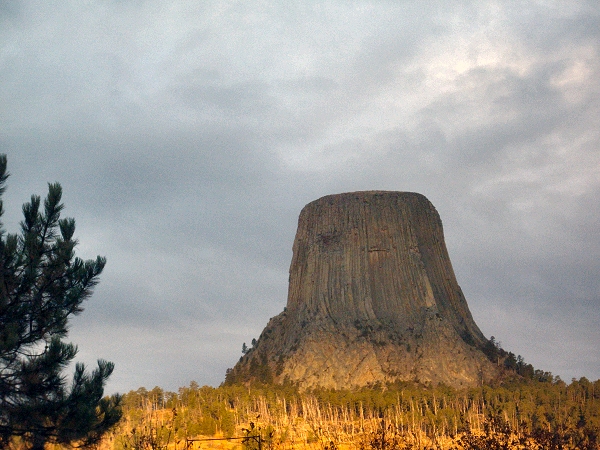
Devil’s Tower in the Sunrise
As I walked around the tower, feeling its walls and connecting with its massiveness, I was strongly impressed that I was on sacred ground; the many medicine bundles tied to tree branches around the base of the formation bear witness to the fact that it is still considered a holy place to many natives who still live in the area; the prayer bundles and flags represent the colors of the four cardinal directions as well as Mother Earth and Father Sky. In a very real sense, Thunder Mountain is also sacred ground, and it moved and pestered and disturbed me as I considered the message which can be read there by those with eyes to see and hearts to feel.
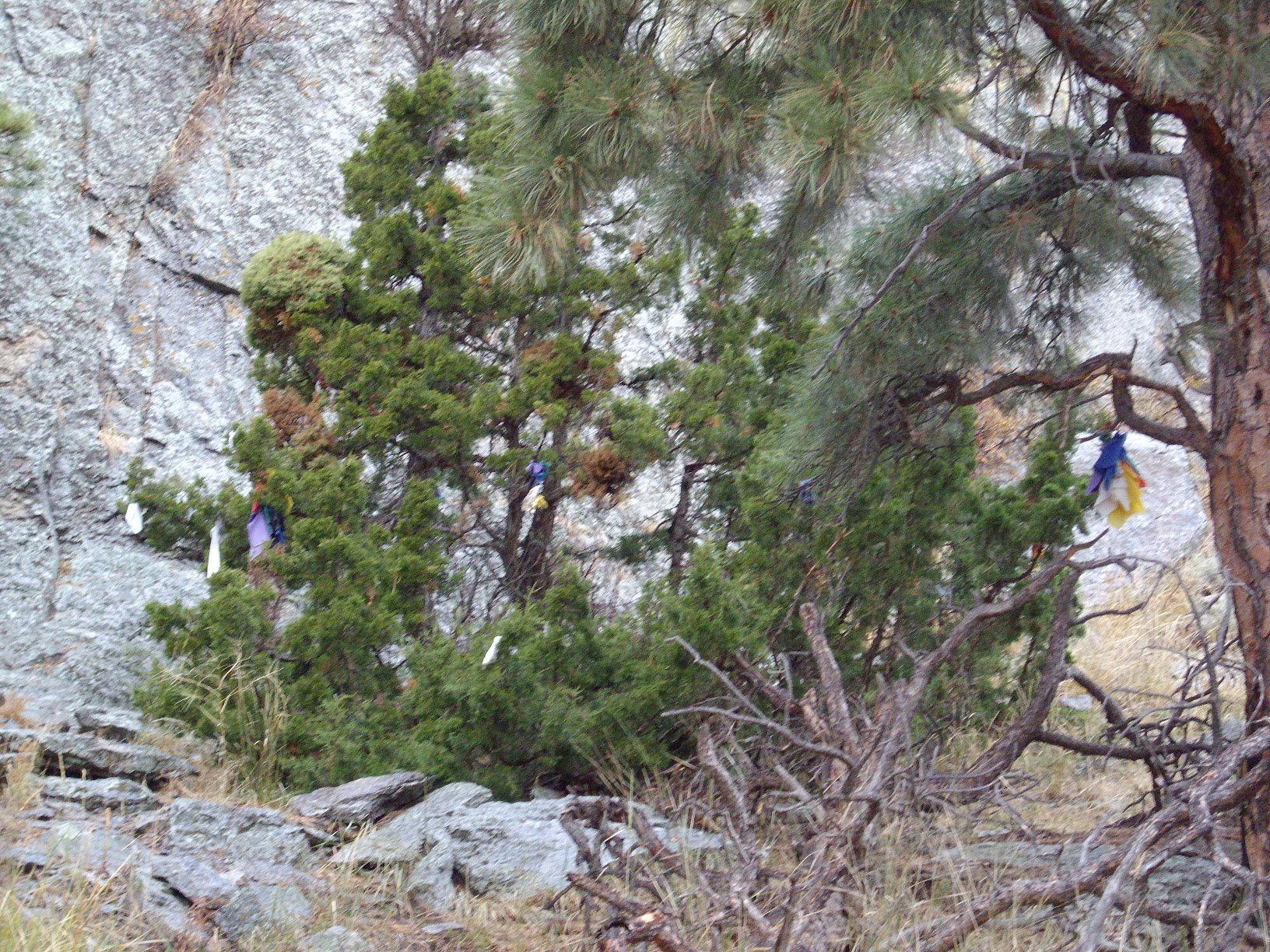
Medicine bundles
As Americans, the descendants of those who swept the natives off the land, we love movies like Dances with Wolves and Jeremiah Johnson, and we cluck our tongues with disapproval at the injustice, and then go home to our comfortable houses, never thinking again of the squalor, unemployment, alcoholism, despair, disenfranchisement and hopelessness that reigns supreme on the res. While some tribes have turned to operating casinos as a means of generating income, even that is a second-class enterprise, bringing with it the social ills associated with the gaming industry and of dubious benefit in the long run. By dint of army interventions, massacres, and an endless stream of broken treaties, the original inhabitants of North America (the South is another story altogether) were raped, and raped, and raped again.
Sunisup.tumblr.com posted a riveting animated gif file which shows the reduction in native landholdings over time, which I have brazenly stolen.

Quoted from the same blog:
“For those who do prefer dealing in numbers, here are some:
By 1881, Indian landholdings in the United States had plummeted to 156 million acres. By 1934, only about 50 million acres remained (an area the size of Idaho and Washington) as a result of the General Allotment Act* of 1887. During World War II, the government took 500,000 more acres for military use. Over one hundred tribes, bands, and Rancherias relinquished their lands under various acts of Congress during the termination era of the 1950s.
By 1955, the indigenous land base had shrunk to just 2.3 percent of its original size.
—In the Courts of the Conqueror by Walter Echo-Hawk”
The first and last frames of the animation, static for comparison:


Although an accurate census was impossible, reasonable estimates put the native population of the USA before the Europeans arrived in the vicinity of 12 million or more. by the 1800’s, that number was down 95% to around 250,000. The Jewish holocaust destroyed around 2/3 of the European population, and is universally regarded as genocide. Although the destruction of the United States indigenous population took 4 centuries to accomplish, the numbers are staggeringly worse, and yet many people still hesitate to use the word genocide to describe what took place here. Everyone laments the loss of thundering herds of bison numbered in the millions; no one seems to care about the human destruction that was taking place simultaneously.
The annexation of the land was ultimately the destruction of nations. The land was their mother, their father, their grocery store, their playground, and the source of their spiritual strength. Assimilation was impossible because of the nature of their culture. The white man didn’t even want the natives for labor, as they did the Africans – they just wanted them dead. In the end, that’s exactly what they got, and ceded to the remainder, for the most part, tiny patches of land barely capable of supporting a hunter-gatherer culture.

Early Indian Tribes, Culture Areas, and Linguistic Stocks (Click to enlarge)
Every tribe lost was a culture, and a language, and a way of looking at the universe. In the end, the losses to humanity were incalculable.
Moving Forward
While it’s fine to participate in intellectual exercises, the question remains: what is the right thing to do now, in the 21st century? The Indian fighters and mountain men are gone, the country has been claimed from coast to coast in the name of the crown, or of God, or of the Republic, those who are alive today are generations removed from the perpetrators of the genocide, and those who have been living here for hundreds of years also have rights. The best solution of all – something like Columbus and his crew’s arriving on Western shores, only to say “Oh, sorry! We didn’t know anyone was living here!” and going straight back home – is unfortunately not possible, except in the realm of Orson Scott Card’s Pastwatch (a phenomenal read, if you’re interested).
We can’t go back; every white settler who has come here, and their descendants, can’t just pack up and go home, and give the land back to the tribes. Not being a sociologist, I’m not even sure what the right thing to do for the remainder of the once-numerous peoples might be. But I am sure of a few things.
More needs to be done, in the name of humanity.
- We who claimed this land are responsible for the reduced economic and educational and spiritual status of our natives, and we owe them a hell of a lot more than they’re getting. While things are far from perfect, much has been done over the last 5 decades to lift the African population from second-class status, but now, as then, the Native Americans continue to be relatively invisible on society’s radar, and that’s not right.
- We need to educate a new generation of human beings from the cradle up: bold, ethical leaders who will work to build a world that works, in the words of R. Buckminster Fuller, “for 100% of humanity, in the shortest possible time, through spontaneous cooperation, without ecological offense or the disadvantage of anyone.” This is not pie in the sky; it’s possible. It may take another 3 centuries to achieve, but it needs to happen, and if we do nothing now it never will. We owe it to those who have gone before, and we owe it to our posterity. Such a world is my most pressing dream, and the reason that I am working to establish The Academy of Greatness. If anyone is able to repair the damage to the indigenous population and other small populations who were oppressed or destroyed by a larger, it will be people like this.
Šuŋgmánitu Tȟaŋka Tanika (The Old Wolf) has spoken.














 Playing in the World Game