The fine line between fake and cool

A post on George Takei’s Facebook feed displayed this photo of Earth and two other planets seen from the surface of Mars, purportedly taken from one of the rovers up there.
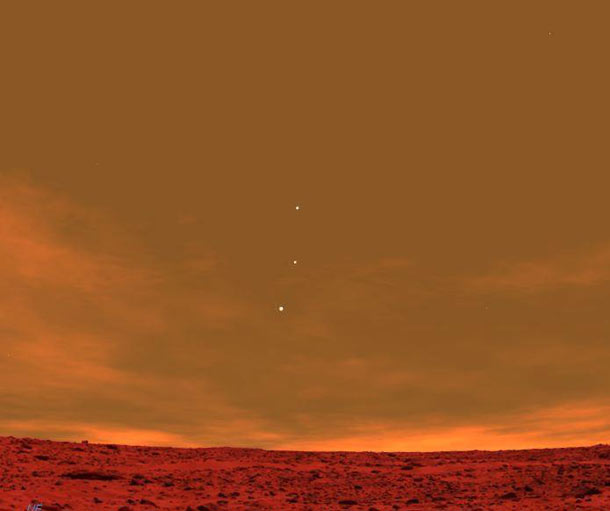
The one on Takei’s feed had an arrow pointing to the lower dot which said, “You are here.”

It’s a pretty picture, but my BS bells went off because there’s just something “off” about the photo, specifically those clouds and the fact that the three dots are the only things visible in the sky.

By the time I saw this, the post had gathered over 2,000 comments, and a brief perusal led me to this post over at Discover, which explains that the image is a computer-generated “planetarium” scene, as witnessed by the little “NE” in the lower left hand corner of the screen.

Sweetly enough, the article also posted this picture…

… which is a real picture, “the first image ever taken of Earth from the surface of a planet beyond the Moon. It was taken by the Mars Exploration Rover Spirit one hour before sunrise on the 63rd Martian day, or sol, of its mission. (March 8, 2004).” Found at NASA’s Flickr Feed, where you can read more information about the shot.

The tiny speck put me immediately in mind of the now-iconic photo of Earth taken by Voyager 1 as it was leaving the earth.
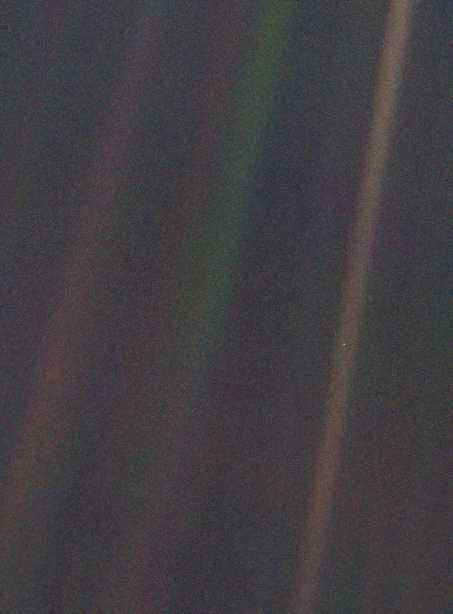
Astronomer Carl Sagan had requested NASA to point Voyager’s cameras back toward home, and this was the resulting image.

In his book Pale Blue Dot: A Vision of the Human Future in Space, astronomer Carl Sagan related his thoughts on a deeper meaning of the photograph:

From this distant vantage point, the Earth might not seem of any particular interest. But for us, it’s different. Consider again that dot. That’s here. That’s home. That’s us. On it everyone you love, everyone you know, everyone you ever heard of, every human being who ever was, lived out their lives. The aggregate of our joy and suffering, thousands of confident religions, ideologies, and economic doctrines, every hunter and forager, every hero and coward, every creator and destroyer of civilization, every king and peasant, every young couple in love, every mother and father, hopeful child, inventor and explorer, every teacher of morals, every corrupt politician, every “superstar,” every “supreme leader,” every saint and sinner in the history of our species lived there – on a mote of dust suspended in a sunbeam.

The Earth is a very small stage in a vast cosmic arena. Think of the rivers of blood spilled by all those generals and emperors so that in glory and triumph they could become the momentary masters of a fraction of a dot. Think of the endless cruelties visited by the inhabitants of one corner of this pixel on the scarcely distinguishable inhabitants of some other corner. How frequent their misunderstandings, how eager they are to kill one another, how fervent their hatreds. Our posturings, our imagined self-importance, the delusion that we have some privileged position in the universe, are challenged by this point of pale light. Our planet is a lonely speck in the great enveloping cosmic dark. In our obscurity – in all this vastness – there is no hint that help will come from elsewhere to save us from ourselves. The Earth is the only world known, so far, to harbor life. There is nowhere else, at least in the near future, to which our species could migrate. Visit, yes. Settle, not yet. Like it or not, for the moment, the Earth is where we make our stand. It has been said that astronomy is a humbling and character-building experience. There is perhaps no better demonstration of the folly of human conceits than this distant image of our tiny world. To me, it underscores our responsibility to deal more kindly with one another and to preserve and cherish the pale blue dot, the only home we’ve ever known.

—Carl Sagan, Pale Blue Dot: A Vision of the Human Future in Space, 1997 reprint, pp. xv–xvi

This quote, and much additional information about the photo and how it was taken, was found at Wikipedia. I had seen the picture and read the quote before, but it never ceases to move me.

Confession: I can’t do higher math.[1] I always wanted to be a doctor, but calculus put a rapid end to that dream, because you need calculus for the pre-med Chemistry degree and screw whole bunches of that, with apologies and honor and homage to my freshman chem teacher, Dr. Alex T. Rowland of Gettysburg College, a good man and a fine professor. But I’ve always loved science, and have stood in awe of the glory and majesty and miracle of the universe from its largest expanses to its smallest bits and pieces. I think I owe that love of science to the hours and hours my mother spent allowing me to roam the halls of the Hayden[2] Planetarium and the Museum of Natural History.


Publicity shots for “Pepper Young’s Wife”, TV-Radio Mirror, March 1957

I loved that rocket – it was in a darkened room, and each section was illuminated by a different color. The fuel chamber had a deep, red glow and I could stare at it for hours. This was one of my favorite books. Alas, my inability to comprehend the fine points of differentiation meant that I had to spend my life as a linguist and not as a scientist, but the love of understanding our world, from the quantum to the cosmic scale, never left me. All I can do is peep through the keyhole to where the big boys and girls are playing, and hope to understand as much as I can from there.

Years ago I happened across a copy of Powers of Ten,  a companion volume to two films of the same name which were based on the book Cosmic View (1957) by Dutch educator Kees Boeke.

Later, this map of the known universe from National Geographic served to pretty much bork my mind out completely.

Trouble is, it doesn’t stop there.
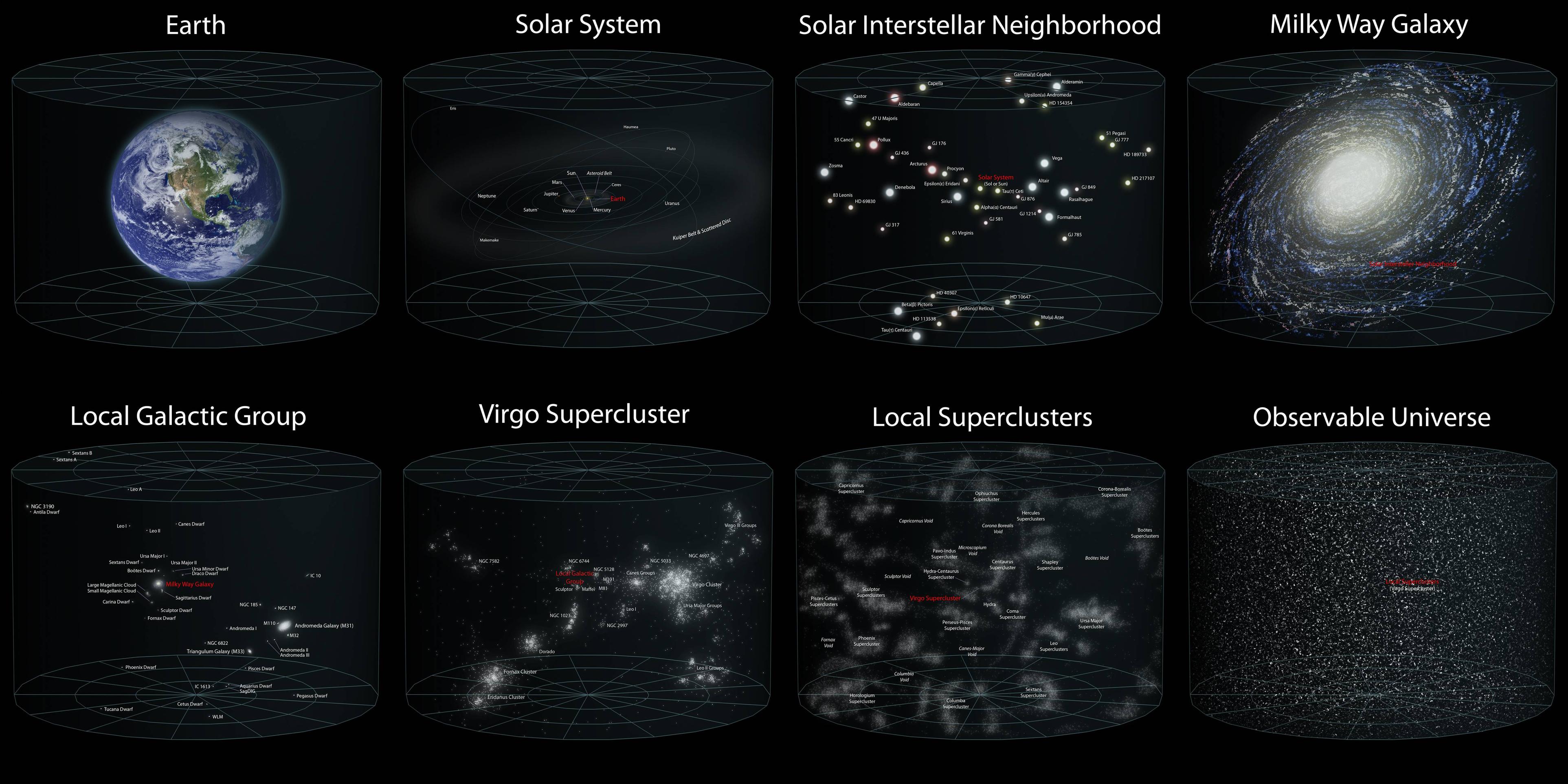
I posted the above map earlier, along with a photo of Hubbles ultra-deep field image, and just recently came across this mind-bending video done by the folks at NASA/ESA:

The animations were based on the red-shift values of the various galaxies captured in the image. The thing is, that is by no means all of it – it’s only the part we were able to capture with our rather primitive (albeit wonderful) instruments.

So what is our place in the universe? Scientists will be grappling with that question for as long as man continues to be relevant. The president of my church, Thomas S. Monson, said in 2001, ” I acknowledge that I do not understand the processes of creation, but I accept the fact of it.” Taken in the context of the rest of his quotation, this has been interpreted by some to mean that we should reject science in favor of faith. I do not see it that way. The miracle of creation, in all its massive and miniscule glory, is before me, and I must accept the fact of it. But another fact remains: for all we know, we know virtually nothing. As tiny as the pale blue dot is in the immeasurably vast universe, so is all our scientific knowledge in the face of all there is to be known. I believe firmly that we do have a purpose and a place in all the vastness, and that purpose is to raise the human condition, to make life better in all possible ways for ourselves and for all whom we encounter. This is sufficient for me. In the words of Hillel, “the rest is commentary.”

And all this because of a single “fake” picture posted on George Takei’s Facebook feed. Thanks, George.

The Old Wolf has spoken.


1Just because I can’t do math doesn’t mean I can’t appreciate it.

A mathematical friend of mine assures me that this equation evaluates to ⅓. I couldn’t say for the two crore question, but I’ll never forget how to write it. See, it’s a limerick, and limericks I can remember. All of them. Darnit.

“Integral zee squared dee zee
From one to the cube root of three
Times the cosine
Of three π over nine
Equals log of the cube root of e.”

[2]With thanks for the correction to Haydn Rawlinson, who apparently knows not only how his own name is spelled but also the Planetarium’s.
Times Square, Then and Now

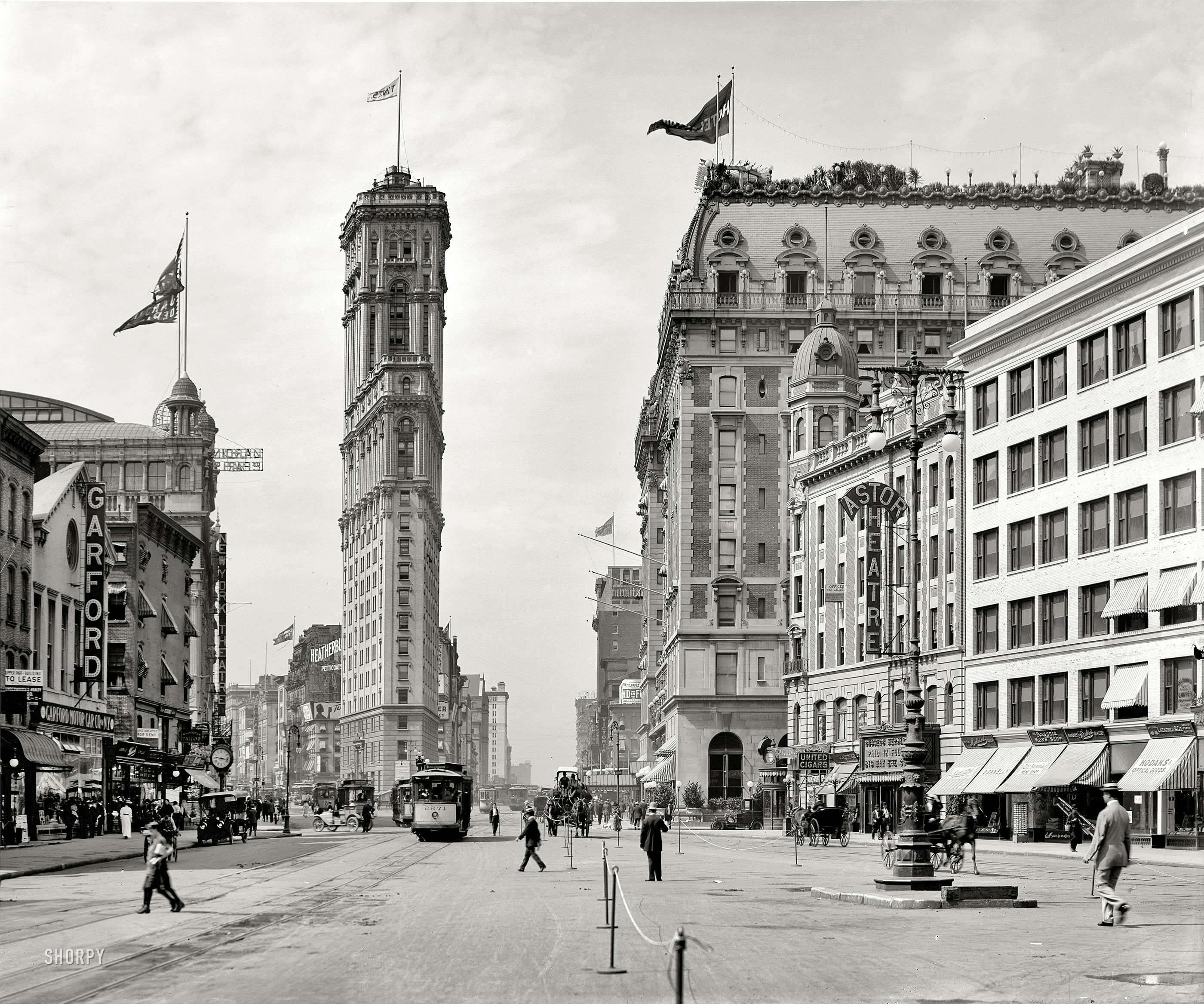
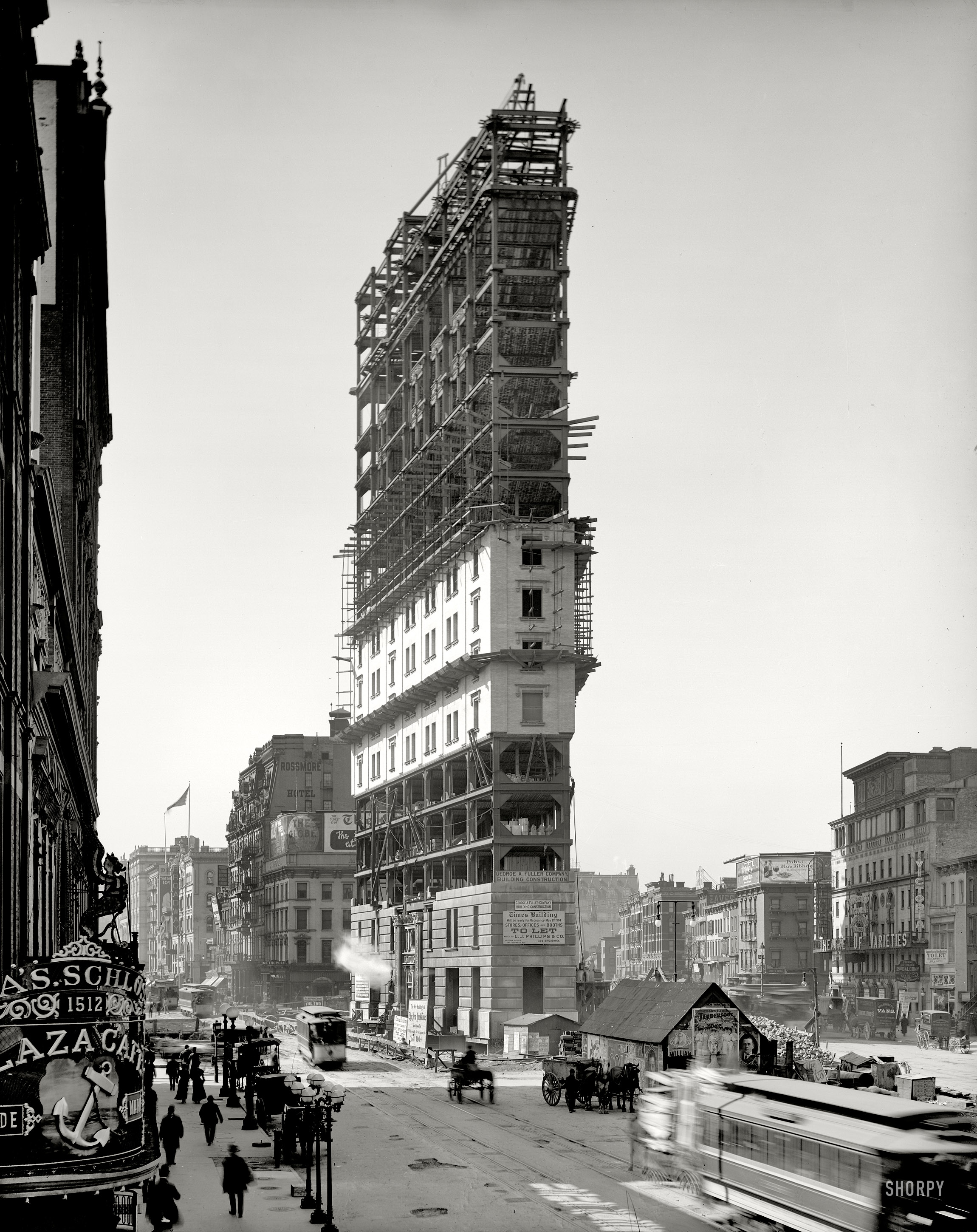
One Times Square under construction, 1903 – Found at Shorpy

Early shot of Times Square  around 1904.

Times Square, 1908 – Found at Shorpy

Times Square, 1911 – found at Ephemeral New York

Longacre Square was renamed Times Square in 1904 when the New York Times constructed their headquarters there.

TIMESSQUARE1922A

Times Square, 1922 – Found at gothamist.com

Times Square at Dusk, 1932 – found at Pu(re)blog

060

Times Square, 1935

s_n21_wpa00552

Times Square theaters by day, in New York City. The Times Building, Loew’s Theatre, Hotel Astor, Gaiety Theatre and other landmarks are featured in this January, 1938 photo. (Bofinger, E.M./Courtesy NYC Municipal Archives) via Urbanobservatory

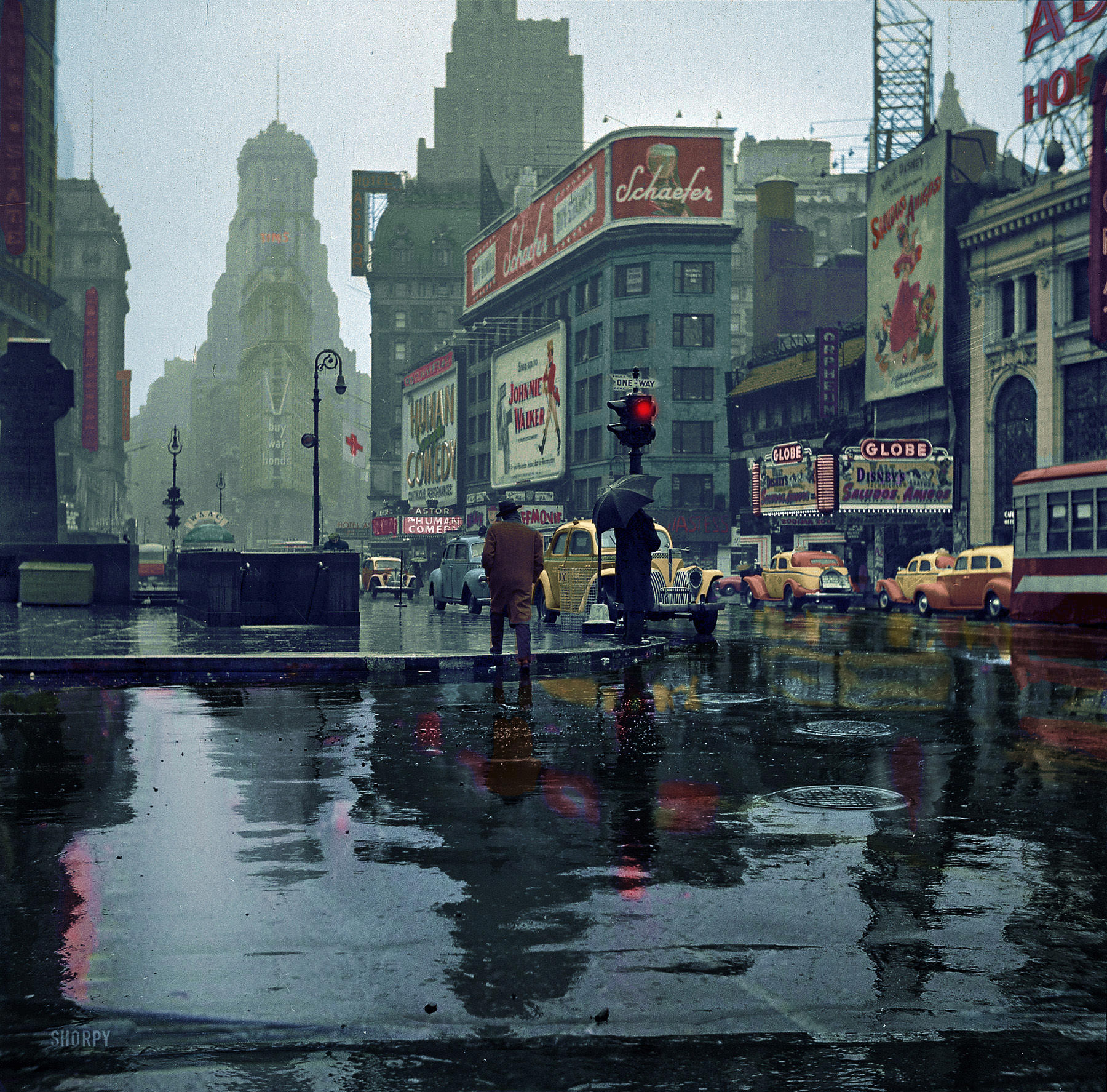
Times Square, 1943

Times Square, 1943, found at Shorpy


i06CcYz

Times Square, between November 1944 and January 1945 based on the “Tomorrow the World” and “3 is a family” marquees.


Times Square 1947 Blizzard

Times Square in a blizzard, 1947


Times Square 1949

Times Square, 1949

hBRP1Xl

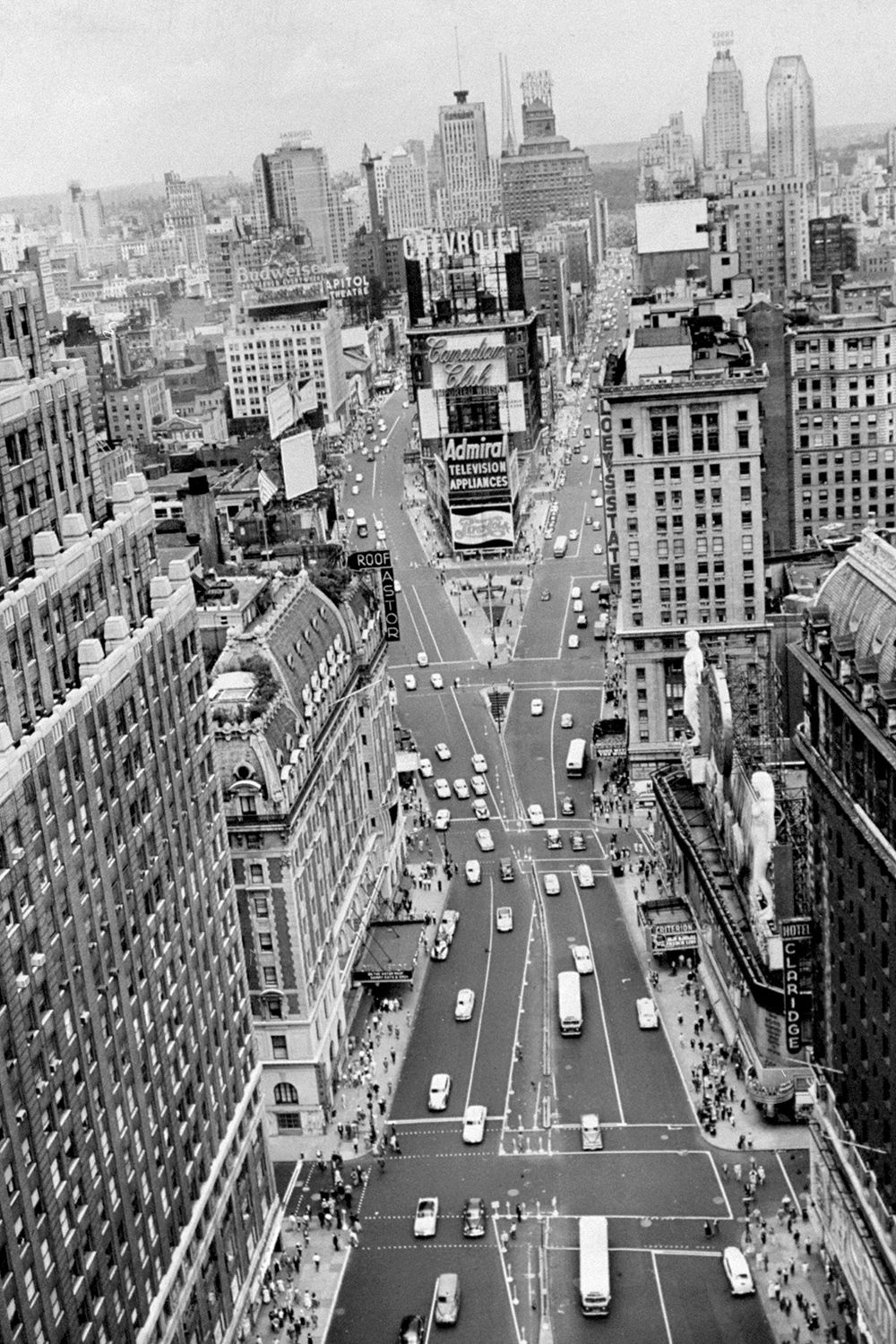
Times Square at night, circa 1950

Times Square, circa 1951

Times Square 1953

Times Square, 1953


Times Square 1954

Times Square, 1954

Times Square, 1955

Times Square, 1955

donhgvk1cidy

Times Square, 1955 – wide view.

Times Square 1957 (2)

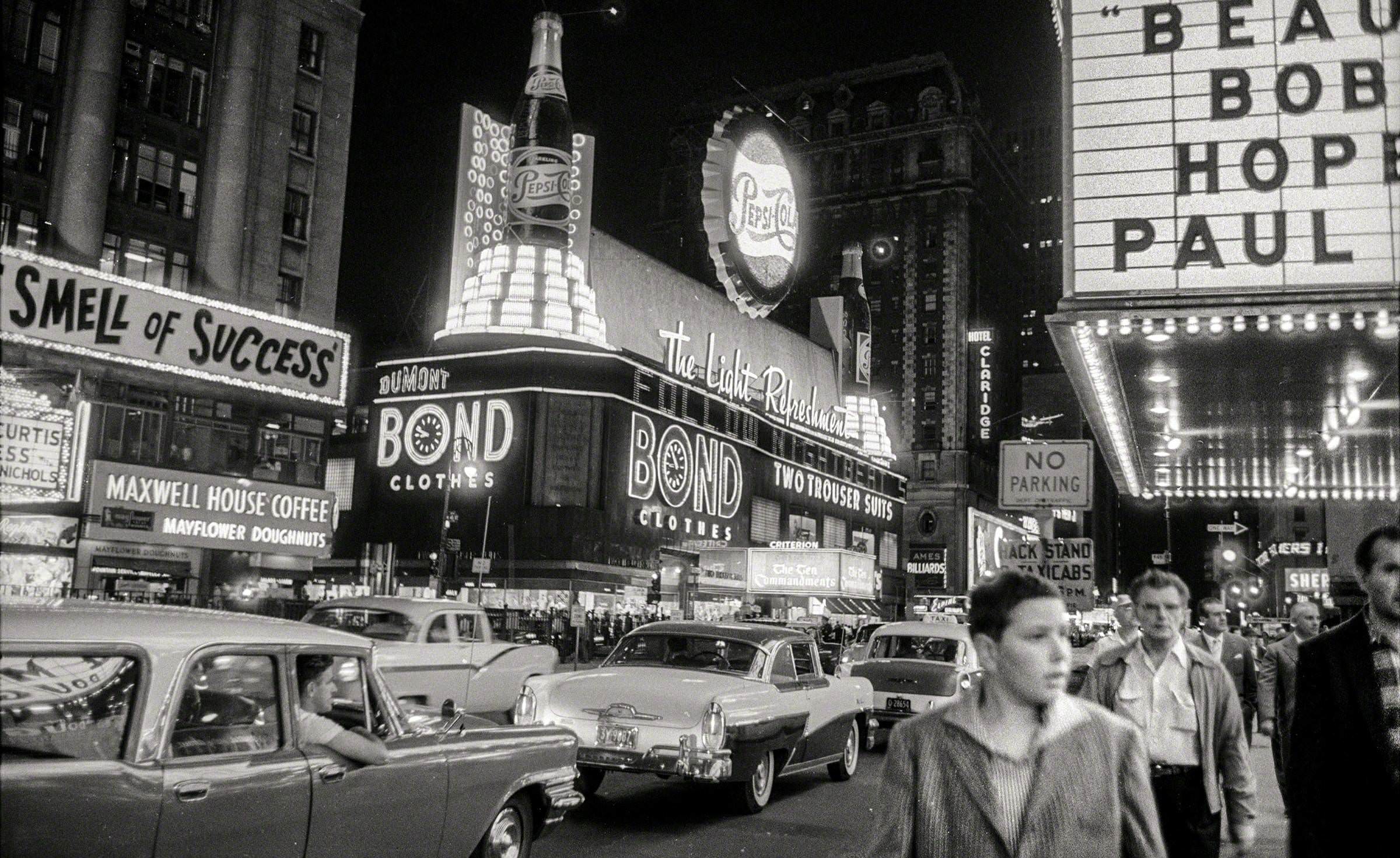
Times Square at night, raining – 1957

Times Square 1957

Times Square at night – 1957

Times Square in 1961

Times Square, 1961. Note the Horn and Hardart Automat.

Times Square, 1964. Found at Frog Blog (Now inactive)

Times Square, 1966

1966

Times Square, 1966, by night

Times Square 1967

Times Square, 1967

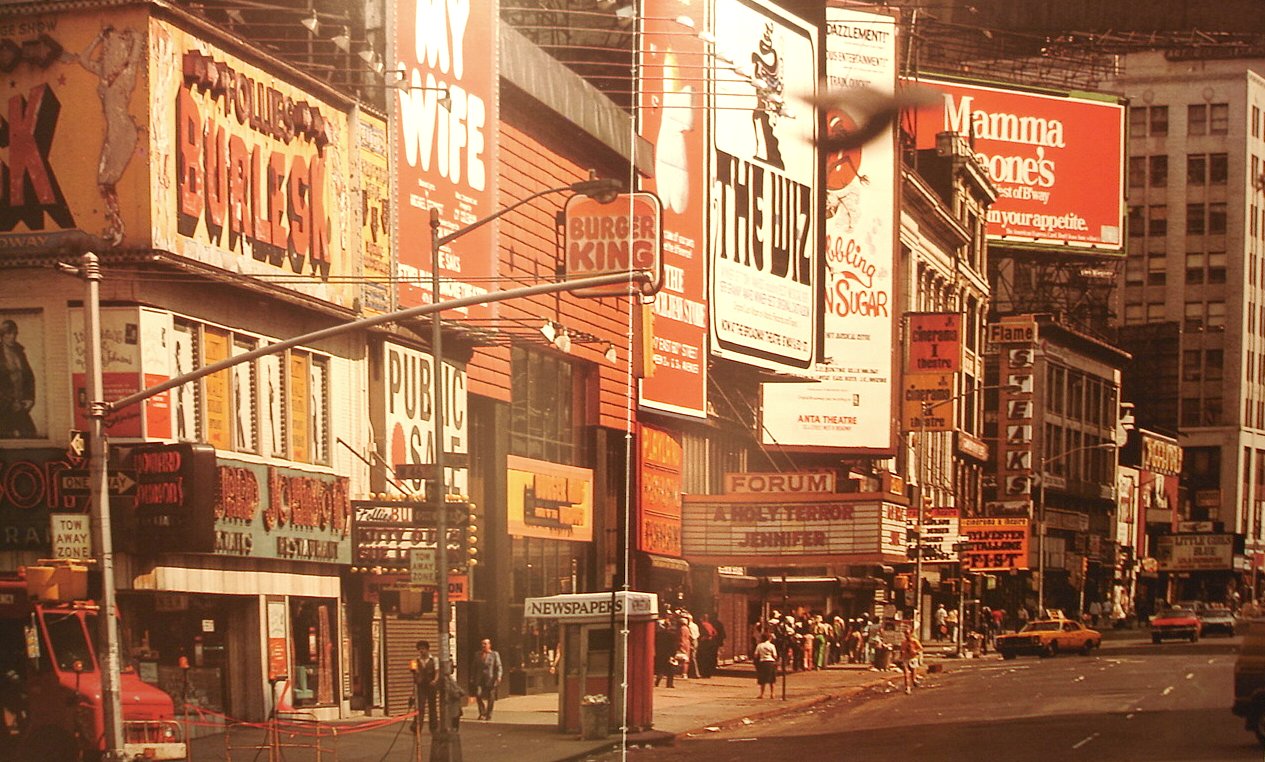
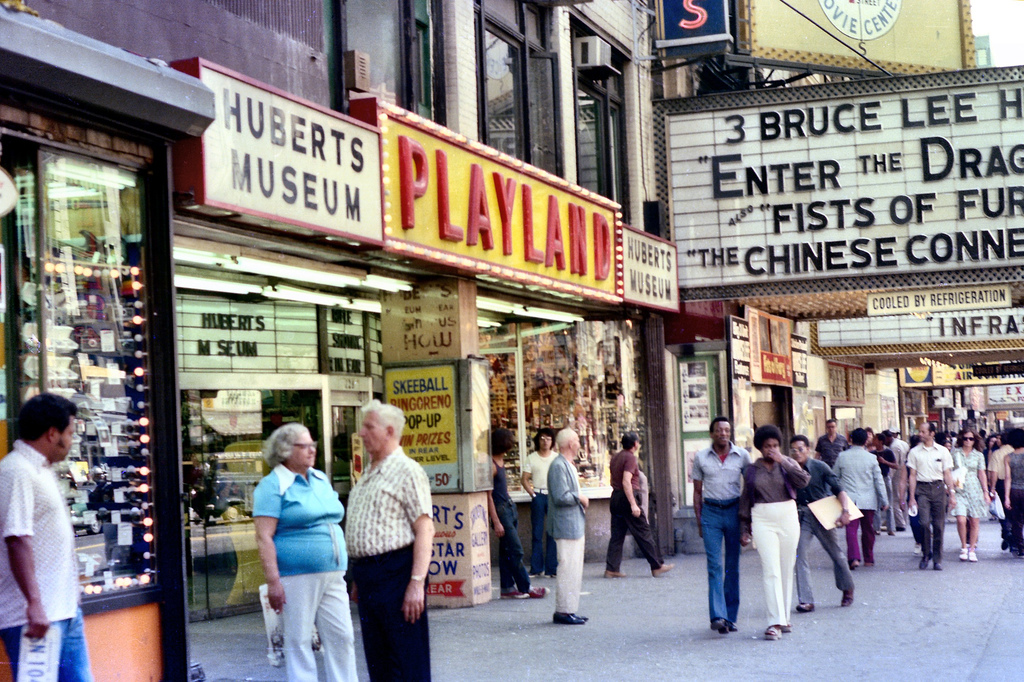
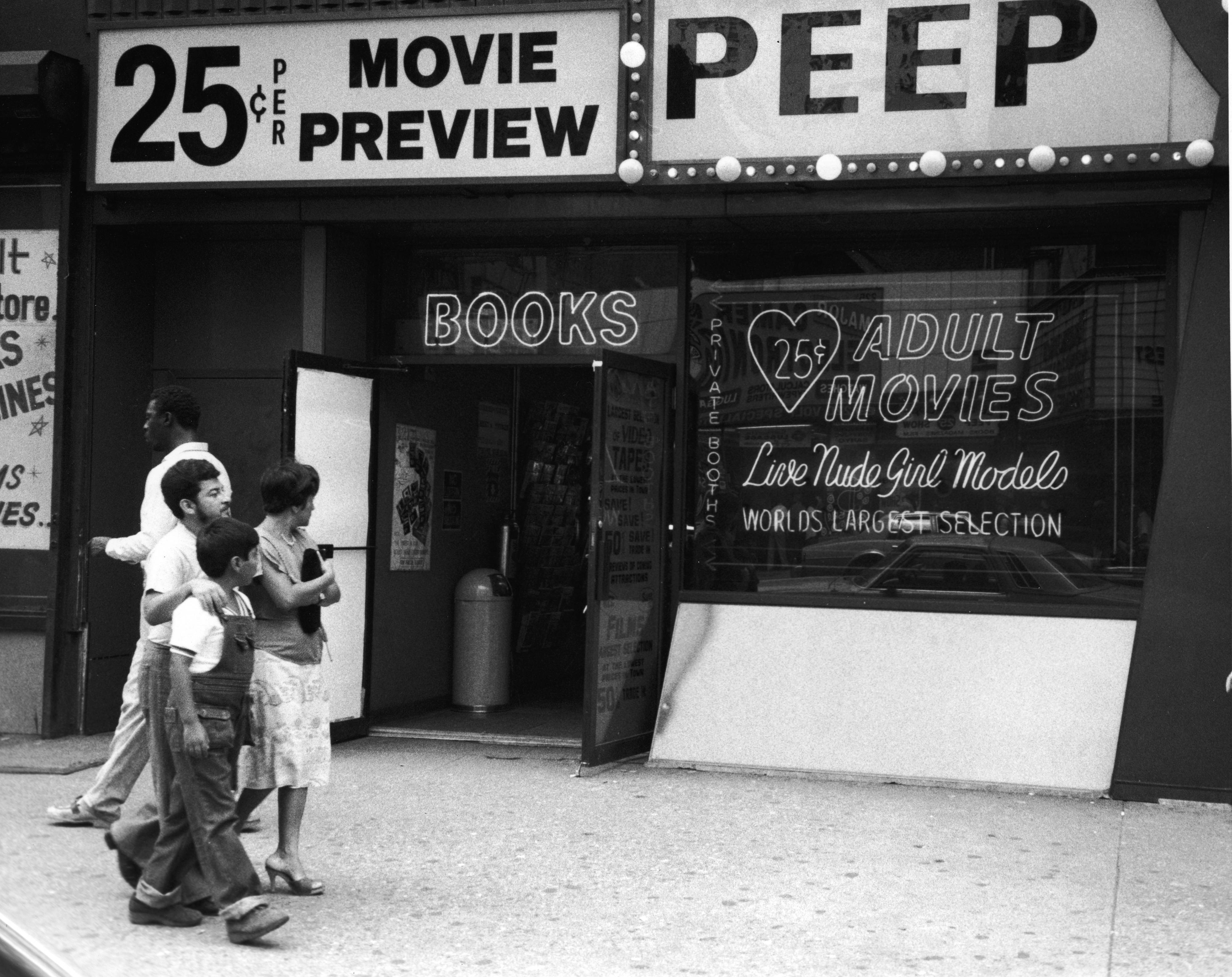
By the 1970’s, Times Square had become a cesspool of smut, as shown in the following images:

Times Square, 1973

I remember this Playland well – You could play Fascination there if you were over 18. There was one transient dude who would park himself right by the entrance and give passers-by the razzberry.

Time Square at night

Filthiest!

I remember one theatre on a side street that advertised “3 Hours of Solid Beavers!”

In the mid 1990’s, Mayor Rudy Giuliani led a campaign to close the smut houses and restore the Times Square area to something more tourist-friendly. Supporters claim it’s an improvement, detractors point to the “Disneyfication” of the area. Having grown up there, I’m in the first camp. The 1970’s were depressing, and I’m glad that era is gone.

Except Moondog. He was cool.

Times Square, March 1996 –  Photo ©Nightrider, Berlin – Found at http://nycj.blogspot.com

Times Square 1999

Times Square, 1999

Times Square, 21st Century – Found at DeviantArt

I won’t be around to see what Times Square looks like when my grandchildren take their grandchildren there, but I’ll bet it will still be something amazing to look at.

The Old Wolf has spoken.

So just how much sushi is that?

Yesterday I posted about the rice on the chessboard problem, and after I finished, my mind got… squirrel!

Well, yeah, that’s about how it works. I started wondering how long that much rice would last if you were feeding the entire population on a daily diet of 2027 calories. All of this is hypothetical, because living on nothing but rice is not great nutrition, but it would keep you alive – sort of – and a good percentage of the world’s population would kiss your feet if you provided them with that much rice (19.7 ounces) daily on a regular basis.

Since that squirrel just trotted through my mind, I’d like to pause here and put in a plug for an awesome book, Earthsearch by John Cassidy. This little wonder is a geography museum for kids that you can hold in your lap, full of games and facts and hands-on stuff. I was reminded of this by the fact that one section actually contains 4.8 ounces of rice, less than half of what the average kid (8-14 years old) needs per day. This is divided again into two bags, 2.8 ounces and 2.0 ounces respectively – and a spinner that shows your odds (1:20) of being born in the Western world. If your spin is lucky, you get to eat almost 500 calories. Spin poorly, and all you get is about 280 calories, enough to keep a kid hungry for a while and drive the point of world malnutrition home.

Back to our regularly scheduled programming: I’m also assuming that everyone is an adult male, 5’11” tall and about 150 lbs, which is where the 2027 calories come from. Of course that’s going to fluctuate wildly when you factor in the dietary needs of women, children, and people of different sizes and metabolisms. Still, it’s good enough for government work – all I’m doing here is coming up with a nice round number that my mind can wrap itself around.

Thanks to a handy dandy spreadsheet, I didn’t need to do much math.

  •  461,168,602,000 metric tons of rice (bigger than Mount Everest, remember), at 35,273.962 ounces per ton is equivalent to 16,267,243,742,541,100 (16.2 quadrillion) ounces.
  • Today, the world’s population, according to Worldometers is estimated at 7,066,853,164.
  • If it takes 19.7 ounces of rice to feed our average citizen, then we’re going to require 139,266,082,699.99 (139.2 billion) ounces of rice to feed the world for a day.

Which means that with his reward from King Shihram, Sissa ibn Dahir could feed today’s world for 116,807 days, or the equivalent of 320 years. That is a lot of sushi.

The Old Wolf has spoken.

No thanks, I just bought it online.

Sunday’s Retail by Norm Feuti – a strip I read with great relish – brings up an interesting point, and the commentary, written by what seems to be a preponderance of retail employees, got me thinking.

(Click the thumbnail for the full-size strip)

The question revolves around the practice of using brick-and-mortar stores as a showroom, leading to an ultimate purchase online or from a competitor.

This is an intriguing discussion and can see both sides of the equation. Reading “Not Always Right” on a regular basis, I am astonished beyond measure at the rudeness, arrogance, stupidity, and sense of entitlement people bring into a store, and always do my best to brighten the day of any retail worker I happen to encounter. And to keep the communication honest and open,  some days I do better than others. As a customer, however, my main difficulty with retail help is a sense of overinvestment – far too many retail workers (admittedly, perhaps, because they have to work with so many asshats on a daily basis and have reached the end of their rope) begin acting as though a return or a complaint were going to affect their bottom line, and they go out of their way to be like Mordac the Preventer. The knife can cut both ways.

The whole concept of using a brick-and-mortar store as a showroom is an unavoidable part of the e-commerce landscape. Customers *will* do it – I confess that I’ve done it myself. But when one is living on a fixed and limited income, pennies count. Unlike the use of smartphones in a movie theater, there has been not been time for society to develop any sort of “retail etiquette” by which it is generally accepted that this practice is “not done in polite society,” but in this economy I can forgive the practice because I know what it’s like to go without those eyeglasses or that dentist appointment in favor of food on the table.

We need things. We shop for them. The nature of retail, combined with the advertising industry, is ultimately to convince the consumer that he or she has a burning need for something which they had never thought of before. As a result, if we’re out shopping for Widget A, and we happen to see Widget B on a shelf which really calls to me, I see no reason to feel obligated to buy either one from the store I’m in if I can get it for less online (including shipping) or at another store (factoring in the cost of gas, and my time to get there).

This is not new. Watch “A Miracle on 34th Street” (the old version) and you’ll see that the concept of store loyalty is tenuous at best. As annoying as this is for store owners, and by metonymy, for store employees, it will only continue to get worse as bandwidth increases and smartphones get smarter. If brick and mortar outlets are to survive, they will need to adapt, and I’d be willing to bet that in 10 years we will have seen some very innovative solutions that have not been thought of at present.

Ultimately, it comes down to choosing our battles. I’d much rather deal head-on with the day-to-day issue of customer rudeness by creating (were I to own and operate a public business) an atmosphere where I could feel comfortable hanging this sign on my door:

This might cost me some business, but it’s the kind of business I don’t want anyway. I suspect (as long as I was running a business that was built on a sound model to begin with) that I’d attract more clientele that appreciated the opportunity to shop where they wouldn’t have to bump into the asshats themselves. I think I’d end up with more business that way, even accounting for the folks that were just window shopping or store hopping.

My two penn’orth, anyway.

The Old Wolf has spoken.

An Open Letter to the World’s Muslims

On September 10th, I posted An Open Letter to Jihadistan. This was addressed to the violent Islamic extremists of the world, rather than to the approximately 1.7 billion Muslims in the world today. Today I share my thoughts with the rest of you.

America is not waging a war against Islam. If you believe that, you are being lied to by people who are perverting your religion for their political purposes.

America is not responsible for, nor does it support the maker of  “The Innocence of Muslims.” This repugnant movie was made by a bigoted sub-human who does not represent the feelings of the vast majority of Americans.

Sheik Hassan Nasrallah of Lebanon today urged the Lebanse to increase their protests, saying “The ones who should be held accountable and boycotted are those who support and protect the producers, namely the US administration.” The US administration does not support the producers of this film, nor does it agree with its message. Nasrallah and other sheikhs and imams around the world calling for protests and violence against the US and the west, are speaking out of ignorance, and in so doing they are twisting the religion of peace into something that is not found anywhere in the Qur’an.

Despite the memories of the terrible events of 9/11 being still fresh in the minds of Americans, our land continues to be a haven for people of the Muslim faith, with over 2,000 mosques and countless masjids. Like you, we have our bigots and our sociopaths – but these do not now, nor have they ever represented us.

We believe that freedom trumps tyranny. If you wish to live in an Islamic republic, then live in an Islamic republic. If you wish to abide by shari’a, abide by shari’a. But let these be a republic and a law where the people are allowed to determine what that means, rather than living in fear that a different opinion or a different lifestyle will bring injury or death to them and their families.

I exhort you to stand down from these protests, this outrage, this violence which has nothing to do with America but rather the political aspirations of a few deluded men. Put your energy into building up your societies and improving the lives of your fellow citizens, and I pledge to you that I will do the same. The vast majority of my countrymen desire only the same things you do – the freedom to establish your lives and provide for your families in safety, and without fear. Things will not be perfect, and mistakes will be made, but none of us should allow the frailties of men to stand in the way of peace and progress.

I leave you with a quote that has been attributed to Marcus Aurelius, but whose origin is unsure. Nevertheless it speaks to me, and speaks the words of my heart.

“Live a good life. If there are gods and they are just, then they will not care how devout you have been, but will welcome you based on the virtues you have lived by. If there are gods, but unjust, then you should not want to worship them. If there are no gods, then you will be gone, but will have lived a noble life that will live on in the memories of your loved ones.”

May we desire peace, and pursue it; may we sow kindness, and reap prosperity.

The Old Wolf has spoken.

*How* much rice?

When I was young, I heard the story of the rice and the chessboard.

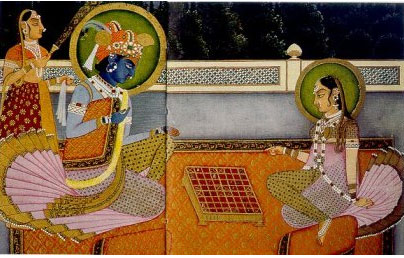
King Shihram of India was an oppressive tyrant. One of his subjects, Sissa ibn Dahir, invented the game of chess as a strategic (and social) training tool, and the king was so pleased that he asked Sissa what reward he wanted. Sissa’s answer was that the king should put one grain of rice (or wheat, in some versions) on the first square of a chessboard, two grains on the second square, four grains on the third square, eight grains on the fourth square, and so on, doubling the number of grains of rice with each square.

The King thought he had gotten off easy, but the simple math of exponential increase demonstrated that Sissa was no fool: the total weight of rice would exceed the weight of all living things on earth and make a heap larger than Mount Everest.

I always wondered just how much rice that was, but back then we didn’t have Wikipedia, and I don’t think such an “inconsequential” article would have made it into the Brittanica. Now, however, all is different.

An illustration of the operating principle is below:

The abbreviations refer to Mega (million), Giga (billion), Tera (trillion), Peta (quadrillion), and Exa (quintillion).

This principle was used by Ray Kurzweil who coined the term “The Second Half of the Chessboard,” referring to the point at which an exponentially growing factor begins to have a significant economic impact on an organization’s overall business strategy. The example above shows that the first square of the second half contains more rice than the entire first half combined.

Mathematically, the total number of grains of rice can be expressed as

(or so I’m told), which resolves to 264 – 1 (or so I’m told.) Dammit Jim, I’m a linguist, not a mathematician.

On the entire chessboard there would be 264 − 1 = 18,446,744,073,709,551,615 grains of rice (that’s 18.4 quintillion), weighing 461,168,602,000 metric tons, which would be a mountain of rice larger than Mount Everest. This is around 1,000 times the global production of rice in 2010 (464,000,000 metric tons).

Looking at the amazing Humphrys map comparing the heights of various mountains, look at how tiny St. Peter’s cathedral is in comparison (click the map for full size).

Even had King Shihram been able to pay, Sissa would have had difficulty finding a place to put his reward. And that’s a whole lot of sushi.

The Old Wolf has spoken.

The Old Phishing Hole

Thieves want your information and your money. They’ll take it any way they can get it. Eastern Europe is a hotbed of cyber-crime but, sensing the opportunity for profit, other nations are getting into the act, and the same old techniques resurface.

Here’s a typical phishing scam email which landed in my inbox today. Protect yourself, be aware, exercise safe computing, and warn your loved ones. This stands to be repeated often and loudly.


From: service@chase.com<gpwtnf@admin.net>
To: admin@chase.com

Subject: NOTICE ID : DXEUWSPLNT

Dear Chase Bank Customer
It has come to our attention that your Chase Bank account information needs to be
updated as part of our continuing commitment to protect your account and to
reduce the instance of fraud on our website. If you could please take 5-10 minutes
out of your online experience and update your personal records you will not run into
any future problems with the online service.
To update your Chase records click on the following link:
http://secureaccess.chase.glchzprjo.%5BLink Obfuscated]-wi.com/chs/chk/index.php?email_login=comcast.net/
Thank you for your patience in this matter.
Sincerely,
Ammy Smith,
Chase Bank Security Departament.
Please do not reply to this e-mail as this is only a notification. Mail sent to this address cannot be answered.
Copyright 2012, CHASE BANK SERVICE, INC. All Rights Reserved.

NICHMOKENLWJJFLDBVSKYXRCHQRWEFILLLKYSO


Right. First off, look at anything that’s green in the email above. These are red flags.

1) Garbage text. Any email that contains strings of junk or random English words strung together is trying to thwart Bayesian spam filtering. It’s a complex algorithgm that is employed by service providers and email clients to try to keep Spam from ever getting to you.

2) Mis-spellings. While human error is possible, most legitimate companies (especially large financial institutions like Chase) are pretty careful about the quality of messages they send out. Bad English, strange punctuation, odd collocations and mis-spellings are all red flags for fraudulent activity (which includes most spam, by the way).

3) Garbage or misdirected links. Just because a web address has the word “Chase” in it doesn’t mean that it’s from Chase. URL’s that contain alphabet soup are to be regarded very suspiciously. Never click on links from an email, especially if the word “money” or “finances” enters into the equation. If you have an account with Wells Fargo, for example, go directly to wellsfargo.com with your browser.

As it turns out, the link above redirects you to this URL:

http://[Link Removed].endoftheinternet.org/chs/chk/index1.php
?source=chase&customer=CrazvSTcCtTvoOIhYiLNI1bplxauXFAqWAQijzkM

(I obfuscated the link to make sure nobody actually clicks on this and goes there.) If you did, what you would see is this:

It looks very, very authentic – except for that garbage URL. In fact, the scammers copied the actual http://chase.com website exactly. If you enter your UserID and password, bingo! You’ve just given Russian cyber-criminals access to all your accounts.

Again: Never click on links inside an email. Always type addresses directly into your browser window to make sure you’re going to the real company’s website.

These particular drones aren’t through with you yet, though. If you enter your information (I put in some really insulting stuff which I can’t repeat here), you’ll be taken to this URL:

http://%5BLink Removed].chaseonline.chase.com.crazvstccttvooihyilni1bplxauxfaqwaqijzkm.
csqifywdn.endoftheinternet.org/chs/chk/email.php

which gives you this page:

So these scumsuckers not only want your financial data, they want access to your email account as well, so they can scam all your friends and send messages from your account.

If you’re aware of these antics, they seem pretty transparent. Unfortunately, a huge percentage of our population is working with computers and the Internet at a “cookbook” level, without any more than a superficial understanding of what they are doing. There’s no judgement around that – it’s great that they’re learning new skills. But if you have loved ones, especially elderly family members who fall into that category, please make sure they are watched over and educated.

Practice Safe Computing

1) Be afraid of any email that includes the words

  • “Verify your account.”
  • “Update your account.”
  • “During regular account maintenance…”
  • “Failure to update your records will result in account suspension.”

or similar things. Legitimate organizations will never ask for your ID or sensitive information by email or telephone

2) Do not click on links inside an email. Always go directly to your financial institution’s website from your browser.

3)Never send sensitive information to anyone in an email. Even if it’s legitimate, emails can be intercepted and read by the bad guys.

Be careful out there, it’s a jungle.

The Old Wolf has spoken.

New York Eateries: Gone But Not Forgotten

Nedick’s was the Starbucks of the 50’s. Orange drink, doughnuts and hot dogs with a signature mustard relish. They were everywhere, even in little hole-in-the-wall joints down in the subways. I confess I like the fresh-squeezed places better down there, with the machines that would cut and squeeze oranges automatically, but Nedick’s is a treasured memory also.
nedicks

Nedick’s in Newark

Nedick’s at Macy’s (Found at The Paper Collector)

Then there was Prexy’s. A local concern with just a few outlets in and around New York, they made hamburgers that were to die for. Little is known about the recipe that made them so good, but I remember eating there a number of times. Oh, those prices.

Prexy’s Matchbook

Prexy’s Logo from a China Plate

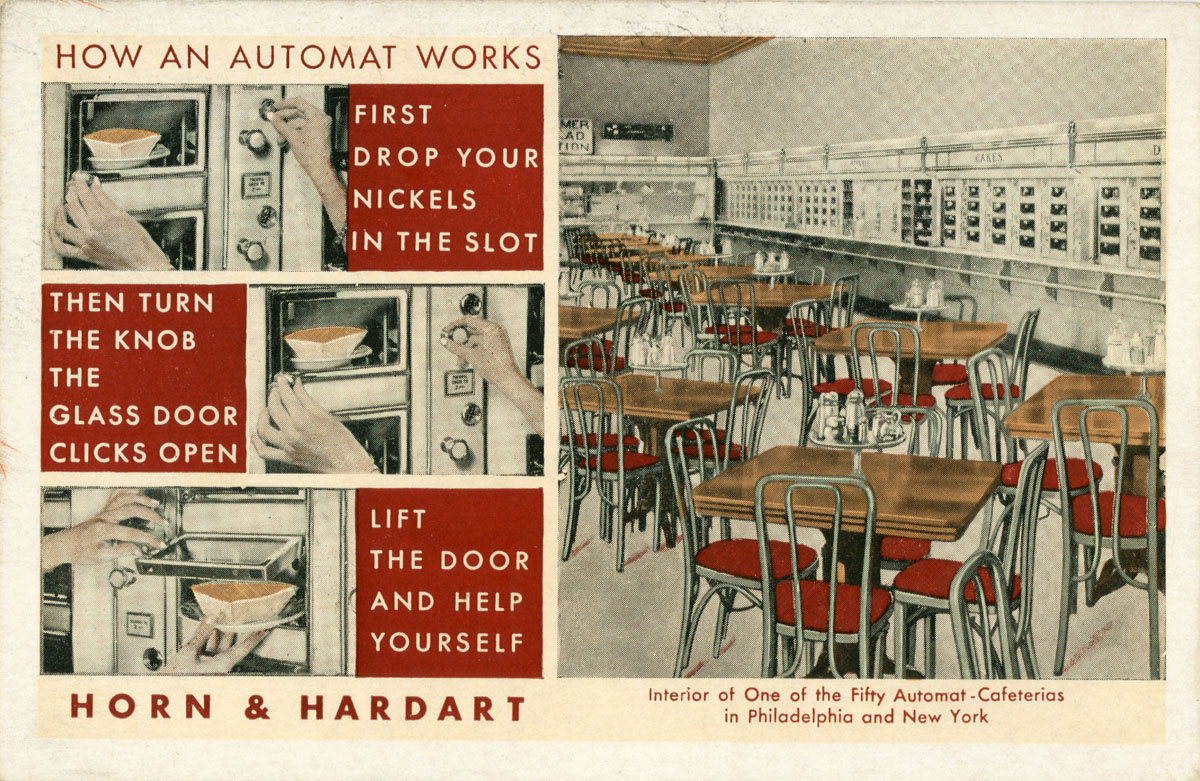
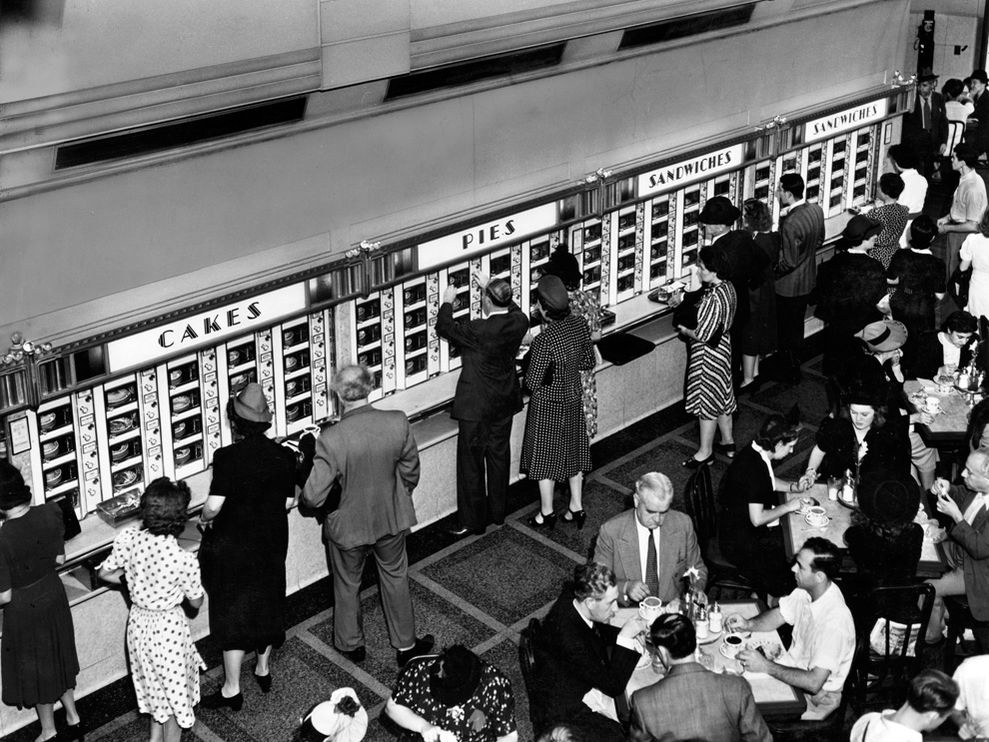
Last but not least, there was the Horn and Hardart Automat


gwKkl


The Automat, 1942, by J. Baylor Roberts

For a kid in the 50’s, nothing was more fun than getting pie or drinks or that incredible macaroni and cheese at the Automat; you’d get your nickels at the booth from a nickel-thrower, ladies with rubber tips on their fingers who could fling out a dollar’s worth of nickels without blinking. I could stand there for hours watching the lazy susans rotate around when they were empty, only to reappear magically refilled with new offerings.

I scored a copy of this book which gives a fascinating history of the chain, including lots of recipes.

Now I’m hungry.

The Old Wolf has spoken.

Home Repair in China

Newser reports that Home Depot is giving up in China; they have discovered that the Chinese prefer “do it for me” rather than “do it yourself.” Most Chinese live in apartments in urban areas, and have access to cheap labor.

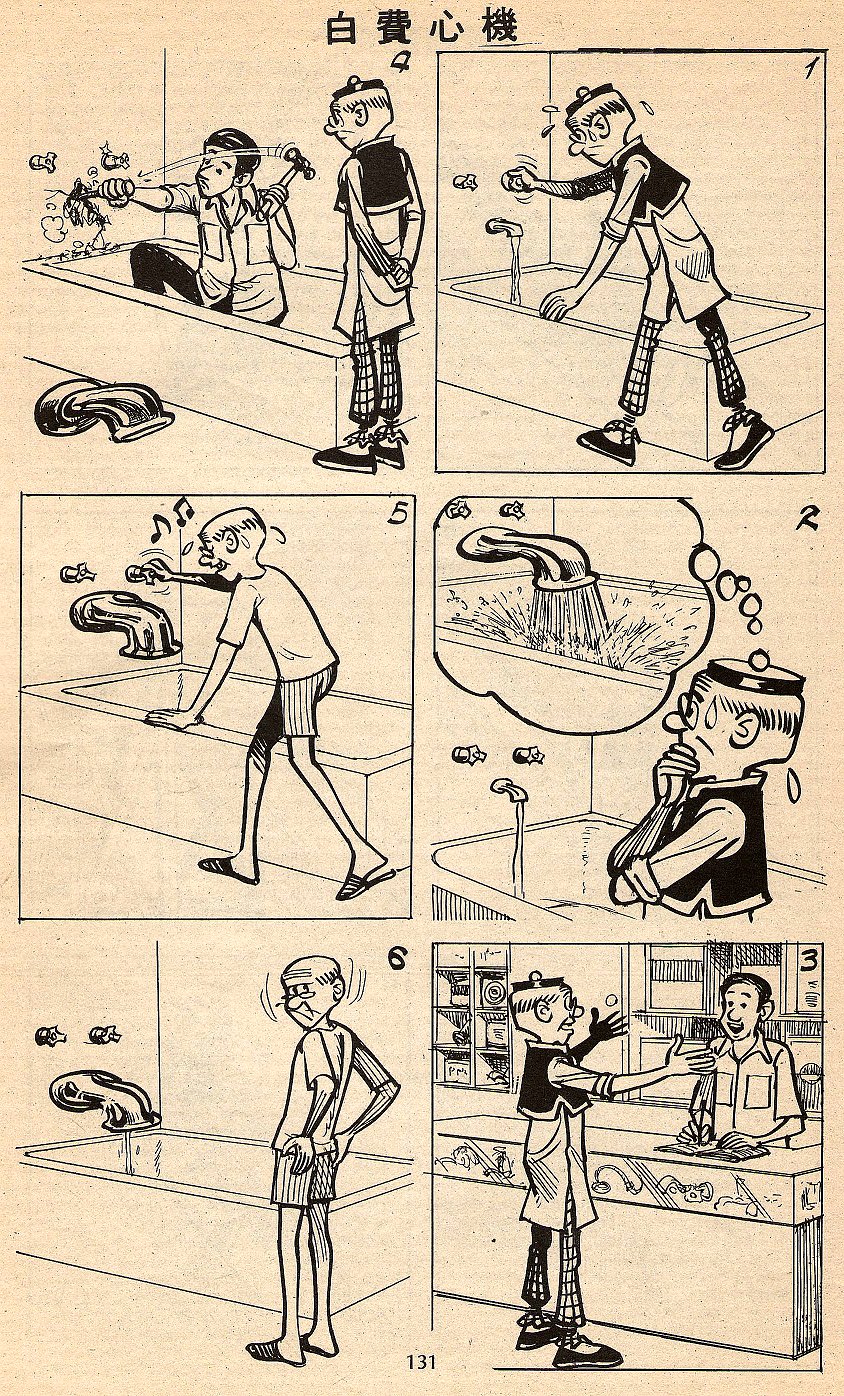
However, I have often wondered if the quality of the work one gets done is not of the best, as illustrated in the following Lao Fu Zi strips (remember to read these from top to bottom, and from right to left):

If you’re not familiar with Lao Fu Zi (known as Old Master Q in English), you can become better acquainted here. Most of these are constructed to be funny even if you don’t read Chinese – the website provides translations as an added touch.

The Old Wolf has spoken.

The Gospel According to St. Sabrett

  1. Only beneath the blue and yellow umbrella shall you eat.
  2. A hot dog shall be eaten on the street, no matter what your Nonna said.
  3. You shall garnish your hot dog with mustard, or with relish, or with onions, or with kraut, or All the Way.
  4. Ketchup shall be an abomination unto you, ye shall not eat of it.
  5. You shall not complain about the price: it is New York.
  6. The water is not dirty, it is hot dog juice.
  7. The skin of a hot dog has a pleasing snap, but ask not what lies beneath.
  8. You shall never visit a hot dog factory, lest you lift up your heel against hot dogs forevermore. You do not want to know how they are made.
  9. Remember St. Papalexis, for he is holy.
  10. A hot dog tastes best at Yankee Stadium, even if it is Nathan’s Famous and not Sabrett. But then, anything tastes good after 10 beers.

Stolen shamelessly from the Huffington Post:

Sabrett-style Onion Sauce Recipe

Makes. 4 hot dogs
Preparation time. 1 hour

Onion Sauce Ingredients
1/2 cup water
1 teaspoon cornstarch or arrowroot
1 tablespoon tomato paste
1 tablespoon inexpensive balsamic vinegar
1 teaspoon Dijon-style mustard
1 teaspoon brown sugar
1/4 teaspoon hot pepper sauce
1 pinch of cinnamon

1 tablespoon olive oil
2 large red onions, peeled thoroughly and sliced thin
1/4 teapoon table salt
2 cloves of pressed or minced garlic

About the onions. Red onions often have an extra layer of tough paper under the outer layer. Make sure you remove it.

About the tomato paste. If you want, you can substitute a 2 tablespoons of ketchup or a sweet tomato based Kansas City style barbecue sauce for the tomato paste.

The hot dog
4 all-beef frankfurters, preferably Sabretts
4 buns
Sauerkraut from the refrigerator section, not the can
Spicy brown Dijon-style mustard

Do this

  1. Combine the water and cornstarch in a bowl and whisk it until there are no more lumps. whisk in the tomato paste, balsamic, mustard, brown sugar, hot sauce, and cinnamon.
  2. Warm the oil in a large skillet, not a non-stick, over medium high heat. Add the onions and sprinkle with the salt. This helps pull the moisture out. Move them around occasionally with a wooden spoon so they don’t burn. Cook until the edges start to brown. Whatever you do, do not let them burn. Add the garlic and cook for another minute.
  3. Add the liquid, stir, and rub the pan with the wooden spoon to scrape up all the flavorful fond, the brown bits on the bottom. Turn the stove to low and simmer with the lid on for 1 hour. Check frequently to make sure it is not burning and the water has not evaporated. Add water if needed. The final result should be thick, not runny, but not pasty. After an hour, taste and adjust salt and other flavors as you wish.
  4. While the onions are simmering, warm the kraut in a pan or for 15 seconds in the microwave, cook the franks, and prepare the buns. The franks can be cooked on a griddle, on a grill, but most pushcarts make “dirty water dogs” by simmering them in water that has become a rich flavorful soup after holding scores of franks over the course of a day. And don’t worry, the franks are precooked so they are pasteurized, and the dirty water is hot enough that nothing can survive. As for the buns, some are toasted on a griddle, but most pushcarts store them in a bin where the steam from the dirty water keeps them warm and moist.
  5. Lovingly place the frank on the bun, squirt on the mustard, add the onions, and then the kraut. Hum quietly, I’ll take Manhattan…

The Old Wolf has spoken.