I saw this posted over on Facebook today, on a fan page called “Being Liberal.”

What caught my attention was the prominent picture of the Salt Lake temple of the Church of Jesus Christ of Latter-day Saints, of which I happen to be a member. There were 3,191 comments when last I checked and the debate was in large part your typical flame war between believers and anti-religionsists.
My response at the Facebook page was as follows:
“A picture of this nature is disingenuous and divisive by nature because it cannot convey even a fraction of the big picture. If, for example, you were to put the dollar value of such structures in a chart next to the dollar value of aid rendered by the organization to the disadvantaged or suffering throughout the world, and then in a third column, the dollar value of personal contributions and charitable service to society made by those who belong to your group, that might actually have some statistical value. Since such comparisons are impossible to quantify, the picture has relatively little empirical value other than to engender bitter polemics. If we were to reduce the massive expenditure down to the least common denominator, one could argue that it’s immoral to have a banana for breakfast when millions in Africa have none. One could create a similar montage of vast expenditures by secular organizations and make exactly the same point, so for me the net impact of the picture is an ill-advised and baseless attack on religion for no other reason than a personal bias.”
At the same page, I found this image:
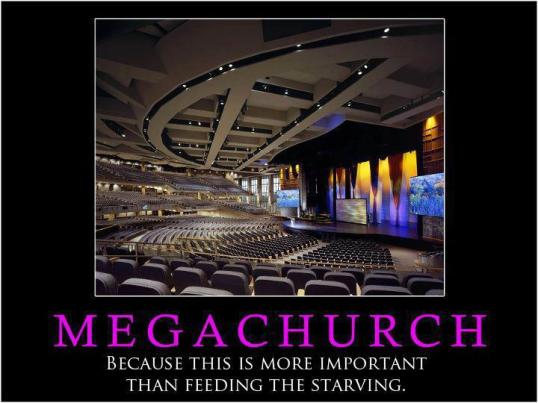
Once again, the LDS Church is targeted. Granted, the conference center (pictured) may have cost more than $350 million to build. At the same time, The Church of Jesus Christ of Latter-day Saints as an organization has donated more than $1 billion in cash and material assistance to 167 different countries in need of humanitarian aid since it started keeping track in 1985, and this is over and above the charitable efforts of its individual members. And from the pulpit pictured above is broadcast to the world on a regular basis messages of hope, of faith, of goodness, of charity, and of service, messages which inspire Church members to live lives in harmony with the teachings of the historical Jesus.
For the sake of comparison, the Palace of the Parliament in Bucharest, Romania, built by the avowed atheist and communist Nicolae Ceauşescu, is estimated to have cost over €3 billion.

There’s a better way to spend one’s energy than tearing down organizations that do a lot of good, simply because one doesn’t happen to ascribe to the philosophy or theology upon which they are based. From a social standpoint, there is nothing intrinsically wrong with either faith or atheism – both systems are capable of tremendous human good and tremendous douchebaggery. Quiet service and the creation of positive energy trumps the public mockery of the beliefs of others any day – at least in my book.
The Old Wolf has spoken.
 Playing in the World Game
the old wolf is quite right.
Chris, I may be remembering incorrectly, but didn’t you “like” a picture that had a picture of some priceless Vatican artwork, the same words, and the same picture of the starving African child?
Nope. Wasn’t me. See my response to Pit below.
Okay. Thanks!
Chris,
I definitely don’t want to diminish the good work of the Mormons – and other religious groups – but I do ask myself, when I see e.g. the grand buildings of my own Catholic church, if they are really necessary and if the money spent on these buidlings and all the “pomp ans circumstances” could not be better spent on helping the needy.
Best regards,
Pit
I have heard it said that the Catholic Church has no right to sell those works of art and do away with all the ceremony, as that would take beauty away from those who cannot afford it. There is at least some validity to that, it seems to me. One does need beauty to feed one’s soul, and artists need to make a living, too. When I listen to or sing sacred music, I am very grateful for past monarchs who sponsored composers!
On the website of an order of nuns that I saw yesterday, there were several pages devoted to the absolutely gorgeous works of art that the nuns produce to support their order. They sew linens to dress priests and the altar, and these products are pretty darned expensive—but nowhere near as expensive as they would be if they were sold at fair prices by people who supported themselves outside a religious community.
And the Catholic Church does spend an awful lot of time, money, and energy in corporal works of mercy such as feeding the poor, educating children in inner cities, and doctoring those who cannot pay for medical care. It’s just that stuff like that doesn’t make headlines. As it used to be said when I was a reporter, “If it bleeds, it leads.”
I’m not saying that the Catholic Church is perfect; no institution on earth is. But we do try to be perfect, as our Heavenly Father is perfect!
Hello there,
Thanks for taking your time and writing such a long answer to my comment: I really appreciate that. What you wrote gives me the opportunity to think my own position over and review it. And it gives me new insight into the subject. I must admit, that what I was “complaning” about is mainly things that can’t be undone any more, as e.g. those big churches were built many years, even centuries ago. And I didn’t want to diminish the work of e.g. nuns and others in any way at all. They make extremely valuable contributions to the welfare of the needy.
Best regards, and thanks again for your views,
Pit
Once one has gotten past the issue of religion-bashing for its own sake, the question is one which can be validly raised, particularly by those within a community of faith. I think it’s plain that one can always do more, and finding ways to do that within one’s own organization is a worthy pursuit. In the case of our own conference center, I have asked myself what might be done with $350 million – but on a global economy scale, that amount of money could vanish with hardly a blip on the poverty scale. Of course, there’s always the story of the fellow tossing starfish back into the sea, with the poignant punchline, “I made a difference to that one” – but I have to weigh that against the story of the woman who anointed the head of the Savior with 300 pence worth (a fortune in those days!) of spikenard, and who was justified for her good work. I don’t reject honest self-evaluation; simply indiscriminate and tasteless broadsides.
There will always be differences of opinion on this. What is enough? What is too much? Some people can worship in a quonset hut or a building made of cinder blocks. Others need what some people call “smells and bells.” And, as Jesus said, “The poor you will always have with you, but you will not always have me.” That’s the next bit of the story about the woman who anointed Jesus’ head.
Amen.
I really appreciated the intellectual insight into this article, along with all the wonderful comments that followed it. I was just searching the internet for pictures of the LDS Conference Center when I found one of the pictures above and wanted to investigate. It was very refreshing to see it was attached to a positive article and not one that was more like the subject this article was addressing.
In regards to the mention of the Catholic Church’s architecturally fascinating buildings, even being LDS and not Catholic, I myself have a hard time not taking the time to admire them. I feel moved, spiritually, when I look at the beauty of these great works of art. These feelings, I believe and it may be proven, can and does move people to feel more in touch with the messages that are attached to them. If those messages are of charity and good will towards others, that in turn can and does lead to actions that support those messages.
Consider this, companies spend way more in just advertising because of the impact messages have on people when but into visualization and also sound, such as music. It is the walking the walk that supports the justification of the talk that these expenditures promote. If only more people could become educated to understand the perspective this article outlines.
Thank you for sharing this with all who run across your article. I intend on sharing it on G+ and FB.
Thank you for the insightful commentary, John!