The “Gifting” Ponzi Scheme

Somehow the previous owners of my home got themselves on a sucker list and regularly get mail from people trying to recruit them into various disreputable money-making schemes. I present one here for your edification.

(Links to full-resolution images are included below each picture.)

Image

Full resolution

(I’ve redacted the names of people on the list, because unlike “Sir Lad,” the owner and operator of this Ponzi scheme, they are victims whether they know it or not.)

Image0001

Full resolution

There’s not much to say about scams of this nature other than do the math, and you’ll see that any such program is unsustainable and depends on a constant influx of new victims and an unsupportable number of people at the bottom. Once again, the success of Sir Lad – the person at the top – is predicated on the failure of thousands of people at the bottom. It’s interesting to note that he has added an additional layer of profit to this scheme – even though he’s no longer on the list of “gift recipients,” as the “monitor” he skims $5.00 or $6.00 from every victim. Notice how the wording of the letter targets the elderly and people in economic distress, those who can least afford to lose what precious resources they have.

I have taken a sample section from an excellent educational website entitled Cash Gifting Watchdog – I recommend this as a must-read for people who want to protect themselves and their loved ones from losing their money to disreputable con-men.


Why do cash gifting programs eventually fail?

If members fail at marketing the programs to an ever-widening base of new members, then the pool of money being “gifted” among the existing members will dry up.

Cash gifting clubs promote themselves at invitation only gatherings similar to Tupperware parties, except that no product is being sold.

All those invited are there because an existing member of the program thinks they have money available to participate and will risk giving it to a complete stranger for the chance to have several complete strangers the same amount of money to them, multiplying their money (again, it’s never called an “investment”).

The “presenters” at cash gifting program gatherings give chalkboard or Power Point presentations which invariably end up with an image of a pyramid, showing how each member will make his or her way from the base to the top, where they will get the big payoff.

The money contributed by an incoming member goes to the top of the pyramid immediately, while the penniless member sits at the base of the pyramid until enough other members join to completely pay off the member at the top and move everyone else up a notch. Once a member is paid off, he or she is free to move on, but for a club to keep working, the money given to that member will have to be replaced from somewhere.

If, for example, the promised payout of a cash gifting club is $20,000, and the gift required is $2,500, only eight new members must be recruited to pay off one old member.

But what happens when a club reaches 100 members? If each of them is to get the full $20,000, for a total of $2,000,000, then 800 people must join. If each of them is to be paid, 6,400 must join. With each new level, the numbers grow more unrealistic.

For this example club, with its relatively low gifting and payout levels of $2,500 and $20,000, to continue for only two cycles after it gets its 100th member, 51,200 members must join.

Many clubs count on their paid off members to keep returning. Even if they all do, it is mathematically impossible for a cash gifting club to survive without an exponentially increasing membership base.

When the pool of new members dries up, so do the cash gifts, and any members who joined too late are out of luck – not to mention money.


Please be alert and aware. Programs like this are doomed to failure for all but those who begin them or happen to be the fortunate one or two at the very top of a new scheme. They are also dishonest, mean, and illegal in the extreme, but skirt the law by various means and tactics and thus are very hard to shut down.

Protect yourselves and your loved ones, particularly the elderly who are the most susceptible to such cons [1]

The Old Wolf has spoken.

Notes
[1] This is a bilingual pun, if you happen to speak French.
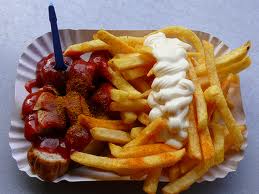
Currywurst

Currywurst! A famous Berlin specialty.

images

They write songs about it:

They have museums for it:

curry1

curry2

curry3

There are recipes for it:

Rezept für Soße:

Zutaten (für 6 Portionen)

200 g Tomatenmark
175 g Apfelmus
500 ml Wasser
15 g Meersalz
15 g Zwiebelpulver, fein
15 g Paprikapulver
25 g Currypulver

Zubereitung

Tomatenmark, Apfelmus und Wasser in einen Topf geben, verrühren und kurz aufkochen.
Gewürze dazu fügen, fertig.

Die Sauce warm über die Currywürste geben! (Für die Currywurst kann man jede Wurstart nehmen: Mettwürstchen, Nürnberger, normale Bratwurst, Siedwürstchen. Das hängt ganz von der jeweiligen Vorliebe ab.)

And we makes it at home, precious:

Curry4

Currywurst!

The Leyat Hélica

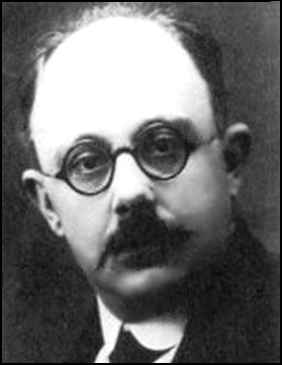
Marcel Leyat (1885-1986), born in Die, France, was an airplane designer and manufacturer. He began turning out airplanes in 1909. In 1919, he began manufacturing automobiles based on his experience with airplanes. The automobiles were built on the Quai de Grenelle in Paris.

leyatport1914

Marcel Leyat in 1914

The first model was called the Hélica, also known as ‘The plane without wings’. The passengers sat behind each other as in an aircraft. The vehicle was steered using the rear wheels and the car was not powered by an engine turning the wheels, but by a giant propeller powered by an 8 bhp (6.0 kW) Scorpion engine. The entire body of the vehicle was made of plywood, and weighed just 250 kg (550 lb), which made it dangerously fast.

696px-Helica_de_Leyat_1921

1921 Hélica at the Musée des Arts et Métiers, Paris. (Found at Wikipedia)

In 1927, A Hélica reached the speed of 106 mph (171 km/h) at the Montlhéry circuit. Leyat continued to experiment with his Helica; he tried using propellers with two and four blades. Between 1919 and 1925, Leyat managed to sell 30 vehicles.

66

Hélica 2H, Series D21 (found at Frog Blog)

A page about Leyat (in French) can be found here.

This vehicle offers a practical solution for keeping bugs off your windshield; pedestrians who happen to encounter the Hélica would not fare well, I fear me.

The Old Wolf has spoken.

It’s a poor joke

The media and the blogosphere is aflame with back-and-forth about the two Australian DJ’s who impersonated Queen Elizabeth to get information about the Duchess of Cambridge’s pregnancy. The tragedy surrounding it is that the nurse who took the call, and actually transferred it to the relevant ward, has now passed away – the victim of a possible suicide, although that has not yet been determined.

The two DJ’s, who have voluntarily gone off the air for an indeterminate period, are as distraught as you might imagine; the prank was never intended to succeed in the first place, and things of this ilk are not uncommon in the radio world. While they are being pilloried (and even threatened with mayhem) by the world at large, it’s pretty plain that they never planned to hurt anyone. Still, it raises the question once again of what constitutes a good joke, and what crosses the line. Far too  many bullies (to bring up another very hot current topic) excuse their actions by saying, “we were just kidding around – it was just a joke.”

The following has been around for a long time, but I’ve saved it – because it’s the best guideline I’ve ever seen. Despite some human lapses in judgment, I’ve done my best to follow it.

When someone blushes with embarrassment…
When someone carries away an ache…
When something sacred is made to appear common…
When someone’s weakness provides the laughter…
When profanity is required to make it funny…
When a child is brought to tears…
Or when everyone can’t join in the laughter…
It’s a poor joke.

The Old Wolf has spoken.

Change or Die

Excerpted from an article by Alan Deutschman

“Change or Die”

What if you were given that choice? For real. … What if a well-informed, trusted authority figure said you had to make difficult and enduring changes in the way you think and act? If you didn’t, your time would end soon — a lot sooner than it had to. Could you change when change really mattered? When it mattered most?

Yes, you say?

Try again.

Yes?

You’re probably deluding yourself.

You wouldn’t change.

Don’t believe it? You want odds? Here are the odds, the scientifically studied odds: nine to one. That’s nine to one against you. How do you like those odds?

Exercise or Die

Dr. Edward Miller, the dean of the medical school and CEO of the hospital at Johns Hopkins University… turned the discussion to patients whose heart disease is so severe that they undergo bypass surgery, a traumatic and expensive procedure that can cost more than $100,000 if complications arise. About 600,000 people have bypasses every year in the United States, and 1.3 million heart patients have angioplasties — all at a total cost of around $30 billion. The procedures temporarily relieve chest pains but rarely prevent heart attacks or prolong lives. Around half of the time, the bypass grafts clog up in a few years; the angioplasties, in a few months. The causes of this so-called restenosis are complex. It’s sometimes a reaction to the trauma of the surgery itself. But many patients could avoid the return of pain and the need to repeat the surgery — not to mention arrest the course of their disease before it kills them — by switching to healthier lifestyles. Yet very few do. “If you look at people after coronary-artery bypass grafting two years later, 90% of them have not changed their lifestyle,” Miller said. “And that’s been studied over and over and over again. And so we’re missing some link in there. Even though they know they have a very bad disease and they know they should change their lifestyle, for whatever reason, they can’t.”

———-

While the article above is slanted at corporate leadership and mentions a particular diet plan that was more successful than others, the reason people don’t change is that the benefits of not changing outweigh the prices they are paying.

Every moment is a choice, and every choice has prices and benefits.

I’m currently about 30 pounds above my ideal weight, and that’s because I’m firmly committed to being 30 pounds above my ideal weight. There’s no other reason, no excuse, no story. It’s what I’m choosing.

I’ve released that excess weight twice in my life, and believe you me, it felt awesome. But while I’m committed to getting back to a healthy lifestyle, I may also be committed to staying safe and comfortable, because that protects me from the fear of failure – and the fear of success. Life gets in the way, and it’s oh, so easy to revert to old habits and patterns that serve as protective barriers against the slings and arrows of outrageous fortune.

My body is telling me it’s really time for a change, and I’m feeling like the price I’m paying is higher than I’m comfortable with. Today the scale reads 187. My intention is to get back to 165, which means I’ll have 3 new suits and a whole closet full of pants I can fit into again.

Watch this space; I’ll report my progress.

We’ll see.

The Old Wolf has spoken.

Lion’s Mane, Nomura, and Photoshop

phoca_thumb_l_denizhayvanlar 395

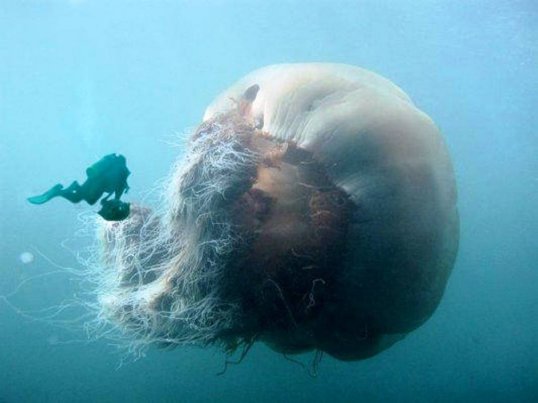
Amazing, isn’t it? Takes your breath away. Despite having been posted over 600,000 times all over the internet, it’s not real.

The Lion’s Mane Jellyfish (cyanea capillata) is big indeed – the largest recorded specimen found, which washed up on the shore of Massachusetts Bay in 1870, had a bell (body) with a diameter of 7 feet 6 inches (2.29 m) and tentacles 120 feet (37 m) long. A similar-sized beast, the Nomura’s Jellyfish (Nemopilema nomurai), grows up to 2 m (6.6 ft) in diameter and weighs up to 200 kg (440 lb).

Cyanea_capillataDLC2007-09s

Lion’s Mane Jellyfish

Echizen Jellyfish

Nomura’s jellyfish

zoorium+lions+mane+jellyfish2

The photo above gives you a better idea of just how big these jellies can be. They are quite large, but not as large as the one in the picture above.

An article at Forbes give’s a journalist’s analysis of why the first image is a fake, based on the kind of internet research that a journalist would do. Not bad sleuthing – the author, Anthony Wing Kosner, describes how his research led him to this article at io9, and he gives some other supporting data as well, such as a debate over at Snopes.com which began in 2007. However, one paragraph of his article disturbed me. He said,

“I agree with all of McClain’s arguments except the one about the Photoshop “halo.” The image of the diver does indeed seem to be in a different light than the surrounding image, but it is hard for anyone but a forensic image analyst to tell the difference between the artifact-ing that happens naturally through jpeg compression around contrasting edges in an image, and an actual “halo” of extra edge-pixels on a pasted-in element.”

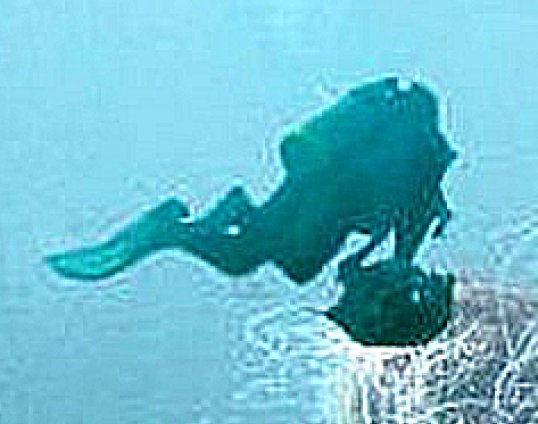
Well, that’s a load of high-grade steer manure. Anyone who has worked with images can spot a blatant photoshop manipulation fairly easily. Enlarge the diver next to the “super giant” and sharpen the image a few times, and that “halo” becomes much more obvious.

artifacts

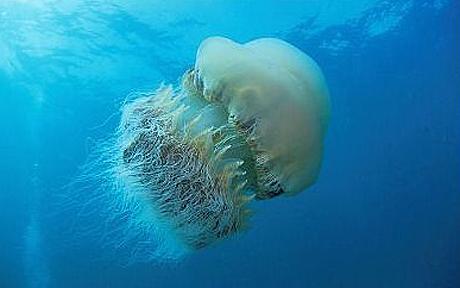
Compare this with an enlarged and sharpened version of the real photo:

Jelly2

If you look around the jelly you can see some evidence of jpeg compression and luminosity variances, but nothing like the obvious manipulation around the diver in the first picture. It may be true that high-quality forgeries require photographic forensic tools to identify, but the one in question doesn’t fall into that category.

There are enough wonders in this universe to boggle our minds without resorting to creating them; unfortunately, in the age of Facebook and Pinterest and Twitter, a phony picture will circle the globe nine times before someone says, “Wait, what?”

The Old Wolf has spoken.