
Man in Los Angeles greets cat. Photo by Nina Leen. Found at sarahreck.tumblr.com.
Man in Los Angeles greets cat. Photo by Nina Leen. Found at sarahreck.tumblr.com.
Ever since everyone in my elementary school class was taught how to read The Herald Tribune (go ndéanai Dia trócaire air), way back in 1961 or so, I have loved the daily funnies. I remember waking up early when I was in high school, heading for a local coffee shop, and starting my day with a cup of coffee and The Waterbury Republican.
There were all kinds of funnies, and I had my favorites, which I assiduously saved for last each day.
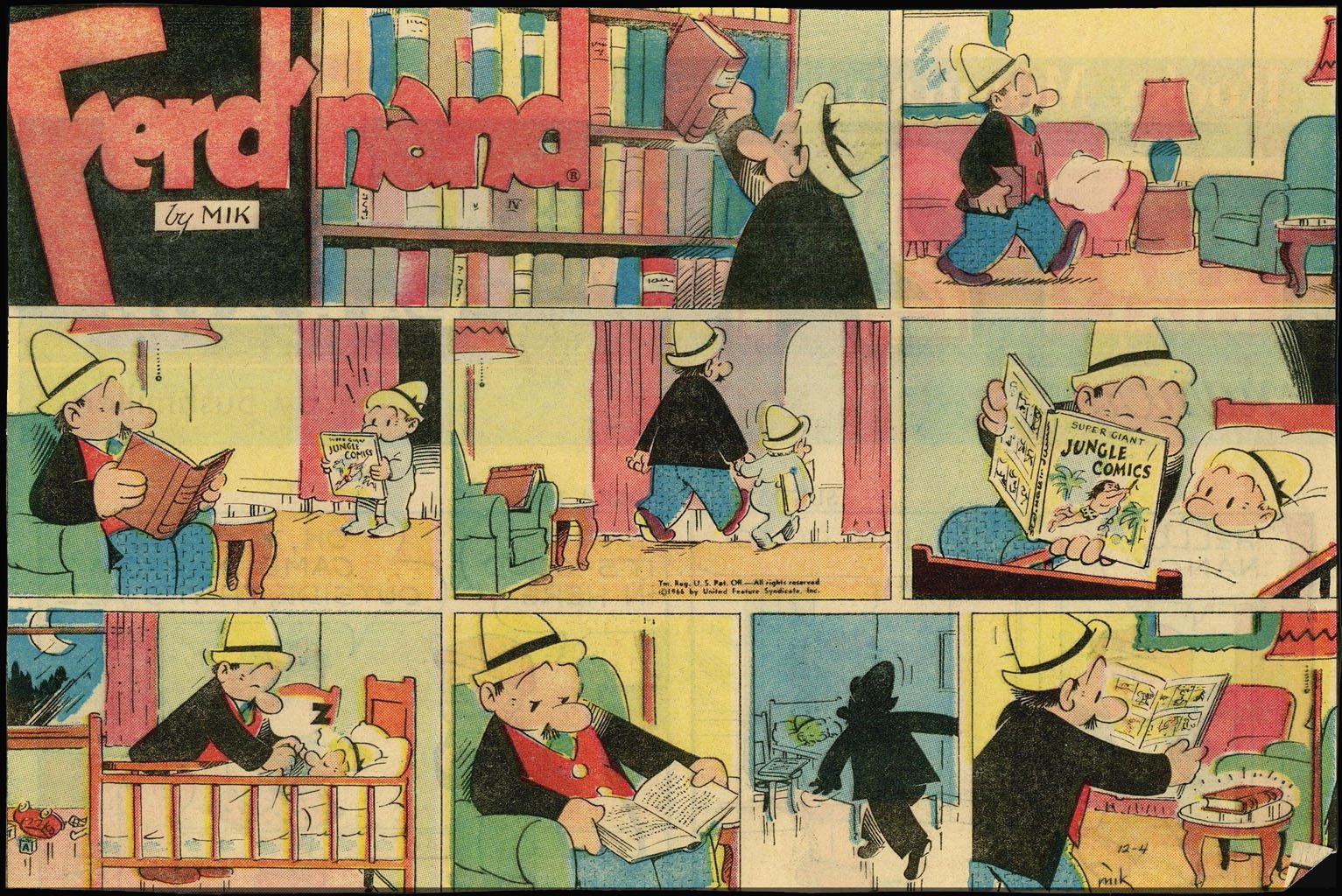
Ferd’nand by Mik (found at mydelineatedlife.blogspot.com)

Dondi, by Irwin Hasen. Found at Mr. Blog’s Tepid Ride
And my all-time favorite:

Rick O’Shay, by Stan Lynde.
Other strips, the soap operas like Mary Worth and Apartment 3-G, did nothing for me and I just skipped over them.
Remember that, there’s going to be a test.
Finally, when the newspapers ceased to be practical because of the internet (around 2002 for me) I became a fan of webcomics.
Webcomics are great. They are directly responsible for my hooking up with my wife, whom I love with all my heart and soul (even though she scared the living daylights out of me this morning at 3 AM and we hates her, hates her, hates her forever precious), and I’ve had to be selective about which ones I read, because there are thousands of them out there, and so many of them are top-drawer.
Some strips have discussion fora attached, one of which was how I met above-mentioned beloved wife (who is still in the doghouse). Most forum participants enjoy discussing and speculating about each day’s strip and upcoming plot possibilities, as well as an entire universe of random topics that crop up; indeed, a forum can become a living community. But there’s a strange phenomenon that afflicts these virtual villages: some people take up residence for the express purpose of being critical of the subject matter. Like the poor degenerate I mentioned in this post, they plunk themselves down and blow raspberries at the strip and its creator, day after day, without end.
Now, some of these people are just trolls, but there seems to be another phenomenon operating here. Like people who leave a religion and then spend the rest of their lives complaining about it, these netizens seem incapable of finding joy in anything positive, but must needs expend their energy complaining about something they hate. For the love of Mogg and his entire holy family, with thousands of webcomics out there, where is the value in reading something that annoys you? Coming back to my newspaper days, I can equate this phenomenon with my taking the time to hand-write a letter to the editor complaining about how boring and insipid I found Mary Worth, and threatening the artist with bodily injury and death. Every day.
A particularly egregious example of this sort of inanity is found at the “Bad Webcomics Wiki” (no link provided):

Essentially it’s nothing more than one man’s cesspool of hate and piss; the author is flat-out miserable, and assuages his pain by inflicting his misery on the rest of the world.
It’s not only the forums, either – artists get direct hate mail from readers, and it appears that this was even the case before the advent of the internet. Gary Larson’s The Pre-History of the Far Side contains some absolutely choice correspondence from people who found his cartoons offensive in some way or another. His response, in addition to mocking them in a published work, was

Teresa Burritt, the authoress of the offbeat Frog Applause, regularly posts hate mail from people, and recently blogged about it; I count a number of cartoonists among my personal friends, and some of them have shared correspondence with me that would either curl your hair or amuse you no end, depending on how you looked at it. Most of these artists take this sort of impotent vitriol in stride, and either ignore it or make a point of mocking it publicly to further enrage their detractors. Others I am acquainted with have a hard time with the sound and fury, and I hope they can get to a point of tranquility where they don’t allow the noisy idiots to dampen their spirits.
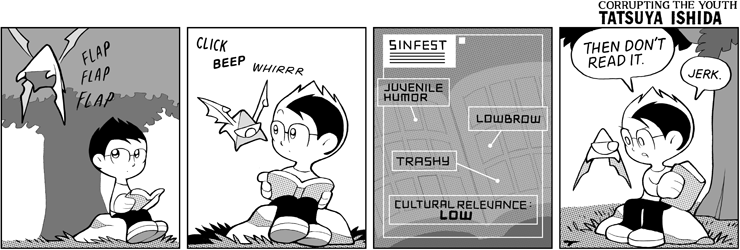
This whole essay was spawned by today’s Sinfest, by Tatsuya Ishida,
and another creation by Paul Taylor, author of the inimitable Wapsi Square:

The whole point here, which I recommend warmly to everyone who ever read a webcomic that they didn’t care for, is this:

Life is far too short to waste your time on such negative energy. If you read something you don’t like, for the love of Mogg’s holy grandmother, just ignore it. Better yet, find something positive to do – anything at all – and do it. As Artemus Ward said to the orfice-seekers pestering Abraham Lincoln:
“Go home, you miserable men, go home & till the sile! Go to peddlin tinware — go to choppin wood — go to bilin’ sope — stuff sassengers — black boots — git a clerk-ship on sum respectable manure cart — go round as original Swiss Bell Ringers — becum ‘origenal and only’ Campbell Minstrels — go to lecturin at 50 dollars a nite — imbark in the peanut bizniss — write for the Ledger — saw off your legs and go round givin concerts, with techin appeals to a charitable public, printed on your handbills — anything for a honest living, but don’t come round here drivin Old Abe crazy by your outrajis cuttings up!”
A better sermon I have never heard.
The Old Wolf has spoken.
Comments are closed for this topic.
I’m a packrat. I freely admit it. However, lately I’ve come to start calling myself an “archivist” – it sounds much more respectable; and there can be value in preserving things for posterity.
A recent series of photographs by Huang Qingjun, however, makes me wistful for the simplicity that some people live with. Well, almost.

Said Huang:
“The idea for the series about people’s material goods, now called Jiadang (Family Stuff), came in 2003 with some photos he took for the magazine Chinese National Geography. But the project didn’t really get under way until three years later, when Huang started travelling around China looking for suitable places and people.
“Most people thought what I was proposing was not normal. When I explained I wanted to set up a photo, that it would involve taking everything out of their house and setting it up outside, that took quite a lot of explaining,” he says.
“But almost all of them, when they realised what I was trying to do, they understood the point.”
These captivating images raise the question: How much 家当 (jiadang) do we really need? So many of us are accumulating things far beyond our needs, in a mad rush to die with the most toys. While I could surround myself with gewgaws and gimcracks (especially in my kitchen) until I had no more place to live, I do understand that 99.9% of it would be useless if it ever came to living without electricity or in, say, 350 square feet of space.
Leonardo Da Vinci once said that simplicity was the ultimate in sophistication. Less stuff means less work taking care of it, dusting it, and moving it; less money spent on acquiring it; and more time to pursue the only thing we can really take with us – relationships.
Am I going to “sell all that I have, and give to the poor” tomorrow? No, not bloody likely – I’m an addict and I know it. But I will be more careful in future, and will bend my will toward offloading as much of it as I can possibly bear to part with.
My thanks to Huang xiansheng for a wonderful glimpse into an unburdened life.
Read more and see more images at the BBC.
The Old Wolf has spoken.
Not too much to say about this classic video, other than it’s a small first step in overcoming deeply-entrenched male attitudes toward women in the workplace. While it seems laughable to watch today, it was produced in deadly earnest. I’d like to think we’ve come a long way since then; yet while progress has definitely been made, there’s still a lot of good-ol’-boy stuff going on in the 21st century. Perhaps it’s time for someone like Steven Spielberg to produce an updated version.
The Old Wolf has spoken.
Some time ago I came across this monstrosity of a toy – obviously from China, and rating about 9.85 on the “what the hqiz?” scale:

This is real. It’s not a Photoshop. And I wonder what kind of mushrooms they’re selling at the Chinese markets these days.
Today I stumbled across a similar offering and immediately despaired of humanity.

The good news is, this isn’t real – but rather a work of art with a message, by artist Darren Cullen.
Cullen says over at his blog,
“It seems like the majority of commentators have misunderstood my intentions however and decided I’m making a comment on reality tv shows exploiting teen pregnancies. I’m not. It’s about the way these toys intrinsically train girls to have and care for children while they are still only children themselves. If you look in any toy catalogue the girls section is wall-to-wall babies and prams, make-up kits, kitchen sets and hoovers. We complain that children are growing up too quick, getting pregnant too early, when the only toys we give them teach kids to act like adults and prepare to have babies. It’s goes without saying that teaching young girls that these are the type of things which adult women should and do concern themselves with is also a very narrow definition of womanhood.”
This is a message I can get behind.
The Old Wolf has spoken.
Courage and determination can change everything.
A young woman in her thirties had been a dancer from a young age. She lost her entire left arm in an accident and fell into a state of depression for a few years.
Someone asked her to lead a dance group for children. That’s when she realized she could not forget dancing. She still loved to dance and wanted to dance again. So she started to do some of her old routines, but having lost her arm, she had also lost her balance. It took a long time before she could even perform simple turns without falling.
It was then that she heard of a young man in his twenties who had lost a leg in an accident. He also was on an emotional roller coaster of denial, depression and anger, but she was determined to find him and persuade him to dance with her. He had never danced in his life, let alone with one leg.
He categorically refused but she did not give up and eventually he accepted against his better judgment, saying that he had no other purpose in life.
She started to teach him dancing.
After several interruptions (never having danced, he did not know how to use his muscles, and discouragement and anger prevailed), they are finally back together and began to receive serious training .
They hired a choreographer to design routines suitable for them and this is the result.
What’s your excuse for not getting what you want out of life?
The Old Wolf has spoken.

Immigrants ready to leave Scotland for Canada, circa 1920 (Canapress).

August 1936. “Family between Dallas and Austin. The people have left their home and connections in South Texas, and hope to reach the Arkansas Delta for work in the cotton fields. Penniless people. No food and three gallons of gas in the tank. The father is trying to repair a tire. Three children. Father says, ‘It’s tough but life’s tough anyway you take it.'” Medium-format nitrate negative by Dorothea Lange for the Resettlement Administration.
Found at Shorpy



 Playing in the World Game