Reply Hazy, Try Again

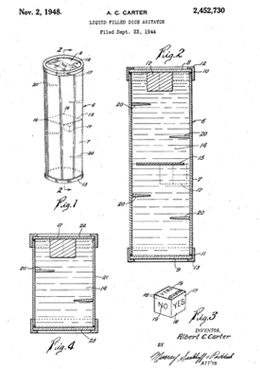
As a youngster I owned one of the ubiquitous Magic 8-Balls, and loved it. However, this novelty did not appear in its current form until 1950. Prior to that date, a number of precursors were on the market. Albert C. Carter invented the working guts, inspired by a “spirit writing” device used by his mother, Mary, a Cincinnati clairvoyant, and applied for a patent in 1944. Carter and his brother-in-law Abe Bookman formed Alabe (Al & Abe) Crafts along with store owner Max Levinson in 1946. The first device developed was called the Syco-Seer, a 7″ tube filled with dark liquid and divided into two compartments – each end held a die and a window, and each end would give different answers. The patent was assigned to Bookman and Levinson, but before the patent was granted in 1948, Carter died under somewhat mysterious circumstances – he lived a troubled life and lived his last years in flophouses, constantly broke; Bookman later said that he bought every idea Carter came up with, which kept him going until his death. “When he was sober, he was a genius,” Bookman said.


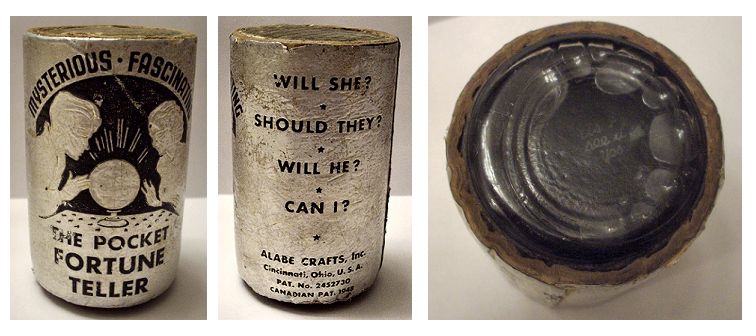
After Carter’s passing, Alabe Crafts made some improvements to the device, reducing it to a single-sided device, and sold it as Syco Slate: The Pocket Fortune Teller.


At some point it was marketed simply as The Pocket Fortune Teller, of one of which I happen to be the proud owner:

Later, Alabe changed the tube to a crystal ball; this did not help sales, but it did attract the attention of Brunswick Billiards, who produced promotional pieces in the form of a “Magic 8-Ball.” After Brunswick’s contract expired, the product continued to be marketed in that form, and is today sold by Mattel who move over a million units a year.

Q: Has the Old Wolf spoken?
A: Signs point to Yes.


External links:

Magic 8 Ball at Wikipedia

Patent Plaques: Magic 8 Ball

Timeless Toys: Classic Toys and the Playmakers Who Created Them


Exploding Hand Grenade – Exact Replica!

Had one of these when I was a kid, and I think I ordered it from Honor House. It was actually quite clever. Cap-loaded, you’d pull the pin and throw it, and the handle would come off and release a snapper which popped the cap. Wish I still had it. Have to make do with this:

Army surplus dummy training fuse, cast-iron grenade copy, routed base. Fun for the office – “Complaint Department – Please Take a Number.”

The Old Wolf has spoken.


ZCMI Parking Lot, 1950’s (and more)

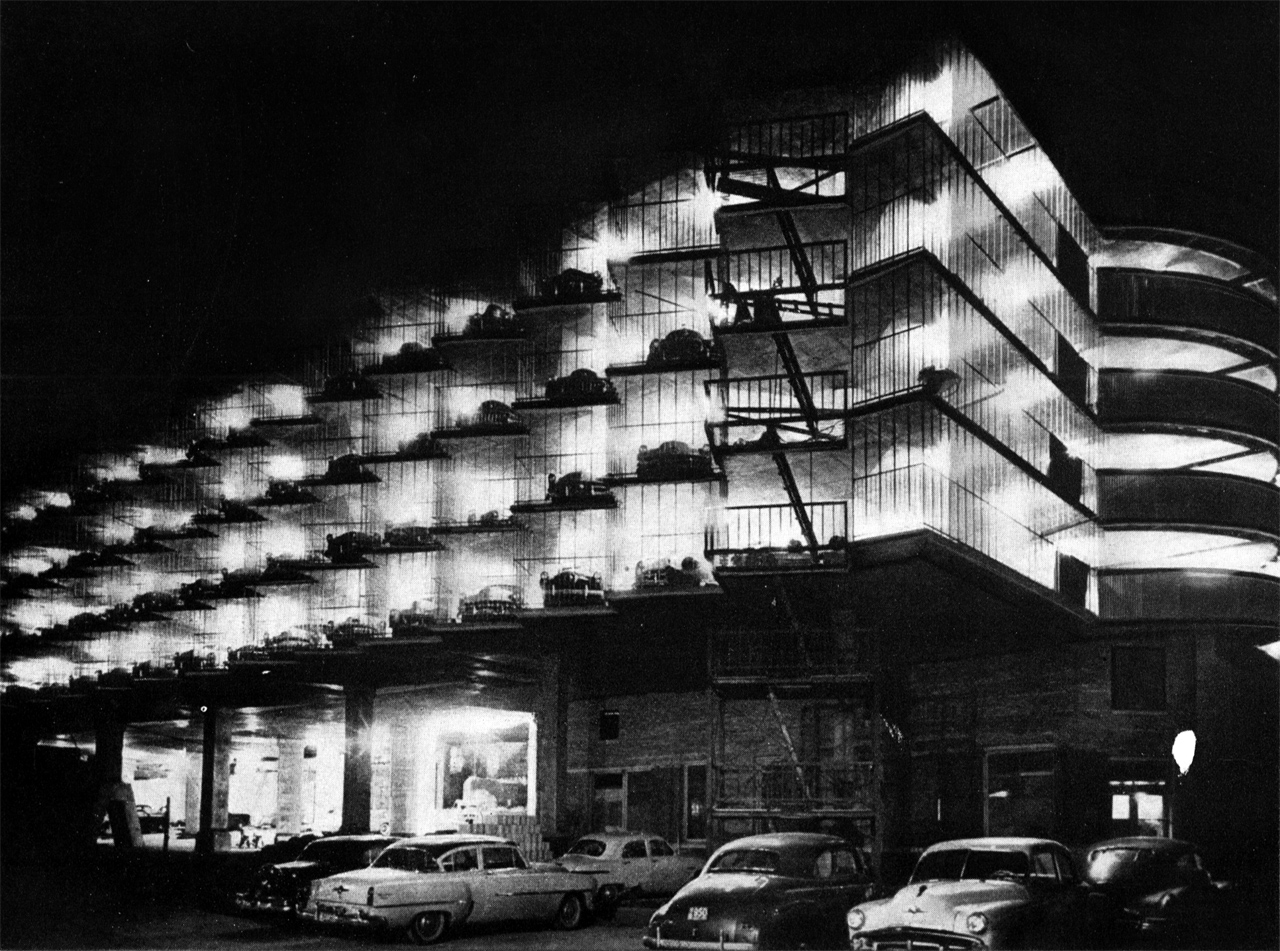
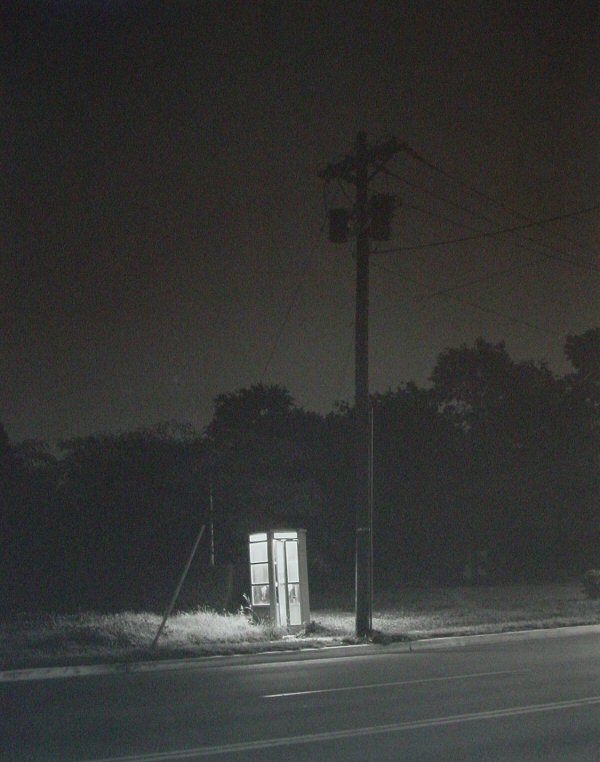
ZCMI (Zion’s Cooperative Mercantile Institute) self-parking garage at night, Salt Lake City, Utah. Image from Georges Blond: J’ai vu vivre l’Amerique, Librairie Arthéme Fayard, 1957

Capacity: 542 vehicles. Designed by L. G. Farrant

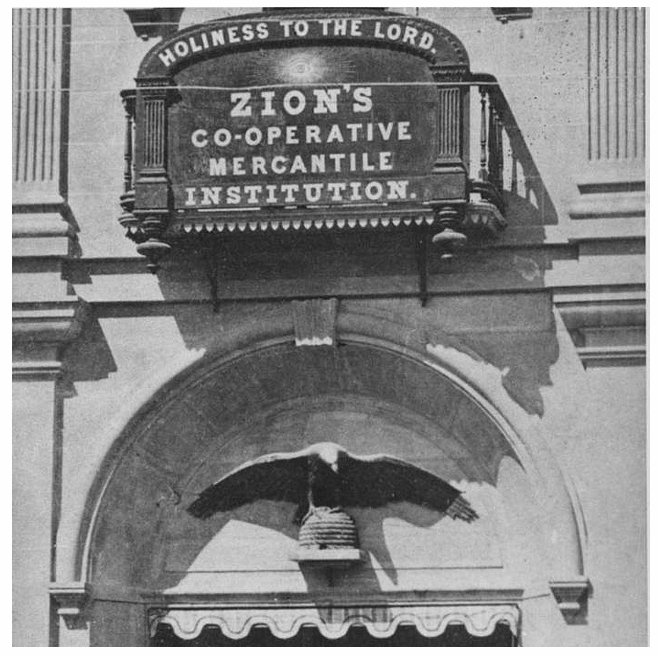
Both the garage and ZCMI, long a beloved and favorite department store, are now gone, but the store’s fabled cast-iron façade has been removed, renewed, and replaced several times as it remains a Salt Lake City landmark. Its first facelift took place when the ZCMI Center Mall was built in 1975.

An early ZCMI marquee.

ZCMI, 1910

The ZCMI Center exterior, 1975-2007

ZCMI Center interior, looking west – 1970’s

ZCMI was popular for good-quality merchandise at reasonable prices, paired with knowledgeable and competent sales help. Sadly, competing businesses in the area resulted in declining revenues, and the store was sold to May Stores (Now Macy’s, Inc.) It operated under the ZCMI name for two years before becoming Meier and Frank. in 2007, the ZCMI mall and the Crossroads Mall across the way were demolished as part of a 1.5 billion-dollar project co-sponsored by Salt Lake City and the Church of Jesus Christ of Latter-day Saints, which opened in March of 2012 as a multi-use center including retail, restaurants, business, entertainment and residential areas. City Creek itself, the original source of water for the 1947 Pioneers, was brought back to the surface and channeled through the development. The ZCMI façade was restored once more and now serves as a front for Macy’s.

ZCMI façade in its final completion stages, City Creek sky bridge behind.

Façade close-up

Façade detail

City Creek parking is now underground and includes capacity for 5,000 cars. You’ve come a long way, baby.

The Old Wolf has spoken.


New York Subway, 1950’s

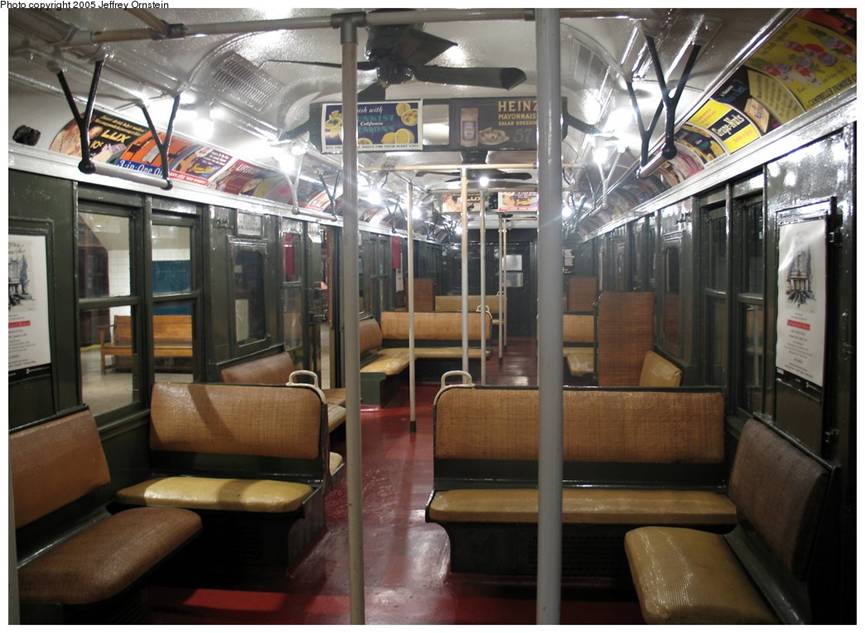
Those rattan-woven seats… I saw a picture of this subway car and had a flashback – as a child, I always thought they looked like corn on the cob. The fans on the ceiling… in the days before air conditioning, those subways could be stifling. And when the trains went over a dead spot in the 3rd rail and the lights went out, the little emergency lights in the ceiling would come on.

These were everywhere – Chiclets and Dentyne and gum, oh my – a piece for a penny. You’d put in your coin, slide the lever, and press it down to vend your prize, or just put your penny in the appropriate slot and turn the dial.

Two lines only: BMT and IRT. IND came later. When you’d get to 42nd Street, red and green light bulbs in the ceiling of the stations would guide you to the correct line, with blue ones for the cross town shuttle. Hole-in-the wall vendors: The Wizard’s Shop that sold magic; fresh-squeezed orange or papaya juice, all sorts of wonderful things.

Such elegant mosaic work in so many of the stations.

The Old Wolf has spoken.

The Proper Care of Floppies

Geek Alert: This is old humor, dating from when floppy disks looked like this:

The Proper Care of Floppies

1. Never leave diskettes in the disk drive, as data can leak out of the disk and corrode the inner mechanics of the drive. Diskettes should be rolled up and stored in pencil holders.

2. Diskettes should be cleaned and waxed once a week. Microscopic metal particles can be removed by waving a powerful magnet over the surface of the disk. Any stubborn metallic shavings can be removed with scouring powder and soap. When waxing diskettes, make sure application is even. This will allow the diskettes to spin faster, resulting in better access time.

3. Do not fold diskettes unless they do not fit in the drive. “Big” diskettes may be folded and used in “little” diskette drives.

4. Never insert a diskette into the drive upside down. The data can fall off the surface of the disk and jam the mechanics of the drive.

5. Diskettes cannot be backed up by running them through the Xerox machine. If your data is going to need to be backed up, simply insert two diskettes together into the drive. Whenever you update a document, the data will be recorded on both diskettes.

6. Diskettes should not be inserted or removed from the drive while the red light is flashing. Doing so could result in smeared or possibly unreadable text. Occasionally the red light continues to flash in what is known as a “hung” or “hooked” state. If your system is “hooking” you, you will probably need to insert a few coins before being allowed to access the disk drive.

7. If your diskette is full and you need more storage space, remove the disk from the disk drive and shake it vigorously for two minutes. This will pack the data enough (Data Compression) to allow for more storage. Be sure to cover all the openings with scotch tape to prevent loss of data.

8. Data access time can be greatly improved by cutting more holes into the disk jacket. This will provide more simultaneous access points to the disk.

9. Diskettes can be used as coasters for beverage glasses, provided that they have been properly waxed beforehand. Be sure to wipe the diskettes dry before inserting into drive. (see item #2 above)

10. Never use scissors and glue to manually edit documents. The data stored is much too small to be seen by the naked eye, and you may end up with data from some other document stuck in the middle of your document. Razor blades and scotch tape may be used, provided the user is equipped with an electron microscope.

11. Periodically spray diskettes with insecticide to prevent system bugs from spreading.


The Old Wolf has spoken

The Flight of the Bee Wolf

Despite the fact that in the last 21 years, computing power has increased by orders of magnitude from what it was in 1990, this article still makes some intriguing and valid points, and is reproduced here for your edification.


STOP BIT • Ben Smith
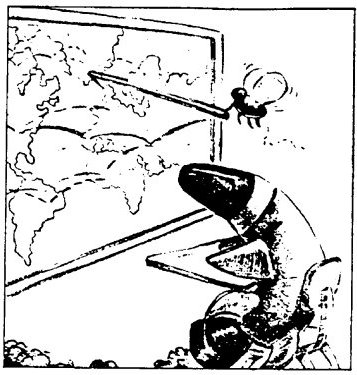
THE FLIGHT OF THE BEE WOLF

Reprinted from BYTE, June 1990, Page 384

Compared to this humble insect, a cruise missile is downright stupid

Today, multiprocessor micro­computers handle hundreds of tasks at virtually the same time. Desktop workstations perform operations that are more complex than those performed by room-size main­frame computers five years ago-and they do it faster. We are using AI systems in real applications without expenditures of millions of dollars. It seems that we are entering the age of truly intelligent systems.

But consider the bee wolf. This seem­ingly insignificant creature is a bee­hunting fly that tunnels its single-occu­pancy home in beach sand. Even though hundreds of bee wolves have their tun­nels in the same area of a beach, each bee wolf will return to its own home and no other.

A biologist covered the opening of one bee wolf’s tunnel with sand to see what the insect would do when it returned and found no tunnel. Without hesitation, the bee wolf went to the location of its entry and began digging.

The biologist noted that each time the bee wolf left for a hunt, it would fly a pat­tern above its home before departing. The creature appeared to be memorizing landmarks. The biologist tested his theory (not to mention the bee wolf’s patience with biologists) by sketching the layout of pinecones around the entrance while the unsuspecting subject was at home. Soon the bee wolf emerged from the tunnel and flew its pattern before heading out in search of prey. Once the bee wolf had departed, the researcher moved the array of pinecones over about a half-meter.

When the bee wolf returned, it at­tempted to find its private cave at the cen­ter of the relocated pinecones. It dug in the sand for a second or two but found no tunnel.

Unlike members of our species, the bee wolf did not call its lawyer, psychia­trist, or parish priest. Instead, it realized that something was amiss and flew a higher pattern over the territory. From this new perspective, it was able to dis­card the erroneous references to pine­ cones and promptly located the true en­trance.

The first computer analogy to this rec­ognition and guidance problem is in a military application. The self-navigating cruise missile uses a system called ter­rain-contour matching (TERCOM). In­side the cruise missile’s guidance com­puter is a set of computer-encoded maps of checkpoints along the programmed flight plan. At these checkpoints, the TERCOM computer compares readings of a radar altimeter with a contour map stored in its memory. If the computer finds no match between the expected data and the real data, it searches for a match with the map of the surrounding area. Once the match is found, the com­puter adjusts the course of the missile to account forthe error.

To fool the cruise missile, you just move the target, leaving behind a dummy target. Because the cruise missile de­stroys itself in the process of destroying its target, it never can discover that it has made a mistake.

Even though the flight-control com­puter in the missile weighs less than 100 pounds, it has the equivalent of millions of transistors. Producing each of these computers costs a good part of a million dollars. In contrast, the bee wolf s brain, which is no bigger than the head of a pin, must carry on far more complex opera­tions than just finding its host’s way home. It must provide control to an aero­dynamically instable machine, its body. The bee wolf also can walk, dig, locate and outmaneuver its prey, and find a mate (a task that would be disastrous for a cruise missile). Compared to the bee wolf, the cruise missile is downright stupid.

Many people falsely place computers in a scale of intelligence well beyond that of the human mind. But even a person with severe learning disabilities per­forms far more complex mental opera­tions in a far shorter time than the largest and fastest computer. What size com­puter and program could control a walk­ing robot that could rise from a chair, put on a coat, go outside, walk around the building on rolling terrain, establish the location of the entrance from visual in­formation, and reenter the building-all this, while maintaining respiration, blood flow, and the input from millions of sensors for pressure, temperature, light, sound, and chemical analyses and production? Now consider the scope of the human brain. How much data is rep­resented by all the memories in just one human being? What complex relation­ship exists between memories to create knowledge?

From this perspective of information processing, you must admit that com­puters are merely sophisticated adding machines. Even when this year’s high­performance machines outperform last year’s model by an order of magnitude, they are still not noticeably closer to the performance of the humble bee wolfs brain, let alone the performance of the human mind.•

Ben Smith is a BYTE technical editor.

Illustration: Karen Maitejat ©1990


Reprinted by the Old Wolf