Make your passwords even stronger

Back in 1998, Scott Adams did a Dilbert strip that made many IT professionals cringe in sympathy.

12717.strip.zoom

As painful as this may seem, it’s one of the few times that Adams had underestimated where technology was going.

Ars Technica recently published an article entitled “Why passwords have never been weaker—and crackers have never been stronger.” I recommend it to anyone who has data on the internet that they want to keep secure. I’ve posted about passwords before, but this article explains why the urgency to use passwords that are uncrackable is even greater. It’s a technical read, but even if you don’t read it, you should be updating all your passwords.

“Newer hardware and modern techniques have also helped to contribute to the rise in password cracking. Now used increasingly for computing, graphics processors allow password-cracking programs to work thousands of times faster than they did just a decade ago on similarly priced PCs that used traditional CPUs alone. A PC running a single AMD Radeon HD7970 GPU, for instance, can try on average an astounding 8.2 billion password combinations each second, depending on the algorithm used to scramble them. Only a decade ago, such speeds were possible only when using pricey supercomputers.”

Recommendations:

  • Use a different password for each account. If one is compromised, the others remain secure.
  • Use combinations of multiple words (Seven Whipped Aardvark Quonset) which would take 27 undecillion years for a desktop PC to crack.
  • “It’s also important that a password not already be a part of the corpus of the hundreds of millions of codes already compiled in crackers’ word lists, that it be randomly generated by a computer, and that it have a minimum of nine characters to make brute-force cracks infeasible. Since it’s not uncommon for people to have dozens of accounts these days, the easiest way to put this advice into practice is to use program such as 1Password or PasswordSafe. Both apps allow users to create long, randomly generated passwords and to store them securely in a cryptographically protected file that’s unlocked with a single master password. Using a password manager to change passcodes regularly is also essential.”

The Old Wolf has spoken.

Selling it

Consumer Reports runs a section called “Selling It,” which documents advertised goofs, glitches and gotchas. Years and years ago I came across a bit on a box of Cheerios™ that offered consumers a free T-Shirt. The fine print on the coupon indicated that shipping and handling was only $18.95. This was back in the days before the internet or digital photography, so I wasn’t able to capture or document it, but I was absolutely gobsmacked that  General Mills would have the chutzpah to put something like this on their product, unless it was a failure in their quality control process.

Sadly, when it comes to separating workers from their dollars, some people have neither scruples nor morals. In fact, the following ad sits at the top of my “Advertising Hall of Shame”. It appeared in Parade Magazine, on August 12, 1990 (click for a larger version):

I have never seen a more deceptive, deviously-crafted advert in my entire life. It is designed to make the uneducated or the unaware think they are getting a satellite dish for $5.00 – even though it says multiple times that they’re not. In fact, what the ad says is:

“We’re selling pretty rabbit ears. Throw away yours, and buy ours.”

But here’s the text:


Why Are We offering Our Nationally Advertised
GFX-100 INDOOR TV “DISH'” ANTENNAS
for only $5

  • No cable box necessary–uses “RF” technology to capture signals right out of the air!
  • Brings in every local VHF and UHF channel from 2 to 83!
  • Legal in all 50 states!
  • No wiring or installation!
  • Works like ordinary pair of “rabbit ears”!
  • You pay NO satellite fees because you DON’T use satellite signals!!!
  • You pay NO cable fees because you’re NOT getting cable!!!

ALLOW UP TO 6-8 WEEKS FOR SHIPMENT. FULL 1-YEAR MONEY-BACK GUARANTEE.

GUARANTEED TO FIRST 10,000 WHO RESPOND BEFORE SEPTEMBER 25, 1990
Throw away your old TV rod antenna! The GFX-100 looks like an outdoor satellite “dish,” but works indoors like ordinary “rabbit ears.” No wiring or installation! Legal in all 50 states. You pay NO cable fees because you’re NOT getting cable!!! You pay NO satellite fees because you’re NOT using satellite technology or service!!! Works entirely via proven “RF” technology–actually pulls signals right out of the air. Instantly locks into every local VHF and UHF channel from 2 to 83 to bring you their movies, sports and special events just like an ordinary pair of “rabbit ears.” No cable box or special attachments needed! Enhances color and clarity, helps pull in weak signals. Compatible with all TVs from 3-inch portables to giant 7-footers. Sits on any TV top in less than 4 linear inches of space! Guaranteed not to utilize, replicate, transmit or interfere with any satellite signal. Complies with all applicable federal regulations. Not technical razzle-dazzle but the sheer aesthetic superiority of its elegant parabolic design make the GFX-100 a marketing breakthrough! At this price, put one on every TV in your home! (Sorry, limit 5 per address. No dealers or wholesalers, please!) We reserve right to extend above time and quantity guarantee. Hurry!
© 1990 RBM Ltd., 1200 Shames Drive, Westbury, NY 11590


Almost every sentence in this ad can be interpreted one of two ways. It’s so devious that it’s almost beautiful. I noticed with wry humor that they never answered their own question, but the answer is clear: “Because we want your money.”

I’m curious how many of these units RBM moved, because nine years later, on July 2, 1999, the same ad appeared in the Weekly World News (which goes to show which demographic they were targeting)

Word-for-word the same – only the price has doubled.

Sheesh.

What will life be like in the year 2000?

A wonderful series of French postcards (no, not that kind, you deviants) from 1898 depict what life would be like 102 years in the future. Some of them are straight out of Jules Verne (particularly their notions of aerodynamics… what’s holding some of those things up in the air is beyond me) but others hit surprisingly close to the mark, allowing for the fact that everything is cast in terms of 1898 technology. Here are some selected images – click each one for full-size.

A torpedo plane

Motorcycle policemen

Schooling

A house on the road

On the hunt for microbes. The image on the right is a electron micrograph of the T4 bacteriophage virus, which for all the world looks like a Lunar Excursion Module.

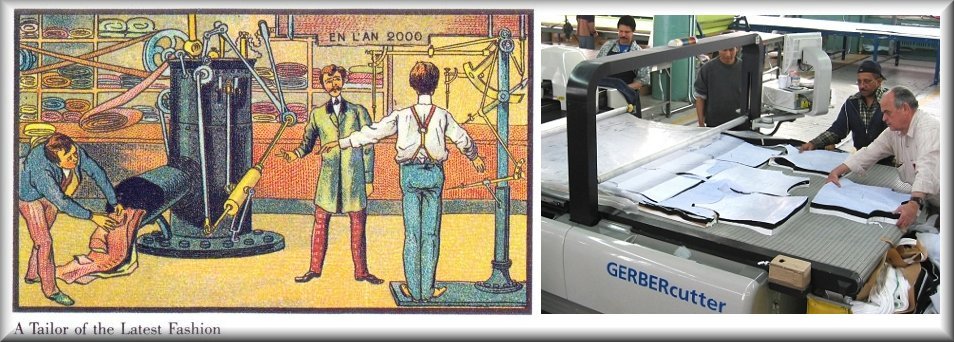
We’re not quite to the stage of computerised  tailors, but we’re getting close. I’m still waiting for replicators.

Remote-control farming. The image on the right shows what could be a very reasonable control panel with large LED display for directing the operation of GPS-controlled combines, planters, and whatnot – and this at a time when only a few farms had electricity.

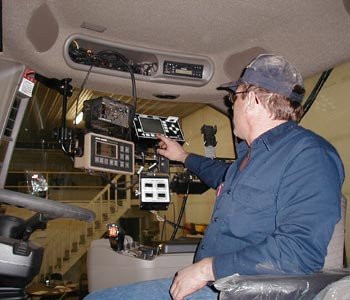
Modern farmer in his GPS-controlled tractor. The technology is there – making something like this practical should not take more than a decade if people were to put some development effort into it.

Electric train concept on the left, Maglev train demo in China on the right.

Heating with Radium. While the concept is novel, the use of radium in industry was fraught with tragedy; obviously direct radioactivity is not a practical heat source.

Motorized skates. On the right, spnKiX – see the KickStarter campaign here.

Electricity for entertainment. The comfortable domestic scene at left, listening to the 21st-century Gazette on a wax recorder, pales in comparison to today’s hypnogourds. And there’s still nothing on worth watching. Except “Fringe.”

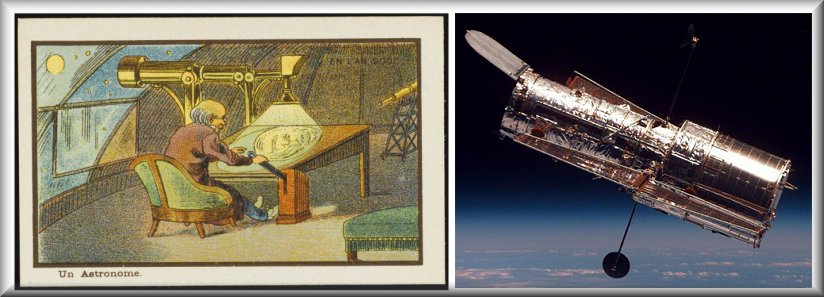
An astronomer viewing the heavens from the comfort of his desk. The Hubble space telescope surpassed all imaginings.

I insert this one because despite the imagined advances in technology, a commensurate advance in social awareness didn’t seem part of the program. The natives look like they were drawn by Jean de Brunhoff (if you’ve ever read “Le voyage de Babar.”

We have a problem with perspective as well as aerodynamics here. The cab on the right is about to take its wing off and crash in flames. Apparently, putting wings on something will allow you to be able to counteract the force of gravity. Also, I chuckled when I noticed that the cab driver still sits outside the passenger compartment, as cabriolet drivers did in the 19th century.

Caption on the left: “An Airbus”. Compare this with the massive Airbus beluga on the right.

Advance Sentinel in a helicopter; modern helicopter drone.

As silly as the Roomba seems, especially when you watch a cat riding one around, it shows that what the mind can concieve, the mind can achieve.

So the question now arises, what will life be like in 2102? We don’t know what we don’t know, and many of the advances we’ve seen in our own lifetimes could not have even been dreamed of in 1898. If we can keep from blowing ourselves up or melting ourselves down, the next century promises to be terribly exciting in terms of technology, given the exponential rate of increase. But if a descendant of mine 100 years from now sits at his or her thought-directed device and inscribes a 3-D blog entry in a bio-electronic storage medium that they are still waiting for that flying car, I’m going to be pissed.

The Old Wolf has spoken.

Ten Reasons Why You Should Never Accept a Diamond Ring from Anyone…

… even If They Really Want to Give You One

99414998_diamonds_239601c

1. You’ve Been Psychologically Conditioned To Want a Diamond

The diamond engagement ring is a 63-year-old invention of N.W.Ayer advertising agency. The De Beers diamond cartel contracted N.W.Ayer to create a demand for what are, essentially, useless hunks of rock.

2. Diamonds are Priced Well Above Their Value

The De Beers cartel has systematically held diamond prices at levels far greater than their abundance would generate under anything even remotely resembling perfect competition. All diamonds not already under its control are bought by the cartel, and then the De Beers cartel carefully managed world diamond supply in order to keep prices steadily high.

3. Diamonds Have No Resale or Investment Value

Any diamond that you buy or receive will indeed be yours forever: De Beers’ advertising deliberately brain-washed women not to sell; the steady price is a tool to prevent speculation in diamonds; and no dealer will buy a diamond from you. You can only sell it at a diamond purchasing center or a pawn shop where you will receive a tiny fraction of its original “value.”

4. Diamond Miners are Disproportionately Exposed to HIV/AIDS

Many diamond mining camps enforce all-male, no-family rules. Men contract HIV/AIDS from camp sex-workers, while women married to miners have no access to employment, no income outside of their husbands and no bargaining power for negotiating safe sex, and thus are at extremely high risk of contracting HIV.

5. Open-Pit Diamond Mines Pose Environmental Threats

Diamond mines are open pits where salts, heavy minerals, organisms, oil, and chemicals from mining equipment freely leach into ground-water, endangering people in nearby mining camps and villages, as well as downstream plants and animals.

6. Diamond Mine-Owners Violate Indigenous People’s Rights

Diamond mines in Australia, Canada, India and many countries in Africa are situated on lands traditionally associated with indigenous peoples. Many of these communities have been displaced, while others remain, often at great cost to their health, livelihoods and traditional cultures.

7. Slave Laborers Cut and Polish Diamonds

More than one-half of the world’s diamonds are processed in India where many of the cutters and polishers are bonded child laborers. Bonded children work to pay off the debts of their relatives, often unsuccessfully. When they reach adulthood their debt is passed on to their younger siblings or to their own children.

8. Conflict Diamonds Fund Civil Wars in Africa

There is no reliable way to insure that your diamond was not mined or stolen by government or rebel military forces in order to finance civil conflict. Conflict diamonds are traded either for guns or for cash to pay and feed soldiers.

9. Diamond Wars are Fought Using Child Warriors

Many diamond producing governments and rebel forces use children as soldiers, laborers in military camps, and sex slaves. Child soldiers are given drugs to overcome their fear and reluctance to participate in atrocities.

10. Small Arms Trade is Intimately Related to Diamond Smuggling

Illicit diamonds inflame the clandestine trade of small arms. There are 500 billion small arms in the world today which are used to kill 500,000 people annually, the vast majority of whom are non-combatants.

In addition, here is an article from Atlantic’s February 1982 issue that deal with the core issues – and since then, things have only gotten worse.

The diamond invention is far more than a monopoly for fixing diamond prices; it is a mechanism for converting tiny crystals of carbon into universally recognized tokens of wealth, power, and romance. To achieve this goal, De Beers had to control demand as well as supply. Both women and men had to be made to perceive diamonds not as marketable precious stones but as an inseparable part of courtship and married life.” (February 1982 ATLANTIC MAGAZINE)

Because of the steep markup on diamonds, individuals who buy retail and in effect sell wholesale often suffer enormous losses. For example, Brod estimates that a half-carat diamond ring, which might cost $2,000 at a retail jewelry store, could be sold for only $600 at Empire [Diamonds Corporation]. (ibid.)

I’m truly grateful that the goodwoman of my house doesn’t like diamonds, but trends to less conventional tastes – this is what she begged for as a wedding band:

Many thanks to Paul Taylor of Wapsi Square for the link to this article.

The Old Wolf has Spoken

(Cross-posted from Livejournal)

Ah! Comic books!

Came across this over at Frog Blog,

A young boy reading comics outside a store in Nebraska in 1948.

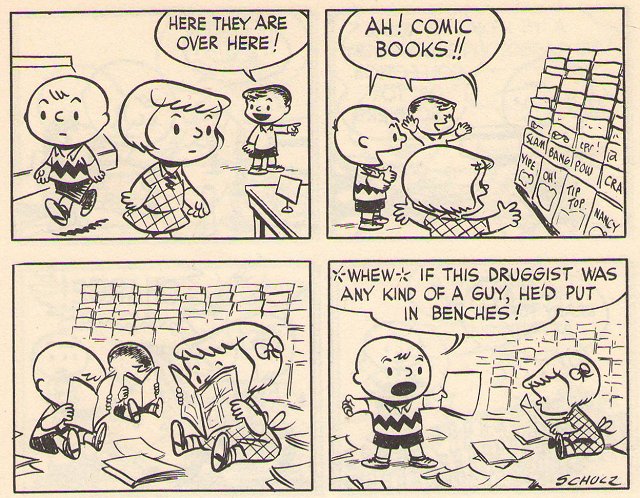
and was immediately put in mind of this old Peanuts™ strip:

Notice the presence of “Nancy” in both cartoon and photograph.

The titles are interesting to contemplate; Archie is just about the only one that still exists. If I had been smart enough to save my comics collection, I could have put all my kids through college.

The Old Wolf has spoken.
It’s hot, and getting hotter.

I’ve never taken a locked-in-concrete stance on the issue of climate change because, simply, I don’t understand all the variables. That said, my gut tells me that the amounts of greenhouse gases we have produced since the beginning of the industrial revolution have got to be taking a toll on our global ecology.

Then along comes an article in The Register, claiming that based on a recent study, temperatures are going down rather than up. So I put the question out into the ether, where I happen to have friends and associates who are far wiser about such matters than I, including career professionals in the field. The responses I got back were enlightening, and I summarize them here.

The chart below comes from the Register’s article.

  1.  The first thing to notice is that the cooling trend line in the above chart is deceptive, and that statistics can be made to say anything you want them to. If you were to begin it at the “Little Ice Age,” it would be trending decidedly upward, with a sharp spike noticeable around the beginning of the 20th century.
  2. The data recorded in Esper’s study (again, see the article linked to above) are of interest, and will doubtless be put through the scientific wringer to see how they add to our overall knowledge of the climate and its behavior. Using a single data set, to draw definitive conclusions about long-term trends is not sound science, however, and Esper’s team does not do so. In this case, either the author of this article misunderstood the paper, or – given the Register’s reputation as a bully pulpit for climate-change skeptics – used the data to support its own pre-conceived conclusions.
  3. Esper’s data focuses exclusively on northern Scandinavia, rather than multiple lines of numbers taken globally. An accurate picture of what is happening planetwide would have to be extrapolated from sources such as ice cores, sediments, tree rings and other empirical data gathered at different time points in varying locations throughout both hemispheres. One such chart attempts to pull together a number of different analyses into a single graphic:

Source and key here.

4.   Well-understood orbital mechanics have satisfactorily explained previous warming periods throughout history.
5.   The Paleocene-Eocene Thermal Maximum, which took place about 55 million years ago, saw the temperature of the world rise 6 °C over a period of 20,000 years, resulting in numerous extinctions but also the rise of other modern mammalian orders. While the cause is not yet clear, it appears that a massive outgassing of carbon from the oceans followed by uncontrolled warming created a planet-wide hothouse that took 150,000 years to cool off. Compare this with the Medieval Warm period, a blip on the grid by comparison, which affected only Europe and the North Atlantic; during the same time other parts of the globe were suffering wet spells or severe drought.

My own experience is that it’s hot, and getting hotter. The past six months have broken numerous local, nationwide and historical heat records since recordkeeping began. If the current trend continues, my grandchildren may experience a world that could be 4.3 °F to 11.5 °F hotter than it is today, and such a heat differential will lead to an increase of the kinds of drought and severe storms we have been seeing in the past year. I have lived in the same area in the west for over 40 years. Over time, our temperatures have risen and our precipitation, particularly in the winter, has decreased. This does not bode well for the future, where our desert state depends on scarce water resources for survival; it’s not the kind of world I want to bequeath to my posterity.

The Battle over Climate Change

A recent article in PopSci lays the battle lines out fairly clearly, and it’s not pretty. When solving a crime, detectives still look at the old standbys of motive, method and opportunity. In the battle over climate change, it helps to ask the single question “Who benefits?” In other words, follow the money. While one could make a case for scientists stirring up public outrage with an eye toward prestige and grant money, or politicians using global warming as a vote-getting strategy, it seems far less an incentive than the prospect of billions in profit lost by industries and corporations which will be impacted by increased restrictions on the amount of carbon they are allowed to pump into our atmosphere.

There are places in the world where people are killed for the price of a meal; small wonder that the amounts of money and power that are at stake result in a firestorm of scientific legerdemain, character assassination and even intimidation and death threats directed at honest scientists who are pursuing nothing but scientific conclusions based on empirical data.

When I distil the admixture of data down to its undiluted essence, I can’t escape the conclusion that we are fouling our nest with exponentially-increasing speed, and those who say it ain’t so have a vested interest in keeping climate change off the table. The good news is that despite adversity (eppure si muove!) scientists have a tendency to keep doing science, and the more time goes on, the clearer the picture will become. In the end (if the science is sound) the only skeptics will be meeting in the room across the hall from the flat earth society.

The Old Wolf has Spoken.

“If we had any, they’d be on aisle three.”

“The Golden Rule for Hardware Dealers: Never let an item in your stock approach the danger level.”

Ah, those were the days. Nowadays you walk into Wal-Mart, or Target, or K-Mart, or Home Depot – and it seems that empty hooks and blank spaces on shelves are the rule rather than the exception.

Challenge No. 1 is to find someone to help you. I’ve walked the length and breadth of these stores and there have been days when not a single associate was to be found. Either they have a 6th sense that lets them know when a customer is in the vicinity so they can hide, or the companies have cut their staff to bare bones – probably a combination of both.

Now that you’ve actually cut one out of the herd, you ask for what you need.

“I’m looking for a stud sensor.”

“What’s that?”

“You know, a device to help you find the studs in your wall so you know where to put nails.”

“If we had any, they’d be on Aisle 3.”

“Yeah, I was on aisle 3 and I couldn’t find what I need.”

“*sigh* – come with me.”

“Here.”

“Well, that’s the kind with a magnet for locating nails. I want the kind that uses proximity sensing.”

“They don’t make those.”

*I show him my old one, which has gone to its reward* “Like this. I need a new one.”

*shrug*

“Who does your ordering?”

“Chicago.”

“We’re in Salt Lake. How could Chicago possibly know what people in Salt Lake need?”

*shrug*

———

Now, compare that with the experience you might have had in a hardware store in the 50’s.

“I’m looking for a left-handed spud wrench.”

“Come with me. We have three kinds. This one has teeth, this one is smooth, and this one is our nicest model – it’s made of solid brass and plays the Star Spangled Banner.”

“Nice. Actually, I was hoping for one that played Liebestraum.”

“I can have one here for you tomorrow. Anything else I can help you with?”

———

The world has changed, and sadly not for the better. Economies of scale, big box stores that pack it deep (all from China, of course) and sell it cheap, means that the customer’s experience is the last thing that counts for anything. Moving product and reducing costs is king. Even if you’re able to get hold of a store manager and ask some probing questions – like “why are you out of all five kinds of lock washers? Doesn’t anyone pay attention to inventory levels?” you will probably get a look that will make you wonder if you put your toupee on backwards this morning. They don’t know, and they don’t care.

Of course, I’m dreaming of a world that’s gone forever. My kids probably think that the way things are today is the way they’ve always been, since they don’t have an experience of anything else. But the disconnect between what I remember (stores that actually went out of their way to get customers in and keep them happy, and took pride in their business) – and what one finds as the standard operating procedure today (“If we don’t have it, that’s tough – buy something else or get out”) is so great that it makes daily errands a real challenge.

Naturally, there are exceptions. I’ve been in some lovely boutique stores and smaller mom-n-pop outfits that still care, but Curiosity is likely to find water on Barsoom faster than you can locate one. If you do find one, spread the word – they would appreciate the recommendations.

The Old Wolf has spoken.



Belo Monte dam project challenged.

“Amazonian chief and indian tribe spokesman Raoni cried when he learned that Brazilian president Dilma approved the construction of the hydroelectric plant of Belo Monte even after tens of thousands of letters and emails and signed petitions with 600,000 signatures were addressed to her – these were ignored.”1

Now, however, it appears that the opposing voices have had an impact – at least for the moment. A Brazilian federal appeals court halted construction efforts until indigenous groups have been appropriately consulted. The ruling states that the Brazilian Congress rushed the project through without required due diligence on the social and environmental impact.

Whether the public outcry will be sufficient to halt the project for good remains to be seen, because there is a huge amout of money and power on the line for a lot of people, but the victory should be savored nonetheless – and knowing that there are people out there who care may bring a small measure of comfort to Raoni and his people.

More information on the ruling from The Guardian.

The Old Wolf has spoken.


1Irondance

Electronics for Dummies

Or, “Oh for simpler days.”

When I was 8, I had a big brother for a very brief time. He was 14, and awesome in the 1950’s “Homer Price” sort of way. He built his own ham radio equipment, had all the soldering tools and an oscilloscope, and had a cool slingshot, and did really neat things at Hallowe’en, and I worshiped him. I regret sincerely that that particular domestic situation didn’t last.

But it was thinking about radios that got me going.

This image appeared over at Teresa Burritt’s Frog Blog, and I got all misty. I remember looking at all of brother’s electronic bits and pieces, and was fascinated by the pretty stripes on the resistors – at 8, I would not have been able to grasp the concepts of resistance, nor appreciate the mnemonic power of  “Bad Boys Rape Our Good Girls But Violet Gives Willingly”. Then a career got in the way, and then technology exploded by several orders of magnitude, and now I’d be about as useful repairing a circuit board as an Australopithecus with a Rolls-Royce jet engine.

But there’s something about going back to basics.

When my son was 12 or thereabouts, a “build your own radio” project happened. I don’t’ recall if he asked me, or I did it just to show him how it was done, or it was some scout thing or other – but a radio got built out of some junk, and it worked.

This was pretty much the design. A toilet paper roll, some copper wire, a headset, a germanium diode, and some assorted junk from around the house, and we were able to listen to KSL and some other local AM stations. I don’t even know if ours had a condenser on it, and I couldn’t tell you why it would be needed or not – I’m still that ignorant.

Life is full of choices, and every choice has prices and benefits. There are so many things on my bucket list, I don’t know if I’ll ever get to all of them. But understanding enough about electronics to be able to do repair work on my little Conn Theaterette organ is one of them.

This one’s not mine, but it looks just the same. All component parts, tubes, you name it. With the spec sheets and my trusty voltmeter, I should be able to keep the thing in top running condition… if I only understood the basics. Which I don’t. Not having studied my Agrippa. Hey, Macarena! Wait, there goes the ADD thing again…

But the point is, I could still learn. Nowadays, circuit boards and electronic parts are so cheap to manufacture that nobody bothers to repair things any more – you just throw it away, and buy a new one. But the principles on which they are built are no different. This voltage in, that voltage out – watts, ohms, condensers, capacitors – they’re all still there, just tiny. And, there are things out there to help.

While things like this are still to be had on eBay,

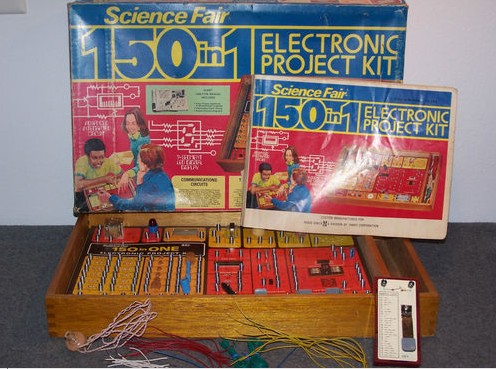
I think a kit like this would be a good place to start,

along with something like this:

And the parts are out there. With audiophiles becoming more and more numerous, the manufacture of vintage tubes has experienced a resurgence. Folks like me may never be able to tell the difference, but there are people who swear by component sound over microcircuitry, just like some folks will never give up their vinyl.

So hope is not lost. I’ve got too much on my plate now to think about it, but this blog entry will be a good reminder for me when things calm down a little.

The Old Wolf has spoken.