In the days before desktop publishing. I can’t imagine having to set this in hot lead or moveable type.
It’s all etaoin shrdlu to me…
The Old Wolf has spoken.
In the days before desktop publishing. I can’t imagine having to set this in hot lead or moveable type.
It’s all etaoin shrdlu to me…
The Old Wolf has spoken.

CompuServe ad, 1982
As I commented somewhere else, when I think of how hard it was to connect to the “Internet” as it was back then, using clunky equipment, acoustical 300 baud modems, and processors slower than my current watch, I am astonished at myself for thinking it was all pretty sweet.

Sitting in front of my Macintosh LC, watching NCSA Mosaic download a progressive jpeg file scan by scan, and still thinking that this was the neatest thing since sliced bread? I realize of course, that it took a while to bring processing speeds and data transfer rates up to where the process could be considered cost-effective:

This Dilbert strip was from May 7, 1997; check the strips from the previous two days as well, they’re pretty funny in retrospect.
Now, with a core i7 machine and a 50MB internet connection (Pretty sweet, huh? Well, just Google around to see what kind of speeds Korea gets on a regular basis. All things are relative, still) I finally feel as if I have the processing power and download speeds to take care of my basic needs. I don’t do high-overhead gaming or image rendering, so I can’t see really needing anything faster for daily use. [1] But it’s taken us 30 years to get here.
<rant> Of course, I’m composing this post on an HP Pavilion Entertainment laptop, one of the worst purchases I ever made back in 2008. This computer is the piece of hqiz from hell (it was nice to see similar things from Shamus over at Twenty Sided, I felt totally vindicated in my white-hot hatred for Hewlett-Packard); the only thing I can say on its behalf is that five years later, it’s still running and I’ve only had to replace the cheap-john battery twice. I know others who have had much less favorable experiences with this particular line, mainly dead computers. The AMD Turion 64 is probably one of the slowest processors they made back in that day, combined with a pre-installed version of Vista and enough bloatware to delight the most jaded software rep; by the sacred skull of Mogg’s grandfather, I’ve ridden tricycles that could go faster. The kindest thing I ever did for myself was to wipe the whole machine and install Win7 Pro, which virtually doubled the response time… and it’s still slow. I’d like to get the entire corporate chain that designed and approved this abomination and condemn them to a year of using their own garbage… with a dial-up connection.</rant>
But Moore’s Law is still in force. Despite the fact that my work-a-day machine is pretty satisfying to use, I can’t possibly imagine what my two granddaughters, now aged 9 and 6, will have seen by the time they get to be my age. I won’t be alive, and I already envy them.
The Old Wolf has spoken.
[1] Well, I lied. If I were richer than Crœsus, I’d buy a professional system and a really nice video editing package, but that’s just a pipe dream for the present.
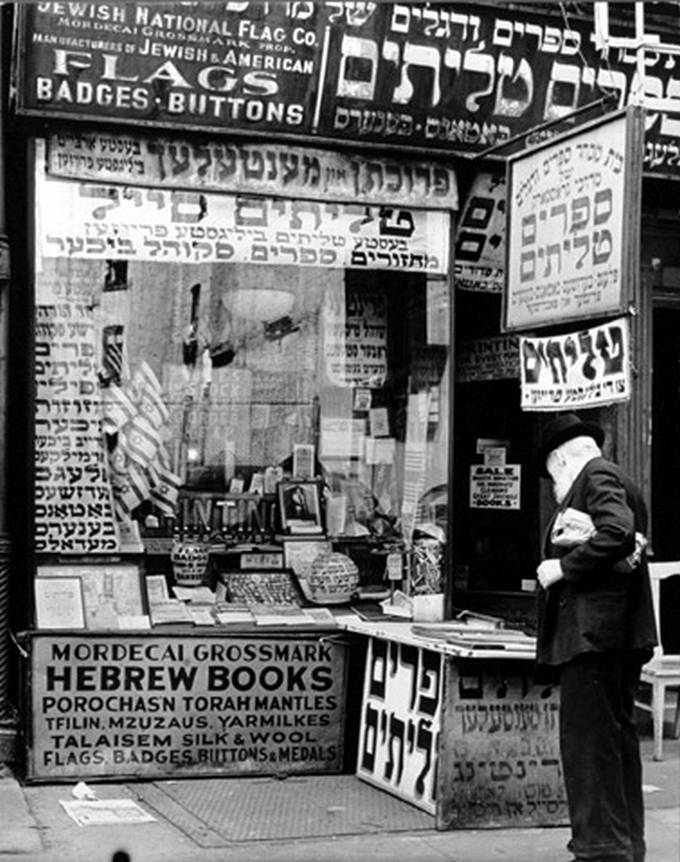
The bookshop of Mordecai Grossmark, around 1934, in New York City.
A recent question over at Reddit asked, “Can you Terrify Us in Just Three Words?”
Below, the top entries or ones that I found especially terrifying (with the really sick ones, sadly abundant, removed for family friendliness).
Search History Subpoena
You Tested Positive
No Toilet Paper
Frenulum Papercut Extravaganza [1]
Nuclear Launch Detected
We Should Talk
You’ll Never Retire
Wow, That’s Small
Continuous Kidney Stones
Everyone Dies Alone
Look Behind You
My Office. Now.
You’re Being Audited
Digital Rights Management
President Kim Kardashian
You Have Cancer
Nutella Was Discontinued
Amy’s Baking Company
No More Bacon [2]
Winter is Coming [3]
President Sarah Palin
I’d have to agree, most of these are downright terrifying. I’m reminded of Hemingway’s bleak short story: “For sale, baby shoes. Never worn;” also, the shortest horror story ever written: “The last man on earth sat alone in a room. There was a knock on the door.”
It was interesting to see what people consider terrifying.
The Old Wolf has spoken.
[1] Ouch! I’ve done my tongue on an envelope, but never this.
[2] One of the most terrifying of all
[3] I’m not a Game of Thrones fan – I’ve neither seen nor read it – but at least I recognized this.
… Well, at least not if you’re a guy. That’s the conventional wisdom, right?

So, conventional wisdom would dictate that if you’re a guy, you’ll score very poorly on this test:

Try it if you’re curious – it’s an interesting experiment.
I expected to fail miserably; my wife is always telling me I can’t tell the difference between red, maroon, magenta, and… what was the name of that color?
Well, as it turns out, I’m on the very high end of the perception scale. Here’s what I managed to do:

My score was 8 – the lower your score, the better you did. The highest (worst) score for my gender and age range was 1970.

And this chart shows where my weaknesses lie:
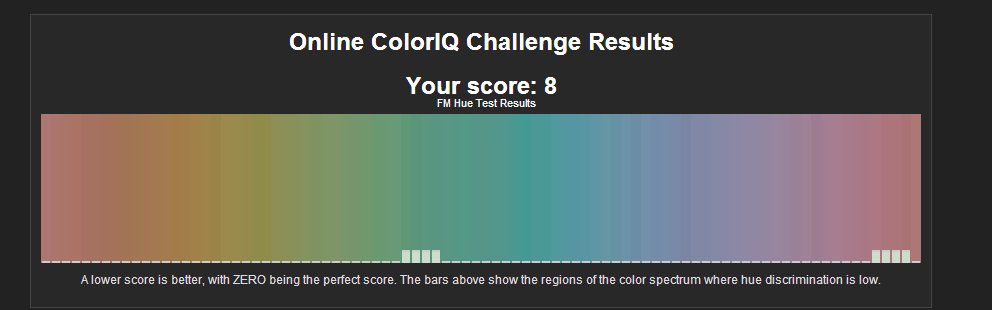
So in terms of actually being able to see differences in colors, my skills are relatively good. However, in terms of being able to name them, I think that I probably fall squarely into my wife’s expectations. Except for a few odd colors, like fuchsia,

which I happen to know because I love this particular plant, I don’t have a lot of names for colors that you don’t see in the office.
There’s not only some psychology at work here, but also some linguistic theory. The languages of some simple cultures, such as Dani, only distinguish two colors: mili for cool/dark hues such as blue, green, and black, and mola for warm/light colors such as red, yellow, and white. Now, that doesn’t mean the Dani peoples can’t see these colors, but only that they don’t have specific words for them. The sky might be “sky mili”, grass might be “soft mili,” etc.
The first color to actually break out as languages increase in sophistication is red, followed by a green/blue (grue) blend, followed by the separation of grue into green and blue. There’s a whole spectrum. One could draw some rather rude conclusions about the relative sophistication of the male brain, but I think that socially, it’s more a case of need and experience. Guys don’t need to know what color that mammoth is to bring it down; as long as you can describe the jerseys of opposing football teams, you’re golden. Ladies, on the other hand… well, you would never wear a mauve top with teal shoes, now would you? These things are important.
The Old Wolf has spoken.
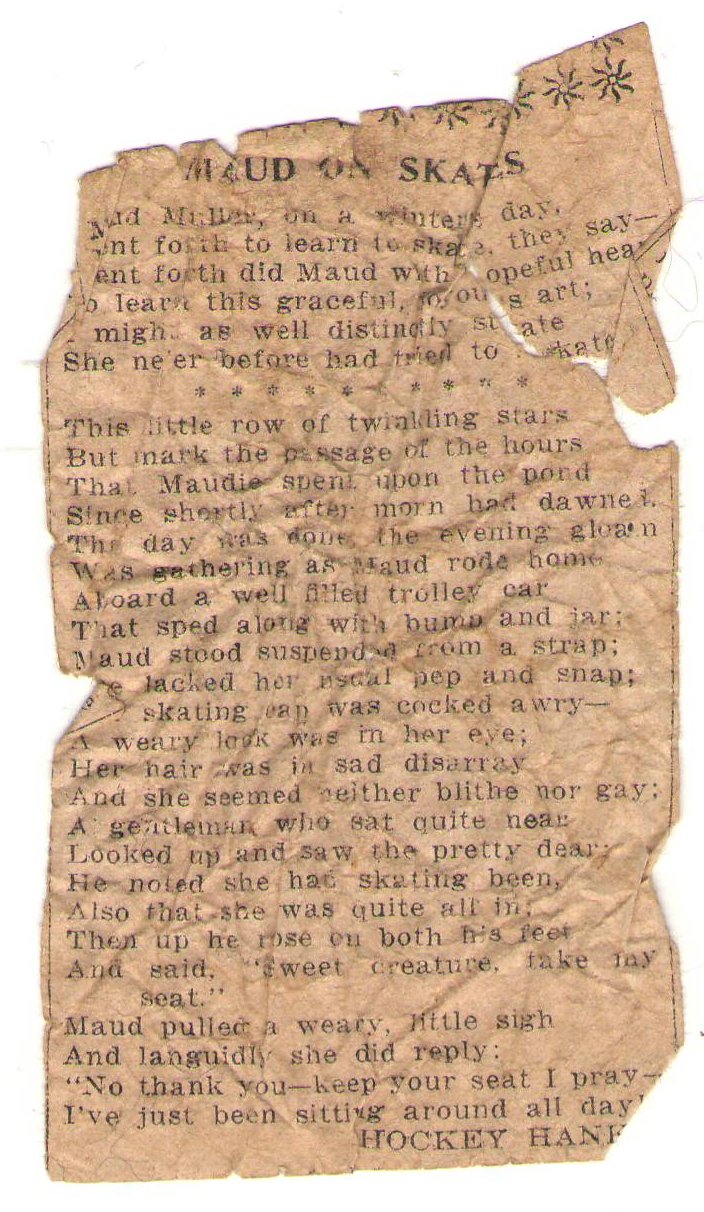
While perusing a children’s book which once had belonged to my wife’s stepfather (I was checking it out to see if it was worth keeping, but it was too badly deteriorated), a scrap of paper fell out – an old newspaper clipping. Old and wrinkled, it was almost like cloth, and turned out to be a humorous poem about a young lady named Maud Muller.
What I discovered was that the original was written by John Greenleaf Whittier, which includes the famous tag line, “For of all sad words of tongue or pen, The saddest are these: ‘It might have been!’ ” It appears that the others I have found are the equivalent of “fan fiction,” but I share them with you anyway in the spirit of fun.
MAUD MÜLLER
by: John Greenleaf Whittier (1807-1892)
MAUD MÜLLER, on a summer’s day,
Raked the meadows sweet with hay.
Beneath her torn hat glowed the wealth
Of simple beauty and rustic health.
Singing, she wrought, and her merry glee
The mock-bird echoed from his tree.
But, when she glanced to the far-off town,
White from its hill-slope looking down,
The sweet song died, and a vague unrest
And a nameless longing filled her breast–
A wish, that she hardly dared to own,
For something better than she had known.
The Judge rode slowly down the lane,
Smoothing his horse’s chestnut mane.
He drew his bridle in the shade
Of the apple-trees, to greet the maid,
And ask a draught from the spring that flowed
Through the meadow across the road.
She stooped where the cool spring bubbled up,
And filled for him her small tin cup,
And blushed as she gave it, looking down
On her feet so bare, and her tattered gown.
“Thanks!” said the Judge, “a sweeter draught
From a fairer hand was never quaffed.”
He spoke of the grass and flowers and trees,
Of the singing birds and the humming bees;
Then talked of the haying, and wondered whether
The cloud in the west would bring foul weather.
And Maud forgot her briar-torn gown,
And her graceful ankles bare and brown;
And listened, while a pleasant surprise
Looked from her long-lashed hazel eyes.
At last, like one who for delay
Seeks a vain excuse, he rode away,
Maud Muller looked and sighed: “Ah, me!
That I the Judge’s bride might be!
“He would dress me up in silks so fine,
And praise and toast me at his wine.
“My father should wear a broadcloth coat;
My brother should sail a painted boat.
“I’d dress my mother so grand and gay,
And the baby should have a new toy each day.
“And I’d feed the hungry and clothe the poor,
And all should bless me who left our door.”
The Judge looked back as he climbed the hill,
And saw Maud Muller standing still.
“A form more fair, a face more sweet,
Ne’er hath it been my lot to meet.
“And her modest answer and graceful air
Show her wise and good as she is fair.
“Would she were mine, and I to-day,
Like her, a harvester of hay:
“No doubtful balance of rights and wrongs,
Nor weary lawyers with endless tongues,
“But low of cattle, and song of birds,
And health, and quiet, and loving words.”
But he thought of his sisters, proud and cold,
And his mother, vain of her rank and gold.
So, closing his heart, the Judge rode on,
And Maud was left in the field alone.
But the lawyers smiled that afternoon,
When he hummed in court an old love-tune;
And the young girl mused beside the well,
Till the rain on the unraked clover fell.
He wedded a wife of richest dower,
Who lived for fashion, as he for power.
Yet oft, in his marble hearth’s bright glow,
He watched a picture come and go:
And sweet Maud Muller’s hazel eyes
Looked out in their innocent surprise.
Oft when the wine in his glass was red,
He longed for the wayside well instead;
And closed his eyes on his garnished rooms,
To dream of meadows and clover-blooms.
And the proud man sighed, with a secret pain,
“Ah, that I were free again!
“Free as when I rode that day,
Where the barefoot maiden raked her hay.”
She wedded a man unlearned and poor,
And many children played round her door.
But care and sorrow, and child-birth pain,
Left their traces on heart and brain.
And oft, when the summer sun shone hot
On the new-mown hay in the meadow lot,
And she heard the little spring brook fall
Over the roadside, through the wall,
In the shade of the apple-tree again
She saw a rider draw his rein,
And, gazing down with timid grace,
She felt his pleased eyes read her face.
Sometimes her narrow kitchen walls
Stretched away into stately halls;
The weary wheel to a spinnet turned,
The tallow candle an astral burned;
And for him who sat by the chimney lug,
Dozing and grumbling o’er pipe and mug,
A manly form at her side she saw,
And joy was duty and love was law.
Then she took up her burden of life again,
Saying only, “It might have been.”
Alas for maiden, alas for Judge,
For rich repiner and household drudge!
God pity them both! and pity us all,
Who vainly the dreams of youth recall;
For of all sad words of tongue or pen,
The saddest are these: “It might have been!”
Ah, well! for us all some sweet hope lies
Deeply buried from human eyes;
And, in the hereafter, angels may
Roll the stone from its grave away!
(One Hundred Choice Selections. Ed. Phineas Garrett. Philadelphia: Penn Publishing Co., 1897.)
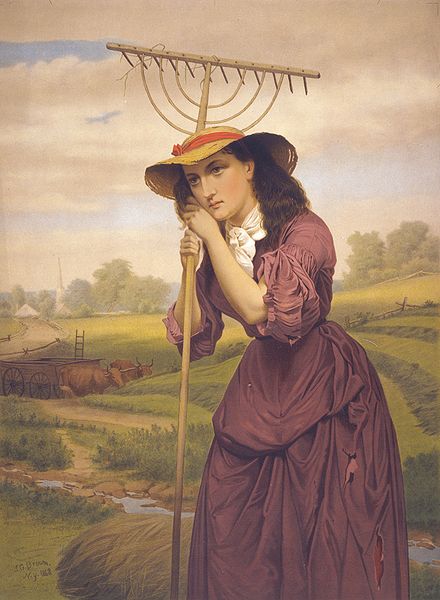
John Gast, artist, after J.G. Brown
“Mr. Whittier’s statement of the origin of his poem “Maud Müller” is thus given. He was driving with his sister through York, U.S.A., and stopped at a harvest field to enquire the way. A young girl raking hay near the stone-wall stopped to answer their inquiries. Whittier noticed as she talked that she bashfully raked the hay around and over her bare feet, and she was fresh and fair. The little incident left its impression, and he wrote out the poem that very evening. “But if I had had any notion that the plaguey little thing would have been so liked, I should have taken more pains with it.” To the inquiry as to the title, Maud Müller, he said it was suggested to him, and was not a selection. It came as the poem came. But he gives it the short German pronunciation, as Meuler, not the broad Yankee, Muller.” (From Parodies of the works of English & American authors, Volume 5, p. 240)
MAUD MULLER IN WINTER
Maud Muller on a winter day
Went out upon the snow to sleigh.
Beneath her high heeled number six
Were a foot of hay and four hot bricks.
Singing she slode, and her merry glee
Shook the snow all off the tree.
“Wait till the clouds roll by!” she howled.
And as she passed the people scowled.
On her dexter side sat a fresh young dude
With his arm out of place as they sweetly slude.
But her howling died, and a vague distress
And a quart of snow filled the back of her dress.
For the reins were held in a careless hand,
And the basest drum in a parade’s band.
Went boom, bum, boom! And one cold day
A tandem left with an upturned sleigh.
Alas, for the dude! three cheers for the sleigh!
And hurrah for the chestnuts that ran away!
The saddest words at hier father’s door
Were these, “You needn’t cone back no more.”
The livery bill when he hied him thence
Was seventeen dollars and fifty cents.
-Boston Globe.
MAUD ON SKATES
Maud Muller, on a winter’s day
Went forth to learn to skate, they say –
Went forth did Maud with hopeful heart
To learn this graceful, joyous art;
I might as well distinctly state
She ne’er before had tried to skate.
* * * * *
This little row of twinkling stars
But mark the passage of the hours
That Maudie spent upon the pond
Since shortly after morn had dawned
The day was doen, the evening gloan
Was gathering as Maud rode home
Aboard a well-filled trolley car
That sped along with bump and jar;
Maud stood suspended from a strap;
She lacked her usual pep and snap;
Her skating cap was cocked awry –
A weary look was in her eye;
Her hair was in sad disarray
And she seemed neither blithe nor gay;
A gentleman who sat quite near
Looked up and saw the pretty dear;
He noticed she had skating been,
Also that she was quite all in’
Then up he rose on both his feet
And said, “Sweet creature, take my seat.”
Maud pulled a weary little sigh
And languidly she did reply:
“No thank you – keep your seat I pray –
I’ve just been sitting around all day!”
HOCKEY HANK
MRS. JUDGE JENKINS
[Being the only genuine sequel to “Maud Müller”)
By Bret Harte
“Maud Müller, all that summer day,
Raked the meadow sweet with hay;
But when he came, with smile and bow,
Maud only blushed, and stammered, “Ha-ow?”
And spoke of her “pa,” and wondered whether
He’d give consent they should wed together.
Old Muller burst in tears, and then
Begged that the Judge would lend him “ten;”
For trade was dull, and wages low,
And the “craps,” this year, were somewhat slow.
And ere the languid summer died,
Sweet Maud became the Judge’s bride.
But on the day that they were mated,
Maud’s brother Bob was intoxicated;
And Maud’s relations, twelve in all,
Were very drunk at the Judge’s hall.
And when the summer came again,
The young bride bore him babies twain;
And the Judge was blest, but thought it strange
That bearing children made such a change;
For Maud grew broad and red and stout,
And the waist that his arm once clasped about
Was more than he now could span; and he
Sighed as he pondered, ruefully,
How that which in Maud was native grace
In Mrs. Jenkins was out of place;
And thought of the twins, and wished that they
Looked less like the men who raked the hay
On Muller’s farm, and dreamed with pain
Of the day he wandered down the lane.
And looking down that dreary track,
He half regretted that he came back;
For, had he waited, he might have wed
Some maiden fair and thoroughbred;
For there be women fair as she,
Whose verbs and nouns do more agree.
Alas for maiden! alas for judge!
And the sentimental,—that’s one-half “fudge;”
For Maud soon thought the Judge a bore,
With all his learning and all his lore;
And the Judge would have bartered Maud’s fair face
For more refinement and social grace.
If, of all words of tongue and pen,
The saddest are, “It might have been,”
More sad are these we daily see:
“It is, but hadn’t ought to be.”
(From Parodies of the works of English & American authors, Volume 5, p. 240)
I’m not a Muslim, so from the outset I admit it’s unfair of me to even attempt any real assessment of the faith. However, I live (as do we all) in a world that is awash in Islamic issues and Islamic news stories and Islamic internecine conflicts and Islamic soul-searching.
Just today I came across two articles which I thought were intriguing and revelatory.
The first, by the honorable Tony Blair [1], points out, legitimately, that there is a problem within Islam that it would be folly to ignore. This is, as the body of the article goes on to explain, is entirely different than claiming that there is a problem with Islam, as so many inflammatory websites and news pieces would have the world believe. It has become de rigeur in some circles to label any criticism of Islam as racist, or “Islamophobic;” nothing could be farther from the truth.

If there is a problem with any ideology that threatens the peace and harmony of people and cultures which touch it, it must be subject to the closest of scrutiny and be willing to succeed or fail on its own merits. We are seeing this today, particularly in the USA where I live, as the humanist community shines the light of reason on the follies and excesses of religions, but particularly Christianity. If the institution has merit, it will endure. If it does not, ultimately it must re-invent itself or fall.
So yes, I agree – and have felt this way for a long time, particularly since the horrors of September 11th – there is a problem within Islam. However, as the second article illustrates, Islam is not what the slavering haters would have us believe.
Global Muslim Delegation Issues Unprecedented Statement Against Anti-Semitism
I have long called for the Islamic mainstream to stand up and shout their outrage about the rot that festers within their own community, much in the same way that mainstream Christians decry the brutal ignorance of the Westboro Baptist Church, and these brave people are doing just that. I laud them for their courage and humanity.
I’ve traveled much in the world, and spent a fair piece of time in Islamic countries. Islam is as varied as every single one of its practitioners, and as a result it’s an exercise in futility and unfairness for either outsider or insider to state unequivocally, “Islam is…”; but recognizing both that there are problems within the community that need to be addressed, and that there are people within the community who are making an effort to do so, are affirming and encouraging – at least to my way of thinking.
As humanity scrabbles its way out of the mud and continues to take baby steps towards the stars, it behooves us all to act as though we are living in a world that works for everyone, even if such a dream is still beyond our grasp.
The Old Wolf has spoken.
[1] Whether you think Mr. Blair is honorable is up to you. I know that during his tenure in office, he was probably as universally reviled as George W. Bush, with whom he collaborated with regards to the Middle East. History will judge; for myself, I respect the man and his efforts.
Beautiful time-lapse video of Mother Nature getting her knickers in a twist. Watch this at 108op and go full screen. You can see a beautiful still from the video here.
Of course, since I have an odd mind, if you hadn’t figured that out by now, I couldn’t help but think of this much older and much less serious video effort:
The Old Wolf has spoken.
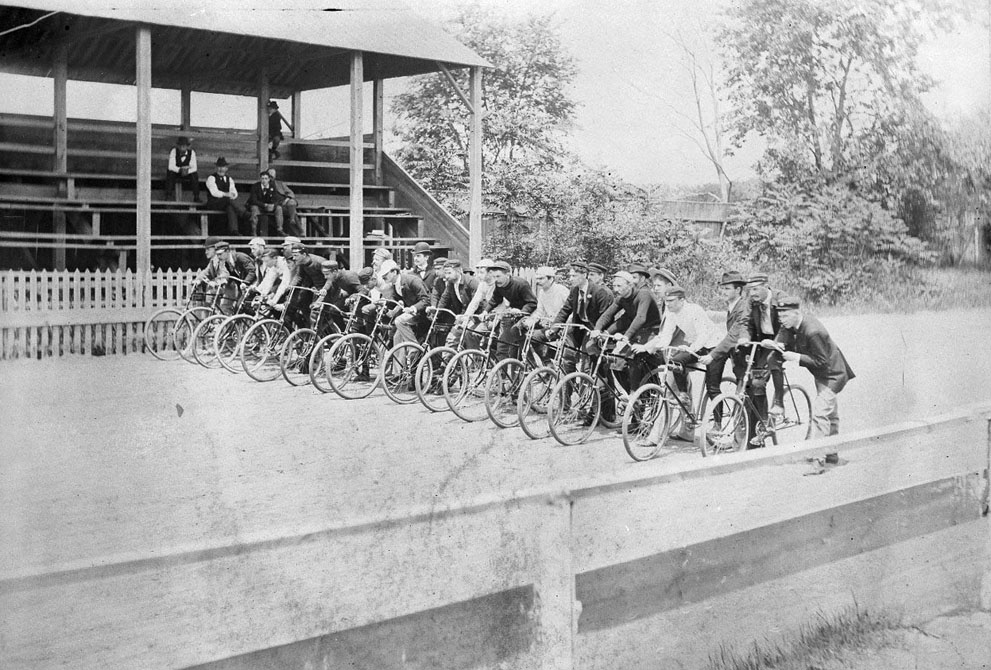
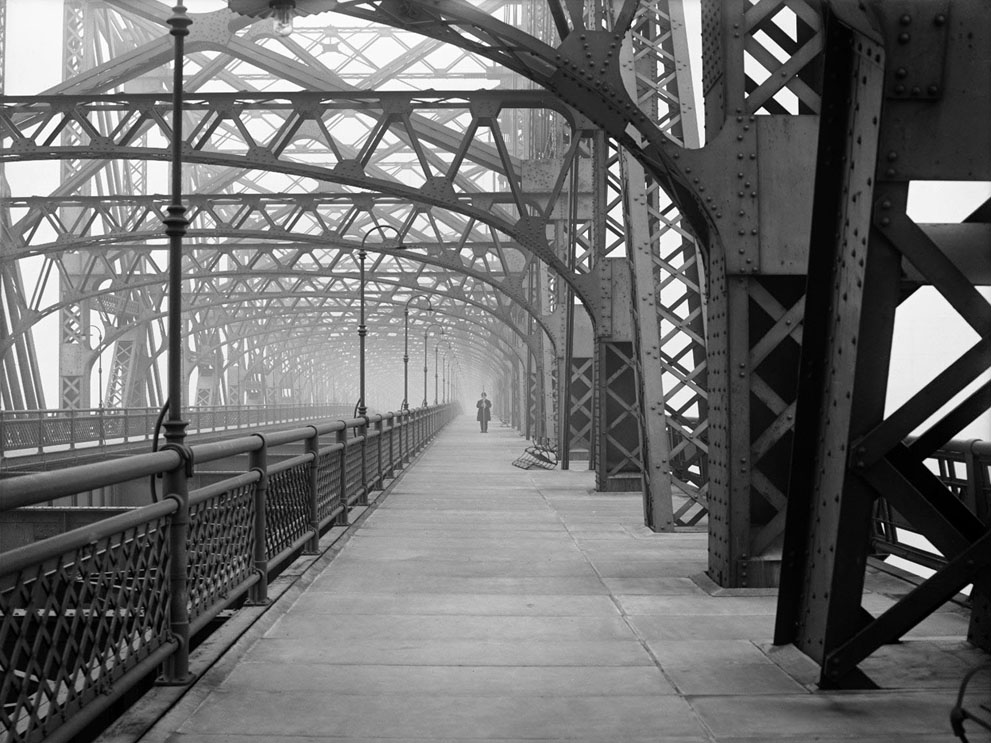
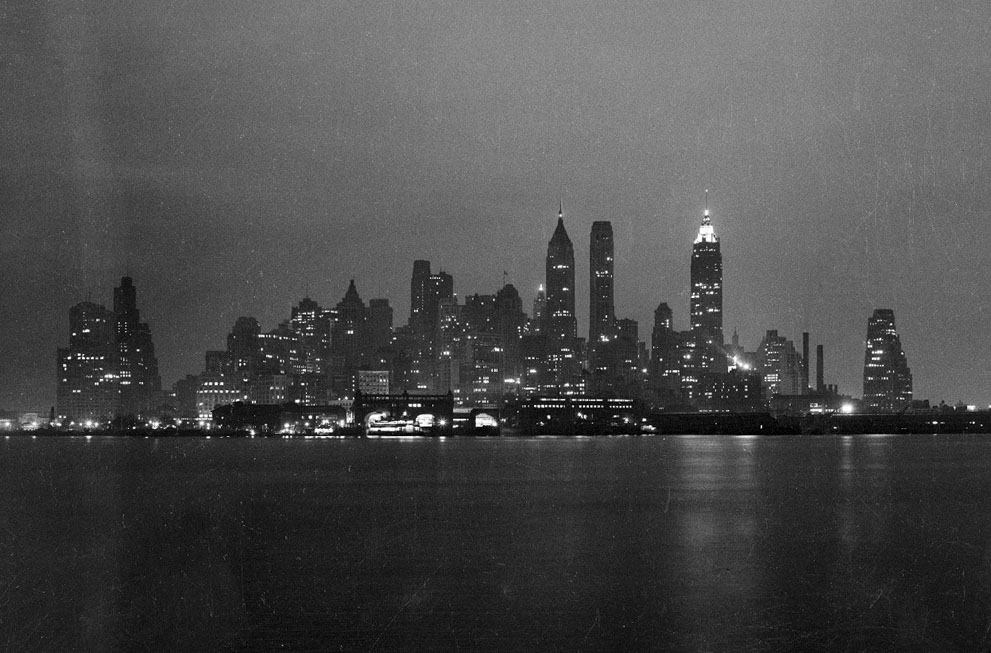
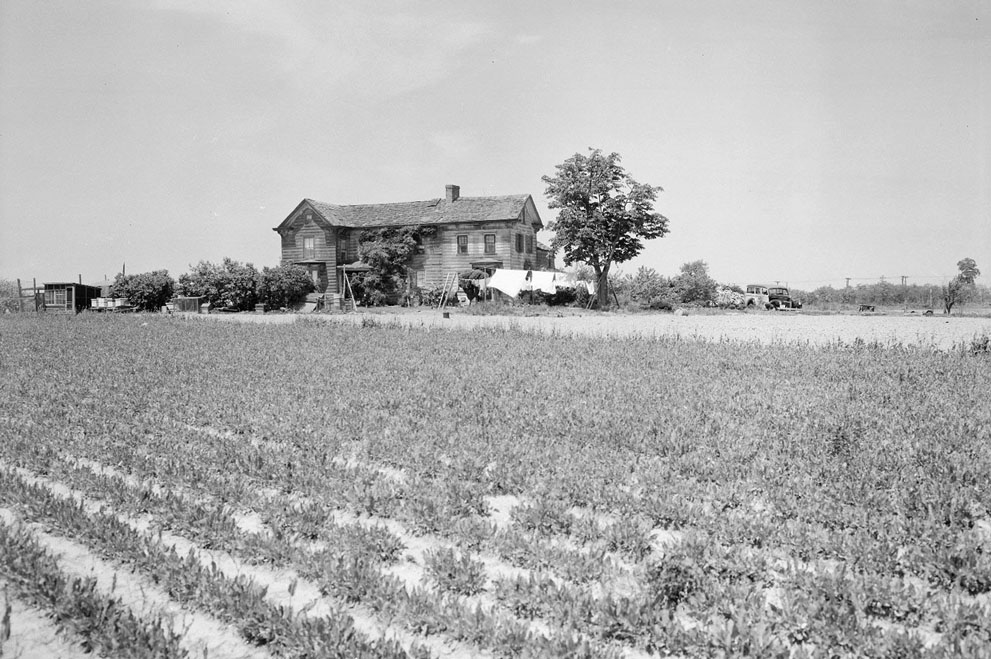
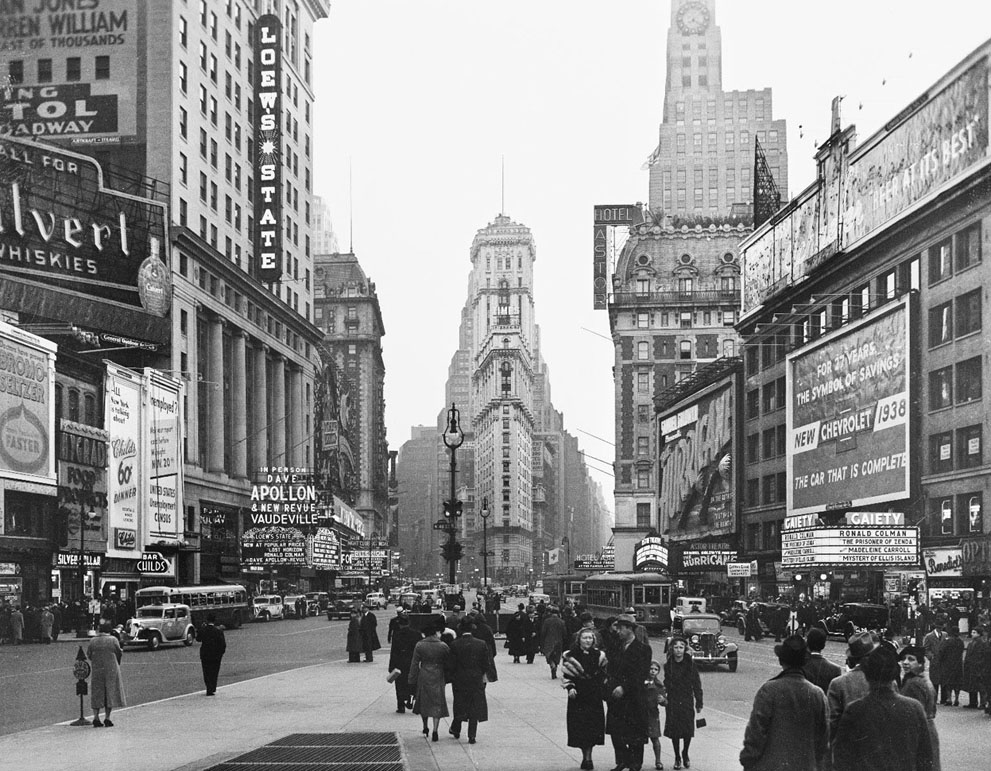
The New York City Municipal Archives just released a database of over 870,000 photos from its collection of more than 2.2 million images of New York throughout the 20th century. Their subjects include daily life, construction, crime, city business, aerial photographs, and more. Visit the selection below, or see 53 photos. Found at The Atlantic.


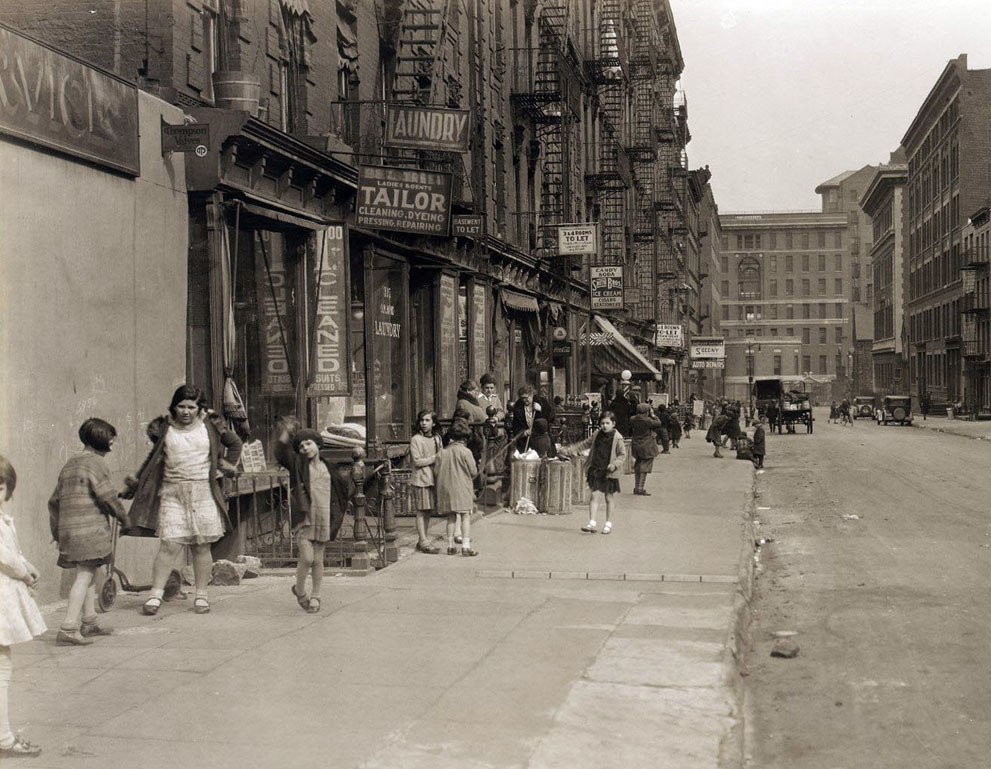









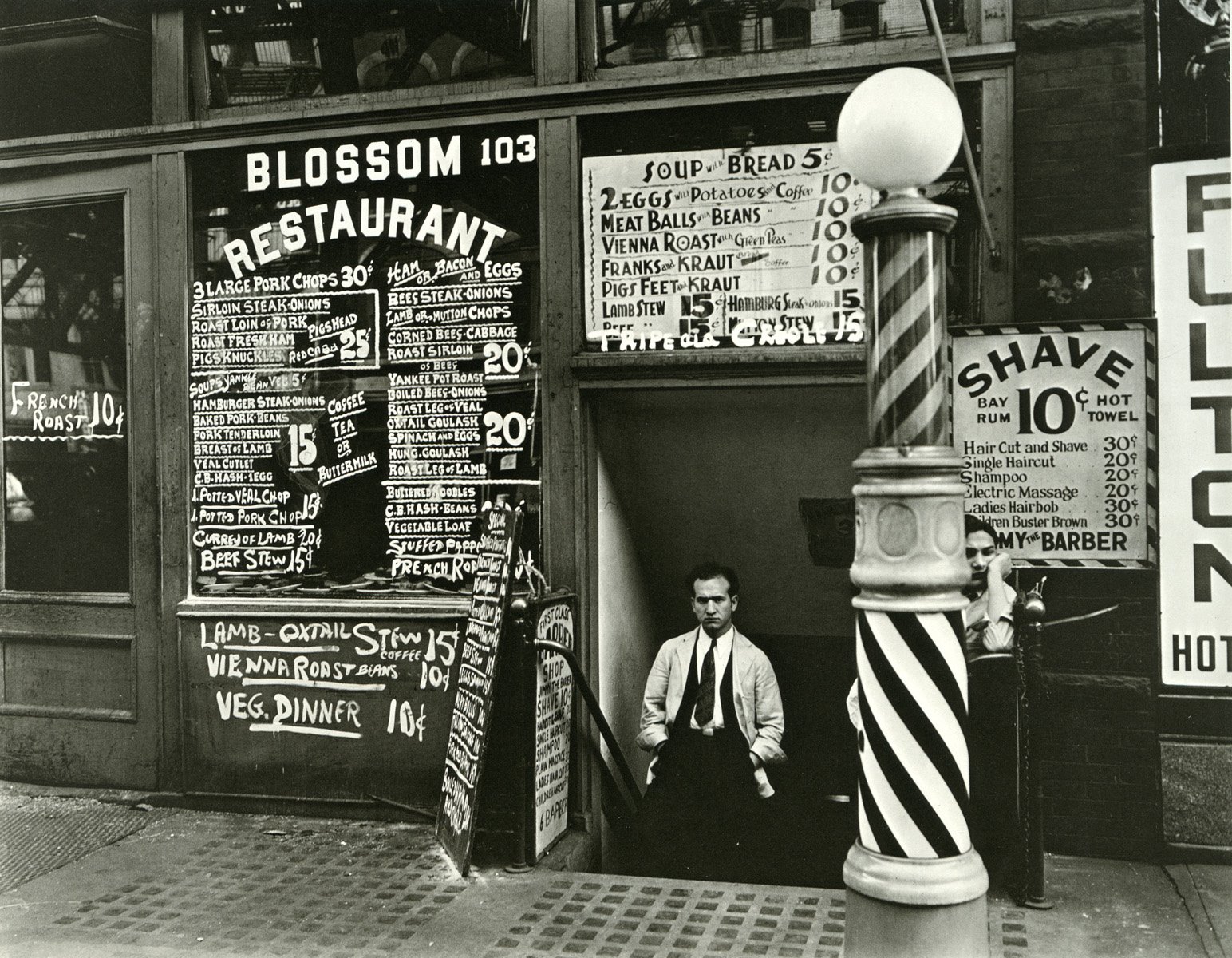
New York City, the Bowery. Photo by Berenice Abbott
Just spend a while looking at those prices. Now, according to the Bureau of Labor Statistics calculator, 30¢ in 1935 would be worth $5.09 today. Where could you get three large pork chops for that price? Certainly not even in my sleepy little town in southern Utah. No, I suspect the BLS has either not factored in the brutality of the depression, or its numbers are somewhat skewed in general.
♫ The Bow’ry, the Bow’ry!
They say such things,
And they do strange things
On the Bow’ry! The Bow’ry!
I’ll never go there anymore! ♫
by Charles H. Hoyt and Percy Gaunt
From the Broadway play A Trip to Chinatown (1891)
The Old Wolf has spoken.
 Playing in the World Game