Their likes shall not be there again

A small tribute to the Waterford Crystal Factory in Kilbarry, Ireland, which I filmed during a family visit in August of 1998. The factory closed under unfavorable circumstances on 30 January 2009; workers staged a two-month sit-in to protest the closing, which only ended in March of that year when they accepted a payout of €10m, but many had worked there all their lives. A PBS Documentary chronicled their last fight.

The cinematography here is not the best, but I’m pleased with the video; the music seems to say just the right thing.

Tá an Sean-fhaolchú labhairthe.


The Salt of the Earth

If you ever wondered where your salary comes from… Well, at least the Romans did; the Latin word salarium, whence we get our word “salary,” shows that there was a solid link in place between employment, salt, and soldiers, although the link is no longer as clear as it seemed earlier.

Be that as it may, salt has been a critical commodity since the beginning of human history, whenever that was. Æons ago, I read a lovely story to my children, which was since republished by Nina Jaffe and Louise August as “The Way Meat Loves Salt: A Cinderella Tale from the Jewish Tradition“.

rabbi

Many years ago in Poland, there lived a rabbi who had a wife and three daughters. One day, the rabbi asks his children a powerful question: “How much do you love me?” His older daughters profess their love in gold and diamonds, but his youngest daughter, Mireleh, declares she loves her father the way meat loves salt. For this remark, she is banished from her father’s home. 

As the Rabbi comes to learn, Mireleh’s declaration was the most powerful of all.

Salt is essential for life. We can’t live without it; salt is composed of sodium and chlorine, and absent sodium in the diet, hyponatremia can cause coma or even death. Notice that doctors put blood pressure patients on low sodium diets, but not no sodium diets; some is always required to keep the body’s functions balanced. Add to that the valuable nature of salt as a preservative, and you can see why it’s been sought after since the dawn of time. In fact, if you want to read a charming science fiction short story about the discovery of salt as a cooking spice, read “First” by Anthony Boucher.

Have you ever wondered where our nation’s salt supplies come from?  Thanks to the Salt Institute, here a map of North America’s major salt deposits and production facilities (click for expanded view):

salt

Salt production has been central to the area around the Great Salt Lake since the arrival of Mormon pioneers in 1847, and continues today, although Morton now has a near monopoly on salt production in the area.

Salt was so essential to human life that many proverbs sprang up around its use; the following list was located at Seventh Wave:

  • “Give neither counsel nor salt till you are asked for it” English Proverb
  • “A kiss without a beard is like an egg without salt” Dutch Proverb
  • “The fish requires salt” Latin Proverb
  • “Without salt the feast is spoiled” Polish Proverb
  • Bread and salt never quarrel” Russian Proverb
  • “Don’t buy the salt if you haven’t licked it yet” Congolese Proverb
  • “Don’t slaughter more pigs than you can salt French Proverb
  • “If I peddle salt, it rains; if I peddle flour, the wind blows” Japanese Proverb
  • “What is salt to tasteless food what is a word to a foolish head” Turkish proverb
  • “Manage with bread and salted butter until God brings something to eat with it” Moroccan Proverb
  • “As a daughter grows up she is like smuggled salt” Chinese Proverb
  • “The cure for anything is salt water – sweat, tears, or the sea” Swedish Proverb
  • “Better a salt herring on your own table, than a fresh pike on another man’s” Danish Proverb
  • “With fortune on your side you can sow salt and harvest grass” Kurdish Proverb
  • “Eternity makes room for a salty cucumber” Russian proverb
  • “The lucky eagle kills a mouse that has eaten salt” Ugandan Proverb
  • “By bread and salt we are united” Moroccan Proverb

The Salty Old Wolf has spoken.

A profession you probably didn’t even know existed…

… and which doesn’t exist any more.

1360_10151738932328851_754066375_n

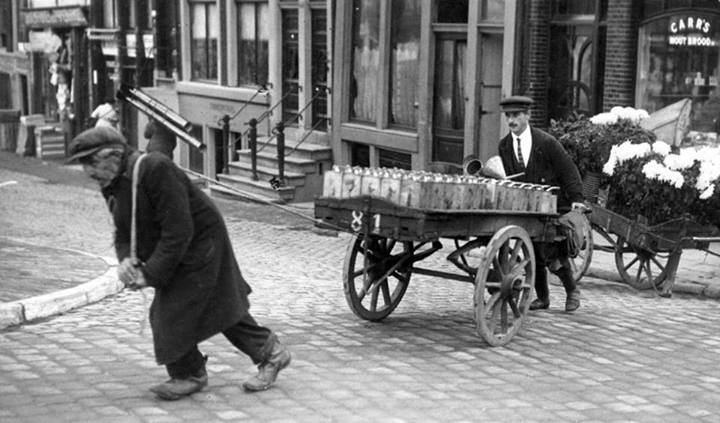
The “Kargadoor” (lit. “Cart-Move-Onward”) would help pushcarts over Amsterdam’s many humpback bridges (photo 1922).

I spotted this photo over at Reddit, posted by /u/lordsleepyhead, and found it intriguing.

Thanks to a friend, I found some further information over at De Jordaan (translation is mine)

High bridges were a source of income for the Kargadoor; these were men who pulled heavy hand carts over a bridge with a rope and hook. Their tool was a long rope with a hook on it. These cart pullers generally had a leather patch on their shoulder to keep from getting hurt by abrasion.
What’s more, this Kargadoor was in turn a source of income for the landlord of the slijterij de Grote Slok (Big Gulp Liquor Store) on the corner.
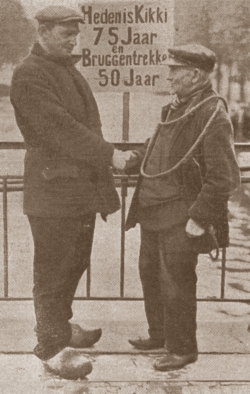
One of the bridges over the Prinsengracht was the domain of Kiki the Kargadoor. He would leave his permanent home when he had gathered six or seven cents; Kiki would disappear to spend his money on drink, all the while keeping the bridge in sight.
He was a bandy-legged little man who could swear like a champion; children always considered him to be a good language teacher.
Kiki was born in 1865 and had a home in the Boomstraat. He passed away at the Municipal Nursing Facility at the Roerstraat in 1940.

Hoist a glass to Kiki, the Kargadoor!

A60Mf133

The caption on the sign reads, “Today Kiki is 75. He’s been a Kargadoor for 50 years.”

The Old Wolf has spoken.

Never, ever, make this mistake.

(This is a re-enactment; no one was harmed in this film)

Every 10 days a child dies from vehicular heatstroke. If you want more grim details, read this 2010 Pulitzer Prize-winning article by Gene Weingarten.

“What kind of person forgets a baby? The wealthy do, it turns out. And the poor, and the middle class. Parents of all ages and ethnicities do it. Mothers are just as likely to do it as fathers. It happens to the chronically absent-minded and to the fanatically organized, to the college-educated and to the marginally literate. In the last 10 years, it has happened to a dentist. A postal clerk. A social worker. A police officer. An accountant. A soldier. A paralegal. An electrician. A Protestant clergyman. A rabbinical student. A nurse. A construction worker. An assistant principal. It happened to a mental health counselor, a college professor and a pizza chef. It happened to a pediatrician. It happened to a rocket scientist. Last year it happened three times in one day, the worst day so far in the worst year so far in a phenomenon that gives no sign of abating. The facts in each case differ a little, but always there is the terrible moment when the parent realizes what he or she has done, often through a phone call from a spouse or caregiver. This is followed by a frantic sprint to the car. What awaits there is the worst thing in the world.”

If you see a child locked in a hot car, phone 911, break a window and save the child. Let the consequences fall where they may.

The Old Wolf has spoken.

Postwar rations

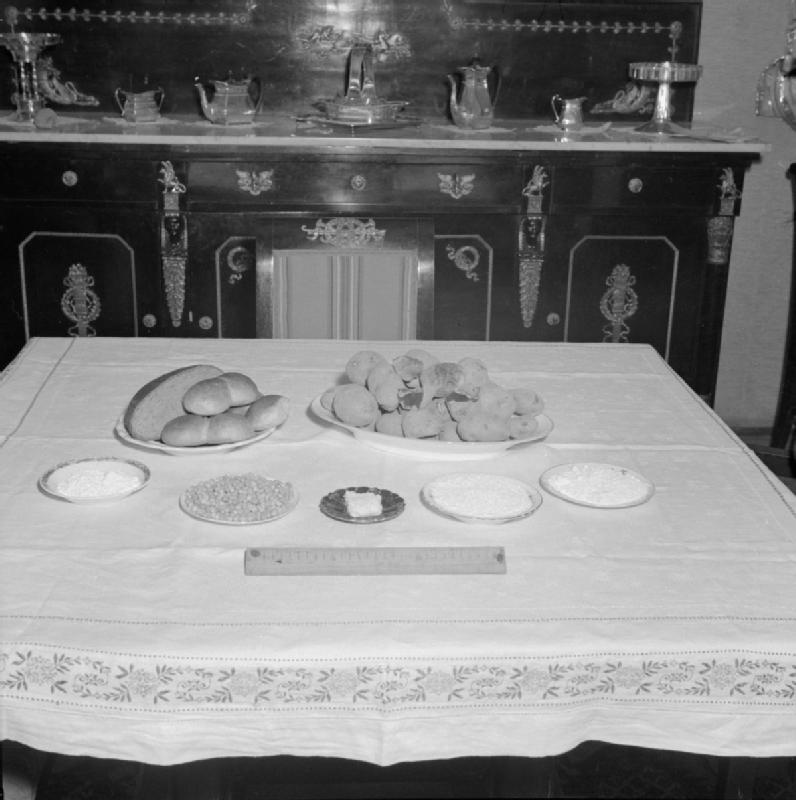
A typical week’s food ration for a postwar Austrian housewife c. 1945-47

Nr1rCpY

Nit allzuviel. No wonder that Austrian cooking went heavy on the oil later, when it became available again; there’s nothing quite like a Wiener Schnitzel fried in lard.

The Old Wolf has spoken.

My brush with infamy, airplane edition

A friend of mine from Norway, on the way back home from a visit to New York (although he didn’t eat at Piccolo Angolo, and is therefore in the doghouse forever), had an interesting experience when, 45 minutes into the flight, his plane began losing cabin pressure and had to return to Newark for servicing. It was newsworthy because Norwegian ski star Aksel Lund Svindal happened to be on the flight as well; a Norwegian website, Aftenposten, recorded the event (you can run it through Google Translate for a fairly readable English version). ABC also briefly mentioned the incident.

This put me in mind of my own scary story, which took place when I was 11 years old and journeying from New York to Salt Lake to visit my mother’s brother for the summer. The plane I was flying in, United Airlines flight 725, lost partial hydraulic power and were not sure what kind of landing they would be able to accomplish. Pilots managed to lower the landing gear manually, and operate the flaps with a backup electrical system; the flight was diverted to Hill AFB in Ogden, which had a longer runway, and the landing was uneventful. However, the stewardesses (that’s what they were called back then, not “flight attendants”) duly gathered up all sharp objects from the passengers, passed out pillows for us to tuck under our seatbelts, and we spent what seemed like an eternity in “crash position.” I remember being intrigued, but not afraid; I think at that age, I wasn’t truly aware of my own mortality, and I don’t think I understood how serious the situation could have been.

The thing that miffed me the most at the time was that I didn’t get a mention in the article as the youngest passenger on board. Ever the attention-seeker, it would seem. At any rate, here for your gratuitous pleasure is the news article from the Salt Lake Tribune of June 29, 1962, chronicling the near-disaster.

19620629 - United 725 2

19620629 - United 725 1

In retrospect, of course, boring and anonymous is much better than burned to a crisp and famous.

The Old Wolf has spoken.