K’minyan Tov

I have long loved and respected the work of Art Spiegelman, author of Maus and Maus II, two graphic novels which autobiographically recount the experiences of his father Vladek through World War II and the years previous.

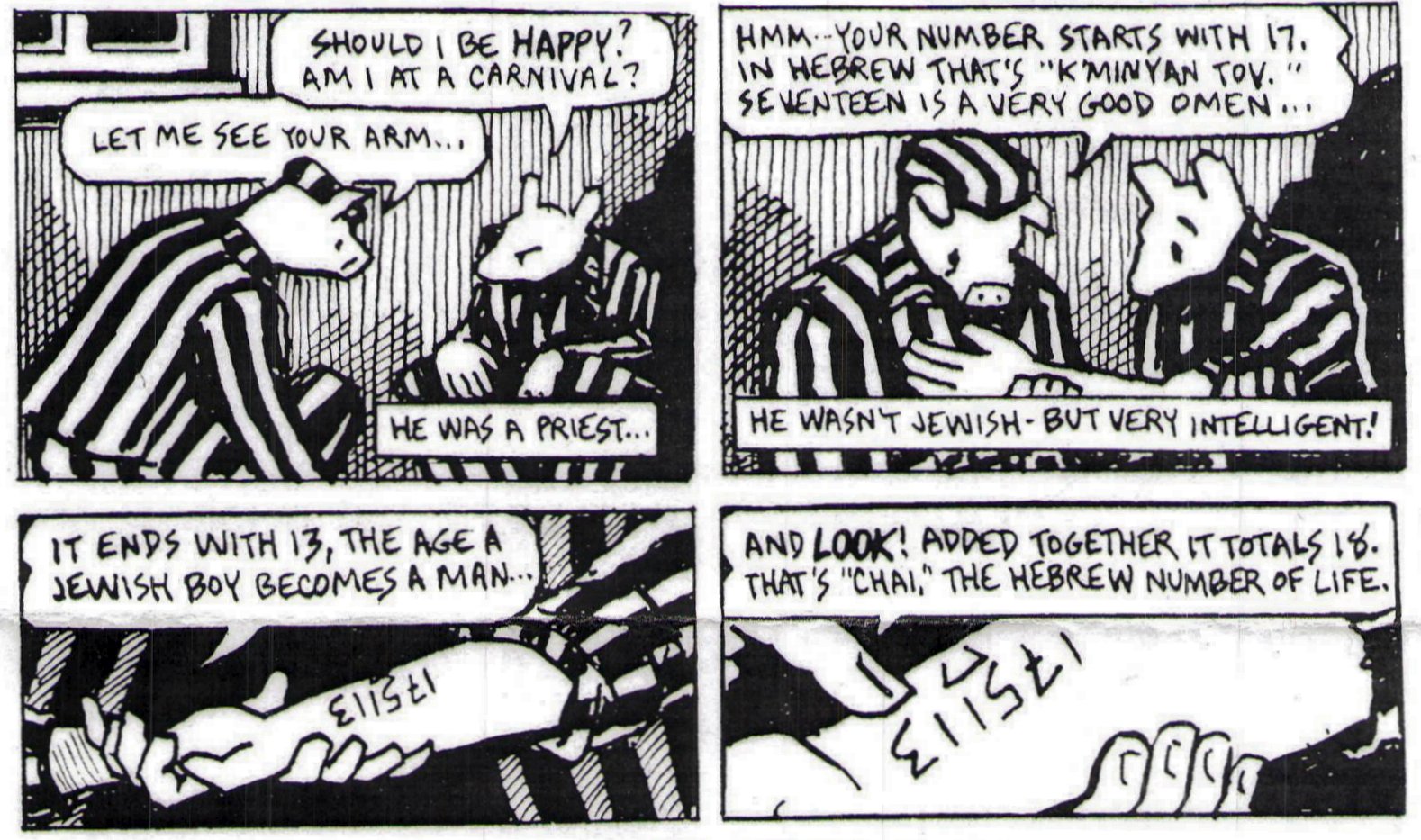
One thing in his account puzzled me, though – the exchange recounted in the panels below, just after Vladek arrives at Auschwitz.

Spiegelman

I had no idea why the priest said that 17 in Hebrew was “kminyan tov,” because seventeen is “shiv’a ‘asar.” The internet didn’t help, because every reference to “k’minyan tov” led back to Spiegelman’s work. I was stumped. It turns out I just didn’t know enough about Hebrew or kabbalistic customs.

After letting the matter rest for about five years, during which interval I began a study of modern Hebrew, I returned to it with a vengeance and did some more digging.

The Polish priest was learned in the ways of gematria, or the mystical assignment of numerical values to Hebrew letters, and divining meaning from how words add up; I first became aware of gematria when I read The Chosen by Chaim Potok.

I was coming at my puzzle all wrong, assuming that minyan was referring to the quorum of ten Jewish male adults required for certain religious obligations. The word itself also means “count,” with “k’minyan” meaning “like the count of.” That expression appears to be used almost exclusively in referring to values in gematria. Look at this post in a forum:

A week or two ago, a posting on the number of brakhot in shmoneh esrei suggested, IIRC, something like that the addition of birkat ha-minim in E”Y changed the 18 to 19. It appears, however that in E”Y there were originally 17 b’rakhot, gematria tov and the addition of birkat ha-minim made it 18, k’minyan chai.

This entire sentence is far over my head in terms of understanding the context, but to have found the expression in an external source was significant. It seems then that this phrase can be read “like the count of ____”, whatever number is being referred to.

Thus the priest reads Vladek’s number (175113) and notes that the first two numbers are 17 – with “טוב” (tov, meaning “good”) being the numbers 9+ 6+ 2 (each Hebrew letter is assigned a value corresponding to its position in the alphabet). Hence “tov” has the value 17; “k’minyan tov” can be interpreted in this case as “like the count of ‘good’.) This would be seen as a good omen. Another interpretation I found indicates that 17 would indicate the 10 men necessary for a minyan, plus seven more, making it a “good minyan” or a “strong prayer group.”  I can’t speak to the accuracy of this interpretation, but it’s interesting nonetheless – this was the first thing that occurred to me, and it didn’t make sense. Now it does. Sorta.

Vladek’s priest friend notices that 1+7+5+1+1+3 equal 18, and the Hebrew word for “life” (חי – chai) is composed of the numbers 10 + 8, or 18, the number referred to in the quote above, which could be read as “like the count of ‘life’.” And this was sufficient for Vladek to express the feeling that he had been given another life. Vladek escaped, and the priest was never seen again.

I don’t think I have the intellectual discipline to pursue this any farther, but my curiosity has been silenced. At least I understand the basic meaning of what Spiegelman was relating in this scene, and that will have to do.

The Old Wolf has spoken.

(For what it’s worth, “Old Wolf” in English gematria is 522, which has the same value as Truth, Birthday, Stephen, Russia, Muslim, Bill Gates, Twelve, Justice, Victor, Vincent, Rand Paul, Priest, Person, Nothing, Lotus, Hail Mary, Yahuwah, Street, Stealing, The Sun, Blessing, Elishone, Cnaan Aviv, Noahs Ark, Elohiym, Lee Vayle, Dustin, Democracy, Praises, Potato, Euro Bay, String, Taav Aaleph, Myth U, Ninety, Baptist, Crackpot, Company, Inside Job, Architect, God Of Buddha, Different, Cotton, Buddhist, The Eyes, Chin Woo, Diaper Dude, Project, Break The Ice, Manifest, Charlemagne, Helsinki, Mackenzie, Gram Of Fat, Oh My God, Gnostic, Archigonic, Samskarda, Tornado, Forecast’, Paternal, Ho Chi Minh, Natural, Black On Black, Dream Logic, Swedish, Sonnet, Mind Of God, Cortez, Paul Rand, Indeed Jobs, Shelter, My Garden, Get Hay At, Consider, King Of All, Vietnam C, All Is One, Veronica, Punish, Fulfilled, Sam Bowie, The Gilded Age, Whether, Def Leppard, Get A T Hay, Pat Crock, טרוטה Truth, Canaanites, Dependent, Lumpy, Fallout, Frighten, Happily, Sticky, Pell Mell, The Mayan, Idiocracy, Pitagora, and Got Milk. Make of that what you will.)

Yes, things have changed.

Found this video the other day, and it made me smile.

Back in the day,  the stores only had VHS tapes (and a precious few, like Video Vern’s in West Valley, had a Betamax section),

Video Vern's Membership Card


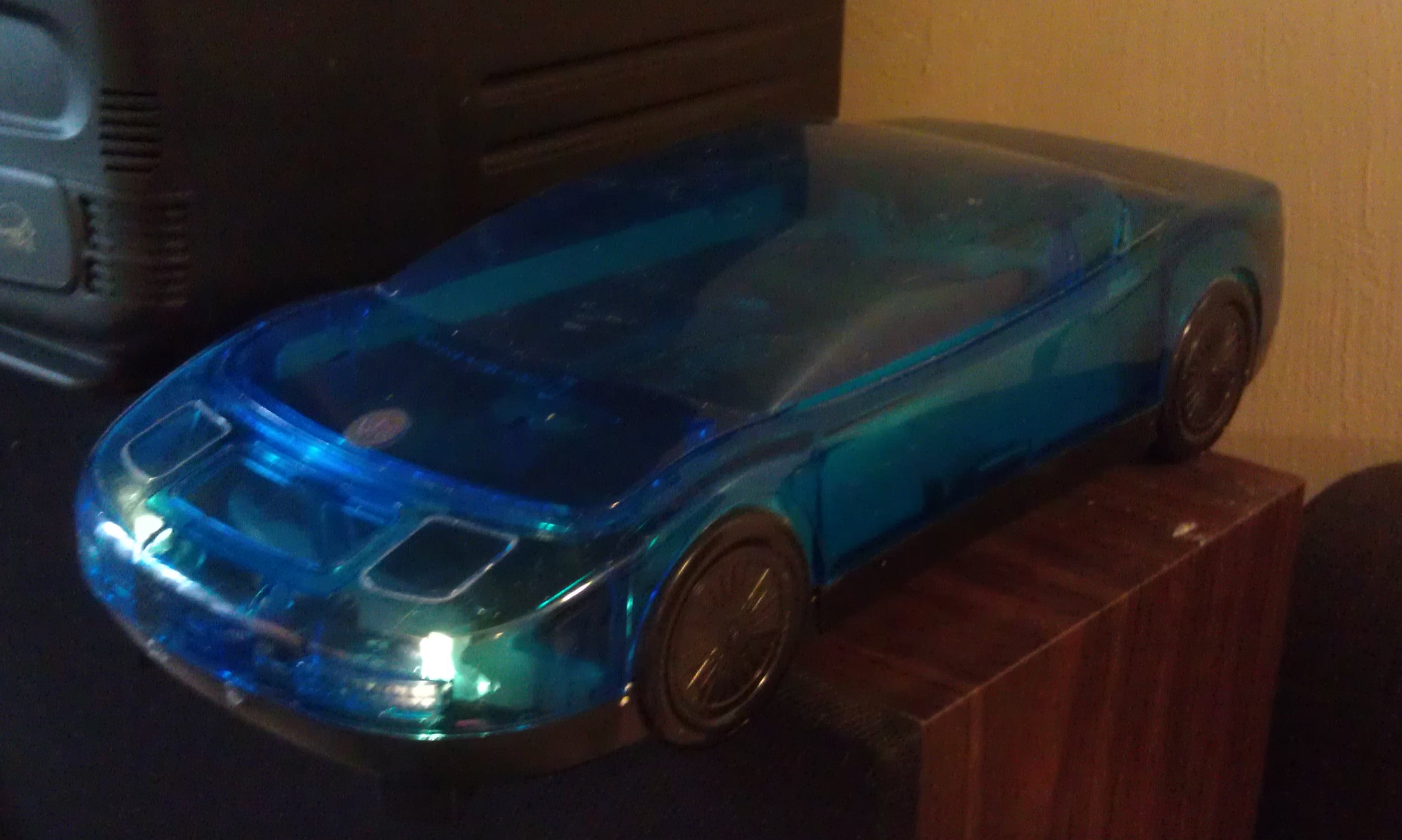
Devices like this were common:

IMAG3199

It’s a tape rewinder – ours looks like a car, and the headlights come on while it’s rewinding. That way you could watch another movie while you were rewinding the first one.

Fortunately, with DVD and Blu-Ray formats, such things are no longer essential – but you can still buy one.

dvdrewinder (1)


Things are so much easier now…

Then again, before the days of home video, going to the movies was a different experience.

When I was a kid, in NYC, you’d pay 50¢ for a matinee ticket. You’d go in and sit down in this massive theatre with one screen, and a big red velvet curtain hanging in front of the stage.

Byrd-1024x682

That’s the Byrd Theatre in Richmond, VA – lovingly restored, but that’s what a lot of them looked like.

An usher with a flashlight would help you find a seat if you needed help. The lights would go down, the curtain would go up, and the show would begin.

First, a newsreel. Then, usually, a cartoon. Then another short subject. Maybe some previews. And finally the main attraction, often with an intermission. And when it was all over, you could sit there and do it all again. And again. And again, if you wanted. If you came in late, you could just wait until the beginning came around again. Nobody chased you out. And all for four bits… a great way to escape the summer heat.

Cool

Now that’s how to watch a movie.

The Old Wolf has spoken.

Stopping for lunch, 1960

6vM5n5w

Robert Kennedy stops for lunch while on the campaign trail for his brother, John F. Kennedy. Bluefield, West Virginia, 1960. A different world, different times.

Caption from Shorpy: “Spring 1960. “Efforts of John F. Kennedy’s campaign team, including members of his family, in West Virginia during Kennedy’s quest for the 1960 Democratic presidential nomination. Includes brother Bob at a drive-in in Bluefield.” From photos by Bob Lerner for the Look magazine article “The Kennedys: A Family Political Machine.” 35mm negative.

The Old Wolf has spoken.

Ripley’s Believe It or Not – Phineas Gage

I have always loved Robert Ripley. As time has gone on, the stories he has reported have been expanded upon and documented; some have proven to be misunderstandings, but very rarely if ever was anything shown to be an outright fraud. The case of Phineas Gage is well-documented; here a comparison of what Ripley reported and information available on the Internet today.

Gage


From Ripley’s Believe It or Not, Two Volumes in One, Simon and Schuster, 1934

The American Crow-Bar Case

Phineas P. Gage, aged twenty-five, a foreman on the Rutland and Burlington Railroad, was employed September 13, 1847, in charging a hole with powder preparatory to blasting. A premature explosion drove a tamping-iron, three feet seven inches long, 1 1/4 inches in diameter, weighing 13 1/4 pounds, completely through the man’s head.

Despite this terrible injury young Gage did not even lose consciousness. he made a complete recovery and lived many years afterward.

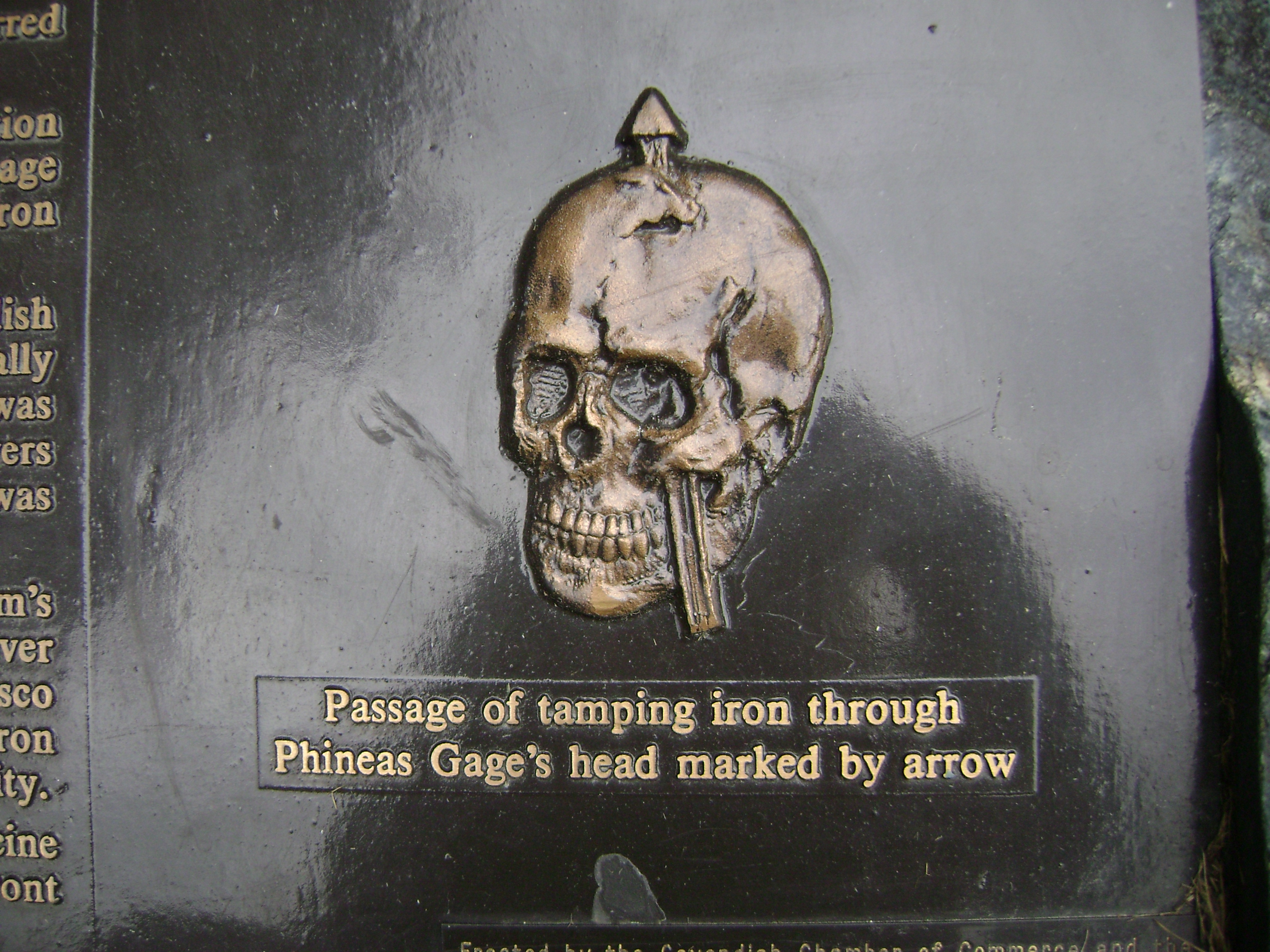
The crow-bar entered the left side of the face, immediately anterior to the inferior maxillary and passed under the zygomatic arch, fracturing portions of the sphenoid bone and the floor of the left orbit. It then passed through the the left anterior lobe of the cerebrum, and in the median line, made its exit at the junction of the coronal and saggital structures, lacerating the longitudinal sinus, fracturing the parietal and frontal bones and breaking up considerable of the brain. The patient was thrown backward and gave a few convulsive movements of the extremities. He was taken to a hotel almost a mile distant. During the transportation he seemed slightly dazed, but not at all unconscious. Upon arriving at the hotel he dismounted from the conveyance, and without assistance walked up a long flight of stairs to the hall where his wound was to be dressed.

Dr. Harlow saw him at about six o’clock in the evening, and from his condition could hardly credit the story of his injury, although his person and his bed were drenched with blood. His scalp was shaved and coagula and debris removed. Among other portions of bone was a piece of the anterior superior angle of each parietal bone and a semicircular piece of the frontal bone, leaving an opening 3 1/2 inches in diameter. At 10 P.M. on the day of the injury Gage was perfectly rational and asked about his work and after his friends. His convalescence was rapid and uneventful.

Professor Bigelow examined the patient three years later, and made a most exceelent report of the case, which had attained world-wide notoriety. Bigelow found the patient quite recovered in his faculties of body and mind, except that he had lost the sight of the injured eye.

The original crow-bar, together with a cast of the patient’s head, was placed in the Museum of the Harvard Medical School, Brookline, Mass., where it is still on exhibition. Ref.:Boston Medical and Surgical Record (1848).

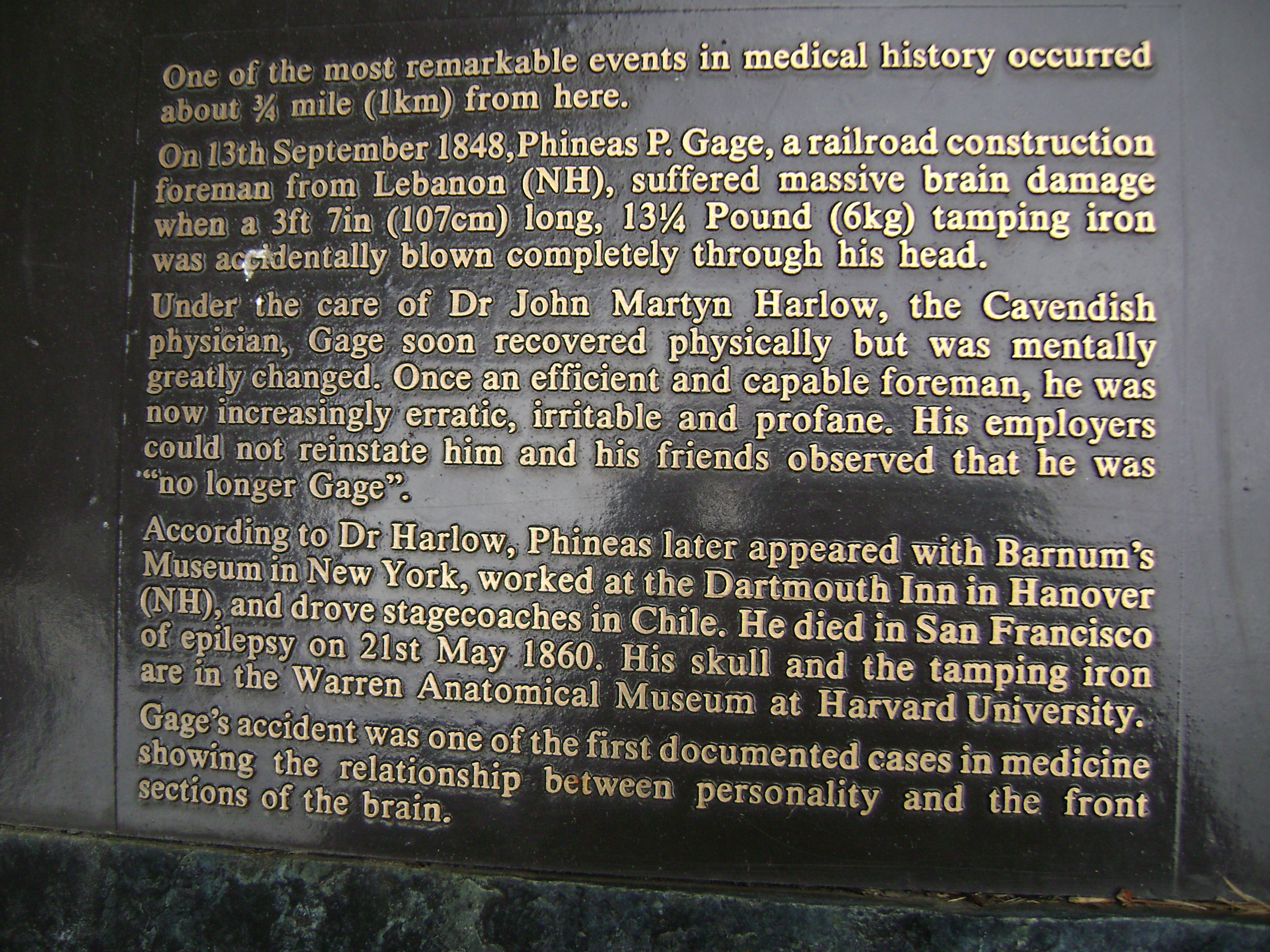
This particular entry fascinated me as a child. Now, of course, we know more: instead of making a complete recovery, Gage’s personality changed; he became “erratic, irritable, and profane,” his friends called him “no longer Gage,” and he died of seizures around 12 years after the accident. Two very interesting and in-depth accounts of Gage and his injury can be read at Slate.com and Interiorpassage.com, and the Wikipedia article is detailed and impartial. While some of the reported facts about Gage and his injury have been distorted over time, the fact remains that he survived an astonishingly devastating brain injury by 12 years and his accident provided medical science with an opportunity to study the relationship between brain trauma and personality change.

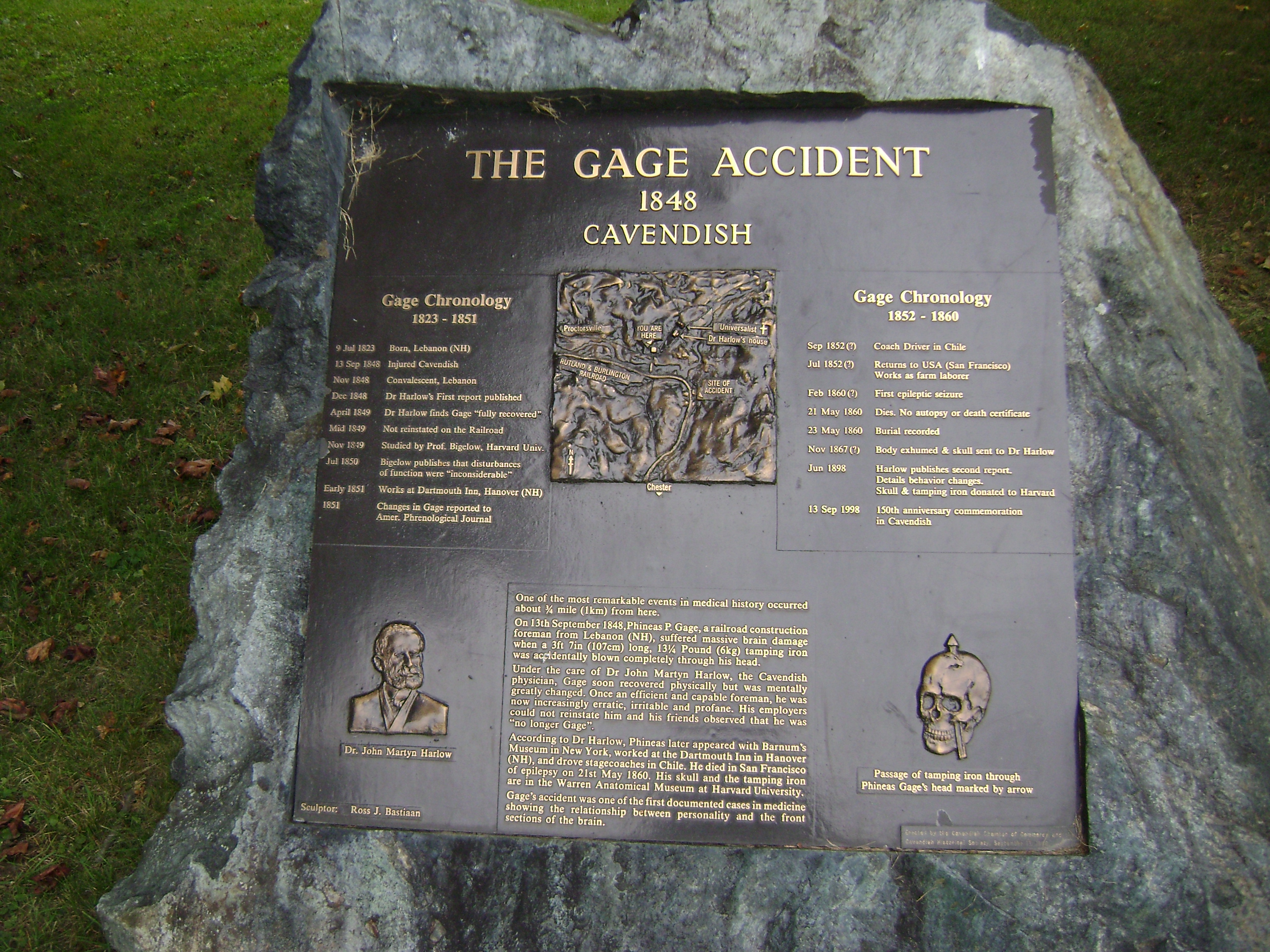
As related in the article at interiorpassage, there is a monument to Gage’s accident at Cavendish, Vermont – the following images (mercilessly ripped from the original article) are revelatory:

DSC01279

DSC01286

DSC012781

Here is an intriguing video about Gage’s experience:

Once again, the Internet provides more information than was available almost 100 years ago; the more time passes, the more accurate such historical accounts become. Ripley did his best, but was limited by what was available in his time. There are still some amazing wonders and curiosities to be found in his books and musea around the country.

The Old Wolf has spoken.

Homeless

photo-1-e524059dbea1cebfe788ab374f45a37680085cdc-s40-c85

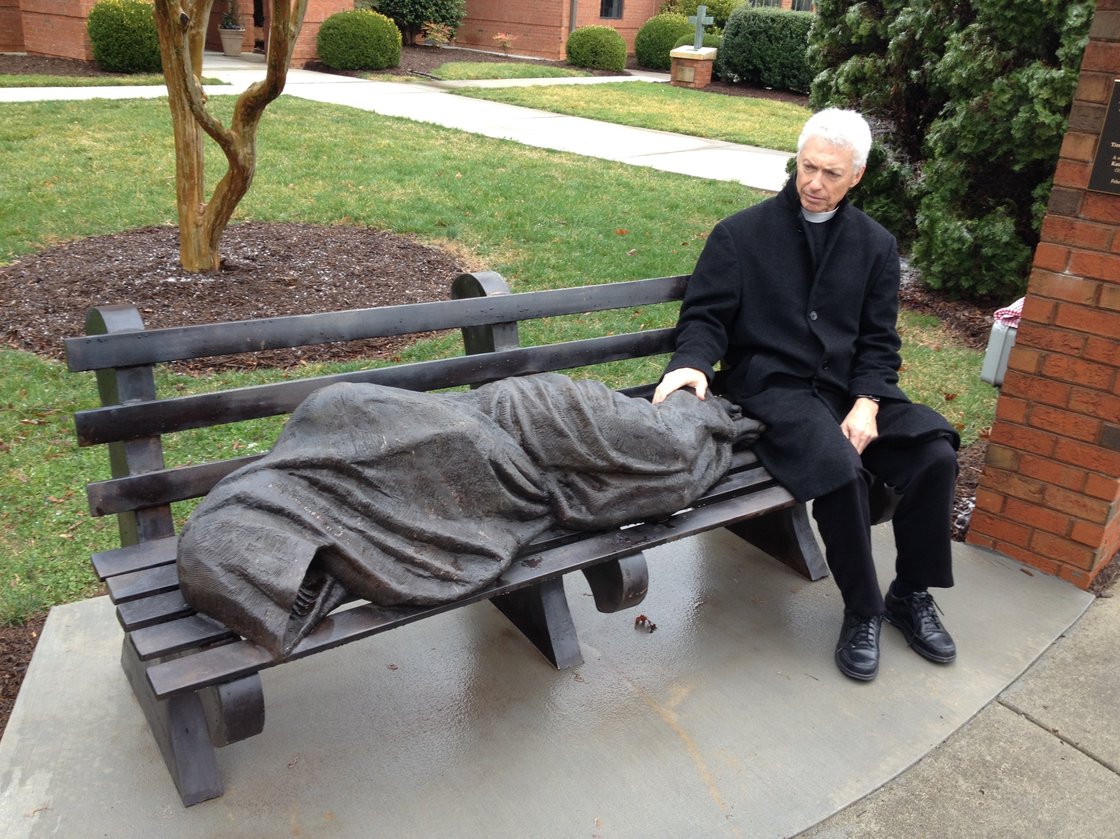
The Rev. David Buck sits next to the Jesus the Homeless statue that was installed in front of his church, St. Alban’s Episcopal, in Davidson, N.C.

This statue of a homeless Jesus disturbed many in Davidson, N.C. Read the whole story at NPR. My favorite quote:

“One woman from the neighborhood actually called police the first time she drove by,” says David Boraks, editor of DavidsonNews.net. “She thought it was an actual homeless person.”

That’s right. Somebody called the cops on Jesus.

But Jesus was homeless. “And Jesus saith unto him, The foxes have holes, and the birds of the air have nests; but the Son of man hath not where to lay his head.” (Matt. 8:20, KJV)

And many, many others – far too many in my own country – also have not where to lay their heads, and the problem continues to get worse, and it’s a difficult issue. A recent article by KSL, Utah’s dominant news source, investigated the seemingly ubiquitous panhandlers with cardboard signs. Their findings were unsettling: many supposed “homeless” were not.

For Utahns, this becomes an even thornier question when their own scriptures speak so powerfully about sharing what we have with the poor:

And also, ye yourselves will succor those that stand in need of your succor; ye will administer of your substance unto him that standeth in need; and ye will not suffer that the beggar putteth up his petition to you in vain, and turn him out to perish. Perhaps thou shalt say: The man has brought upon himself his misery; therefore I will stay my hand, and will not give unto him of my food, nor impart unto him of my substance that he may not suffer, for his punishments are just—

But I say unto you, O man, whosoever doeth this the same hath great cause to repent; and except he repenteth of that which he hath done he perisheth forever, and hath no interest in the kingdom of God. For behold, are we not all beggars? Do we not all depend upon the same Being, even God, for all the substance which we have, for both food and raiment, and for gold, and for silver, and for all the riches which we have of every kind? – Book of Mormon, Mosiah 4:16-19

I’ve been approached by many panhandlers. Sometimes I’ve given, and too generously for my own budget; other times, I have not – and have always felt badly that I couldn’t help. But I know that along the way, I’ve been stung by con-men and scammers, and they can be so very aggressive, and at the same time so very convincing. It’s very hard to separate the wheat from the chaff. Unfortunately, unlike modern online games, people don’t have little bars floating over their heads to show how much health they have left. You have to trust, and that’s not always easy; Frank Crane has been attributed as saying, “You may be deceived if you trust too much, but you will live in torment if you don’t trust enough.”

For the day-to-day encounters, there’s no easy answer. For myself, I give when I can. When I can’t, I try to keep in mind that “I give not because I have not, but if I had I would give.” But even that is cold comfort, because for so many, the need is real. Read up on 7 Myths About the Homeless that have been debunked. It’s not at all clear-cut.

https://youtu.be/Bel3vITdnGE

As a society, we tend to filter out the homeless; the above video illustrates the problem in a very moving way.

For me, the issue strikes very close to home. One of my children has been living rough for almost half her life. I want nothing more for her than to have a stable, peaceful existence where she can provide for herself and have enough. I can’t just take her in – it’s not as simple as that. And I’m not in the financial position to be able to support her externally except on occasion. It is a serious dilemma.

There are valid ways of helping the homeless. Giving money directly is generally discouraged, simply because there is no guarantee that panhandlers will spend it in ways that increase the quality of their lives. But it’s important to remember that the availability of social services is not equal for all; single white females who are not drug addicts or otherwise handicapped find the social net is full of holes.

I’m not a sociologist, or a wealthy philanthropist (much to my chagrin.) I have no sweeping, long-term answers. But I see the problem and wish that I could do more. From where I sit, spending a hell of a lot less on fruitless and interminable military campaigns and instead redirecting those resources to raising the standard of living of our own people would be a good place to start.

The Old Wolf has spoken.