Funniest code comments written by programmers (without the ads and commentary)

Originally found at itaxsmart.

  1. /* When I wrote this, only God and I understood what I was doing. Now, God only knows */.
  2. /* I dedicate all this code, all my work, to my wife, Darlene, who will have to support me and our three children and the dog once it gets released into the public. */
  3. /* Drunk, fix later */
  4. /* Magic. Do not touch. */ [1]
  5. /* This code sucks, you know it and I know it. Move on and call me an idiot later */
  6. */ I am not responsible of this code.They made me write it, against my will.*/
  7. /* I can’t divide with zero, so I have to divide with something very similar result = number / 0.00000000000001. */
  8. /* If you’re reading this, that means you have been put in charge of my previous project. I am so, so sorry for you. God speed. */
  9. /* If this code works, it was written by Paul DiLascia. If not, I don’t know who wrote it.*/

[1] This must have been the code that produced miraculous results… for a brief time. I’ve referred to this before, but it seems appropriate here.

CALL MAGIC

One day while cleaning off my desk there came
Into my hands a scrap, upon it writ
Five lines of code – a subroutine whose name
Was “Magic” which required no arguments.

My curiosity began to itch.
I wrote a simple driver with but one
“Call Magic” statement – and submitted it
And walked outside to bask beneath the sun.

Four hours later I awoke in pain.
A sunburn had decided it should
Take out a lease and dwell upon my skin.
So I returned inside in no sweet mood.

I claimed my job – my reason was enraged.
Queer looks were given me when I exclaimed,
“Great Caesar’s Ghost,” for on its final page
Was “For your sunburn try some Solarcaine™”.

Three times I ran that job – three times amazed.
For once it solved a problem that had been
My tormentor for months, and, sans arrays,
It gave a winning strategy for Gin.

The second run output a proof which showed
That every map with four colors may be
Completely marked and all adjacent nodes
Have different hues for their identity.

The third described a model of the skies
Which made the Einstein formulation seem
As trivial as one plus four is five,
And yet could be explained to a Marine.

Just one more time I ran that job and while
It executed I sat deep in thought.
I concentrated all my earthly guile
On making “Magic” show the key to Luck.

The world is full of greed and avarice.
It spins on axes hewn from Mankind’s lust.
Small children learn – avoid the precipice
Of grabbing for that final piece of crust.

No trace of “Magic” could be found by this
Sad author after I turned in that job
Which disappeared with all the prevous
Results collected – dust to worthless dust.

-Dan Nessett

Sketches of Life in the Uintah Basin

Alice Woolf

Alice Bartlett Woolf, 1916-1997

Alice Bartlett Woolf, a painter, writer, master teacher, horse breaker, and story teller, was also a dear friend of my mother. While working on scanning my mother’s papers, I came across an article that Alice had submitted to the Utah Humanities Review for their first edition in October of 1947. I found it delightful, and thought it worth sharing here. I have provided a PDF version of the article for anyone who wants to download it. The essay gives a homey, affectionate and impartial look at Mormon communities in the first half of the 20th century; there is much to be envied in the lifestyle of these simple and sincere people.


SKETCHES OF LIFE IN THE UINTAH BASIN

Woolf, Alice B.
Utah Humanities Review
1 (October1947): 313–319.

 Expecting the mode of life and the people to be much changed, I was going “home” for a vacation in the red sand hills of northeastern Utah. As I turned my car north from U.S. highway 40, I was delighted to see again the small farms on either side of a very muddy and rutted road. Of course, I reasoned, the very structure of the farms, with outbuildings, Jackson-fork hay derricks, stackyards, and straw-covered. sheds couldn’t have all disappeared in the space of fifteen years. But what of the people? Had the innovation of elec­tric lights, radios and refrigerators changed their way of life? Did they still refer to a journey to Salt Lake, or some place other than the Uintah Basin as “outside”? Had the oil boom in the nearby town of Vernal urbanized them?

Woolf1

SUNDAY MORNING – Alice Woolf

 After several weeks in Uintah and Duchesne counties I concluded that life in general was much the same as it had been when I was a child of the sagebrush, happily riding my pony between prairie dog holes.

Of course, one may wonder why anyone should hope that small communities of people would not change; and after some thought, I decided that the people in the farm area to the south of the Uintah Mountains are, by and large, the happiest group I have ever known. I had been worried lest the “finer things” of civilization had made them unhappy with their lot, for to the casual observer the small farmer in the Uintah Basin has so many natural odds against him that it seems incredible that the country has ever been popu­lated. He has a constant battle with wind, sand, drouth, and grasshoppers. Getting water to the land has been a major problem since the land was homesteaded, and even today everyone donates time to the building of canals and ditches, in an effort to fight the desert dryness.

Main Street

MAIN STREET – Alice Woolf

 The main factor in this happiness the people enjoy, it seems to me, is the complete social integration of all members of the community. From birth, children go through the same experiences as their elders. They work or: the farms, go to church, visit the stores, listen to conversations, attend dances and all public social functions. Most of their parents did the same. Thus the group becomes tightly knit. Everyone in our own particular community (the nucleus of each community being the church, school, store, and post office) knows whether you were quiet or fiendish in church, how well you did your lessons in school, when you had your first date, how much a dozen you are getting for your eggs now that you are grown and farming for yourself.

One finds the people themselves tolerant and understanding with members of their own community, or of com­munities they would consider neighboring. They discuss the faults and failings of friends, as well as their good qualities, with joyous abandon. However, this ready acceptance extends only to the group. A stranger entering their midst – let’s say someone from “outside, ” perhaps Colorado or Wyoming – would receive a very reserved welcome from everyone, and it would take considerable good-will on the stranger’s part to draw any attention but the rather austere courtesy that is far from impolite, but leaves the atmosphere a little frigid.

Farm methods have improved somewhat in the last few years. There are more tractors and less broken-down teams. Nearly everyone has a car, and there are actually people in the farming district who are getting running water.

In dress the people are utilitarian rather than stylish. The men wear overalls and work shirts, and the women effect the typical “Utah” house dress and apron.

Country Store

COUNTRY STORE – Alice Woolf

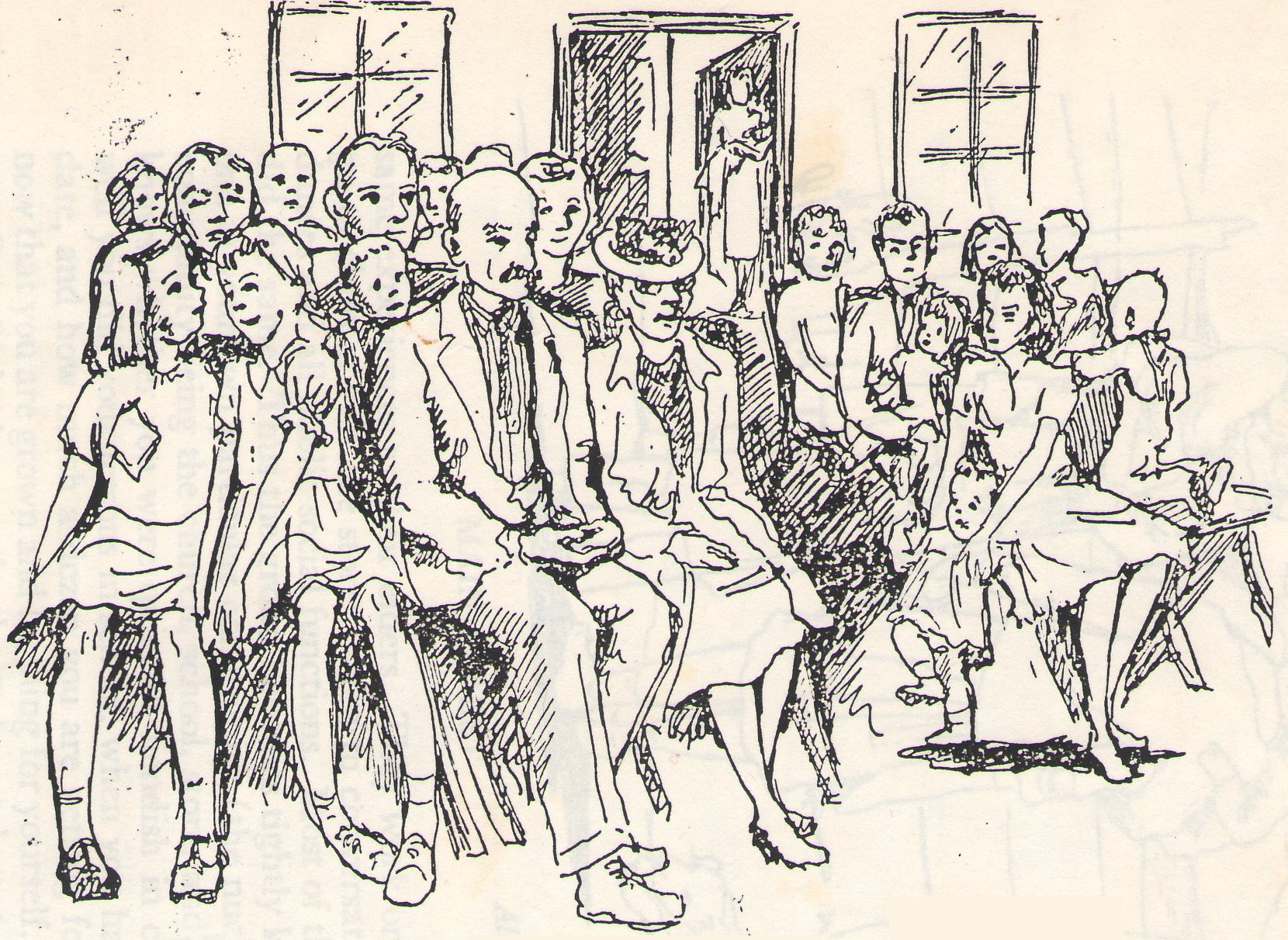
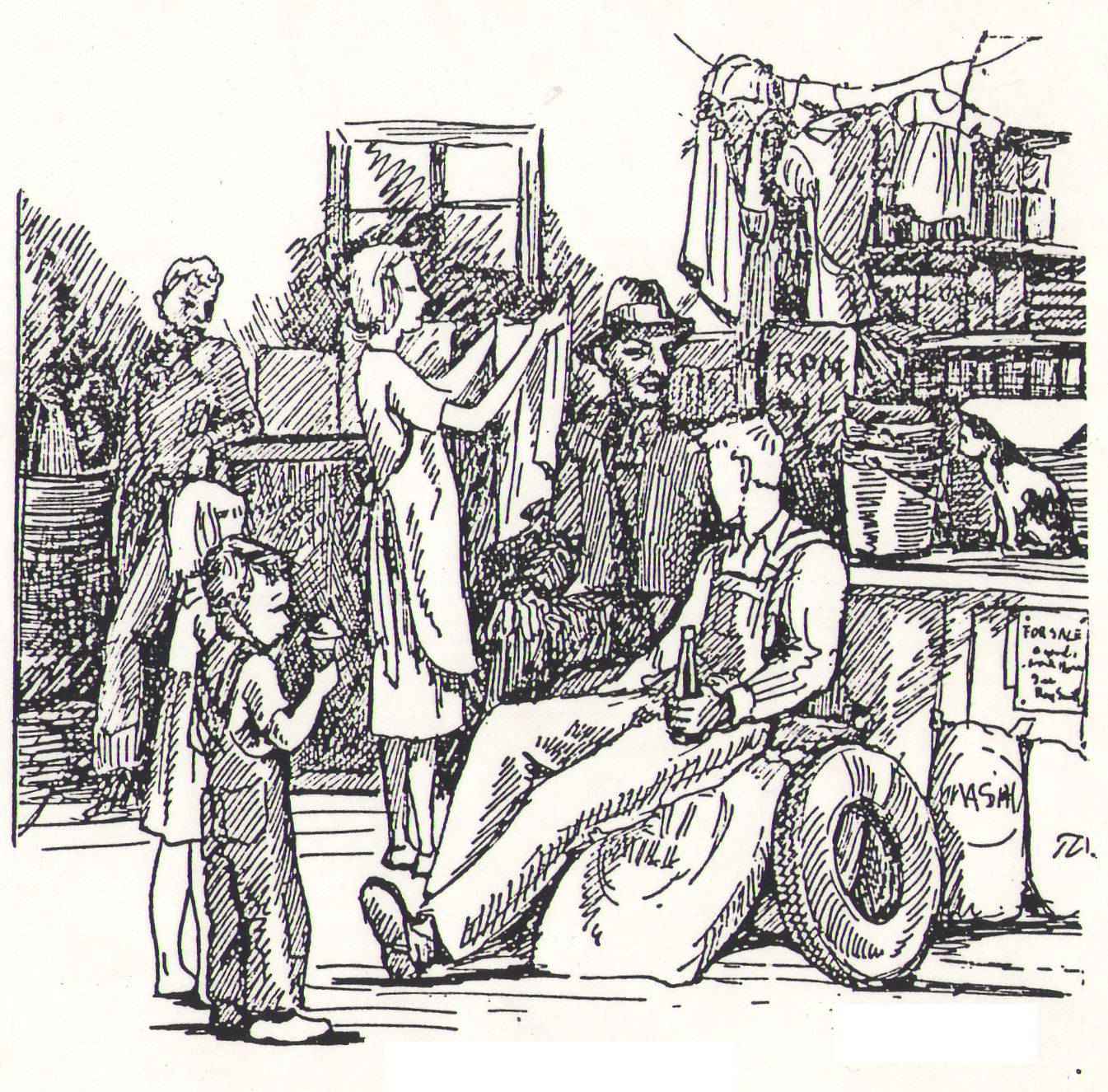
 In the series of sketches, I chose several pictures which depict the life of the people. The one entitled “Main Street” is actually a typical thoroughfare in rural life. The barbed wire fence in the background encloses a pasture that lies between the store and the school house. l would like to call attention again to the children, who, even though small, are becoming used to grown-up talk, and the exigencies of grown­up life.

I have chosen two other sketches dealing with social pleasure. One is the interior of a typical rural store, where the people come partly to buy and partly to visit. There is nearly always a family or two in the store, the men, of course, discussing weather and crops, and the women doing exactly what visiting women have always done talking a mile a minute. The second sketch concerns a dance. This one happens to be at a Gold-and-Green Ball, but is a scene that might be sketched at any country’ dance. Unlike dances in the city, this one is not selective; everyone comes. Many come as “lookers-on.” They simply choose a scat and tend children and visit. The young women, both married and unmarried, come in delightful confections of pink and blue tulle, as “formal” as can be. Older children slick up in their Sunday best and dance or not as they feel inclined. The charm of the whole occasion is that everyone has a good time, the dancers dancing, the onlookers speculating about any new romances, and the children just being children. At midnight the three or four-piece orchestra plays “Home Sweet Home, ” and the hall is vacated, except for a few older boys who stay to put the chairs up for church next morning.

Gold and Green Ball

GOLD AND GREEN BALL – Alice Woolf

 When someone in the community dies, friends of the family build the coffin. This is looked on not so much as a distasteful task as a last kindly gesture toward the de­ceased, and even though neighboring towns have undertak­ing parlors, it is rare indeed that the dead are not cared for by their own friends.

Making coffins

MAKING COFFINS  – Alice Woolf

Sunday morning finds nearly everyone at church. If chores or housework keep people until past the starting time, they come late, expecting everyone to understand. Here again we see ail ages amalgamated together in the large general assembly. No one minds the general hubbub caused by the small children, least of all the people conducting the church service, who are very likely tending children of their own. Somehow everyone comes away from the church up­lifted spiritually, although an outsider might find the whole atmosphere confusing.

Last but not least is the sketch called “Saturday Night.” Never, in my return visit, did I fail to feel nostalgic as I walked into a warm kitchen and saw the tub on the floor and warm towels on the down-turned open door. If there is one thing above others that seems to cement family solidarity, it is the Saturday night bath. By the time everyone has par­ticipated in chopping wood and carrying water in prepara­tion, and has emerged clean and shining from a tin tub, all seems right with the world.

Saturday Night

SATURDAY NIGHT – Alice Woolf

 After spending several months in such an area, it is a little difficult to return even to the modestly urban life of Salt Lake City, as it is always hard to leave a peaceful life among happy people for a life that is more hectic and far less happy. Struggling with wood-chopping, water-carrying, and a cow-to-you milk supply is incidental when one has a joyful life. If one makes the slightest attempt to live within the group mores and customs his life can be an open book – ­read and accepted by all, good and bad alike; and he can of course help in accepting his acquaintances, good and bad alike. With such community solidarity, as long as one stays in the community, security and contentment are forever present.


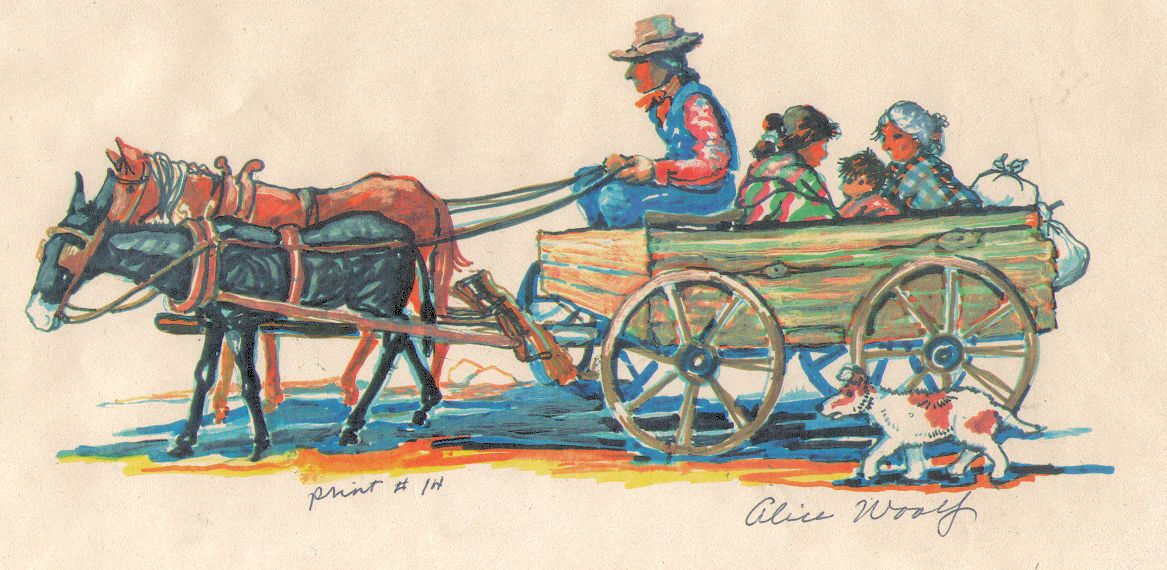
Two prints of artwork by Alice WoolfAlice Woolfe Print 1 Alice Woolfe Print 2Alice and my mother were born in the same year; Alice passed five years before mother did, but they were lifelong friends, and I recall hearing many stories about her as I was growing up. I’m pleased to share this bit of Utah history which, thanks to Alice’s insights, has been preserved.

The Old Wolf has spoken.

The Myth of “Administrative Leave”

Police-badge-generic

Every time I see an article posted about bad police behavior, someone chimes in about the officer being given “paid vacation” for his or her transgression.

It is not “paid vacation.”

Below a comment from redditor /u/thatsnotminesir, a police officer who gave a comprehensive explanation of what “administrative leave” really means, at least in his department – and it sounds like this is how it should work.

The myth I see the most of reddit is that when officers get in trouble, they just get “paid vacation.”

When an accusation of misconduct comes up, especially criminal misconduct, the officer is placed on Administrative Leave with pay. This is NOT the punishment. This is to get them off the streets while the investigation is being conducted, while at the same time, not punishing them (financially at least) until the accusations are investigated and proven.

When an accusation of Police Misconduct is investigated, there are TWO separate investigations. One is an Administrative Investigation, the other is a Criminal Investigation. They have to be separate because of Garrity.

Garrity is like the evil twin of Miranda for government employees, mostly police. After the Garrity admonitions are read to us, we MUST answer all questions, and MUST answer them truthfully. If we refuse to answer, or lie, we can be fired just for lying or refusing to answer.

That completely violates our 5th Amendment Right against self incrimination. Because of that, nothing said after Garrity can be used against us in criminal court. It can only be used in administrative actions against our employment.

Therefore, two separate investigations are conducted. An Administrative Investigation where they read us Garrity, and a Criminal Investigation where they read us Miranda. Nothing found in the administrative investigation can be used against us in the criminal, but things found in the criminal CAN be used against us in the administrative. So the criminal is usually done first, then the administrative afterwards.

Because the administrative is usually done after the criminal, that’s why it often takes time for the firing to happen, because the firing won’t happen until after the Administrative. While that seem strange to the laymen, if the Administrative was done first, and officer could say “Yeah I stole the money” under Garrity and it couldn’t be used against him in court. But if the criminal is done first, and he says “Yeah I stole the money” after Miranda, it can be used to prosecute him AND to fire him.

Once the two investigations are complete, THEN the punishment is handed down if the charges are sustained. Media articles don’t always follow up on the case, so all people read in papers is “officer got in trouble, is on paid leave.” Administrative Leave is just the beginning, not the end of the story.

Even then, the Administrative Leave isn’t fun. The take your badge and gun and you are basically on house arrest between the hours of 8am and 5pm on weekdays. You cannot leave your home without permission of your superiors, even it its just to go down the street to the bank or grocery store. You must be available to come into the office immediately at any time for questioning, polygraphs, or anything else involved in the investigation. Drink a beer? That’s consuming alcohol on duty, you’re fired. So even when officers are cleared of the charges and put back on the street, Admin. Leave still isn’t “paid vacation.”

EDIT: I did not realize the wiki explained garrity, but gave such a poor example of the admonitions, leading to some confusion. Here is a much better example.[3]

EDIT:#2 I changed the Garrity wiki link because the wiki had a very poor example of the warnings, which led to a lot of confusion. Plus the change has a lot of links to more information on garrity for those wanting to learn more about it.[4]

Here’s the original wiki[5] for those who wonder what I changed.

This was an eye-opener for me. Anyone who has watched cop shows knows about Miranda rights, but I had never heard of Garrity. The post was a good education – forever after, I will never wince the same way I used to when a news article mentions administrative leave.

There are a lot of stories in the media this year about police misconduct. That may be a good thing, but a lot of it seems like clickbait, low-hanging fruit for getting eyeballs on ads. It would be critical for our nation for every police department in the country to weed out its rotten apples and bad actors, but even if this were to happen, the number actually purged would be very small in comparison to the majority of men and women who entered law enforcement for better motives.

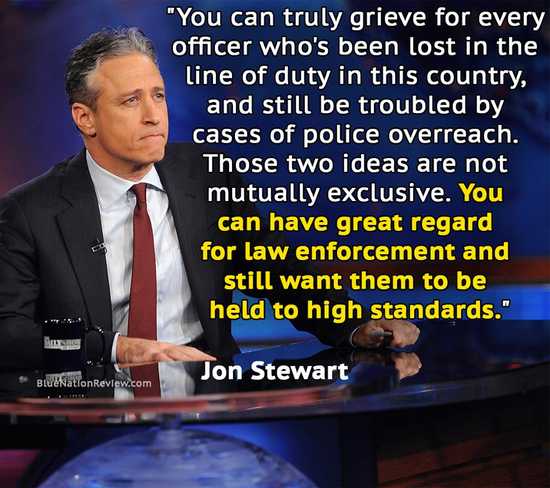
Let’s not forget what Jon Stewart recently said:

1508529_366016606913554_2066128560612870967_n

“You can truly grieve for every officer who’s been lost in the line of duty in this country and still be troubled by cases of police overreach. Those two ideas are not mutually exclusive.”

The Old Wolf has spoken.

Am I Charlie? Or am I just paying lip service?

ch1057

“The Untouchables 2” – You mustn’t mock us!

In light of the recent tragedy in Paris at the offices of Charlie Hebdo, a discussion sprung up on Facebook when a friend of mine, in reference to this article at the Daily Beast, asked the question, “where does humour cross the line into something rather ugly, threatening and repellent?”

I commented as below:

In some ways, Charlie Hebdo is the Westboro Baptist Church of the literary world. It’s a partially flawed analogy because WBC produces nothing positive whatsoever except hatred and misery, while Charlie Hebdo satirizes many things that deserve satire. Are they offensive? Absolutely… but then so is South Park, which show is afraid to pillory nothing. Mad and Cracked back in the 60s and 70s were very similar [1]; the French outfit simply doesn’t have the same restraints on them as American television or magazines, so they’re free to add all the crude sexual [and religious and political and social] humor they want. It may be this “crossing of the line” that some people find so offensive rather than the actual satire itself.

Nonetheless, the same principles of free speech apply here:

1) You’re free to say and publish what you want, and the government can’t come after you for it.
2) You are *not* free from the consequences of your speech.

In this sense, I agree with the thesis of the article. Charlie can be pretty nasty; just look at the comments of Dutch cartoonist Bernard Holtrop (Willem):

“We have a lot of new friends, like the pope, Queen Elizabeth and (Russian President Vladimir) Putin. It really makes me laugh,” Bernard Holtrop, whose pen name is Willem, told the Dutch centre-left daily Volkskrant.

“Marine Le Pen is delighted when the Islamists start shooting all over the place,” said Willem, 73, a longtime Paris resident who also draws for the French leftist daily Liberation.

He added: “We vomit on all these people who suddenly say they are our friends.”

The authors and cartoonists who work at Charlie Hebdo are not necessarily nice people, but they know who they are and they know the risks they are taking by being deliberately offensive. Unfortunately, this week some of them paid the price for taking those risks. This is sad, and unconscionable, and they didn’t deserve to die… but in the grand scheme of things this was not totally surprising.

I remember buying some of the first editions of Charlie when I was living in Italy in 1970. There was a parallel publication in Italian called, interestingly, “Linus.” I now wish I still had them – they’d be worth quite a bit.

As part of the discussion, another member of our community indicated she could identify with Willem’s disgust, citing the world leaders who are marching in Paris while pursuing national policies of destruction and/or oppression. And that’s a valid debate. I replied,

It is another debate entirely, and one that needs to continue. There are many who see the outpouring of support for Charlie as a good thing, others see it as superficial lip-service. And certainly, In that crowd of thousands marching in Paris, you would find thousands of reasons for being there.

In this particular case, I see Willem’s reaction (and those of many, many others in the blogosphere) as a confirmation of the axiom that reality is perception. We see things not as they are, but as we are.

Charlie Hebdo in many ways crosses the boundaries of responsible journalism into the realm of “we’re going to be assholes  just because we can.” And while that aspect of satirical organs is repugnant to many, even those not the targets of their caustic commentary, it is and must remain protected – because if you shut them down, where does the censorship stop?

What happened in Paris is a tragedy of immense significance, and it has ignited a vigorous debate on the nature and aims of the Islamic extremist movement. In these attacks some have seen more than just revenge for offensive cartoons; journalists and analysts all over the world have chimed in suggesting that the true motive was to actually inflame hatred for Islam, making it easier for the terrorist groups to recruit the uneducated and the ideologically susceptible.

In the end, Charlie Hebdo is a pretty lowbrow publication, but I will defend to the death their right to be that way (as Voltaire’s biographer stated, although not Voltaire himself) – because if I don’t, it clears the pathway to the censorship of all writing, including my own, just because it happens to offend somebody, somewhere. And by the same token, I’m free to read it or not read it, and free to choose whether or not I will be offended.

So, yes. As Albert Uderzo so elegantly said by coming out of retirement:

asterix-jesuischarlie

“I’m Charlie too.”

The Old Wolf has spoken.


[1] Check out this tasteful ad for a revival of Disney’s Snow White from Mad’s December, 1970 issue:

snow

The 1967 Aftra Strike

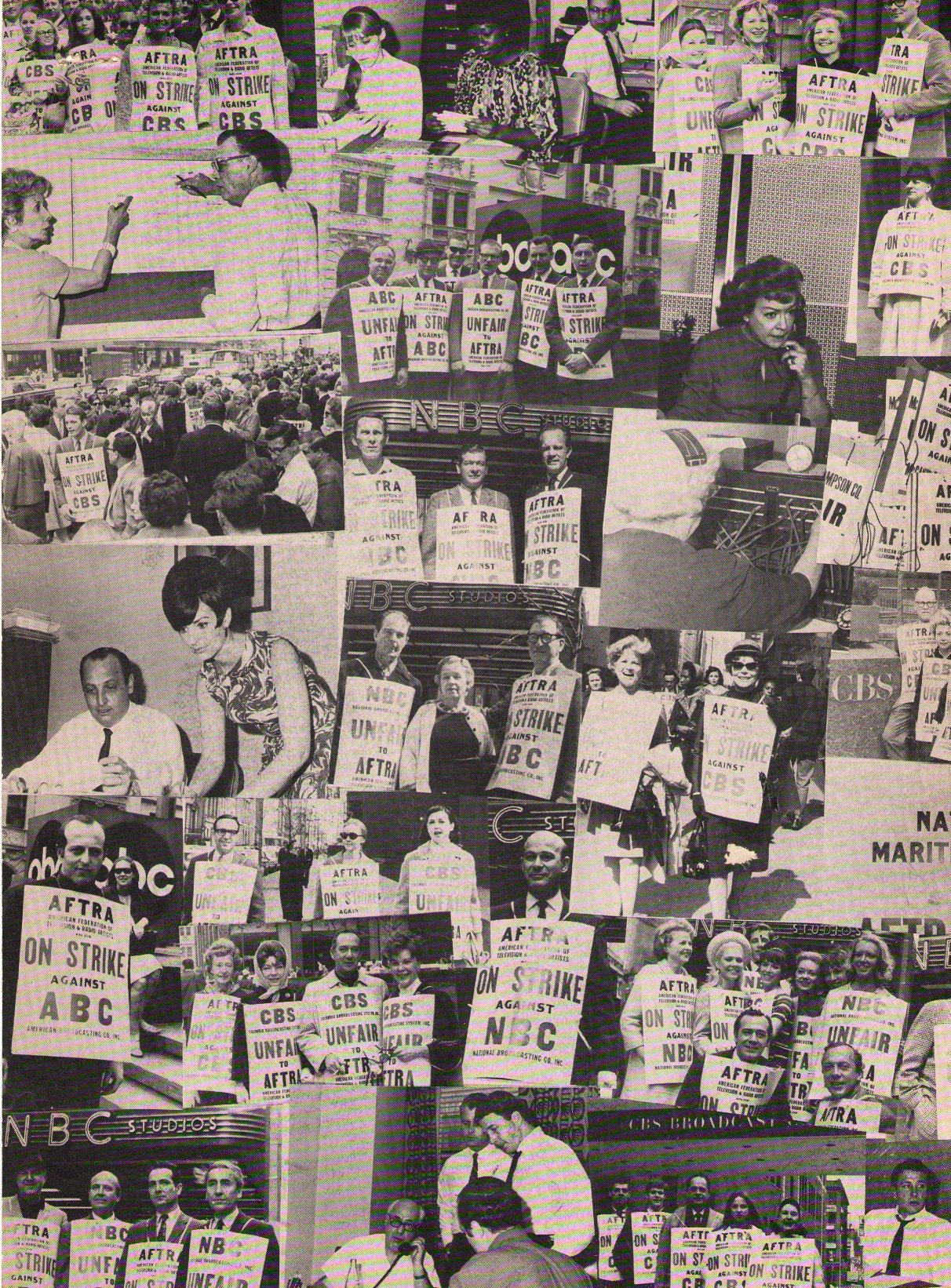
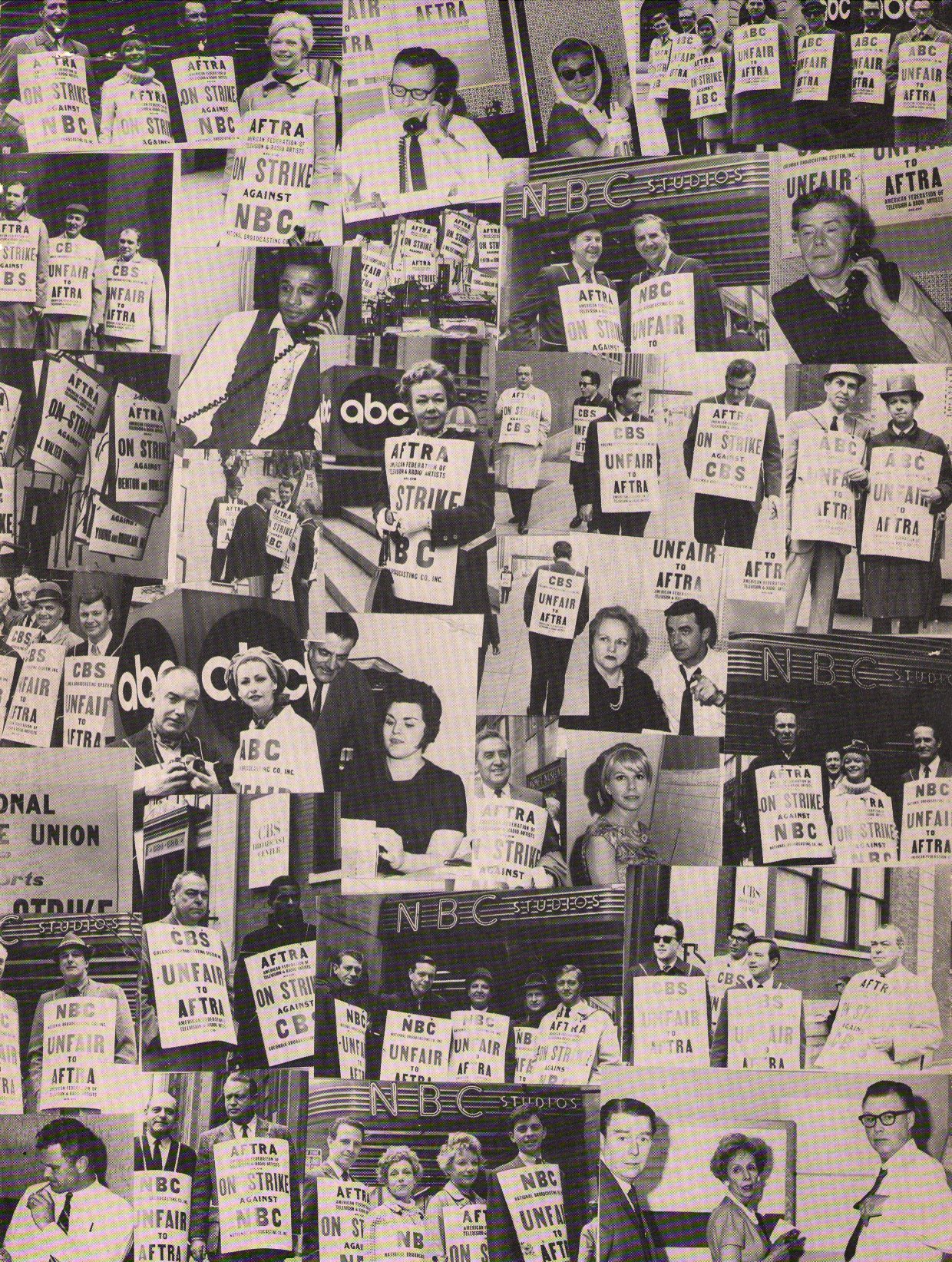
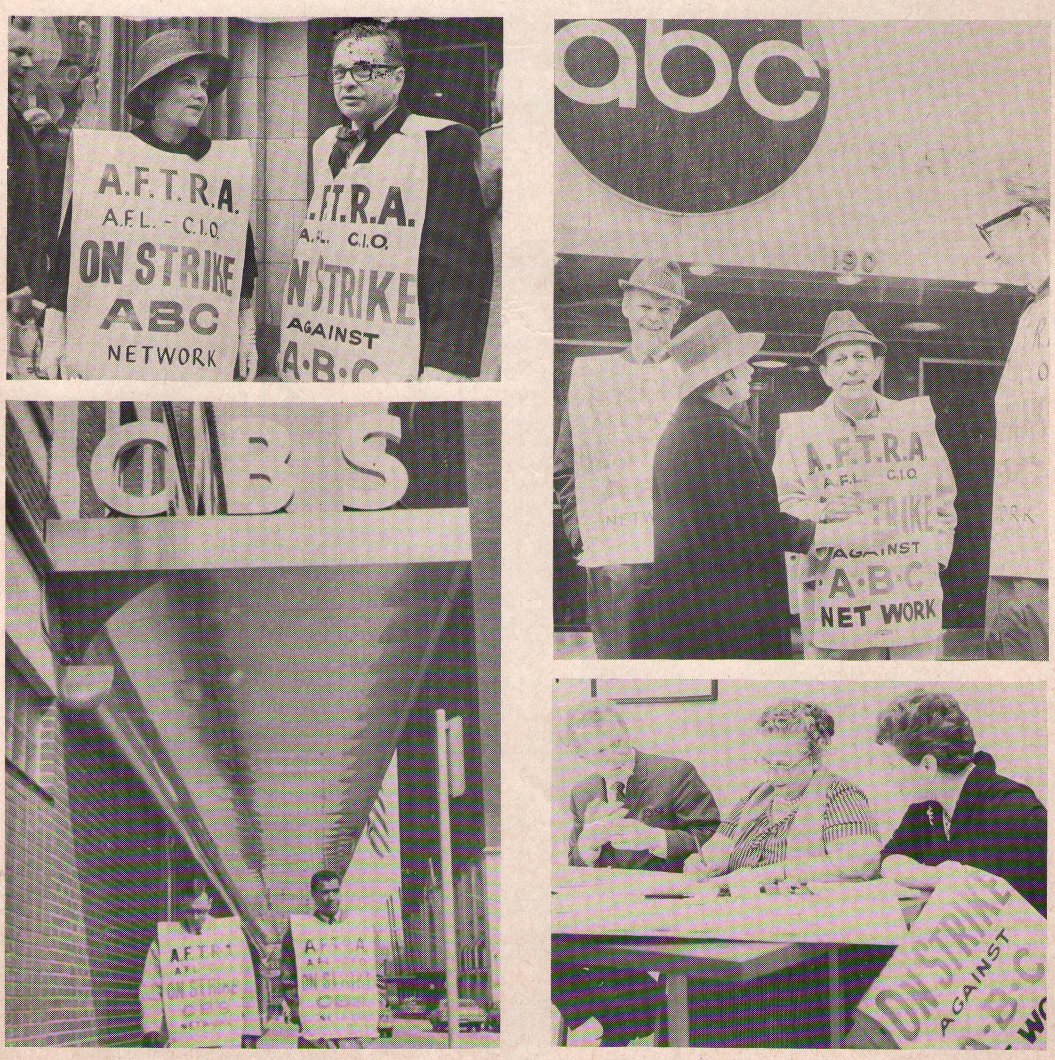
Images below found in Stand By! – February/March 1967. My mother can be seen in the first picture at top right, second from right.

Image
Image0001
Image0002

Anchors Away: Huntley, Brinkley, and Cronkite and the 1967 AFTRA Strike

Socolow, Michael J., Journalism History, Summer 2003
Extract of an article found at Questia

In March 1967, the American Federation of Television and Radio Actors (AFTRA) called its firstnationwide strike. Although almost all programming on the national television networks ceasedproduction, the evening newscasts continued to be broadcast. NBC’s Chet Huntley crossed thepicket line, calling AFTRA a union “dominated by announcers, entertainers, and singers.” Hispartner, David Brinkley, refused to work, and CBS’ Walter Cronkite also supported the union.The strike represents a pivotal yet often overlooked moment in broadcast journalism history. Itcreated the perception of tension between Huntley and Brinkley that would play a role in the“CBS Evening News” surpassing the “Huntley-Brinkley Report” as the nation’s most highly-ratedevening news broadcast in 1967-68.

On the evening of March 29, 1967, most of the approximately 10 million regular viewers of the“CBS Evening News” probably were surprised at seeing the unfamiliar face of a twenty-nine yearold CBS corporate executive peering out from the screen. Ernest Leiser, the executive producer ofthe “CBS Evening News,” had spent that afternoon auditioning several members of the CBS Newsmanagement team to fill the anchor’s chair. Each took a turn reading a four-minute script in thebrightly lit studio. None matched the delivery or screen presence of Arnold Zenker, the programmanager for CBS News, who earlier that same morning had delivered the morning news over theCBS-TV network. Leiser called Zenker at home and told him to report back to the studio, and afew hours later he began reading the day’s top stories to the national television audience.Nowhere in that evening’s script did he mention the fact that the program’s regular anchorman-Walter Cronkite-was out on strike. When the American Federation of Television and RadioArtists (AFTRA) called a strike against the networks that morning, he immediately supported theunion and walked out.1

The idea of a celebrity television news anchor participating in a labor action seems absurd today.Even in 1967, the notion of broadcasters earning more than $100,000 a year striking againsttheir management was considered strange at best, laughable at worst. As U.S. News and WorldReport noted, “never had the country seen anything quite like it.”2 Although the era of thecelebrity journalist had yet to fully bloom, viewers and critics alike shared skepticism that a TVanchorman could be considered a member of the working class. In reporting on this unique laboraction, the press often stressed its more humorous aspects. Newsweek joked that “Eugene Debswould never have believed it,” and on the strike’s second day, the New York Times reported that“Today” show host Hugh Downs was chauffeured to the picket line “in a Cadillac limousinesupplied by the network.”3

The 1967 strike was an important moment in the history of television news. It raised definitionalissues about the social and political status of celebrity anchormen, and it offered the notoriouslyhabitual evening news audience an excuse to change the channel and alter the ratings dynamicbetween the most popular programs. Yet while the significance is clear, the strike has beengenerally ignored in the scholarship of television journalism. In Edward Bliss’ comprehensiveNow the News, the strike received two sentences in 470 pages of text.4 Historians have generallyfollowed the lead of the journalists involved, who downplayed the strike’s impact. Rememberingthe strike in a 1995 interview, NBC’s David Brinkley called it “pointless and quite silly.”5

However, in his 1995 memoir, Brinkley admitted that somehow, in a difficult to define manner,the strike led to the end of NBC’s leadership in the evening news ratings competition. His boss atthe time, Reuven Frank, had concurred in his 1991 memoir, Out of Thin Air.6 Because the strikeaffected the ratings dynamic between the two most-watched evening news programs, it was apivotal moment in broadcast history. (Full article continues with paid subscription at Questia).

This was a bit of history that I remember. The strike was ultimately settled with a new contract, but I recall my mother telling me about her days on the picket line.

The Old Wolf has spoken.

UPS Sure as Hell Doesn’t Want My Business

Not if they’re going to make shipping a package online so flaming impossible.

I used to have a UPS account years ago, but apparently they purge them after a year of inactivity. So I went to their website to try to ship a package this morning.

ups

So they give you the option to ship as a guest, but then the website throws an error and tells me I must login.

In the meantime, I get an email from PayPal stating that there’s a pending charge.So there’s obviously no problem with UPS getting access to my PayPal account. Take note of that, there’s going to be a test.

I wasn’t really all that excited about registering, so I end up calling their customer support people, who promptly shunted me off to a technical support department.

Tech support has me try submitting the shipment again. Same error message. And another pending charge in my PayPal account. The rep told me I needed to create an account.

Fine. I’ll create an account.

UPS 2

Oh, this is getting fun. Try again with a different email account, a different user name, the whole works. Same result.

Call tech support back. The lady manages to create a profile for me, although every bit of information I gave her was horribly mis-spelled, including the UserID.

OK, I can live with a UserID that’s not one of my choice. Go into my profile and change all the information. She directs me to the area where I can add my PayPal account as a default payment method. Go through all the steps. The PayPal side seems to work fine.

ups 4

Another error. The lady tells me helpfully that there’s something wrong with my PayPal account. Oh wait, remember? You can actually submit requests successfully so oh, gee, I guess there’s not. Not to mention the fact that I’ve been using this account successfully for years. She tells me it’s because I have tried to access the account unsuccessfully three times, so I have to wait a full 60 minutes before trying again.

No, sorry. UPS threw the error the first time I tried shipping a package this morning. I ask her for someone in her department who is able to really dig in and find out why UPS is throwing all these errors. She says there is no one, and that I’d have to try contacting the programmers at corporate.

Good luck with that.

OK, fine. I guess I’ll make a credit card my default payment method.

UPS 3

This is my standard business card which works like a charm everywhere else in the world.

Call Tech Support back. They helpfully direct me to the number provided with the error message, saying that I have to call that number to get any help.

So i call. And get a recording. Naturally, this is Saturday and no one can take my call until Monday.

By now, I’ve spent over two hours just trying to ship a single package.

I have come to one inescapable conclusion:

download

It’s clear UPS doesn’t want my business. Their clunky and inoperable website, and the inability of their representatives to help me overcome these myriad problems, has guaranteed that they won’t get it.

The Old Wolf needs a drink and it’s a bloody shame he’s teetotal. He’ll just have a good cry instead.

Let’s Clean Up Facebook in 2015: Hoaxes to Avoid

I keep seeing them crop up on my wall. The Facebook Privacy notice. The “so-and-so is giving away a Maserati to a random user.” OMG you won’t believe this shocking video. and on and on.

These hoaxes are designed for one purpose only: No good.

Below I list some of the most common hoaxes and scams that are prevalent on Facebook. If we could just get people to stop sharing these, we’d be cutting out a lot of clutter and saving some folks a lot of hassle.

1) The Facebook Privacy hoax.

By this statement I give notice to Facebook it is strictly forbidden to disclose, copy, distribute or take any other action against me based on this profile is private and confidential information.

The sentence above is the core of this hoax, although there may be more verbiage associated with it.

If you have posted this, delete it at once. Don’t share it. If you have friends that have posted it, refer them to this article which explains the hoax in detail, and have them delete it.

2) The Free Giveaway Hoax

“Disneyland is giving away two annual passes to a random Facebook user who likes and shares and comments on this post.” Or maybe it’s 50 Cent. Or Walmart. Or Bill Gates. Or Lamborghini.

☛ NO, THEY ARE NOT.

This is a prime example of “like farming.” You need to be aware of what this is and how it works. A great video by Hoax Slayers explains the like-farming business clearly and concisely. Don’t contribute to the financial well-being of criminals. Do not share these posts, and do what you can to have them deleted.

3) The “Talking Angela” scare.

WARNING FOR TO ALL PARENTS WITH CHILDREN THAT HAVE ANY ELECTRONIC DEVICES , EX : IPOD,TABLETS ETC …. THERE IS A SITE CALLED TALKING ANGELA , THIS SITE ASKS KIDS QUESTIONS LIKE : THERE NAMES , WHERE THEY GO TO SCHOOL AND ALSO TAKE PICTURES OF THEIR FACES BY PUSHING A HEART ON THE BOTTOM LEFT CORNER WITHOUT ANY NOTICES . PLEASE CHECK YOUR CHILDREN’S IPODS AND ALL TO MAKE SURE THEY DO NOT HAVE THIS APP !!! PLEASE PASS THIS MESSAGE ON TO YOUR FRIENDS AND FAMILY MEMBERS THAT HAVE KIDS !!!!

This is a totally bogus warning. It was written by someone ignorant and gullible, and sadly has spread around Facebook like wildfire. There is no truth to it.

4) The “OMG You’ve gotta see this shocking video gross yuck!” scam.

It may say something like “OMG you won’t believe how you look in this vid!” or things like that. Key words to watch out for are:

  • shocking
  • gross
  • disgusting
  • unbelievable
  • amazing

These are not always just space-occupying like-farming hoaxes – they ofthe get you to install bad software or simply spread themselves to other Facebook users. There’s one safe way to protect yourself:

☛ – Don’t follow the links, don’t press any buttons that say “allow”. Just don’t.

5) “See who has unfriended you,” “see your top three friends,” “change your Facebook background to pink,” “see who has viewed your profile,” etc.

None of these apps or ones like them do what they say they will do. They are there for the purpose of gathering your information, your friends’ information, and passing the gathered information on to third-party marketers.

Facebook works best without any apps at all. If you don’t use them, you don’t have to worry about their invading or sharing your information.

If we could rid facebook of these five categories of hoaxes, our feeds would be a lot cleaner and the criminals who originate them would have to find other ways to generate thier ill-gotten cash.

Be Careful Out There.

The Old Wolf has spoken.

Commentary: Question to the Islamic Terrorist

Published at VG News.

This should be read by every Muslim, preached over every pulpit by every Imam.

2340538

These are the terrorists who attacked Charlie Hebdo yesterday. But there have been many such in recent years.

While the world picks up the pieces and tries to rebuild, I have some questions for you. You whose bloodlust cannot be slaked.

I ask because I’m a Muslim. And you say you are Muslim. And you say you kill for the God in whom we both believe. You are even proud of this, and some Muslims support you. Most do not, and I ask on their behalf:

“What have you really accomplished?”

Yesterday you killed 12 people and freedom of expression. You say that you avenged the Prophet. You were violated because caricatures were drawn. Charlie Hebdo had a circulation of 50,000. You changed this yesterday. Those caricatures you thought were worth killing for, so that no one would ever again dare to caricature our prophet? Those cartoons had a circulation of 500 million yesterday. At the very least.

Newspapers worldwide have the cartoons on the front pagte today, online, on paper. Millions have changed their profile picture to a caricature of Muhammad . You said “Charlie Hebdo is dead.” The world responded by saying “Je suis Charlie,” “I’m Charlie.” You’ve made ​​Charlie Hebdo immortal. And freedom of speech has reemerged stronger than ever. And did you know that many Muslims, who in 2005 and 2006 were hurt and depressed over the Mohammed cartoons, yesterday wrote that they have changed their minds? They say that the killing of the defenseless is a far greater insult against Muslims than caricatures will ever be. They say: “Draw, draw, draw.” This is what you have achieved.

You threaten and kill

You came onto the stage in earnest on 11 September, 2001. You began with the terrorist attacks in the United States. There you killed 2,996 people. You helped start the “war on terror”. It’s not over yet. And perhaps the war will never be won. The war has resulted in 116,657 civilian casualties, and the count is still rising. Most are Muslims like you and me. Children, the elderly, women and men. Tens of thousands of civilians have been killed by NATO forces, tens of thousands of civilians have been killed by you. You call them victims in the war for God, and you butcher them down without blinking, your your fellow-muslims. And your fellow-muslims must answer for your crimes. Hate crimes against Muslims in Western countries are on the rise. This is what you have accomplished.

You say you are going to spread “true Islam.” Your method is automatic weapons, suicide bombs, indoctrination and fear. Pure fear. You threaten to behead, whip and stone your fellow-muslims into believing in what you believe is true Islam. You call yourselves IS and have killed 24,000 people in Iraq: Muslims, Yazidis, Christians. You use children as soldiers and sell women as sex slaves. You are few, but Muslims are numerous. The many will never live as demanded by the few. Therefore you can never make progress with democratic means. So you resort to the sword and call yourself a lion. Over a hundred Muslim eminent scholars, with close to a billion Muslims behind them, call you an insult to Islam. This is what you have achieved.

The day you lost the battle

The last few years have started something new. You go for the most defenseless. Women, children, aid workers and journalists. You shoot one Malala in the head, because you do not like what she says. Today hear a whole world of Malalas. You shoot 132 children, most boys in puberty, because you think Islamic writings demand that, in the head. From close range. You think this will scare the Pakistani military and the Pakistani people. Pakistan responds with airstrikes, mass executions of convicted terrorists, and mass mobilization against you. A mobilization Pakistan has never seen before. So what have you accomplished, really?

Have you ever thought of the following: If you possess the one truth, should not one billion Muslims follow this of their own free will? You’ve had well over a decade to fight for your case, your interpretation. If your arguments had weight, would you not then have managed to convince all cartoonists to put away the pen? Do you see that you lost your case the day you picked up your weapons? I ask because I am a Muslim.

Shazia Sarwar

Things you may not have known about Apollo 11

Originally posted at craignelson.us in 2009, the original post appears to be gone, but thanks to the Wayback Machine, I present it for your consideration.

24 – During Apollo liftoffs, NASA VIPs sat 3.5 miles away from the pad, since if the rocket exploded, it would do so with 4/5ths the power of an atomic bomb, meaning 100-pound shrapnel thrown a radius of 3 miles. Neil Armstrong recently commented that today, Americans are shocked when the Shuttle doesn’t work every time, but during Apollo, NASA employees were always surprised when the Saturn did.

23 – The threat of pad catastrophe was so imminent that NASA engineered a number of methods to rescue the crew. There was an entirely separate 3-rocket assembly attached to the nose cone of the capsule, ready to launch the men off their booster, deploy the chutes, and drift into an Atlantic splashdown. There were 600-feet-per-minute high-speed elevators which would be met by armored personnel carriers, and a cable car attached to a slide wire which could carry all three men 2500 feet at 50 mph away from the immolating missile to a rubber-walled below-ground bunker.

22 – There was one prayer at the start of every NASA mission shared by astronaut crew and ground control engineers alike: “Dear Lord, please don’t let me [screw] up.”

21 – During countdown, Neil Armstrong, Buzz Aldrin, and Mike Collins sat in absolute silence for 30 minutes.

20 – As his rocket rose into the sky, Saturn V overseer Wernher von Braun recited, aloud, the Lord’s Prayer with tears in his eyes. He then turned to a colleague and offered, “You give me $10 billion and 10 years and I’ll have a man on Mars.”

19 – The computers aboard each of the Apollo 11 spaceships had less power than today’s cellphones.

18 – Those who believed American astronauts were daredevil cowboys would be surprised by what Neil Armstrong and Buzz Aldrin made sure to bring with them on this mission: Slide rules.

17 – Instead of watching his dad on television during the flight, Mike Collins only wanted to play with his pet bunny, Snowball; after ignoring almost everything about Apollo 11, Marky Armstrong looked up from what he was doing at one point, realized that it was his dad who was on the TV screen, and ran over to hug it.

16 – Much of the heroics needed by astronauts went into enduring what was arguably the world’s worst camping trip. Drinking water was a fuel-cell by-product, but Apollo 11’s hydrogen gas filters didn’t work, making every drink so bubbly that some believe the bravest man on the mission was the Navy frogman who opened the hatch after splashdown. NASA meals were vacuum-sealed in plastic. Cubes of cereal and cookies were eaten straight out of the bag, while freeze-dried entrees (a process that combined flash-freezing with vacuum-s*cking to remove all moisture) needed to be rehydrated through a nozzle with either hot or cold (and gassy) water and kneaded into a mash, which was then squeezed out like toothpaste and was as delicious as it sounds. Of the 2500 calories they were supposed to eat each day, an Apollo crewman averaged 1400. Urinating and d3fecating in zero gravity, meanwhile, were never successfully addressed by any NASA engineering triumph; the latter was so troublesome that agency doctors prescribed foods that produced as little waste as possible, and more than one astronaut spent their entire mission on lomotil to avoid the procedure entirely.

15 – As Aldrin and Armstrong monitored the landscape of their landing path, it became clear that something was off, that they were going to overshoot NASA’s carefully-plotted landing site by about 4 miles. Instead of a computer-controlled touchdown, Armstrong would have to land on the moon himself. During one of his lunar lander training sessions, however, he’d almost died, with 3/5ths of a second to spare. In the Apollo 11 touchdown, he would almost wholly run out of fuel. Astronaut Don Lind: “At the end, all we knew was that the LM was descending at 1 foot per second and scooting across the surface at 47 feet per second, with only about 60 seconds’ worth of descent fuel left. My heart was pounding so hard I was afraid they’d kick me out of the Astronaut Corps.”

14 – NASA’s simulator training worked so well that many astronauts would calm themselves during real-world crises by thinking, “This is just like a simulation.”

13 – In case of disaster, William Safire prepared a speech which President Nixon would have given as the astronauts lived out their final hours. It began: Fate has ordained that the men who went to the moon to explore in peace will stay on the moon to rest in peace. And it concluded: For every human being who looks up at the moon in the nights to come will know that there is some corner of another world that is forever mankind.

12 – The “one small step for man” wasn’t actually that small. The commander had set his ship down so gently that the legs’ shock absorbers hadn’t deployed, and the bottom of the ladder was 3.5 feet away from the Moon’s surface. Armstrong first stepped onto one of Eagle’s footpads and hoisted himself back onto the ladder to make sure he could get back to his ship before taking the ’small step,’ and then warned Aldrin about how big a drop it actually was.

11 – Armstrong’s first assignment was to immediately grab a rock just in case there was an emergency abort. Instead, he became so engrossed in taking pictures that Mission Control had to nag him 3 times about the sample. Aldrin, meanwhile, had to remember not to lock the door after exiting the LM, since there was no outside handle. When it was his turn with the Hasselblad, Aldrin took very few pictures of Armstrong, all of them a small figure in a vast panorama featuring the Lunar Module. There is today only one good photograph of Neil Armstrong on the moon — one he took himself, reflected in Aldrin’s gold visor.

10 – Armstrong later confessed to astronaut Alan Bean that their next task was the most difficult and frightening one of all: planting the American flag. It turned out that, contrary to many geologists’ conjecture, the moon’s surface (at least in the Sea of Tranquility where Eagle had landed) was a thin sweep of dust covering hard, dense, impenetrable rock. After pounding and sweating away at the task for much too long, Aldrin and Armstrong could only get their flagpole in a few inches. Both were convinced that, live on television with billions watching, they would step back from the flag — which was torsoed with wires to always wave erect in the vacuum of the moon — only to see it topple over into the dust. Amstrong tried patting a mound of dirt at the base to stabilize it, but the situation was so dicey that he and Aldrin spent the rest of their moonwalk carefully avoiding it. NASA had kept secret the manufacturer of the moon flag, insisting that they were bought anonymously. But the president of flag-maker Annin uncovered that it had come Sears, an exclusively Annin retailer. He begged the agency’s Public Affairs Office to publicly acknowledge this, but NASA refused. They said, “We don’t want another Tang.”

9 – Returning to the LM, Aldrin and Armstrong had now worked for over 24 hours nonstop, and needed to sleep. But there was a constant racket from the interior system pumps and the micrometeorites exploding like hail on the LM’s mylar skin. Aldrin: “It was very chilly in there. After about 3 hours it became unbearable. We could have raised the window shades and let the light in to warm us, but that would have destroyed any remaining possibility of sleeping.” Armstrong found that his hammock put him directly in the line of sight of the craft’s telescope, which at that moment was focused on the Earth. For the exhausted but restless flyer, it seemed as if a huge, unblinking blue eye was staring down at him.

8 – Orbiting overhead in the mothership Columbia, Mike Collins, meanwhile, had spent countless hours peering through the sextant trying to determine his crewmates’ landing spot, but he still didn’t know where Eagle was, exactly … and Houston didn’t know, either. The next morning, Collins radioed, “You’ve given up looking for the LM, right?” and Houston replied, “Affirmative.”

7 – Astronaut Nurse Dolores “Dee” O’Hara: The astronauts “have something, yes, that something that men have for whom death is a toy to play with, or who have seen something you haven’t seen. The ones who have been up, especially. They have something, a sort of wild look, I would say, as if they had fallen in love with a mystery up there, sort of as if they haven’t got their feet back on the ground, as if they regret having come back to us … a rage at having come back to earth. As if up there they’re not only freed from weight, from the force of gravity, but from desires, affections, passions, ambitions, from the body. Did you know that for months John [Glenn] and Wally [Schirra] and Scott [Carpenter] went around looking at the sky? You could speak to them and they didn’t answer, you could touch them on the shoulder and they didn’t notice; their only contact with the world was a dazed, absent, happy smile. They smiled at everything and everybody, and they were always tripping over things. They kept tripping over things because they never had their eyes on the ground.”

6 – In the wake of Apollo 11, the speaker at one NASA scientific banquet was British astrophysicist Fred Hoyle, who had predicted in 1948 that, once a picture of the earth from space had been made, a whole new way of thinking would result. He told the attendees: “You have noticed how, quite suddenly, everybody has become seriously concerned to protect the natural environment. It happened almost overnight, and one can understand how one can ask the question, ‘Where did this idea come from?’ You could say, of course, from biologists, from conservationists, from ecologists, but after all, they’ve really been saying these things for many years past, and previously they’ve never even got on base. Something new has happened to create a worldwide awareness of our planet as a unique and precious place. It seems to me more than a coincidence that this awareness should have happened at exactly the moment man took his first step into space.”

5 – Though JFK had publicly announced, “We choose to go to the moon in this decade and do these other things, not because they are easy, but because they are hard. Because that goal will serve to organize and measure the best of our energies and skills,” privately, he would ask, “Can you fellows invent some other race here on earth that will do some good?” and commented about getting a man on the moon: “The cost, that’s what gets me.” Twice, Kennedy would propose to Khrushchev that the two merge their efforts in a join US-USSR mission to the moon, but the Russians, not wanting the West to see the limits of their military technology, declined.

4 – Lyndon Johnson’s budget director informed the president, in great detail, the vast amount of money that would be saved by not going to the Moon before 1970. But Johnson demurred, insisting he owed it to John Kennedy to make that deadline.

3 – Soon after President Kennedy’s assassination, his widow sat down with Teddy White for an interview which remained unpublished until 1995, a year after her death. Jackie commented on the various memorial plans that, “I’ve got everything I want; I have that flame in Arlington National Cemetery and I have the Cape. I don’t care what people say. I want that flame, and I wanted his name on just that one booster, the one that would put us ahead of the Russians … that’s all I wanted.”

2 – Fearing a public relations calamity, NASA never allowed Armstrong, Aldrin, or Collins to ever fly again.

1 – Since 1981, the Pentagon’s annual space budget has been bigger than NASA’s.
The Overview Effect: Seeing Earth from the Outside

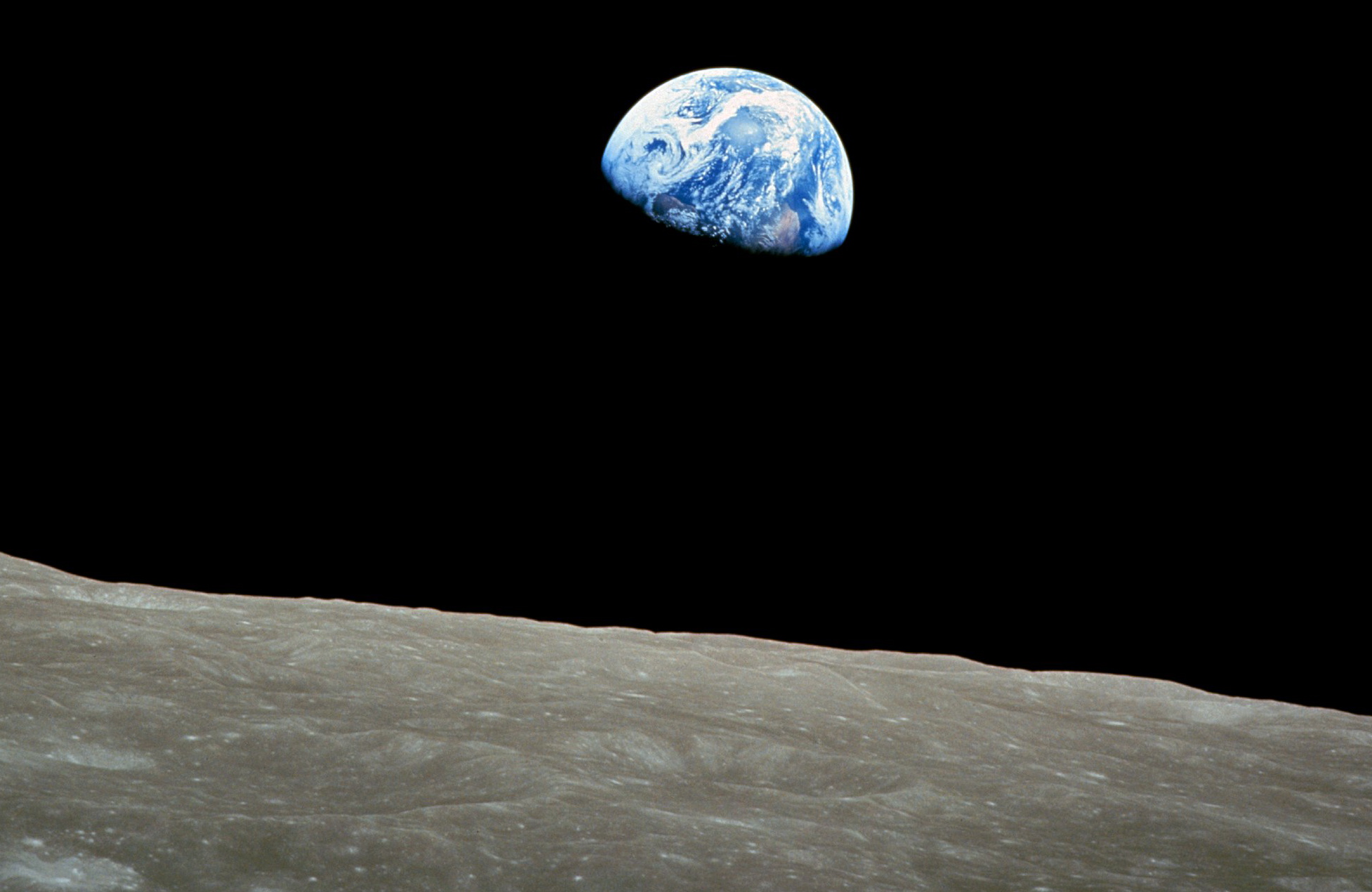
Writer Frank White coined the term “The Overview Effect” to describe the deep changes that astronauts experience once they see Earth from space. He said, “In 1968, Apollo 8 went to the Moon. They didn’t land, but they did circle the Moon; I was watching it on television and at a certain point one of the astronauts casually said: we are going to turn the camera around and show you the Earth. And he did. And that was the first time I had ever seen the planet hanging in space like that. And it was profound.”

nasa-apollo8-dec24-earthrise

Apollo 8: Earthrise. ©Nasa

Astronaut Edgar D. Mitchell said,

“You develop an instant global consciousness, a people orientation, an intense dissatisfaction with the state of the world, and a compulsion to do something about it. From out there on the moon, international politics look so petty. You want to grab a politician by the scruff of the neck and drag him a quarter of a million miles out and say, ‘Look at that, you son of a bitch.”

But you don’t need to have gone into space to have obtained that awareness; some forward-thinking individuals divined the importance of our island earth from their armchairs. In 1948, British astrophysicist Fred Hoyle predicted the change of viewpoint when he said,

“Once a photograph of the Earth, taken from outside, is available, we shall, in an emotional sense, acquire an additional dimension… Once let the sheer isolation of the Earth become plain to every man, whatever his nationality or creed, and a new idea as powerful as any in history will be let loose.”

Subsequent to Apollo 11, Hoyle spoke at a NASA scientific banquet and said,

“You have noticed how, quite suddenly, everybody has become seriously concerned to protect the natural environment. It happened almost overnight, and one can understand how one can ask the question, ‘Where did this idea come from?’ You could say, of course, from biologists, from conservationists, from ecologists, but after all, they’ve really been saying these things for many years past, and previously they’ve never even got on base. Something new has happened to create a worldwide awareness of our planet as a unique and precious place. It seems to me more than a coincidence that this awareness should have happened at exactly the moment man took his first step into space.”

A recent short documentary, Overview, collects statements from many astronauts who have had this unique experience.

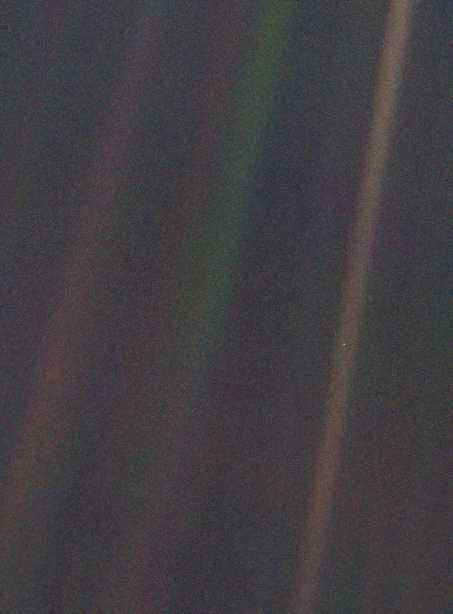
With his famous essay on “The Pale Blue Dot,” Carl Sagan captured the essence of this effect, without himself ever having been in space physically, although he probably plumbed the universe more deeply in his mind than the vast body of humanity.

Pale_Blue_Dot

“… Look again at that dot. That’s here. That’s home. That’s us. On it everyone you love, everyone you know, everyone you ever heard of, every human being who ever was, lived out their lives. The aggregate of our joy and suffering, thousands of confident religions, ideologies, and economic doctrines, every hunter and forager, every hero and coward, every creator and destroyer of civilization, every king and peasant, every young couple in love, every mother and father, hopeful child, inventor and explorer, every teacher of morals, every corrupt politician, every “superstar,” every “supreme leader,” every saint and sinner in the history of our species lived there – on a mote of dust suspended in a sunbeam.

The Earth is a very small stage in a vast cosmic arena. Think of the rivers of blood spilled by all those generals and emperors, so that, in glory and triumph, they could become the momentary masters of a fraction of a dot. Think of the endless cruelties visited by the inhabitants of one corner of this pixel on the scarcely distinguishable inhabitants of some other corner, how frequent their misunderstandings, how eager they are to kill one another, how fervent their hatreds. Our posturings, our imagined self-importance, the delusion that we have some privileged position in the Universe, are challenged by this point of pale light.

Our planet is a lonely speck in the great enveloping cosmic dark. In our obscurity, in all this vastness, there is no hint that help will come from elsewhere to save us from ourselves.

The Earth is the only world known so far to harbor life. There is nowhere else, at least in the near future, to which our species could migrate. Visit, yes. Settle, not yet. Like it or not, for the moment the Earth is where we make our stand.

It has been said that astronomy is a humbling and character building experience. There is perhaps no better demonstration of the folly of human conceits than this distant image of our tiny world. To me, it underscores our responsibility to deal more kindly with one another, and to preserve and cherish the pale blue dot, the only home we’ve ever known…”.
– Pale Blue Dot: A Vision of the Human Future in Space

Recently published at YouTube was a video of the final message of Wubbo Johannes Ockels (March 28, 1946 – May 18, 2014), who was a Dutch physicist and an astronaut of the European Space Agency (ESA), riding on Space Shuttle STS-61-A, and becoming the first Dutch citizen in space. After his astronaut career, Ockels was professor of Aerospace for Sustainable Engineering and Technology at the Delft University of Technology. On May 29, 2013 it was announced that Ockels had an aggressive form of kidney cancer (renal cell carcinoma) with a metastasis in his pleural cavity, and a life expectancy of one to two years. He died from complications of cancer on May 18, 2014, one day after making this video.

A transcript in English of Dr. Ockels’ remarks follows.

“We need some luck. Some other spacecraft. Something, because with what we have now, it’s going to be finished. As an astronaut, you feel excluded to a particular group of people. And those are the people in the majority. They are you, not being aware of the danger in which you live.

But now suppose I’m going to change all of you. Suppose I can transfer the experience which I have to you. Then you would go out and see the earth, and you would see the blue sky, not the blue sky which you see when you go outside; in space you see that you are the only one. The only planet. You have no spare. And so you have to take care of this one only planet.

Our earth has cancer. I have cancer too. And most people with cancer, they die. When in fact, everybody will die. If we make enough people to continuously survive mankind on the earth, we need to conserve our own planet, and you when you have the spirit and the insight and the attitude of an astronaut, you start to love the earth in a way that other people can’t. And if you really love something, you don’t want to lose it.

You know, my wife, she doesn’t want to lose me. She wants to do everything to let me stay alive. That’s the love and attitude which human kind should have to the earth. We do not have 50% of our roofs covered with solar. We do not have more than half of our cars electric. We certainly do not have a production in which there is a reasonable amount of material recycled. We don’t have all these things.

And then the question comes, ” OK, well what’s wrong?” Well, what’s wrong is the mindset. I’m sure, but I can’t claim it, but when I heard 18 April 2013 that I had a very bad cancer, damn kidney cancer, and also changed into a sarcomatoid, which means that, you know, which to slip through all kinds of things [by this he meant metastasis], and this, the doctor, beautiful doctor, and he said you have a fair amount of time. And of course each time I asked him, “what does ‘fair’ mean?” and then he was not very accurate, but he said, “Well, months, maybe a year.”

I got over a year, a good year, because I believed that the good future, and I believed, you know, you can do things with the power, with the mind power. We, we people coming from the same molecules out of one bloody strong star which bursted out, we who have developed over billions of years, life, life, is made by we, we humanity are so strong that we can save the earth – but we also can destroy it. Even a small thing does something.

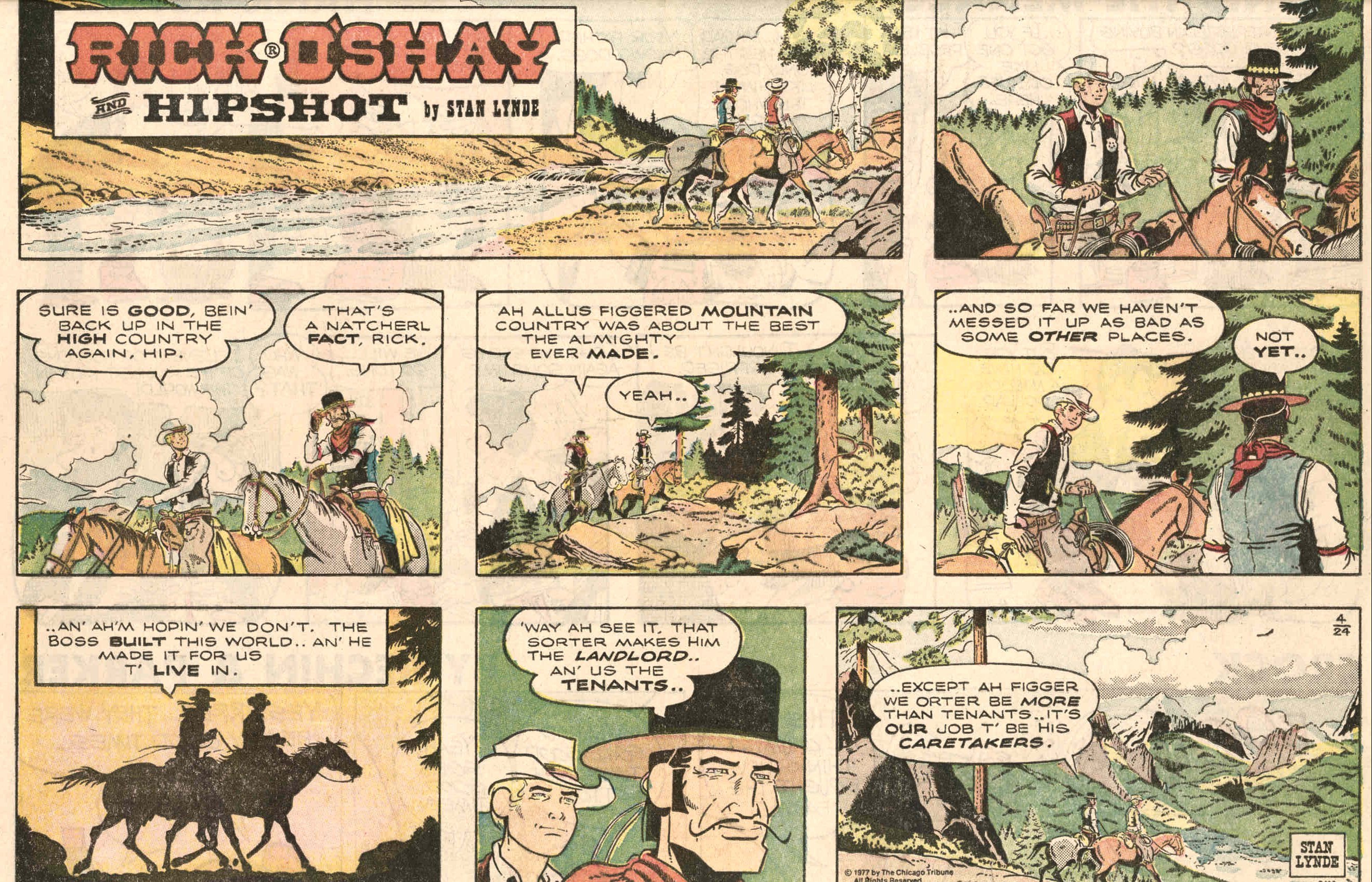
The overwhelming burden of experience from those who have been outside the Earth’s atmosphere is that this little planet we live on is the only home we have, and we need to take care of it. Even if you happen to be a person of faith, taking the chiliastic view that we don’t need to worry about the Earth because God is going to come down and take care of everything strikes me as irresponsible, and unfair to future generations. Western Artist Stan Lynde captured my own sentiments decades ago:

RickOShay2

While efforts are being made by forward-thinking individuals to reduce the damage we’re doing to our planet, there is still much to be done. We owe it to future generations to make a difference now. “Drill, baby, drill” just doesn’t do it for me.

The Old Wolf has spoken.