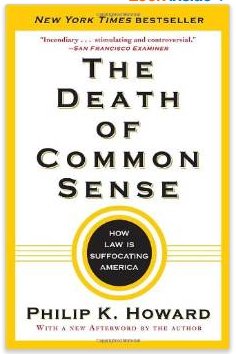
This article, written 20 years ago, is an excerpt from Howard’s book by the same name. It was published in US News and World Reports on January 30, 1995.

It is even more relevant today than it was then.
This is a copyright article – if anyone really objects to its presence here, I’ll take it down. But it deserves to be read, as does the entire book.
The Death of Common Sense
Philip K. Howard
In the winter of 1988, nuns of Mother Teresa’s Missionaries of Charity were walking through the snow in the South Bronx in their saris and sandals to look for an abandoned building that they might convert into a homeless shelter. They came to two fire-gutted buildings on 148th Street and, finding a Madonna amid the rubble, thought that perhaps Providence itself has ordained the mission. New York City offered the abandoned buildings at $1 each, and the Missionaries of Charity set aside $500,000 for the reconstruction. The only thing unusual about the plan was that the nuns, in addition to their vow of poverty, avoid the routine use of modern conveniences, and there would be no washing machines or other appliances. For New York City, the proposed homeless facility would literally be a godsend. Although the city owned the buildings no official had the authority to transfer them except through an extensive bureaucratic process. For 18 months, the nuns were directed from hearing room to hearing room discussing the project with bureaucrats. In September 1989, the city finally approved the plan, and the Missionaries of Charity began repairing the fire damage.
Providence, however, was no match for law. New York’s building code, they were told after almost two years, required an elevator. The Missionaries of Charity explained that because of their beliefs they would never use the elevator, which also would add upward of $100,000 to the cost. The nuns were told the law could not be waived even if an elevator didn’t make sense.
Mother Teresa gave up. Her representative said: “The Sisters felt they could use the money much more usefully for soup. and sandwiches.” In a polite, regretful letter to the city, the Missionaries of Charity noted that the episode “served to educate us about the law and its many complexities.” No person decided to spite Mother Teresa. It was the law of government, which controls almost every activity of common interest-fixing potholes, running schools, regulating day-care centers, controlling workplace behavior, cleaning up the environment and deciding whether to give Mother Teresa building permit. And what it required offends common sense. Law designed to make Americans’ lives safer and fairer has now become an enemy of the people.
Government acts like some extraterrestrial power, not an institution that exists to serve us. The bureaucracy almost never deals with real-life problems in a way that reflects an understanding of the situation. We seem to have achieved the worst of both worlds: a system of regulation that goes too far while it also does too little.
This paradox is explained by the absence of the one indispensable ingredient of any successful human endeavor: the use of judgment. In the decades since World War II, we have constructed a system of regulatory law that basically outlaws common sense. Modern law, in an effort to be “self-executing,” has shut out our humanity.
The motives to make the law this way had logic. Specific legal mandates would keep government in check and provide crisp guidelines for citizens. Layers of “process”-procedural deliberations-would make sure decisions were responsible. Handing out “rights” would cure injustice. But it doesn’t work. Human activity can’t be regulated without judgment by humans, adjusting for circumstances and taking responsibility.
The public’s fury with government was demonstrated in the November election, and the Republicans who won power now promise to get government off our backs. This rhetoric never turns to reality, though, because the public does not want to cut government essential services. The public is mad at how government works-its perpetual ineptitude and staggering waste-not mainly what government aims to do.
Moreover, the GOP’s Contract With America proposes to take only small steps in the direction of real reform. One proposal would impose a moratorium on many pending regulations- an idea equivalent to cutting off your leg to lose weight. Another Republican theme is to return government functions to. states, which could be a real benefit in certain areas like welfare but disastrous in others like environmental protection. The federalism idea ignores the fact that state governments are typically as ineffective and wasteful as the federal government. To liberate Americans from red tape, real reform must be aimed at simplifying how government works. Ending our suffocating legal system should be reformers’ goal.
LAW REPLACES HUMANITY
The tension between legal certainty and life’s complexities was a primary concern of those who built our legal system. The Constitution is a model of flexible law that can evolve with changing times and unforeseen circumstances. Today, we no longer remember that words can impose rigidity as well as offer clarity. Law had an identity crisis when Oliver Wendell Holmes Jr., then a law professor, suggested in 1881 that law was not certain after all but depended on how the judge and jury saw the facts. This stimulated a wide range of reform movements, especially to codify the common law into statutes. Progressives at the turn of the century, New Dealers in the 1930s and Great Society reformers in the 1960s expanded the role of government in huge ways.
Another form of lawmaking also took hold in the ’60s that focused not on government’s role but on its techniques. Legal details proliferated. The Federal Register, a report of new and proposed regulations, increased from 15,000 pages in the final year of John Kennedy’s presidency to over 70,000 pages in the last year of George Bush.
Precision became the goal. The ideal of lawmaking was to anticipate every situation, every exception and codify it. With obligations set forth precisely, according to this rationale, everyone would know where he stood. But the drive for certainty has destroyed, not enhanced, law’s ability to act as a guide. “Regulation has become so elaborate and technical that it is beyond the understanding of all but a handful of mandarins,” argued former Stanford Law DeBanay less Manning. No tax auditor, no building code examiner can possibly know all the rules in thick government volumes. What good is a legal system that cannot be known?
Instead of making law a neutral guidepost protecting against unfairness and abuse, this accretion of law has given bureaucrats almost limitless arbitrary power. A few years ago, the federal Occupational Safety and Health Administration decided workers needed more protection from hazardous chemicals. Bureaucrats decided that everything that could conceivably have a toxic effect should be shipped with a Material Safety Data Sheet describing the possible harmful effects of each item. The list grew and grew until it totaled over 600,000 products. In 1991, OSHA turned its attention to bricks. Bricks can fall on people, of course, but they had never been considered poisonous. The OSHA regional office in Chicago sent a citation to a brick maker for failing to supply an MSDS form with each pallet of bricks. If a brick is sawed, OSHA reasoned, it can release small amounts of the mineral silica. The fact that this doesn’t happen much at construction sites was of no consequence. Brick makers thought the government had gone crazy, and they feared a spate of lawsuits. They began sending the form so that workers would know how to identify a brick (a “hard ceramic body with no odor”) and giving its boiling point (“above 3,500°” Fahrenheit). In 1994, after three years of litigation, the poison designation was removed by OSHA.
The proliferation of rules may not produce the benefits of certainty and fairness, but it creates endless opportunities for smart lawyers seeking angles and advantages. Law, supposedly the backdrop for society, has been transformed into one of its main enterprises. For some billionaires, cable-TV companies, congressmen and litigators, close scrutiny and manipulation of the rules are a means to an end, The words of law give them lower taxes, a way to circumvent price controls, a secret means of playing favorites and a tool to grind the other side into the ground.
housing, gets regular citations for code violations like nonaligning windows and closet doors that do not close tightly. Does the city think that those clean, inexpensive rooms are somehow unworthy of a city that itself provides cots 18 inches apart for those who have no pltadc sel eep? A city inspector recently told the YMCA, after it had virtually completed a renovation, that the fire code had changed and a different kind of fire-alarm system, costing an additional $200,000, would have to be installed. “Don’t they realize th$a2tO Oth,CeM Xl can provide yearlong programs for a hundred kids?” asked Paula Gavin, the YMCA’s president. In our obsessive effort to perfect a government of laws, not of men, we have invented a government of laws against men.
THE NEVER-ENDING PROCESS
In 1962, Rachel Carson shocked the nation by exposing the effects of DDT and other pesticides in her book The Never-Ending Spring. There was also another side to the issue: Pesticides give us apples without worms and the most productive farms in the world. In 1972, Congress required the newly created Environmental Protection Agency to review all pesticides (about 600 chemical compounds at that time) and decide which should be removed from the market. The deadline was three years. More than 20 years have passed, and yet only 30 pesticides have been judged. Hundreds of others, including some on which there are data suggesting significant risk, continue to be marketed. “At this rate,” said Jim Aidala, a onetime congressional pesticide expert, “the review of existing pesticides will be completed in the year 15000 A.D.”
Making decisions, it almost seems too obvious to say, is necessary to do anything. Every decision involves a choice and the likelihood that somebody will lose something; otherwise, there would be no need to decide. This is the issue that paralyzes government decision making. “The problem with government,” argues economist Charles Schultze of the Brookings Institution, “is that it can’t ever be seen to do harm.” Bureaucrats find it nearly impossible to say yes. Yet the act of not choosing is not benign: We may eat something bad because the EPA never made a decision.
Sometimes government cannot act even in the face of imminent peril. In the early-morning hours of April 13, 1992, in the heart of Chicago’s downtown Loop, the Chicago River broke through the masonry of an old railroad tunnel built in the last century. Several hundred million gallons of water from the river were diverted into the basements of downtown office buildings, knocking out boilers, short-circuiting countless electric switches, ruining computers and turning files into wet pulp. Total losses were over $1 billion. Several weeks before the accident, the leak in the tunnel had come to the attention of John La Plante, then Chicago’s transportation commissioner, a public servant with 30 years of exemplary service. He knew that the river was immediately overhead and that a break could be disastrous. He ordered his engineers to shore up the ceiling. As a prudent administrator, he also asked how much it would cost. The initial guess was about $10,000. His subordinates then went to a reputable contractor, who quoted $75,000. Although the amount was paltry, the discrepancy gave La Plante pause. He put it out for competitive bids. Two weeks later, before the bidding process had even begun, the ceiling collapsed.
Bureaucrats don’t even seem capable of looking in the right direction. How things are done has become far more important than what is done. The process has become an end in itself. A weakness of human nature that prompts many to avoid responsibility has become institutionalized in layers of forms and meetings. As a result, government accomplishes virtually nothing of what it sets out to do. It can barely fire an employee who doesn’t show up for work.
The actual goals of government are treated like a distant vision, displaced by an almost religious preoccupation with procedural conformity. Public servants who dare take the initiative can be smothered. In the late1 980s Michael McGuire, a senior research scientist at the University of California at Los Angeles, found himself in trouble. His lab is funded by the Veterans Administration. Its lawn also needs to be cut. When the lawn mower broke, McGuire decided to buy another one. During a subsequent routine audit, the federal auditor asked why the lawn mower was different. McGuire told the truth: He had thrown out a broken federal lawn mower (after saving usable spare parts). That prompted an investigation resulting in several meetings with high-level federal officials. After months, they rendered their findings: They could find d no malice, but they determined McGuire to be ignorant of the proper procedures. He received an official reprimand and was admonished to study VA procedure, which he noted was “about the size of an encyclopedia.” One other fact: McGuire bought the lab’s lawn mower with his own money.
Orthodoxy, not practicality, is the foundation of process. Its credo is for complete fairness: its demons are corruption and favoritism. But concepts like equality and uniformity have no logical stopping point; no place where they say, “The Chicago commissioner shouldn’t worry about bidding procedures with the river only a few feet above the leak.” No one risks drawing the line. Any potential complaint is answered with one more “review” or “fact finding” procedure.
One destructive message of this is that bureaucrats can’t be trusted to exercise their judgment. And the cost of this mistrust is almost inconceivable. The paperwork it generates in the name of “oversight” and “accountability” often costs more than the product it purchases. The Defense Department announced last year that it spent more on procedures for travel reimbursement ($2.2 billion) than on travel ($2 billion).
Setting priorities is difficult in modem government because process has no sense of priorities. Important, often urgent, projects get held up by procedural concerns. Potentially important breakthroughs in medicine wait for years at the Food and Drug Administration. Even obviously necessary safety projects can’t break through the thick wall of process. In 1993, during a snowstorm at New York’s La Guardia Airport, a Continental Airlines DC-9 had to abort a takeoff and ended up with its nose in Long Island Sound. Another 100 feet and many lives would probably have been lost. Two years earlier, another plane had slid off the runway, killing 27 people. The 7,000-foot runway is about 70 percent as long as those at most commercial airports, and the Port Authority of New York and New Jersey, which runs the airport, had been trying to add 460fe et for six years. But the agency had spent years talking to environmental agencies and community groups whose procedural rights took precedence over making the airport safer.
The irony of our obsession with process is that it has not prevented sharp operators from exploiting the government’s contracting system, as the weapons-procurement scandals of the 1980s showed us. Its dense procedural thicket is a perfect hiding place for those who want to cheat. It has also led to a system so inconclusive that fairness is lost: Advocates can bludgeon their adversaries endlessly in public disputes that become too costly to see to a conclusion. And nothineg ver gets done.
We must remember why we have process at all. It exists to serve responsibility. Process was not a credit card given out to each citizen for misconduct or delay; nor was it an invisible shield given to each bureaucrat. Responsibility, not process, is what matters.
A NATION OF ENEMIES
Finding a public bathroom in New York City is not easy. To remedy the problem, Joan Davidson, then director of the J. M. Kaplan Fund, a private foundation, proposed in 1991 to finance a test of six sidewalk toilet kiosks in different sections of the city. The coin-operated toilets, which cleaned themselves after every use, were small enough not to disrupt pedestrian traffic and would pay for themselves with the sale of advertising for the side panels. The proposal was greeted with an outpouring of enthusiasm. Then came the problem: Wheelchairs couldn’t fit inside them. The director of the Mayor’s Office for People with Disabilities said the idea was “discrimination in its purest form.” The city’s antidiscrimination law, she pointed out, made it illegal to deny to the disabled any access to public accommodation. A protracted battle ensued.
The ultimate resolution, while arguably legal, was undeniably silly: Two toilet kiosks would be at each of the three locations, one for the general public and the other, with a fulltime attendant, for wheelchair users only. The test proved how great the demand was. The regular units averaged over 3,000 flushes per month. The wheelchair-friendly units were basically unused; the cost of the attendant was wasted. Making trade-offs in situations like this is much of what government does. Almost every government act, whether allocating use of public property, creating new programs or granting subsidies, benefits one group more than another, and usually at the expense of everyone else. Most people expected leaders to balance the pros and cons and make decisions in the public interest. The government of New York, however, lacked this power because it had passed an innocuous-sounding law that created “rights” elevating the interests of any disabled person over any other public purpose.
Rights have taken on a new role in America. Whenever there is a perceived injustice, new rights are created to help the victims. Yet these new rights are intended as an often invisible form of subsidy. They are provided at everyone else’s expense, but the check is left blank. They give open-ended power to one group, and it comes out of everybody else’s hide. The vocabulary of accommodation, the most important language for a democracy, is displaced.
The “rights revolution” did not begin with any of this in mind. It was an effort to give to blacks the freedom the rest of the citizenry enjoyed. The relatively simple changes in law in the Civil Rights Act of 1964 sparked a powerful social change for the good. But that inspired reformers in the 1960s to consider using “rights” as a method to eliminate inequality of all kinds. Reformers zeroed in on the almost nuclear power that “rights” could bring to their causes. People armed with new rights could solve their own problems by going straight to court, bypassing the maddeningly slow process of democracy. The most influential thinker was Charles Reich, at Yale. In his 1964 article “The New Property,” Reich laid out a simple formula to empower citizens: Government decisions should be considered the property of the people affected. Government employees facing termination, professionals licensed by the state and contractors doing government business no longer would be subject to the judgment of government officials. Everyone would have a “right” that government would have no choice but to respect. In a follow-up article, Reich focused on what he thought was the area in which government largess was most important to the individual: welfare. He called for a “bill of rights for the disinherited.” His vision heralded a new era of self-determination. Power would be transferred to the wards of the welfare state. Who would draw the line? “Lawyers,” he proclaimed, “are desperately needed now.”
Reich got his wish. Today, even ordinary encounters-between teachers and students, between supervisors and employees- now involve lawyers. Like termites eating their way through a home, “rights” began weakening the lines of authority of our society. Traditional walls of responsibility-how a teacher manages a classroom or how a social worker makes judgments in the field-began to weaken.
The Supreme Court embraced Professor Reich’s concepts in a 1970 decision, Goldberg x Kelly, which held that welfare benefits were “property” and could not be cut off without due process. Congress began handing out rights like land grants. Floodgates opened allowing juveniles, the elderly, the disabled, the mentally ill, immigrants and many others – even animals included under the Endangered Species Act – their days in court.
After 30 years of expanding rights against workplace discrimination, Congress has succeeded in “protecting” over 70 percent of all American workers. But are we witnessing a new age of harmony and understanding in the workplace? Hardly. Even those who are successful are bitter. Ellis Cose, in The Rage of a Privileged Class, describes the extraordinary anger of successful blacks-partners in law firms, executives in companies- who feel they are being held back because of race. These feelings, however, mirror those of white professionals who believe blacks are promoted primarily because they are black.
A paranoid silence has settled over the workplace. Only a fool says what he really believes. It is too easy to be misunderstood or to have your words taken out of context. Those hurt most by the clammed-up workplace are minorities and others whom the discrimination laws were intended to help. The dread of living under the cloud of discrimination sensitivity and the lurking fear of potential charges often act as an invisible door blocking any but the most ideal minority applicant.
Beyond the workplace, public schools have been the hardest hit by the rights revolution, especially when it comes to special education. Timothy W. was a profoundly disabled child, born with quadriplegia, cerebral palsy, cortical blindness and virtually no cerebral cortex. His mother thought he should go to school. Experts consulted by the Rochester, N.H., school district concluded he was not “capable of benefiting” from educational services, but a federal judge ruled that the school was obligated to provide a program because under the Individuals with Disabilities Education Act, it didn’t matter whether he could benefit. Law books are filled with such cases as local school districts try to stem the hemorrhaging of their budgets. But the districts almost always lose. A right is a right.
Teachers, too, have suffered as the “rights” accorded students have allowed disruptive students to dominate classrooms. Except in the cases of egregious student conduct, most teachers often don’t bother to act at all against misbehaving students. The procedures they have to follow are just too onerous. The easiest course is just to do nothing.
Rights are not the language of democracy. Compromise is. Rights are the language of freedom and are absolute because their role is to protect our liberty. By using the absolute power of freedom to accomplish reforms of democracy, we have undermined democracy and diminished our freedom.
THE RETURN TO PRINCIPLES
Like tired debaters, our political parties argue relentlessly over government’s goals, as if our only choice is between Big Brother and the laissez-faire state. They miss the problem entirely Our hatred of government is not caused mainly by what government aims to do. It’s how law works that drives us crazy. Law is hailed as the instrument of freedom because without law there would be anarchy, and we would eventually come under the thumb of whoever gets power. Too much law, we are learning, can have a comparable effect. It is no coincidence that Americans feel disconnected from government: The rigid rules shut out our point of view. By exiling judgment, modern law changed its role from useful tool to brainless tyrant.
Before American law became the world’s thickest instruction manual, its goal was to serve general principles. The sunlight of common sense shines high whenever principles control: What is right and reasonable, not the parsing of legal language, dominates the discussion. With the goal always shining before us, the need for lawyers fades. Both regulators and citizens understand what is expected of them and can use their judgment. They can also be held accountable.
We have invented a hybrid government form that achieves nearly perfect inertia. No one is in control. No one makes decisions. This legal experiment hasn’t worked out. It crushes our goals and deadens our spirits. Modern law has not protected us from stupidity and caprice but has made stupidity and caprice dominant features of our society. And because the dictates are ironclad, we are prevented from doing anything about it. Our founders would wince; they knew that “the greatest menace to freedom,‘ as the late Chief Justice Earl Warren reminded us in 1972, “is an inert people.”
Law cannot save us from ourselves. Waking up every morning, we have to go out and try to accomplish our goals and resolve disagreements by doing what we think is right. Energy and resourcefulness, not millions of legal cubicles, are the things that make America great. Let judgment and personal conviction be important again. There is nothing unusual or frightening about it. It’s just common sense.
From US News & World Report, January 30. 1995. pp. 57-61. Adapted from The Death of Common Sense by Philip K. Howard. Reprinted there by permission of Random House
The Old Wolf has spoken.







 Playing in the World Game