
“New Shoes” by Gerald Waller, Austria 1946
Six year-old Werfel, living in an orphanage in Austria, hugs a new pair of shoes given to him by the American Red Cross. Published in “Life” magazine.
Makes you think, doesn’t it?
The Old Wolf has spoken.
“New Shoes” by Gerald Waller, Austria 1946
Six year-old Werfel, living in an orphanage in Austria, hugs a new pair of shoes given to him by the American Red Cross. Published in “Life” magazine.
Makes you think, doesn’t it?
The Old Wolf has spoken.

Cointe Observatory, built by the University of Liège in 1881-82. In the course of renovation with the intention that it should house the Service Régional des Fouilles Archéologiques. (Wikipedia)

Mohandas Gandhi as a young attorney, 1893

Ben Kingsley as Gandhi, 1982 – Best Actor.
Thought patterns and philosophies have changed over time – many of us are familiar with sexist advertisements that ran in magazines in newspapers in decades and centuries past:

Yikes. And this isn’t even the worst of them.
I was recently pointed to a collection of ads that were not only stupid but downright dangerous:









Some of these simply contravene common sense, like the “vitamin doughnuts” ad above, but some of them are downright toxic, for example the DDT advertisement. You can see a full exposition on each of these over at Collector’s Weekly.
And of course, don’t forget the “Guinness is Good For You” campaign:

Have we changed all that much, though? I rant regularly about quack remedies and sleazy advertisements that seem so prevalent on the web (if you don’t want to see these, consider using AdBlocker Plus for Firefox or Chrome – you’ll see almost no ads.)
As I said at the post I referenced above, regarding the “Açaí Berry / Colon Cleanse” scam,
Colon cleansing is unnecessary and potentially harmful. Your colon is an amazing apparatus. With the exception of abnormal medical conditions such as fecal impaction due to longstanding constipation, or intestinal torsion, your colon cleanses itself efficiently and regularly. If you do a colon cleanse, you’re likely to lose a few pounds as the result of clearing out two days worth of food in your system, but as soon as you start eating again, it will come right back. Colon cleansing on a regular basis can disrupt the natural intestinal flora, and impair the colon’s natural ability to regenerate its lining. A diet rich in soluble and insoluble fibers is all your body needs to keep your colon happy, and doing what it does best – absorbing nutrients and expelling wastes.
As for the berry itself,
Antioxidants are good. Virtually thousands of randomized, double-blind, placebo-based studies published in JAMA, Lancet and other mainstream medical journals show that free-radical scavengers help improve overall health. Fruits are full of antioxidants. The açaí berry is a fruit. Just like strawberries, kiwis, oranges, grapefruits, pomegranates, mangosteens, ningxia wolfberries, and you name it. When consumed as part of a balanced diet, they’re all good for you. But there is nothing “miraculous” about this or any other fruit.
The sad bottom line is that most advertising is borderline unethical by nature. It’s either
It’s a conundrum, because advertising is what drives commerce, and commerce is what drives society. If nobody bought anything, practically nobody would have a job and our economy would collapse.
I don’t have all the answers, but if the human race is ever going to crawl out of the mud, ethical business is a must. We need to teach our upcoming generations that the end does not justify the means.
The Old Wolf has spoken.

One of the oldest photos of the Great Sphinx, from 1880. Notice that much of the Sphinx is still under the sand.
Egyptians call him “أبو الهول” (abu al-hol, the father of terror or the terrifying one.)

The sphinx – profile in 1976 © Old Wolf Enterprises
Built in around 2500 BC, that makes him close to 4,500 years old – an astonishing lifespan. The loss of his nose was attributed to Muhammad Sa’im al-Dahr in 1378, when he became angered that local peasants were making sacrifices to the sphinx for favorable crops. Today, however, we know better [1]. Despite weathering over time, for something so ancient, he has survived remarkably well.
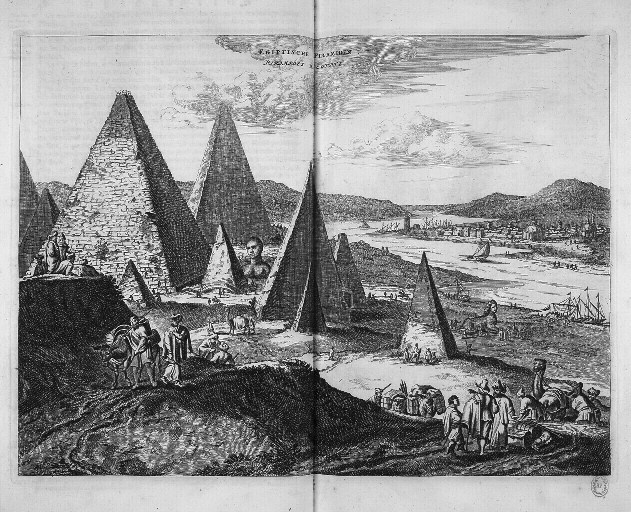
The Great Sphinx of Giza in Olfert Dapper, ”Description de l’Afrique” (1665) Notice that there are two sphinges [2]
From Wikipedia
From the Bronze Age, the Hellenes had trade and cultural contacts with Egypt. Before the time that Alexander the Great occupied Egypt, the Greek name, sphinx, was already applied to these statues. The historians and geographers of Greece wrote extensively about Egyptian culture. Heredotus called the ram-headed sphinxes criosphinges, and the hawk-headed ones hieracosphinges.
The word sphinx comes from the Greek Σφίγξ, apparently from the verb σφίγγω (sphíngō), meaning “to squeeze”, “to tighten up”. This name may be derived from the fact that the hunters for a pride of lions are the lionesses, and kill their prey by strangulation, biting the throat of prey and holding them down until they die. However, the historian Susan Wise Bauer suggests that the word “sphinx” was instead a Greek corruption of the Egyptian name “shesepankh,” which meant “living image,” and referred rather to the statue of the sphinx, which was carved out of “living rock” (rock that was present at the construction site, not harvested and brought from another location), than to the beast itself.
There was a single sphinx in Greek mythology, a unique demon of destruction and bad luck. According to Hesiod, she was a daughter of Orthus[8] and either Echidna or the Chimera, or perhaps even Ceto;[9] according to others, she was a daughter of Echidna and Typhon. All of these are chthonic figures from the earliest of Greek myths, before the Olympians ruled the Greek pantheon. The Sphinx is called Phix (Φίξ) [3] by Hesiod in line 326 of the Theogony, the proper name for the Sphinx noted by Pierre Grimal’s The Penguin Dictionary of Classical Mythology.
The Great Sphinx at Giza is not the only one around – there are countless sphinges throughout Egypt and elsewhere:

Sphinx at Memphis, Egypt

Rows of ram-headed sphinges at Luxor.
Regardless of the number, however, the Great Sphinx at Giza remains one of the wonders of the world from any century.
The Old Wolf has spoken.
[1]

From Goscinny et Uderzo, Astérix et Cléopatre, Dargaud Editeur, 1965
[2] Sphinges is the classical plural for sphinx.
[3]
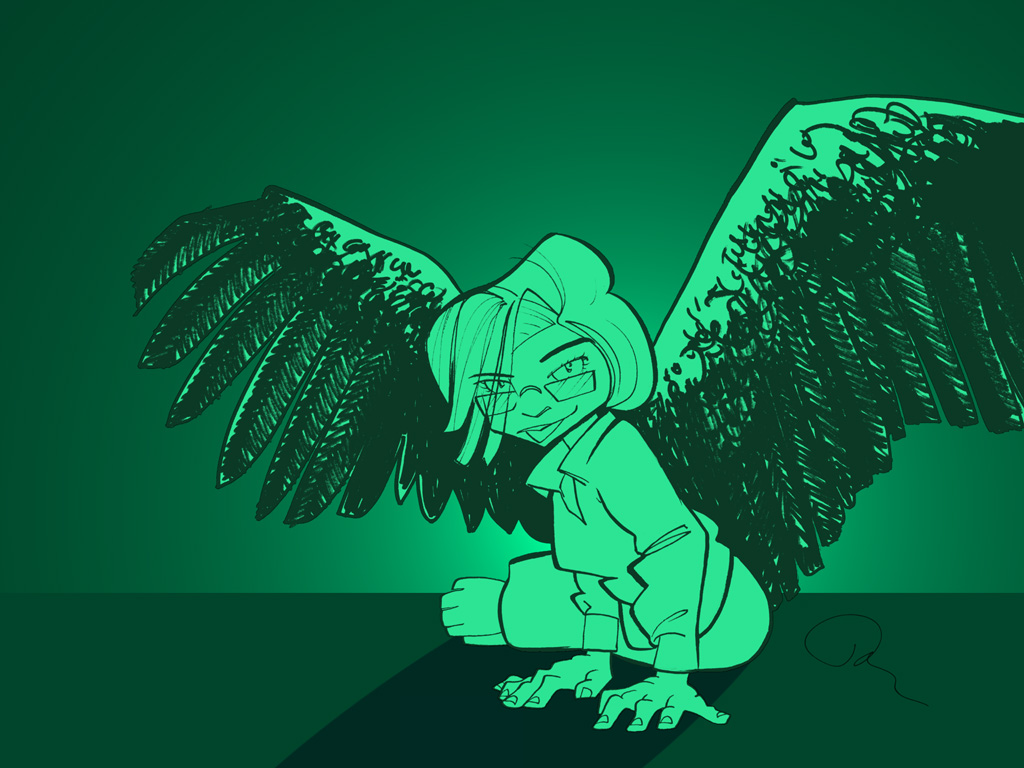
Phix, leading character in Paul Taylor’s Wapsi Square. Read it.
“Wapsi Square is named for the fictitious neighborhood in Minneapolis where the characters live. Its protagonist is Monica Villarreal, a feisty, busty, 4’10” tall latina who has recently moved from a safe world of normalcy where all she had to question was her own inner demons, to a world of supernatural lunacy, drunken college girls who have the power to obliterate the universe, an Aztec golem named Tepoz who can make the best damned martini in the world, a psychologist demon barista, and a host of other characters, some of whom may just live downstairs from you.” (Wiki)
We’ve seen it a million times from the front; here’s what an early version looked like from behind the camera.

The beginning of the Hollywood era: the filming of the MGM screen credits, 1928


Hope there’s a trainer somewhere off camera…
The Old Wolf has spoken.

The Statue of Liberty surrounded by scaffolding as workers complete the final stages in Paris. Circa 1885
I wonder how many people really feel a sense of immense gratitude to France for this incredible gift, which became the icon of our country. I know I do – I feel it every time I see her. Both countries cherish Liberty, despite the pains we continue to suffer as we travel into a new century.
Au peuple de la France, un grand merci.
The Old Wolf has spoken.
Saw this over at Aewl’s journal and had to share, because it’s funny… but it also brings up some serious issues.
“Don’t try to fix it. I just need you to listen.” Every man has heard these words. And they are the law of the land. No matter what.
Piggybacking on my previous post about Shopping Strategies, no one in their right mind would dispute that men and women are wired differently. John Gray has made gozillions of dollars touting that fact, and others before him. Yet we still continue to have difficulty in the area… mostly because as humans, we suffer from the greatest addiction ever know… being right.
<stereotype>Men want to fix. That’s why hardware stores have such a powerful attraction. It’s one of the things we do. You know, women are good for teaching, nurturing, healing, shopping, managing, cleaning, organizing, loving, supporting, sharing, socializing, volunteering, helping, beautifying, serving… and guys are good for picking up heavy stuff.</stereotype>
But there’s some incontrovertible reality between those HTML tags; for every guy that loves kittens and knitting and cooking and cuddling, and for every girl that loves a good blood-n-guts / sword-swinging / explosions-are-many / bad-guys-get-ground-up action movie, there are a thousand who “fit the mold.” And the little video above is all about staying within the box. Men want to fix, and women want to be valued for nothing else than who they are.
However, as I commented over at Aewl’s place,
For a good relationship to succeed, both partners have to step out of their societal boxes. No, it’s not about the nail; but in the [slightly modified] words of Monty Python’s logician, ‘even given that the activities of listening to your feelings and removing the nail are mutually exclusive, now that the listening is over, surely then, the nail may now, logically, be removed.’ A better response would have been (if one can dream of a perfect world,) “Thanks for listening to what I was feeling. That helps me feel valued and considered. I’m open to input on how to get rid of this nagging pain…”
For open, honest, responsible communication to take place, partners need to give up their sense of entitlement – the concept of “that’s the way I am, you just need to understand me” is only half of the equation. The other part is eminently captured in Emerson’s quote: “Shall I tell you a secret of a true scholar? Every man I meet is my master in some point, and I can learn from him.” So when the rubber meets the road, it’s not about the nail – but if you’re happy hanging on to that nagging pain when there’s someone sitting in front of you with a pair of pliers, then by all means, continue suffering.
The Old Wolf has spoken.

It’s now clear why things such as this happen on a regular basis:

Stepping out of the humor track for a second, I just discovered this as well – apparently it’s a very serious matter:
Doctors’ sloppy handwriting kills more than 7,000 people annually. It’s a shocking statistic, and, according to a July 2006 report from the National Academies of Science’s Institute of Medicine (IOM), preventable medication mistakes also injure more than 1.5 million Americans annually. Many such errors result from unclear abbreviations and dosage indications and illegible writing on some of the 3.2 billion prescriptions written in the U.S. every year.
Read the full article at: Time: Cause of Death: Sloppy Doctors
The Old Wolf has spoken.

How could parents ensure that their children were getting sunlight and fresh air when living in apartment buildings? The baby cage, ca. 1937
Yikes Ô Yikes!


