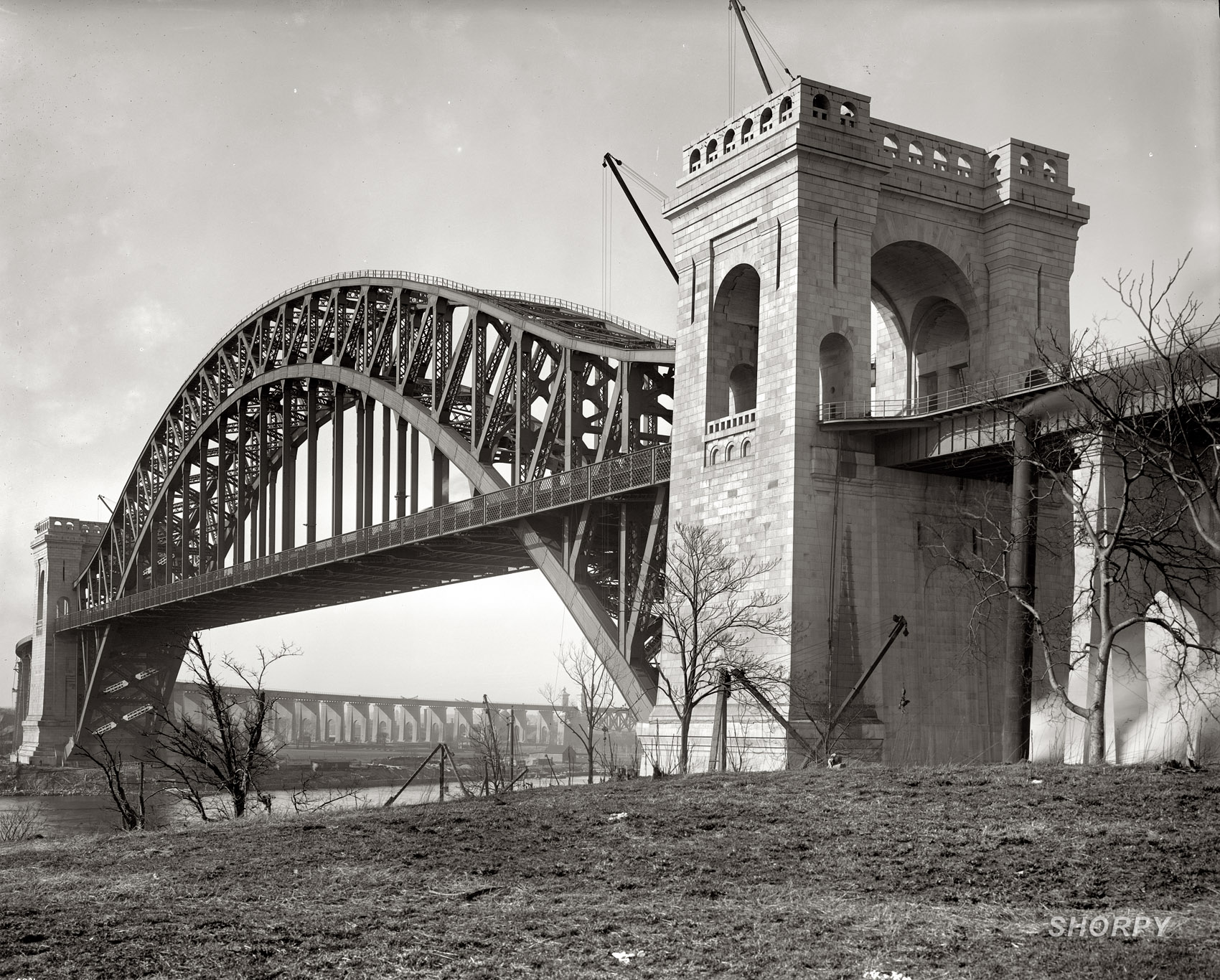
“Hell Gate Bridge (New York Connecting Railroad Bridge),” circa 1915. This steel arch span over the East River was completed in 1916.
Found at Shorpy
“Hell Gate Bridge (New York Connecting Railroad Bridge),” circa 1915. This steel arch span over the East River was completed in 1916.
Found at Shorpy

Found at the Health Physics Historical Instrumentation Collection
Doramad radioactive toothpaste was produced during World War II by Auergesellschaft of Berlin. The same company founded by Carl Auer von Welsbach who invented the gas lantern mantle!
A gamma spectroscopy analysis did reveal trace quantities of thorium, but the levels are too low to be detected with a simple hand-held survey meter.
——-
Tales from the Atomic Age
Paul W. Frame
Alsos and the Nazi Thorium
This story is adapted from the book Alsos, written by Samuel Goudsmit, H. Schuman Inc., New York, 1947. It appeared in the December 1996 issue of the Health Physics Society Newsletter.
In the early 1940s, the U.S. was at war and extraordinary efforts were underway to build an atomic bomb. The government even went so far as to confiscate the uranium oxides used by ceramics manufacturers to produce red/orange glazes. More than a few collectors must have been upset at the disruption in their supply of red dinnerware. Still, sacrifices were required. Similar confiscations occurred in occupied Europe to supply the Nazi A-bomb project, and keeping track of Germany’s atomic research was an allied intelligence effort code-named Alsos (the Greek word for grove, as in General Leslie Groves).
In the fall of 1944, the Alsos team learned that Auer Gesselshaft, a German chemical company involved in securing and processing uranium, had taken over the French company Terres-Rares during Nazi occupation. Ominously, Auer had shipped Terres-Rares’ massive supply of thorium to Germany. That the Germans wanted thorium suggested that their atomic research was further advanced than previously thought. Shortly after Paris was liberated, the Alsos team converged on the Terres-Rares office. They found it empty. Petersen, the Auer company chemist involved in securing the uranium and thorium supplies, had fled the allied advance (in Now It Can Be Told, Leslie Groves gives this man the name Jansen).
Petersen had gone to a town on the French-German border searching for some missing railroad cars carrying the thorium. And, as luck would have it, the area was captured by the allies shortly after Petersen arrived. Alsos had their first prisoner—and a suitcase bulging with documents! Among these was a dossier on a businesswoman who plied the world’s oldest profession sur les rues de Paris. Petersen’s explanation for having the dossier was that the woman had charged him an exorbitant 3000 francs although “in Berlin . . . it is only seven marks and a half per fling.” He said he was hoping to contact the proper authorities (whoever they would be) to recover some of his money. When the Alsos investigators took to the streets, they found that all aspects of Petersen’s implausible story proved true. However, the suitcase’s most shocking document revealed that Petersen had recently visited Hechingen, a town rumored to be a center for atomic research. Later it would be learned that the Germans had a lab there with an isotope separation unit and, in a nearby cave, an experimental pile. When the site was eventually captured, a ton and a half of metallic uranium cubes from the pile (likely produced by the Auer company) were found buried in a nearby field. Petersen’s explanation for his trip to Hechingen: he was visiting his mother (no doubt seeking advice on how to recover his 3000 francs). Darn thing was, his mother actually lived there.
Ultimately, Alsos’ hard work paid off and they discovered the true reason why Terres-Rares’ thorium supplies had been confiscated: the Auer Company, recognizing that the end of the war was near, and concerned about the consequent loss of business, concluded that there was no better future for their company than in cosmetics and related consumer products! Radium had already been used in toothpaste (Radiogen), why not use thorium instead? Auer had the patent, and with the thorium in hand they were ready to hit the ground running. They even formulated the following potential advertisement: “Use toothpaste with thorium! Have sparkling, brilliant teeth—radioactive brilliance!”
——-

Tube front:
Doramad
Radioaktive Zahncreme [Radioactive Toothpaste]
Biologisch wirksam [Biologically Effective]
Reinigend · Keimtötend · Erfrischend [Cleans – Kills bacteria – Refreshes]
Auergesellschaft Aktiengesellschaft [Auergesellschafft Inc.]
Abteilung Chemie · Berlin N 65. [Chemical Division – Berlin N 65]
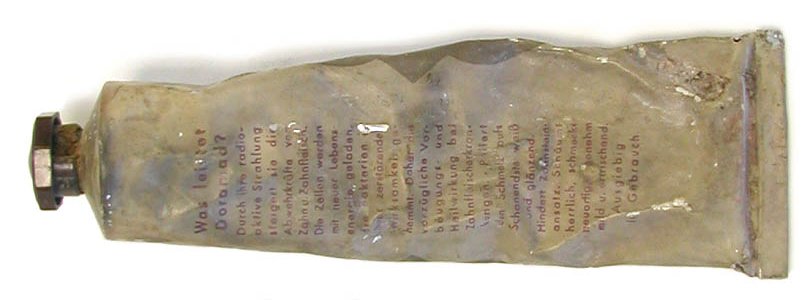
Tube back:
Was leistet Doramad?
Durch ihre radioaktive Strahlung steigert sie die Abwehrkräfte von Zahn u. Zahnfleisch. Die Zellen werden mit neuer Lebensenergie geladen, die Bakterien in ihrer zerstörenden Wirksamkeit gehemmt. Daher die vorzügliche Vorbeugungs- und Heilwirkung bei Zahnfleischerkrankungen. Poliert den Schmelz aufs Schonendste weiß und glänzend. Hindert Zahnsteinansatz. Schäumt herrlich, schmeckt neuartig, angenehm, mild u. erfrischend. Ausgiebig im Gebrauch.
What Does Doramad Do?
With its radioactive radiation, it enhances the defensive abilities of teeth and gums. The cells are charged with new life energy, and the destructive power of bacteria is blocked. This results in excellent preventative and healing effects in the case of gum disease. Enamel is gently polished to brilliant whiteness.
ts radioactive radiation increases the defenses of teeth and gums. The cells are loaded with new life energy, the bacteria are hindered in their destroying effect. This explains the excellent prophylaxis and healing process with gingival diseases. It gently polishes the dental enamel so it turns white and shiny. Prevents plaque buildup. Foams wonderfully with a new, pleasant, mild and refreshing taste. Can be used sparingly.
Size: 4 3/4″ long
The following images are of a Doramad brochure.




This is a good example of the kinds of radioactive quack cures which have been introduced over the years. If it had any effects at all, it would probably contribute to radium jaw.
The Old Wolf has spoken.
Anyone who has spent any serious time studying Latin has probably felt the need for something more powerful than Tylenol™ to quiet the throbbing in his or her head. In the absence of Oxycontin™, humor has long been a good substitute for mitigating the effects of “bonus, bona, bonum, boni, bonæ, boni…”
Here a random collection of humorous tidbits regarding the vagaries of classical Latin (and other languages). Macaronics are, properly, text which uses multiple languages, and often bilingual puns.

While not macaronics proper, it’s still a great Latin joke: It reads (liberally translated), “If you can read this bumper sticker, you’re well-educated and TOO DAMN CLOSE!”
——-
What is this that roareth thus?
Can it be a Motor Bus?
Yes, the smell and hideous hum
Indicat Motorem Bum!
Implet in the Corn and High
Terror me Motoris Bi:
Bo Motori clamitabo
Ne Motore caedar a Bo—
Dative be or Ablative
So thou only let us live:—
Whither shall thy victims flee?
Spare us, spare us, Motor Be!
Thus I sang; and still anigh
Came in hordes Motores Bi,
Et complebat omne forum
Copia Motorum Borum.
How shall wretches live like us
Cincti Bis Motoribus?
Domine, defende nos
Contra hos Motores Bos!
–Alfred Dennis Godley
The above poem pokes fun at the difficulty of Latin declensions, and inflects the words “motor” and “bus” as though they were classical Latin nouns (which, in a certain sense, they are.)
——
Latin verbs are memorized with their principal parts:
Most Latin verbs are regular:
amo, amare, amavi, amatus (to love)
salto, saltare, saltavi, saltatus (to dance)
Some, however, are devilishly irregular:
sum, esse, fui, futurus (to be)
ferro, ferre, tuli, latus (to carry) – did you know transfer and translate are basically the same word, meaning “carry across”?
Students, in apparent desperation at having to learn these niceties, came up with
flunko, flunkere, faculty, bouncem
to which I add my own sophomoric creation:
farto, fartere, pui, flatus
I’m quite proud of it, actually. And thanks to reader bman:
spitto, spittere, achtui, splattus

——-
As the title of this article indicates, “leges romanorum boni sunt” (the laws of the Romans are good,) but obviously this sounds like something much sillier.
——-
A bad Latin joke:
A professor of Latin at Yale, (sounds like a limerick in the offing, doesn’t it?) having ordered a meal at a fine New Haven restaurant, decided that he would like some wine with his dinner. So he summoned the wine steward and asked for a bottle of hock. Feeling clever, he added, “hic, haec, hoc.”
“Very good, sir,” replied the wine steward, and left.
Twenty minutes later, no wine. The learned man summoned the steward again, and asked, “Didn’t I order a bottle of hock?”
“You did indeed, sir,” replied the steward, “but then you declined it.”
——
Found on the wall at Pompeii:[1]
Civili derego
Fortibus in ero
Demes nobus, demes trux
Vadis inem, causan dux
——-
Dicora, dicora, doggium!
Ascendit mus horologium.
Insonuit ora,
Descendit mus,
Dicora, dicora, doggium!

——-
Parvus Jacobus Horner
Sedebat in corner
Edens a Christmas Pie
Infuerit thumb,
Extraherit plum,
Clamans, “Quid sharp puer am I!”
——-
Mollis abuti
Has an acuti;
No lasso finis
Molly divinis.
——-
Macaronics are not restricted to Latin, but rather are more properly any sort of bilingual wordplay. As a teenager playing with calligraphy, I did this for my father, who long treasured it:

It’s no more Provençal than I am Abkhazian, but it makes for a funny sign, and good advice in any age.
——-
The above sign leads me to one of the greatest collections of macaronics ever, Mots d’Heures: Gousses, Rames by Louis d’Antin van Rooten. This is a collection of (purportedly) classical French poetry with illuminating notes. However, if one reads them aloud, they become heavily-accented modern Mother Goose rhymes. One of my favorite examples:
Jacques s’apprête
Coulis de nos fête.[a]
Et soif que dites nos lignes.[b]
Et ne sauve bédouine tempo[c] y aussi,
Telle y que de plat terre, cligne.[d]
Notes:
a. Coulis, a sort of strained broth. Jacques was either a sauce chef or an invalid.
b. Jacques was also an alcoholic, since his thirst is beyond description.
c. He was fond of Arab music.
d. He believed the earth was flat. The last word of the line, meaning “wink,” is obviously a stage direction. Poor Jacques, whoever he was, was obviously considered a fool.
——-
A similar work was created for German by John Hulme: Mörder Guss Reims – the Gustav Leberwurst Manuscript. A sample:
Um die Dumm’ die Saturn Aval;
Um die Dumm’ die Ader Grät fahl.
Alter ging’s Ohr säss und Alter ging’s mähen.
Kuh den “putt” um Dieter Gitter er gähn’.
——-
If you are familiar with both classical Greek and French, you might be both delighted and scandalized by
οὐκ ἔλαβον πόλιν, ἀλλά γάρ ἐλπίς έφὲ κακά .[2]
Supposedly from a text by Xenophon – I have not been able to source it definitively – the sentence means “They did not capture the city, since they didn’t have a hope of taking it.” It’s pronounced “Ouk élabon polin, alla gar elpis éphè kaka.”
In French, however, it sounds like something quite different, the kind of thing schoolchildren would laugh up their sleeves about: “Où qu’est la bonne Pauline? À la gare, elle pisse et fait caca.” Google Translate will help you out if you’re really curious.
Vetus lupus locutus est.[3]
[1]Not really. I don’t think the Pompeiians would have resonated with
See, Willy, there they go
Forty buses, in a row
Dem is no bus, dem is trucks!
What is in ’em? Cows and ducks.
[2] If any classical Greek scholar would care to correct this – I know it’s not perfect – I welcome your input.
[3] Resistance is futile.
“Psychic Sylvia Browne told Amanda Berry’s mother that Berry had died when the two appeared on a talk show shortly after Berry’s disappearance nearly 10 years ago. Since Berry and two other kidnapped girls were found alive at a house in Cleveland this week, Browne and her psychic readings are facing a backlash from disgusted critics.”
-USA Today
Sylvia Browne
In an interesting episode of “Criminal Minds,” (Cold Comfort, 4/14), the plot seems to lend credence to the supposition that psychics can assist law enforcement to resolve cases.

Stanley Usher, portrayed by Vondie Curtis-Hall
According to a recent article at Slate on the same topic, “Academics have repeatedly tested the abilities of psychics to provide any useful information in a crime investigation, and the results are damning.” The article is worth a read.
When my mother was alive, her twilight years were plagued by an onslaught of scam mail and phone solicitations that very nearly bankrupted her, and would have done so completely were it not for some very favorable and rare events that recovered the bulk of her funds. As a result, I spent a good bit of time putting together the Sweepstakes Fraud Factsheet. Most of this website has to do with the rampant scamming of elders and the gullible by selling sweepstakes entry aggregations under the false head of “You may have already won…”, one section describes the Psychic Connection.
If you find yourself on a “sucker list”, sweepstakes offerings are not the only things you will receive. The crooks think, “Ah! We’ve found someone stupid!” and you will receive some of the most bizarre solicitations you have ever seen. “Psychics” and “Clairvoyants” from all over will want to improve your luck, free you from curses, cast out evil spirits, teach you how to win contests, and much more.
Be smart! Avoid worthless solicitations of this nature like the plague! Never respond, or you’ll find yourself inundated with hundreds of similar offers.
Here is one of the most disgraceful examples of this kind of fraud.
As the Slate article mentions, “While not especially good at making predictions, psychics are typically quite skilled at self-promotion.” Science and good police work trump mumbo-jumbo every time.
The Old Wolf has spoken.

Notice the Automat sign on the left, lovingly mentioned here.
Things may not be as bad now as they were then… or then again, they may. We don’t have breadlines but we have food banks, and most of them are straining under the load. Too many people are out of work, too many are underemployed, and too many have simply given up.
Our country deserves better.
The Old Wolf has spoken.
This beautiful video was taken by an early British pioneer of film named Claude Frisse-Greene, who made a series of travelogues using the colour process his father William – a noted cinematographer – was experimenting with. It’s like a beautifully dusty old postcard you’d find in a junk store, but moving. (Found at Vimeo).
Music by Jonquil and Yann Tiersen.
This is “moving” in more than one way; I was quite touched to contemplate these scenes.
The Old Wolf has spoken.
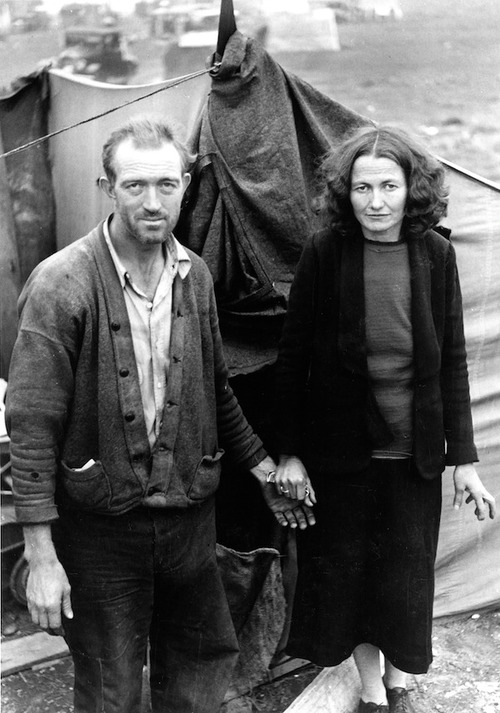
Joad Family Album, 1938 (Horace Bristol)
In the winter of 1937-38, photographer Horace Bristol and writer John Steinbeck teamed up for a Life magazine assignment and for nearly two months traveled California interviewing migrant workers of the Great Central Valley. Before finishing the project, however, Steinbeck withdrew—deciding to utilize the research for his novel The Grapes of Wrath instead of an article for Life. When Steinbeck’s book was published in 1939, Life ran an article featuring the photographs taken by Bristol. Rather than using the real names of those photographed, Life used the fictional names of Steinbeck’s characters with captions featuring excerpts from The Grapes of Wrath—thus creating a photo album for the fictional Joad family that has since been mistaken for reality.
Found at Glaserei.

Horace Bristol: Rose of Sharon
“A CLOCK of Lives operated by the Statistical Office in Berlin, Germany, informs spectators that the German population is constantly increasing. To insure being seen by many people, the clock was placed in Dönhoffplatz, a busy Berlin thoroughfare. The clock tolls the number of births and deaths occurring every quarter of an hour. The tone of the bells indicates whether a birth or a death has occurred.”

Another view of the Clock of Lives:
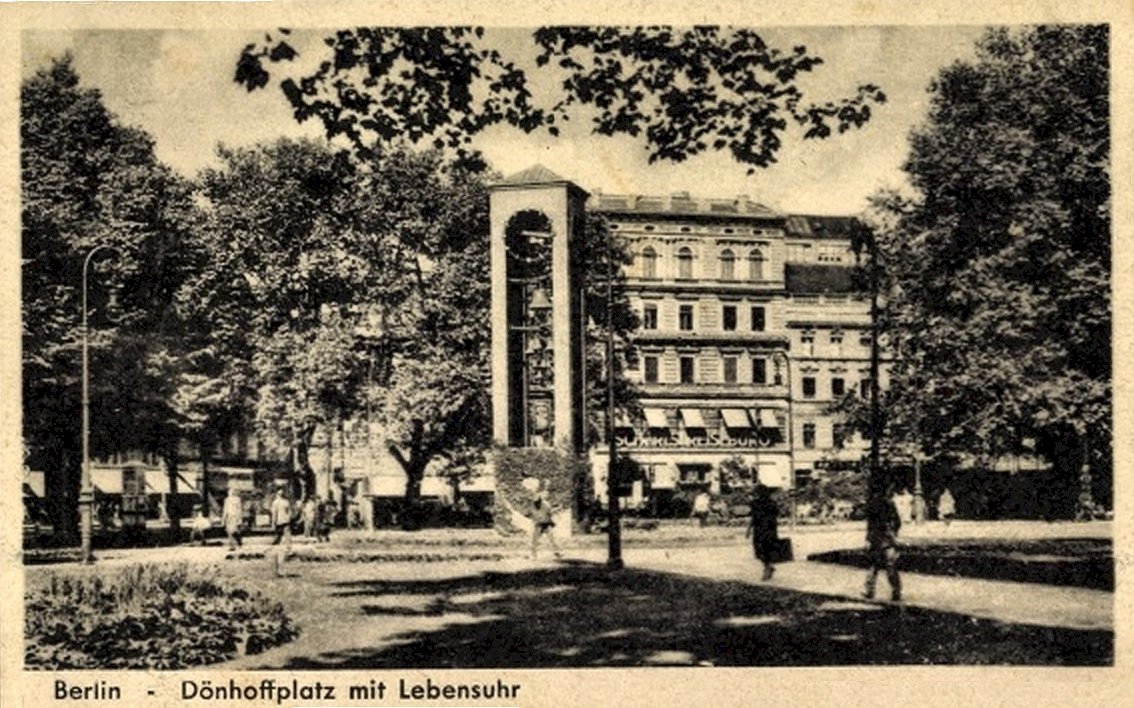
The clock, more properly called the Wilhelm-Lach Tower, was built in 1935. The small bell tower had the following inscription:
Every five minutes, nine children are born in the German Reich – every five minutes, seven men die. This tower is dedicated to the memory of the first National Socialist Mayor in the Central District, P[arty] M[ember] Wilh[elm] Lach, Born 9 June 1801- Died 6 July 1935″
According to the German Wikipedia site, the buildings around the square were heavily damaged during the war, and were largely razed and rebuilt. It is assumed that the clock tower met its demise around the same period.
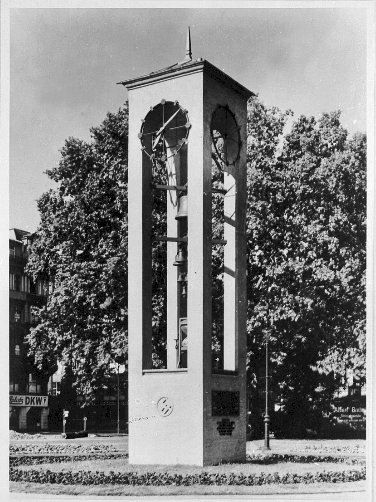
A photo of the clock memorial taken in 1935.
Berlin no longer has a population clock, but it has a pretty sick world time clock in Alexanderplatz:

Der Alte Wolf hat gesprochen.
From the July, 1934 issue of Moderm Mechanix:

Educated Clock Sings, Talks, and Plays the Pipe Organ
A CRIPPLED inventor of Akron, Ohio, has recently completed what he believes is the world’s most wonderful clock. The remarkable instrument gives the comparative time in 27 different cities. In addition, it sings, talks and plays a reedless pipe organ every hour.
Every day the clock commemorates the death of America’s martyrs. At the hour of Lincoln’s funeral it recites the Gettysburg address. The time of President McKinley’s burial is marked by a playing of the old hymn, “Lead, Kindly Light.” At the hour of President Garfield’s interment, the remarkable timepiece plays “Gates Ajar.”
Valued at $50,000, the educated clock was built by 70-year-old Marvin Shearer after ten years of painstaking work. The clock contains 5000 pieces of wood, a mass of electrical control wires several miles in length, and is twice the height of an ordinary man.
The inventor’s granddaughter made two comments on the original page; I have reproduced them here in slightly edited form.
There were actually TWO clocks.
Marvin Shearer was my grandfather. I have searched everywhere for one of his clocks. I did trace the “Electric Wonder” to the Hotel Lobby of the Ritz in New York City but when it was remodeled, they got rid of the clock. No one there has been there long enough to know what happened to it. If anyone ever locates one of them PLEASE e-mail me at donnaleecotter16 [at] gmail [dot] com.
Here is what I know of his works:
Marvin carved a clock that was eight feet wide and thirteen feet high. It was called the ELECTRIC WONDER. He started this clock in 1927, and completed it in 1931. He also carved a second smaller clock, and perhaps a third.
There is an article in “The New York Times” dated April 7, 1909, about a “Wonderful Clock Made by Cripple”.
Another article I found was in The “Omaha World Herald” dated November 15, 1903, titled, “Queer Clock That Tells Many Things an Ohio Man Works on for Three and a Half Years”.
The Electric Wonder
This exhibit took 15 months to design. It contains 7172 pieces of wood from 32 different countries, from all parts of the world.
It has nearly 1½ miles of electric wire, 17 clock dials, and gives time in all parts of the world.
It shows important events of United States History from 1492 to 1934.
Our Navy of 47 ships pass by according to their classification.
It tells the weather conditions 24 hours in advance. It plays a reedless pipe organ, the only one of its kind in the world.
It shows and gives the Funeral Marches of our assassinated Presidents.
It shows the goddess of Liberty or eternal light in memory of American soldiers who lost their lives while in service for their country. It has chimes, harps, electrical cascade, electrical railway, an airship and a dirigible. Also, Indian history and arrowheads of the lone Indians from the battlefield of Custer’s Last Fight.
The Electric Wonder is 13 feet high, weighs 3800 lbs. has 168 electric lights and took 19,000 hours or nearly 7 years to build.
It has been endorsed by leading electricians and engineers of today. It is a merit to its maker as well as mankind.
I repeat the plea of the inventor’s granddaughter – if anyone has any clue as to the ultimate fate of this or other of Shearer’s works, please contact her. This is an astonishing achievement.
The Old Wolf has spoken.

November 1942. “Chicago, Illinois. These pneumatic tubes in the Illinois Central Railroad yardmaster’s office connect him with the general office.”
Found at Shorpy.

