The Voice of Alexander Graham Bell

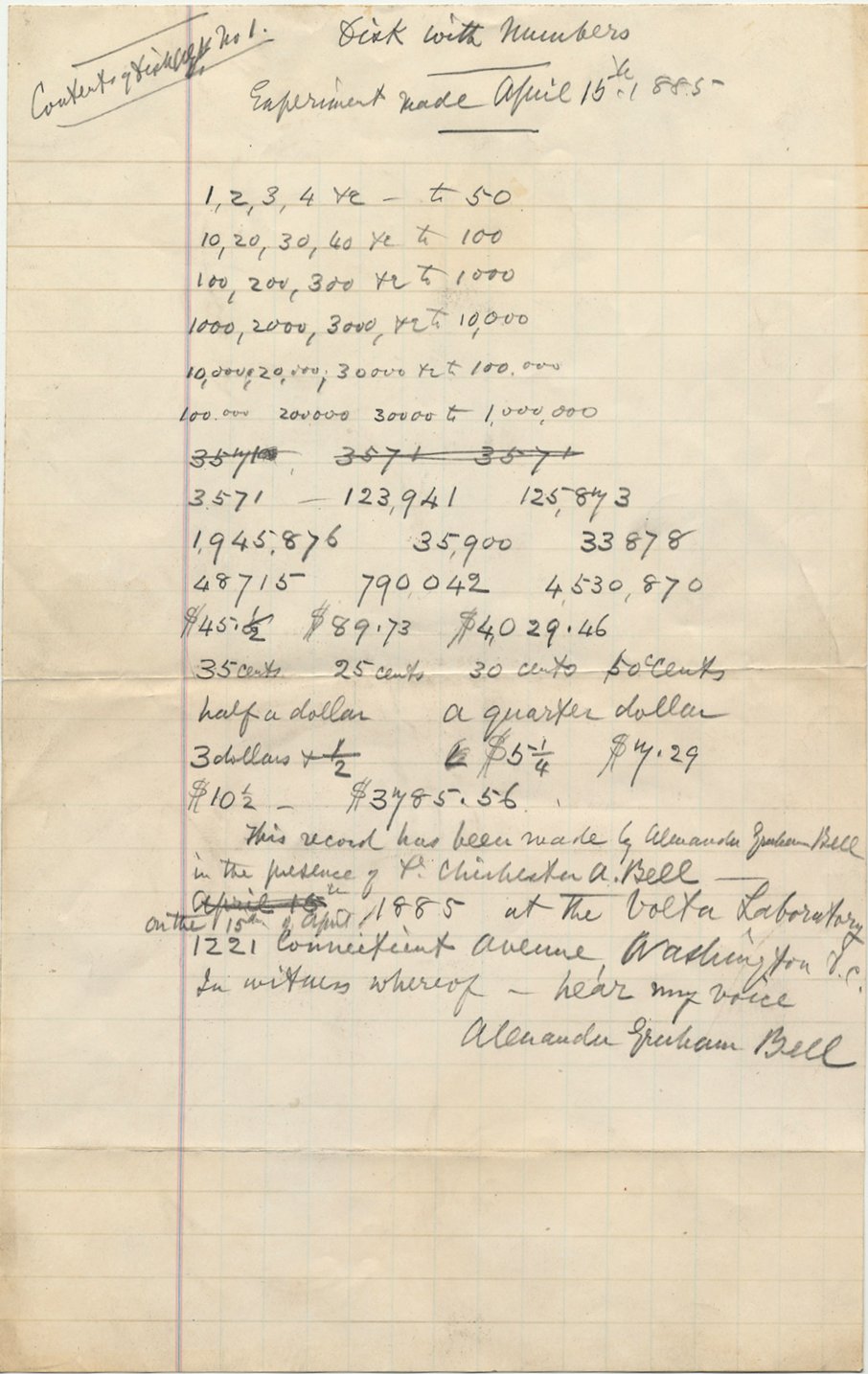
According to The Verge, new data-retrieval techniques have enabled researchers to play a wax disc recorded by Alexander Graham Bell on 15 April 1885, and previously deemed “uplayable”. Not only was the wax disc, which had been donated to the Smithsonian by Bell himself, heavily damaged, there was also no indication of what kind of device could play it back. However, by dint of taking high-resolution images of the disc and then using computer analysis to rebuild damaged areas, Bell’s voice can be heard clearly. He spends most of his time reciting numbers, but provides an audio “signature” at the end of the recording.

transcript


Bell’s transcript of the recording

The recording itself, with captions.

An intriguing bit of history.

The Old Wolf has spoken (but not as well as Alexander Graham Bell.)

The Century Chest

Here there be treasure.

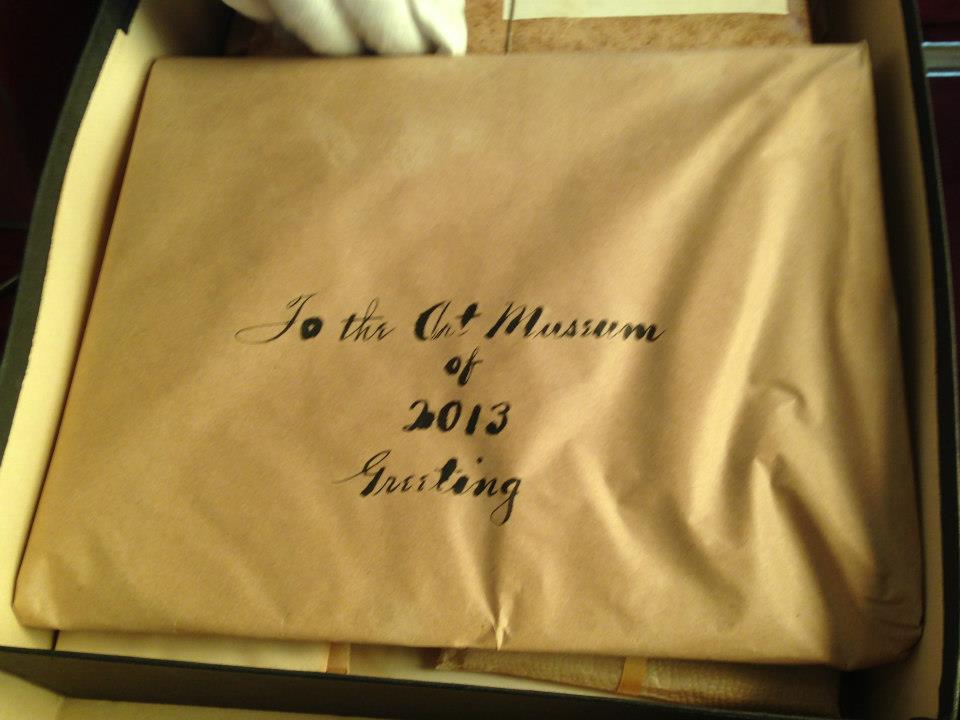
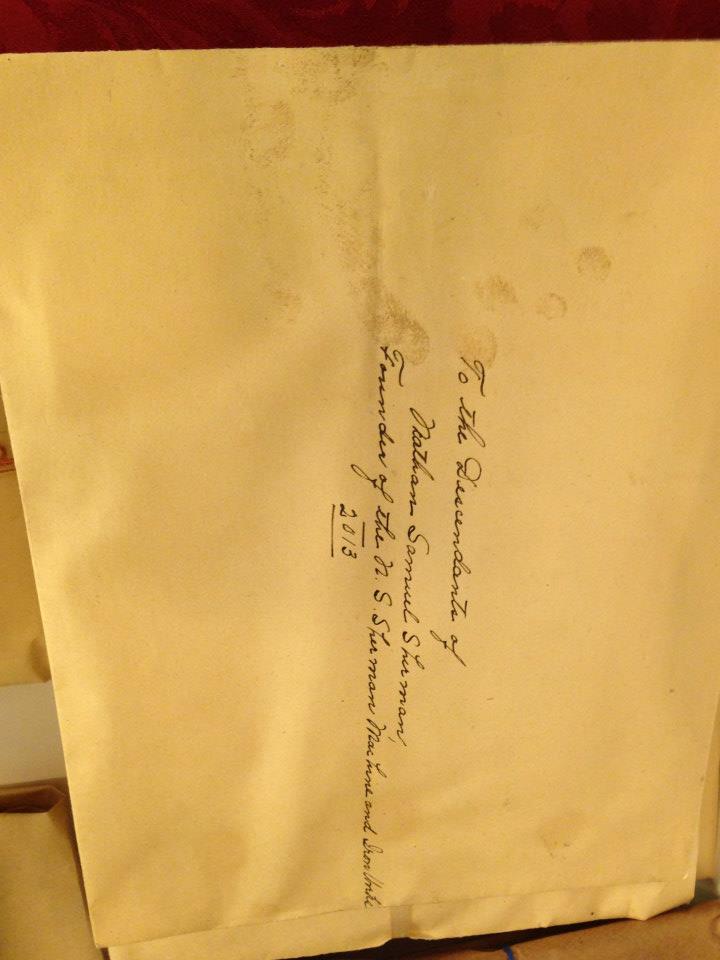
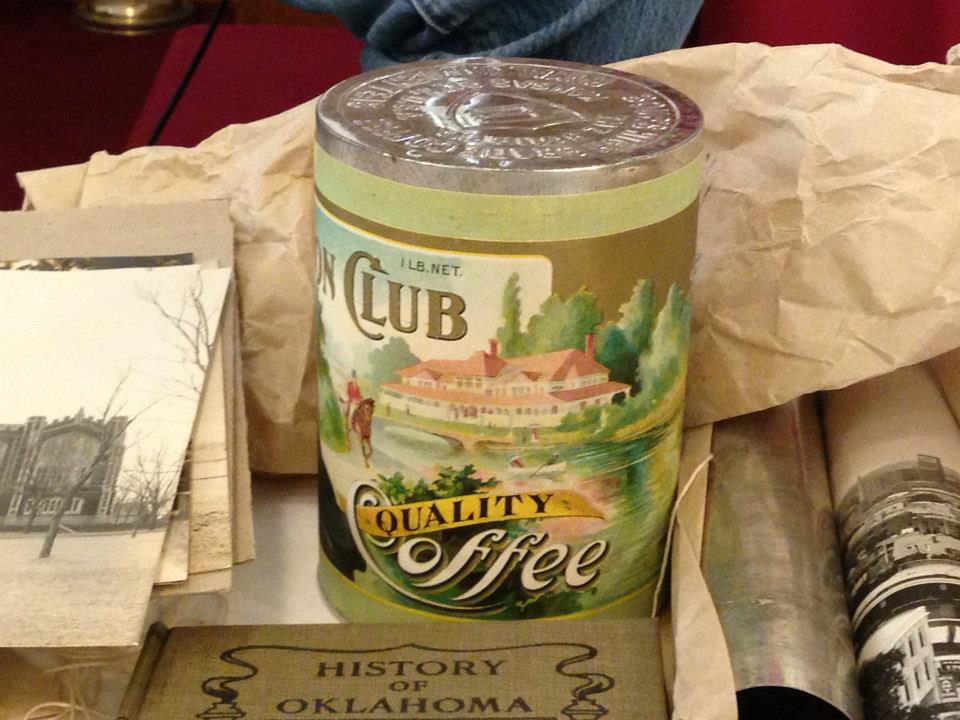
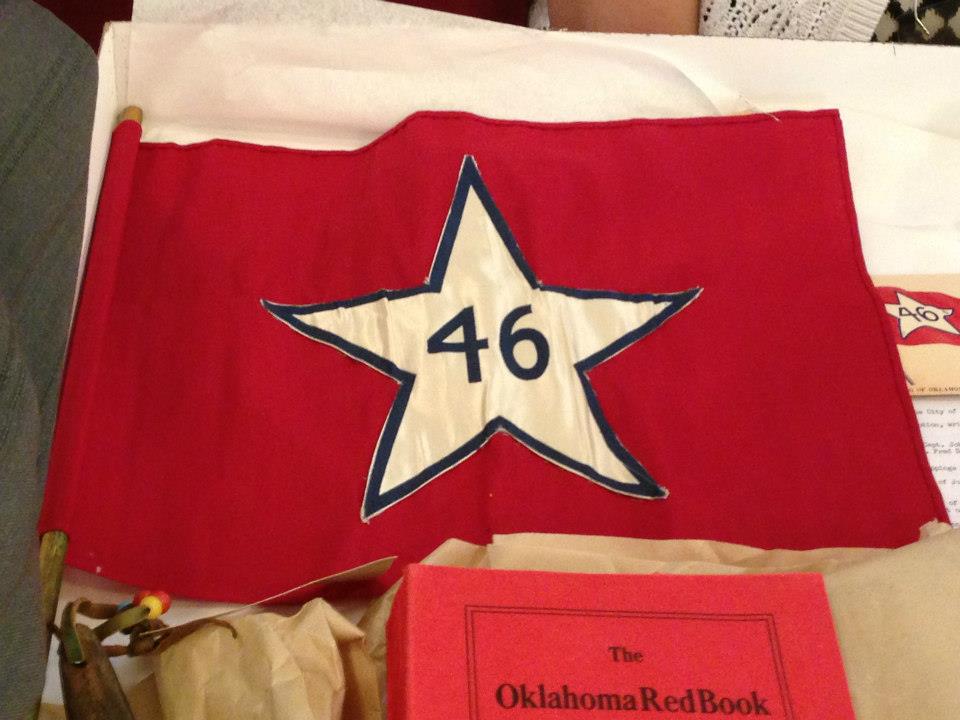
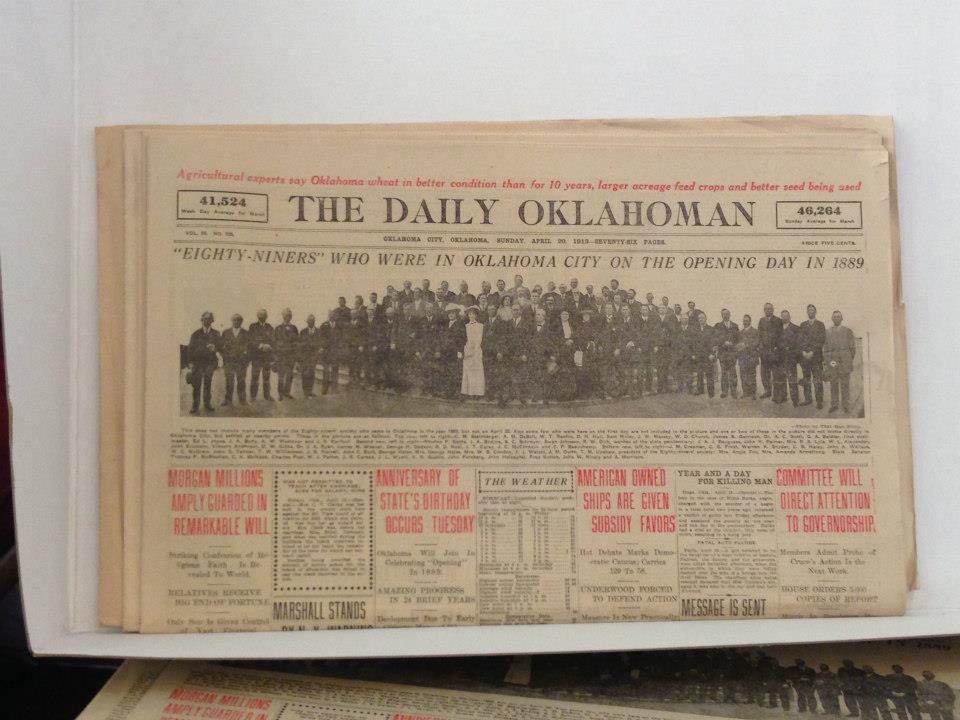
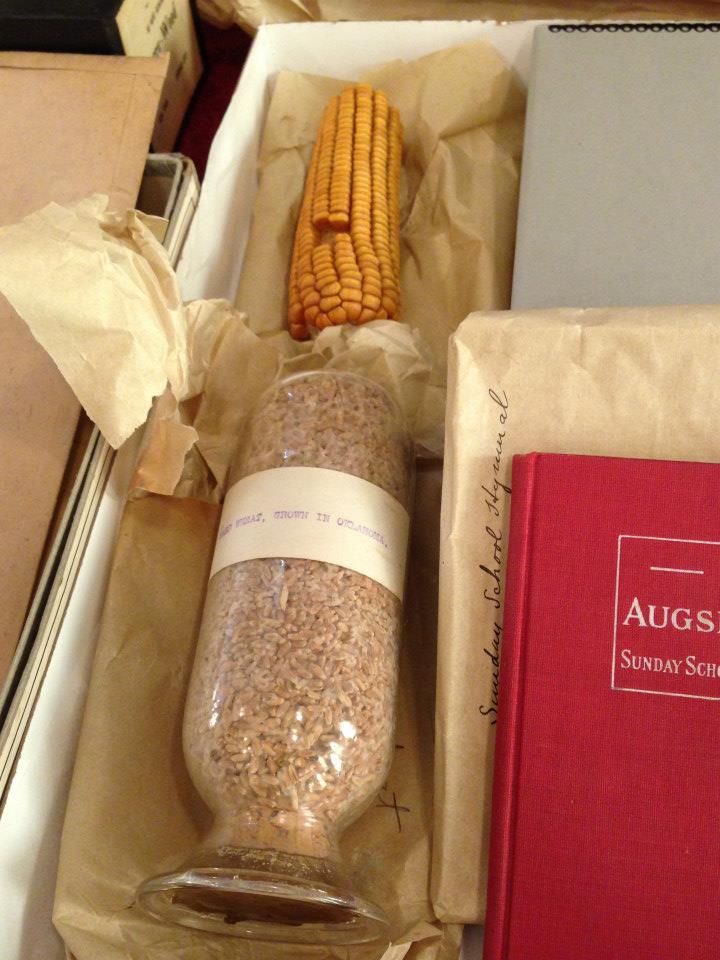
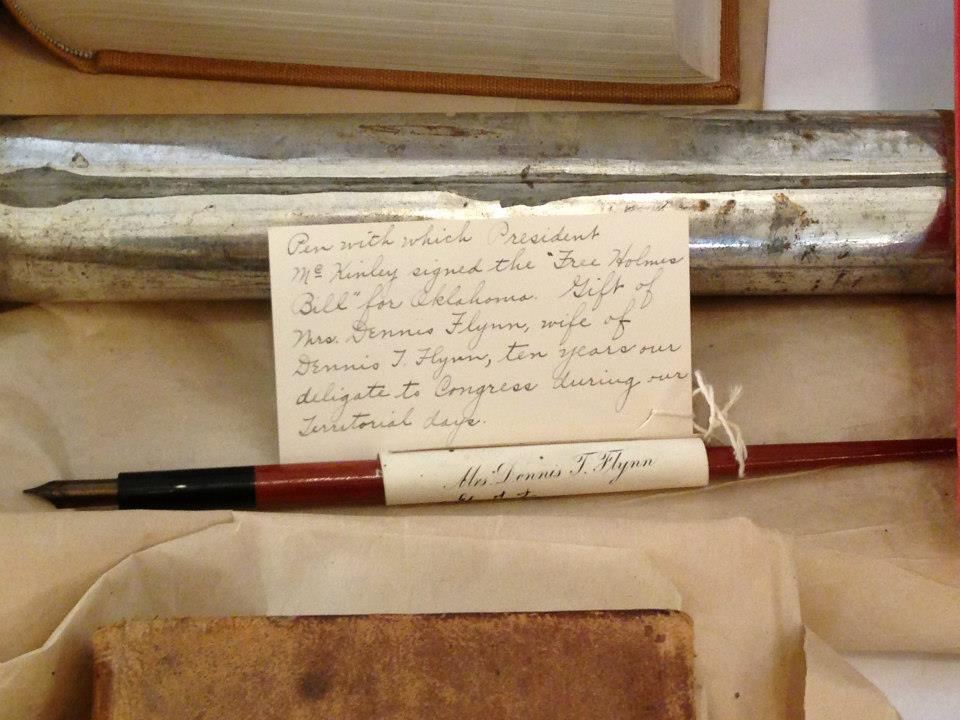
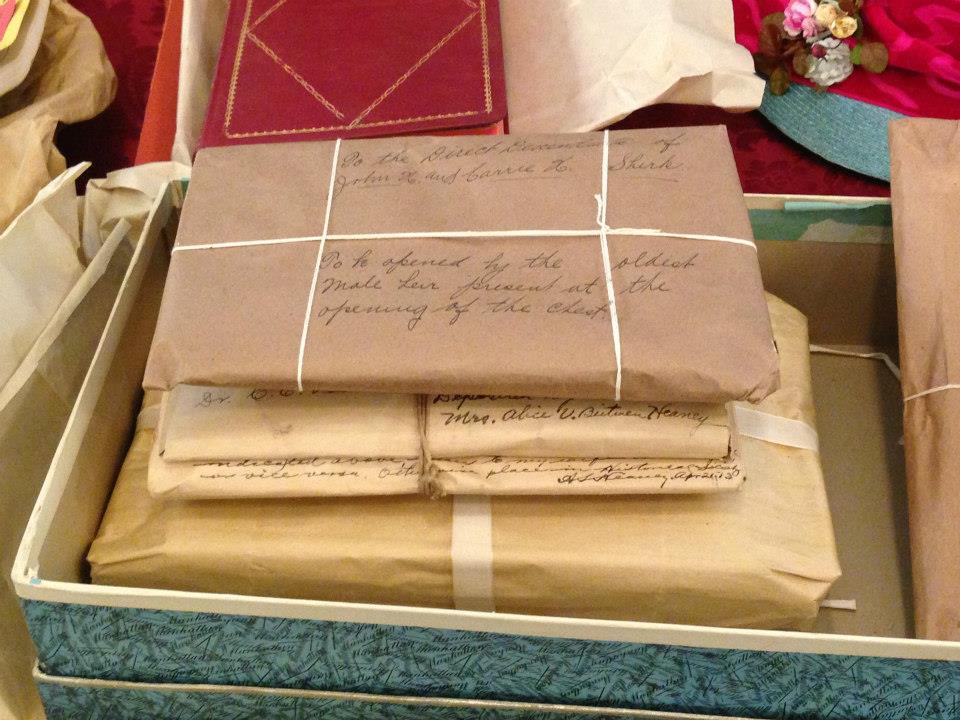
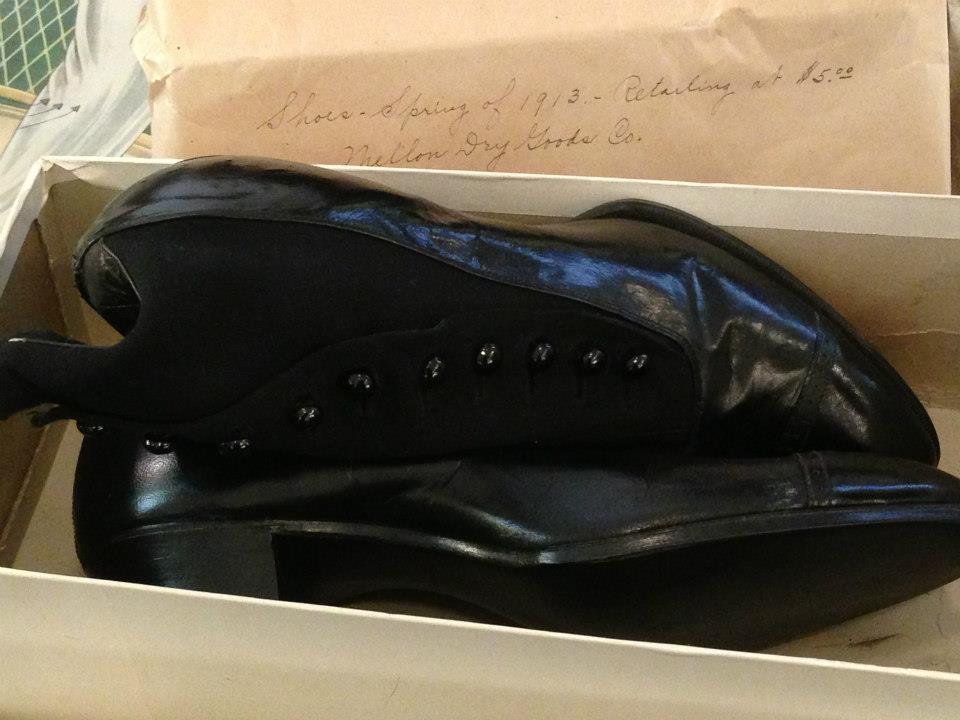
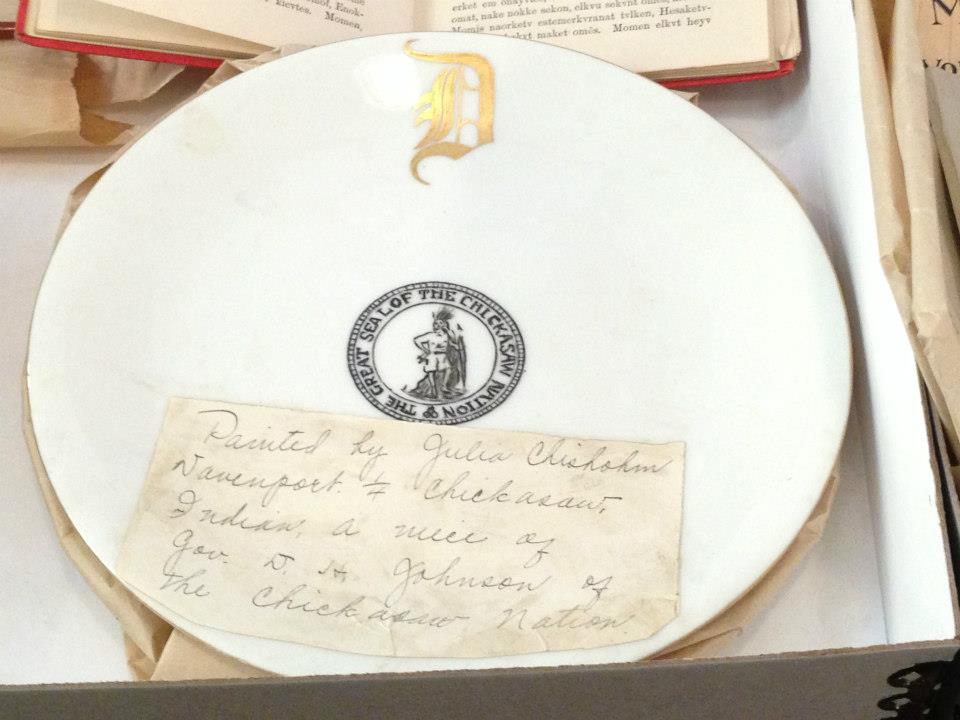
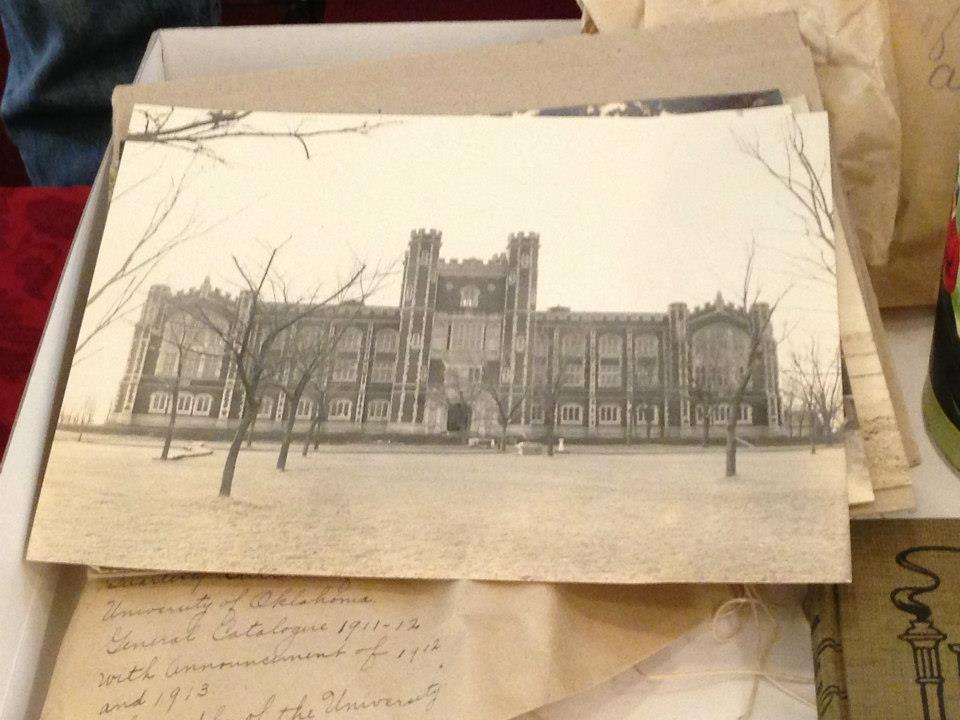
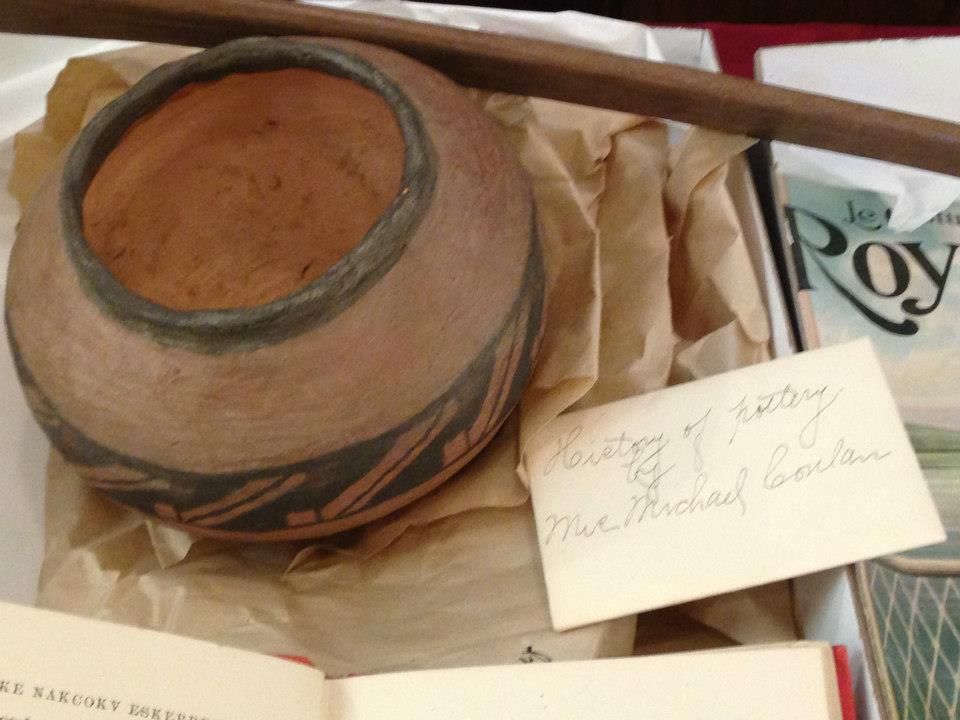
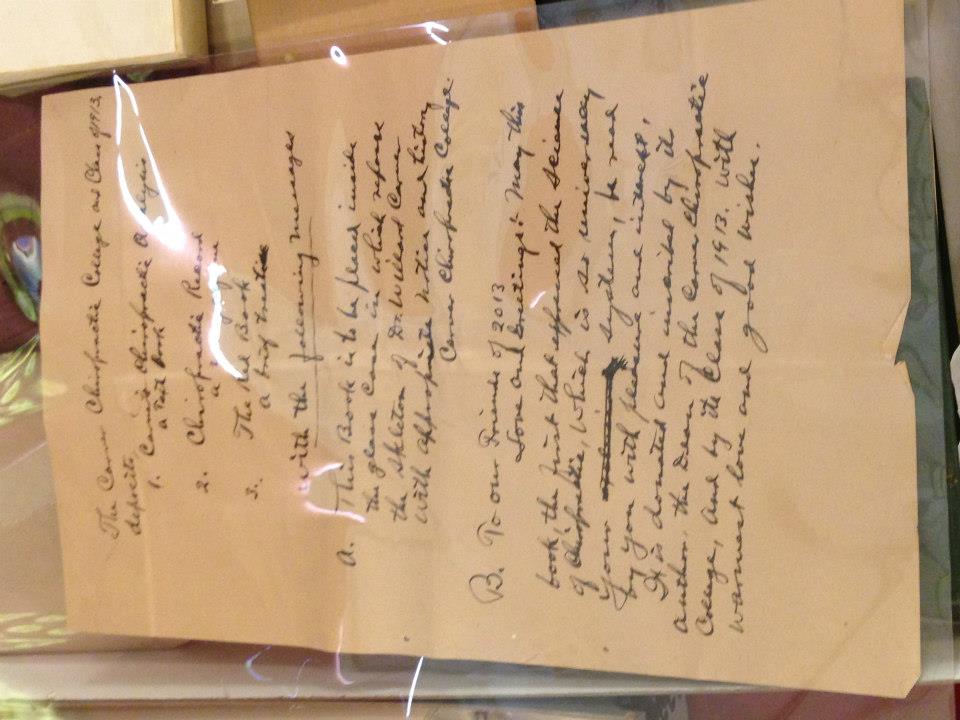
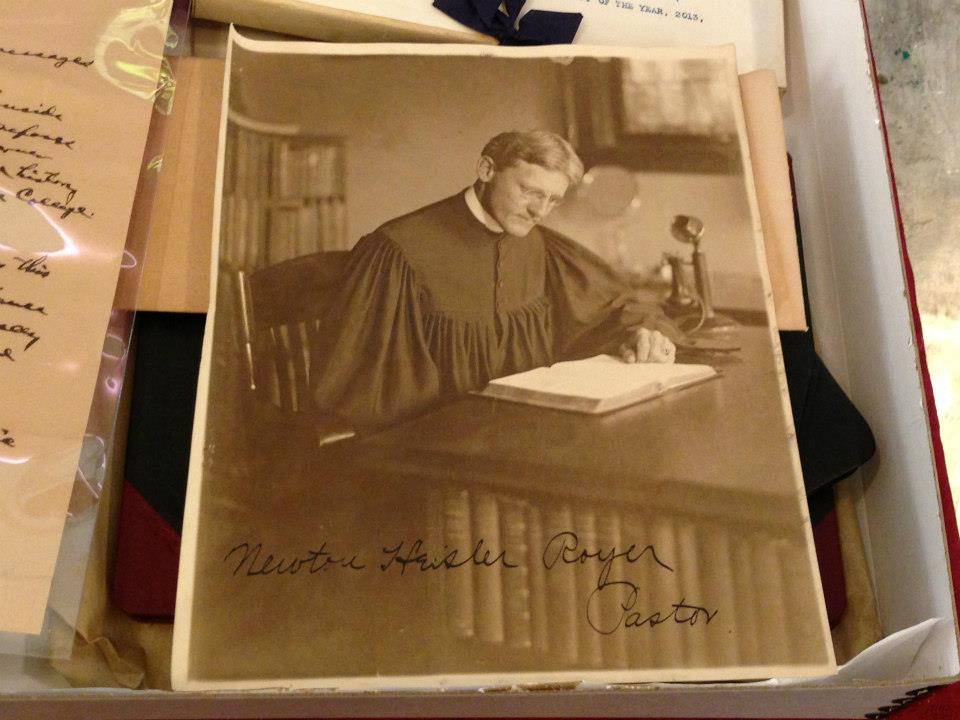
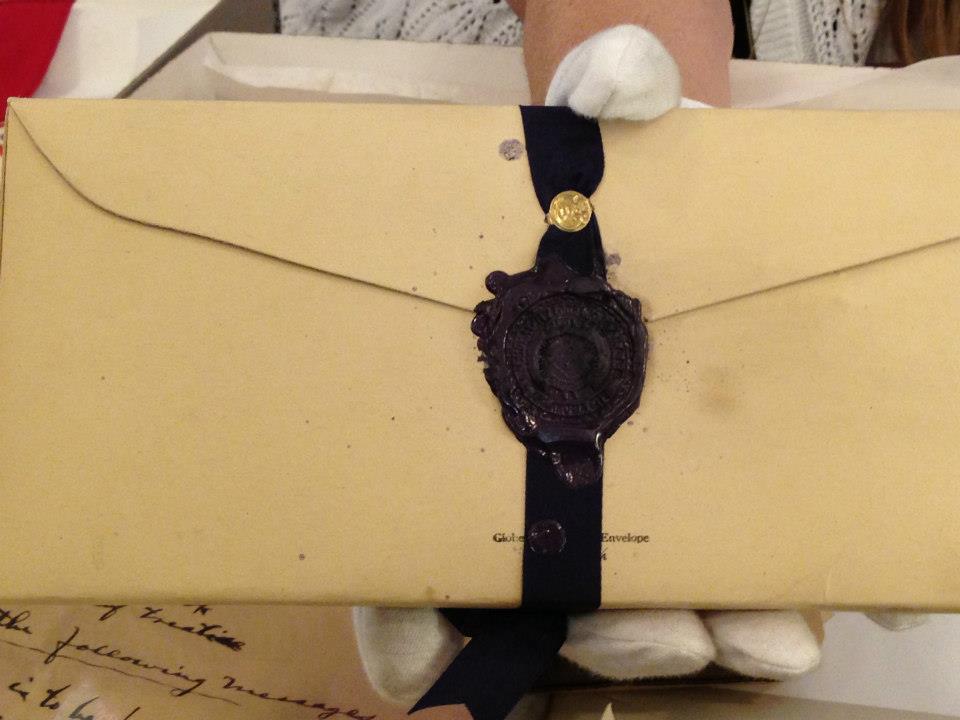
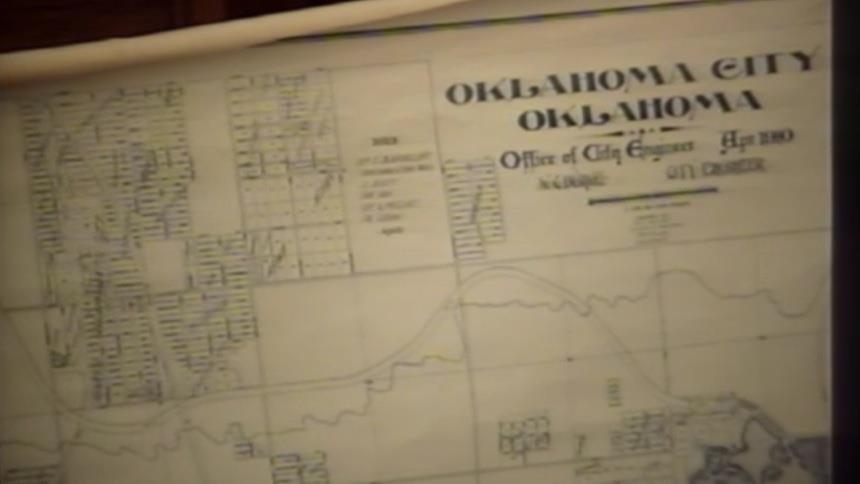
“On April 22, 1913, a “Century Chest” was buried in the basement of the First English Lutheran Church (now the First Lutheran Church of Oklahoma City) at 1300 North Robinson. The ceremony was witnessed by a capacity crowd including Governor Lee Cruce and other notable Oklahoma residents.

Through a century of dutiful vigilance the congregation of the First Lutheran Church has guarded the Century Chest in order that on April 22, 2013, the chest would be unearthed and the past would come alive. The church has partnered with the Oklahoma Historical Society to ensure the treasures of 1913 are preserved and exhibited at the Oklahoma History Center.” (From Oklahoma History)

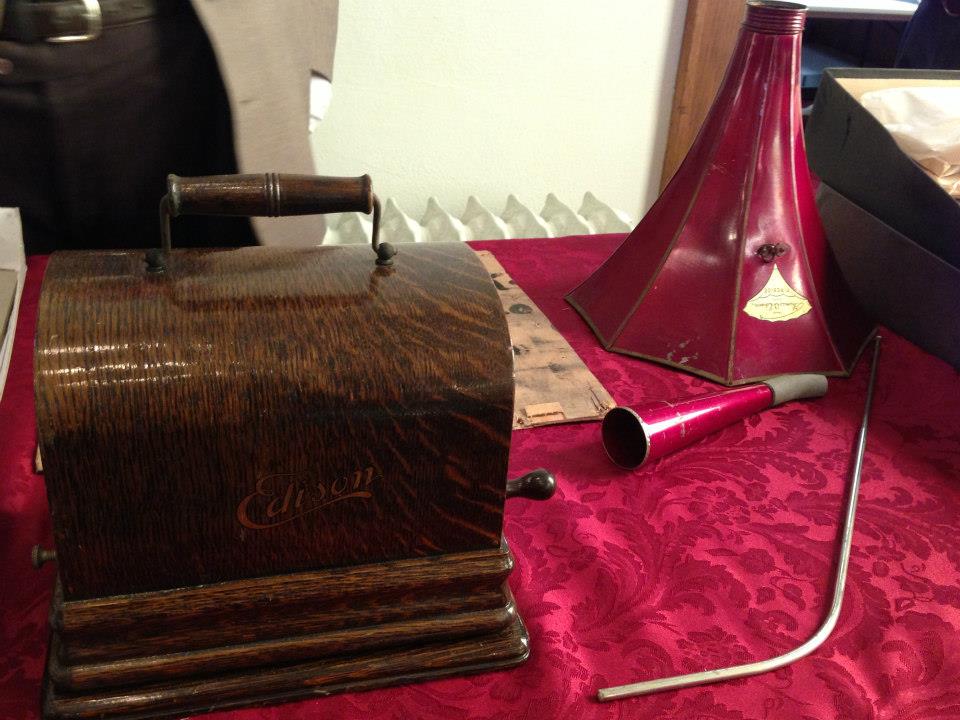
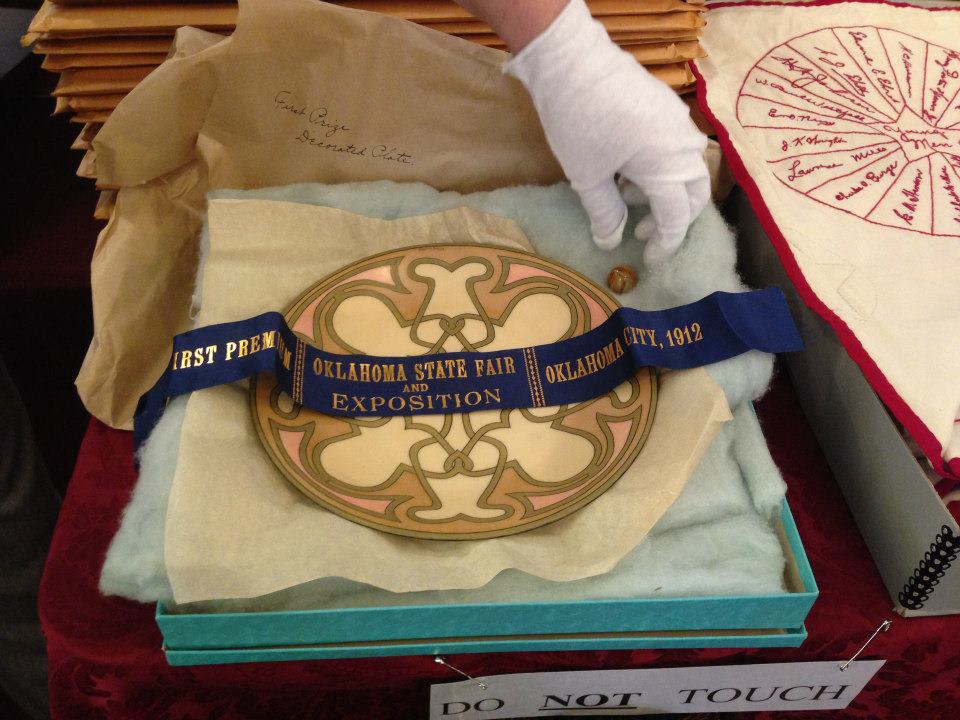
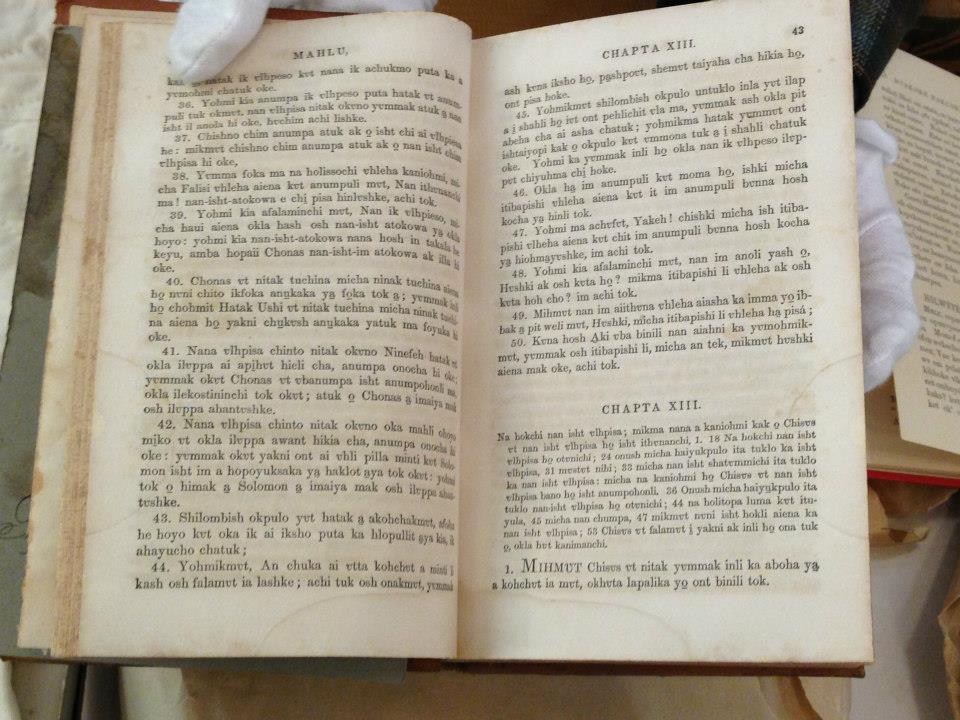
Some of the beautiful and well-preserved items found:

Photo1


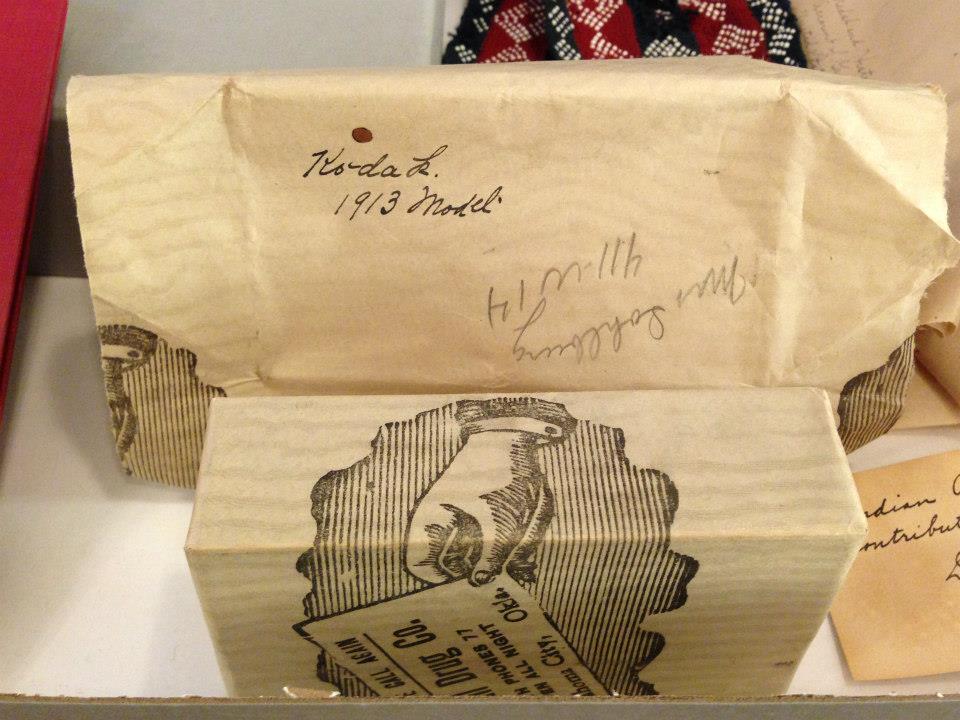
Kodak camera


Photo2


Photo3


Photo4

Graphophone

Photo5


Wax cylinders for graphophone


Photo6


Photo7


Photo8


Photo9


Photo10


Photo11


Photo12


Photo13


Photo14


Photo15
Photo16


Photo17


Photo18


Photo19


Photo20


Photo21


Photo22


Photo23


Photo24


Photo25


Photo26


Photo27


Photo28


Photo29


Photo30


Photo31


Photo32


What a wonderful glimpse into the world of 100 years ago. Many other items were included, and will be preserved and curated by the state.

The Old Wolf has spoken.

The Etz Hayyim (Tree of Life) Shtender

I recently posted about the “Hidden Synagogue.” This post has been immensely popular, given the beauty and uniqueness of the artwork it showcases.  Thanks to reader Stephen Levinson who left me a comment at that entry, I have another wondrous thing to share with you.

The Yiddish word “shtender” (שטענדער) literally means a “stander,” but most people would know one as a “lectern.” As a child, I first saw one in the public library, being used to hold up Webster’s large dictionaries.

Traditional Shtender

Shtenders are very popular in yeshivot (jewish institutes of religious learning), and they can be tall, as above, or smaller, to fit on a desk.

sm-shtender_1338_detail

Now, thanks to Stephen, I am aware of another piece of mind-bending craftsmanship and faith, the Tree of Life Shtender.

When I watched this video, I first thought, “Nice concept, but it’s just 3D graphics.”

Wrong. It’s the real McCoy, kinder. Every object you see in the shtender is real, and the whole is beautifully carved.

shtender


The Tree of Life shtender

33

The Sabbath Candelabra

An 18-year collaborative work of art between David Moss and artist Noah Greenberg, a number of these beauties have been created and placed in museums, synagogues, and private homes.

Moss himself has described his work in far better detail than I ever could – click through for his explanations; another website on the topic can be found at Bezalel Editions.

Items like this are the product of immense love and devotion, not to mention painstaking craftsmanship. I am pleased to share them with my readership.

The Old Wolf has spoken.

The Fugio Cent

While not the first coinage to be minted in our country, these were the earliest coins issued by the authority of the United States.

Fugio_cent

Obverse

Fugio_cent_reverse


Reverse

The front of the coin depicts the word “fugio” (Latin = “I fly”), a sun, and a sundial, over the motto “Mind your business.” The coin was reputedly designed by Benjamin Franklin, and it is suggested that the image combined with the words form a rebus, meaning “Time flies; do your work.” However, I like the interpretation that each person should tend to his or her own affairs without getting involved in those of others. Franklin is not around to ask.

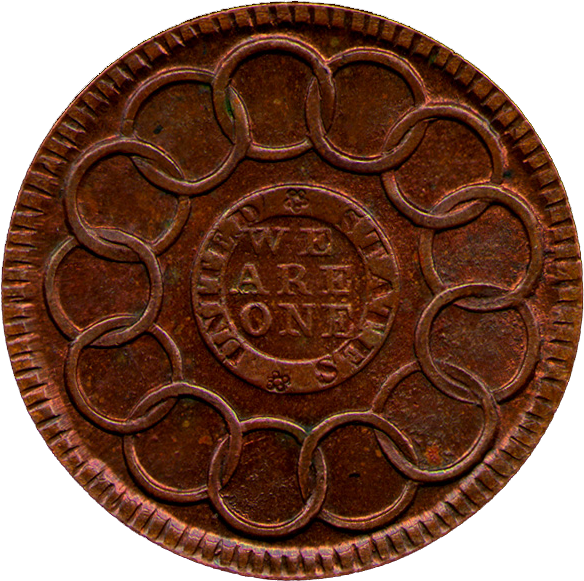
The reverse of the coin shows the words “United States,” “we are one,” and thirteen rings representing the thirteen original colonies.

I’d love to have one of these in my collection.

The Old Wolf has spoken.

Missing in Action

386725_10151366926980240_248913553_n

I think most of us would like to live forever. Teenagers certainly think they will, and some folks enter their names into the Darwin Award pool, gleefully shouting YOLO! all the while.

Darwin award candidate[1]

The sad fact is, the bus will come for each and every one of us[1] sometime within the next 115 years, based on mortality statistics. For me it will come much sooner than that, but I’m certainly in no rush.

With the advent of social media, however, there is now the option (and inevitability) that our online presence can or will outlast our physical presence on this green earth. As the first picture above alludes to, some of us would rather not have our online presence be quite so public.

Whatever the case, we now have options to handle any situation. Like anything else, a little bit of advance preparation goes a long way. For people heavily involved in the online world who would like to buy a bit of immortality, Google has launched a “Data After Death” tool, which arranges for your email, blog posts, Google+ data, contacts, documents, photos and YouTube videos to be sent to one or more loved ones or deleted entirely if your account becomes inactive for a length of time. Of course this can be done manually by putting instructions into a will or codicil, but that presupposes you have descendants who give a rat’s south-40, and who are technically savvy enough to carry out your wishes. As for deleting your browser cache and history, at this point only a human can do that for you; fortunately, my wife and all my kids are fairly connected, and will probably be willing to help out.

More than craving any sort of immortality, this essay was spawned by the loss of some online friends and acquaintances. One, a long-time participant in an online forum, passed away suddenly, and the other forumites only learned the sad news through fortunate happenstance. A second, a very prolific and talented digital artist, completely vanished from the online world without a word; the third, a web cartoonist and blogger par excellence shut down her blog, deactivated her email account, and left a two-sentence explanation for her readers that she  would probably not be heard from in the foreseeable future. All of these were cause for concern. Whenever the bus comes for me, I want my friends to know about it.

In my previous post, I mentioned The Last Sermon of Ladson Butler. I may do something similar – and hopefully I’ll have time before a meteor lands on me – but I will almost certainly do it electronically. I’ve already got instructions in my will file on how to log in to my Facebook account and the forums I frequent most often, to let people know that I’ve shuffled off to the great beyond, in case anyone cares. Even if they don’t, knowing what happened is better than seeing someone just go silent.

To my now-silent acquaintances – and this includes many people with whom I interacted over a period of years on various fora and listservs, and who have simply moved on or drifted away – I miss you – and I hope that wherever you are and whatever you’re doing, life brings you all the joy and happiness you deserve.

The Old Wolf has spoken.


[1] If you haven’t already, watch “Heart and Souls” with Robert Downey, Jr. A delightful film.

heart-and-souls-bus1

The Last Sermon of Ladson Butler

(Cross-posted from Livejournal)

One of the items which I saved from my father’s papers when he passed away was a letter sent to my parents in 1951 by Laurie and Olin Lee Hanlin, residing at the time in Mariposa, California.

Recorded inside, in beautiful hand calligraphy, was a piece entitled “The Last Sermon of Ladson Butler”. Long before I entered the Way of the Compassionate Samurai, this beautiful piece of writing moved me, and I treasured it for decades without knowing who this Ladson Butler was.

LadsonButlerSmall

Now, through the miracle of the internet, in the same way I was able to track down Grace Noll Crowell’s work (you’ll read about that in a future essay or two), a few fragmentary clues arose. It appears that Butler was employed by the Yawman & Erbe Company, a machine manufacturing concern. The most intriguing tidbit, however, was an obituary published in the February, 1951 issue of “Sphinx”, the predominant magician’s trade magazine from 1902 to 1953.

On January 25th, in New York City, Ladson Butler died. He was born in 1877 in Charleston, South Carolina. Although strictly an amateur he had been very active in magic for over forty years and was a friend of many professionals. For the past several years he has been one of the members of the Board of Directors of The Sphinx.

Ladson Butler lived for many years in the city of Buffalo and during much of that time he regularly wrote a column for The Sphinx giving news of events in magic of upper New York State. He also was the organizer of The Magician’s Club of Buffalo. For the past number of years he had made New York City his home. He was a past president of the S.A.M. Parent Assembly.

Perusing other hits on Google, apparently Butler, although tagged as an “amateur” in his obituary, was quite a prolific contributor to “The Sphinx”, and developed and documented more than one magical routine, including the Whispering Queen and the Han Ping Chien coin move.

This in itself was enough of a hook to pique my interest, as I was at one time an active member of the S.A.M. (Society of American Magicians) in New York City. What moved me more, however, was re-reading his sermon after my life’s experiences of the past two and a half years, beginning with a Klemmer & Associates Champion’s Workshop in May of 2007. Ladson Butler, born in 1877, was a Compassionate Samurai in every sense of the word. I regret he passed away 5 months before I was born, but am pleased to have known him if only through his final words to his friends, here recorded for your appreciation.

The Last Sermon of Ladson Butler

Dearly beloved:

I have always hated the idea of going away without saying goodbye. And since the call of the Grim Reaper is sometimes without warning, a trip for which my bag is always packed, I am writing now, what I think I might write if the old boy with the scythe gave me time. If I do have time to think before checking out, it will be a great comfort to know that you will receive this, my last message. Incidentally, I have already revised it from time to time, and will try to keep it up to date. Some few of you will weep, I know, and bless you for whatever kindly thoughts lie behind your tears, but remember this:

I go with hands and pockets full of the only merchandise I can carry with me, the kind and loving thoughts of friends.
Be sure that I went away rich beyond the dreams of avarice (that old cliché) in all that can matter to me now.
Did we enjoy each other? Let’s think only of that.

But before I go I want to pass on to you some of the things which have so profoundly influenced my life. Take, for example, some of the ‘orphics’ of Elbert Hubbard1:
Do your work as well as you can and be kind.
That has been my religion for years.
I would rather be deceived by people than to distrust them. That gave me an altered view that has lasted for fifty years.
This one from Robert Ingersoll, often quoted by Hubbard:
The dead carry in their clenched hands only that which they have given away.
Doesn’t it give you a better idea of what things are really worthwhile? Looking back, I can’t get much pleasure from whatever I sold, but how I have enjoyed and enjoy now whatever I have been able to give without immediate or financial return.

Would like a source of spiritual strength and faith? Let me give you Walt Whitman’s “Leaves of Grass,” my standby these many years. How I have been upheld and strengthened by such lines. Certainly I have no knowledge of a hereafter but what faith I have in this world or next is built on these lines.

I know I am deathless. I know this orbit of mine cannot be swept by the carpenter’s compass.
I know I shall not pass like a child’s carlacue cut with a burnt stick at night.
My foothold is tenon’d and mortis’d in granite.
And whether I come to my own to-day, or in ten thousand or ten million years, I can cheerfully take it now, or with equal cheerfulness I can wait.

I am not afraid. I see no evidence of a future life although old Walt Whitman’s words tempt me to believe. But if I am wrong and you my orthodox friends are right, I’ll take my chances.

O Thou didst with pitfall and gin
Beset the road I was to travel in
Thou wilt not with predestination ’round about enmesh me
And then impute my fall to sin.

With my attitude and deeds toward my fellow men, I’ll set my case with any Gods there may be. Don’t worry my friends.

——————-

Butler passed away ten days after penning this last version of his farewell message – he must surely have known that the curtain between this life and the next was getting thin.


1Elbert Hubbard was an American writer, publisher, artist, and philosopher. Some of his best thoughts are preserved in An American Bible, published in 1911 and edited by his second wife, Alice, which also contains thoughts from Benjamin Franklin, Thomas Jefferson, Thomas Paine, Abraham Lincoln, Walt Whitman, Robert Ingersoll and Ralph Waldo Emerson.

Any dog can love

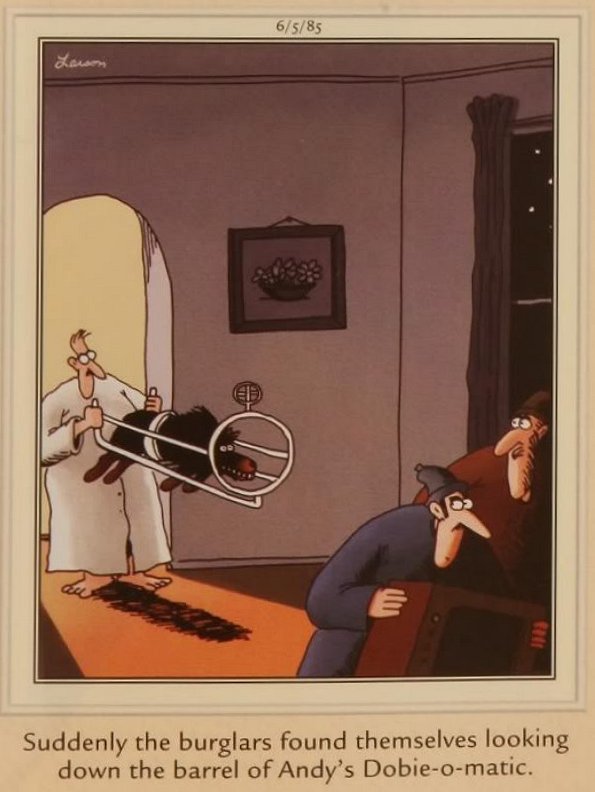
Certain breeds of dog get a bad rap, especially in the media. If ever there’s an incident where dogs frighten, hurt or kill a person, you can be sure it will be reported with much more terror and alarm if the dog happened to be a Doberman, a Rottweiler, a German Shepherd, or a Pit Bull.
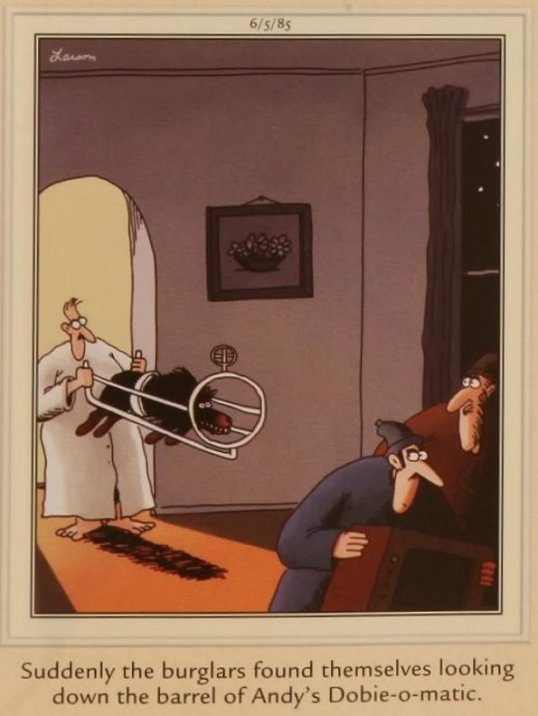
dobie

Humanity has been living with dogs for a long, long time, and it would be well for us to remember that although domesticated, they are the descendants of grey wolves.

1287650965_1024x768_grey-wolf-howling-in-the-morning

There came a time when dogs realized there was value in a partnership with those hairless apes.

Done Evolving

Cartoon by Nick Kim

People who have had any relationship with dogs at all know that these creatures are some of the most loving, brave, and faithful souls that have ever been sent to earth.

Dogs Make You Feel Better

Most recently, therapy dogs brought comfort to those affected by the Boston Marathon tragedy.

—————-

Quality

If you can start the day without caffeine,
If you can get going without pep pills,
If you can resist complaining and boring people with your troubles,
If you can eat the same food every day and be grateful for it,
If you can understand when your loved ones are too busy to give you any time,
If you can overlook it when something goes wrong through no fault of yours and those you love take it out on you,
If you can take criticism and blame without resentment,
If you can ignore a friend’s limited education and never correct him,
If you can resist treating a rich friend better than a poor friend,
If you can face the world without lies and deceit,
If you can conquer tension without medical help,
If you can relax without liquor,
If you can sleep without the aid of drugs,
If you can say honestly that deep in your heart you have no prejudice against creed, color, religion or politics…

Then my friends, you are almost as good as your dog.

—————–

Here’s a lovely story that gets forwarded around a lot. It’s a glurge, and I still like it.

A man and his dog were walking along a road. The man was enjoying the scenery, when it suddenly occurred to him that he was dead. He remembered dying, and that the dog walking beside him had been dead for years.

He wondered where the road was leading them. After a while, they came to a high, white stone wall along one side of the road. It looked like fine marble. At the top of a long hill, a tall arch that glowed broke in the sunlight. When he was standing before it, he saw a magnificent gate in the arch that looked like mother of pearl, and the street that led to the gate looked like pure gold.

He and the dog walked toward the gate, and as he got closer, he saw a man at a desk to one side. When he was close enough, he called out, “Excuse me, where are we?” “This is Heaven, sir,” the man answered. “Wow! Would you happen to have some water?” the man asked. Of course, sir. Come right in, and I’ll have some ice water brought right up.” The man gestured, and the gate began to open. “Can my friend,” gesturing toward his dog, “come in, too?” the traveler asked. “I’m sorry, sir, but we don’t accept pets.” The man thought a moment and then turned back toward the road and continued the way he had been going with his dog.

After another long walk, and at the top of another long hill, he came to a dirt road, which led through a farm gate that looked as if it had never been closed. There was no fence. As he approached the gate, he saw a man inside, leaning against a tree and reading a book. “Excuse me!” he called to the reader. “Do you have any water?” “Yeah, sure, there’s a pump over there.” The man pointed to a place that couldn’t be seen from outside the gate. “Come on in.” “How about my friend here?” the traveler gestured to the dog. “There should be a bowl by the pump.” They went through the gate, and sure enough, there was an old-fashioned hand pump with a bowl beside it. The traveler filled the bowl and took a long drink himself, then he gave some to the dog.

When they were full, he and the dog walked back toward the man who was standing by the tree waiting for them. “What do you call this place?” the traveler asked. “This is Heaven,” was the answer. “Well, that’s confusing,” the traveler said……”The man down the road said that was Heaven, too?” “Oh, you mean the place with the gold street and pearly gates? Nope. That’s Hell.” “Doesn’t it make you mad for them to use your name like that?” “No. I can see how you might think so, but we’re just happy that they screen out the folks who’ll leave their best friends behind.”

—————–

A recent news article at the BBC describes a dog who kept a young girl alive in freezing temperatures.

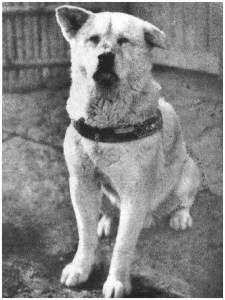
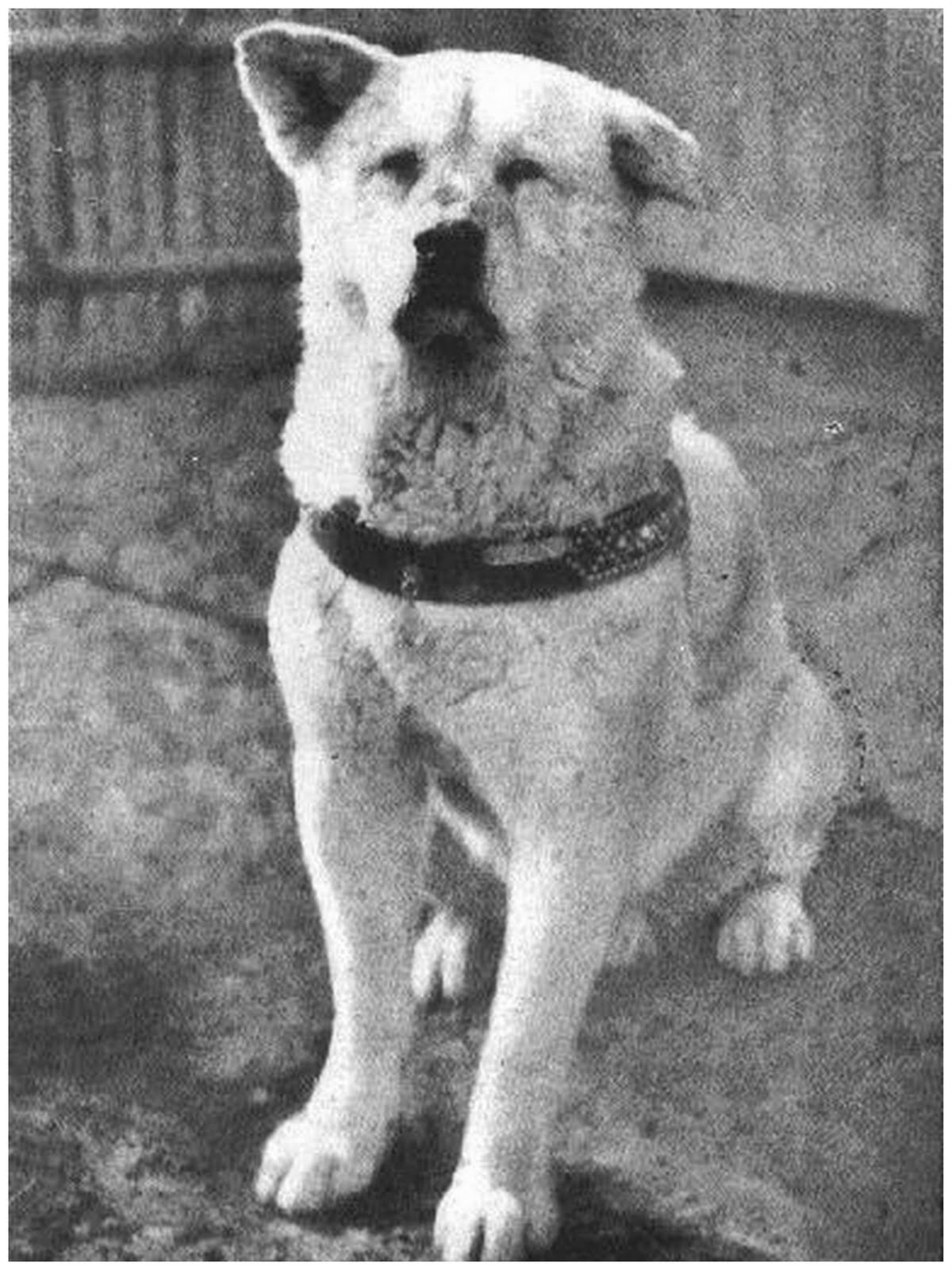
And of course, there are the stories of Hachikō

1Blogger1

Red Dog

red dog 1

The red dog monument

red dog 2

Koko (go ndéanai Día trocaire air)[1], the kelpie who starred in the iconic movie,

and Greyfriar’s Bobby.

Greyfriars_Bobby

Albumen print (ca. 1865), thought to be of Bobby (from Wikimedia Commons)

Although Bobby’s story has been challenged by numerous authorities, there is no end of documented tails [sic] (see Hachikō above) of dogs who have demonstrated extraordinary love and faithfulness.

I’ve known many dogs, but none as faithful or loving as Céilidh. She was the very best… we covered thousands of miles together on our walks.
Ceilidh2

For what it’s worth, there are cultures in the world that consider dogs unclean. I can only pity them… they are missing out on one of the greatest sources of love and friendship that the Earth has to offer.

All of this having been said, there is no breed of dog that has ever exhibited a tendency for more aggressiveness than another. The breeds I mentioned above have gotten an especially bad rap because many people train these dogs to be aggressive for use in security, police work, or the heinous activity of dogfighting. Because they are animals, they will respond exactly as they are trained – consciously or unconsciously – to do.

A famous poem by By Dorothy Law Nolte, Ph.D. has a lot to say about dogs as well as children:

Children Learn What They Live

If children live with criticism, they learn to condemn.
If children live with hostility, they learn to fight.
If children live with fear, they learn to be apprehensive.
If children live with pity, they learn to feel sorry for themselves.
If children live with ridicule, they learn to feel shy.
If children live with jealousy, they learn to feel envy.
If children live with shame, they learn to feel guilty.
If children live with encouragement, they learn confidence.
If children live with tolerance, they learn patience.
If children live with praise, they learn appreciation.
If children live with acceptance, they learn to love.
If children live with approval, they learn to like themselves.
If children live with recognition, they learn it is good to have a goal.
If children live with sharing, they learn generosity.
If children live with honesty, they learn truthfulness.
If children live with fairness, they learn justice.
If children live with kindness and consideration, they learn respect.
If children live with security, they learn to have faith in themselves and in those about them.
If children live with friendliness, they learn the world is a nice place in which to live.

Copyright © 1972 by Dorothy Law Nolte

Dogs are even more intuitive and less reasoned than children. Mark Twain once famously said,

If you pick up a starving dog and make him prosperous, he will not bite you. This is the principal difference between a dog and a man.”

Any dog that is raised with love will give love, devotion, protection, and service in return. Any dog that is beaten, abused, starved, chained, made afraid, or tortured is a candidate for aggressive behavior – I don’t care if it’s a Pit Bull or a Yorkshire Terrier… dogs have no sense of their own size, as anyone with a chihuahua can attest to.

Pit bulls tend to get the worst rap of all, and it’s entirely undeserved.

FearFact

This poster by the National Canine Research Council (full-size PDF file here) outlines a number of fears about Pit Bulls, with the documented facts about the breed. The same things, however, could be said about any breed of dog that is looked up on by the public (again, largely thanks to the media and the entertainment industry) as being dangerous.

BanStupidPeopleNotDogs

To end this essay on a lighter note, I share a story that I first heard in Irish. The translation below is mine.[2]

——————

Ti-Boy and the Dogs

Like his father, Ti Charlie, and his uncle, Ti Antoine, Ti-Boy LeBlanc was a big strapping fellow, and never was there a more terrible bully in Terrebonne Parish, Louisiana, than his dog. The other night, Ti-Boy was drinking beer and eating boiled crawfish with a couple of his buddies in a bar on route 20. In comes a stranger, and after a few words with the bartender, up comes he to Ti-Boy.

Stranger: Is that your big dog out there?
Ti-Boy: Yeah, he’s mine.
Stranger: Well, my dog just killed your dog.
Ti-Boy: Your dog killed my dog? Incroyable! What kind of dog do you have, anyway?
Stranger: A Chihuahua.
Ti-Boy: A Chihuahua?!? You’re putting me on! There’s no chance in Hell that a little bitty dog like that could do any damage to a dog that’s as big as a horse!
Stranger: I’m telling you he killed it.
Ti-Boy: How?!
Stranger: The little creature got stuck in its throat…

The Old Wolf has spoken.


[1] Irish = “May God have mercy upon him,” said when mentioning someone deceased.

[2] The original story:

Ti Boy agus na Madraí

Dála a athar, Ti Charlie, agus a uncail, Ti Antoine, fear mór scafánta ba ea Ti Boy LeBlanc. Bhí maistín mór millteach aige an madra ba mhó i bParóiste Terrebonne, Louisiana. Tráthnóna amháin bhí Ti Boy ag ól beorach agus ag ithe boiled crawfish lena chuid cairde i dteach tábhairne ar Route 20. Tháinig strainséir isteach. Tar éis cúpla focal leis an mbartender, chuaigh an fear seo go dtí Ti Boy.

Strainséir: An leatsa an mada mór amuigh ansin?
Ti Boy: Sea. Is liomsa é.
Strainséir: Bhuel, tá mo mhadasa théis do mhadasa a mharú.
Ti Boy: Mharaigh do mhadasa mo mhadasa? Incroyable! Cén sórt mada tá agat, anyway?
Strainséir: Chihuahua.
Ti Boy: Chihuahua!?! Tá tú ag tarraingt asam! Dheamhan seans ag mada beag bídeach mar sin aon damáiste a dhéanamh do mhada atá chomh mór le bromach!
Strainséir: Tá mé á rá leat gur mharaigh sé é.
Ti Boy: Cén chaoi?!
Strainséir: Chuaigh an créatúirín i bhfostú ina scornach…

(Originally found at http://www.ncf.carleton.ca/~bj333/HomePage.home.html – link now 404)