
This astonishing photo of the Milky Way rising over the Australian horizon with the Magellanic Clouds on the left was captured by Greg Gibbs. Visit his website for more starry goodness.
The Old Wolf has spoken.
This astonishing photo of the Milky Way rising over the Australian horizon with the Magellanic Clouds on the left was captured by Greg Gibbs. Visit his website for more starry goodness.
The Old Wolf has spoken.
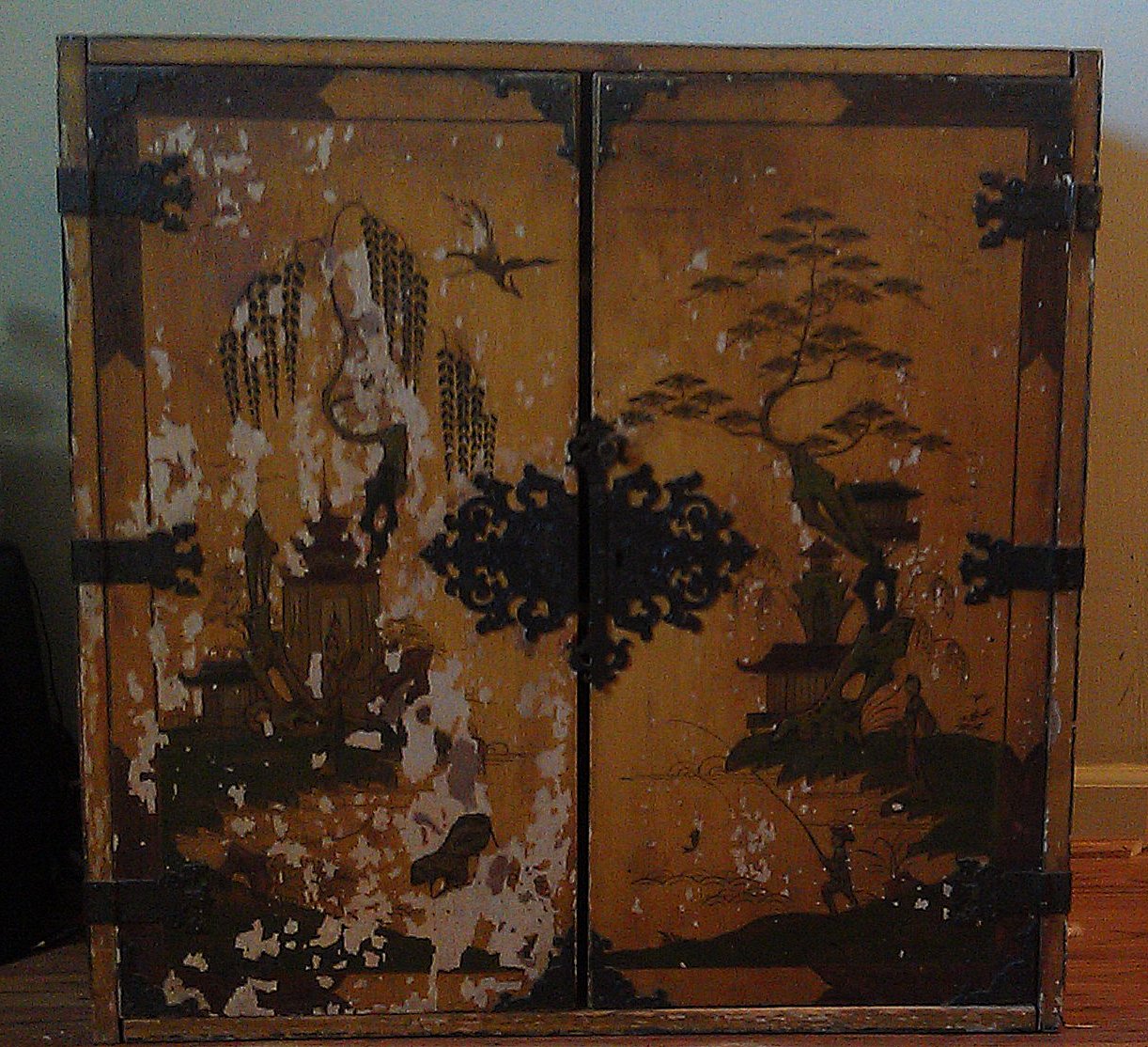
Anyone know furniture? This old laquered cabinet served as my mom’s bar for decades. The laquer is now chipping away – the left side looks a lot like the front – but I have no idea if it’s salvageable, or worth restoring – or should just be repaired, sanded, stained, and used as a functional antique. Input welcome!

I recently posted about the “Hidden Synagogue.” This post has been immensely popular, given the beauty and uniqueness of the artwork it showcases. Thanks to reader Stephen Levinson who left me a comment at that entry, I have another wondrous thing to share with you.
The Yiddish word “shtender” (שטענדער) literally means a “stander,” but most people would know one as a “lectern.” As a child, I first saw one in the public library, being used to hold up Webster’s large dictionaries.
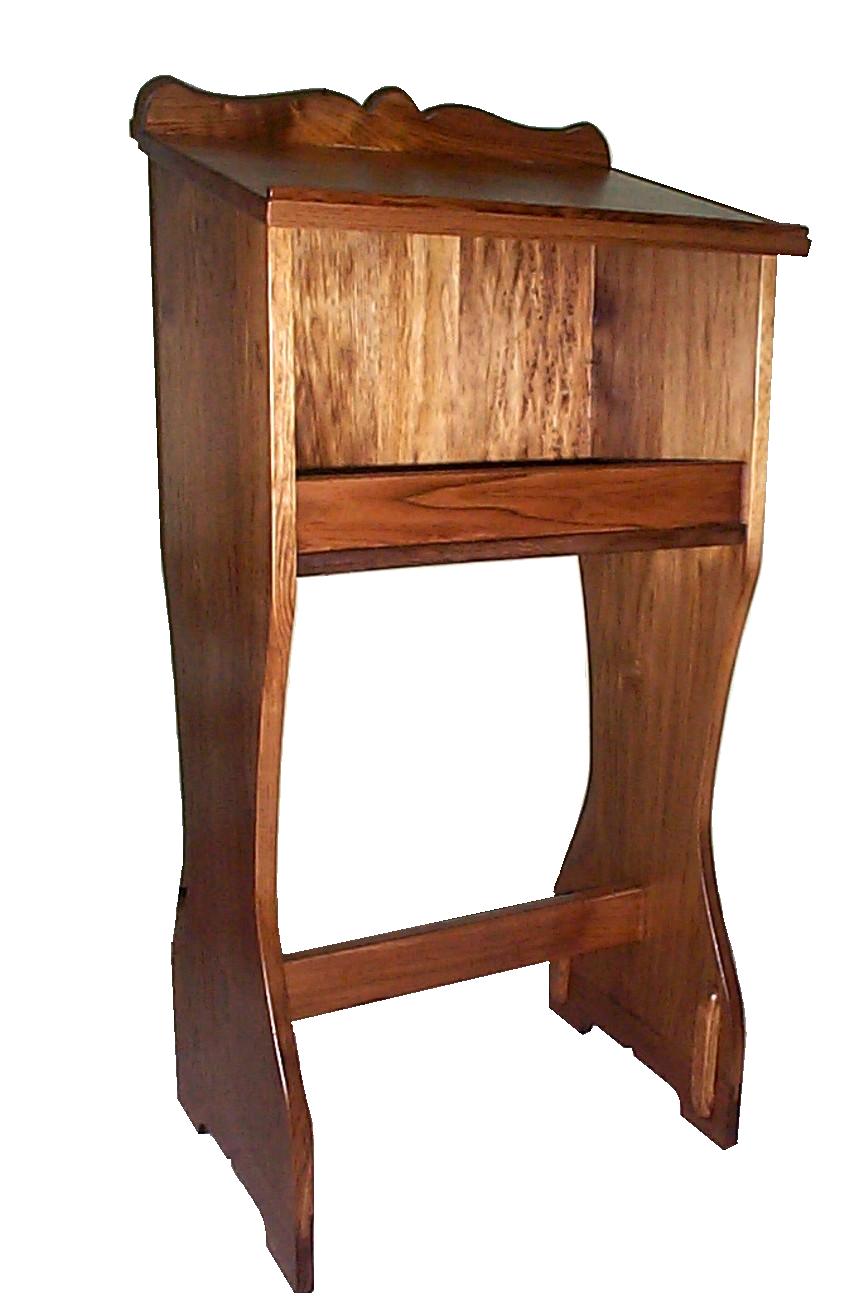
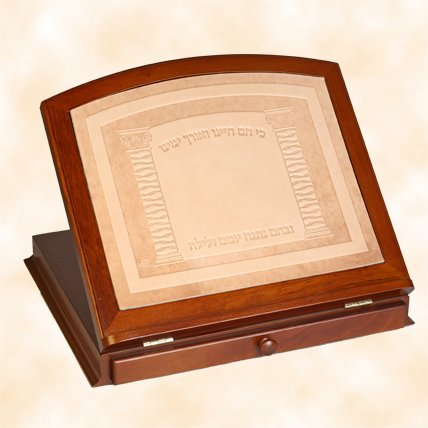
Shtenders are very popular in yeshivot (jewish institutes of religious learning), and they can be tall, as above, or smaller, to fit on a desk.
Now, thanks to Stephen, I am aware of another piece of mind-bending craftsmanship and faith, the Tree of Life Shtender.
When I watched this video, I first thought, “Nice concept, but it’s just 3D graphics.”
Wrong. It’s the real McCoy, kinder. Every object you see in the shtender is real, and the whole is beautifully carved.
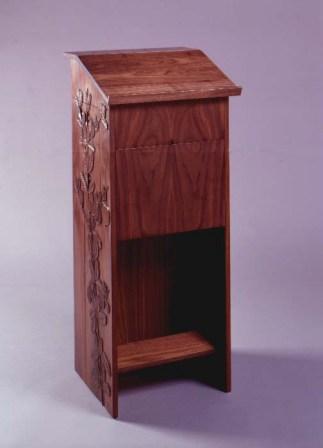
The Tree of Life shtender
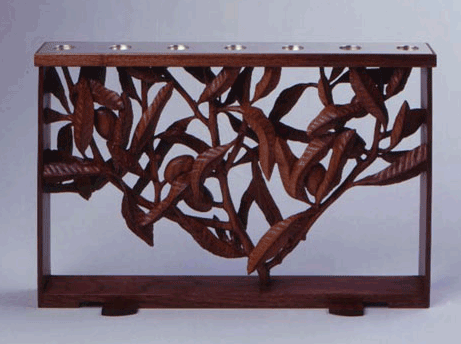
The Sabbath Candelabra
An 18-year collaborative work of art between David Moss and artist Noah Greenberg, a number of these beauties have been created and placed in museums, synagogues, and private homes.
Moss himself has described his work in far better detail than I ever could – click through for his explanations; another website on the topic can be found at Bezalel Editions.
Items like this are the product of immense love and devotion, not to mention painstaking craftsmanship. I am pleased to share them with my readership.
The Old Wolf has spoken.
Notes:
Why We Tell Stories
When the founder of Hasidic Judaism, the great Rabbi Israel Shem Tov, saw misfortune threatening the Jews, it was his custom to go into a certain part of the forest to meditate. There he would light a fire, say a special prayer, and the miracle would be accomplished and the misfortune averted.
Later, when his disciple, the celebrated Maggid of Mezritch, had occasion, for the same reason, to intercede with heaven, he would go to the same place in the forest and say: “Master of the Universe, listen! I do not know how to light the fire, but I am still able to say the prayer,” and again the miracle would be accomplished.
Still later, Rabbi Moshe‑leib of Sasov, in order to save his people once more, would go into the forest and say, “I do not know how to light the fire. I do not know the prayer, but I know the place, and this must be sufficient.” It was sufficient, and the miracle was accomplished.
Then it fell to Rabbi Israel of Rizhin to overcome misfortune. Sitting in his armchair, his head in his hands, he spoke to God: “I am unable to light the fire, and I do not know the prayer, and I cannot even find the place in the forest. All I can do is to tell the story, and this must be sufficient.”
And it was sufficient.
-from Wiesel, Elie, Souls on Fire
This teapot strikes me in much the same way. It is almost saying, “We cannot worship in the synagogue, but we can worship at home, and it must be sufficient. And for many, it was sufficient. Hence to my way of thinking, calling it a “hidden synagogue” is not totally amiss.
———————-
Found at Reddit, these are photos of a mind-bending piece of artwork.
The original photos are at Imgur. I cannot adequately express in words how beautiful this is.
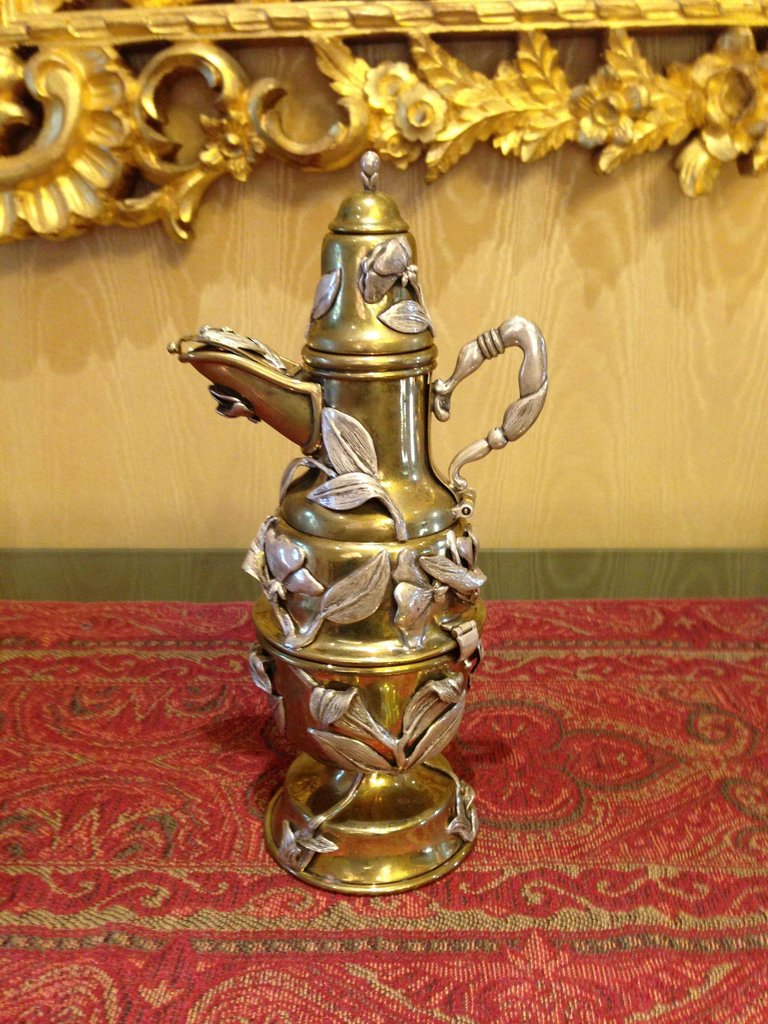
The complete teapot

Remove the top…

Its’ a hidden dreidel

Remove the next layer‘
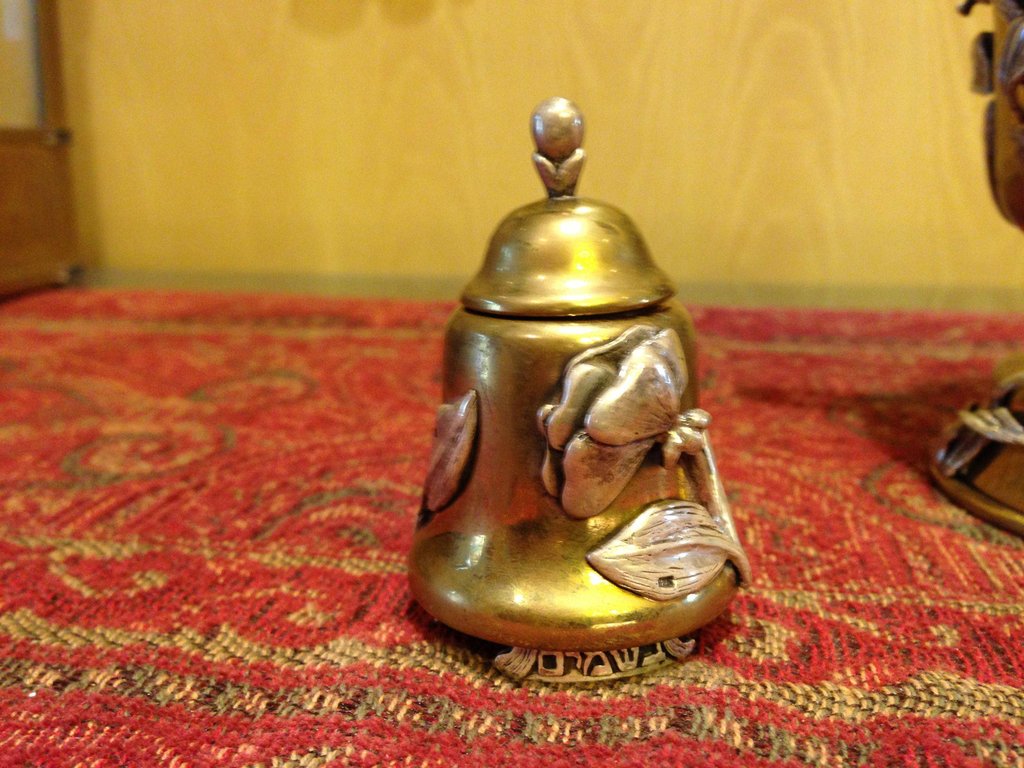
A perfume/spice holder.

Opened
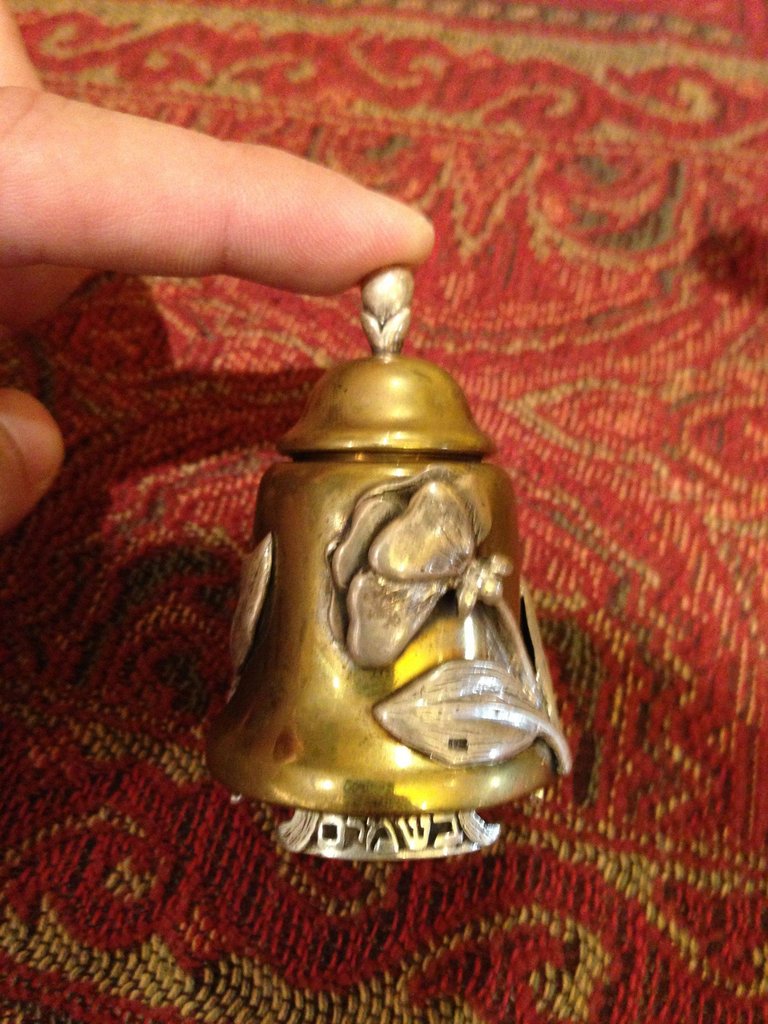
The Hebrew word on the bottom says בשמים (basmim), “spices or perfumes”

The next layer is…

The eternal flame.

The Front View – The inscription reads, “The light of god is man’s soul.”

But there’s another secret:

A complete megilla (the scroll containing the biblical narrative of the Book of Esther, traditionally read in synagogues to celebrate the festival of Purim.)
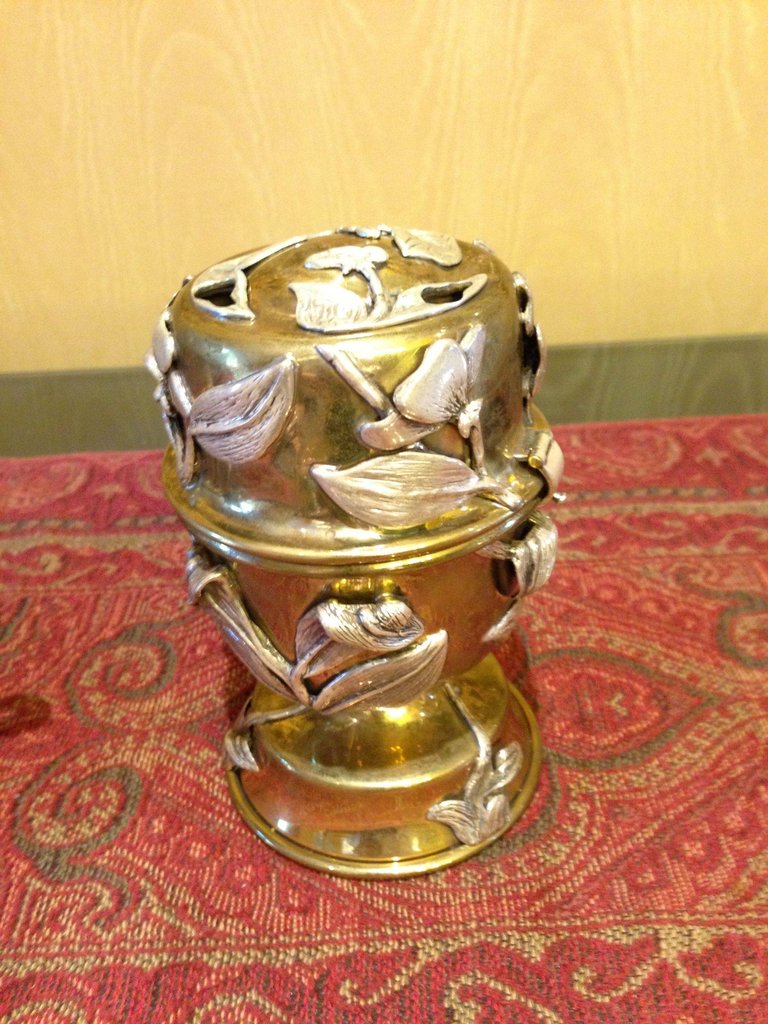
The main body is designed to hold an etrog, the yellow citron or Citrus medica used by Jews on the week-long holiday of Sukkot.
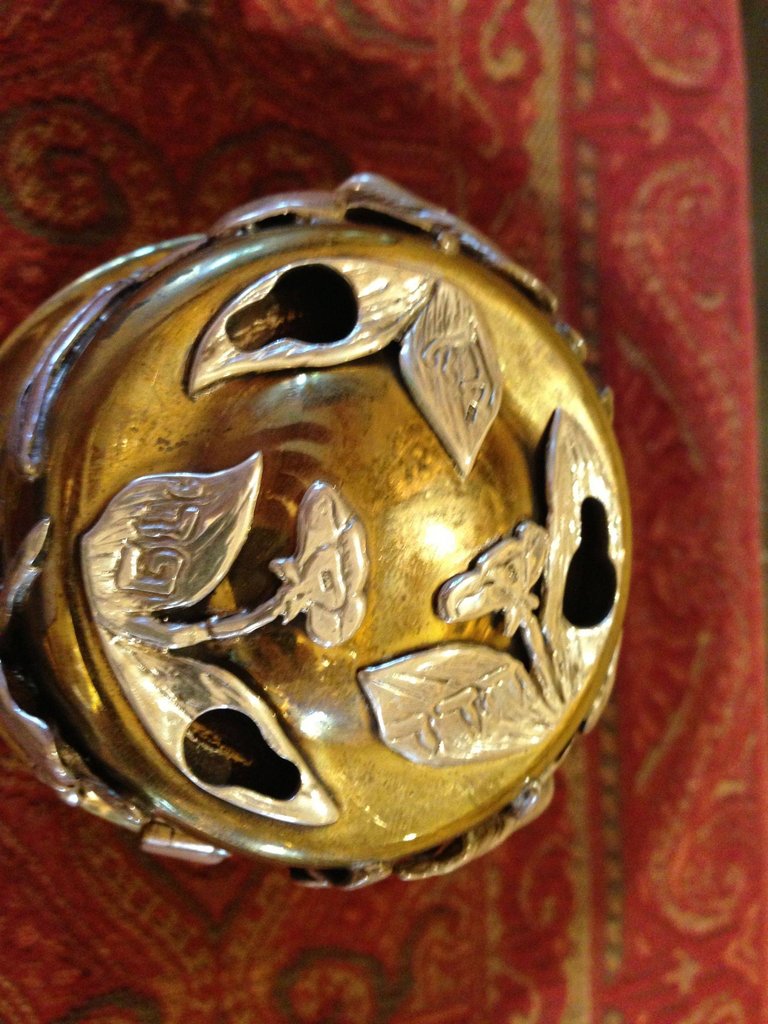
The words say “pri etz hadar” (the fruit of the majestic tree), a biblical reference to the etrog.

Inside

Candlesticks for Shabbos

Closeup of candlesticks
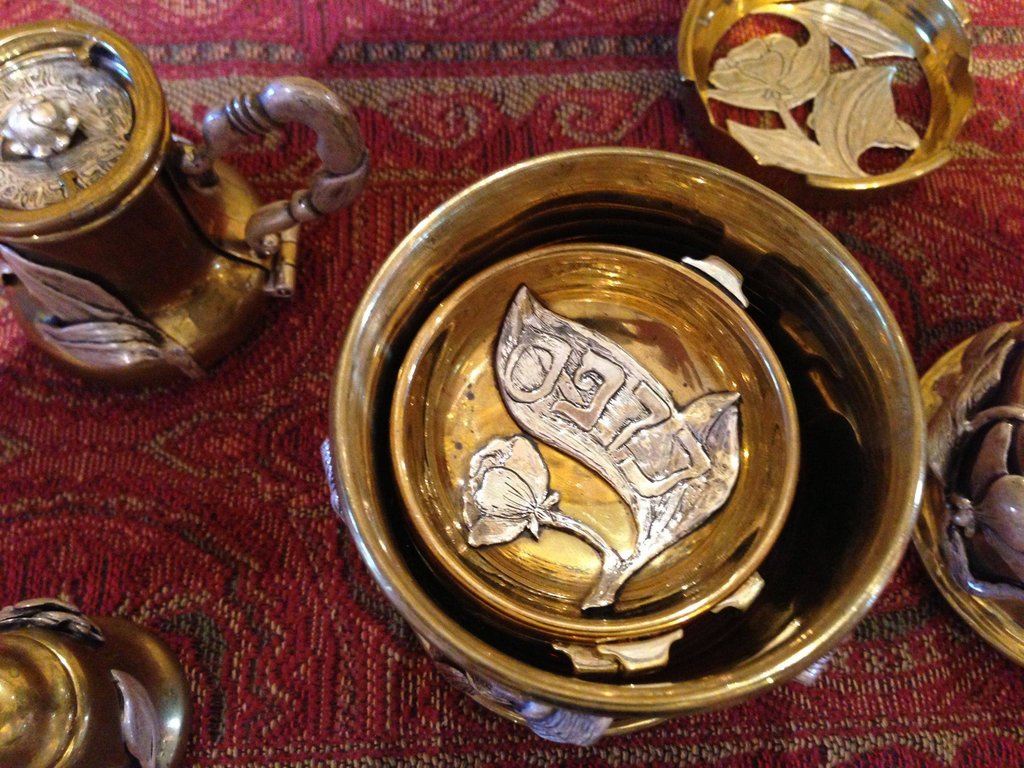
Remove the flowered tray, and under the candlesticks is…

A Seder plate.
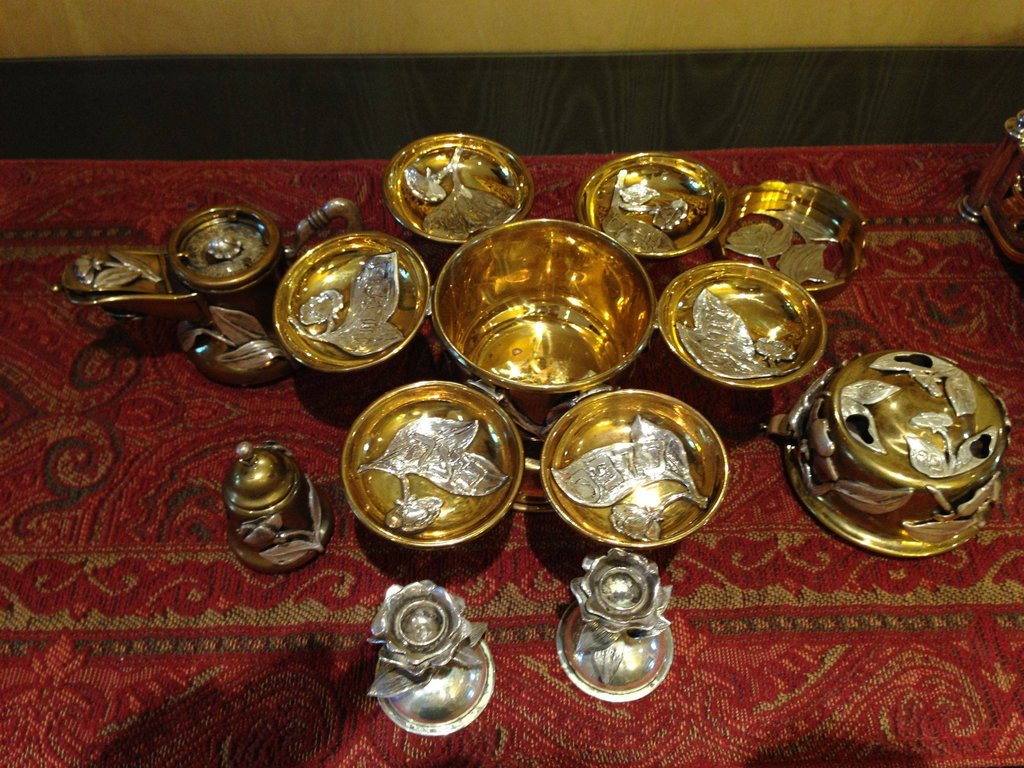
Complete

But there’s one more thing.
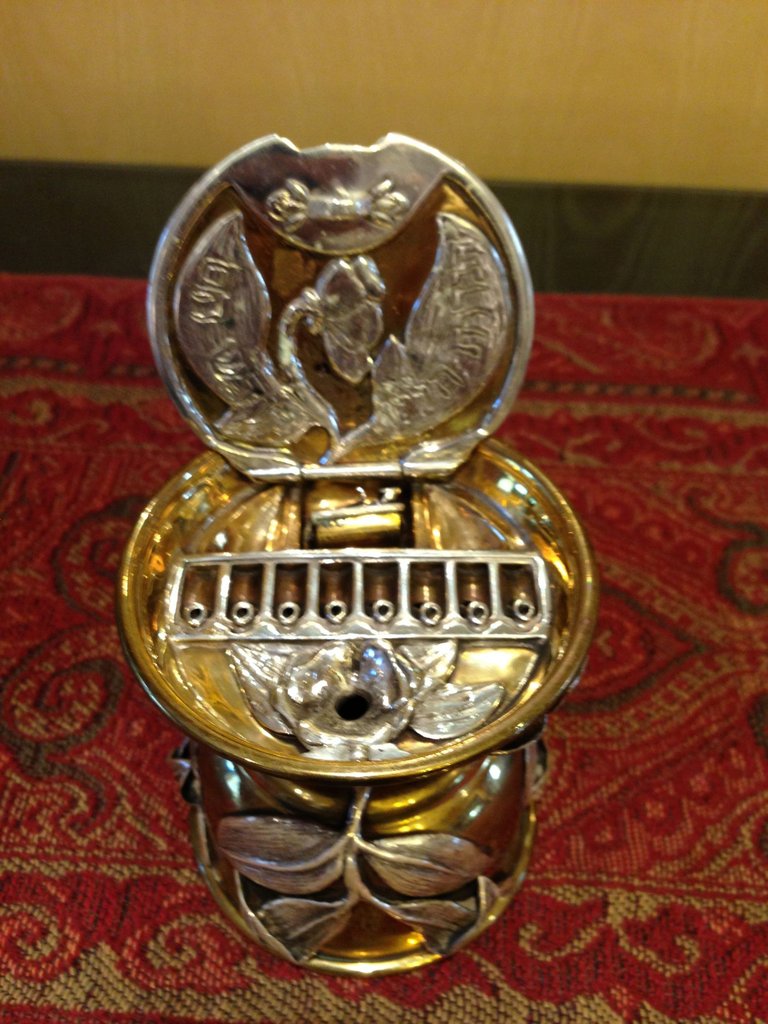
A menorah.[1]
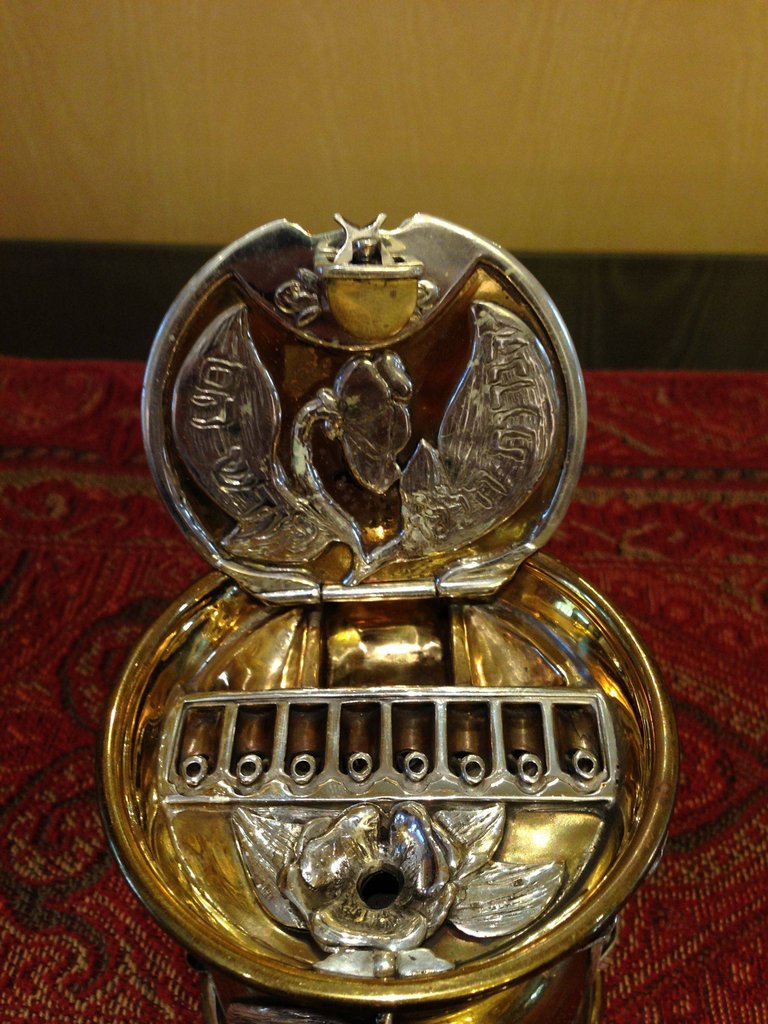
With the shammash (“servant”), the 9th light of the menorah used to light the other 8 candles.
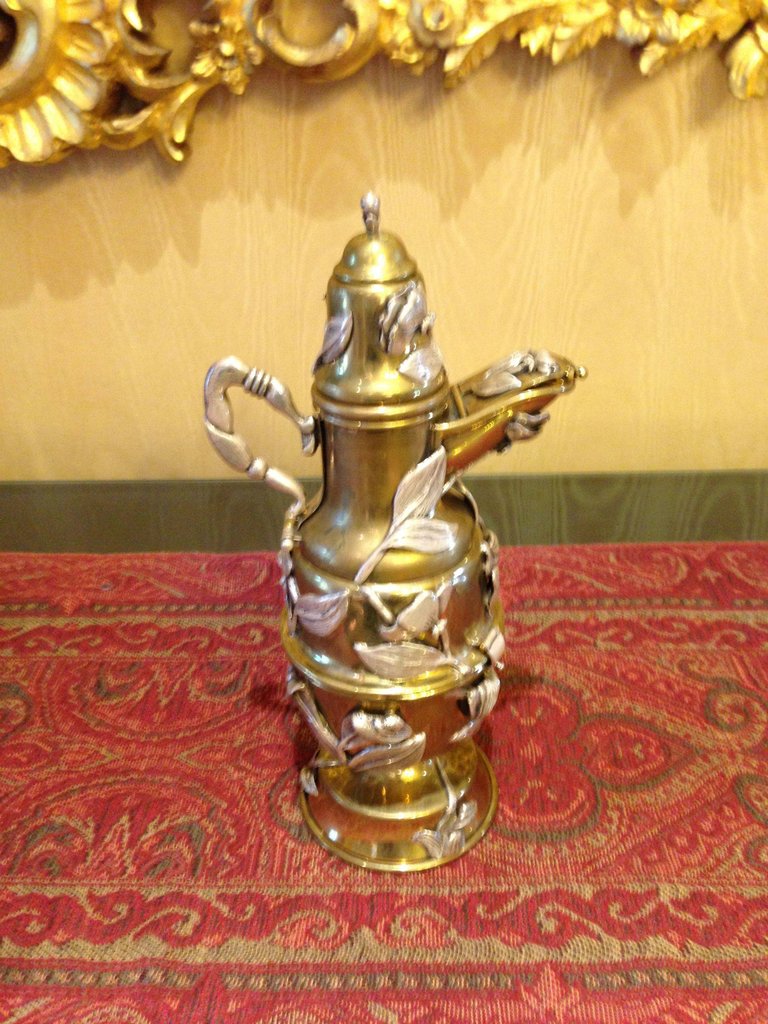
Reassembled
The Old Wolf is in awe.
[1] With regards to the lamp, Wikipedia has this to say:
The Hanukkah menorah (Hebrew: מנורת חנוכה m’noraht khanukkah, pl. menorot) (also Hebrew: חַנֻכִּיָּה hanukiah, or chanukkiyah, pl. hanukiyot/chanukkiyot, or Yiddish: חנוכּה לאמפּ khanike lomp, lit.: Hanukkah lamp) is, strictly speaking, a nine-branched candelabrum lit during the eight-day holiday of Hanukkah, as opposed to the seven-branched menorah used in the ancient Temple or as a symbol. The ninth holder, called the shamash (“helper” or “servant”), is for a candle used to light all other candles and/or to be used as an extra light. The menorah is among the most widely produced articles of Jewish ceremonial art. The seven-branched menorah is a traditional symbol of Judaism, along with the Star of David.
In the English-speaking diaspora, the lamp is most commonly called a “Hanukkah menorah,” or simply “menorah” for short, whereas in Modern Hebrew it is exclusively called a chanukkiyah, and the Hebrew word menorah simply means “lamp”. The term chanukkiyah was coined at the end of the nineteenth century in Jerusalem by the wife of Eliezer Ben Yehuda, the reviver of the Hebrew language.
Since I am an English speaker, and since the vast majority of Americans are familiar only with the 9-branched “מנורת חנוכה” seen at Chanukkah, I’m sticking with “menorah.” Those who wish to call it a “חַנֻכִּיָּה” are correct in doing so.

A member of a mobile propaganda team shows movies and slides, sings songs accompanied by clappers, and tells stories praising the accomplishments of the new China. In this way, propaganda reached the smallest villages. By Xin Liliang & Wu Qingxun.
Found at Glaserei
Two 1980’s-era color lithographs of Paris.
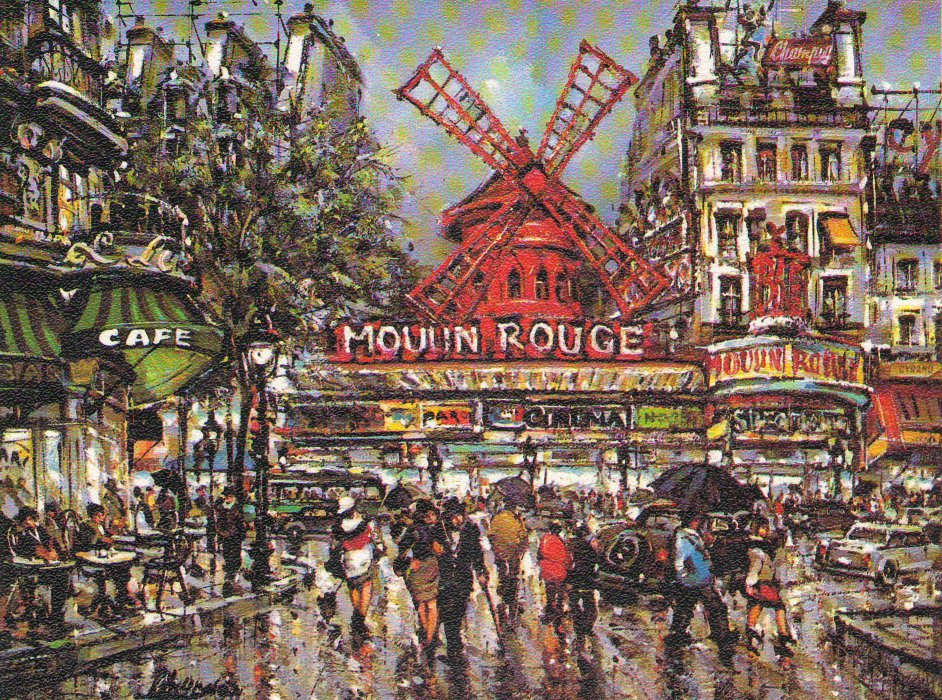
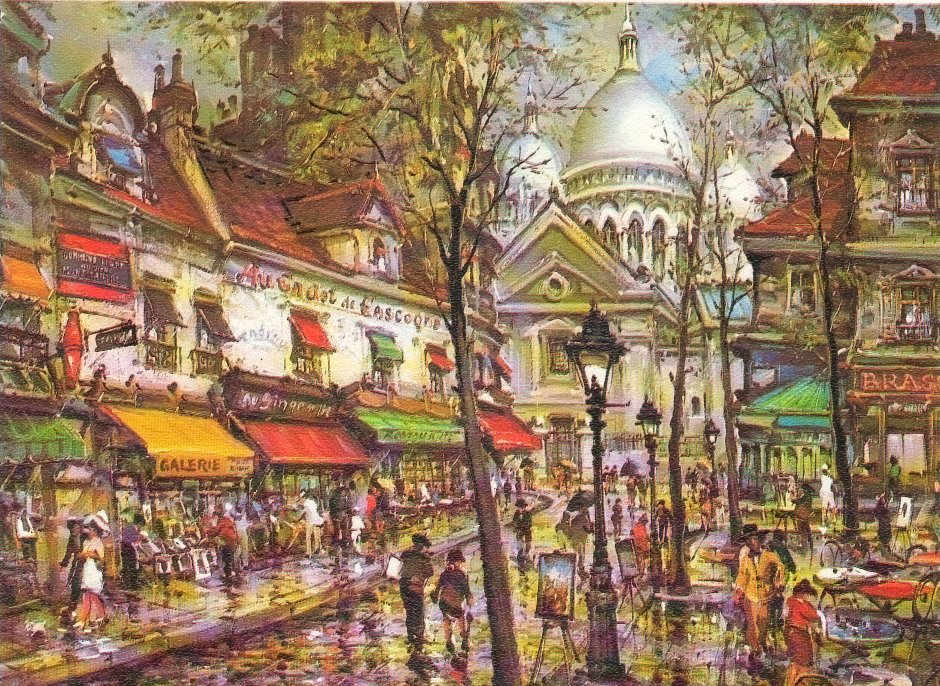
Every place has its beauties and unique attractions, but there is no other city in the world quite like Paris.
The Old Wolf has spoken.
Someone spent a long time doing this. It rather blew my mind. I thought I’d share it.
The Old Wolf has spoken.
I love the art of Disney, particularly the craftsmanship that was present around 1940 when both Pinocchio and Fantasia came out. These are probably examples of the finest 2D animation ever produced, and both have long been among my favorite films.
I have one small nit to pick, however – it has bothered me since I sat through 4 consecutive showings of Pinocchio in 1972 or thereabouts – I noticed it then, but had no way of verifying what I had seen at the time.
As Gepetto drifts off to sleep, he sends Figaro to open the window.

As kitty pushes the window open and walks out into the moonlight, the color artists got a bit mixed up:
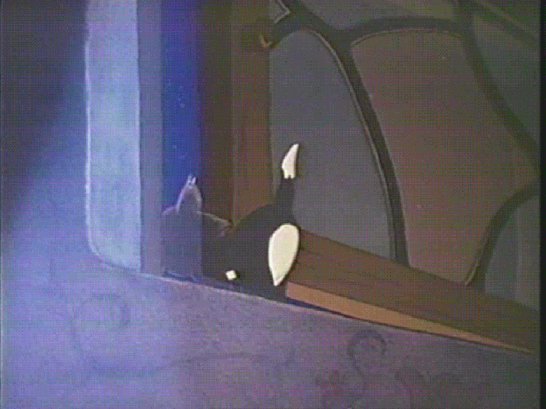
Notice that you can see the window frame through Figaro’s body.
A tiny detail and forgivable, and I had no way of verifying this until the advent of VCR’s and DVD’s, but I’m glad that I wasn’t just seeing things.
The Old Wolf has spoken.
Generations come and go. As we’ve often seen by what the Motion Picture Academy considers good films, compared with, say, the Golden Globes or the Sundance Film Festival – just being a big name doesn’t guarantee quality. And sometimes the most creative content slips under everyone’s radar.
If you’ve never watched Mike Jittlov‘s “The Wizard of Speed and Time,” you owe it to yourself to do so. This is not what you’d called “polished cinematography” by, oh, “Avatar” standards – but the special effects, done by one man in his effing garage, are absolutely brilliant.
And his song “Merry Birthday to You” (composed so he wouldn’t have to pay royalties for the old standby) is so much more fun than the boring, blah unsalted farina original.


Electrician J. W. Dalhouse works on a locomotive at Shaffers Crossing in Roanoke, Virginia, March 19, 1955
Photo by Conway Link
 Playing in the World Game
