Bernie Sanders on the Senate Floor

May be an image of 1 person and fire

Note: This post is public. If you don’t like what’s being said here, leave your thoughts on your own wall. Comments supportive of MAGA, the GOP, or the Oligarchy will be summarily deleted.

—-

A few hours ago on the floor of the Senate, Bernie Sanders torched billionaires, scorched Trump, and burned every shred of political cowardice in his path.

Here is his fiery speech, word for word:

“Mr. President,

In the last couple of weeks, I’ve had the opportunity to travel in many parts of our country. And I have been able to talk to folks in Nebraska, in Iowa, Wisconsin, Michigan, Nevada, Colorado, and Arizona. And what I am hearing from in all of these states and in fact all over the country is that our nation right now faces enormous crises, unprecedented crises in the modern history of our country.

And how right now at this moment we respond to these crises will not only impact our lives, it will impact the lives of our kids and future generations. And in terms of climate change, the well-being of the entire planet.

And Mr. President, what I have to tell you is that the American people are angry at what is happening here in Washington, DC and they are prepared to stand up and fight back. In my view and what I have heard from many, many people is that they will not accept an oligarchic form of society where a handful of billionaires control our government, where the wealthiest person on Earth, Mr. Musk, is running all over Washington, DC slashing the Social Security Administration so that our elderly people today are finding it extremely difficult to access the benefits that they paid into.

Where Mr. Musk and his friends are slashing the Veterans Administration so that people who put their lives on the line to defend us will not be able to get the health care that they are entitled to or get the benefits that they are owed in a timely manner. Slashing the Department of Education. Slashing USAID.

And why is all of this slashing taking place? It is taking place so that the wealthiest people in this country can receive over $1 trillion dollars in tax breaks.

Now, I don’t care if you are a Democrat, a Republican, or an Independent. There are very few people in this country who think that you slash programs that working families desperately need in order to give tax breaks to billionaires.

Mr. President, I am the former chair of the U.S. Senate Committee on Veterans’ Affairs, and I have had the honor of meeting with veterans in my own state of Vermont—all over Vermont—but all over the country. These are the men and women who put the uniform of this country on and have been prepared to die to defend our nation and American democracy.

And these veterans and Americans all over our nation will not accept an authoritarian form of society with a president who undermines our Constitution every day. Every day there’s something else out there where he’s undermining our Constitution and threatening the very foundations of American democracy. That is not what people fought and died to allow to happen.

Mr. President, I am not a historian, but I do know that the founding fathers of this country were no dummies. They were really smart guys. And in the 1780s, they wrote a Constitution and established a form of government with a separation of powers.

A separation of powers—with an executive branch, the president; a legislative branch, the Congress; and a judicial branch.

These revolutionaries in the 1780s had just fought a war against the imperial rule of the King of England who was an absolute dictator, the most powerful person on Earth. And these revolutionaries here in America forming a new government wanted to make absolutely sure that no one person in this brand new country that they were forming would have unlimited powers.

And that is why we have a separation of powers. That is why we have a judiciary, a Congress, and an executive branch. In other words, way back in the 1780s, they wrote a Constitution to prevent exactly what Donald Trump is trying to do today.

So, let us be clear about what is going on. Donald Trump is attacking our First Amendment and is trying to intimidate the media and those who speak out against him in an absolutely unprecedented way.

Mr. President, he has sued ABC, CBS, Meta, the Des Moines Register. His FCC is now threatening to investigate NPR and PBS. He has called CNN and MSNBC “illegal.”

In other words, the leader—or the so-called leader—of the free world is afraid of freedom. He doesn’t like criticism. Well, guess what? None of us like criticism. But you don’t get elected to the Senate, you don’t get elected to the House, you don’t become a governor, you don’t become a president of the United States unless you are prepared to deal with that criticism.

And the response to that criticism in a democracy is not to sue the media, is not to intimidate the media. It’s to respond in the way you think best.

But Mr. President, it is not just the media that Trump is going after. He is going after the constitutional responsibilities that this body, the United States Congress, has. And I will say it amazes me, it really does, how easily my Republican colleagues here in the Senate and in the House are willing to surrender their constitutional responsibilities. Give it over to the president.

Trump has illegally and unconstitutionally withheld funds that Congress has appropriated. You can’t do that. Congress has the power of the purse. We make a decision. We argue about it here. Big debates, vote-aras, the whole thing. Make that decision. That money goes out. The president does not have the right to withhold funds that Congress has appropriated.

Trump has illegally and unconstitutionally decimated agencies that can only be changed or reformed by Congress. You don’t like the Department of Education, you don’t like USAID, fine. Come to the Congress. Tell us what reforms you want to see. You do not have the right to unilaterally do away with these agencies.

Trump has fired members of independent agencies and inspectors general that he does not have the authority to do.

But Mr. President, it is not just the media that he is trying to intimidate. It is not just the powers of Congress that he wants.

Now, in an absolutely outrageous, unconstitutional and extraordinarily dangerous way, he is going after the judiciary. His view is that if you don’t like a decision that a judge renders, you get rid of that judge. You try to impeach that judge. You intimidate judges so that you get the decisions that you want.

You know, I’m thinking back now as someone who is not a supporter of the Roberts court, and I’m thinking about one of the worst Supreme Court decisions that has ever been rendered—that is Citizens United. I’ll say more about that in a moment. And I’m thinking about the Supreme Court’s decision to overturn Roe v. Wade, taking away American women’s right to control their own bodies.

In my view, these were outrageous decisions, unpopular decisions. But it never occurred to me, because maybe I’m old-fashioned and conservative, and I believe that you live by the rule of law, to say, “Hey, look at the decision Roberts made. We’re going to impeach him.”

No, we try to elect a new president who’s going to appoint new Supreme Court justices. That is the system that people have fought and died to defend.

But it’s not just the movement toward oligarchy, which is outraging millions of Americans—Democrats and Republicans, by the way—and it’s not just the movement toward authoritarianism that we are seeing. The American people, especially with Mr. Musk and 13 billionaires in the Trump administration running agency after agency…

The American people are saying as loudly as they can that they will not accept a society of massive economic and wealth inequalities, where the very richest people in our country are becoming much richer while working families are struggling to put food on the table.

Having gone all over this country, I can tell you that the American people are sick and tired of these inequalities and they want an economy that works for all of us—not just the 1%.

You know, Mr. President, we deal with a whole lot of stuff here in the Congress, and you know, virtually all of it is important in one way or another.

But let’s do something, you know, fairly radical today. Let’s try to tell the truth—the real truth—about what is going on in our society today. Something that we don’t talk about too much here in the Senate. We don’t talk about it too much in the House. We don’t talk about it too much in the corporate media.

But the reality is that today we have two Americas. Two very, very different Americas.

And in one of those Americas, the wealthiest people have never ever had it so good. In the whole history of our country, the people on top have never ever had it so good as they have it today.

Today, we have more income and wealth inequality than there has ever been in the history of America. Now, I know we don’t discuss it. You don’t see it much on TV. You don’t hear it talked about here at all. But the American people do not believe that it is appropriate that three people—one, two, three—Mr. Musk, Mr. Bezos, and Mr. Zuckerberg, three Americans, own more wealth than the bottom half of American society. 170 million people. Really? Three people own more wealth than 170 million people? Anybody here think that is vaguely appropriate?

And by the way, those very same three people—the three richest people in America—were right there at Trump’s inaugural, standing right behind the president. So, you want to know what oligarchy is? I know there’s some confusion out there. What is oligarchy? Well, it starts off when you have the three wealthiest people in the country standing right behind the president when he gets inaugurated.

The top 1% in our country now own more wealth than the bottom 90%.

CEOs make 300 times more than their average worker.

And unbelievably—real inflation-accounted-for wages today—the average American worker, if you can believe it, despite a massive increase in worker productivity, is lower today than it was 52 years ago. And during that period, there was a $75 trillion transfer of wealth that went from the bottom 90% to the top 1%. That is the reality of the American economy today. And you know what? Maybe we might want to be talking about that.

And in our America today, in that top America, that one America, the 1% are completely separate and isolated from the rest of the country. You think they get on a subway to get to work? Think they sit in a traffic jam for an hour trying to get to work? Not the case.

They fly around in the jets and the helicopters that they own. They live in their mansions all over the world in their gated communities. They have nannies taking care of their babies. They don’t worry about the cost of child care. And they send their kids to the best private schools and colleges.

Sometimes they vacation not in a Motel 6, not in a national park, but on the very own islands that they have. And on occasion, for the very very richest—just to have for a kick, have a little bit of fun—maybe they’ll spend a few million dollars flying off into space in one of their own spaceships. Sounds like fun.

But it is not just massive income and wealth inequality that we’re dealing with today. We have more concentration of ownership than ever before. While the profits on Wall Street and corporate America soar, a handful of giant corporations dominate sector after sector—whether it’s agriculture, transportation, media, financial services, etc., etc.

Small number of huge corporations—international corporations—dominating sector after sector. And as a result of that concentration of ownership, they are able to charge the American people outrageously high prices for the goods and services we need.

Mr. President, we don’t talk about it too much. Maybe we should. But there are three Wall Street firms—BlackRock, Vanguard, and State Street—that combined are the major stockholders in 95% of our corporations. Got that? Three Wall Street firms—three—are the major stockholders in 95% of American corporations.

So, Mr. President, that is one America. People on top doing phenomenally well. Not only do they have economic power, they have enormous political power. That’s what’s going on there. They live like kings. That’s one America.

But there is another America.

And in that other America, 60% of our people are living paycheck to paycheck. And millions of workers from one end of this country to the other are trying to survive on starvation wages.

And unlike Donald Trump, I grew up in a family that lived paycheck to paycheck. And I know the anxieties that my mom and dad had, living in a rent-controlled apartment. Can we afford to buy this? Why did you buy that?

And that’s the story taking place all over America.

What does living paycheck to paycheck mean?

It means that every single day, millions of Americans worry about how they’re going to pay their rent or their mortgage. All over the country, rents are skyrocketing. And people are wondering: What happens—what happens to me and my kids if rent goes up by 20% and I can’t afford it? Where do I live? Do I have to take my kid out of school? Where do I put my kid? In worst case scenario, do I live in my car?

Let’s be clear. There are many people who are working today who are living in the back of their cars.

How do I pay for child care?

I talked to a cop, a guy the other day—a police officer—spending $20,000 a year for child care.

How do I buy decent food for my kids when the price of groceries is off the charts?

What happens if I get sick or my kid gets sick or my mother gets sick and I got a $12,000 deductible and I can’t afford to go to the doctor?

How, at the end of the month, am I going to pay my credit card bill—even though I am being charged 20 or 30% interest rates by the usurious credit card companies?

People are worrying about simple things. What happens if my car breaks down and the guy at the repair shop says it’s going to cost $1,000 and I don’t have $1,000 in the bank? And if I don’t have a car, how do I get to work? And if I don’t get to work, how do I have an income? And if I don’t have an income, how do I take care of my family?

Those are the crises that millions of Americans are experiencing today.

But it’s not just working-age Americans.

Today, in our country, half of older workers—older workers—have nothing in the bank as they face retirement. And they’re watching TV and they’re saying, “Mr. Musk is firing Social Security workers,” and actually worrying whether Social Security will be there for them.

And it’s not just older workers with nothing in the bank wondering what happens when they retire. Twenty-two percent of seniors are trying to survive on $15,000 a year.

I dare anybody in this country—let alone somebody who’s old, who needs health care, needs to keep the house warm—try to survive on $15,000 a year. And there are people here, by the way, talking about cutting Social Security.

Mr. President, it is not just about income and wealth inequality. It is about a health care system which everyone in the nation understands is broken, is dysfunctional, and is outrageously expensive.

I hear my Republican friends—you know, I don’t know where they are today—wanting to destroy the ACA. And my Democratic friends say, “Oh, we got to defend the ACA.” ACA is broken. It doesn’t work.

In my state, the cost of health care is going up 10, 15%. In America today, you got 85 million people uninsured or underinsured.

Function of the health care system today is not to do what a sane society would do—guarantee health care to all people in a cost-effective way—something which, by the way, every other major nation on Earth manages to do.

The function of our health care system, as everybody knows, is to make billions of dollars in profits for the insurance companies and the drug companies.

So I say to my Democratic friends: It’s not good enough to defend the Affordable Care Act. It’s a broken system. You got to have the guts to stand up and allow us to do what every other major nation does—guarantee health care to all people as a human right—not allow the drug companies and the insurance companies to make massive profits every year.

And Mr. President, I want to touch on an issue that gets virtually no discussion, but I think it is enormously important—and it says a hell of a lot about what’s going on in our society today.

In America, according to international studies, our life expectancy—how long we live as a people—is about four years lower than other countries. Most European countries—people there live longer lives. Japan—they live even more longer lives than in Europe.

So, question number one: Why is that happening?

We spend $14,000 a year per person on health care—almost double what any other country spends. And yet people around the world are living, on average, four years longer than we do.

But here is the really ugly fact—even worse than that.

And that is that in this country, on average, if you are a working-class person, you will live seven years shorter lives than if you’re in the top 1%. If you’re a working-class person, your life will be seven years shorter than if you are wealthy.

In other words, being poor or working-class in America today amounts to a death sentence.

Mr. President, it’s not only a broken health care system.

We have got to ask ourselves a simple question—and the Biden administration began a little bit of movement in this direction—and that is: Why are we living in a nation where one out of four people can’t even afford the prescription drugs their doctors prescribe?

Why are we in some cases paying ten times more than our neighbors in Canada or in Europe? How does that happen?

And the answer of course has to do with the greed of the pharmaceutical industry and their power right here—all of the campaign contributions that they make—which has prevented us from negotiating prices.

But it’s not just health care or prescription drugs.

When we look at what’s going on in America—in Vermont and throughout this country—we have a major housing crisis. Here we are, the richest country on Earth: 800,000 people sleeping out on the streets, and 20 million people are spending more than 50% of their limited incomes on housing.

Can you imagine that? You’re a working person, spending 50% of your income on housing. How do you have money to do anything else? And the cost of housing is soaring.

Do not tell me, Mr. President, that in a nation which could spend a trillion dollars on the military—a nation that gives massive tax breaks to the rich—that we cannot build the millions of units of housing that we desperately need.

So, Mr. President, why is all of this happening?

Why do we have a health care system that is broken? Prescription drugs that are the most expensive in the world? A housing system? Education in deep trouble?

Talked to educators in Vermont, all over the country. Talked to a principal the other day from Vermont. Their starting salary at a public school? $32,000 a year. But don’t worry—they can’t afford to even bring people in because they can’t afford the housing in the community.

Why have we let education sink to the level that it has?

So I think the bottom line of all this is: The American people, I think, are catching on. And Mr. Musk—I must thank him—because he has made it very clear we are living in an oligarchic form of society.

If anybody out there thinks that Mr. Musk is running around out of the goodness of his heart trying to make our government more efficient, you have not a clue as to what is going on.

What these guys want to do is destroy virtually every federal program that impacts the well-being of working people—Social Security, Medicare, postal service, public education, you name it—so they can get huge tax breaks for the rich and eventually make government so inefficient that they will have the ability, as large corporations, to come in and privatize everything that is going on.

So, Mr. President, this is a pivotal moment in American history. And I sense that the American people have had it up to here.

They are prepared to fight back.

They do not want a government run by billionaires who have it all—whose greed is uncontrollable.

You know, we have in Vermont—and I think a lot of this country—serious problems with addiction, with drugs. People drinking too much alcohol. People smoking too many cigarettes.

But the worst form of addiction that this country now faces is the greed of the oligarchy.

You might think that if you had 10, 20 billion dollars, it would be enough. You know—kind of enough to let your family live for the next 20 generations.

But it’s not.

For whatever reason—whatever compulsive reason they have—these guys want more and more and more, and they are prepared to destroy Social Security, Medicare, nutrition programs for hungry people in order to get even more.

That, to me, is disgusting.

So, Mr. President, we are at a pivotal moment in American history. But having been all over this country—or many parts of this country—I am absolutely confident that the American people (and I’m not just talking about Democrats, who are as complicit in the problems that we have right now as our Republicans, because we got a two-party system which is basically corrupt)…

You got Mr. Musk over on the Republican side saying to any Republican who dares to stand up and defy the Trump agenda, we are going to primary you.

And on the Democratic side, you got AIPAC and you got other super PACs saying, you stand up for working people—you’re in trouble as well.

We got a corrupt campaign finance system in which billionaires are able to buy elections. And that’s why all over this country, people are not happy with our two-party system—the Republicans and the Democrats.

So, Mr. President, this is a pivotal moment in American history.

But we have had difficult moments before. And I am confident, from the bottom of my heart, that if we stand together, and we do not allow some right-wing extremists to divide us up by the color of our skin, or our religion, or where we were born, or our sexual orientation…

If we stand together, we can save this country. We can defeat oligarchy. We can defeat the movement toward authoritarianism. And in fact, we can create an economy and a government that works for all—not just a few.”

—-

This nation needs more Bernies. More AOC’s. More people with good hearts and common sense who are willing to stand up to the fascists, the dictators, and the oligarchs who are raping our country for their own enrichment.
The Old Wolf has Spoken

The Great Resignation

From a Tweet thread posted on 1 November, 2021 by Kurt Eichenwald ¹

Sharing because it needs sharing.

“The Great Resignation” is not about people not wanting to work. It is about a dawning recognition that, for a larger and larger portion of this country, the American dream is dead, and with it, the inspiration of working toward a better future for oneself. Instead, work becomes not the means towards reaching an aspiration – a spouse, children, a home, vacations, personal growth, a retirement. Instead, the greed culture has turned work for millions into just a means of survival, with wages stagnant, healthcare unaffordable, insurance treated as a luxury, paid free time an impossibility, children unaffordable, homes a dream. Yes, work is important – but not without the promise of a future. Many young people see nothing but 40 years of the same, further enriching the obscenely rich. This system has taught people how to survive without, because they don’t believe they will ever have. If they reasonably don’t believe they will ever be able to afford a house or to raise children, and never will have group insurance or a paid vacation, and can make it living with their parents, and have already been taught by McResources (real thing) and Walmart how to apply for Food Stamps and Medicaid because those multibillion dollar corporations know they don’t pay enough for their employees to survive, and are already getting those benefits, and have the choice of just saying “forget it, im going to work on my painting or sewing or whatever, I am tired of being abused by my supervisor, I am tired of being screamed at by customers for things out of my control, I am tired of watching adults throw temper tantrums and then being [bawled] out by my company because I could have handled it better. I can survive without all of this. I can be happier without all of this. I am paid so little, my life won’t be that different.”

THAT is why we have the Great Resignation. Because we, the Boomers have endlessly sucked up the capital that could go down to the younger generations to enrich ourselves, then pushed down the debt. Entry level jobs that can be done with a high school education now demand college degrees, PLUS unpaid internship experience. So, to do most anything with the possibility of a future, younger generations have to go to college. But to do it, they have to load up on debt. Then we sneer at them when they talk about how their terrible wages and horrible debt make home buying etc. impossible. Oh sure, the children of ..the rich are fine. And their parents sneer “maybe stop buying avocado toast” as if a single pleasure in life equals the cost of a home. All of this starts and stops with greed and corporations. Pay more, and stop pulling up the ladder. Not all jobs need college degrees.

Many years ago, I interviewed Bill Clark, then the National Security Advisor under Reagan. After the interview, I asked him some background, and asked what college he got his degree from. Sheepishly, he said he didnt. Only had a high school degree. Thats the 1980s – the National Security Advisor for the President of the United States had only a high school education. But I will bet anything, to be the social media voice at Wendy’s, no matter how funny you are, you have to be a college graduate with internships in social media etc etc. Not all jobs need college degrees. Companies need to stop requiring them for jobs that don’t. And they need to start paying fair wages. And treating people like human beings.

People never wanted to “work.” They wanted to invest their effort toward living a better life. And if work doesn’t do that, if work merely makes life worse to people who have been taught how to survive without wages so that McDonalds and Walmart et al can shift their  wage costs onto taxpayers, then a Great Resignation was inevitable.

Footnotes

¹ Kurt Alexander Eichenwald (born June 28, 1961) is an American journalist and a New York Times bestselling author of five books, one of which, The Informant (2000), was made into a motion picture in 2009. Formerly he was a senior writer and investigative reporter with The New York Times, Condé Nast’s business magazine, Portfolio, and later was a contributing editor with Vanity Fair and a senior writer with Newsweek. Eichenwald had been employed by The New York Times since 1986 and primarily covered Wall Street and corporate topics such as insider trading, accounting scandals, and takeovers, but also wrote about a range of issues including terrorism, the Bill Clinton pardon controversy, Federal health care policy, and sexual predators on the Internet. (Wikipedia)

Auto Repair: Don’t believe everything they tell you

It pays to shop around, and to do your research. There are a lot good, honest repair shops out there, and probably even a few dealerships – but it always pays to take what you’re told by a mechanic with a grain of salt until you’ve done your homework.

Here are a few examples taken from personal experience.

AAMCO Transmissions, California – 1987

Hopping on the freeway in San Diego after a lovely vacation to Disneyland and Sea World with our little family of 5 in our Buick Skylark, whZZZzzzz, the transmission goes out. On the strength of a robust advertising campaign, we had our car towed to a local “Double A – beep beep! – M C O” dealer, where we were told that the entire transmission needed to be replaced: $2400.00, please. In 1987, that was not chump change by any means. Oh, and since they had already pulled the transmission, they wanted $750.00 to put it back in if we didn’t like their estimate.

Results of research: After a bit of digging in the local Yellow Pages – alas, the Internet didn’t exist back then – we found Interstate Transmissions who came and towed our car, plus the transmission and appurtenant bits and pieces in a box – and put us back on the road for $1,200 with a lifetime warranty as well. A couple of years later the transmission failed again, and an equivalent shop in Utah honored the warranty, repairing the transmission at no cost. I also learned why AAMCO stands for “All Automatics Must Come Out,” and never gave them the time of day again. Savings: $1,200 or $2,400, depending on how you look at it.

The following examples are all based on my 2007 Prius, which has been a good and faithful workhorse but which is now coming to the end of her economically viable life. At 240,000 miles, I think I’ve gotten my money’s worth. Good Molly.¹

Big O Tires, Utah – around 2015

Took the car in for a snow-tire changeover. Technician takes me over to the car and does “Grampa’s bounce test” on the back bumper. “Struts are shot, you should replace them. The parts aren’t cheap, it will be about $1,200.00 for each side.”

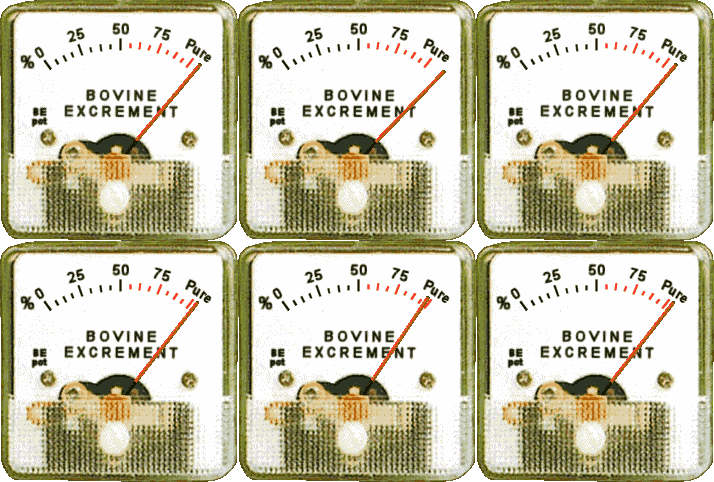
The price alone would have been enough to make me go do some research, even if my “BS-Meter” hadn’t already redlined.

Results of research: Average 2019 prices for strut replacement on both sides runs about $700.00, including alignment. I never had the work done. At 235,000 miles in 2019, the suspension is still just fine. According to a good article at MarketWatch, “At some service places, staffers (service writers, techs, even managers) are paid partly on commission,” so that could explain the stratospheric and unnecessary quote. In the interest of fairness, on other occasions that I went there I got quick work at a fair price. Savings: $2,400.00

Toyota dealership, Maine – 2018

My hybrid battery finally gave up the ghost after 11 years. Toyota quoted me $3500.00 for a new hybrid battery.

Results of Research: Most local shops wouldn’t touch it. Found a rebuilt battery for around $900.00 at Hometown Hybrids in Texas, free shipping both ways (returning the core) and some great YouTube videos showing step-by-step on replacing the battery. Took me about 4 hours, in and out. Runs like new. Savings: $2,500.00

VIP Tires and Service, Maine, 2018

I developed an exhaust leak and thought my manifold gasket had gone bad. Technician at VIP told me I had a bad manifold gasket and a crack in the exhaust system near the heat shield. “Need to replace the whole muffler, we can do both jobs for $649.00.”

Results of research: Muffler was just fine, thank you, and there was no crack in the pipe. Savings: $649.00

Meineke, Maine, 2018

Meineke replaced the manifold gasket for me without charging me for parts because I had had it done last year there as well. That was good. Replacing the gasket didn’t solve the problem, though, and I was still getting a lot of noise and exhaust from up front. After some more analysis, technician says “Here’s where we start,” and shows me an estimate to replace my catalytic converter for $810.82.

Results of Research:  Just out of curiosity, I checked with the dealership. I had been throwing a P0420 code (“catalytic converter operating below threshold”)² for a long time:

At this point, I figured that it was probably time to have it replaced, especially if I was considering selling the car. Toyota dealership quoted me around $2,600 for the job. Found a direct-fit converter online for $104.00, and a local mechanic installed it for me for $176.00. Savings: $2,320 or $530, depending.

Toyota Dealership, Maine, 2019

My rear wiper motor gave up the ghost; the local Toyota dealership at first declined to quote me a price for repair, saying – as they always do – “You’ll need to bring it in for a diagnostic.” Now, there’s a certain level at which this makes sense; you can’t really diagnose problems over the phone, especially when granny has a problem and the solution might be one of a dozen things. But in this case I knew what I wanted – a price to replace the motor. So they quoted me around $500.00, with the caveat that this would just be for the motor replacement ($146.00 for the part, $250.00 for labor), but if the problem was in the wiring or the switch, it could be a lot more, which I understand. Kinda.

Results of Research: Found a motor at a junkyard for $30.00. Watched a YouTube video showing how to replace it. Took me half an hour – most of that time was spent looking for tools in various places in the house. So Toyota wanted to charge me two hours of labor for what would have been a 15-minute job. Savings: $470.00


The takeaway from these experiences is always get a second opinion, and if you don’t like that one, get a third. Research parts and labor costs online, do what you can by yourself, and keep poking away at the issue for as much time as you have until you’re satisfied you’re getting an honest solution.

The Old Wolf has spoken.

————————————

¹ Although, for the sake of reddit karma, I was really hoping I could get her to 280085.

² Some free advertising for the FIXD OBD-II Active Car Health Monitor: This little plug-in device monitors your car’s health continually and transmits information to an app on your phone. You can clear any codes with the tap of a button, and keep track of what may actually be wrong in your engine or exhaust system, saving you a lot of money for diagnostic charges (although a lot of auto parts stores will check your codes for free as well.) Best $60.00 I ever spent.

The Zumwalt-class Destroyer

20180825_142737

Currently under construction at Bath Iron Works in Maine, the second Zumwalt-class destroyer being readied after sea trials. The first, the USS Zumwalt (DDG-1000) was commissioned 15 October 2016, and this one – the Michael Monsoor – is slated for commisisoning in January 2019 (Estimated).

[This photo was taken on a lighthouse-viewing cruise out of Boothbay harbor. Not pictured is the Security tug floating very prominently between us and the ship, making sure our boat didn’t get too close.]

A lot of information about this class of ships can be found at Wikipedia.

The military funding and procurement process is a byzantine labyrinth that few can understand, fraught with politics and pork-barrel legislation and contractors vying for a slot at the government trough. But the story behind this project beggars the imagination, given that the Navy originally wanted 32 of these destroyers, and ultimately settled for three, with $9.6 billion in R&D costs spread over all three ships for a total cost of $7.5 billion per ship.

As if that weren’t bad enough, this class of vessel was designed around an Advanced Gun System, but the Long Range Land Attack Projectile (LRLAP) that was the only projectile usable turned out to be so expensive after the scale-back of the destroyer program, between, $800,000 and $1 million per shell (per shell!) that the program was cancelled altogether.  Designing a new shell would involve retrofitting the AGS, also unfeasible, and the Navy was left struggling to figure out how to re-purpose an obsoleted multi-billion dollar ship.

For what it’s worth, the ship does have some intriguing qualities, including its ultra-low radar profile, but one is left to wonder how such massive fiscal cock-ups could be allowed to occur.

According to Ed Prince, a political pundit who worked on numerous campaigns, there are five basic reasons for cost overruns in defense contracts.

  1. Congress/military keeps changing the specs. Nothing increases the costs like having to make changes mid-way through production. It also delays the production which increases prices.
  2. Conflicting needs missions of the armament. In an attempt to keep costs down, weapon systems will have to do multiple duties to meet the different demands of the military so instead of a clean, straight-forward system, a much more complicated one gets authorized even if it more costly.
  3. In an effort to curry favor with Congress, weapons manufacturers scatter the development and manufacturing process to as many Congressional districts as possible which is hardly an efficient way to build things and invariably causes over-runs.
  4. The current system often relies on former military personnel who have retired and then gone to work for the defense industry where they can earn many multiples of their military salary. It does not make for efficient oversight.
  5. Reality. If a program is going over-budget, what can the military do? Cancel the project? Presumably, they still want it. That would delay it even longer and that’s assuming that there is another contractor capable of producing the system.

Clearly, there may be a whole host of other reasons, but these seem reasonable to the layman’s eye. And since I’m neither an economist nor a military strategist, I really have no solutions to offer – but as a taxpayer, I know that this kind of expenditure, along with failed projects that have nothing to show for the money spent, rub me the wrong way. (The F-22 Raptor, close to $80 billion spent on 187 aircraft, has seen some service, but remains fraught with operational and training problems.)

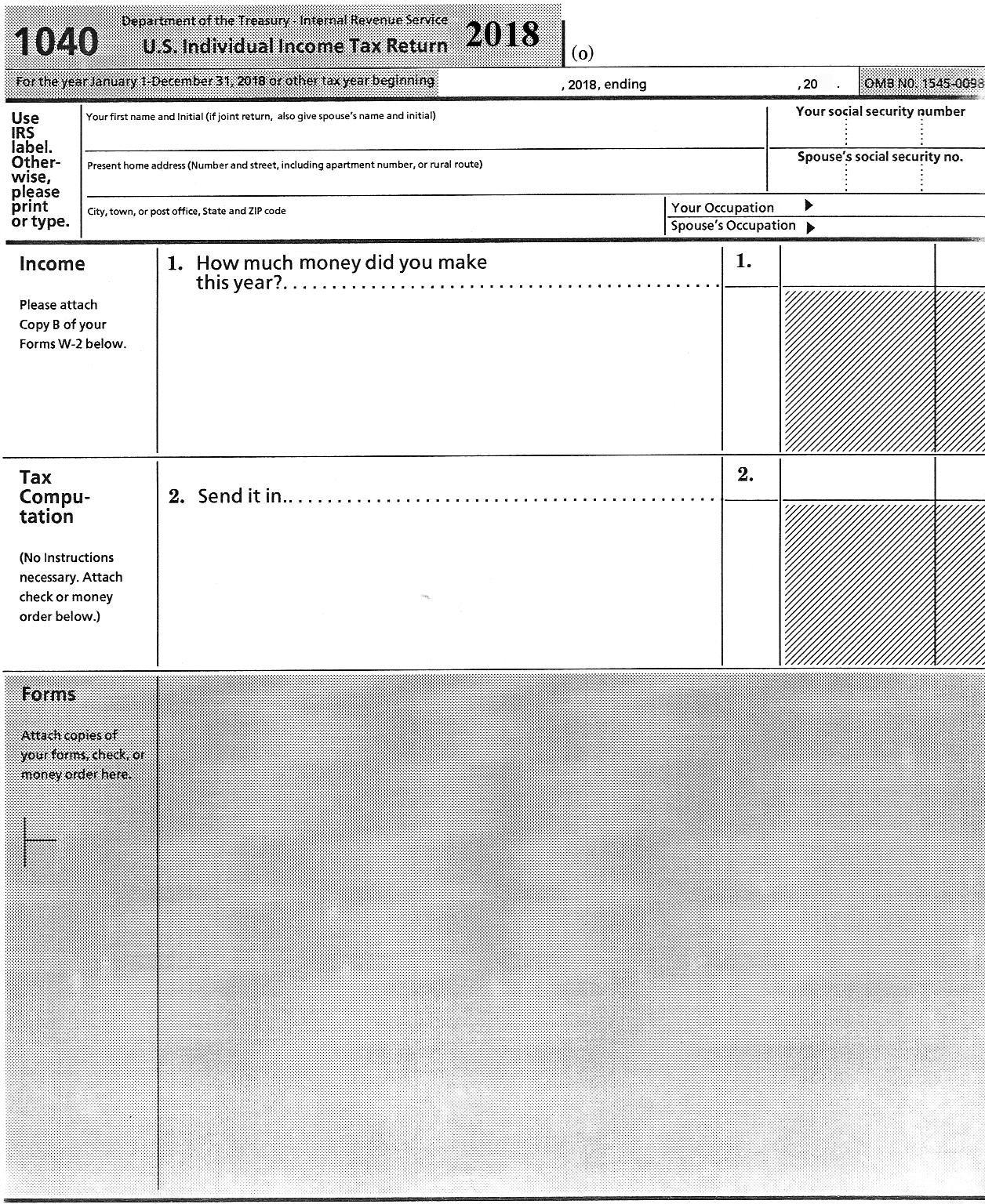
Lately, despite 45’s tax cuts (which have been definitively shown to favor the wealthy over the course of the next 10 years), I keep feeling that tax season is creeping more and more in this direction:

2018 Tax Form

Now I know taxes are necessary in any republic the size of the USA, but I wish taxpayers had the right and privilege of indicating where their taxes were going. I’d be tempted to give all my taxes to the arts and education, and let the Navy hold a bake sale for their next advanced technology program.

No, that’s not practical, and the Constitution provides for the Common Defense, so a certain amount to maintain our armed forces is necessary, but I wish our legislators had more fiscal responsibility toward their taxpayers than to the lobbyists and corporations that fill their re-election war chests. That’s why it’s important for concerned citizens who favor progressive government to get their fannies into the voting booths this November, and henceforth forevermore.

In that vein, I realized that just a couple of tweaks to a famous song recorded by Nancy Sinatra makes it very relevant to today’s political landscape (with apologies to Lee Hazelwood!)

You keep saying you got something for me
Something you call yuuuuge but confess
You’ve been a’messin’ where you shouldn’t ‘ve been a’messin’
And now someone else is getting all your best

These booths are made for voting
And that’s just what they’ll do
One of these days these booths are gonna vote all over you.

You keep lyin’ when you oughta be truthin’
You keep losing when you oughta not bet
You keep samin’ when you oughta be a’changin’
Now what’s right is right but you ain’t been right yet

These booths are made for voting
And that’s just what they’ll do
One of these days these booths are gonna vote all over you.

You keep playing where you shouldn’t be playing
And you keep thinking that you’ll never get burnt (HAH)
I just found me a brand new box of matches (YEAH)
And what he knows you ain’t had time to learn

These booths are made for voting
And that’s just what they’ll do
One of these days these booths are gonna vote all over you.

Are you ready, booths? Start start votin’!

The Old Wolf has spoken.

Coin collecting – nobody makes money but the dealers.

I learned this lesson the hard way as a kid, as I sank endless amounts of allowance and paychecks and tips into a coin collection and various and sundry offerings from the Franklin Mint, touted as “brilliant investments” and “guaranteed to be coveted”. Yes, some of the things I gathered were very pretty, but 50 years later when it came time to divest myself of the items for this reason and that, I found out that most of the stuff was worth: melt value. That’s just the sad reality of the collecting world.

The same holds true for stamps: the mint sheets of things like the Mercury mission

301748

Face value: $4.00. Dealer price today: $18.40. Hardly a brilliant investment over time, and that’s for a mint sheet. Certainly not what my father envisioned as he gathered sheets like this which I ended up inheriting. Individual cancelled stamps collected from envelopes will fetch you… well, kindling, really. With the exception of a few very rare beauties, stamp collecting is a hobby for amateurs (in the original sense, meaning “those who love”) rather than investors.

Not that dealers out there are not still trying to flummox the unwise and the uninformed. Look at this beautiful collection of Liberty Seated coins from PCS stamps and coins, offered for only two payments of $295.00:

5cd6ba31-248f-4733-ad48-84a5cd678138_400_0

Yes, it’s very attractive. Here’s the potential breakdown of value, taken from the PCGS website – you can be sure that the coins you get will be the commonest (hence cheapest) varieties out there, and all in “Very Good” condition, or between grade 8 and 10.

1877 CC Liberty Seated Half Dollar – grade 8 – $59.00
1876 CC Liberty Seated Quarter – Grade 8 – $60.00
1876 CC Liberty Seated Dime – Grade 8 – $29.00

Total $148.00

That pretty little case probably costs about 30.00 or less from a dealer in China – so for a premium of $400.00 you can have someone put together a set of coins that you could own for 1/3 the price. Even 50 years down the road, don’t expect your investment to appreciate anywhere near that much.

Old US coinage can be beautiful, and top specimens command insane prices from the wealthy bidders who buy them at auction – but if you want to make money from collecting coins… become a dealer.

The Old Wolf has spoken.

Some things come and go, some things stick around

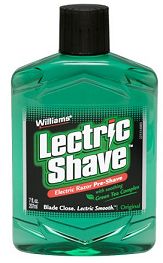
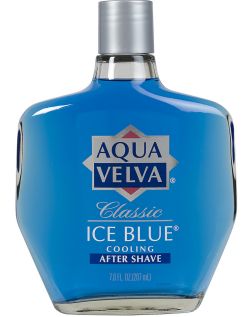
When I started shaving as a lad, I was able to use a blade for a while but there was a lot of blood involved until my skin got used to it. I began to understand the impact of “bleeding from every pore.” I finally gave that up; I wanted a shave, not a self-sacrifice. “Zit zot! Cut my face to shreds!”

When I switched to using a trusty Braun (I’ve had three since 1975), I started using a combination of LectricShave™ and AquaVelva™ for the befores and afters.

11288898  aci-038_1z

They work well, I liked them then, and I like them now. And it occurred to me that they’ve changed almost not at all since their introduction (AquaVelva in 1929!) and have survived without using a lot of fancy and idiotic marketing (although the late 50s and early 60s TV ads for LectricShave were pretty insipid, as most commercials from that era.)

https://youtu.be/Rqt0DmnUStg

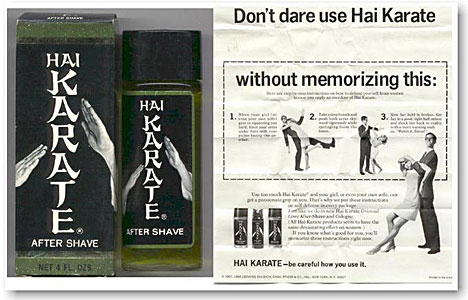
Back in the late 60s and early 70s, there was a brand of after-shave called HaiKarate – under the “sex sells” rubric, they produced some really cheesy commercials showing nerdy guys with horn-rimmed glasses fending off sex-crazed women; each bottle came with a self-defense insert and the slogan, “Be careful how you use it.”


perfume_1975hai_karate

Although re-introduced in the UK in 2014, this product faded out in the 1980s. Unsurprisingly.

Other products came and went, some of which I remember fondly.

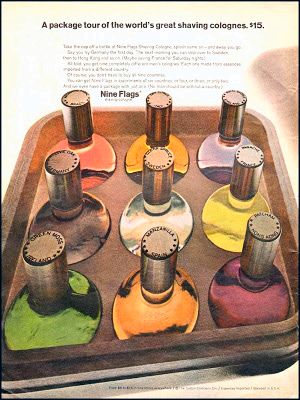
I purchased a set of “Nine Flags” colognes once, and I recall being very partial to “Italy” – the dry citrus was very easy on my nose.

Flags

Flags 2

This is one I wish had endured. You can still find some floating around on eBay, but time is not kind to these fragrances – in my experience, the chemicals begin to break down and they can smell rancid after a while.

I’m glad that the two products I have used for most of my life are still around.

The Old Wolf has spoken.

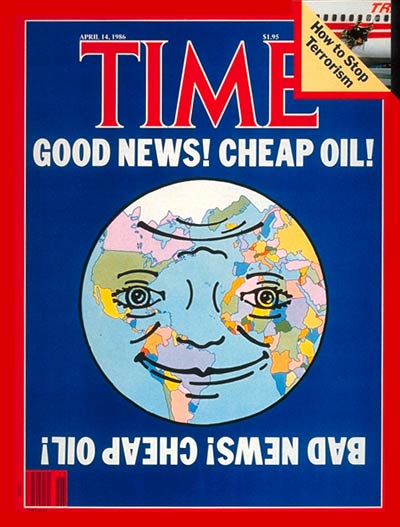
Good News! Cheap Oil! Bad News! Cheap Oil!

Cheap Oil

This cover of Time appeard on April 14, 1996. The lead article started off,

The epic oil plunge of the 1980s started out slowly and a bit remotely. To most people, it was just a downward-sloping diagram on the financial page, an abstract reminder of the mysterious world of desert oil wells, filthy-rich Arabs and the irritating antics of OPEC. But suddenly oil’s new situation is hitting home with the wallop of a 42-gal. oil barrel dropped on the front porch. Last week consumers, businessmen and traders around the world watched in awe as the price of crude dipped below $10 per bbl. for the first time in almost a decade. Oil, which as recently… [subscribe to read full article]

Interestingly enough, the same article by Stephen Koepp (which you can read in full) appeared on 24 June, 2001:

The epic oil plunge of the 1980s started out slowly and a bit remotely. To most people, it was just a downward-sloping diagram on the financial page, an abstract reminder of the mysterious world of desert oil wells, filthy-rich Arabs and the irritating antics of OPEC. But suddenly oil’s new situation is hitting home with the wallop of a 42-gal. oil barrel dropped on the front porch. Last week consumers, businessmen and traders around the world watched in awe as the price of crude dipped below $10 per bbl. for the first time in almost a decade. Oil, which as recently as January was selling for $26 per bbl., was on a breathtaking–and dangerous–ride down a slippery slope.

Not being a subscriber to Time, I’d be interested to know if the oil price mentioned was changed to reflect the current situation, or if the article was sheer copypasta.

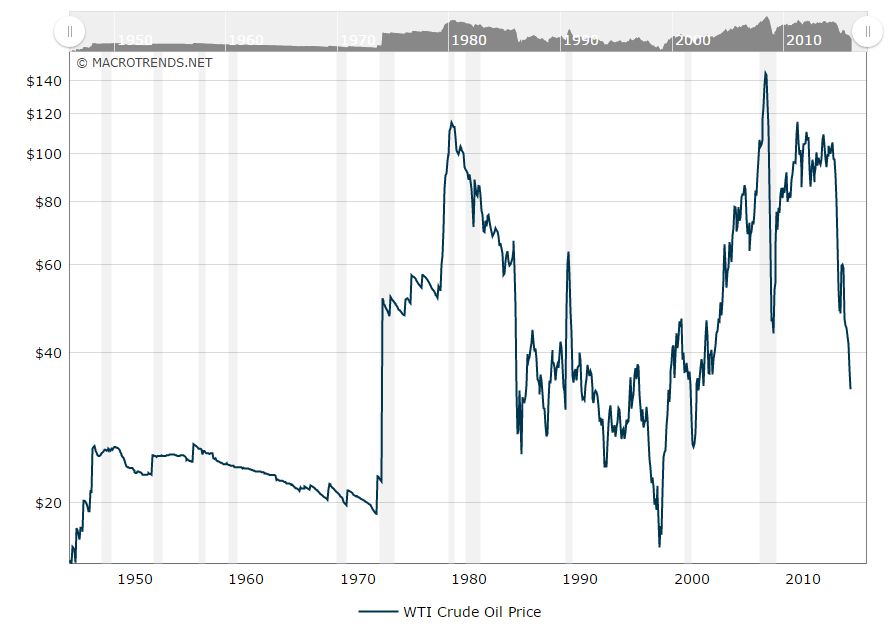
At any rate, tracking the historical price of oil online is fraught with difficulty. One chart from Mactrotrends (click through for the interesting interactive version) shows oil dropping at its lowest recent point to $16.28 per barrel in 1998 – I remember that around that time, the price of gas on the street dropped below $1.00 for the first time in ages.

oil prices

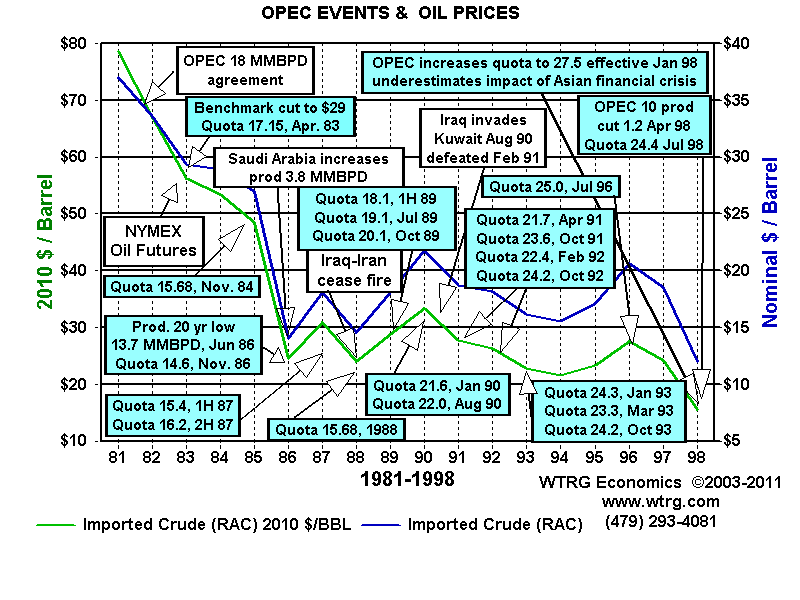
The problem with a lot of charts on the web is that they show prices adjusted for inflation rather than the price actually paid:

Opec

This article, from whicht the chart above was gathered, mentions crude oil prices plummeting to below $10.00 per barrel, but that doesn’t agree with the previous data from Macrotrends, unless one looks at the “Nominal” price rather than the price in 2010 dollars.

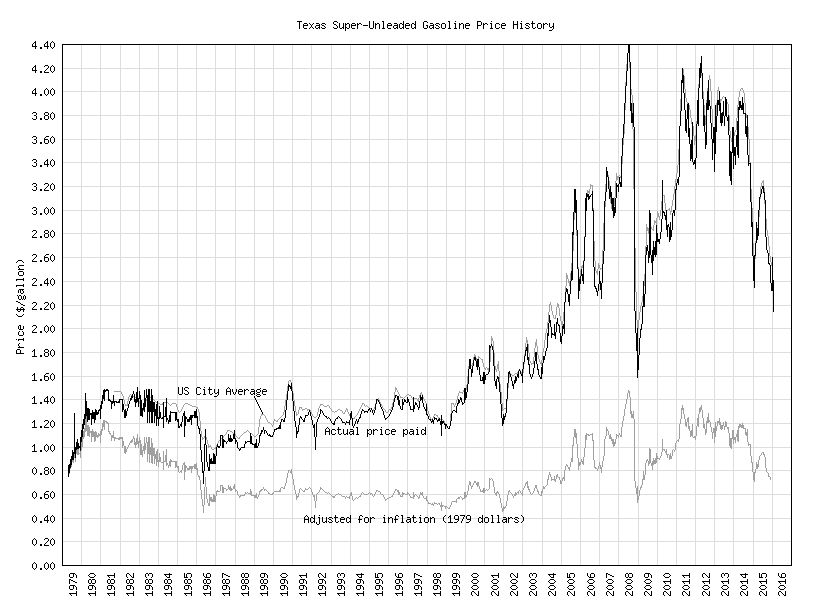
Interesting to note are the actual prices on the street for gasoline over time.

Texas Gas

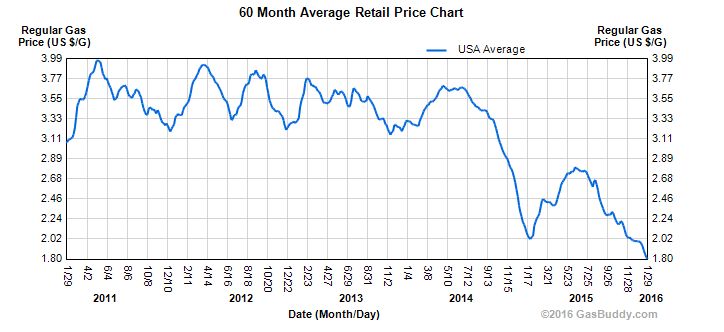
This chart of Texas prices shows gas dipping below $1.00 for almost a full year in 1995-1996, but the trend now is decidedly downward, and even this chart is out of date – as of January 29, 2016, gas is selling for $1.39 in the Dallas/Fort Worth area. Given what oil prices are doing lately, we are marching amazingly close to that $1.00 boundary, and I will be interested to see what the next few months bring. The 5-year chart from GasBuddy shown below gives you an idea of the trend:

Buddy

Yesterday I paid $1.75 in Lewiston, Maine, at BJ’s (a shopping club like Costco), but I noticed that many places were pushing that price anyway.

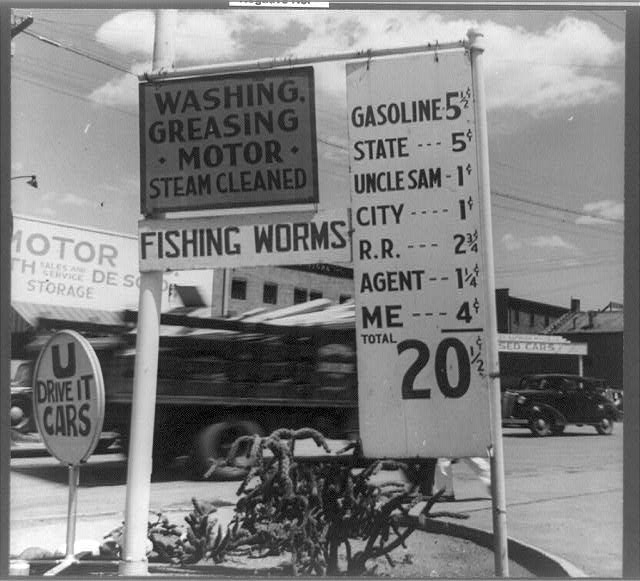
What’s of interest to me is that gas station owners (while they appreciate lower prices of wholesale stock because it does translate into higher profits, haven’t seen a major improvement in their bottom line as a result of fuel sales in over half a century:

Gas1955

Notice that the 20¢ price of gas leaves only 4¢ profit for the station owner in 1955, whereas CBS Money Watch (worth reading) reported in 2014:

“…you should know that after all the ups and downs in a year, gas stations do not make much money from selling gasoline. After credit card fees and other operating costs, net profit for gasoline sales averages 3 cents a gallon, according the National Association of Convenience Stores.”

That means that profit margins on gasoline sales have remained historically paper-thin.

Jack at Shell Station with Dog

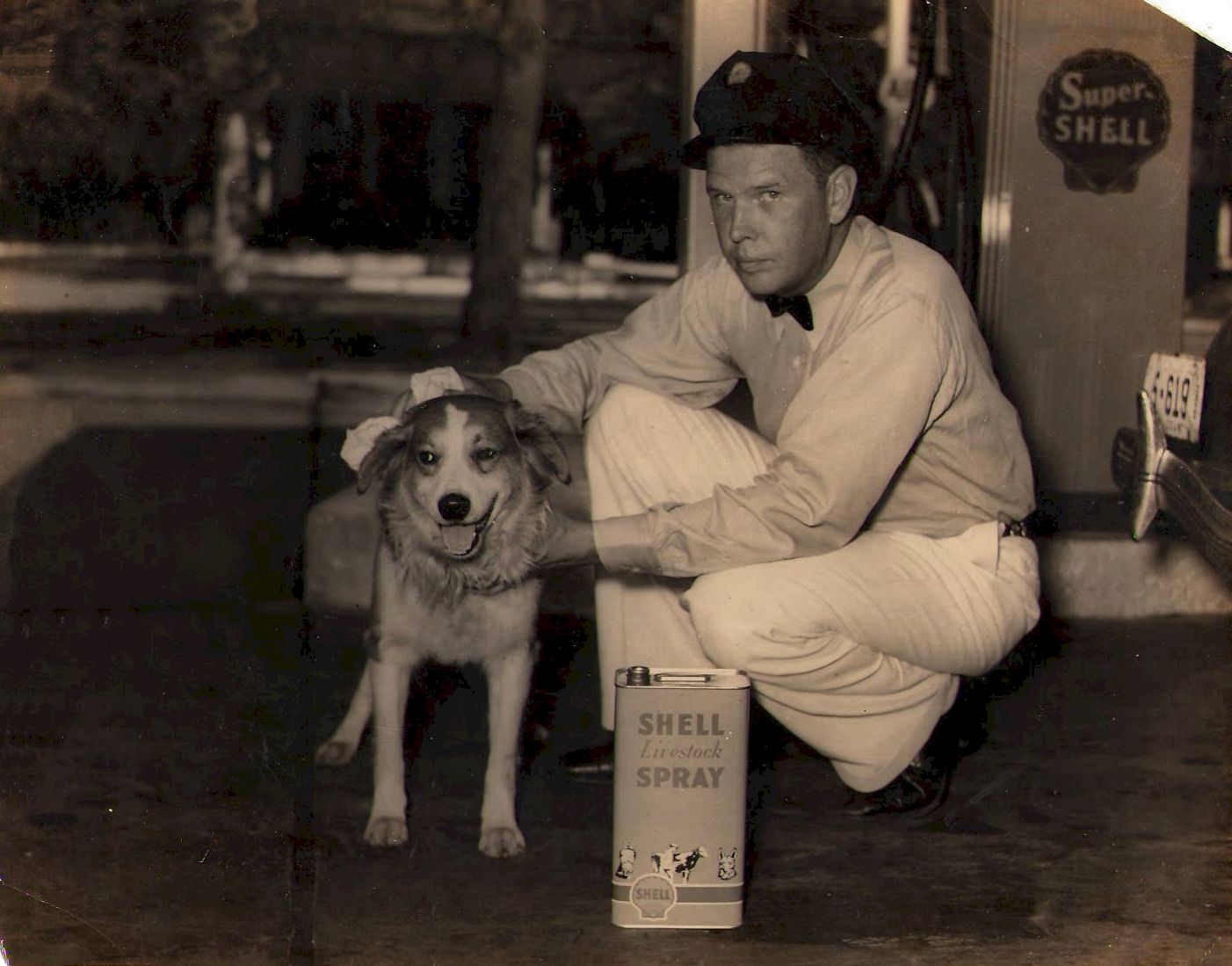
My wife’s father at his Shell station in the 50s. He could have been selling gas at these prices.

As of January 2016, taxes in Maine look like this:

State Excise Tax: 30¢
Other Taxes and Fees: .01¢
Total State Taxes and Fees: 30.01¢
Federal Excise Taxes: 18.40¢
Grand total: 48.41¢

Factor in wholesale costs and other operating costs and fees, and it’s easy to see why a gas station that depended solely on fuel sales would be out of business in a week, much like movie theaters depending on concession sales to stay afloat.

Oil prices dropping again. and only the good Lord knows when the trend will reverse itself. Still, in the changing production landscape which differs from that of 1996 with fracking and oil shale and all sorts of other sources going on, there are winners and losers – this New York Times article outlines the current situation in terms that can be understood by someone other than the late John Nash. The Times predicts that prices are not likely to rise any time soon.

Naturally, for travelers and for those who heat their homes with oil (like me,) this is a boon. If you want to take a cross-country trip, the time is definitely now. On the other hand, the loss to the losers may ultimately be significant enough that drastic measures will be take to raise prices, which will once again curtail supply.

What’s clear to me is that as a nation we need to wean ourselves off dependence on oil, both domestic and foreign. (This is said realizing that for the foreseeable future, oil cannot be completely replaced in our economy.) Trends are encouraging, with efficient electric and self-driving vehicles on the visible horizon, as well as a growing green-energy sector. This is not even factoring in the impact of oil-combustion emissions on global climate change. Anything that can be done to swap as many kilowatts of electricity as possible from oil (and coal) to renewable sources will be a good thing.

The Old Wolf has spoken.

WindPower

Wind power? I’m a big fan.

An alternate look at consumerism.

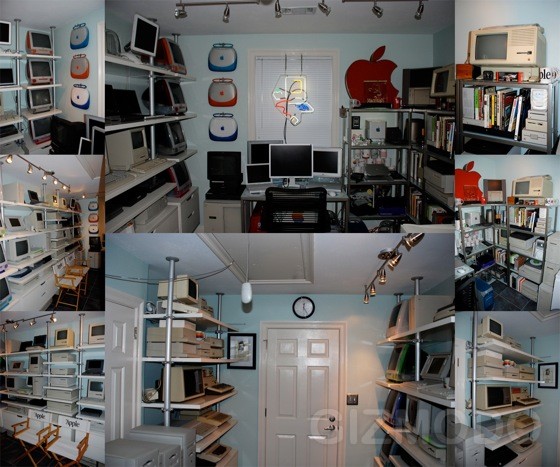
Over at Gizmodo, one can view James Savage’s spare room, filled with a working copy of almost every Apple computer ever made:

18s0naretzf67jpg

At Metafilter, user Pastabagel posted this on October 4, 2007.

Coveting possessions is unhealthy. Here’s how I look at it:

All of the computers on Ebay are mine. In fact, everything on Ebay is already mine. All of those things are just in long term storage that I pay nothing for. Storage is free.

When I want to take something out of storage, I just pay the for the storage costs for that particular thing up to that point, plus a nominal shipping fee, and my things are delivered to me so I can use them. When I am done with them, I return them to storage via Craigslist or Ebay, and I am given a fee as compensation for freeing up the storage facilities resources.

This is also the case with all of my stuff that Amazon and Walmart are holding for me. I have antiques, priceless art, cars, estates, and jewels beyond the dreams of avarice.

The world is my museum, displaying my collections on loan. The James Savages of the world are merely curators.

As I am the curator of their things, and thus together we all share the world.

A year ago, Pastabagel did an expanded essay on the same theme, which I felt was worth sharing:

Hi, I’m the author of that original post on Metafilter. (I can’t believe it’s been 7 years since I wrote that!). I’ve done a lot of thinking and writing about this, and I think what it boils down to is this.

The amount of freedom you have is directly proportional to the time between your desire for something and the moment you reach out to grasp it.

For most people, this time is short. The see something they want and immediately they reach for it. Consider the immortal words from Fight Club: “The things you own end up owning you.” If you are owned, then you are a slave. Slaves are not free.

If the thing you see arouses such a desire in you that you immediately move to own it, then you are not free. The thing own you, and you exist to serve it.

All these concepts like store, property, ownership, etc. are illusions designed to convince you that buying is something other than you giving someone your money, which is a physical manifestation of your time. (It literally represents the time that you worked in the past, or if on credit, the time you will have to work in the future to pay the debt.)

If you see something in a store that you like, you know exactly where it is. It’s in the store, safe and secure. You can go see it anytime you want. If you bought it, nothing would change but it’s position.

Now, you imagine that buying it changes your identity. You see the thing and your mind constructs a meaning for that thing (helpfully aided by advertising which is sooo impartial and on your side). This $12 moleskine notebook means I’m a creative( you think), unlike that $1 Staple notebook, which functions in exactly the same way.

You desire something because they made you desire it. I’m convinced that the forces of marketing and advertising are so effective and have been so thoroughly perfected, that it is almost impossible to resist for anyone. For any person, there is some product out there that these tricks work on. For you it’s sneakers, someone else is t-shirts, etc.

What we have to do is cultivate that control. You want this, but don’t reach for it. Walk away and ask yourself “why do I want that? What is it about that thing that makes me want it and not other things?” Replace the insitinctive motion to your wallet with an instinctive question. Why this?

And it’s true that you may never find it again, because it will be replaced by something else that you will immediately desire and have to have. And when that happens, the other thing will seem dulled and faded. There is always something new. Desire is never satisfied. It’s a an endless cycle.

Freedom is an act of resistance. The only force that operates on our lives now with any power is consumerism. The messages of consumerism will define our world and our identities if we don’t intervene on our own behalf. Your money is valuable because it represents your time, and your time is your life. Don’t trade your life for some new crap.

Look at the thing and admire the thought and creativity that went into it. And with your hands firmly in your pockets, turn and walk away.

This is, to me, extraordinarily sound advice, particularly for someone who is entranced by books, yarn, and geekology. I think I need to put this on my wall in the form of a “Desiderata” and look at it regularly. I mean, how many of the things that I “want” would I really use on a regular basis in a way that would enrich my life and the lives of others?

The Old Wolf has spoken.

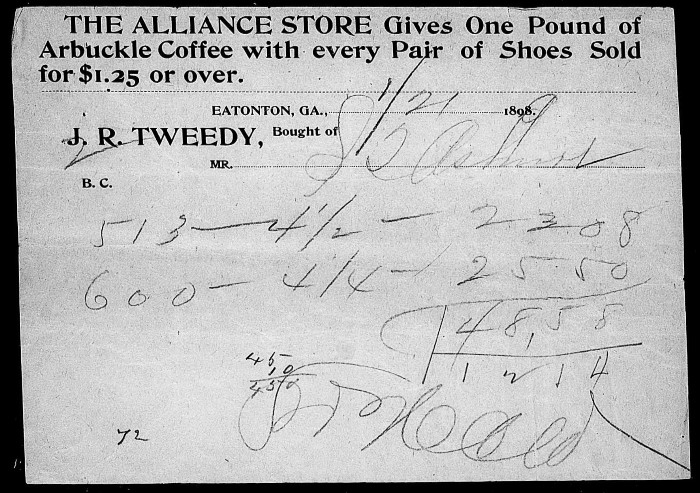
1898: A Free Pound of Coffee with Every Pair of Shoes

coffee

This interesting receipt showed up in some Georgia probate files. Prices back then were insane, compared to today’s – but one must also factor in wages and overall cost of living.

According to various inflation calculators, a dollar in 1898 was worth $27.08 in 2013, making a pair of shoes for ten bits the equivalent of $33.85. And that pound of coffee? 18¢, or about $4.87 in 2013 dollars.

Not a bad Dreingabe¹; today’s coffee runs about $12 to $15 per pound, unless you want kopi luwak, which you can score for $350.00 online if you happen to like coffee beans that have been shat out by a civet.

The Old Wolf has spoken.


¹ German: bonus or give-away

Dorothea Lange – 1939, Motherless family in Yakima Valley

Saw this photo over at reddit and it really pulled at my heartstrings.

T0CjziI

The oldest of the children in this photo by Dorothea Lange takes care of the others in her migrant family, most likely while the father is working in the fields. She is stunningly beautiful, but carries a heavy and unwanted load on her young shoulders.

8b34327r

Another image of the middle child, wearing a sack dress.

8b34328u_0

“Youngest little girl of motherless family.” Toppenish in the Yakima Valley of Washington State. August 1939. Photograph by Dorothea Lange. Seen at Shorpy.

Poverty of this nature still exists in our country, let alone the rest of the world, but these images are a stark reminder of a very difficult time for our nation.

The Old Wolf has spoken.