John Howard Griffin

I read “Black Like Me” about once a year.

Widely acclaimed for its daring, roundly criticized for its superficiality, it still resonates 50 years later.

Yes, as a nation we’ve made significant forward motion, but the recent viral video featuring Ms. Karen Klein who was bullied by some truly misguided 7th-graders until she wept demonstrates in a riveting manner how the herd instinct operates. If a group of people conspire to keep another person/group/race/religion down, and no one does anything to stop it, things spiral out of hand in a frightening manner. Translate those four boys into an entire society and you can see that the primal brutalities which lay at the heart of the slave trade and all subsequent indignities inflicted upon those of African descent are in no way gone… just covered up with a veneer of respectability. There are still some really, really mean people out there.

I was 4 years old when Rosa Parks shook the world, 8 years old when “whites only” was still seen commonly around the South, and 14 years old when civil-rights activists marched from Selma to Montgomery. I was fortunate to have been raised in the multi-racial, multi-faith, and multi-cultural environment of New York, but there are millions of people my age who were not, and for whom second-class citizenship was as normal as a toasted English muffin. Many of them are still alive, and old habits and old ideas die hard.

The good news is that the rising generation is being brought up in a world where intolerance and prejudice is largely looked upon as an abomination rather than the norm. Witness the more than $600,000 raised by over 30,000 people from 80 nations for the good Ms. Klein by indiegogo, who, thanks to that outpouring of support and execration of the bully mentality, will never have to work again. Witness the punishment of the four boys involved, who instead of the usual slap on the wrist were handed 1-year suspensions, community service, and anti-bullying counseling. Nowadays, more and more people are becoming aware that they detest bullies, and racists fit squarely into that category.

Griffin’s book was described by Stokely Carmichael (Kwame Ture) as “an excellent book—for whites.” Griffin himself agreed and ultimately scaled back his lecturing, realizing that it was disingenuous for a white man to be speaking for the black community when they had many powerful voices of their own. Yet in the 21st century, when the black power movement has become more or less a historical footnote in the consciousness of today’s young people, this book – along with some others I could recommend1 – is in some ways more germane now than it was then, precisely because the long road of the African American is no longer front and center in the American psyche, but the old attitudes remain, percolating just below the surface and in danger of surfacing should we as a society cease to be vigilant.

I recall that when I read this book for the first time, I wished fervently that I could get hold of the original Sepia articles which preceded the book’s publication. I wanted more pictures than the few small prints that adorned the paperback’s cover. I still wish that, but thanks to the miracle of the Internet, many photos of Griffin have surfaced. I have collected all the ones I can find, in the best possible resolution, and I present them here for their historical value. NB: I have no doubt these pictures are still copyright by someone, somewhere; if you own these images and have an issue with their being displayed here, a quick comment will be more than sufficient to have them removed.

John Howard Griffin

Griffin after a 1946 Air Force accident left him blind – he learned cane walking in the French Quarter of New Orleans, and when he returned there for his Sepia project he had to re-learn the quarter as a sighted man.

Taking large doses of medication designed for vitiligo patients and lying under a sun lamp, Griffin darkened his natural skin to a dark brown tanned base, which was then covered with stains on his face, legs and hands.

Griffin shaved his head, and applied coat after coat of stain, wiping off the excess until he could pass for black, and was even considered by many African-Americans with whom he associated to be one of the “darker Negroes.”
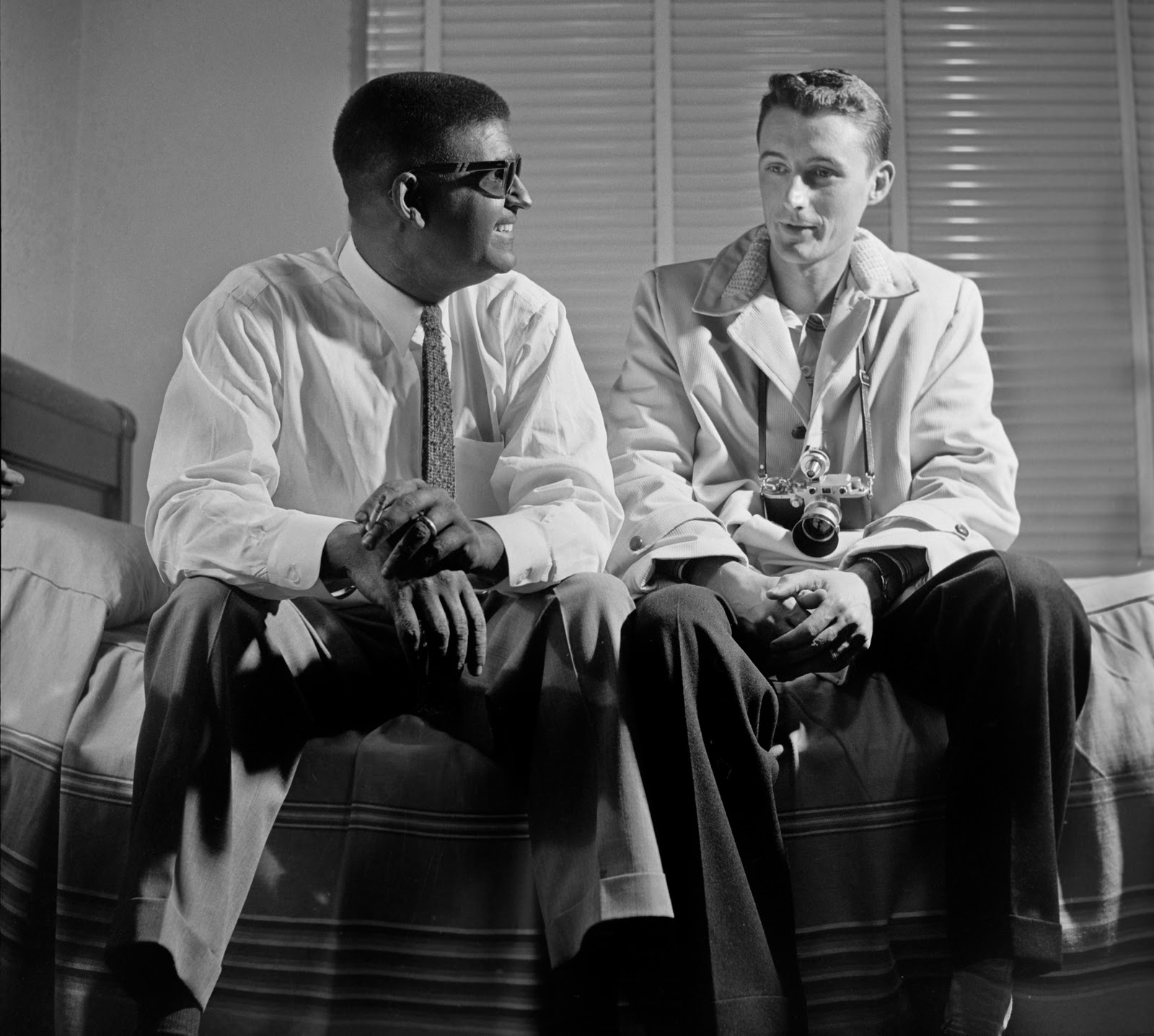
After his initial tour through the South, Griffin returned to the places he had written about with photographer Don Rutledge, show here in 1959, to chronicle his project in photographs. It looked odd to have a white photographer taking pictures of a black man, so the two of them had to present Rutledge as a tourist, with Griffin just “happening” into the picture at the right time.

“Here it was pennies and clutter and spittle on the curb. Here people walked fast to juggle the dimes, to make a deal, to find cheap liver or a tomato that was overripe. Here was the indefinable stink of despair.” (From Black Like Me)

While walking the French Quarter as a white man, Griffin looked for a way to enter black society. He often stopped at the shoeshine stand where Sterling Williams worked, and they chatted a number of times. After making the transition, he returned to Williams and confided in him; Williams and his partner, who owned the stand, provided a critical service to Griffin to help him make the initial shift into the world of a black man in New Orleans.
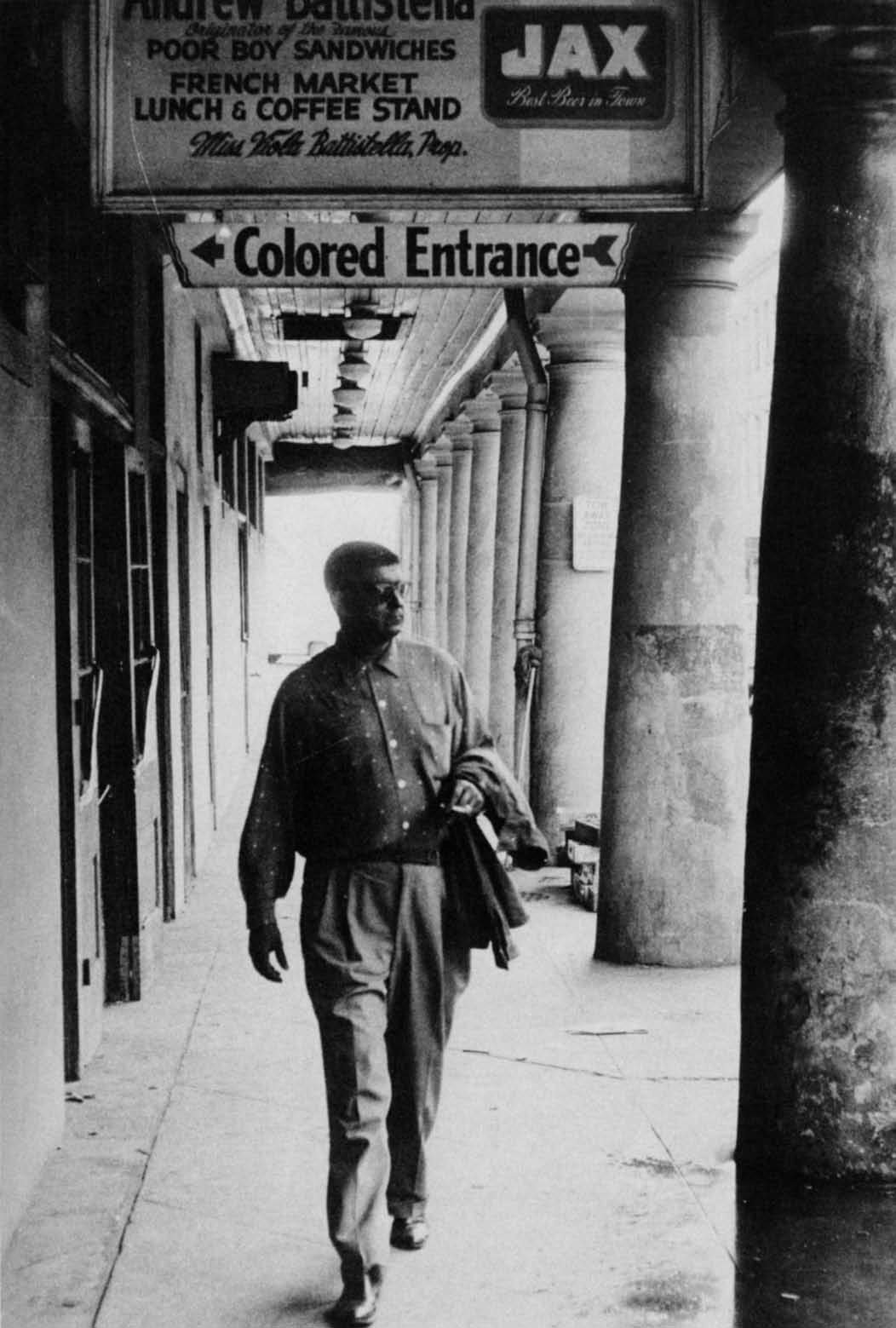
“I got off and began walking along Canal Street in the heart of town… I passed the same taverns and amusement places where the hawkers had solicited me on previous evenings. They were busy, urging the white men to come in and see the girls. The same smells of smoke and liquor and dampness poured out through half-open doors. Tonight they did not solicit me. Tonight they looked at me but did not see me.” (From Black Like Me).
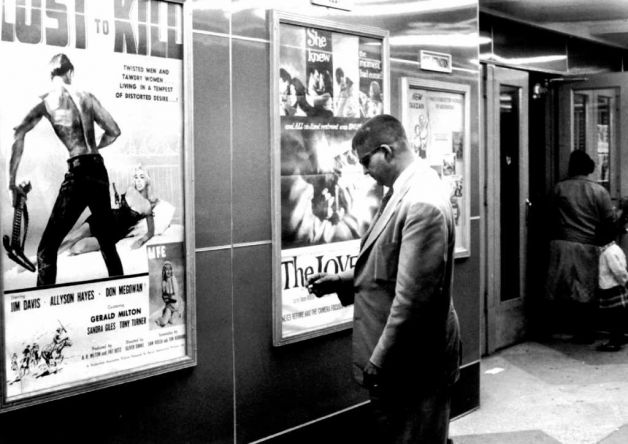
Griffin appearing to look at a movie poster.
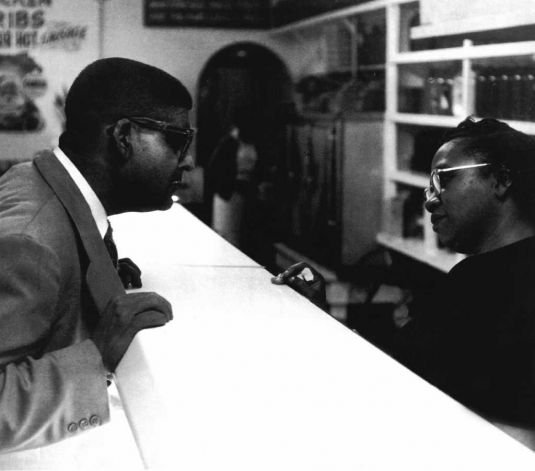
Griffin found that as a black man he was the recipient of rejection, abuse, and outright hatred at the hands of white people, whereas blacks treated him with great warmth. Passing through the same areas as a white man, he found the exact opposite; the white South looked elegant, refined and graceful, and all doors were open to him, but the black community regarded him with suspicion and treated him as an enemy.

After the publication of Griffin’s works and publicity about his experiment began to spread, at one point he was hanged in effigy from the center of Main Street in Mansfield, Texas where he lived. The dummy was later removed and placed in the dump under this sign. While hostility from some whites was intense once the project became known, the vast majority of letters sent to Griffin from all over the world were ones of support. Still, as a result of threats to his family, Griffin moved to Mexico for a time until the worst of the storm had blown over.

I keep this remarkable book on my shelf along with others, to remind me. So that I will never forget. Despite my cosmopolitan upbringing, I am a child of those times, and I must never allow a whisper of intolerance or prejudice to surface.


1 Other books which I read periodically include To Be A Slave, by Julius Lester; Death at an Early Age by Jonathan Kozol; and Black Boy by Richard Wright. Libraries bulge with other, more erudite works, but these speak to me, and help me to stay centered.


Disclaimer

We are not alone.

Pure science would say that since there is no evidence of life beyond our own planet, one can neither assume nor rule out life elsewhere.

Our place in the universe. Click to make massive.

Yet a mind open to surprises looks at the above schematic, factors in the existence of 70,000,000,000,000,000,000,000 stars (that’s 70,000 million million million) in the known universe, and that’s as of 2003, and wonders what kind of hubris allows for this incomprehensible vastness and beauty to exist solely to amuse us? As of 2012, Wikipedia reports, “Data from the Habitable Exoplanets Catalog (HEC) suggests that, of the 725 exoplanets which have been confirmed as of 14 January 2012, four potentially habitable planets have been found, and the same source predicts that there may be 27 habitable extrasolar moons around confirmed planets.”

The Hubble Ultra Deep Field image was taken of an area of the sky just a tad over 3 arcminutes across. That’s smaller than a 1 mm by 1 mm square of paper held at 1 meter away, and equal to roughly one thirteen-millionth of the total area of the sky; with the exception of one or two local stars in our neighborhood, every pinprick of light in this image is a galaxy. Every single spot. Add to that the fact that galactic scale is unfathomable; despite the existence of hundreds of billions of stars in a single cluster, when our own celestial home collides with its nearest neighbor, the Andromeda Galaxy, no two stars will ever come close enough to collide. (Watch the video at the link, it’s elegant.)

Using the Drake equation to estimate the number of civilizations with whom we might have communication is an exercise in futility, simply because none of the terms are or can be known, but I don’t need higher math to look out into such mind-bending vastness and see a result higher than zero. For me, life out there is inevitable.

No, I can’t get my head around the idea that we’re the only thing out here, or the best, or the brightest. Unless someone figures out how to void the laws of the universe, it’s unlikely that we’ll ever know, but that doesn’t dampen my certainty: we’re not alone.

The Old Wolf has spoken.

More doctors smoke Camels™

Back in the day, not only doctors but babies, sports figures and Santa Claus would hawk tobacco products. My mother did Camel commercials, and I remember that for a while she would regularly receive a carton of Camels in the mail from the sponsor as part of her compensation. Small wonder I took up the habit when I went away to prep school – back in the day, it was still considered the cool thing to do. And, as I had no other claim to fame and fortune, I developed the knack of finding the nastiest, strongest brands I could – Gauloises, Players, English Ovals, and some Turkish abomination or other come immediately to mind. By 1969,  when I finally quit, I was smoking 3 packs a day of unfiltered anything; when I’d cadge cigarettes from my mother, who smoked Carltons (what an abomination they were), I’d have to rip the filters off.

Despite a sea change in conventional wisdom, today roughly 1 in 6 people still use tobacco worldwide; in the USA, 20% of adults still used tobacco as of 2010. Big tobacco and those who took payoffs to promote this deadly product shoulder a large part of the responsibility.

If you smoke, quit now. It will kill you.

The Old Wolf has smoken.

Critics: The most powerful essay of all time

And it was spoken in the context of a cartoon, a show ostensibly for children.

“In many ways, the work of a critic is easy. We risk very little yet enjoy a position over those who offer up their work and their selves to our judgment. We thrive on negative criticism, which is fun to write and to read.

But the bitter truth we critics must face is that, in the grand scheme of things, the average piece of junk is more meaningful than our criticism designating it so. But there are times when a critic truly risks something, and that is in the discovery and defense of the new.

Last night, I experienced something new, an extraordinary meal from a singularly unexpected source. To say that both the meal and its maker have challenged my preconceptions is a gross understatement. They have rocked me to my core. In the past, I have made no secret of my disdain for Chef Gusteau’s famous motto: Anyone can cook. But I realize that only now do I truly understand what he meant. Not everyone can become a great artist, but a great artist can come from anywhere. It is difficult to imagine more humble origins than those of the genius now cooking at Gusteau’s, who is, in this critic’s opinion, nothing less than the finest chef in France. I will be returning to Gusteau’s soon, hungry for more.”

-Anton Ego, Ratatouille
Text and Image ©Pixar, 2007

There are very few unbiased and balanced critics out there, be it in the worlds of literature, theatre, food, art, or whatnot. Most of them get off on savaging what they either consider substandard, or as is too often the case, what they do not understand. With very few exceptions, there is good to be found everywhere one looks for it – but most critics are looking for the sensational, or for an excuse to be snarky.

As far as I am concerned, most of them fall well below my threshold of relevancy.

The Old Wolf has spoken.

The School for Animals

Once upon a time the animals decided they must do something heroic to meet the problems of a “new world” so they organized a school. They had adopted an activity curriculum consisting of running, climbing, swimming and flying. To make it easier to administer the curriculum, all the animals took all the subjects.

The duck was excellent in swimming. In fact, better than his instructor. But he made only passing grades in flying and was very poor in running. Since he was slow in running, he had to stay after school and also drop swimming in order to practice running. This was kept up until his webbed feet were badly worn and he was only average in swimming. But average was acceptable in school so nobody worried about that, except the duck.

The rabbit started at the top of the class in running but had a nervous breakdown because of so much makeup work in swimming.

The squirrel was excellent in climbing until he developed frustration in the flying class where his teacher made him start from the ground up instead of the treetop down. He also developed a “charlie horse” from overexertion and then got a C in climbing and D in running.

The eagle was a problem child and was disciplined severely. In the climbing class, he beat all the others to the top of the tree but insisted on using his own way to get there.

At the end of the year, an abnormal eel that could swim exceeding well and also run, climb and fly a little had the highest average and was valedictorian.

The prairie dogs stayed out of school and fought the tax levy because the administration would not add digging and burrowing to the curriculum. They apprenticed their children to a badger and later joined the groundhogs and gophers to start a successful private school.

Does this fable have a moral?

—————-

This story, in the public domain, was written by George Reavis when he was the Assistant Superintendent of the Cincinnati Public Schools back in the 1940s. This was a handout for my Educational Administration classwork in 1972.

The Old Wolf has spoken.

Some people don’t do nothing.

First they came for the communists,
and I didn’t speak out because I wasn’t a communist.

Then they came for the trade unionists,
and I didn’t speak out because I wasn’t a trade unionist.

Then they came for the Jews,
and I didn’t speak out because I wasn’t a Jew.

Then they came for me
and there was no one left to speak out for me.

-Martin Niemöller (one of several versions)

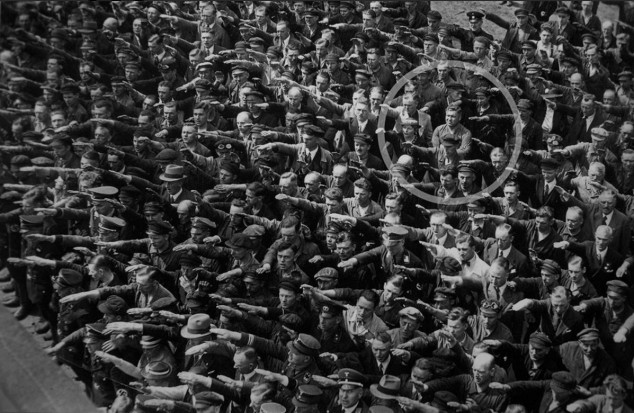
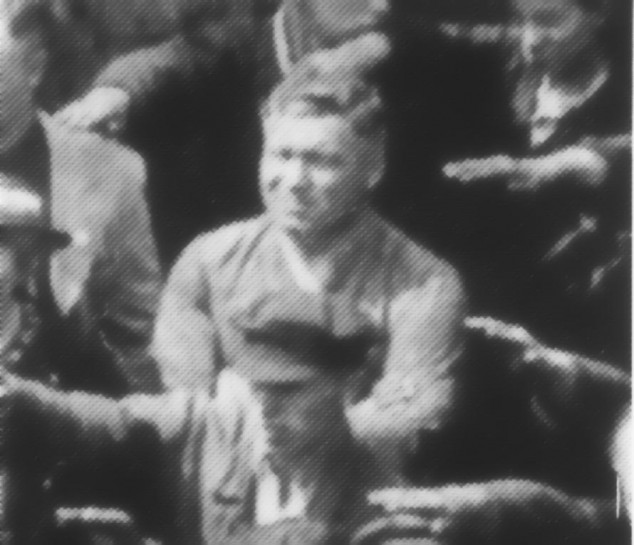
August Landmesser was a worker at the Blohm + Voss shipyard in Hamburg, Germany, and is best known for his appearance in a photograph refusing to perform the Nazi salute at the launch of the naval training vessel Horst Wessel on 13 June, 1936. He had been a Nazi Party member from 1931 to 1935, but after fathering children with a Jewish woman, he had been found guilty of “dishonoring the race” under Nazi racial laws and had come to oppose Hitler’s regime….

[He] was discharged from prison on 19 January, 1941…. In February 1944 he was drafted into a penal unit, the 999th Fort Infantry Battalion, where he was declared missing in action and presumably killed.

Courage comes in all colors.

The Old Wolf has Spoken.

Disclaimer

Some thoughts on Memorial day.

Yesterday, I posted this on facebook:

“There are never sufficient words to thank those who have paid the price, and their families, to keep us free from bondage. My gratitude to all who ever wore the colors, past and present.”

A couple of my friends (and I do consider them friends) who live in countries other than mine made some comments which prompted an uncharacteristic stirring of my little gray cells – usually they’re quite content to veg out on TNG reruns, energized by my wife’s creampuffs.

Since I happen to have thought of Picard and Company, let me throw out one of my favorite quotes, from Star Trek: Insurrection – “Some of the darkest chapters in the history of my world involved the forced relocation of a small group of people to satisfy the demands of a large one. I’d hoped that we had learned from our mistakes, but it seems some of us haven’t.”

It’s no secret that many people – especially in countries where the horrors of war have reduced their homes and families to rubble and ashes – tend to look at flag-waving with fear, associating it with blind nationalism and conquering hordes, and history is replete with examples. With due respect to them, I maintain there are light-years between patriotism and nationalism, and that it is possible to embrace the one and abhor the other.

In his “Notes on Nationalism,” George Orwell said, “By ‘patriotism’ I mean devotion to a particular place and a particular way of life, which one believes to be the best in the world but has no wish to force on other people [emphasis added]. Patriotism is of its nature defensive, both militarily and culturally. Nationalism, on the other hand, is inseparable from the desire for power. The abiding purpose of every nationalist is to secure more power and more prestige, not for himself but for the nation or other unit in which he has chosen to sink his own individuality. ”

Especially in the aftermath of 9/11, an outpouring of national sentiment could be forgiven; after all, our nation had suffered a horrific, direct attack by a hostile external force. Yes, there were pockets of idiocy to be found, but the vast majority of our populace saw the enemy for what it was – not a nation, a people, a race or a faith to be subjugated, but rather a small and deadly coalition of radicals who were opposed to the fundamental principles of freedom and equality upon which our nation was founded.

This iconic image captured the heart of the nation in the days following that terrible moment, and served to send a message to those who would hurt and make afraid; not a message of conquest or domination, but rather of stalwart determination: You may hurt us, but we will heal, and we will be stronger; and we will not rest until we find you.

Every nation has its wars, and every war has its soldiers; some volunteer, but most are drafted. The vast majority of those who fight and die in national conflicts have little idea what they are really fighting for,  but they put the uniform on and fight just the same. For their sacrifice and their willingness to serve, we honor them, and that honor has very little to do with patriotism, and nothing to do with nationalism; it has only to do with respect for their stalwart bravery, and the ongoing sacrifices made by the families of those who never came home.

I wave the flag on Memorial Day to honor those who gave up their tomorrows that I and my children might enjoy ours. That’s what Memorial Day means to me, and I am not ashamed.

The Old Wolf has spoken.

Disclaimer