Acorn Bread, and other meditations

(Posted in its original form on Sep. 22nd, 2009 at my Livejournal)

For the longest time I’ve been fascinated with the concept of acorns for food.

The seed (haha!) must have been planted in my mind when I was very young; my cousins who lived in the country – I was a New York City boy – had this lumbering black dustmop named Puffy who would devour acorns that he was given. I thought this terribly funny, since they were so bitter (naturally, being kids, we tried them!) And of course, the archetypical squirrel is always burying acorns.

Years later, having become a gastronome of sorts, the advent of the internet revived my curiosity, and I determined to find some acorn flour at some online store and try making bread or pancakes or what not. Guess what? You can’t find acorn flour for sale. Acorn starch, yes – but that’s different. There is, however, no dearth of information out there on how the native Americans used to process acorns, and so I archived off a few pages and determined to make the experiment at some point.

In 2009, while on one of my rambles up in the foothills north of Salt Lake, I stumbled across several groves of scrub oak that were replete with ripe, brown acorns, and managed to gather about 3 pounds of them.

The trick when gathering acorns is to get them when they’re brown enough to be ripe, but before the acorn weevils have gotten into them. As a result, it’s recommended to gather about ⅓ more acorns than you think you’re going to need. So if you see an acorn that looks like this:

you know it’s already occupied, and you don’t want to bother cracking it. Unless, of course, you’re interested in what goes on in an acorn after it falls – there is a fascinating article in the June, 1989 issue of National Geographic entitled “Life in a Nutshell”, which I recommend to all budding entomologists. If, however, that’s not your bag, the normal reaction is going to be “Eww”. Just be aware that some acorns which look sound are going to be compromised anyway:

Depending on the damage, part of the nut can often be salvaged.

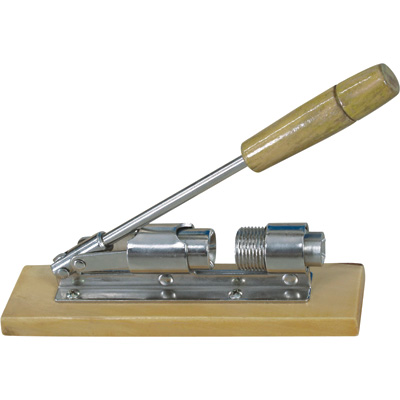
So get yourself a nutcracker [1] and go about shelling your acorns. Like chestnuts, acorns have an interior brown skin which sometimes must be scraped off, but most of the time it just pops off with the husk. Certain varieties – I gathered nuts from a number of different groves – have the membrane in between the two halves of the kernel, so that will have to be removed as well.

When you’re done, you’ll have a nice bunch of acorns to work with.

I would have had a few more, but I ended up hucking out about ⅕ of what I had gathered… I just got so tired of shelling them, and all I had left were the smaller ones (see Note 1 below).

Be aware that like apples, acorns will go brown in the air quickly, so you may look in your bowl and think that a lot of them were bad to start with. However, if you were careful, the brown spots are not bug damage but simple oxidation. And if you missed a spot or two, hey – extra protein.

The next step is leaching out the tannin. According to Peggy Spring, an education coordinator with the San Antonio Natural Area Parks, “the Texas oaks reported to have the sweetest taste include Emory oak (Q. emoryi), which is so mild it can be used without processing, white oak (Q. alba), plateau live oak (Q. fusiformis), bur oak (Q. macrocarpa), and chinkapin oak (Q. mulenbergii). The acorns of each of these oaks (mostly white oaks) mature in one year, which may account for their lower tannic acid content. Red oak acorns (like Texas Red Oak) take two years to mature.” How bitter are your acorns? Only one way to find out – taste ’em. Odds are, they’ll need to be leached. High concentrations of tannin can cause G.I. upset, kidney damage and cirrhosis of the liver, so it’s better to be safe than sorry.

There are many ways to leach out tannin, some more practical than others. The natives would often put their shelled nuts in a basket and let a swift-flowing river take care of the job for a couple of days. To me, this seems the most logical, but clean, swift-flowing rivers are hard to find for most people. Others suggest simply allowing the acorns to soak and replacing the water when it goes brown, until the acorns are no longer bitter.

I chose the 3-hour boil method. After the first boiling of 15 minutes, the water looked like this:

Pour off the water, refill, and continue.

After about 12 boilings, the water started to look not quite so muddy, so at that point I was done. The acorns tasted at this point like an artichoke heart, nutty with a sweet aftertaste.

Next, dry the acorns in a 200° oven for an hour. In they go:

And out they come.

At this point they’re no longer soggy, but still not totally dry. So I popped them into my food processor on pulse setting just until the acorns were crumbled, and put them back in the oven for another hour and a half.

Now what I had was dried acorn meal. Run this through my Magic Mill III:

… and the end result is about 2 cups of acorn flour, which you can use in your favorite recipe – for bread, or pancakes, or biscuits, or whatever floats your boat.

I chose a bread recipe that uses about 6½ cups of flour, resulting in a bread that was only partly acorns, but which still had a very nice flavor.

Here’s the recipe:

Acorn Bread

Scald:  1 C Milk

Add:

1 C Water
1 T Shortening or Lard
1 T Butter
2 T Sugar
1 T Salt

In a separate bowl, combine:

¼ C 105°-115° (F) Water
1 package active dry yeast

and let dissolve 3-5 minutes. Add the lukewarm milk mixture to the dissolved yeast.

Have ready:

6½ C Flour (white flour and acorn flour to taste)

Stir in 3 cups flour (use the acorn flour first), then work in remaining flour by kneading on a floured surface until smooth and elastic.

Place dough in greased bowl and cover, allow to rise in a warm place until double, at least 1 hour. Punch down, and if time permits, allow to double again. Turn out, divide into 2 loaves and let rest 5 minutes. Place in pans and again allow to rise until almost double in bulk.

Preheat oven to 450°. Bake loaves 10 minutes – reduce heat to 350° and bake 30 minutes longer. Test for doneness by turning out a loaf and thumping the bottom. If it sounds hollow, it’s done. If not, put it back in for a few more minutes. Remove loaves from pans at once and allow to cool on rack before storing.

Now, if I were to go about this again, I would do the following things differently:

  • Find bigger acorns. Scrub oak tasted fine, but the shelling took forever.
  • Use a pecan sheller, as mentioned in the note below.
  • Gather more acorns to start with, so I could get a decent amount of flour, some to use, and some to keep.
  • Use a different leaching method, probably just letting the nuts sit in cold water and changing it every now and then. It might take longer, but I think the nuts would retain more of their nutrition.
  • Use less acorn flour. It’s heavier than wheat flour, and has no gluten, so it can’t be used alone – there’s nothing to bind the bread.

Further thoughts

Besides the bread, a lot of benefits accrued to me during this exercise. The entire time that I was harvesting, shelling, leaching, grinding and making bread, I turned my mind to the original occupants of this continent. This was a labor-intensive process. If you were going to use acorns as a major food source for a community, you’d pretty much have to put the entire female population to work on the process. Given that 3 lbs of acorns resulted in about 8 ounces of flour, you’d need a lot of acorns, and a lot of hands to do the necessary work. Granted, these folks spent a good part of their day working on food production anyway, but it left me with a huge sense of respect for what was necessary.

The exercise also made me think about the history of our nation in general, with no small amount of sadness. A few weeks ago, prior to my Acorn Escapade, I re-watched “Dances with Wolves.” I recalled the Gary Larson cartoon on the subject:

So I hopped over to Rotten Tomatoes.com to see if there was really anyone who didn’t like the film. To my surprise, it only got a 78% positive rating. One review, which was pretty representative of the opposition, said: “The political correctness is so politically correct and sappy and sucky and conscience-appeasing and politically-pacifying and just generally brain-numbing…”. Well, all I can say is that after 400 years of being raped by the white man, the autochthones of this continent are entitled to a little political correctness. The attitude of our nation toward the native has been and continues to be, “Bohica!” [2]. Don’t believe me? Just take a drive through the four corners area and down into the Res, and you’ll see the results of the white man’s benevolence. And, I haven’t the slightest idea of how to go about making it right.

These thoughts brought to you by the humble Acorn.

belch

The Old Wolf has spoken.


1Acorns are soft-shell nuts. I recommend using a pecan sheller rather than a regular nutcracker.

These are available online at any number of places.

2 “Bend over, here it comes again”

Next time I’ll stick to pizza

Another Old Wolf failed enterprise:

Posted this on Facebook the other day.

  1. Yes, it’s a Photoshop that I created just for giggles.
  2. My favorite comment was “There was no way that place was gonna stay in business once Hjálmar’s Hákarl Hut opened across the street.”
  3. Visit my Banquet from Hell

Since we’re on the subject of Photoshops:

This is extra funny if you speak Hebrew.

And now for some real restaurants:

There have been several of these around the country. There is currently one in Bluffton, SC.

I swear I saw one in Utah around 30 years ago. Sadly , it didn’t last. I’d eat there for sure.

Piliçmatik (“Chickenmatic”) is a Turkish restaurant franchise – they specialize in roasted chickens.

And now, a plug:

The One World Cafe is a nonprofit community kitchen аnd foundation which began іn Salt Lake City, Utah in 2003. Іts motto іs “a hand up, nоt а hand out.” The concept began when owner Denise Cerreta had an epiphany to serve food, let people choose their own portions and let them price those portions themselves. In 2012, Ms. Cerreta made the hard decision to close the Salt Lake location and dedicate her time to replicating the concept around the nation. Learn more here. But I’m sorry they left Salt Lake; they had great food, and an even better philosophy.

The Old Wolf has spoken.

New York Eateries: Gone But Not Forgotten

Nedick’s was the Starbucks of the 50’s. Orange drink, doughnuts and hot dogs with a signature mustard relish. They were everywhere, even in little hole-in-the-wall joints down in the subways. I confess I like the fresh-squeezed places better down there, with the machines that would cut and squeeze oranges automatically, but Nedick’s is a treasured memory also.

nedicks

Nedick’s in Newark

Nedick’s at Macy’s (Found at The Paper Collector)

Then there was Prexy’s. A local concern with just a few outlets in and around New York, they made hamburgers that were to die for. Little is known about the recipe that made them so good, but I remember eating there a number of times. Oh, those prices.

Prexy’s Matchbook

Prexy’s Logo from a China Plate

Last but not least, there was the Horn and Hardart Automat


gwKkl


The Automat, 1942, by J. Baylor Roberts

For a kid in the 50’s, nothing was more fun than getting pie or drinks or that incredible macaroni and cheese at the Automat; you’d get your nickels at the booth from a nickel-thrower, ladies with rubber tips on their fingers who could fling out a dollar’s worth of nickels without blinking. I could stand there for hours watching the lazy susans rotate around when they were empty, only to reappear magically refilled with new offerings.

I scored a copy of this book which gives a fascinating history of the chain, including lots of recipes.

Now I’m hungry.

The Old Wolf has spoken.

The Gospel According to St. Sabrett

  1. Only beneath the blue and yellow umbrella shall you eat.
  2. A hot dog shall be eaten on the street, no matter what your Nonna said.
  3. You shall garnish your hot dog with mustard, or with relish, or with onions, or with kraut, or All the Way.
  4. Ketchup shall be an abomination unto you, ye shall not eat of it.
  5. You shall not complain about the price: it is New York.
  6. The water is not dirty, it is hot dog juice.
  7. The skin of a hot dog has a pleasing snap, but ask not what lies beneath.
  8. You shall never visit a hot dog factory, lest you lift up your heel against hot dogs forevermore. You do not want to know how they are made.
  9. Remember St. Papalexis, for he is holy.
  10. A hot dog tastes best at Yankee Stadium, even if it is Nathan’s Famous and not Sabrett. But then, anything tastes good after 10 beers.

Stolen shamelessly from the Huffington Post:

Sabrett-style Onion Sauce Recipe

Makes. 4 hot dogs
Preparation time. 1 hour

Onion Sauce Ingredients
1/2 cup water
1 teaspoon cornstarch or arrowroot
1 tablespoon tomato paste
1 tablespoon inexpensive balsamic vinegar
1 teaspoon Dijon-style mustard
1 teaspoon brown sugar
1/4 teaspoon hot pepper sauce
1 pinch of cinnamon

1 tablespoon olive oil
2 large red onions, peeled thoroughly and sliced thin
1/4 teapoon table salt
2 cloves of pressed or minced garlic

About the onions. Red onions often have an extra layer of tough paper under the outer layer. Make sure you remove it.

About the tomato paste. If you want, you can substitute a 2 tablespoons of ketchup or a sweet tomato based Kansas City style barbecue sauce for the tomato paste.

The hot dog
4 all-beef frankfurters, preferably Sabretts
4 buns
Sauerkraut from the refrigerator section, not the can
Spicy brown Dijon-style mustard

Do this

  1. Combine the water and cornstarch in a bowl and whisk it until there are no more lumps. whisk in the tomato paste, balsamic, mustard, brown sugar, hot sauce, and cinnamon.
  2. Warm the oil in a large skillet, not a non-stick, over medium high heat. Add the onions and sprinkle with the salt. This helps pull the moisture out. Move them around occasionally with a wooden spoon so they don’t burn. Cook until the edges start to brown. Whatever you do, do not let them burn. Add the garlic and cook for another minute.
  3. Add the liquid, stir, and rub the pan with the wooden spoon to scrape up all the flavorful fond, the brown bits on the bottom. Turn the stove to low and simmer with the lid on for 1 hour. Check frequently to make sure it is not burning and the water has not evaporated. Add water if needed. The final result should be thick, not runny, but not pasty. After an hour, taste and adjust salt and other flavors as you wish.
  4. While the onions are simmering, warm the kraut in a pan or for 15 seconds in the microwave, cook the franks, and prepare the buns. The franks can be cooked on a griddle, on a grill, but most pushcarts make “dirty water dogs” by simmering them in water that has become a rich flavorful soup after holding scores of franks over the course of a day. And don’t worry, the franks are precooked so they are pasteurized, and the dirty water is hot enough that nothing can survive. As for the buns, some are toasted on a griddle, but most pushcarts store them in a bin where the steam from the dirty water keeps them warm and moist.
  5. Lovingly place the frank on the bun, squirt on the mustard, add the onions, and then the kraut. Hum quietly, I’ll take Manhattan…

The Old Wolf has spoken.

Yorkshire Pudden – Stanley Holloway

(Holloway’s monologue leaves off the last 3 verses, but it’s lovely to listen to!)

YORKSHIRE PUDDEN
by
Weston and Lee

Hi waitress, excuse me a minute, now listen,
I’m not finding fault, but here, Miss,
The ‘taters look gradely… the beef is a’reet,
But what kind of pudden is this?

It’s what?…
Yorkshire pudden!, now coom, coom, coom, coom,
It’s what? Yorkshire pudden d’ye say!
It’s pudden, I’ll grant you… it’s some sort of pudden,
But not Yorkshire pudden… nay nay!

The real Yorkshire pudden’s a dream in batter,
To make one’s an art, not a trade,
Now listen to me, for I’m going to tell thee,
How t’ first Yorkshire pudden wor made.

A young angel on furlough from heaven,
Came flying above Ilkley Moor,
And this angel, poor thing, got cramp in her wing,
And coom down at owd woman’s door.

The owd woman smiled and said, ‘Ee, it’s an angel,
Well I am surprised to see thee,
I’ve not seen an angel before… but thou ‘rt welcome,
I’ll make thee a nice cup o’ tea.’

The angel said, ‘Ee, thank you kindly, I will’,
Well, she had two or three cups of tea,
Three or four Sally Lunns, and a couple of buns…
Angels eat very lightly you see.

The owd woman looking at clock said, ‘By Gum!
He’s due home from mill is my Dan,
You get on wi’ ye tea, but you must excuse me,
I must make pudden now for t’ owd man.

Then the angel jumped up and said, ‘Gimme the bowl…
Flour and watter and eggs, salt an’ all,
And I’ll show thee how we make puddens in Heaven,
For Peter and Thomas and Paul’.

So t’ owd woman gave her the things, and the angel,
Just pushed back her wings and said. ‘Hush’
Then she tenderly tickled the mixture wi’ t’ spoon,
Like an artist would paint with his brush.

Aye, she mixed up that pudden with Heavenly magic,
She played with her spoon on that dough,
Just like Paderewski would play the piano.
Or Kreisler now deceased would twiddle his bow.

And then it wor done and she put it in t’ oven
She said t’ owd woman, ‘Goodbye’,
Then she flew away leaving the first Yorkshire pudden,
That ever was made… and that’s why…

It melts in the mouth, like the snow in the sunshine,
As light as a maiden’s first kiss,
As soft as the fluff on the breast of a dove…
Not elephant’s leather, like this.

It’s real Yorkshire pudden that makes Yorkshire lassies,
So buxum and broad in the hips,
It’s real Yorkshire pudden that makes Yorkshire cricketers,
Win County championships.

It’s real Yorkshire pudden that gives me my dreams,
Of a real Paradise up above,
Where at the last trump, I’ll queue up for a lump,
Of the real Yorkshire pudden I love.

And there on a cloud… far away from the crowd,
In a real Paradise, not a dud ‘un,
I’ll do nowt for ever… and ever and ever,
But gollup up real Yorkshire pudden.


And all this because the goodwoman of the house served me divine Yorkshire puddings for breakfast…

Bad cartoon about Hákarl

If you’ve visited my Banquet from Hell, you may have seen the entry about the Icelandic delicacy(?) hákarl, or fermented shark. Every now and then I get a strange idea in my head for a cartoon, and thought I can’t draw worth a cow pie, I have to get it on paper to quiet it down. Here’s one such misfortune (click it for the full-size penance).

The Old Wolf has drawn badly.

Food Irradiation

I’ve long had in my library a September 1958 National Geographic entitled “You and the Obedient Atom.” It’s an intriguing look at the scientific applications of nuclear radiation, and one of these has always intrigued me.

Ektachromes by Gervase A. Arndt ©1958 N.G.S.

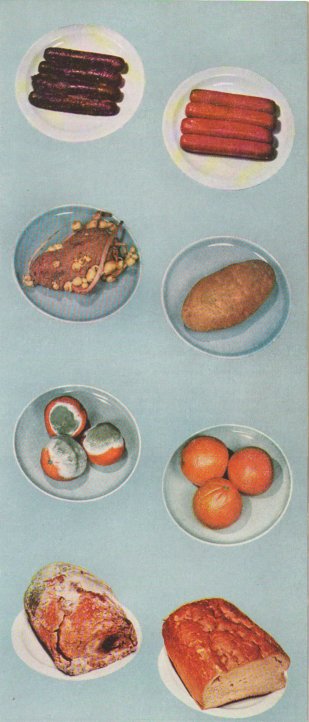
“Bombarded Foods Stay Germ-free as Others Rot

Using gamma rays to destroy micro-organisms that cause decay, the Army Quartermaster Corps preserves foods for weeks and months at room temperatures. When exposures are light, changes in taste are scarcely noticeable; gamma radiation does not linger.

Foods irradiated in Argonne’s pool (illustration not shown – Argonne National Laboratory near Chicago) and elsewhere were first fed to rats, without harmful effect. Later, military volunteers tried samples. Congressmen have eaten entire gamma-sterilized dinners.

Both samples of frankfurters were kept three months in air¬tight plastic wrappers. Irradiated meat on right looks as fresh as ever. A potato sprouts six months after harvesting; in its opposite, sprouting is delayed. Treated oranges stay fresh and juicy. Moldy bread contrasts with a two-month-old treated loaf. The Food and Drug Administration has not yet certified gamma-treated foods for the market.”

National Geographic, September, 1958

Wow. What a way to reduce spoilage. Yet despite the massive consumer push-back against GMO’s or “frankenfoods,” we hear almost nothing about irradiation today. Doing a bit of research, I came across

Apparently foods treated by radiation will display the “radura”

And yet despite the initial approval by the FDA of irradiated foods for certain applications and continuing research showing its safety, I have never once in my life seen the radura on any food label, anywhere.

“Irradiation has not been widely adopted due to an asserted negative public perception, the concerns expressed by some consumer groups and the reluctance of many food producers.[47]

Consumer organizations, environmentalist groups, and opponents to food irradiation refer to some studies suggesting that a large part of the public questions the safety of irradiated foods, and will not buy foods that have been irradiated.[48]

On the other hand, other studies indicate the number of consumers concerned about the safety of irradiated food has decreased in the last 10 years and continues to be less than the number of those concerned about pesticide residues, microbiological contamination, and other food related concerns. Such numbers are comparable to those of people with no concern about food additives and preservatives. Consumers, given a choice and access to irradiated products, appear ready to buy it in considerably large numbers”

Wikipedia, Food Irradiation

Irradiation works by destroying DNA, preventing microorganisms from reproducing or creating toxic byproducts. Obviously people are going to have concerns about consuming modified (destroyed) DNA in the same way as they will about consuming transgenic foods, but that doesn’t mean the issues are the same. Still, given what we know about how prions work and the devastating effects of BSE, people are right to be concerned enough to do their homework.

Given the relative paucity of irradiated foods on the market, it’s probably safe to say you are not likely to encounter any, but I’m going to do a bit more digging. If it is safe, it could go a long way to reducing food waste, which at this point reaches a level of about 40% of all consumables in the US alone.

The Old Wolf has spoken.


In Praise of Nuts

Edit: Just a couple of months ago, I became aware of these – they could be a marketing trial balloon, but I hope they last – they’re pretty close, even though the hazelnuts are finely ground.

snickers
On other days, I might be talking about my friends; today, it’s this:

I first encountered this candy bar in Austria, where I lived from 1975 to 1976. It’s basically a Mars bar with hazelnuts instead of almonds, and I loved them. Nuts Bars were first manufactured in the Netherlands beginning in 1950. When Mars started its own company in 1961, the Nuts Chocolate Factory was born. Subsequently production moved to the Nuts Factory Elst (Gelderland) in 1966. The company was then acquired in 1979 by the British Rowntree Mackintosh, and in 1988 by the Swiss company Nestlé. Today, the Nuts bars are manufactured in the Czech Republic.

At the time, you could walk into Hofer’s and score 3 for öS 8.90, or about 18¢ each. Not distributed in the US, you have to get them from importers who charge $19.00 for a pack of six (shipping included) and screw whole bunches of that. What’s more, I’ve found two blogs thus far that have savaged them, saying they are blah, bland and boring. I wonder if Nestlé has changed the formula in the name of the bottom line?

If nothing else, I still have the memories.

The Old Wolf has spoken.


In Search of the Missing Malt

“Malted Milk.” The phrase used to be as common as “Ice Cream Sundae.” Now, you’re lucky if you can find a place that even knows what that is.

Walk into Wendy’s and ask for a malt, and they’ll probably serve you a blank stare. Explain what it is you want, and they’ll say, “Oh, you mean a Frostie.”

No, I most definitely don’t. If I want a filet mignon, don’t offer me a hot dog, just because they’re both meat. Although in the case of the hot dog, that’s questionable.

No, a Frostie is an artificial abomination concocted in the frozen heart of Satan himself, and that goes for every fast food joint that serves something similar, so don’t think I’m picking on Wendy’s.

Some places still offer them – Dairy Queen is one – but I’ll have to be honest: I have not recently had a malt anywhere that I could distinguish from a shake. They must dispense the malt with a salt shaker.

Malt.

It’s a powdered mixture of malted barley, wheat flour, and whole milk, which is evaporated until it forms a powder. It comes in two versions, diastatic (used by bakers to create a good crust on dough) which contains enzymes that convert starch into sugar, and non-diastatic malt which is used for flavoring.

Flavoring, do you hear me? That means you use more than a smidgen.

You know how Peter and Walter Bishop, and Olivia Dunham, and Colonel Broyles1 work? Yeah, their weird shit-o-meter starts at 9.5.

With a good malt, you start with at least a tablespoon and work up from there.

To find a good malt nowadays, you have to find a roadside shop that’s run by old-school people, not a major chain. Their shakes and malts will be made with real ice cream, not that Mogg-accursed soft hqiz that probably has more chemicals in it than your average shampoo. No, real ice cream, scooped from a tub; real whole milk, lovely natural flavorings, whole fruit, perhaps some real whipped cream, and real malt. Lots of it. As much as you ask for. And it will be made in something like this,

not extruded into a cup like the ejecta of some spawn of Tophet.

If you’re fortunate enough to find one of these, check the thickness of the final product. If they’re knights of the old code, the spoon (a metal one, please) will stand up straight.

I know where one or two of these are. One is a tiny ice-cream shack in Broadway, Virginia. Another is Mel’s Drive-in on Lombard Street in San Francisco. The others… well, I’m not saying. You’ll enjoy the hunt more if you find one yourself.

But now you know what to look for.

The Old Wolf has spoken, and now he’s drooling.


1If you’re not familiar with Fringe, you’re missing out. More, I cannot say lest I spoil the fun. Go buy the DVD’s and enjoy the ride. This season (V) is the last, but not because it wasn’t popular with its fans.