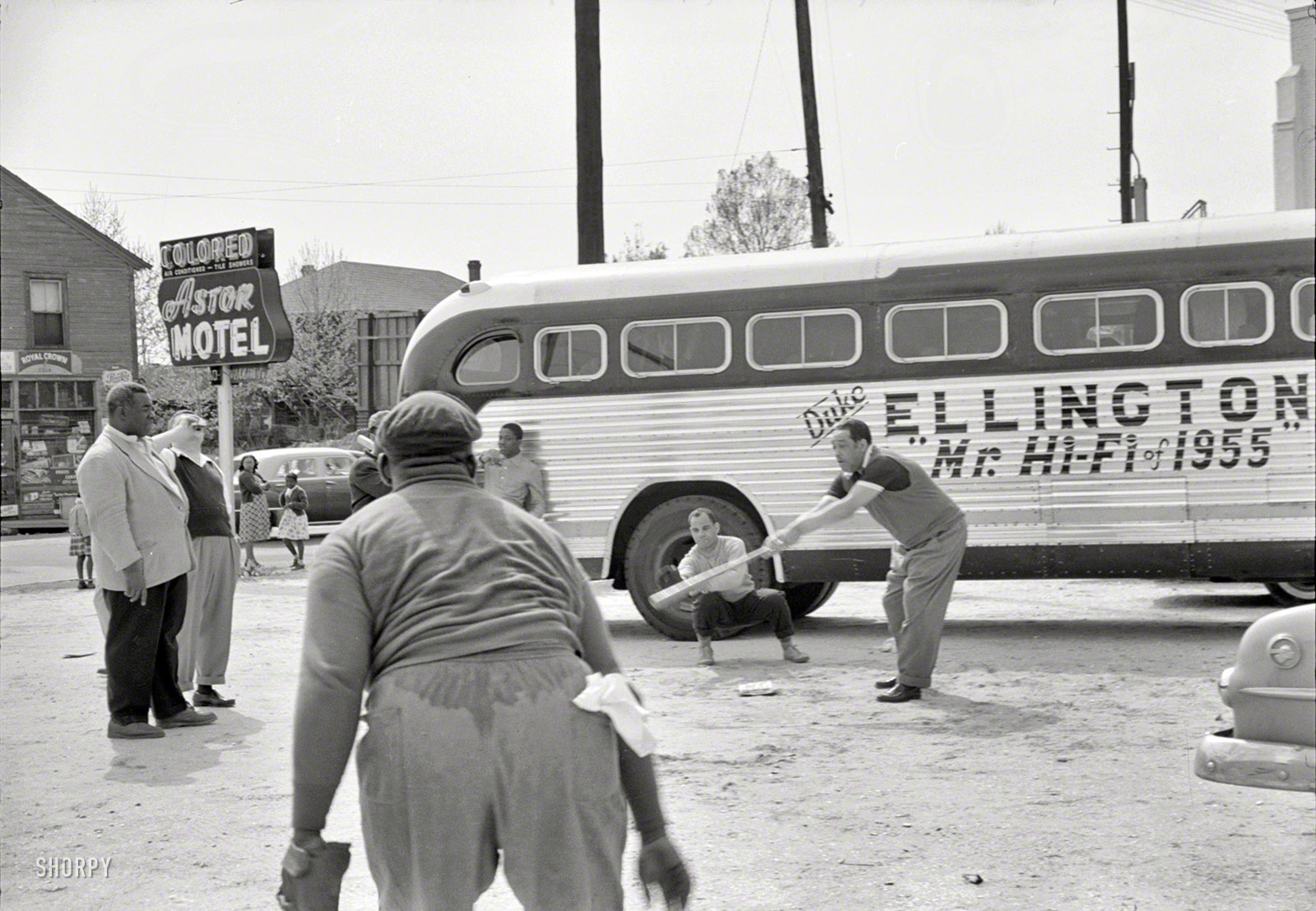
Duke Ellington and band members playing baseball in front of their segregated motel while touring in Florida, 1955

Colored

Originally spotted this at /r/historyporn, but the original source is from Shorpy. Some interesting comments from both sites:

Shorpy commenter Evado recognized the church just barely visible in the upper-right of the photo.

redditor 170lbsApe provided a street view of  the lot they were playing on here.

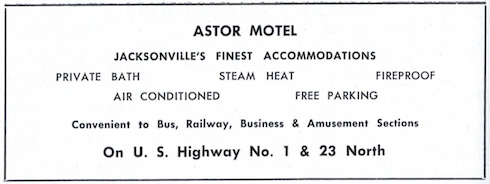
This is an ad for the Astor from the 1956 The Negro Travelers’ Green Book, according to Vonderbees.

Screen_Shot_2014-03-24_at_5.05.51_PM


William Lafferty posted: “The hotel’s ad in the 1956 Green Book puts it at “US 1 and US 23 North” in Jacksonville. The street address appears to have been 1111 Cleveland.”

I’m now suddenly struck with the thought that many old motel signs I’ve seen that seem to advertise COLOR TV excessively prominently (though no doubt that was a nice amenity when it first appeared) may have been advertising color of a different sort a few years previously and were simply saving money on the cost of sign alterations.

Not sure if this is the case or not – most of these signs seem to be custom-crafted to advertise RCA:

color-tv-louise-morgan

But it’s an interesting thought just the same.

I’ve posted about the phenomenon of segregated facilities several times before. It makes my head throb every time I think about this unhappy period of American history.

The Old Wolf has spoken.

Reaching for the brass ring

In modern English, “grabbing the brass ring” or getting a “shot at the brass ring” means to go for the gold, or to strive for the best possible reward. The phrase has been found in dictionaries as early as the late 19th century.

MiPTEwI


Coney Island, 1958, photo by Harold Feinstein

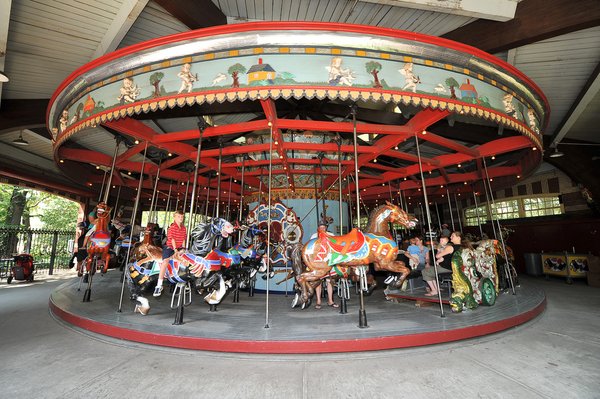
The phrase originated with carousels in the late 1800’s; according to Wikipedia:

 “A brass ring is a small grabbable ring that a dispenser presents to a carousel rider during the course of a ride. Usually there are a large number of iron rings and one brass one, or just a few. It takes some dexterity to grab a ring from the dispenser as the carousel rotates. The iron rings can be tossed at a target as an amusement. Typically, getting the brass ring gets the rider some sort of prize when presented to the operator. The prize often is a free repeat ride.”

I grew up in New York in the 50s, and the first carousel in Central Park was opened in 1871. The current one, the Friedsam Memorial Carousel, was  installed in 1950, but I don’t ever recall a brass-ring device; if they ever had one, it must have been removed earlier before its relocation from Coney Island.

l

It’s a great analogy for life. To get that brass ring, you have to stretch, to reach out, to take a risk. Those who sit on the inside, or who watch that little dispenser go by ever turn without reaching for it, will never know what it means to succeed, or even to fail while trying.

Finding our dreams in life is often difficult because we’re too busy living our fears, but one thing is certain: reaching for the stars will always get us farther than sitting in the mud.

steve-jobs-quote

Go ahead. Reach for the brass ring.

The Old Wolf has spoken.

New York, 1865

IZPHo3b

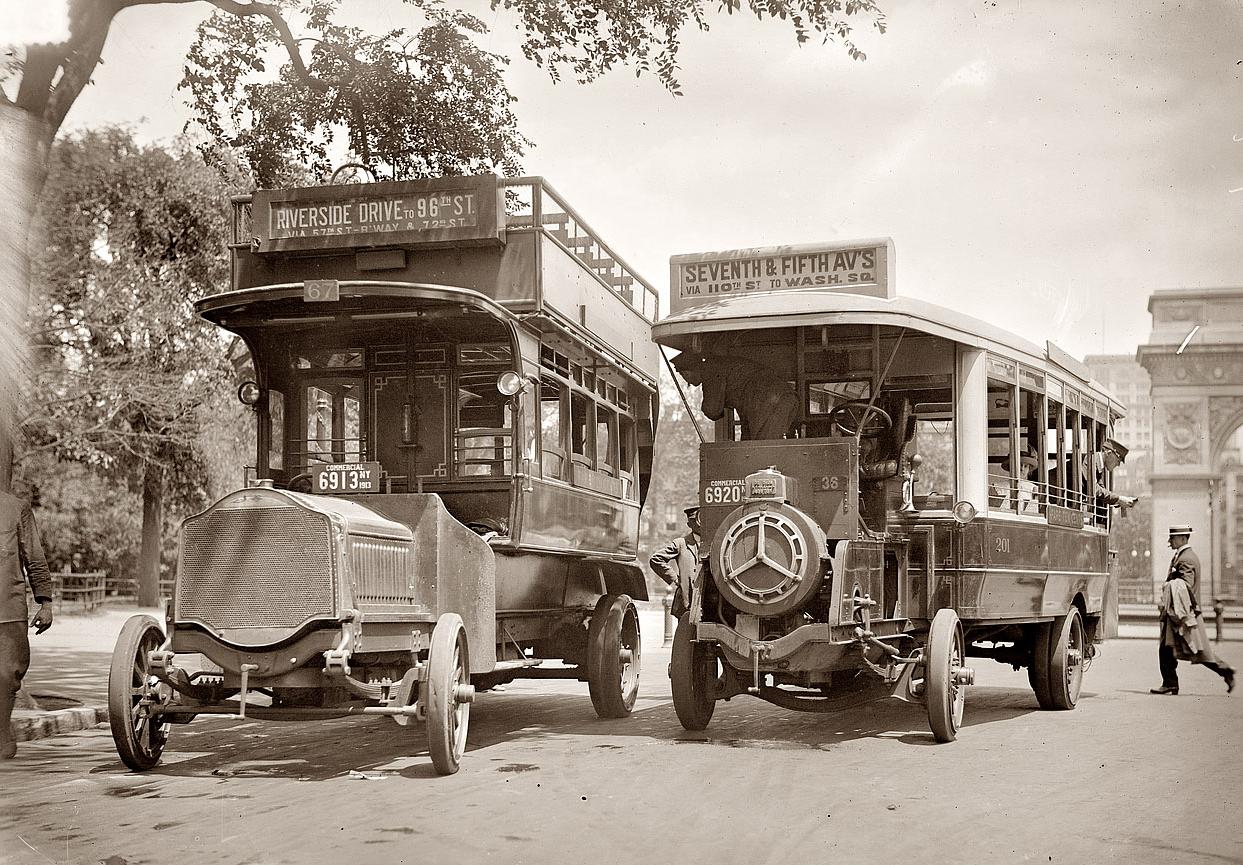
This photo of lower Hudson Street was taken by Marcus Ormsby in 1865, to showcase the John Peake pharmacy. It’s a beautiful capture of day-to-day life in New York at the close of the civil war.

Some intriguing information about this photo can be found at Ptak Science Books. As one who was raised in New York, such historical photos fascinate me.

The Old Wolf has spoken.

The Many Origins of the English Language

Stumbled across an amazing interactive chart showing the various influences which affected the development of the English language over time, and felt it was worth sharing.

English


The picture above is a static capture of the cumulative results; if you want to explore in more detail, have a look at Lexicon Valley. The author, Philip Durin, writes,

The elephant in the room, however, is how Latin and French dominate the picture in just about every period. Even the Anglo-Saxons borrowed from Latin (e.g. fork, street,wine), and ever since the Norman Conquest English has been borrowing hugely from French and Latin—quite often taking the same word partly from each of these languages, especially in the medieval period. Words like government, pay, science, orwar (from French), or action, general, person, and use (French and/or Latin) have become an indispensable part of English. Even among the 1000 most frequently used words in modern English, not far short of 50 percent have come into the language from French or Latin. Numbers do not always tell us everything, though: the total of loanwords from early Scandinavian is relatively low, but the language of the Vikings has left some of the most intimate traces in the vocabulary of English, with words likeleg, skin, sky, and even they, their, and them.

This is an intriguing overview, and now I’m anxious to get a copy of his book, Borrowed Words.

The Old Wolf has spoken.

To the Bravery of the Swiss – The Lion of Lucerne

Even though I lived in Switzerland for around 5 months, I never had a chance to see the “Lion of Lucerne,” a stunning monument to the Swiss Guard who perished in 1792 during the French Revolution, when revolutionaries stormed the Tuileries Palace in Paris, France.

Lion1

Lion2

Images: Wikipedia

This beautiful tribute was designed after 1818 by noted Danish sculptor Bertel Thorvaldsen[1], and carved between 1819 and 1820 by Lukas Ahorn.

Of this statue, Mark Twain said:

“The commerce of Lucerne consists mainly in gimcrackery of the souvenir sort; the shops are packed with Alpine crystals, photographs of scenery, and wooden and ivory carvings. I will not conceal the fact that miniature figures of the Lion of Lucerne are to be had in them. Millions of them. But they are libels upon him, every one of them. There is a subtle something about the majestic pathos of the original which the copyist cannot get. Even the sun fails to get it; both the photographer and the carver give you a dying lion, and that is all. The shape is right, the attitude is right, the proportions are right, but that indescribable something which makes the Lion of Lucerne the most mournful and moving piece of stone in the world, is wanting.

The Lion lies in his lair in the perpendicular face of a low cliff–for he is carved from the living rock of the cliff. His size is colossal, his attitude is noble. How head is bowed, the broken spear is sticking in his shoulder, his protecting paw rests upon the lilies of France. Vines hang down the cliff and wave in the wind, and a clear stream trickles from above and empties into a pond at the base, and in the smooth surface of the pond the lion is mirrored, among the water-lilies.

Around about are green trees and grass. The place is a sheltered, reposeful woodland nook, remote from noise and stir and confusion–and all this is fitting, for lions do die in such places, and not on granite pedestals in public squares fenced with fancy iron railings. The Lion of Lucerne would be impressive anywhere, but nowhere so impressive as where he is.”

Next trip to Switzerland.

The Old Wolf has spoken.


[1] Perhaps Thorvaldsen’s most famous work is his Christus in the Vor Frue Kirke in Copenhagen, of which a copy resides in the visitor’s center of the Church of Jesus Christ of Latter-day Saints in Salt Lake City.

img_5421trim (1)

The Original Penn Station, New York City

J3Qa8Yt


New York, circa 1911, the original Pennsylvania Station lived for only half a century, ultimate succumbing to declining train ridership and the pressure to build upward.


09670u


Another view from Gimbels department store, circa 1910.


1-2-3A2-25-ExplorePAHistory-a0b3e3-a_349

The general waiting room

800px-Penn_Station_tracks-Cervin-Robinson-April-1962


1962, the year before its demise.

Fondly remembered, sadly missed.

The Old Wolf has spoken.

1954: Creature from the Black Lagoon

t2kIcF3


High-resolution production still. Notice the cloning to make the image wider. Trivia: redditor /u/Artikunu chimed in to say, “Fun fact: my great grandfather is the creator of the Creature From the Black Lagoon’s mask and costume. The mask was a treasured family heirloom, until one of my relatives sold it. It was worth around $75,000.”

I love photos like this. At one point I had a beautiful production still of Margaret Hamilton as the wicked witch of the west, autographed to me and procured for me by my father. Sadly, it was purloined about 25 years ago by one of the young men I used to serve as a Webelos den leader; I was never able to recover it. On the other hand, I have a number of great production stills of my dad in various rôles, so I’ve got that going for me, which is nice.

Light Test


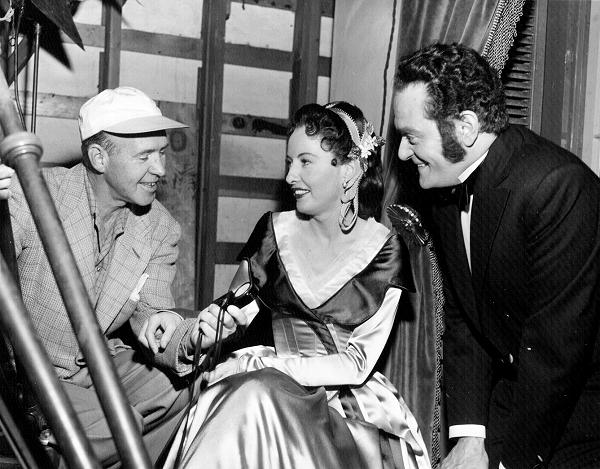
Dad with Barbara Stanwyck and a lighting technician: “Man with a Cloak,” 1951.

The Old Wolf has spoken.

The Seegers on the Road

Today is John Steinbeck’s 112th birthday – or would have been, if he weren’t dead. But some pictures that ran across my Facebook feed this morning seemed somehow relevant.
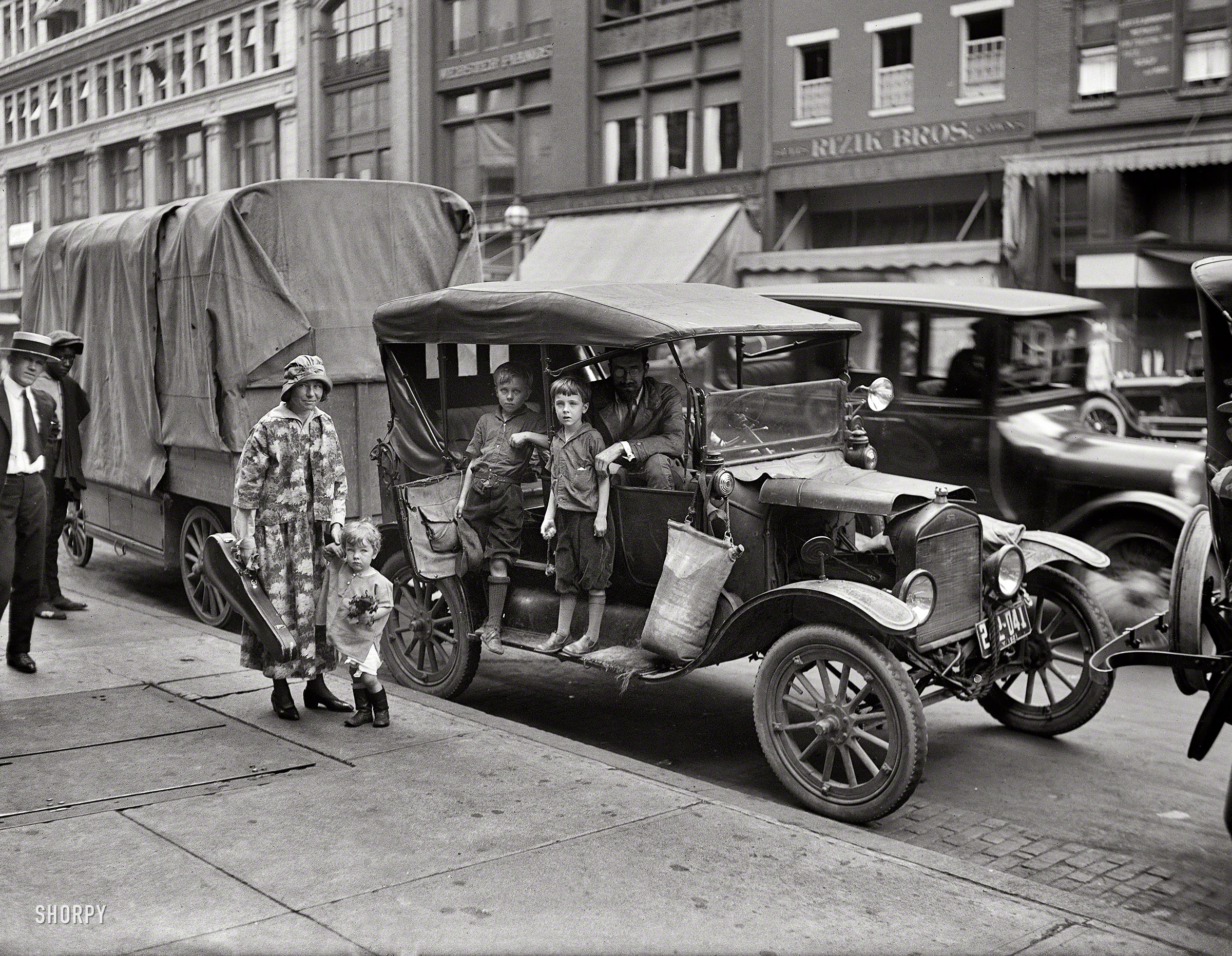
HEC/31200/31241a.tif

May 1921. Washington, D.C. “Professor Charles Seeger, a composer, is a brother of Alan Seeger, the war poet. His wife is a distinguished violinist.” Little Pete Seeger, 2 years old, and family along with their camping rig. Harris & Ewing Collection glass negative.

The Seeger family  More on this intriguing bit of ephemera was written about in the Washington Post (text and image found at Shorpy):

Washington Post, May 22, 1921.

TRAVEL AND LIVE IN AN AUTOMOBILE

Charles Seeger, Wife and Three Sons See World While Living Outdoors

LIKE WANDERING MINSTRELS

Mrs. Seeger Famed as Violinist. Husband Professor of Music In California.

Bound for wherever they happen to stop, paying no attention to daylight saving or other forms of time, and spreading music wherever they go, Mr. and Mrs. Charles Seeger, once of the University of California and now “wandering minstrels” of the world at large, are encamped at Rock Creek park, their home an itinerant Ford and a home-made trailer. They are accompanied by their three little boys.

Mr. and Mrs. Seeger, the latter known in musical circles as Constance Edson Seeger, are taking the boys to museums and places of interest wherever they stop, and the two [older] boys are learning to play the violin.

Their Profession in Music.

“We are trying to solve the problem of educating three boys, and at the same time lead a worth-while outdoor life,” said Mr. Seeger yesterday. Mr. Seeger says that they got the idea while they were at the University of California, where he was head of the music department for seven years after graduating from Harvard and studying music in Europe and where Mrs. Seeger gave violin recitals following her graduation from the New York Institute of Musical Art and a course at the Conservatory of Paris.

The Seegers came here from Richmond and to that city from Pinehurst, N.C., where they spent some time. In addition to the three boys, Charles, 8; John, 6, and Peter, not yet 2 [actually, he had just turned 2], they have taken with them Miss Marion Brown, whom they picked up at Pinehurst and who tutors the children and cares for them while their parents are giving concerts.

The Seeger “home” is a house of five and a half feet in width by fourteen feet in length, and contains all the comforts of home, including a sewing machine, a portable organ and games for the boys. It even has a front porch, which slides under the trailer while traveling.

Going to New England.

The Seegers spent the winter at Pinehurst and are now en route to the New England States for the summer, expecting to go back South when the winter approaches again. Increasing rents make no difference in their lives, as a camping place is always available.

Mr. Seeger is the brother of the famous war poet Alan Seeger, whose “I Have a Rendezvous With Death,” written shortly before he died, has become immortal.

Mr. and Mrs. Seeger gave a concert lecture at the Corcoran Art Gallery last night.
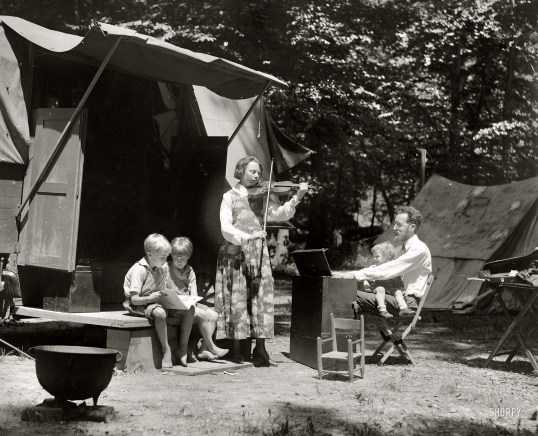
04252u

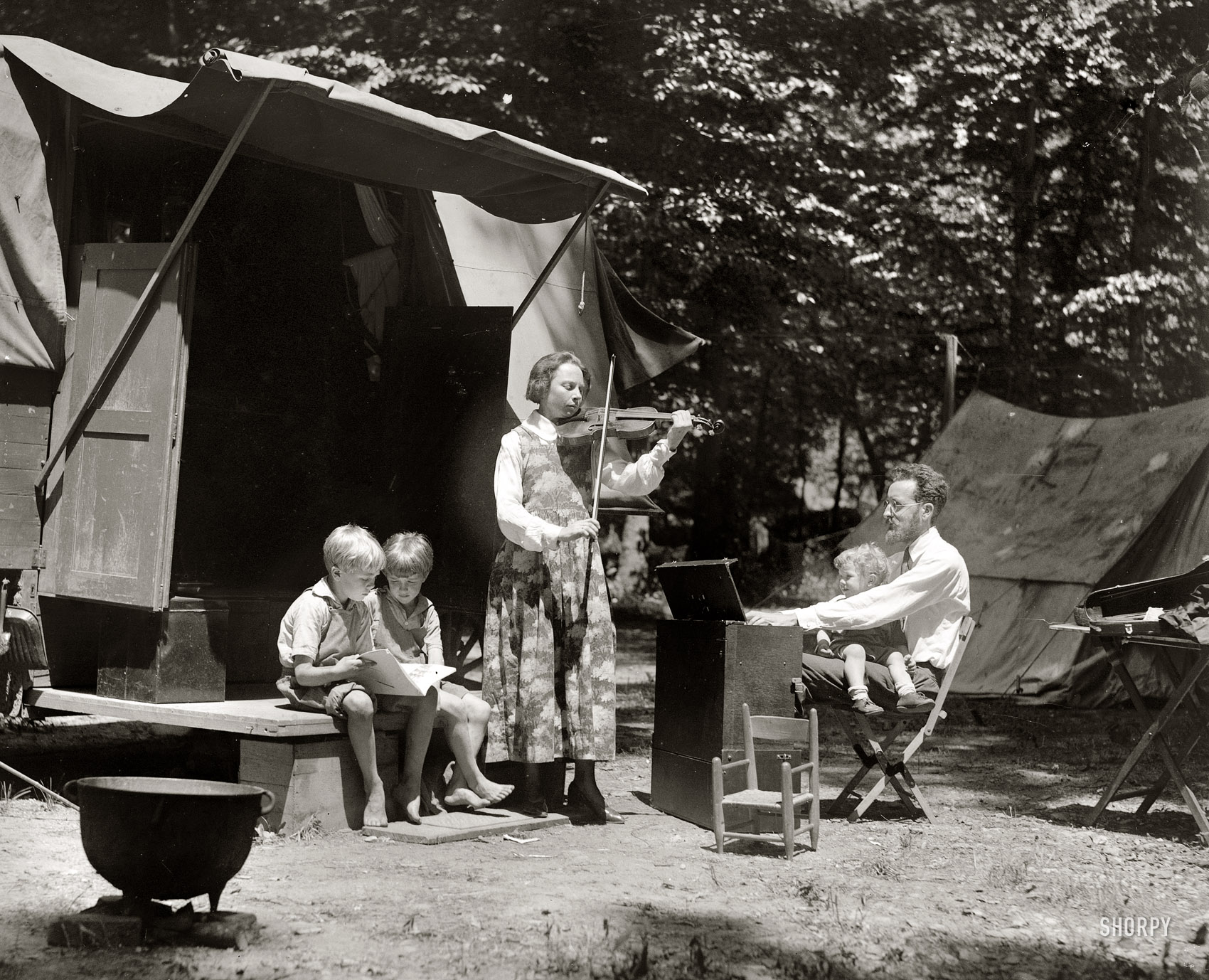
May 23, 1921. Washington, D.C. “Professor Charles Louis Seeger and family.” Charles Seeger, wife Constance Edson Seeger and their 2-year-old son Pete, of future folkie fame. National Photo Co. Collection glass negative.

Another image of the itinerant Seegers. These images have nothing directly to do with Steinbeck, but there’s a distinctly “Grapes of Wrath” feel about their living style in these pictures. They weren’t destitute like the Joads, but my mind couldn’t help but make the connection. There is part of me that would love to be able to live on the road… as long as I had a comfortable motor home with some bookshelf space and the funds to support such a lifestyle.

The Old Wolf has spoken.