This iconic photo taken in 1932 showed a group of construction workers nonchalantly enjoying lunch on a girder [1] high above New York. A bit of backstory on the photo can be found at The Reel Photo.
What is not often seen is what happened after that particular photo was taken, which is just what you might expect.
Nothing better than a good nap after lunch.
The Old Wolf has spoken.
[1] On that note:
An Irish labourer turns up at a building site and asks for employment. “Thick paddy,” thinks the foreman.
“Right ven, Paddy, fink we can hire you? Wot’s the difference between a joist and a girder ven, Paddy?”
“Sure and that’s easy,” replied the Irishman. “Joist wrote Ulysses, and Girder wrote Faust.”
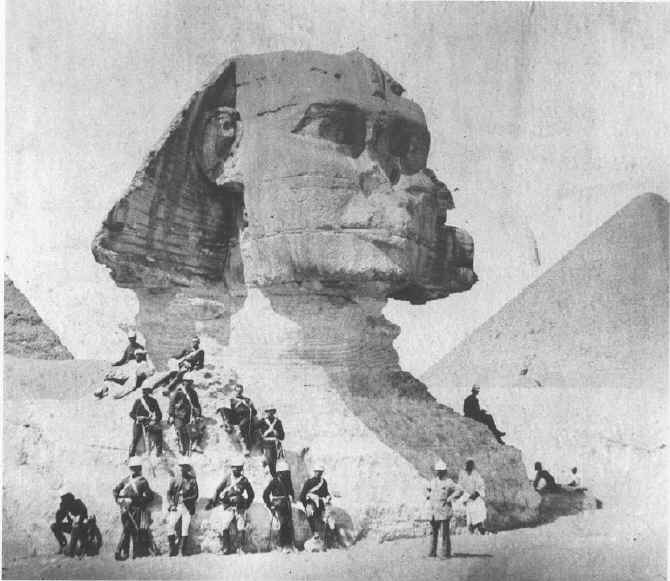
Built in around 2500 BC, that makes him close to 4,500 years old – an astonishing lifespan. The loss of his nose was attributed to Muhammad Sa’im al-Dahr in 1378, when he became angered that local peasants were making sacrifices to the sphinx for favorable crops. Today, however, we know better [1]. Despite weathering over time, for something so ancient, he has survived remarkably well.
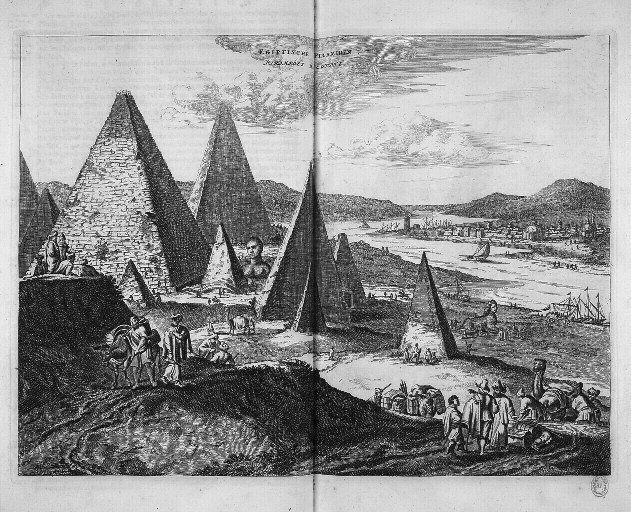
The Great Sphinx of Giza in Olfert Dapper, ”Description de l’Afrique” (1665) Notice that there are two sphinges [2]
From Wikipedia
From the Bronze Age, the Hellenes had trade and cultural contacts with Egypt. Before the time that Alexander the Great occupied Egypt, the Greek name, sphinx, was already applied to these statues. The historians and geographers of Greece wrote extensively about Egyptian culture. Heredotus called the ram-headed sphinxes criosphinges, and the hawk-headed ones hieracosphinges.
The word sphinx comes from the Greek Σφίγξ, apparently from the verb σφίγγω (sphíngō), meaning “to squeeze”, “to tighten up”. This name may be derived from the fact that the hunters for a pride of lions are the lionesses, and kill their prey by strangulation, biting the throat of prey and holding them down until they die. However, the historian Susan Wise Bauer suggests that the word “sphinx” was instead a Greek corruption of the Egyptian name “shesepankh,” which meant “living image,” and referred rather to the statue of the sphinx, which was carved out of “living rock” (rock that was present at the construction site, not harvested and brought from another location), than to the beast itself.
There was a single sphinx in Greek mythology, a unique demon of destruction and bad luck. According to Hesiod, she was a daughter of Orthus[8] and either Echidna or the Chimera, or perhaps even Ceto;[9] according to others, she was a daughter of Echidna and Typhon. All of these are chthonic figures from the earliest of Greek myths, before the Olympians ruled the Greek pantheon. The Sphinx is called Phix (Φίξ) [3] by Hesiod in line 326 of the Theogony, the proper name for the Sphinx noted by Pierre Grimal’s The Penguin Dictionary of Classical Mythology.
The Great Sphinx at Giza is not the only one around – there are countless sphinges throughout Egypt and elsewhere:
Sphinx at Memphis, Egypt
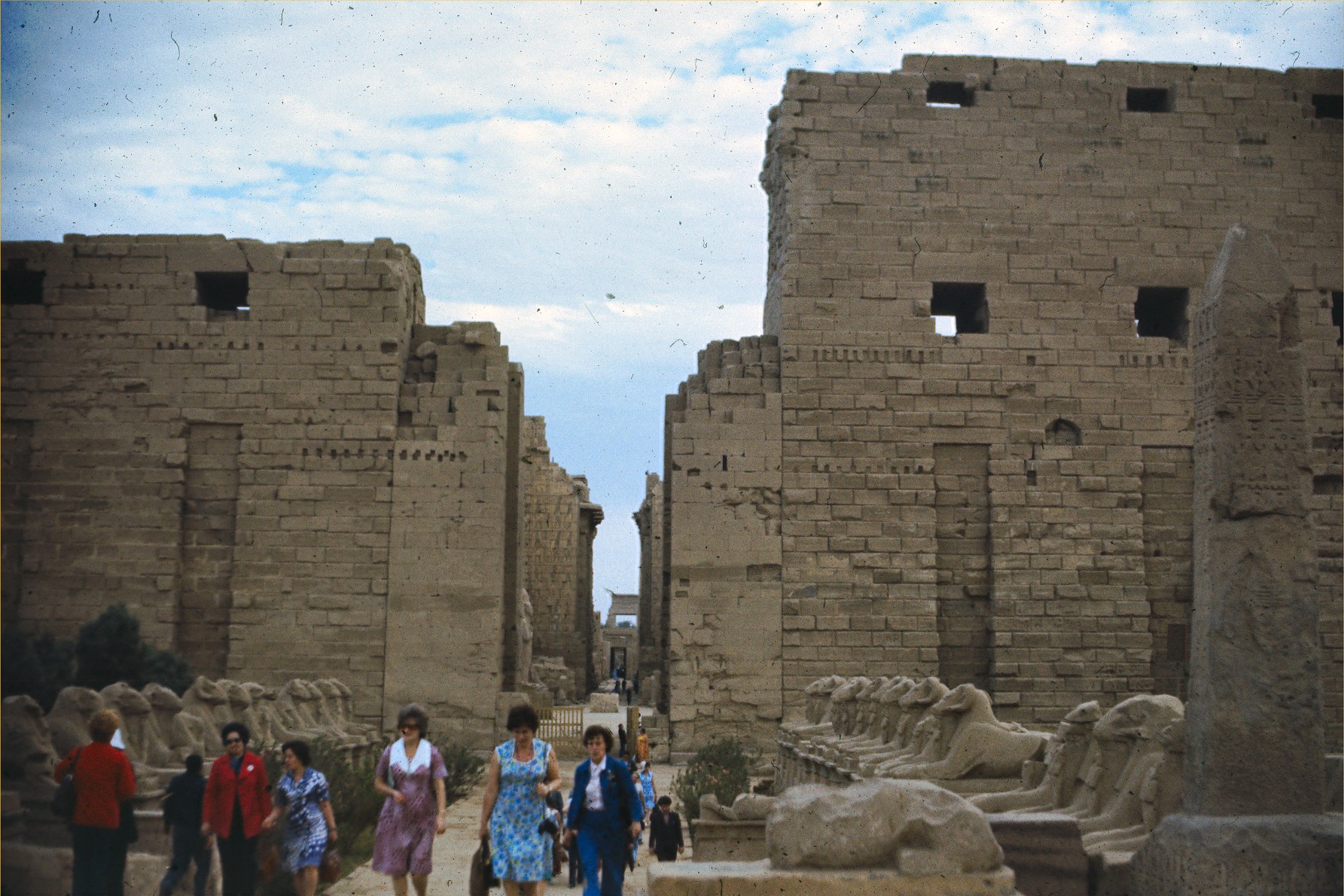
Rows of ram-headed sphinges at Luxor.
Regardless of the number, however, the Great Sphinx at Giza remains one of the wonders of the world from any century.
The Old Wolf has spoken.
[1]
From Goscinny et Uderzo, Astérix et Cléopatre, Dargaud Editeur, 1965
[2] Sphinges is the classical plural for sphinx.
[3]
Phix, leading character in Paul Taylor’s Wapsi Square. Read it.
“Wapsi Square is named for the fictitious neighborhood in Minneapolis where the characters live. Its protagonist is Monica Villarreal, a feisty, busty, 4’10” tall latina who has recently moved from a safe world of normalcy where all she had to question was her own inner demons, to a world of supernatural lunacy, drunken college girls who have the power to obliterate the universe, an Aztec golem named Tepoz who can make the best damned martini in the world, a psychologist demon barista, and a host of other characters, some of whom may just live downstairs from you.” (Wiki)
The Statue of Liberty surrounded by scaffolding as workers complete the final stages in Paris. Circa 1885
I wonder how many people really feel a sense of immense gratitude to France for this incredible gift, which became the icon of our country. I know I do – I feel it every time I see her. Both countries cherish Liberty, despite the pains we continue to suffer as we travel into a new century.
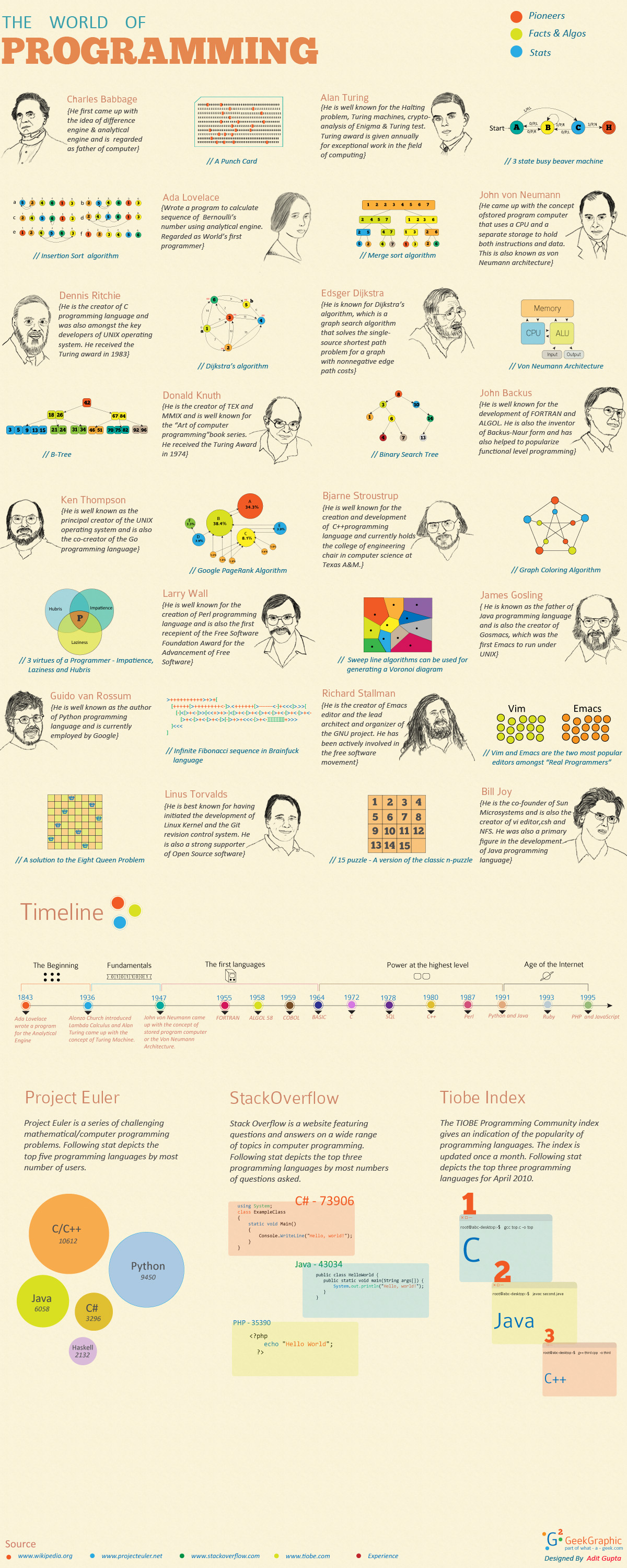
Listen, I know leetspeak is paleolithic and not funny anymore, but it’s a great lead-in to this awesome infographic about programming. If it got you here, mission accomplished. Suck it down.
Although I was a programmer for years, having started with FORTRAN on a Univac 1108, and progressing through PL/I in the IBM environment to Algol on Data General machines, and using Basic, PL/M, Javascript and C in the PC environment, this chart forces me to confront the fact that I only really danced around the core of the programming world. But having done as much as I did, I thoroughly respect the people who code for today’s computers, tablets and smartphones.
Programming is a fertile field for humor, mostly as a stress-reliever. I shared a poem by Dan Nessett previously, and I’ll give you a few more examples of his work – and that of others – below.
This poem appeared in Droll Science by Robert L. Weber (1987), and was noted as an original submission for that volume. However, I first saw it printed off on a Tektronix thermal printer at Washington State’s Office of Financial Management in 1980, so I’m not sure quite what to make of that.
——-
Another poem by Nessett, also chanted to the cadence of “Hiawatha”:
The strange tale of Jeremiah Hoop
Jeremiah Hoop, a stranger, came to be advised concerning The addition of some figures Needed for his Income Tax.
To the University of Hoopla State he brought his query, “Please explain what I must do to Add these on your fine computer.”
“Please attend,” the first man told him. “The error in your computation Will depend on the solution Of this Eigenvalue problem.”
“Epsilon in this case surely Will destabilize your answer And your round-off will truncate so That your sum must disappear.”
Jeremiah’s admiration Of this man’s remarkable grasp Of the gallic language did not Rid him of his pressing question.
So he sought and found another Fine distinguished-looking teacher – “Ah! A fine example of the Non-deterministic parsing Requisite in PDL Automata and T. M. Scanners.
Here, I have a proof that this is Quite unsolvable,” he answered. “Huh!?!” was all that Mr. Hoop Could muster after this Greek lesson.
Once again he posed the question. Once again a Rorschach answer. “If we generalize your question Into one of n-dimensions We can then apply the Tensor Calculus and Einstein’s methods.”
“With but one Christoffel symbol And ignoring oscillations, I believe we’ll find the answer To our question in three years.” Again and once more Jeremiah Questioned those of higher learning –
If we write a microprogram…” or, “An SVC exists…” “Pooh!” was all that Jeremiah Could respond, exasperated. “In the time I’ve wasted asking, I could sum the list by hand.”
Wiser, Jeremiah Hoop turned And in silence walked away. Went back to his farm in Clodville. Laughed out loud occasionally.
One day while cleaning off my desk there came Into my hands a scrap, upon it writ Five lines of code – a subroutine whose name Was “Magic” which required no arguments.
My curiosity began to itch. I wrote a simple driver with but one “Call Magic” statement – and submitted it And walked outside to bask beneath the sun.
Four hours later I awoke in pain. A sunburn had decided it should Take out a lease and dwell upon my skin. So I returned inside in no sweet mood.
I claimed my job – my reason was enraged. Queer looks were given me when I exclaimed, “Great Caesar’s Ghost,” for on its final page Was “For your sunburn try some Solarcaine™”.
Three times I ran that job – three times amazed. For once it solved a problem that had been My tormentor for months, and, sans arrays, It gave a winning strategy for Gin.
The second run output a proof which showed That every map with four colors may be Completely marked and all adjacent nodes Have different hues for their identity.
The third described a model of the skies Which made the Einstein formulation seem As trivial as one plus four is five, And yet could be explained to a Marine.
Just one more time I ran that job and while It executed I sat deep in thought. I concentrated all my earthly guile On making “Magic” show the key to Luck.
The world is full of greed and avarice. It spins on axes hewn from Mankind’s lust. Small children learn – avoid the precipice Of grabbing for that final piece of crust.
No trace of “Magic” could be found by this Sad author after I turned in that job Which disappeared with all the previous Results collected – dust to worthless dust.
– Dan Nessett
——-
Ode to a Programmer
(Unknown)
“No program is perfect,” they said with a shrug. “The client is happy – what’s one little bug?” But he was determined; The others went home. He dug out the flowcharts, Deserted, alone. Night passed into morning, The room became cluttered With core-dumps and punch-cards. “I’m close,” he muttered. Chain-smoking, cold coffee, Logic, deduction, “I’ve got it!” her cried, “Just change one instruction!” Then change two, then three more, As year followed year, And strangers would comment, “Is that guy still here?” He died at the console Of hunger and thirst. Next day he was buried Face down, 9-edge first. And his wife, through her tears, Not accepting his fate, Said, “He’s not really gone, He’s Just Working Late!”
——-
Even though times were undoubtedly simpler in 1978,
I’m sure programmers have always had the same challenges.
Quoted for truth
——-
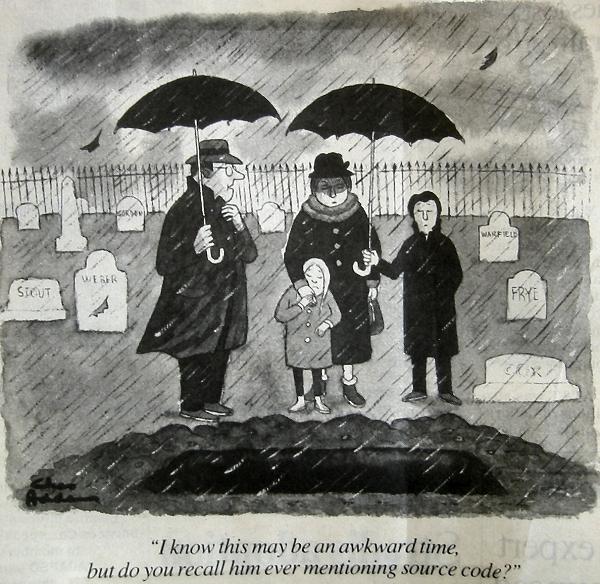
On that note, a bit of history. Back in 1984, the company I joined was running on Wang OIS hardware, at one time the foremost word processing system available in the business world. Their famous V2 editor, designed in tight assembly code to run in 32K of workspace (although most workstations by that time had 64K) was stored in the Wang headquarters in Lowell, Massachussetts, in a tall rack of drives. Source code and backups, all in the same rack. Which got knocked over. Hence no improvements were ever made to the editor; when it came time for Wang to release WP Plus, they basically had to re-write the code from the bottom up, emulating the function of their own editor… and of course it was slower than molasses. Source code is important…
——-
While Mike Royko praised the virtues of the Macintosh in 1995, it was not always popular; at the Macworld in 1986, Philippe Kahn, then CEO of Borland International, raised hackles when he called the Mac a “piece of shit.” He later did an about face when he woke up and smelled the money, but it was a gutsy thing to say in the middle of a convention of Mac enthusiasts.
I know people like this. Me, I’ll use whatever’s at hand, whatever works, whatever’s cheapest. I love the Mac platform but have never been able to afford it for my own personal machines (fortunately I was able to dig deeply into Apple technology at work, and for years attended the Macworld conventions in San Francisco, where I serendipitously encountered some of my favorite music. I’ve never dared navigate the Unix learning curve, despite being told by all my friends that it’s the only way to go. So I’m happy with my core i7 machine, which will probably meet my needs for the foreseeable future. Running Win7 Pro 64, I finally feel as though I have a machine that is really fast enough for everything I care to do. Heck, I can even play Duke Nukem 3D (Forever was a huge disappointment) using the eduke32 port – what more could a man ask for? [1] – and XP is still available as a virtual machine for the few programs that choke at Win7.
One of the earliest iterations of this joke that I’ve seen.
I think this has happened in real life more than once.
A friend of mine in Norway posted this one.
-Did you have your own computer when you were little?
-We didn’t even have the Internet.
-Huh‽
-Why is your iPad so big and clunky? Is it a first generation?
-That’s a TV.
-Huh‽
It’s somewhat disturbing to take note of the fact that there are young people alive today who don’t know a world without the Internet. Problems, of course, are always grist for the humorist’s mill:
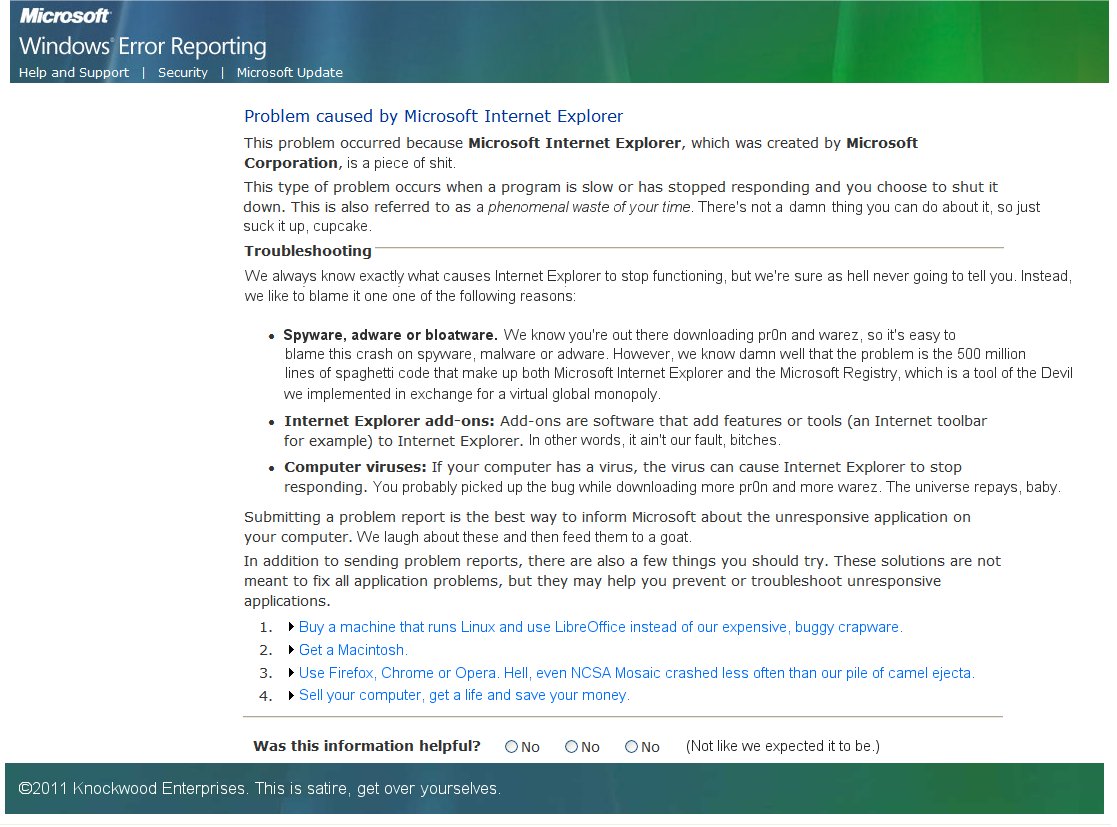
Despite Microsoft’s best efforts to manage 1080 lines of operating system code, this still happens:
Fortunately they give their valued users an opportunity to provide feedback:
If you’re not satisfied with the bounteous information provided when things go wrong, you can always call Microsoft Customer Support
Naturally, as the above recording indicates, they will always try to redirect you to their website:
On that note, users who need help need to make sure their tech support agents are competent, and not evil:
Computer humor goes back a long, long way – Byte Magazine enjoyed throwing an April Fool’s advert into their “What’s New” section. Interesting technology from 1981 – can you spot the joke?
A year earlier, Datamation published a lovely send-up of Poe’s “The Raven” which still resonates with coders of today, even though the architecture has shifted a bit (many versions of this can be found around the internet, but I believe this one is the original).
Of course, many people even today are afraid of technology, and the supermarket rags wasted no time exploiting those fears:
As technology became more mainstream, people needed to learn how to deal with it in everyday situations:
(From Ernie, later The Piranha Club)
Dave Barry had some interesting things to say about technophobes in 1995.
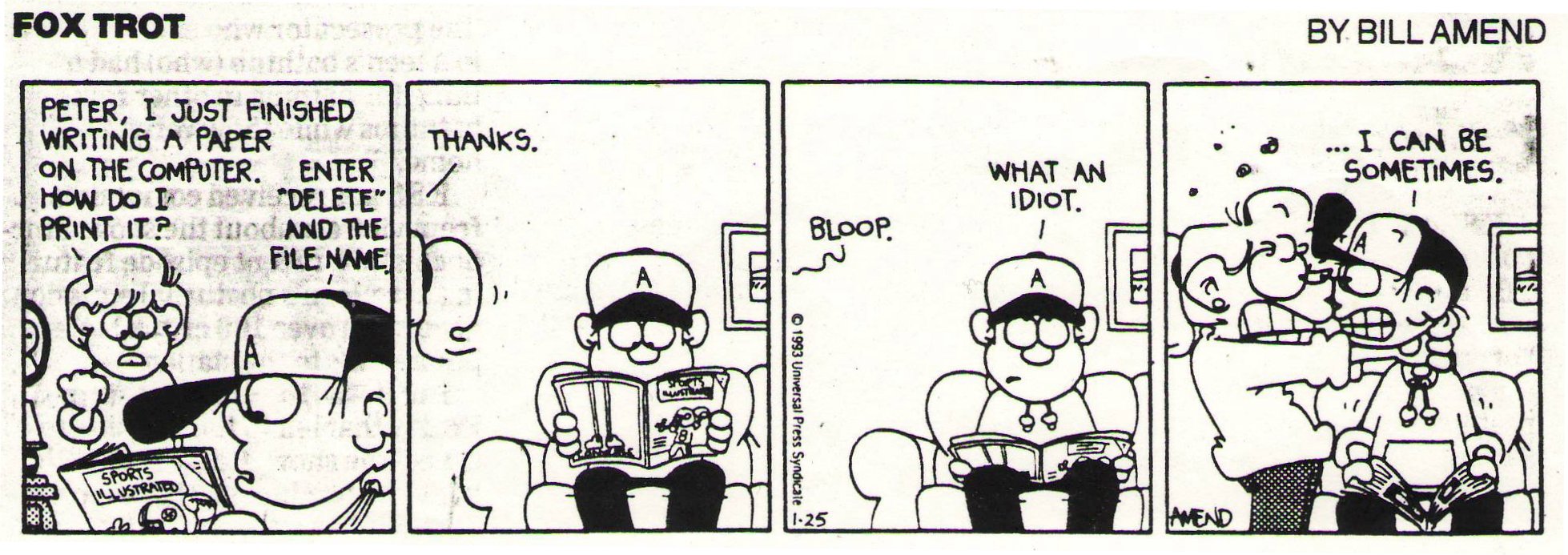
Some were more successful than others:
But students did their best to adapt and take advantage of all technology had to offer:
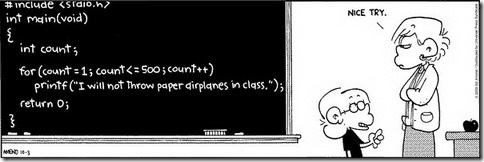
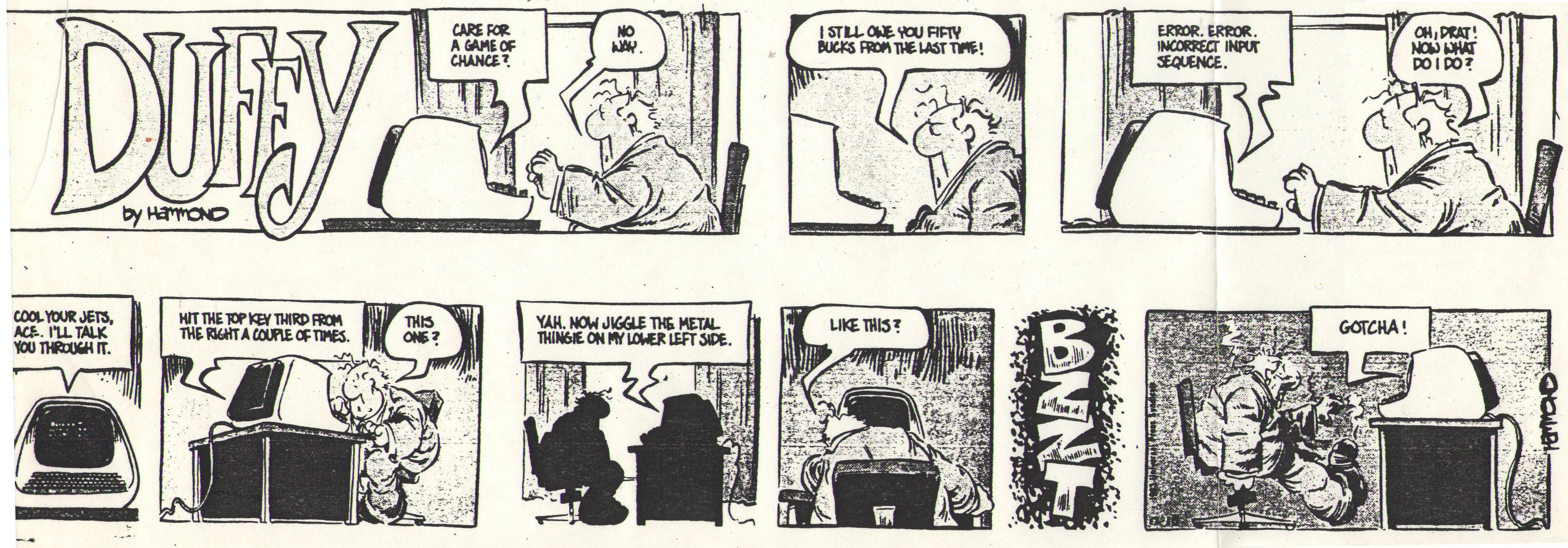
Working in a software development environment is never easy. There are so many bosses and customers and dotted lines that situations like this are fairly common:
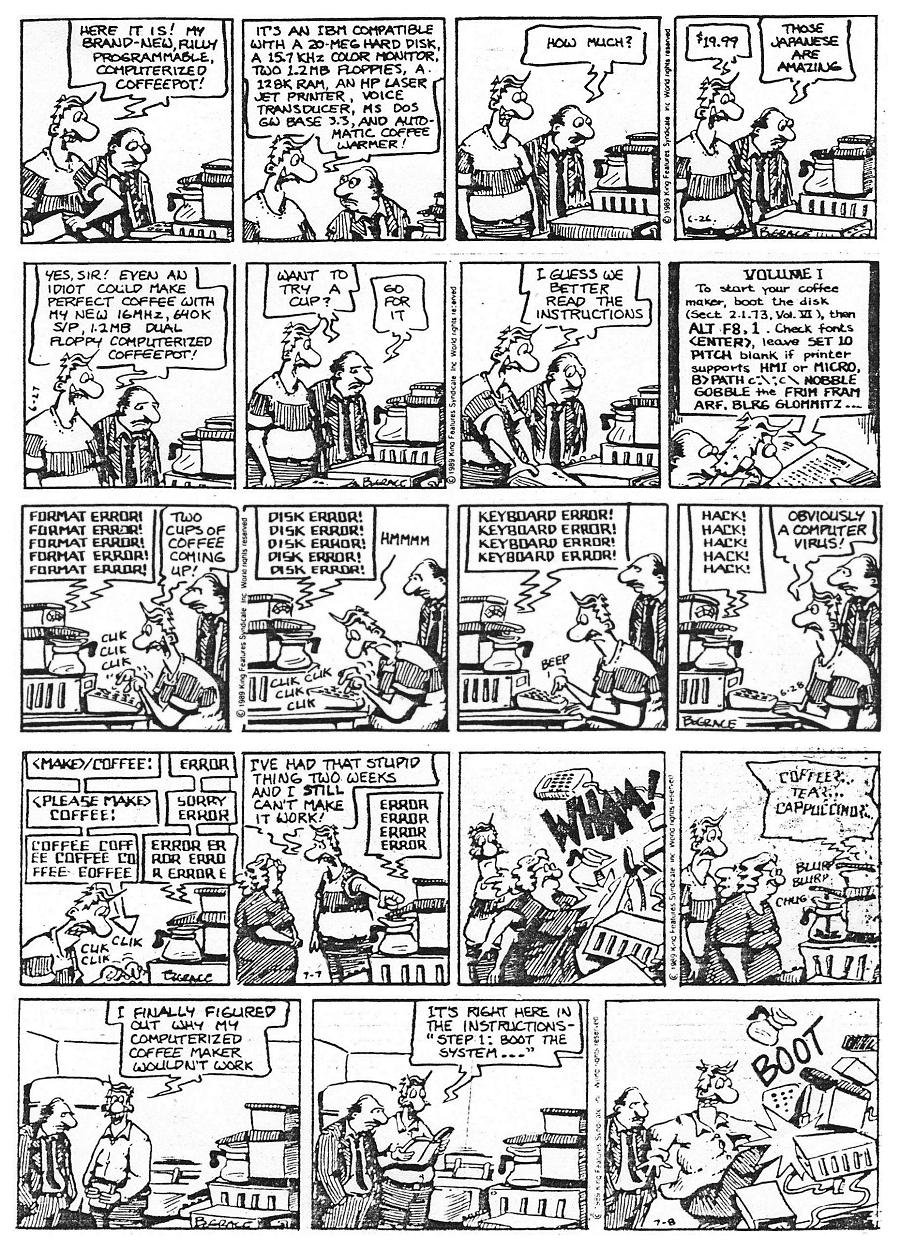
Every new technology has to work the bugs out:
We’ve come a long way since the early days of computing. Moore’s Law[2], outsourcing and competition have done a lot to keep consumer prices on a downward trend (except for Apple, of course):
This state-of-the-art computer from Tandy would cost $15,937.75 in 2013 dollars, according to the Bureau of Labor Statistics. If you wanted to add a 28K Modem, it would only cost you an additional $800.00;
Whereas a 15 Megabyte Hard Drive would set you back $2495.00… plus $495.00 for that “required installation kit.”
Hardware back then was ruddy expensive; that Tandy 5000 would cost $16,004.44 in 2013 dollars, and for that you could buy the best, fastest system available today with every conceivable bell and whistle, and still have enough left over for some nice add-ons.
Today’s internet connection speeds make this seem like stone-age technology (although working for Washington State’s Office of Financial Management in 1980, I was connecting to WASU’s IBM’s over a 300 BAUD AT&T TTY terminal, and felt incredibly blessed when our new TI’s bumped that to 1200 BAUD – all things are relative!) (Keep in mind that my HTC Incredible 2 smartphone, already 5 years old, has a 1 GHz processor, 786MB of ram, and a 32GB memory card that’s smaller than my fingernail, and I paid around $200.00 for it.)
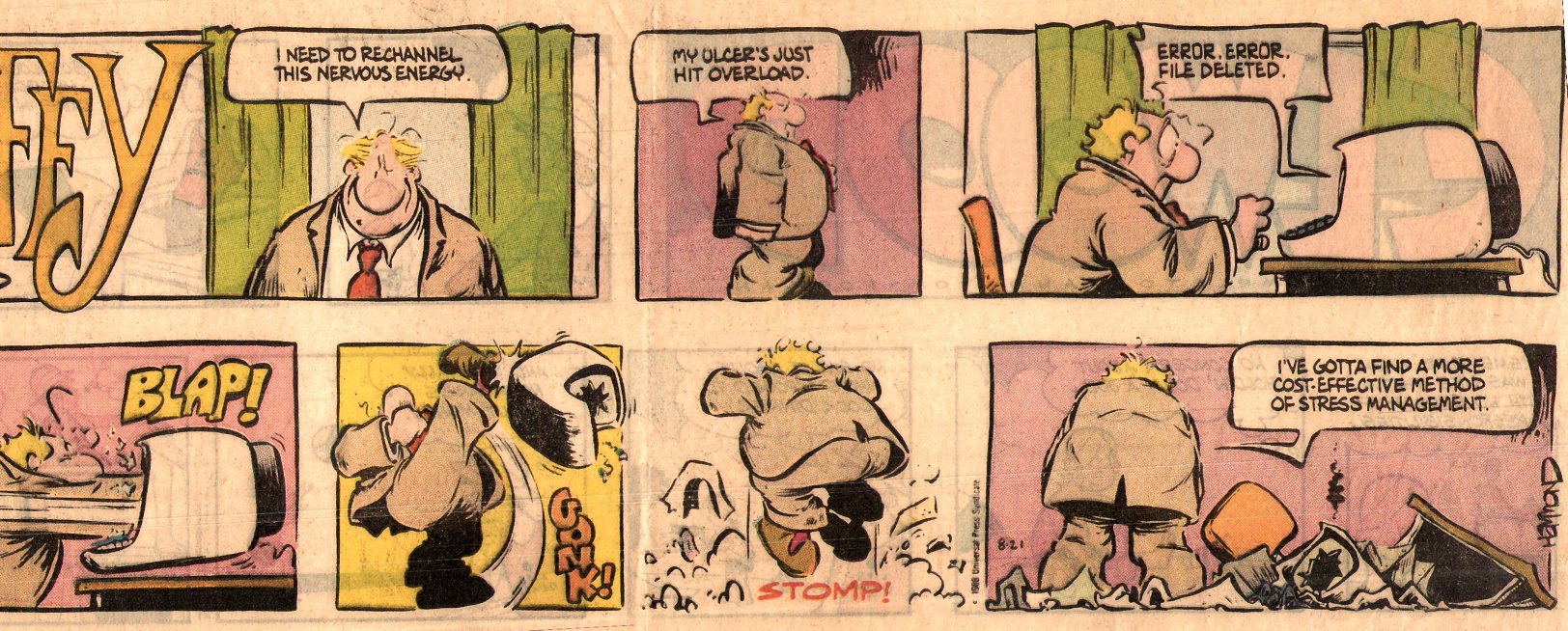
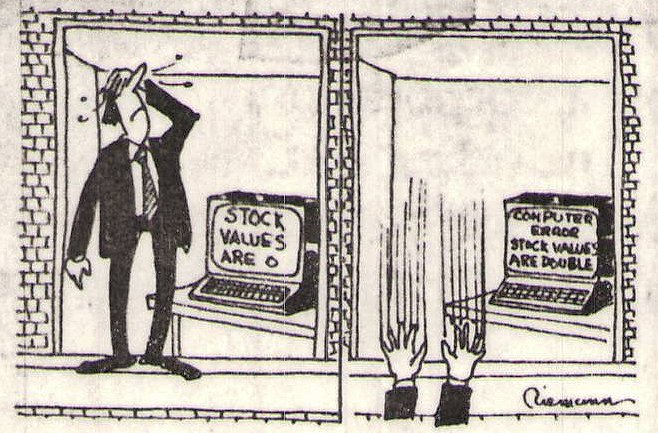
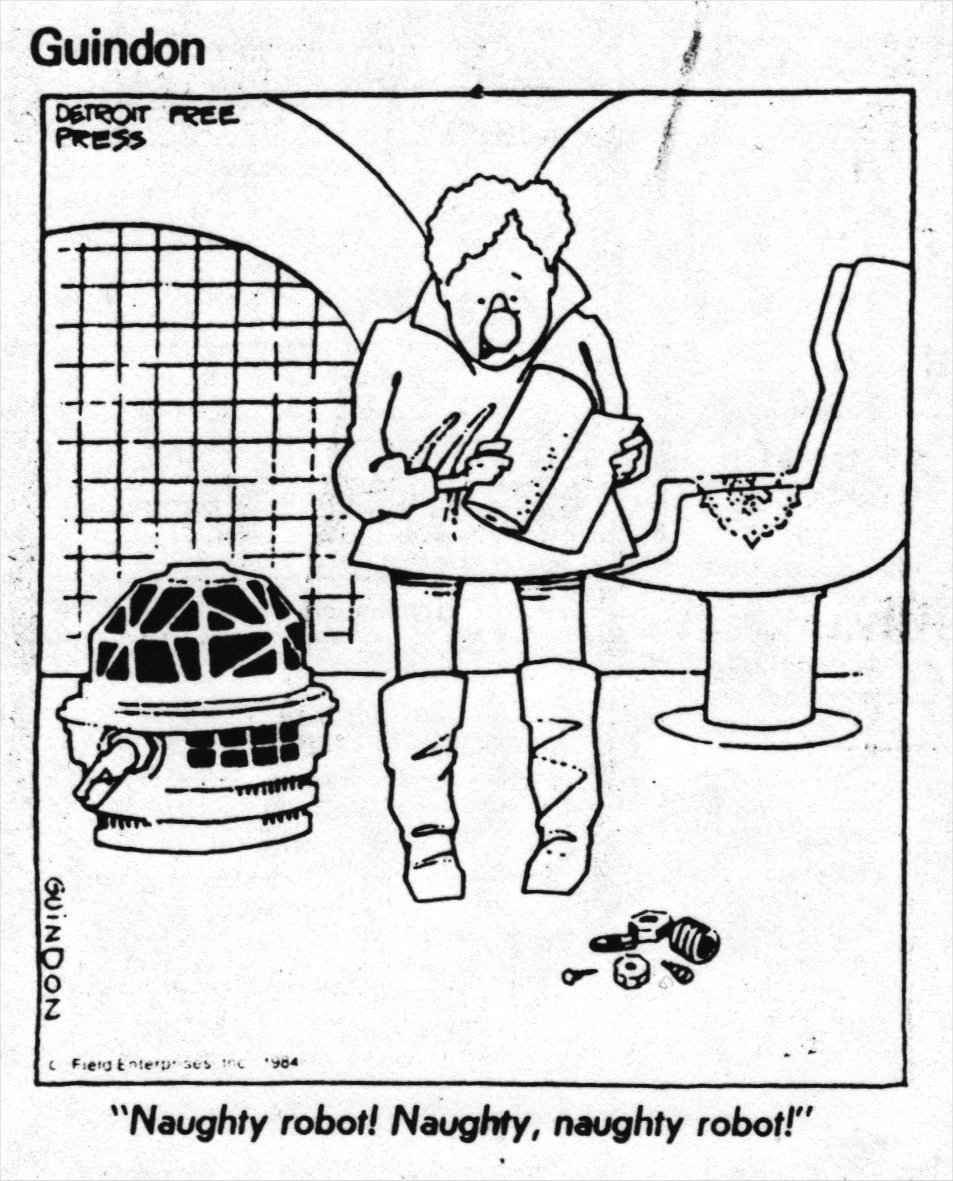
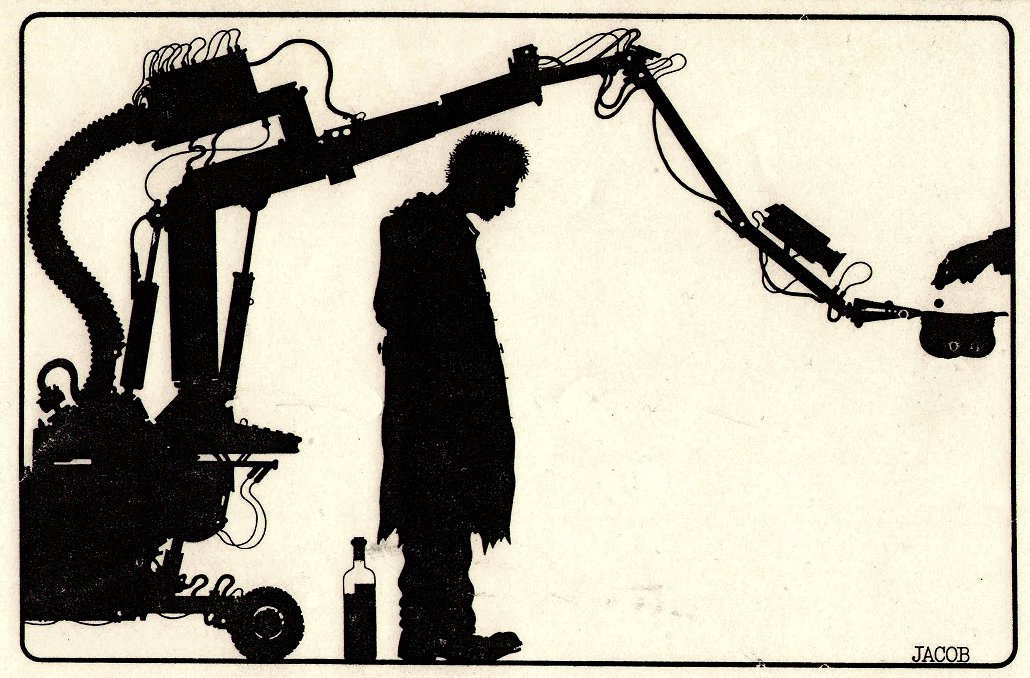
There may come a day when we begin to regret making our computers smarter than we are:
\
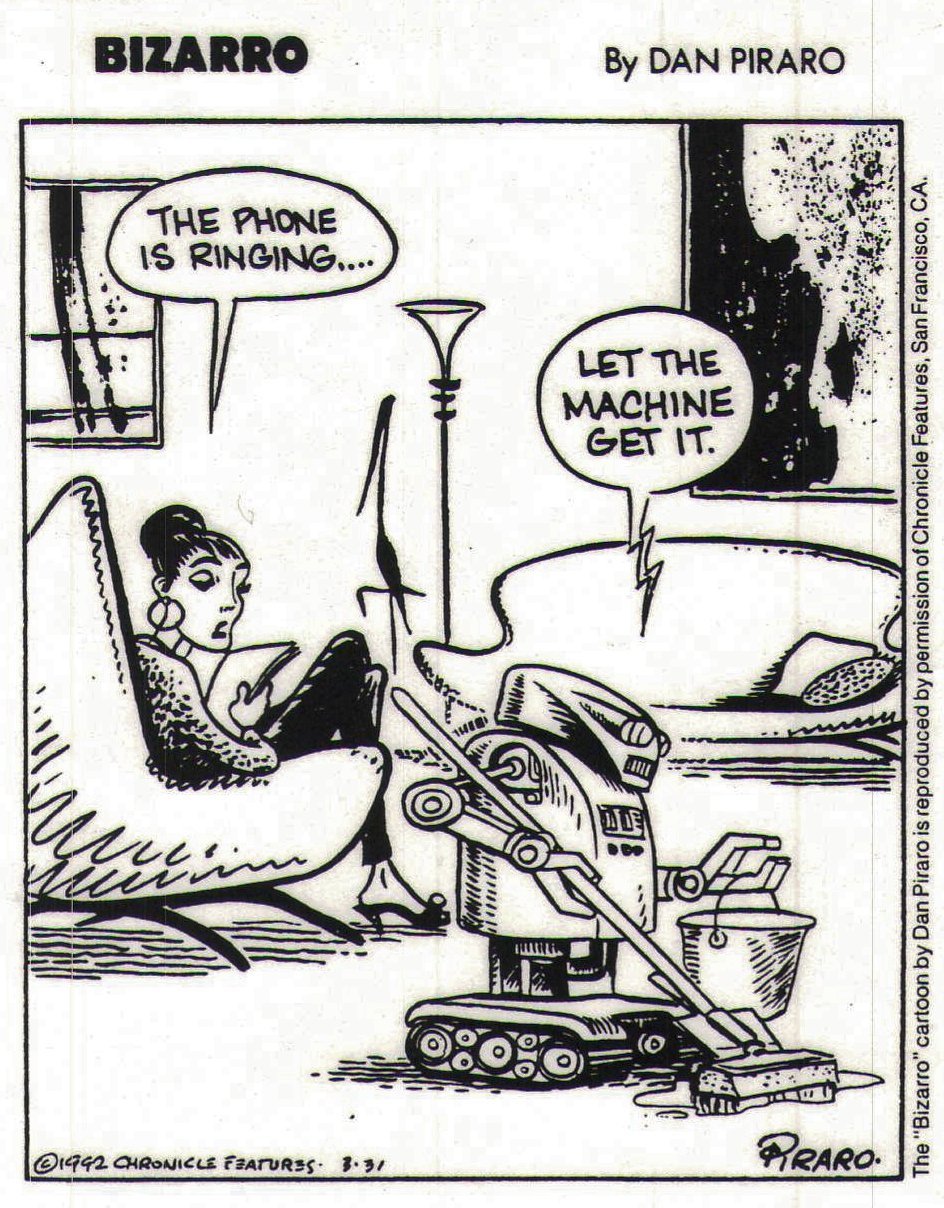
But until that time, we will just have to accept the fact of what computers really are: wonderful servants, but harsh taskmasters.
The Old Wolf has spoken.
[1] Well, maybe smoothly-working versions of all of the Myst series. The first one is a bear to get working in any emulated environment.
[2] Moore’s law simply says that computer power doubles every eighteen months. First stated in 1965 by Gordon Moore, one of the founders of the Intel Corporation, this simple law has helped to revolutionize the world economy, generated fabulous new wealth, and irreversibly altered our way of life. When you plot the plunging price of computer chips and their rapid advancements in speed, processing power, and memory, you find a remarkably straight line going back fifty years. (This is plotted on a logarithmic curve. In fact, if you extend the graph, so that it includes vacuum tube technology and even mechanical hand-crank adding machines, the line can be extended over 100 years into the past.)
Exponential growth is often hard to grasp, since our minds think linearly. It often starts deceptively slowly. It is so gradual that you sometimes cannot experience the change at all. But over decades, it can completely alter everything around us.
According to Moore’s Law, every Christmas your computer games are almost twice as powerful (in terms of memory and processing speed) as they were the previous year. Furthermore, as the years pass, this incremental gain becomes truly monumental. For example, when you receive a birthday card in the mail, it often has a chip which sings “Happy Birthday” to you. Remarkably, that chip has more computer power than all the Allied Forces of 1945. Hitler, Churchill, or Roosevelt might have killed to get that chip. But what do we do with it? After the birthday, we throw the card and chip away. Today, your cell phone has more computer power than all of NASA back in 1969 when it sent two astronauts to the moon. Video games, which consume enormous amounts of computer power to simulate 3D situations, use more computer power than main frame computers of the previous decade. The Sony Playstation of today, which costs $300, has the power of a military supercomputer of 1997, which cost millions of dollars.
-Kaku, Michio, Physics of the Future: How Science Will Shape Human Destiny and Our Daily Lives by the Year 2100.
The only authenticated photo of William Bonney, taken around 1879. “He was said to be friendly and personable at times, and it’s been said that he was as lithe as a cat. Contemporaries described him as a “neat” dresser who favored an “unadorned Mexican sombrero”. (Wikipedia) Note: the Wikimedia Commons image has been enhanced and mirrored.
Personally, I like Morris and Goscinny’s take better: Billy ends up getting his just deserts.
… that gets shared around and around and around with nary an attribution. I looked, and was not able to find anything credible; two friends with greater Google-fu than I were able to identify a source, and thanks to them.
Parents Selling Children
Original caption: August 4, 1948 – Chicago, Illinois: They’re on the auction block. These small children of Mr. and Mrs. Ray Chalifoux of Chicago, Illinois.
For long months 40 year old Ray and his wife, Lucille, 24, waged a desperate but losing battle to keep food in the mouth and a roof over their heads. Now jobless and facing eviction from their near barren flat, the Chalifoux have surrendered to their heart breaking decision. Photo shows mother sobbing as the children pose wonderingly on the steps. Left to right: Lana,6. Rae, 5. Milton, 4. Sue Ellen, 2 years old.
One wonders at what happened after the photo was taken. Hard times are hard.
[Edit: Many thanks to reader Jen who found a recently-published followup:
Lana (top left) was likely adopted and died of cancer in 1998; RaeAnn (top right) was sold for $2 along with her brother Milton (bottom left) to an abusive family. Sue Ellen (bottom right) was adopted. David, inside mother Lucille Chalifoux’s womb in this picture, was adopted as well. Lucille would have four moure daughters; “She kept them; she didn’t keep us,” David says.


































 Playing in the World Game
