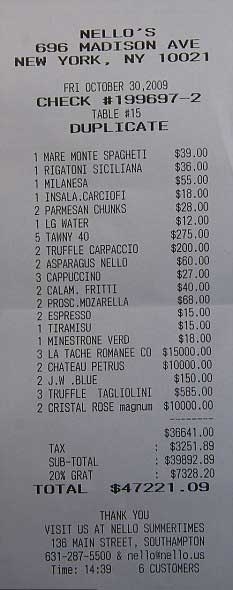
Abramovic vs. Nello

On November 2, 2009, Business Insider published a picture of this receipt, claiming that Russian Billionaire Roman Abramovic had dropped the price of a nice SUV on dinner, including a few bottles of rawther pricey wine. Abramovic’s agent soon came forth with a rebuttal, implying that Nello Balan was up to his usual antics.

Cityfile published this piece on May 15, 2010 – the original page is now gone, and I had to dig it up from the Wayback machine:


Nello Balan is the owner of Nello, the exceedingly mediocre Italian restaurant on the Upper East Side. He’s also one of the city’s most shameless—and most notorious—publicity hounds. Balan’s latest attempt at drumming up attention, however, now appears to be exploding in his face. Last week, a receipt “surfaced” indicating that Russian oligarch Roman Abramovich had spent $52,000 on lunch. (The bill was for $47,000, but TMZ, which first reported the story, said the billionaire had tacked on a $5,000 tip.) But a spokesman for Abramovich tells us the bill wasn’t his and the mogul may pursue legal action against Balan for suggesting otherwise.

Last week’s report—which TMZ has since scrubbed from its website—followed two other recent cases where massive bills magically made their way into the hands of the media. First there was fellow Russian billionaire Mikhail Prokhorov, who allegedly spent $19,000 on lunch two weeks ago. Then there was Jay-Z and Beyoncé, who supposedly spent $1,200 on Dom Perignon, truffles and lobster salad last week.

Naturally, these bills don’t make the news because some absent-minded waiter keeps dropping the receipts at the feet of tabloid reporters. They’re fed to the media by Balan himself. (Amusingly, when the details of Prokhorov’s meal were reported in the pages of the Post, Rich Calder wrote that Balan had “declined to disclose Prokhorov’s exact tab,” but a “source” had provided the paper with a copy.)

But is Balan just concocting these receipts out of thin air? Abramovich’s rep says that the the Russian mogul was, in fact, at Nello’s on the date in question. But he didn’t spend anything close to what the receipt indicated and he may now take legal action against Balan for spreading the lie. (It would have been a bit of a waste to order all that expensive wine anyway; Abramovich was accompanied by his girlfriend, Dasha Zhukova, who is seven months pregnant.) Here’s what John Mann, who heads up corporate communications for Abramovich’s London-based holding company, had to say when we asked about the bill:

The $47,000 check for lunch at Nello’s in New York on Friday, October 30, 2009, published by various media outlets over the weekend, is in no way connected to Mr. Roman Abramovich. While Mr. Abramovich and five others did dine at Nello’s on that date, their total bill amounted to only a couple of percent of that amount. The assertion that they ran up a bill of any greater magnitude is entirely false.

We are in the process of investigating the origins of this inaccurate story, which we have been told was perpetuated by people connected to the restaurant. Our legal counsel has been instructed to review any appropriate action to rectify this situation.

It wouldn’t be beyond Balan to make this up. He’s tried to bribe reporters in the past, he was once arrested for choking his girlfriend, and he’s been investigated for tax evasion. And he might just be desperate enough to conjure up fake receipts considering the financial problems he’s had in recent months.

We reached out to Balan for comment, but the normally chatty restaurateur didn’t feel like talking. The receptionist who answered the phone said she “didn’t think” Balan was there at the moment, then put us on hold for a minute before returning to the line. “Can you call back on Monday? He’s in Europe until then.” Then she hung up.


Who’s telling the real story? Uncertain. No one has claimed the receipt, and Nello’s isn’t talking. Just another everyday tale from the Big Apple.

The Old Wolf has spoken.

Like European Shops? They’re different.

This article by Art Buchwald appeared in various forms in various newspapers. In honor of a young acquaintance of mine who has been living and studying in France, I reproduce here a version that was published in the Pennsylvania Observer-Reporter on August 1, 1977.


During the past eight years I have made a scientific study of the attitude of European sales people toward a foreign customer. They vary in each country according to temperament and while it isn’t fair to generalize that’s exactly what I’m going to do.

In Italy when a customer walks into a store he is greeted like a long-lost brother.

“Welcome signor; welcome signor. Please come into the shop where it is nice and cool. You do not have to buy anything, you can just look.”

“I would like a poplin shirt. Do you have any?”

“Do we have any? That’s all we have is poplin shirts. We specialize in poplin shirts. Mama, give me the best quality poplin shirts for these nice people.”

While Mama is dragging out the shirts the man says, “Are you from America?”

You say you are.

“I have relatives in Chicago. You know them? The Qualliteris? Look, here is their picture! My cousin has seven children! Please do look, that is Rosita, Antonio, Carlotta, Alfredo, Giuseppe, Charles, and Thomaso. Rosita is seven, Antonio is…”

The shirts finally come. The man says, “Beautiful Egyptian cotton. Notice the pearl-like quality of the buttons, how the tail of the shirt is rounded gently, the pleated pocket and the firm rich feel of the collar. Please to touch it yourself. Where else in the world can you find a shirt like this? Take a dozen. In America you will thank me for selling you these shirts.”

You are touched by his kindness. You buy a dozen. His wife gives your wife a bouquet of flowers. They both escort you to the door You shake hands with them. They shake hands with you. They ask you to come back soon. They tell you not to miss a visit to St Peter’s and they give you the names of a trattoria in Rome and friends in Florence. There are tears in their eyes as you walk away. Everybody is happy.

In London you walk into a store and you are greeted by a man in a tail coat who bows and asks if he can be of help. You ask for the shirt counter. He clicks his fingers and calls for a salesman who rushes up and stands at attention as the man in the tail coat snaps, “Shirts for this gentleman.”

[Editor’s note: In the back of my mind I can hear Captain Peacock calling, “Mr. Humphries, are you free?”]

The salesman says, “Right this way,” and takes you to the counter. “What size and what colour,” he asks.

You tell him you want a poplin and a button-down collar if possible.

He looks down embarrassed as if you had just asked him how much salary he makes. “Is there anything wrong with a button-down shirt?”

“To be frank, Sir, in England we don’t think too much of the button-down collar. Of course you Americans like that sort of thing but we consider it rather iffy, if you know what I mean. It’s just not the sort of thing you would wear except to a very bad cricket match. Of course if you want a button-down shirt I’d be very happy…”

“Heavens, no,” you say, “What is the proper shirt to wear?”

“Ah, the proper shirt,” he smiles. “This is the style now. You will notice the Duke of Norfolk wears only this type of shirt. It is worn by men of distinction of every profession. I’m sure a person like yourself would wear only the latest attire.” He shames you into buying a dozen.

But in France, everything is different. You walk into a shop which is quite empty with six or seven salespeople standing around.

You wait 15 minutes and finally someone comes up to you and speaking in the tone that a Poujadist would use on a tax collector says, “What do you want?” You tell him you want a shirt. “What size?” he says sneeringly.

“Size 17.”

“Ha!” he shouts. “We don’t have your size. Do you think we carry everyone’s size? How much place do you think we have here? The largest size we have is 16½.”

You tell him you’d like to see it.

A look of disappointment comes over his face.

“What color,” he says.

“White.”

“Ha!” he shouts. “We don’t have white. We only have them in colors. Do you think we can stock both white and colored shirts?”

Another salesman comes over and asks in French what the trouble is. The fellow salesman tells him in French, “This idiot wants a white shirt. First he asks for a size 17 and now he wants it in a 16½. What kind of store does he think we run?”

“These Americans are all crazy.”

You say you’ll take a colored one. The salesman is furious. He shoves the box of shirts in front of you and says, “Please don’t touch them or you’ll have to pay for them.”

You select one and he throws it into a bag. “Four thousand francs,” he says.

You give him a five-thousand franc note.

“Don’t you have change? Do you think we can make change for everyone who comes into the store?”

Everyone looks at you as if you had just slapped the man in the face.

You say you have no change, and there is a conference of the salesman, the manager and the cashier. They keep looking at you and whispering to each other. Finally, the cashier, who writes the entire transaction in a large ledger, produces the thousand franc note.

The salesman slaps the purchase into your hand and throws the change down on the counter. As you walk out of the door you hear him saying to the other people, “C’est incroyable. Incroyable.”

©1977, Los Angeles Times Syndicate


Having lived in Europe in a number of different countries, I can vouch for the fact that this is just barely satire.

The Old Wolf has spoken (but Art Buchwald has spoken better.)