How to have a Merry Christmas

Well, according to one math professor, this is how it’s done:

  1. CodeCogsEqn
  2. CodeCogsEqn (1)
  3. CodeCogsEqn (2)
  4. CodeCogsEqn (3)
  5. CodeCogsEqn (4)

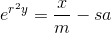
Funny. But all joking aside, Oxfam has come up with a practical formula for knowing whether or not you’re really enjoying the holidays, and it looks like this (and there’s no reason this wouldn’t work for Chanukkah as well):

formula-oxfam

That’s a bit more complex; here’s what it boils down to as a “word problem”:

“It’s great to see that ultimately, happiness at Christmas comes down to quite simple things, such as enjoying time off work to spend with friends and family.”

Key ‘happiness factors’ include:
• Number of calories consumed on Christmas Day (any more than 7,000 calories and you’ll be too stuffed to enjoy yourself)
• Amount of time off work (just one day off boosts happiness by 70%, with three weeks being the optimum amount)
• Centimetres of snow (15cm is ideal)
• Family arguments (more than five and happiness levels plummet)
• Number of hours spent trawling the shops for gifts (any more than 10 hours and shopping-induced stress sees happiness decline rapidly)
• Miles driven to see friends and family (0 miles is ideal, with 500 miles generating a 40% reduction in happiness levels)
• The number of gifts you receive has an impact on happiness (6 gifts gets you to optimum happiness levels), but….
• ….most crucially, how many gifts you give (even giving just one present makes a huge difference to happiness levels, increasing Christmas enjoyment by 50%).

To estimate your score, visit the original article. (But we need a bigger picture of the formula there.)

The Old Wolf has spoken.

An open letter: Dear Mr. Cumberbatch, I’m really, really sorry.

Sorry on a very personal level, because a person’s name is the icon and the symbol by which they are known all their lives, and it deserves to be respected. A certain man once had a dream that his deceased grandfather appeared to him and asked, “I would like to know what you have done with my name.” The man responded, “I have never done anything with your name of which you need be ashamed.” Our names and our family reputations are sacred things.

But I just can’t help it. Your monicker is so distinctive, and your acting prowess has garnered you such deserved fame, that your name can be mangled in an infinite number of ways – yet people still know who is being referred to.

I’ve seen myriad iterations, and every time I hear you mentioned in the media, or in conversation, my poor mind comes up with another one; it’s a curse.

Burgerking Chuckecheese
Ipecac Bandersnatch
Beanbag Cabbagepatch
Bumbershoot Cattleranch
Bensonmum Cadillac
Bentobox Charizard

are some of the more polite ones I’ve seen, or conjured up.

Of course, you’re not the first one to suffer such a societal affliction. Decades ago, when Engelbert Humperdinck was popular, people did much the same thing, but in the absence of the Internet, things just couldn’t go as viral as they do today. The best example I saw was in a “B.C.” cartoon by Johnny Hart where he was referred to obliquely as “Balthazar Bumperdingle.”

Your rôle as Khan was the first time I really became aware of you; since then, you seem to be everywhere at once. You have become the Paul Muni of the 21st century, and that’s a good thing, because your skills and versatility make you a delight to watch.

So thanks for the great entertainment, and please accept my brain’s apologies for buying into the linguistic buffoonery. You’re a classy guy, and I look forward to much more of your work.

The Old Wolf has spoken.

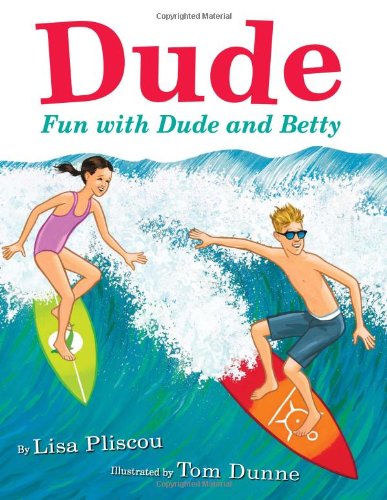
Check out this totally non-bogus book – Fun with Dude and Betty!

Some time ago I found a page from this book on reddit and thought it was hilarious. I must have posted about it on Facebook, because some time later, as part of a surprise package from a good friend in Virginia, along came a copy of it. I was delighted, because it’s such a delightful homage to an era that I grew up in (although as an eastern boy, this language never was part of my ideolect.

Most people from my generation will remember Dick and Jane; here I present to you Dude – Fun with Dude and Betty.

51lgSWq+kzL

I’d copy the whole thing for you, but that would really be bogus; as the copyright notice states,

“No way can any part of this book be used or reproduced in any manner whatsoever unless you get written permission, ’cause that would be fully dropping in, dude. Although you can use short quotations in, like, critical articles and reviews.”

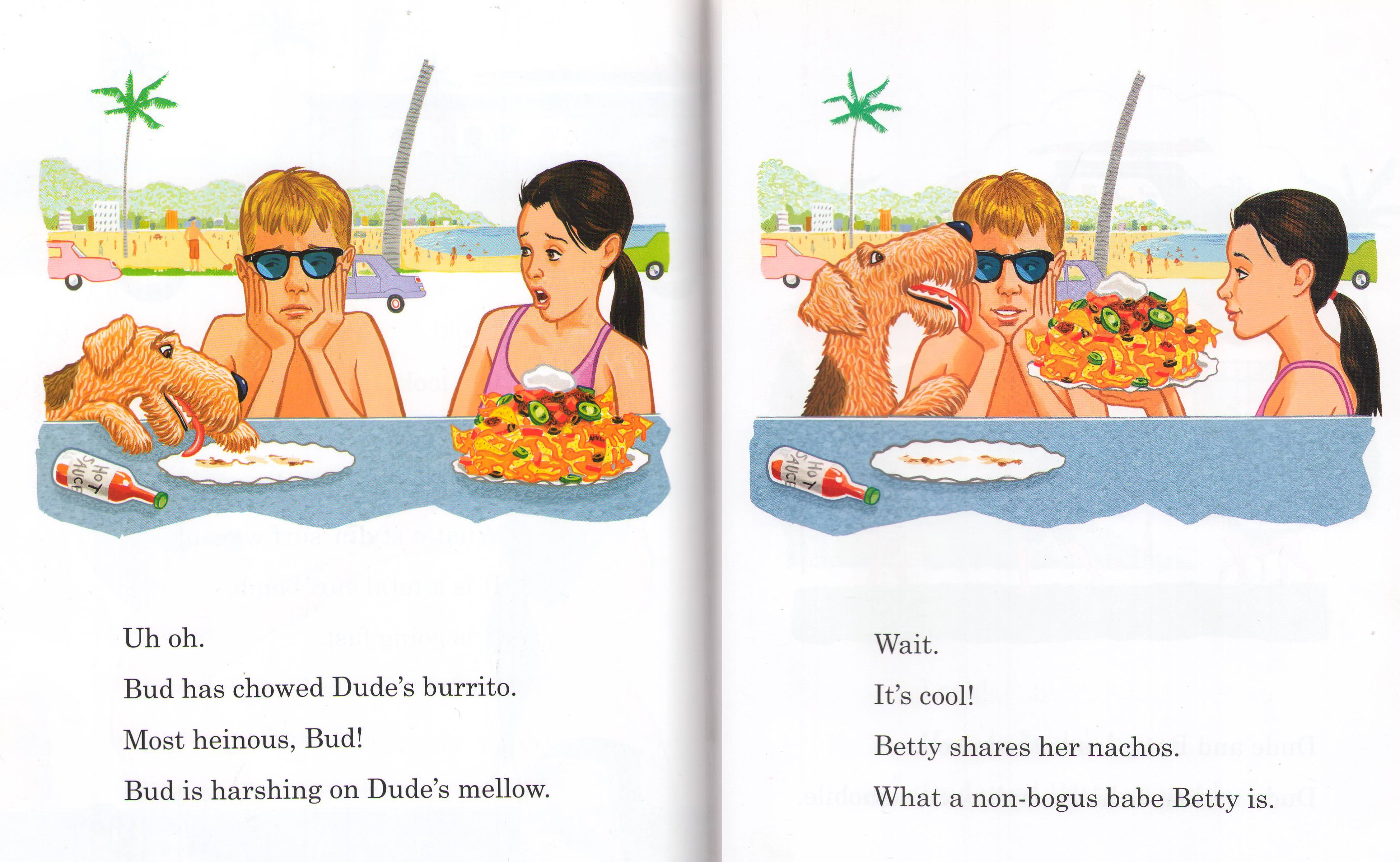
And we don’t want to be bogus. So I’ll give you, like, just one page – the one I found the funniest:

dude

“Bud is harshing on Dude’s mellow” made me laugh harder than it should have. But the whole book is like this, with language and feel straight out of the 60s surfer scene. Tubular, dude!

There’s even a glossary of terminology in the back, for those non-cool dudes and dudettes who didn’t dig this scene as kids. Wait, that may be mixing a bit of 50s beatnik terminology in there, but it’s cool.

If you want to score a copy of this book for yourself, you can find it at Amazon.

The Old Wolf has, like, spoken, dude.

Found: The Swan Song of a Modern Hiawatha

Hiawatha

For decades, I’ve had a snippet of a poem running around in my head:

“Simple math and shrubbery pruning, checkers, lunch and water polo.”

This comes to mind often when I consider the un-challenging slate of classes for which I see many college freshmen sign up.

Today someone posted something on Facebook – which, thanks to the lack of a search function I can no longer find – that made me think of it again, and despite earlier searches on Google coming up poor, this time I got a hit.

The link took me to a page in the Gainesville Sun from August 10, 1985, in a column by Bill Henderson. He credited the source thusly:

“To honor the coming season I would have you read an ode to the football player himself. An ode I stole some years back from some fellow hack that I would acknowledge if I could remember his name.”

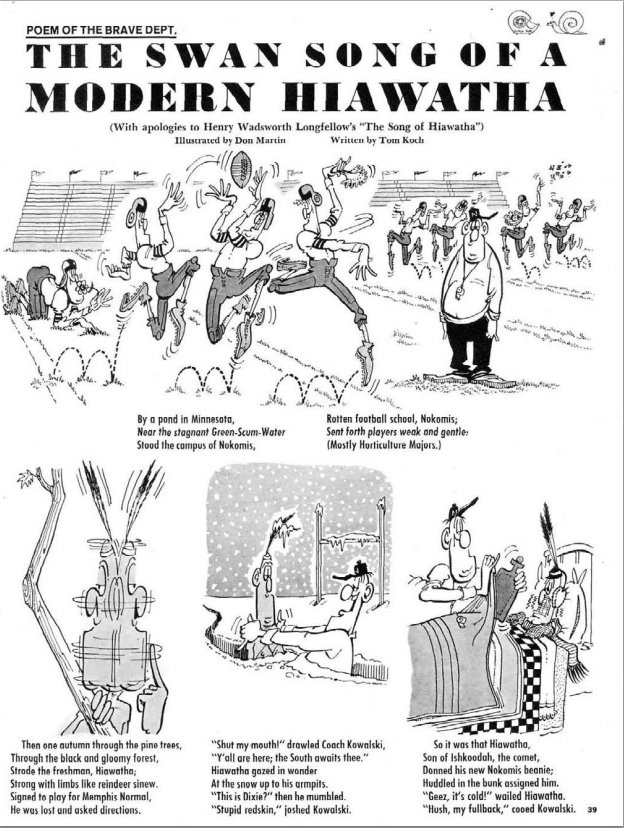
Having seen the full text of the poem again, I was pretty sure the original appearance of the poem was in Mad Magazine, of which I was a faithful and voracious reader through the 60s and 70s. A bit more Googling, and I had located the source: Mad #100, January 1966: “The Swan Song of a Modern Hiawatha” – with apologies to Henry Wadsworth Longfellow’s “The Song of Hiawatha.”

So here, for your gratuitous enjoyment, is the full text of the poem as it appeared in Mad. Be warned – this is politically incorrect for our day and age, and needs to be framed in the mindset of the 60s.

Edit: With thanks to commenter Dave Meek who pointed out that a line was missing in the first stanza. A search for verification led to a discovery of the entire issue of Mad #100 online in PDF format, enabling me to add the image above, as well as an entire stanza that was also missing.

The Swan Song of a Modern Hiawatha
Text: Tom Koch / Art: Don Martin.

By a pond in Minnesota
Near the stagnant Green-Scum-Water
Stood the campus of Nokomis,
Rotten football school, Nokomis;
Sent forth players weak and gentle:
(Mostly horticulture majors.)

Then one autumn thru the pine trees
Through the black and gloomy forest,
Strode the freshman, Hiawatha;
Strong with limbs like reindeer sinew,
Signed to play for Memphis Normal,
He was lost and asked directions.

“Shut my mouth,” drawled Coach Kowalksi,
‘Ya’ll are here; the South awaits thee,”
Hiawatha gazed in wonder
At the snow up to his armpits.
“This is Dixie?” thus he mumbled,
“Stupid Redskin,” joshed Kowalski.

So it was that Hiawatha,
Son of Ishkoodah, the comet,
Donned his new Nokomis beanie;
Huddled in the bunk assigned him.
“Geez, it’s cold!” wailed Hiawatha.
“Hush, my fullback,” cooed Kowalski.

Soon the young brave, Hiawatha,
Found himself matriculated;
Signed for classes that befit him;
Simple math and Shrubbery Pruning,
Checkers, Lunch and Water Polo,
(Perfect course; wrong institution.)

In their quest for football players,
All the frats sought Hiawatha
‘Til they studied close his features,
Then, as one wheel aptly put it,
“I dunno, Could be an Injun’
Yet to me, he still looks Jewish.”

One by one did Hiawatha
Learn to know the campus creatures;
Erickson, the hot rod owner,
Nippersink, the brooding Commie;
Best of all, he soon discovered
Emmie Sue, the Chi Omega.

“Ee-wa-voom!” yowled Hiawatha,
(Football practice now forgotten),
I was taught by wrinkled Grandma
How to woo the elk and otter,
Speak of marriage to the pine cone.
THIS the old crone failed to mention.”

Days of torment quickly followed
For the harried Coach Kowalski,
Left with three men in his backfield
While the fourth played hanky-panky
Out behind the pipestone quarry;
Fiendish plans engulfed the mentor.

On that frigid autumn evening,
Emmie Sue, the Chi Omega,
Listened with a wide-eyed horror
As the coach, most confidential
Warned her darkly of “the nut who
Thinks he’s living now in Memphis.”

Came the dawn and grieving Emmie
Sought the help of Doctor Swinehorst,
Dean of studies Psychiatric
At the Med School of Nokomis.
“All’s not lost,” the Doc assured her,
“If you think you can afford me.”

Soon the young brave, Hiawatha,
Lay upon the couch of Swinehorst,
Lay there fearless as the birch tree,
“Tell me of your childhood trauma,”
Said that Doc with notebook handy;
“What of Mom and Dad and siblings?”

Hiawatha answered calmly,
“Daddy was a white-fire comet;
Mom a songbird in the willows,
I had many forest brothers:
Brown bear, moose and timid rabbit.”
“Ach du Lieber!” cried out Swinehorst.

Emmie Sue, the Chi Omega,
Heard the tragic diagnosis.
“Crazy as a loon,” said Swinehorst,
“Even thinks the loon’s his sister,
I’d suggest you drop this savage;
Date instead my son, the dentist.”

Hiawatha, brokenhearted,
Now without his love beside him
Turned his thoughts at last to football;
Learn what meant the mumbled signals
Of the quarterback, Wochowicz;
Scrimmaged ’til his bridgework rattled.

Happy then was Coach Kowalski,
Dreamed he in untroubled slumber
Neath the full moon, Nu-see-wah-goo,
Of Nokomis, undefeated;
Dreamed of glory soon to come on
New Year’s Day in Pasadena.

Only Gitchee-Goomee Teachers
Hated rival of Nokomis,
Barred the path the coach envisioned,
Waiting tensely for the kickoff,
Hiawatha eyed the bleachers;
There sat Emmie with the dentist.

“Aush-wea-ecch,” moaned Hiawatha
As the pigskin bounced before him,
Caromed off his furrowed forehead
Toward the goal where Gitchee-Goomee’s
Tackle grabbed it unmolested,
Scored the first of 14 touchdowns.

With the Dean on Monday morning,
Hiawatha got the message:
“F” in Math and Shrubbery Pruning.
“Memphis pledged I’d pass,” he bleated.
Roared the Dean in tones like thunder,
“Memphis! Buster, you’re in Flunksville.”

Quiet reigns now in Nokomis.
Gone is Emmie; gone the dentist;
Gone the mob lynched Kowalski.
All that’s left; a voice heard faintly;
Hiawatha, college dropout,
Back home chatting with the chipmunk.

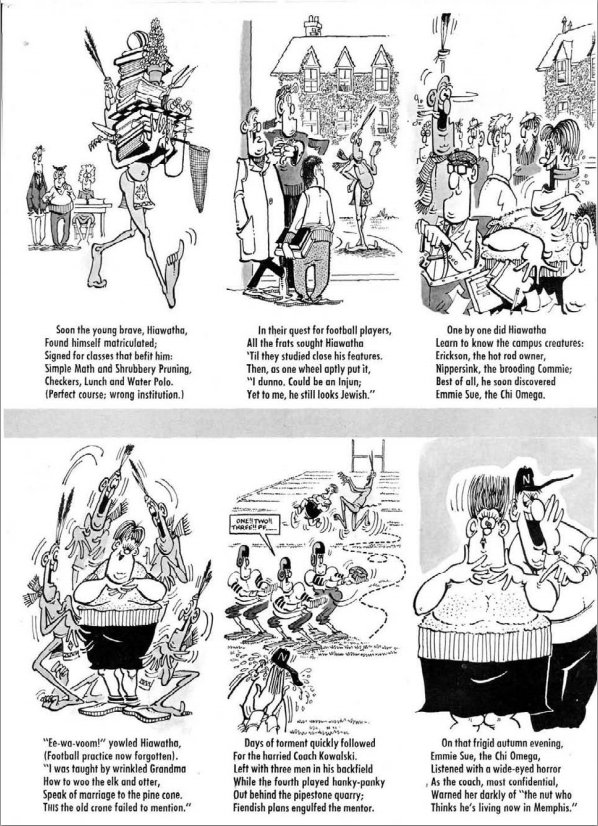
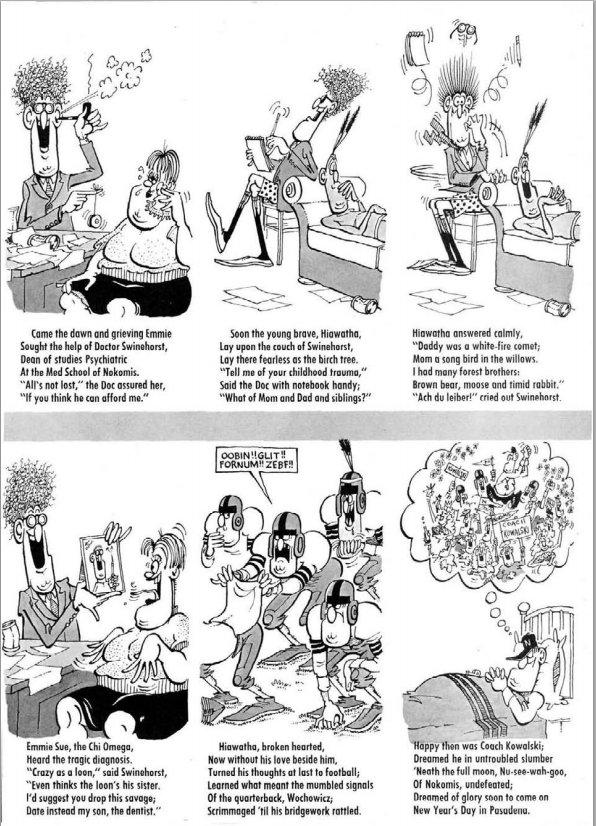
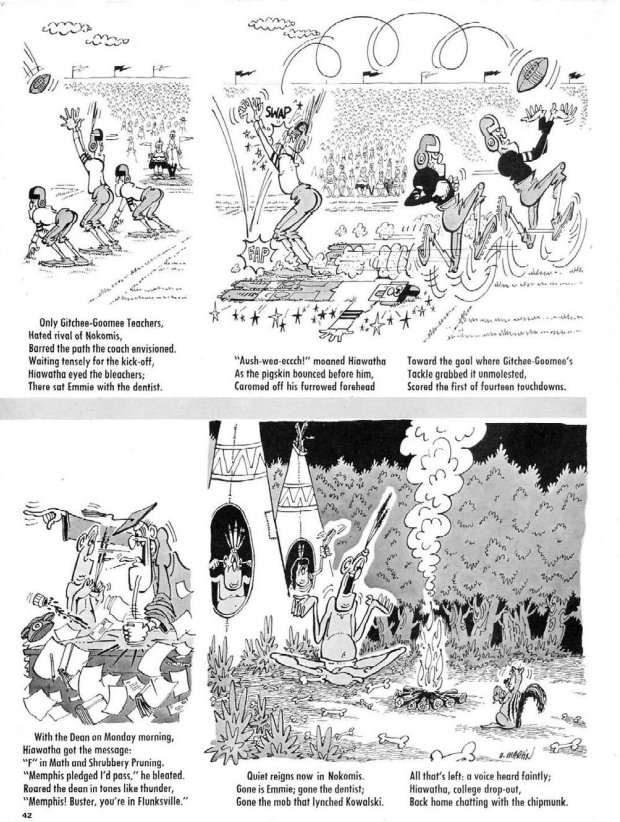
I can now present you with the original in all its glory, accompanied by Don Martin’s hilarious illustrations (click each image to enlarge):

Hia1  Hia2  Hia3  Hia4

You’re welcome.

The Old Wolf has spoken.

After an Internship (courtesy of the reddit community)

reddit is a strange beast. Tailor your subreddits and settings carefully to avoid the dark side and the NSFW (not safe for work) stuff, and it can be a source of valuable information as well as good entertainment. If you like cats, paving your floor with pennies (don’t forget the sealer), using bananas for scale, and a host of mad references, you may find it a congenial place. But I digress.

Recently redditors began posting pictures of what it’s like after an internship at [company name.] I found these amusing – and revelatory – so I have collected them here for your reading pleasure.

2Mdmqu6

At Google

mEKsmTV

At Microsoft

2KKL0wq

At EA

Rz5VksX

At Apple

F85lYXa


At Comcast

RzWxO7Q

At reddit

And, of course, what it’s like after an internship at pretty much anywhere these days:

homeless person sleeping in cardboard box


The Old Wolf has spoken.

A shout-out to Weird Al Yankovic – Word Crimes

I make misteaks when I’m writing. But I try not to make big ones, and I do my best to correct them when they occasionally crop up.

ten artist chirtmas list 5

These gigantic erasers have been around since I was a kid in the 50s; fortunately I have never needed one that big. Whilst typing, I can’t ever seem to spell “friend” right the first time; it’s just a quirk, I suppose.

That said, I am always gobsmacked when I see people confusing loose and lose, or their/there/they’re, or its/it’s. Maddening. I tend to be a descriptive linguist rather than a proscriptive one, knowing that languages flow like the mighty Mississippi river over time, and that usage is king – but there’s a difference between colloquialisms and ignorantisms (that last is a neologism.)

Now comes Weird Al, with his second music video in a stream of 8, released one each day. I’ve always loved his work, and this one immediately rose to the top of my favorites list because of the subject matter, near and dear to the heart of a linguist.

I’ll let Al speak for himself.

And now the Old Wolf has done spoke.

The Magic Fishbone

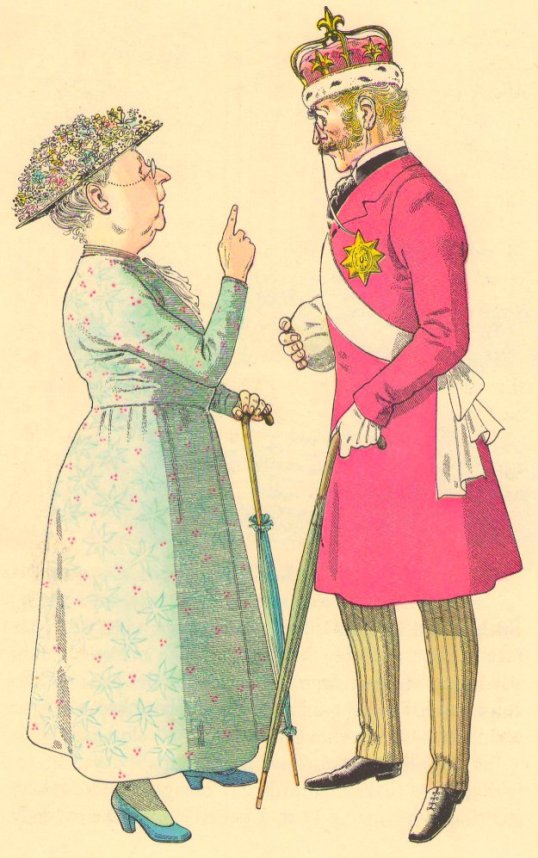
I first encountered this story in a general collection of children’s literature.  I loved the delicious language and the whimsical nature of the storytelling, the absurd names and the illogical non-sequiturs. Only after I had read it to my kids a number of times did I realize who the author was: the illustrious Charles Dickens, and then everything made a lot more sense. It originally appeared as Part II of a work called Holiday Romance. [1] The Good Fairy Grandmarina has long been one of my favorite characters – for no-nonsense, she puts Mary Poppins to shame.

So without further ado, I present you the full text of “The Magic Fishbone.” Have no pity for the dreadful little snapping pug-dog next door – Dickens certainly didn’t.

THERE was once a king, and he had a queen; and he was the manliest of his sex, and she was the loveliest of hers. The king was, in his private profession, under government. The queen’s father had been a medical man out of town.

They had nineteen children, and were always having more. Seventeen of these children took care of the baby; and Alicia, the eldest, took care of them all. Their ages varied from seven years to seven months.

Let us now resume our story.

One day the king was going to the office, when he stopped at the fishmonger’s to buy a pound and a half of salmon not too near the tail, which the queen (who was a careful housekeeper) had requested him to send home. Mr. Pickles, the fishmonger, said, ‘Certainly, sir; is there any other article? Good-morning.’

The king went on towards the office in a melancholy mood; for quarter-day was such a long way off, and several of the dear children were growing out of their clothes. He had not proceeded far, when Mr. Pickles’s errand-boy came running after him, and said, ‘Sir, you didn’t notice the old lady in our shop.’

‘What old lady?’ inquired the king. ‘I saw none.’

Now the king had not seen any old lady, because this old lady had been invisible to him, though visible to Mr. Pickles’s boy. Probably because he messed and splashed the water about to that degree, and flopped the pairs of soles down in that violent manner, that, if she had not been visible to him, he would have spoilt her clothes.

Just then the old lady came trotting up. She was dressed in shot-silk of the richest quality, smelling of dried lavender.

‘King Watkins the First, I believe?’ said the old lady.
Grandmarina

‘Watkins,’ replied the king, ‘is my name.’

‘Papa, if I am not mistaken, of the beautiful Princess Alicia?’ said the old lady.

‘And of eighteen other darlings,’ replied the king.

‘Listen. You are going to the office,’ said the old lady.

It instantly flashed upon the king that she must be a fairy, or how could she know that?

‘You are right,’ said the old lady, answering his thoughts. ‘I am the good Fairy Grandmarina. Attend! When you return home to dinner, politely invite the Princess Alicia to have some of the salmon you bought just now.’

‘It may disagree with her,’ said the king.

The old lady became so very angry at this absurd idea, that the king was quite alarmed, and humbly begged her pardon.

‘We hear a great deal too much about this thing disagreeing, and that thing disagreeing,’ said the old lady, with the greatest contempt it was possible to express. ‘Don’t be greedy. I think you want it all yourself.’

The king hung his head under this reproof, and said he wouldn’t talk about things disagreeing any more.

‘Be good, then,’ said the Fairy Grandmarina, ‘and don’t. When the beautiful Princess Alicia consents to partake of the salmon, – as I think she will, – you will find she will leave a fish-bone on her plate. Tell her to dry it, and to rub it, and to polish it till it shines like mother-of-pearl, and to take care of it as a present from me.’

‘Is that all?’ asked the king.

‘Don’t be impatient, sir,’ returned the Fairy Grandmarina, scolding him severely. ‘Don’t catch people short, before they have done speaking. Just the way with you grown-up persons. You are always doing it.’

The king again hung his head, and said he wouldn’t do so any more.

‘Be good, then,’ said the Fairy Grandmarina, ‘and don’t! Tell the Princess Alicia, with my love, that the fish-bone is a magic present which can only be used once; but that it will bring her, that once, whatever she wishes for, PROVIDED SHE WISHES FOR IT AT THE RIGHT TIME. That is the message. Take care of it.’

The king was beginning, ‘Might I ask the reason?’ when the fairy became absolutely furious.

‘WILL you be good, sir?’ she exclaimed, stamping her foot on the ground. ‘The reason for this, and the reason for that, indeed! You are always wanting the reason. No reason. There! Hoity toity me! I am sick of your grown-up reasons.’

The king was extremely frightened by the old lady’s flying into such a passion, and said he was very sorry to have offended her, and he wouldn’t ask for reasons any more.

‘Be good, then,’ said the old lady, ‘and don’t!’

With those words, Grandmarina vanished, and the king went on and on and on, till he came to the office. There he wrote and wrote and wrote, till it was time to go home again. Then he politely invited the Princess Alicia, as the fairy had directed him, to partake of the salmon. And when she had enjoyed it very much, he saw the fish-bone on her plate, as the fairy had told him he would, and he delivered the fairy’s message, and the Princess Alicia took care to dry the bone, and to rub it, and to polish it, till it shone like mother-of-pearl.

And so, when the queen was going to get up in the morning, she said, ‘O, dear me, dear me; my head, my head!’ and then she fainted away.

The Princess Alicia, who happened to be looking in at the chamber-door, asking about breakfast, was very much alarmed when she saw her royal mamma in this state, and she rang the bell for Peggy, which was the name of the lord chamberlain. But remembering where the smelling-bottle was, she climbed on a chair and got it; and after that she climbed on another chair by the bedside, and held the smelling-bottle to the queen’s nose; and after that she jumped down and got some water; and after that she jumped up again and wetted the queen’s forehead; and, in short, when the lord chamberlain came in, that dear old woman said to the little princess, ‘What a trot you are! I couldn’t have done it better myself!’

But that was not the worst of the good queen’s illness. O, no! She was very ill indeed, for a long time. The Princess Alicia kept the seventeen young princes and princesses quiet, and dressed and undressed and danced the baby, and made the kettle boil, and heated the soup, and swept the hearth, and poured out the medicine, and nursed the queen, and did all that ever she could, and was as busy, busy, busy as busy could be; for there were not many servants at that palace for three reasons: because the king was short of money, because a rise in his office never seemed to come, and because quarter-day was so far off that it looked almost as far off and as little as one of the stars.

But on the morning when the queen fainted away, where was the magic fish-bone? Why, there it was in the Princess Alicia’s pocket! She had almost taken it out to bring the queen to life again, when she put it back, and looked for the smelling-bottle.

After the queen had come out of her swoon that morning, and was dozing, the Princess Alicia hurried up-stairs to tell a most particular secret to a most particularly confidential friend of hers, who was a duchess. People did suppose her to be a doll; but she was really a duchess, though nobody knew it except the princess.

This most particular secret was the secret about the magic fish-bone, the history of which was well known to the duchess, because the princess told her everything. The princess kneeled down by the bed on which the duchess was lying, full-dressed and wide awake, and whispered the secret to her. The duchess smiled and nodded. People might have supposed that she never smiled and nodded; but she often did, though nobody knew it except the princess.

Then the Princess Alicia hurried down-stairs again, to keep watch in the queen’s room. She often kept watch by herself in the queen’s room; but every evening, while the illness lasted, she sat there watching with the king. And every evening the king sat looking at her with a cross look, wondering why she never brought out the magic fish-bone. As often as she noticed this, she ran upstairs, whispered the secret to the duchess over again, and said to the duchess besides, ‘They think we children never have a reason or a meaning!’ And the duchess, though the most fashionable duchess that ever was heard of, winked her eye.

‘Alicia,’ said the king, one evening, when she wished him good-night. ‘Yes, papa.’

‘What is become of the magic fish-bone?’

‘In my pocket, papa!’

‘I thought you had lost it?’

‘O, no, papa!’

‘Or forgotten it?’

‘No, indeed, papa.’

And so another time the dreadful little snapping pug-dog, next door, made a rush at one of the young princes as he stood on the steps coming home from school, and terrified him out of his wits; and he put his hand through a pane of glass, and bled, bled, bled. When the seventeen other young princes and princesses saw him bleed, bleed, bleed, they were terrified out of their wits too, and screamed themselves black in their seventeen faces all at once. But the Princess Alicia put her hands over all their seventeen mouths, one after another, and persuaded them to be quiet because of the sick queen. And then she put the wounded prince’s hand in a basin of fresh cold water, while they stared with their twice seventeen are thirty-four, put down four and carry three, eyes, and then she looked in the hand for bits of glass, and there were fortunately no bits of glass there. And then she said to two chubby-legged princes, who were sturdy though small, ‘Bring me in the royal rag-bag: I must snip and stitch and cut and contrive.’ So these two young princes tugged at the royal rag-bag, and lugged it in; and the Princess Alicia sat down on the floor, with a large pair of scissors and a needle and thread, and snipped and stitched and cut and contrived, and made a bandage, and put it on, and it fitted beautifully; and so when it was all done, she saw the king her papa looking on by the door.

‘Alicia.’

‘Yes, papa.’

‘What have you been doing?’

‘Snipping, stitching, cutting, and contriving, papa.’

‘Where is the magic fish-bone?’

‘In my pocket, papa.’

‘I thought you had lost it?’

‘O, no, papa.’

‘Or forgotten it?’

‘No, indeed, papa.’

After that, she ran up-stairs to the duchess, and told her what had passed, and told her the secret over again; and the duchess shook her flaxen curls, and laughed with her rosy lips.

Well! and so another time the baby fell under the grate. The seventeen young princes and princesses were used to it; for they were almost always falling under the grate or down the stairs; but the baby was not used to it yet, and it gave him a swelled face and a black eye. The way the poor little darling came to tumble was, that he was out of the Princess Alicia’s lap just as she was sitting, in a great coarse apron that quite smothered her, in front of the kitchen-fire, beginning to peel the turnips for the broth for dinner; and the way she came to be doing that was, that the king’s cook had run away that morning with her own true love, who was a very tall but very tipsy soldier. Then the seventeen young princes and princesses, who cried at everything that happened, cried and roared. But the Princess Alicia (who couldn’t help crying a little herself) quietly called to them to be still, on account of not throwing back the queen up-stairs, who was fast getting well, and said, ‘Hold your tongues, you wicked little monkeys, every one of you, while I examine baby!’ Then she examined baby, and found that he hadn’t broken anything; and she held cold iron to his poor dear eye, and smoothed his poor dear face, and he presently fell asleep in her arms. Then she said to the seventeen princes and princesses, ‘I am afraid to let him down yet, lest he should wake and feel pain; be good, and you shall all be cooks.’ They jumped for joy when they heard that, and began making themselves cooks’ caps out of old newspapers. So to one she gave the salt-box, and to one she gave the barley, and to one she gave the herbs, and to one she gave the turnips, and to one she gave the carrots, and to one she gave the onions, and to one she gave the spice-box, till they were all cooks, and all running about at work, she sitting in the middle, smothered in the great coarse apron, nursing baby. By and by the broth was done; and the baby woke up, smiling, like an angel, and was trusted to the sedatest princess to hold, while the other princes and princesses were squeezed into a far-off corner to look at the Princess Alicia turning out the saucepanful of broth, for fear (as they were always getting into trouble) they should get splashed and scalded. When the broth came tumbling out, steaming beautifully, and smelling like a nosegay good to eat, they clapped their hands. That made the baby clap his hands; and that, and his looking as if he had a comic toothache, made all the princes and princesses laugh. So the Princess Alicia said, ‘Laugh and be good; and after dinner we will make him a nest on the floor in a corner, and he shall sit in his nest and see a dance of eighteen cooks.’ That delighted the young princes and princesses, and they ate up all the broth, and washed up all the plates and dishes, and cleared away, and pushed the table into a corner; and then they in their cooks’ caps, and the Princess Alicia in the smothering coarse apron that belonged to the cook that had run away with her own true love that was the very tall but very tipsy soldier, danced a dance of eighteen cooks before the angelic baby, who forgot his swelled face and his black eye, and crowed with joy.

And so then, once more the Princess Alicia saw King Watkins the First, her father, standing in the doorway looking on, and he said, ‘What have you been doing, Alicia?’

‘Cooking and contriving, papa.’

‘What else have you been doing, Alicia?’

‘Keeping the children light-hearted, papa.’

‘Where is the magic fish-bone, Alicia?

‘In my pocket, papa.’

‘I thought you had lost it?’

‘O, no, papa!’

‘Or forgotten it?’

‘No, indeed, papa.’

The king then sighed so heavily, and seemed so low-spirited, and sat down so miserably, leaning his head upon his hand, and his elbow upon the kitchen-table pushed away in the corner, that the seventeen princes and princesses crept softly out of the kitchen, and left him alone with the Princess Alicia and the angelic baby.

‘What is the matter, papa?’

‘I am dreadfully poor, my child.’

‘Have you no money at all, papa?’

‘None, my child.’

‘Is there no way of getting any, papa?’

‘No way,’ said the king. ‘I have tried very hard, and I have tried all ways.’

When she heard those last words, the Princess Alicia began to put her hand into the pocket where she kept the magic fish-bone.

‘Papa,’ said she, ‘when we have tried very hard, and tried all ways, we must have done our very, very best?’

‘No doubt, Alicia.’

‘When we have done our very, very best, papa, and that is not enough, then I think the right time must have come for asking help of others.’ This was the very secret connected with the magic fish-bone, which she had found out for herself from the good Fairy Grandmarina’s words, and which she had so often whispered to her beautiful and fashionable friend, the duchess.

So she took out of her pocket the magic fish-bone, that had been dried and rubbed and polished till it shone like mother-of-pearl; and she gave it one little kiss, and wished it was quarter-day. And immediately it WAS quarter-day; and the king’s quarter’s salary came rattling down the chimney, and bounced into the middle of the floor.

But this was not half of what happened, – no, not a quarter; for immediately afterwards the good Fairy Grandmarina came riding in, in a carriage and four (peacocks), with Mr. Pickles’s boy up behind, dressed in silver and gold, with a cocked-hat, powdered-hair, pink silk stockings, a jewelled cane, and a nosegay. Down jumped Mr. Pickles’s boy, with his cocked-hat in his hand, and wonderfully polite (being entirely changed by enchantment), and handed Grandmarina out; and there she stood, in her rich shot-silk smelling of dried lavender, fanning herself with a sparkling fan.

‘Alicia, my dear,’ said this charming old fairy, ‘how do you do? I hope I see you pretty well? Give me a kiss.’

The Princess Alicia embraced her; and then Grandmarina turned to the king, and said rather sharply, ‘Are you good?’ The king said he hoped so.

‘I suppose you know the reason NOW, why my god-daughter here,’ kissing the princess again, ‘did not apply to the fish-bone sooner?’ said the fairy.

The king made a shy bow.

‘Ah! but you didn’t THEN?’ said the fairy.

The king made a shyer bow.

‘Any more reasons to ask for?’ said the fairy.

The king said, No, and he was very sorry.

‘Be good, then,’ said the fairy, ‘and live happy ever afterwards.’

Then Grandmarina waved her fan, and the queen came in most splendidly dressed; and the seventeen young princes and princesses, no longer grown out of their clothes, came in, newly fitted out from top to toe, with tucks in everything to admit of its being let out. After that, the fairy tapped the Princess Alicia with her fan; and the smothering coarse apron flew away, and she appeared exquisitely dressed, like a little bride, with a wreath of orange-flowers and a silver veil. After that, the kitchen dresser changed of itself into a wardrobe, made of beautiful woods and gold and looking glass, which was full of dresses of all sorts, all for her and all exactly fitting her. After that, the angelic baby came in, running alone, with his face and eye not a bit the worse, but much the better. Then Grandmarina begged to be introduced to the duchess; and, when the duchess was brought down, many compliments passed between them.

A little whispering took place between the fairy and the duchess; and then the fairy said out loud, ‘Yes, I thought she would have told you.’ Grandmarina then turned to the king and queen, and said, ‘We are going in search of Prince Certainpersonio. The pleasure of your company is requested at church in half an hour precisely.’ So she and the Princess Alicia got into the carriage; and Mr. Pickles’s boy handed in the duchess, who sat by herself on the opposite seat; and then Mr. Pickles’s boy put up the steps and got up behind, and the peacocks flew away with their tails behind.

Prince Certainpersonio was sitting by himself, eating barley-sugar, and waiting to be ninety. [2] When he saw the peacocks, followed by the carriage, coming in at the window it immediately occurred to him that something uncommon was going to happen.

‘Prince,’ said Grandmarina, ‘I bring you your bride.’ The moment the fairy said those words, Prince Certainpersonio’s face left off being sticky, and his jacket and corduroys changed to peach-bloom velvet, and his hair curled, and a cap and feather flew in like a bird and settled on his head. He got into the carriage by the fairy’s invitation; and there he renewed his acquaintance with the duchess, whom he had seen before.

In the church were the prince’s relations and friends, and the Princess Alicia’s relations and friends, and the seventeen princes and princesses, and the baby, and a crowd of the neighbours. The marriage was beautiful beyond expression. The duchess was bridesmaid, and beheld the ceremony from the pulpit, where she was supported by the cushion of the desk.

Grandmarina gave a magnificent wedding-feast afterwards, in which there was everything and more to eat, and everything and more to drink. The wedding-cake was delicately ornamented with white satin ribbons, frosted silver, and white lilies, and was forty-two yards round.

When Grandmarina had drunk her love to the young couple, and Prince Certainpersonio had made a speech, and everybody had cried, Hip, hip, hip, hurrah! Grandmarina announced to the king and queen that in future there would be eight quarter-days in every year, except in leap-year, when there would be ten. She then turned to Certainpersonio and Alicia, and said, ‘My dears, you will have thirty-five children, and they will all be good and beautiful. Seventeen of your children will be boys, and eighteen will be girls. The hair of the whole of your children will curl naturally. They will never have the measles, and will have recovered from the whooping-cough before being born.’

On hearing such good news, everybody cried out ‘Hip, hip, hip, hurrah!’ again.

‘It only remains,’ said Grandmarina in conclusion, ‘to make an end of the fish-bone.’

So she took it from the hand of the Princess Alicia, and it instantly flew down the throat of the dreadful little snapping pug-dog, next door, and choked him, and he expired in convulsions.

The Old Wolf has spoken. No reason. There! Hoity toity me! I am sick of your grown-up reasons.’


[1] I, however, first encountered the story in a volume of Best in Children’s Books; the delightful illustrations for the story, of which I have included one, are by Robin Jacques.
[2] I know of few authors beside Dickens who could come up with a sentence like this and make it work in a story.

25 Years of Dilbert

Edit: Ten years after I wrote this, the landscape has changed considerably. For some reason Adams has made a hard shift to the right, and outed himself as an unrepentant racist, which resulted in his strip being dropped by newspapers all over the country and even his online outlet gave him the boot. This is sad, but there it is. But I still find humor and painful reality in his past strips, although in the ten years since I wrote this, his comics seemed to lack the wit and cleverness of the earlier decades.

If you’ve worked in an office, you probably know Dilbert like you know your significant other. If, by the vagaries of chance, you do not… what are you waiting for?

On April 16, 1989, Scott Adams published the first Dilbert cartoon. Four days ago, the 25th anniversary of Adams’ amazing strip passed, with nary a hiatus or a break. Each episode resonates with someone in the business world, and amazingly, the well shows no sign of running dry, as the corporate world continues to be full of pointy-haired bosses, egomaniacal CEO’s, and maddening co-workers.

2419.strip.zoom

Don’t you just want to slap this guy? Haven’t we all know someone equally self-absorbed, clueless and abusive during our careers? How people like this ever get hired, and then manage to keep their jobs, is a total mystery to me – except the model has not gotten stale at all:

Boss

Adam Scott as Ted Hendricks in “The Secret Life of Walter Mitty.”

Adams 25-year journey is full of wonders: good advice for dealing with abusive bosses and clueless co-workers, but also, if you read between the lines, a scathing commentary about the state of affairs in corporate America as well as pointers for those who want to be good bosses and good employees.  Adams follows up and expands on his philosophies over at the Dilbert Blog.

One of the most succinct analyses of what’s wrong with business today, and what could be right, is found in Adams’ book The Dilbert Principle; he calles it OA5 (Out at Five). I quote it here without permission and hope I don’t get sued by one of his army of lawyers:

New Company model: OA5

The key to good management is knowing what’s fundamental to success and what’s not.

Companies with effective employees and good products usually do well.

That might seem like a blinding flash of the obvious, but look around your company and see how many activities are at least one level removed from something that improves either the effectiveness of the people or the quality of the product. When I refer to product, I mean the entire product experience from the customer’s perspective including the delivery, image and channel.

Any activity that is one level removed from your people or your product will ultimately fail or have little benefit. It won’t seem like that when you’re doing it, but it is a consistent pattern.

It’s hard to define what I mean by being “one level removed” but you know it when you see it. Examples help:

  • If you are writing code for a new software release, that’s fundamental, because you’re improving the product. But if you’re creating a policy about writing then you’re one level removed.
  • If you’re testing a better way to assemble a product, that’s fundamental. But if you’re working on a task force to develop a suggestion system then you’re one level removed.
  • If you’re talking to a customer, that’s fundamental. If you’re talking about customers you’re probably one level removed.
  • If you’re involved in anything in the list below, you’re one level removed from the fundamentals of your company and you will not be missed if you are abducted by aliens.

Not fundamental

  • Quality Faire
  • Process Improvement Team
  • Recognition committee
  • Employee satisfaction survey
  • Suggestion system
  • ISO 9000
  • Standards
  • Policy improvement
  • Reorganization
  • Budget process
  • Writing vision statements
  • Writing mission statements
  • Writing an “approved equipment list”

These “one off” activities are irresistible. You can make a convincing argument for all of them. You couldn’t run a company, for example, without a budget process. I’m not suggesting you try. But I think you can focus more of your energy on the fundamentals (people and product) by following a simple rule for all the “one off” activities.

Rule for “one off” activities: consistency. Resist the urge to tinker. It’s always tempting to “improve ” the organization structure, or to rewrite the company policy to address a new situation, or to create committees to improve company morale. Individually, all those things seem to make sense. But experience shows that you generally end up with something that is no more effective than what you started with.

For example, companies tinker endlessly with the formula for employee compensation. Rarely does this result in happiness and more productive employees. The employees redirect their energies toward griping and preparing resumes, the managers redirect their energies toward explaining and justifying the new system.

The rule of consistency would direct you toward keeping your current compensation plan- warts and all- unless it is a true abomination. The company that focuses on fundamentals will generate enough income to make any compensation plan seem adequate.

The best example of a fruitless, “one off” activity that seems like a good idea is the reorganization. Have you seen an internal company reorganization that dramatically improved either the effectiveness of the employees or the quality of the product?

Sometimes there are indirect benefits because reorganization is a good excuse for weeding out the ninnies, but that hardly justifies the disruption. The rule of consistency would say it’s best to keep the organization as it is, unless there’s a fundamental shift in the business. Add or subtract people as needed, but leave the framework alone. Let the employees spend time on something besides reordering business cards.

Many of the ” one off” activities start taking care of themselves if you’re doing a good job with your people and your products. A Company with a good product rarely needs a Mission Statement. Effective employees will suggest improvements without being on a quality team. Nobody will miss the Employee recognition Committee if the managers are effective and routinely recognize good performance. The budget process will suddenly look very simple if you’re making money (by focussing on your products).

As far as consistency goes, I would make an exception for changes that are radical enough for “reengineering” a process. It is the fiddling I object to, not elimination or major streamlining.

Out at Five

I developed a conceptual model for a perfect company. The primary objective of this company is to make employees as effective as possible. The best products usually come from the most effective employees, so employee effectiveness is the most fundamental of the fundamentals.

The goal of the hypothetical company is to get the best work out of the employees and make sure they leave work by five o’ clock. Finishing by five o’clock is so central to everything that follows that I named the company OA5 (Out at five) to reinforce the point. If you let his part of the concept slip, the rest of it falls apart.

The goal of OA5 is to guarantee that the employee who leaves at 5 PM has done a full share of work and everybody realizes it. For that to happen an OA5 company has to do things differently than an ordinary company.

Companies use a lot of energy trying to increase the employee satisfaction. That’s nice of them, but let’s face it-work sucks. If people liked work they’d do it for free. The reason we have to pay people to work is that work is inherently unpleasant compared to the alternatives. At OA5 we recognize that the best way to make employees satisfied about their work is to help them get away from it as much as possible.

An OA5 company isn’t willing to settle for less productivity from the employees, just less time. The underlying assumptions for OA5 are:

  • Happy employees are more productive and creative than unhappy ones.
  • There’s a limit to how much happiness you can get while you’re at work. Big gains in happiness can only be made by spending more time away from work.
  • The average person is only mentally productive a few hors a day no matter how many hours are “worked”.
  • People know how to compress their activities to fit a reduced time. Doing so increases both their energy and their interests. The payoff is direct and personal –they go home early.
  • A Company can’t do much to stimulate happiness and creativity, but it can do a lot to kill them. The trick for the company is to stay out of the way. When companies try to encourage creativity it’s like a bear dancing with an ant. Sooner or later the ant will realize it’s a bad idea, although the bear might not.

Staying out of the way

Most people are creative by nature and happy by default. It doesn’t seem that way because modern management is designed to squash those impulses. An OA5 is designed to stay out of the way and let the good things happen. Here’s how:

  1. Let the employees dress any way they want, decorate their work places any way they want, format memos any way they want. Nobody has demonstrated that these areas have any impact on productivity. But when you “manage” those things you send a clear signal that conformity is valued above either efficiency or creativity. It’s better to get out of the way and reinforce the message that you expect people to focus on what’s important.
  2. Eliminate any artificial “creativity” processes in the company, such as the Employee Suggestion Plan or Quality Teams. Creativity comes naturally when you’ve done everything else right. If you have a good e-mail system, a stable organization chart, and an unstressed workplace the good ideas w2ill get to the right people without any help. The main thing is to let people know that creativity is okay and get out of the way.

What does an OA5 manager do?

“Staying out of the way” isn’t much of a job description for a manger. So if you want to be a manager in an OA5 company you’ll need to do actual work too. Here are the most useful activities I can think of for the manager:

  1. Eliminate the assholes. Nothing can drain the life force out of your employees as much as a few sadistic assholes who seem to exist for the sole purpose of making life hard for others.
  2. Make sure your employees are learning something every day. Ideally they should lean things that directly help on the job, but learning anything at all should be encouraged. The more you know, the more connections form in your brain and the easier every task becomes. Learning creates job satisfaction and supports a person’s ego and energy level. As an OA5 manager you need to make sure every person is learning something every day. Here are some ways :
  • Support requests for training even when not directly job related.
  • Share your own knowledge freely and ask others to do the same, ideally in small digestible chunks.
  • Make trade magazines and newspapers available
  • If the budget allows, try to keep employees in current computers and software. Make Internet connections available.
  • Support experimentation sometimes even when you know it’s doomed (if the cost is low).
  • Make teaching a part of everybody’s job description. Reward employees who do a good job of communicating useful information to co-workers.

Collectively all these little things create an environment that supports curiosity and learning. Imagine a job when after you’ve screwed up your boss says, “What did you learn?” instead of “What the hell were you thinking?”

  1. Teach employees how to be efficient. Lead by example, but also continuously reinforce the following behavior in others:
  • Do creative work in the morning and do routine, brainless work in the afternoon. For example, staff meetings should be held in the afternoon (if at all). This can have a huge impact on people’s actual and perceived effectiveness.
  • Keep meetings short. Get to the point and get on. Make it clear that brevity and clarity is prized. The reward for brevity is the ability to leave at 5 o’clock with a clear conscience. Every company says that brevity is good but only an OA5 company rewards it directly.
  • Blow off low priority activities and make it clear why. Don’t be sucked into an activity because it’s the polite thing to do. If it’s a “one off” activity, say no. Say why you’re saying no. Be direct.
  • Respectfully interrupt people who talk too long without getting to the point. At first it will seem rude. Eventually it gives everybody permission to do the same, and that’s a tradeoff that can be appreciated. Remember, there’s a reward-you get out at five.
  • Be efficient in little things. For example, rather than some Byzantine process for doling out office supplies, add $25 a month to each employee’s paycheck as a “supply stipend” and let employees buy whatever they need from their local store. If they spend less, they keep the difference.
  • If you create an internal memo with a typo, just line it out and send it. Never reprint it. Better yet, stick with e-mail.

A culture of efficiency starts with the everyday things that you can directly control: clothes, meeting lengths, conversations with co-workers and the like. The way you approach these everyday activities establishes the culture that will drive your fundamental activities.

What message does a company send when it huddles its managers together for several days to produce a Mission statement that sounds something like this:

“We design integrated world-class solutions on a worldwide basis”

Answer: it sends a message that the manager’s can’t write can’t think and can’t identify priorities.

Managers are obsessed with the big picture. They look for the big picture in Vision Statements and Mission statements and Quality programs. I think the big picture is hidden in the details. It is in the clothes, the office supplies, the causal comments and the coffee. I’m all for working for the big picture, if you know where to find it.

Finally- and this is the last time I’m going to say it- we’re all idiots and we’re going to make mistakes. That’s not necessarily bad. I have a saying ” Creativity is allowing yourself to make mistakes. Art is knowing which ones to keep.”

Keep your people fresh, happy and efficient. Set a target and get out of their way. Let art happen. Some times idiots can accomplish wonderful things.

Along with all the smiles and groans and winces and good entertainment, I’ve learned a lot from Adams and Dilbert along the way. Congratulations to Scott for a tremendous run, and I’m looking forward to the next 25 years, or as long as Adams feels motivated to keep Dilbert coming.

The Old Wolf has spoken.

Alcohol: joyous, insidious, confusing, and funny.

“That’s the problem with drinking, I thought, as I poured myself a drink. If something bad happens you drink in an attempt to forget; if something good happens you drink in order to celebrate; and if nothing happens you drink to make something happen.”

― Charles BukowskiWomen

 ❦

prince
– What are you doing there?
– I’m drinking.
– Why are you drinking?
– To forget.
– To forget what?
– To forget that I’m ashamed.
– Ashamed of what?
– Ashamed of drinking!

Antoine de Saint-Exupéry, The Little Prince

 ❦

I’m a drinker with a writing problem. I only drink on two occasions—when I’m thirsty and when I’m not.

– Breandán Ó Beacháin

 ❦

1620546_10152321161097840_269085463_n


 ❦

After celebrating a bit too enthusiastically, a gentleman staggered out of a bar and began weaving down the street toward home. Ahead of him two nuns approached, and being solicitous of his impaired condition, discreetly parted to let him walk between them.

Nuns


In a moment the fellow stopped, scratched his head, and said to himself, “Now how did she do that?”

 ❦

AN ABERDEEN PROVERB.

“Dinna spend money on drink, but aye keep a corkscrew.”

  ❦

A friend who’s in liquor production,
Has a still of astounding construction,
The alcohol boils,
Through old magnet coils,
He says that it’s proof by induction.

David Letterman’s Top Ten Least Popular Alcoholic Beverages
=========================================

10. Really, Really, Really, Really Old Milwaukee
9. D Train Scotch
8. Amaretto Di Gotti
7. Orville Redenbacher’s Butter Flavored Vodka
6. McBourbon
5. Dinty Moore’s Pork N’ Booze
4. Ernest, Julio, Tom and Roseanne Gallo
3. Dr. Scholl’s Medicated Tequila
2. Seagrams 7, Mets 0
1. Chivas Regis

“There’a a phrase, “the elephant in the living room”, which purports to describe what it’s like to live with a drug addict, an alcoholic, an abuser. People outside such relationships will sometimes ask, “How could you let such a business go on for so many years? Didn’t you see the elephant in the living room?” And it’s so hard for anyone living in a more normal situation to understand the answer that comes closest to the truth; “I’m sorry, but it was there when I moved in. I didn’t know it was an elephant; I thought it was part of the furniture.” There comes an aha-moment for some folks – the lucky ones – when they suddenly recognize the difference.”
― Stephen King

I’ve been mostly teetotal all my life, and fully so since 1969. My Italian relatives would give me a little wine cut with water at dinner, because that’s what was done. When I got really sick at home, mother would make me a toddy with milk, honey, and a half-jigger of brandy. I feel just great, mommy! And one time – once only – in college, I got falling-down drunk at a party up the canyon, and the next morning had the mother of all five-alarm hangovers, one which made the following seem like a romp in the park on a spring day:

Dixon was alive again. Consciousness was upon him before he could get out of the way; not for him the slow, gracious wandering from the halls of sleep, but a summary, forcible ejection. He lay sprawled, too wicked to move, spewed up like a broken spider-crab on the tarry shingle of the morning. The light did him harm, but not as much as looking at things did; he resolved, having done it once, never to move his eyeballs again. A dusty thudding in his head made the scene before him beat like a pulse. His mouth had been used as a latrine by some small creature of the night, and then as its mausoleum. During the night, too, he’d somehow been on a cross-country run and then been expertly beaten up by secret police. He felt bad.

From Kingsley Amis, Lucky Jim.

It was at that point that I decided that alcohol was not my preferred vehicle for having a good time. Bill Cosby dealt with that particular subject expertly here:

Now in some ways, this is a pity. There are some lovely wines and liqueurs out there – I remember fondly some Lambruscos and Irish coffees and some of Uncle Carlo’s home-made wine and those aforementioned hot-toddies, to name a few. It’s a shame that synthehol isn’t a thing. On the other hand, there are some truly hellish concoctions out there as well.

History has shown how well prohibition worked – for good or ill, alcohol will always be a part of human society – but for all the humor and enjoyment humans can find in responsible drinking, the social costs of alcohol abuse are staggering. Despite unflagging efforts by organizations such as MADD, penalties for impaired driving in this country are a joke – killing while drunk behind the wheel is often punished with a slap on the wrist, while repeat offenders manage to avoid serious consequences again and again. This must stop; if we are to consider ourselves a civilized species, the social right to a “good time” ends where people and property are negatively impacted.

I got sober. I stopped killing myself with alcohol. I began to think: ‘Wait a minute – if I can stop doing this, what are the possibilities?’ And slowly it dawned on me that it was maybe worth the risk.
Craig Ferguson

The Old Wolf has spoken.

Mario on the Sheng

As a follow-up to my post on strange ways of making music, I share with you an astonishing performance of the Mario theme (it seems to be a very popular demonstration piece) on an odd Chinese instrument called the Sheng, one of the oldest Chinese instruments known. It has an odd quality that combines a wind instrument with a steel drum. The thing I love best about this performance is the incorporation of some of the game’s sound effects into the piece.

If you want to hear a young lady really get down on the sheng in a more traditional setting, have a listen here:

For what it’s worth, some more Mario follows:

There is more of interest  in the world than I could possibly learn in a thousand lifetimes.

The Old Wolf has spoken.