Reposting this from… well, I’m not sure where, but it looks like Tumblr. Anyway, it’s 100% on-target. Very slightly bowdlerized.
My wife and I have started taking our own re-usable plastic containers when we eat out, to bring our leftovers home without adding to the landfill.
Pervocracy
Note to vacationing non-Americans: while it’s true that America doesn’t always have the best food culture, the food in our restaurants is really not representative of what most of us eat at home. The portions at Cheesecake Factory or IHOP are meant to be indulgent, not just “what Americans are used to.”
If you eat at a regular American household, during a regular meal where they’re not going out of their way to impress guests, you probably will not be served twelve pounds of chocolate-covered cream cheese. Please bear this in mind before writing yet another “omg I can’t believe American food” post.
nettlepatchwork
Also, most American restaurant portions are 100% intended as two meals’ worth of food. Some of my older Irish relatives still struggle with the idea that it’s not just not rude to eat half your meal and take the rest home, it’s expected. (Apparently this is somewhat of an American custom.)
xenoqueer
Until you’re hitting the “fancy restaurant” tier (the kind of place you go for a celebration or an anniversary date), a dinner out should generally also be lunch for the next day. Leftovers are very much the norm.
From the little time I’ve spent in Canada, this seems to be the case up there as well.
jumpingjacktrash
The portions in family restaurants (as opposed to haute cuisine types) are designed so that no one goes away hungry.
Volume IS very much a part of the american hospitality tradition, and Nobody Leaves Hungry is important. but you have to recognize that it’s not how we cook for ourselves, it’s how we welcome guests and strengthen community ties.
So in order to give you a celebratory experience and make you feel welcomed, family restaurants make the portions big enough that even if you’re a teenage boy celebrating a hard win on the basketball court, you’re still going to be comfortably full when you leave.
Of course, that means that for your average person with a sit-down job, who ate a decent lunch that day, it’s twice as much as they want or more. that’s ok. as mentioned above, taking home leftovers is absolutely encouraged. that, too, is part of American hospitality tradition; it’s meant to invoke fond memories of grandma loading you down with covered dishes so you can have hearty celebration food all week. pot luck church basement get-togethers where the whole town makes sure everybody has enough. that sort of thing. it’s about sharing. it’s about celebrating Plenty.
it’s not about pigging out until you get huge. treating it that way is pretty disrespectful of our culture. and you know, contrary to what the world thinks, we do have one.
theunnamedstranger
atreefullofstars
Reblogging because I honestly never thought about it but yeah, this lines up.
This is also why the idea of “pay a lot for fancy food on tiny plates” pisses so many Americans off. Unless you are rich enough not to care about throwing your money away, it’s not just a ridiculous ripoff in terms of not filling you up, it’s stingy. Restaurants are places of hospitality. If I pay that much for a plate it had better be damn good and it had better be generous. Otherwise they are just trying to fleece me out of my money AND saying they don’t value me as a customer.
If I go to IHOP or Olive Garden or whatnot, I absolutely don’t need to eat again until evening if I had leftovers, and until the next day if I did eat everything (you can’t really take pancakes home as leftovers).
But EVEN IF I DID EAT EVERYTHING and then ate a full meal on top of that, later, it’s really not anyone’s place to criticize what other people eat. It just isn’t. Let it go. It’s old.
Making fun of American food culture and food habits isn’t original or surprising or witty or funny or getting one over on us or crafting a clever retort or whatever. It’s lazy and petty and childish.
Yeah, we eat a lot of hamburgers. They’re delicious. Cope.
At once I began to get pushback on the source, so I thought I’d do a bit of digging – and what I found was interesting.
One thing is certain – the quote was part of Apple’s “Think Different” campaign. There were two versions of the commercial, one voice-overed by Steve Jobs himself (this one never aired):
And the one that actually hit the airwaves, with Richard Dreyfuss as the narrator:
But who actually wrote the text?
Not Jack Kerouac: “Sometimes attributed to Kerouac on the internet, perhaps because it evokes his famous quote from On the Road: “The only people for me are the mad ones, the ones who are mad to live, mad to talk, mad to be saved, desirous of everything at the same time, the ones who never yawn or say a commonplace thing, but burn, burn, burn, like fabulous yellow roman candles exploding like spiders across the stars and in the middle you see the blue centerlight pop and everybody goes “Awww!” ” (Wikiquote)
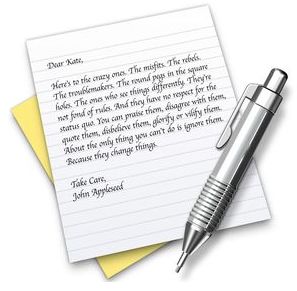
Not John Chapman, aka “Johnny Appleseed“: If you look closely at the Text Edit icon in Apple’s OS X, you’ll see the the quote there in the form of a letter to “Kate” from “John Appleseed.”
This has led some to attribute the quote to Chapman himself, which is just all wrong – the language is never something that the historical Johnny Appleseed would have used; on a side note of interest, this article at the Smithsonian suggests that Chapman was planting apples for hard liquor, not for eating.
“Apple cider provided those on the frontier with a safe, stable source of drink, and in a time and place where water could be full of dangerous bacteria, cider could be imbibed without worry.”
So who is the John Appleseed referred to in the icon, and who is Kate?
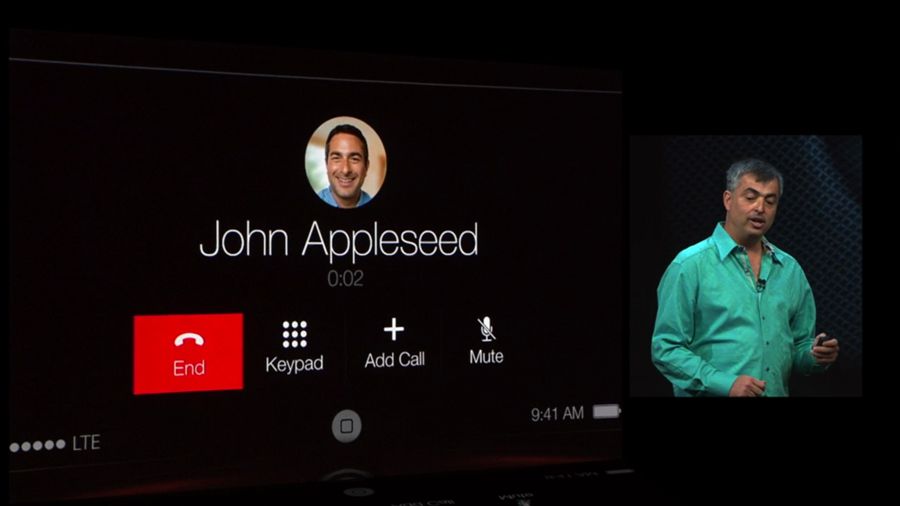
Not John Appleseed, the shadowy “Apple Insider:” This article at Techradar gives the background on who John Appleseed was – a Cupertino-based software developer who had developed Apple II software under his own name. When Apple’s CEO Mike Markkula (also a coder) developed some Apple II software under the pseudonym John Appleseed, the real Appleseed didn’t sue – he launched a campaign to meet Steve Jobs, as described in the article. Ultimately Appleseed’s image and name became the face of the iPhone and other products, although he was never really an “Apple Insider.”
Unfortunately for him, Jobs died, Apple evolved, and his usefulness as a mascot came to an end. As for Kate? Best guess is that she’s an open source text editor in KDE in the linux operating system. It is possible that during his time of interfacing with Steve Jobs, some of Appleseed’s ideas may have insinuated them into Jobs’ consciousness to have an impact later.
Yes, it was Rob Siltanen and Lee Clow (and a few others): Rob Siltanen chronicled the real genesis of the campaign’s text in an article at Forbes (caution: Forbes now makes you whitelist their site if you have AdBlock Plus installed, which I happen to think is a scummy move – but there it is.) Siltanen and Lee Clow were employed by the TBWA/Chiat/Day advertising agency that were shooting to get Apple’s business for a new campaign. The whole article is a fascinating first-person look at how the campaign was designed, pitched, and won.
Some of the original thoughts behind the text in question came from these quotes from “Dead Poet’s Society,” among others:
“We must constantly look at things in a different way. Just when you think you know something, you must look at it in a different way. Even though it may seem silly or wrong, you must try. Dare to strike out and find new ground.”
“Despite what anyone might tell you, words and ideas can change the world.”
“We don’t read and write poetry because it’s cute. We read and write poetry because we are members of the human race. And the human race is filled with passion. Poetry, beauty, love, romance. These are what we stay alive for. The powerful play goes on and you may contribute a verse. What will your verse be?”
So even though the text was really a collaborative effort, at the end Lee Clow made sure that Steve Jobs’ name was included in the credits on the campaign. As a result, I’m going with “Correct Attribution by Association” on the authorship of the quote.
Nah, that’s the xenomorph from the almost-forgotten TV drama, “Something is Out There.” For what it’s worth, it was quite terrifying at times, but noteworthy as it used this term long before the “Alien” franchise was born.
This is a skeuomorph:
It will be easily recognized as the universal “save” icon in many computer programs. But floppy disks are no longer used for saving things (for the most part,) and many young people have probably never even seen or held one.
Wikipedia defines a skeuomorph thusly:
[It] is a derivative object that retains ornamental design cues from structures that were necessary in the original.Examples include pottery embellished with imitation rivets reminiscent of similar pots made of metaland a software calendar that imitates the appearance of binding on a paper desk calendar.The term ‘skeuomorph’ is compounded from the Greek: skéuos, σκεῦος (container or tool), and morphḗ, μορφή (shape). It has been applied to material objects since 1890and is now also used to describe computer and mobile interfaces.
Webster’s 3rd International Dictionary contains 472,000 words, of which I know but a fraction. Despite the fact that my education has not been wanting and it takes a concerted effort to get me scurrying to the dictionary, this was a new one on me and I learned it over at reddit. It’s kind of like octothorpe, the ten-dollar word for the hash mark, number sign, or pound sign (#) now so commonly used at Twitter and elsewhere. #insanity
Some other examples of skeuomorphs:
An electric kettle in the form of a stove-top kettle.
This woody-style car, where the false wood grain is not part of the vehicle’s structure.
Sofware interface for an audio program, designed to look like a physical device.
What got me thinking about this is a picture of some really old candy-heart type floppy disks that must have been manufactured in the 80s or thereabouts:
Back then, these would have been much more recognizable than they are today.
So remember that the next time you click on the little disk icon to save your document, you’re using a skeuomorph.
The above image (click it to enlarge) was created by AndreaMosaic, a free software program that allows one to create the kind of photomosaics invented by Robert Silvers. I’m not sure what the legal ramifications of all this is, but I love the result.
This was the original picture I used to create the mosaic:
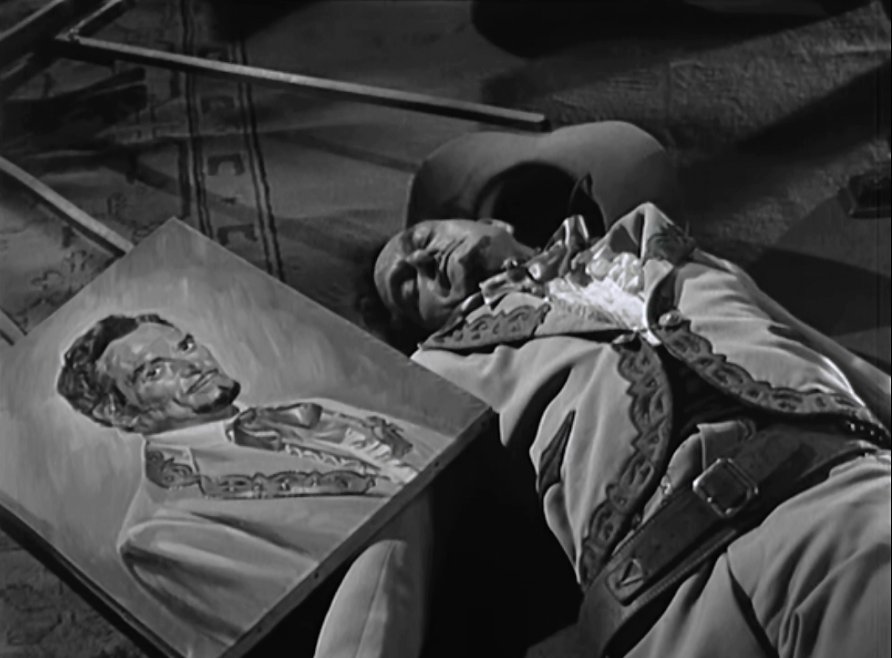
This painting is one of two created for the Warner Brothers show “Cheyenne;” the episode was “Road to Three Graves.”
Dad died well. He had lots of practice during his career.
Both painted on rice paper and in a balsa wood frame, one was crashed into during the filming; the other survived in his possession and it came to me when he passed on. Joe was a long-time visitor of the Eldred Center in Provo, Utah, where he had many friends; after his death, I donated the picture to the center where it hung by the office. I once took my wife there and showed it to her, because I was quite pleased they remembered him with such fondness.
In a sweet and romantic gesture, she later arranged to go back to the center and re-purchase it for me as a gift, a deed which brought tears to my eyes; it now hangs over our mantel during the month of June, representative of both Father’s Day and our shared birthday. A couple of years ago the old Eldred Center was demolished and moved to a new recreation center; heaven only knows what would have happened to the portrait had my beloved not rescued it. Perhaps it would have gone to the new location, perhaps not. In 2013, close to 25 years would have passed since Joe’s death, and few seniors of today would remember him; whatever the case, I am most grateful to have this treasured painting back in my possession,
The mosaic, by the way, is composed of multiple images from my father’s career, as well as his sculptures.
Every time I see an article posted about bad police behavior, someone chimes in about the officer being given “paid vacation” for his or her transgression.
It is not “paid vacation.”
Below a comment from redditor /u/thatsnotminesir, a police officer who gave a comprehensive explanation of what “administrative leave” really means, at least in his department – and it sounds like this is how it should work.
The myth I see the most of reddit is that when officers get in trouble, they just get “paid vacation.”
When an accusation of misconduct comes up, especially criminal misconduct, the officer is placed on Administrative Leave with pay. This is NOT the punishment. This is to get them off the streets while the investigation is being conducted, while at the same time, not punishing them (financially at least) until the accusations are investigated and proven.
When an accusation of Police Misconduct is investigated, there are TWO separate investigations. One is an Administrative Investigation, the other is a Criminal Investigation. They have to be separate because of Garrity.
Garrity is like the evil twin of Miranda for government employees, mostly police. After the Garrity admonitions are read to us, we MUST answer all questions, and MUST answer them truthfully. If we refuse to answer, or lie, we can be fired just for lying or refusing to answer.
That completely violates our 5th Amendment Right against self incrimination. Because of that, nothing said after Garrity can be used against us in criminal court. It can only be used in administrative actions against our employment.
Therefore, two separate investigations are conducted. An Administrative Investigation where they read us Garrity, and a Criminal Investigation where they read us Miranda. Nothing found in the administrative investigation can be used against us in the criminal, but things found in the criminal CAN be used against us in the administrative. So the criminal is usually done first, then the administrative afterwards.
Because the administrative is usually done after the criminal, that’s why it often takes time for the firing to happen, because the firing won’t happen until after the Administrative. While that seem strange to the laymen, if the Administrative was done first, and officer could say “Yeah I stole the money” under Garrity and it couldn’t be used against him in court. But if the criminal is done first, and he says “Yeah I stole the money” after Miranda, it can be used to prosecute him AND to fire him.
Once the two investigations are complete, THEN the punishment is handed down if the charges are sustained. Media articles don’t always follow up on the case, so all people read in papers is “officer got in trouble, is on paid leave.” Administrative Leave is just the beginning, not the end of the story.
Even then, the Administrative Leave isn’t fun. The take your badge and gun and you are basically on house arrest between the hours of 8am and 5pm on weekdays. You cannot leave your home without permission of your superiors, even it its just to go down the street to the bank or grocery store. You must be available to come into the office immediately at any time for questioning, polygraphs, or anything else involved in the investigation. Drink a beer? That’s consuming alcohol on duty, you’re fired. So even when officers are cleared of the charges and put back on the street, Admin. Leave still isn’t “paid vacation.”
EDIT: I did not realize the wiki explained garrity, but gave such a poor example of the admonitions, leading to some confusion. Here is a much better example.[3]
Here’s the original wiki[5] for those who wonder what I changed.
This was an eye-opener for me. Anyone who has watched cop shows knows about Miranda rights, but I had never heard of Garrity. The post was a good education – forever after, I will never wince the same way I used to when a news article mentions administrative leave.
There are a lot of stories in the media this year about police misconduct. That may be a good thing, but a lot of it seems like clickbait, low-hanging fruit for getting eyeballs on ads. It would be critical for our nation for every police department in the country to weed out its rotten apples and bad actors, but even if this were to happen, the number actually purged would be very small in comparison to the majority of men and women who entered law enforcement for better motives.
Let’s not forget what Jon Stewart recently said:
“You can truly grieve for every officer who’s been lost in the line of duty in this country and still be troubled by cases of police overreach. Those two ideas are not mutually exclusive.”
More information about Garrity
The Garrity rights, Garrity rule or Garrity warning is a protection that is utilized by many law enforcement officers each year. Simply, Garrity is an invocation that may be made by an officer being questioned regarding actions that may result in criminal prosecution.
The Garrity Warning
This article is geared toward law enforcement, but the Garrity Warning is also available for other employees of state and local government organizations.
The Garrity Warning is often misunderstood as it is inconsistently applied throughout the country. In some states it may be read to the employee before questioning begins. In other states, the employee must invoke his or her Garrity Rights.
Simply, our Constitution protects everyone from having to criminally incriminate themselves. We cannot be forced to testify against ourselves.
By invoking the Garrity, the officer is invoking his or her right against self incrimination. Any statements made after invoking Garrity, may only be used for department investigation purposes and not for criminal prosecution purposes.
The Garrity Rule stems from the court case Garrity v. New Jersey, 385 U.S. 493 (1967), which was decided in 1966 by the United States Supreme Court. It was a traffic ticket fixing case of all things.
Officers were advised that they had to answer questions subjecting them to criminal prosecution or lose their jobs. The Court held that this was Unconstitutional.
Technically, there are two prongs once Garrity has been triggered.
First, if an officer is compelled to answer questions as a condition of employment, the officer’s answers and the fruits of those answers may not be used against the officer in a subsequent criminal prosecution. Second, the department becomes limited as to what they may ask. Such questions must be specifically, narrowly, and directly tailored to the officer’s job.
Thus, the basic thrust of the Garrity Rights is that a department member may be compelled to give statements under threat of discipline or discharge but those statements may not be used in the criminal prosecution of the individual officer. This means that the Garrity Rule only protects a department member from criminal prosecution based upon statements he or she might make under threat of discipline or discharge.
Also, the Garrity Rule is not automatically triggered simply because questioning is taking place. The officer must announce that he or she wants the protections under Garrity. The above statement should be prepared in writing, and the officer should obtain a copy of it. If a written statement is being taken from an officer, the officer should insist that the Garrity Warning actually be typed in the statement. Consult your attorney and union delegate for the laws regarding Garrity in your state before providing any statement.
In New Jersey, the Garrity Warning is actually covered in the New Jersey Attorney General Guideline on Internal Affairs. Simply, if an officer being questioned invokes his Garrity Rights, the agency can contact the county prosecutor. The county prosecutor can elect to grant use immunity which will prohibit any part of the officer’s statement from being used against him or her in a criminal proceeding. But, if use immunity is granted, the officer is required to answer the questions.
Below is an excerpt from the Guideline:
If the subject officer states that he refuses to answer any questions on the grounds that he may incriminate himself in a criminal matter, even though the investigators do not perceive a criminal violation, the department should discontinue the interview and contact the county prosecutor.
If the department wants to continue its administrative interview, and the county prosecutor agrees to grant use immunity, the department shall advise the subject officer, in writing, that he or she has been granted use immunity in the event his or her answers implicate him or her in a criminal offense. The officer must then answer the questions specifically related to the performance of his or her official duties, but no answer given by him or her, nor evidence derived from the answer, may be used against the officer in a criminal proceeding. At this point, if the officer refuses to answer, he or she is subject to disciplinary charges for that refusal which can result in dismissal from the agency.
It is, of course, always recommended to seek advice from an attorney qualified in the field before answering any formal questions.
Below is the actual Garrity Warning:
1. I am being questioned as part of an investigation by this agency into potential violations of department rules and regulations, or for my fitness for duty. This investigation concerns
2. I have invoked my Miranda rights on the grounds that I might incriminate myself in a criminal matter.
3. I have been granted use immunity. No answer given by me, nor evidence derived from the answer, may be used against me in any criminal proceeding, except for perjury or false swearing.
4. I understand that I must now answer questions specifically, directly and narrowly related to the performance of my official duties or my fitness for office.
5. If I refuse to answer, I may be subject to discipline for that refusal which can result in my dismissal from this agency.
6. Anything I say may be used against me in any subsequent department charges.
7. I have the right to consult with a representative of my collective bargaining unit, or another representative of my choice, and have him or her present during the interview.
Assistant Prosecutor/Deputy Attorney General Authorizing: __________________________
Signature:________________________________
Date:_______________ Time:_____________
Location:_________________________________
Witnessed by: ______________________________
______________________________
These are sometimes referred to as the Garrity rights.













 Playing in the World Game