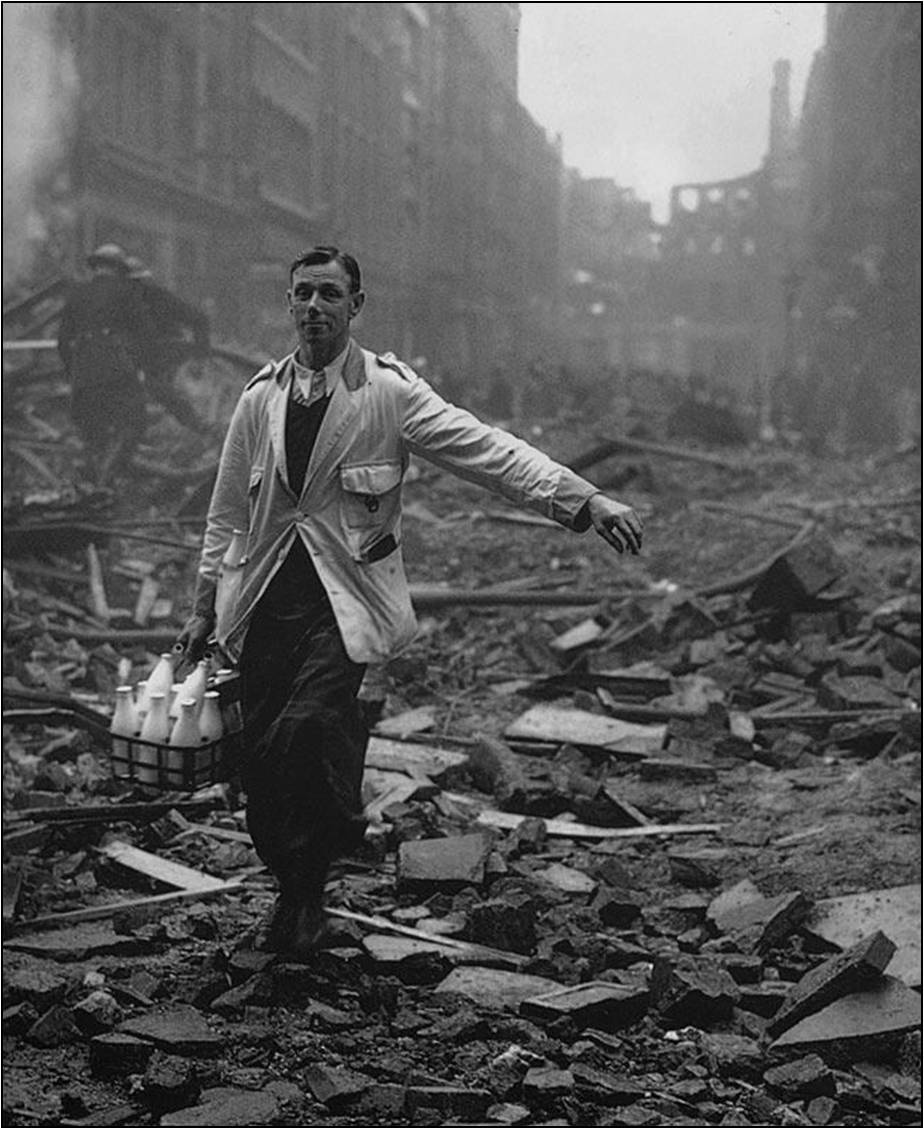
What looks like an object lesson in keeping the upper lip stiff turns out to be a bit of propaganda designed to give courage to Londoners living in unimaginable conditions… but carries a powerful message just the same. The photograph from 1940 was staged; the milkman is the photographer’s assistant and posed for this photo in order to boost the morale of the brave citizens of London. However, the blitz was real, and I have no doubt that the photo represents countless acts of just such courage and endurance which were not captured on film.
The 267-day Blitz left 30,000 Londoners dead and another 50,000 wounded… without dampening British resolve or significantly damaging its ability to wage war. Without meaning disrespect to anyone or minimizing their loss, these numbers make the attacks on 9/11 look small by comparison. The high-profile nature of the target, however, and the fact that modern-day Americans have never experienced destruction of this nature on their home soil, increased the psychological impact of the event. In both cases, the forces of evil failed in their purpose, and only left their intended victims stronger in the end.
I found a reference to this interview elsewhere, but the original link was dead. Fortunately I found the full interview at another site, and choose to reproduce it here for preservation. It is a piercing look at an honest and complex man. I have added the images to the original text.
Since coming to the paper three years ago this week, the Star’s theatre critic Richard Ouzounian has attracted considerable attention to his series of celebrity interviews. McArthur and Company has just published 56 of them under the title “Are You Trying To Seduce Me, Miss Turner?” named after his encounter with the star of the stage version of The Graduate. The excerpt that follows is one of his favourites.
This is one that I owed Richard Harris.
When we met at the Toronto Film Festival in September 2001, I felt as if I had spent a privileged patch of time with a unique man.
As you’ll read below, he opened his heart and soul to me about a great many things.
Unfortunately, most of it never got into the paper. When I returned from our time together, my editors told me to “play up the Harry Potter angle and forget about the rest,” just as Harris had suspected they would.
The next day, when the truncated interview appeared, Harris was rightly furious and vented about it to one of my colleagues.
“I trusted that bastard, and told him a lot of important things, but what does he print? Nothing but goddamn Harry Potter.”
That day, by the way, was Sept.11, and everything soon acquired a different perspective.
I never saw Harris again, and I thought of trying to write to him, but time slipped through my fingers.
Harris died on Oct.25, 2002, of Hodgkin’s Disease. And when, shortly after his passing, I found out that this book was to be published, I made myself a promise. I vowed to dig out my notes from that afternoon we spent together and print the interview that Richard Harris had entrusted me to deliver.
Here it is.
“Don’t ask me about that damned stupid Harry Potter movie. That’s not why I’m here.”
Richard Harris, as always, isn’t afraid to speak his mind, even to the point of denigrating his work as Aldus Dumbledore in the upcoming Harry Potter And The Philosopher’s Stone.
He’s at the Toronto International Film Festival to help drum up support for something that he does believe in: My Kingdom, the film by Don Boyd that sets Shakespeare’s King Lear in contemporary Liverpool.
Harris, who turns 71 on Oct.1, plays a British crime lord named Sandeman whose wife’s murder causes him to divide his “kingdom” among his three daughters.
“I like this movie because it’s not afraid to embrace the darkness. Most films run around lighting tiny candles and think they make a damn bit of difference. Don Boyd has a pretty good idea of how black the universe can be and so do I.”
His rheumy eyes search me out. “I know what it’s like to scrape the bottom of the barrel of despair and stir the shavings into your Guinness. That’s a cup we’ve drained to the dregs many times, both me and Lear.”
The parallels with Shakespeare’s tragedy are skilfully worked out by director Boyd, and Harris does some of his richest work, made even more effective because it’s so understated. “At first they wanted me to rant and rave, but I told them no. People will see it and say, `Look, it’s Richard Harris going over the top again,’ and I won’t do it.”
He sees me smiling and pokes my arm roughly. “All right now, tell the truth, what was the worst bit of overacting you ever saw me do … out with it!”
I volunteer that it was probably in 1977’s Orca and Harris laughs until he’s stopped by a fit of coughing, something that happens several times during our 90 minutes together.
“Oh, that fecking killer whale! What a piece of shite that was. No wonder I was hitting the blow so heavy in those days.” His gaze is suddenly level. “You know cocaine nearly killed me?” I nod feebly in agreement, having heard the gossipy reports over the years. “My heart stopped, and they had to bring me back to life again — 1978, I think that was.”
He sips at his coffee. “I’d like to say I changed my life overnight, but that wouldn’t be the case. I tried though, and I got better … even if my acting didn’t.”
I ask him why he seems so eager to put himself down.
“Because I had a gift of gold once, and I threw it all away for a handful of silver. I took the talent God gave me and pissed it into a river called Hollywood.”
He was one of nine children born to an Irish farmer named Ivan Harris in Limerick on Oct.1, 1930. “All nine of us were looking for a way out, and I thought mine was going to be a rugger, but the TB ended all that.
“So I decided to become an actor instead. Why? I had the gift of the gab and I could charm the knickers off any girl that drew breath. I was a handsome bugger then. No, not handsome, beautiful.”
Harris sees me staring askance at his vainglorious boast and chafes. “Well, I was beautiful, dammit, and I’m such an ugly old beast now that I can take some pride in the joys of my youth.”
He made a huge stage success in Brendan Behan’s The Quare Fellow, and a spate of British films followed, culminating in his performance as Frank Machin in Lindsay Anderson’s 1964 This Sporting Life.
“They cast me as a rugger player who was a bastard. That didn’t take much acting from me. No wonder it made me a star.” And brought him his first Oscar nomination for Best Actor.
After a detour to Italy to star in Michelangelo Antonioni’s Red Desert, Harris went to Hollywood, making a decorative hole on the screen in films like Hawaii and Caprice.
Then, in 1967, came Camelot.
“Don’t ask me why I still love that bloody story so much. But I can’t look at the movie anymore. I was too gorgeous then. It makes me weep to see what a rag-and-bone man I’ve turned into.”
A young waiter retrieves Harris’s coffee cup, giving his disreputable looks a wide berth. “Can I smoke here?” Harris shouts after him. Getting no answer, he shrugs and lights up a cigarette. “I’ll just do it till they order me to stop, which is what I’ve done all my life.”
Camelot made him a superstar, and then he hopped to the top of the recording charts as well, with his unexpected rendition of Jimmy Webb’s “Macarthur Park.” I tell Harris how much I used to enjoy hearing him sing it.
“Sentimental bollocks,” is his initial reply, but then he softens. “I still remember some of it, especially when I’m in my cups.” And then, magically, he rasps out a few lines:
“I will drink the wine while it is warm
And never let you catch me looking at the sun …”
We look at each other for a moment, and then he breaks the spell. “That’s not bad, but don’t ask me why they left that fecking cake out in the rain …”
And again he laughs, until a bout of coughing stops him. “I’m not well, not at all well, but after all I’ve done to my body in my lifetime, that shouldn’t surprise me.”
Harris had one last film hurrah with the surprise success of A Man Called Horse in 1970, but for the rest of the decade, the work got worse and worse, while the antics got wilder and wilder.
In the 1980s, the excesses of his early days gave way to relative sobriety, while years of touring as King Arthur in the stage version of Camelot rebuilt his finances, and allowed him the luxury of choice.
“When you’re poor and raising a family, you take what comes along. Now I can commit to the work I do. I cannot put it on at eight in the morning and take it off at six in the evening. When the picture is rolling I give it my all, and then when it’s over, I disappear. I tell the rest of the cast, ‘You’ll never hear from me again.'” ¹
Quality films like 1990’s The Field, which earned him his second Oscar nomination, were the result of his new work habits, as are pictures like My Kingdom, which he’s eager to start discussing again after our journey through his past.
The Field
My Kingdom
“I like the way they’ve worked out my motivation. You see, the beginning is the tricky part. You always wonder why Lear gives his kingdom away, but now that they’ve added the murder of my wife, I have a reason.”
He smiles wickedly. “It reminds me of the day years ago when John Major put his leadership of (Britain’s) Tory party up for grabs. I ran into Brian Mulroney in an elevator at the Savoy Hotel, and asked him what he thought of Major’s move. Mulroney shook his head and said to me, ‘I don’t understand it. You never give up power.’ “
Another thing Harris likes is the fact that this Lear has no Fool, but spends his time instead with his grandson, and Harris is well known for his devotion to his grandchildren.
In fact, were it not for one of them, he would not have agreed to take part in the Harry Potter films.
“Look, I had never even read the books,” admits Harris. “All I knew was that they kept offering me the job and raising the salary every time they called me. And I turned them down for a very good reason.”
“You see, anyone who signs up for the Potter films has to agree to be in the sequels, all of them! I didn’t know if that’s how I wanted to spend the last years of my life, and so I said no.”
He chuckles as he recalls the flurry surrounding his reluctance. “Newspapers, radio, television all had a go at me. The world wanted into this film and this cantankerous f—er called Richard Harris said no.
“But then my granddaughter Ella, who is 11 and whom I worship with my life, came to me one day and said, `Papa, I hear you’re not going to be in the Harry Potter movie.’ I told her that was indeed the case, and then she looked me right in the eye and said, `If you don’t play Dumbledore, then I will never speak with you again.'”
Harris holds out his hands to show how helpless he felt. “What could I do? I didn’t dare have that hanging over my head, and so I said yes.
“It actually turned out to be a pleasant experience. I worked two days one week, then two weeks off, then a few more days’ work. Maybe three weeks in all spread out over months. Very nice at my age — that’s the way to do it.”
He’s also fond of his leading man, 12-year-old Daniel Radcliffe, who plays Potter. “Well, a bit before shooting started, (director) Chris Columbus asked if I’d mind spending some time with the kids so they’d get used to me, and I said `Sure.’ So we all got together one evening, and I sat there showing them card tricks while they sat around discussing show business.
“Finally, Chris got us to read some of our scenes together, and when I finished, young Daniel said to me, `That was quite a good reading. I think you’ll be good in the part.’ Lord, to have that much confidence at his age. I don’t have that much confidence now.”
Although he hadn’t read the books before accepting the role, Harris has come to have great respect for author J.K. Rowling. “I’d like to crawl inside her mind and her bank account. Her command of language is extraordinary. My name, Albus Dumbledore, means `a white Dorset bumblebee,’ and that’s certainly what I look like nowadays.”
Harris, suddenly tired, looked at me. “There, I gave you the stuff about Harry Potter. That’s what the papers want. But try to use the rest of what I said as well.
“Because, you see, I don’t just want to be remembered for being in those bloody films, and I’m afraid that’s what going to happen to me.”
As he stood up, we shook hands, and he held mine for a long time. “To tell you the truth, lad, I’ve done damn little that I’d like to be remembered for — except my sons.”
My Kingdom has never been released in North America, except for a one-week “memorial” showing in Los Angeles in December 2002, after his death.
It deserves a wider audience for many reasons, but most of all, to see this great actor looking unafraid at the shadow of mortality as it moved inexorably toward him.
So let us not remember this man only for Rowling’s Dumbledore, but for a long and stellar career. What he left us to marvel at could hardly be called “pissing away his gift,” but then artists are always their own worst critics.
The Gladiator
The Old Wolf has spoken.
Footnotes
¹ What an experience that must have been for his fellow actors. Had I been that fortunate, I would have said (as did Henry James said in “The Real Thing”), “I’m content to have paid the price–for the memory.”
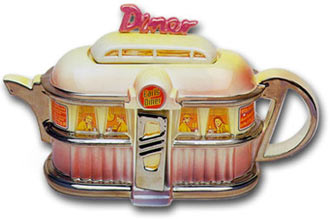
This lovely toaster teapot comes you courtesy of The Teapottery. Only one of many charming designs for those who want a bit of whimsy with their cuppa.
Diner teapot
Airstream teapot (approved for its authenticity by Airstream, Inc.)
Visit The Teapottery’s web page for much, much more teapot goodness.
Deliciousness like this cannot be hid under a bushel, but rather must be set atop a hill for all to see.
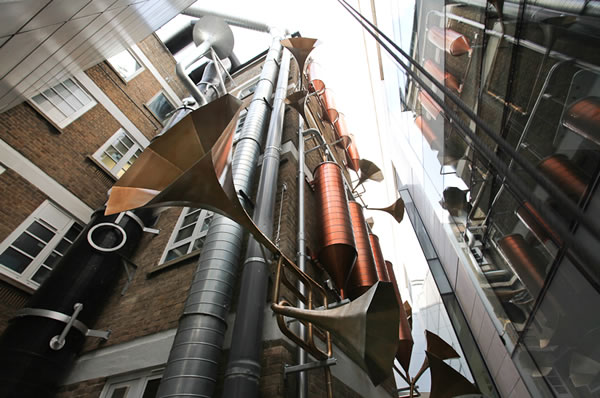
An architectural project, a secret garden of music and healing, dwells in an unlikely space between London’s Great Ormond Street Hospital and a neighboring building. It looks like Animusic crossed with the Pompidou museum in Paris, sounds like the Swingles on magic mushrooms and accompanied by a chorus of angels; and feels as though Agatha Heterodyne had landed on Pandora and tried to recreate the world of Alice in Wonderland.
A friend of mine posted this picture of the Glowing Eye nebula (gacked from APOD) in the constellation of Aquila, taken by the Hubble telescope. It’s clear that the universe is watching.
However, we are peering just as deeply into the void, and now moreso than ever.
According to the Miami Herald, the Atacama Large Millimeter Array, better known as ALMA, is by far the largest radio telescope on earth. Interestingly, despite their size, the dishes are portable. Engineers transported them around the plateau on two giant flat-bed trucks. What the telescope picks up depends on where the antenna are positioned. Click to the Herald article for more details.
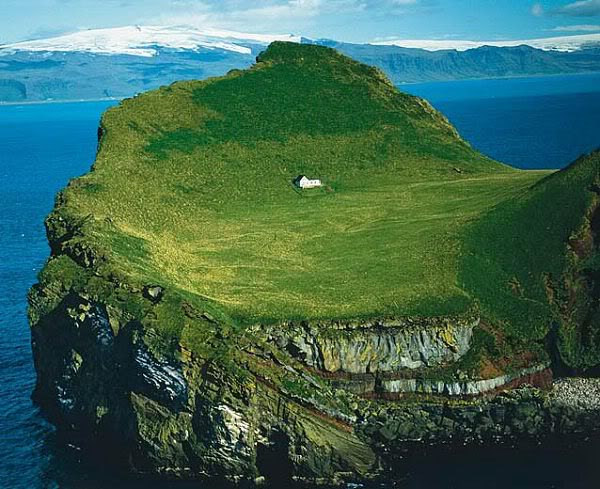
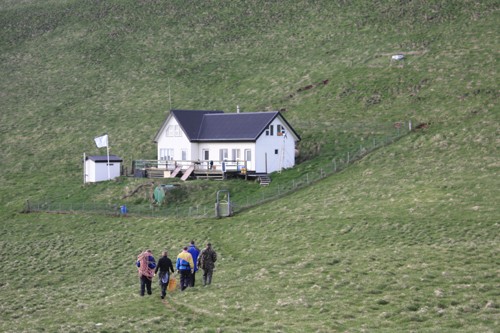
This picture showed up on Reddit with the title “Because fuck everybody,” and after I stopped laughing, it piqued my curiosity.
As it turns out, this is the island of Elliðaey (63° 28’05.10″ N, 20° 10’31.98″ W), the third largest island of the Westman Islands, located south of Iceland. The island is a mere 0.18 mi² in area and is uninhabited. From this website, we learn the following information (translation is mine, so it’s imperfect but gives the gist):
“On the island is a large fishing house owned by the Ellidagrim Islands Society, which engages in puffin egg hunting in summer and in spring. In earlier times there was a hunting lodge called simply “dwelling.” The first building which was built on the island still stands. It is used for storage, and is west of the ‘Skápana.’[1] In 1953, a new lodge was built at the foot of Hábarð (the highest peak on Elliðaey) because the old building failed the test of time. In 1985, work began on a new two-story fishing house which was attached to the house that was built in 1953; it was completed in 1987. In 1994 it was discovered that the 1953 edifice had deteriorated to such an extent that it was no longer useable. It was therefore demolished and another house built instead in the same location, with construction being completed in 1996. Between 2000-2001, a small house west of the lodge was built, which houses the Ellidagrim Islands Society sauna.”
A recent picture showing the 1996 lodge, and the small sauna finished in 2001.
There’s a lot of misinformation out there about this island, chief among which is that Iceland gave Elliðaey to the singer Björk as a royalty payment for her services to the nation.
From “The Independent”, 2-10-2000:
THE ICELANDIC singer Björk may have put her nation on the map, but plans to grant her exclusive use of an uninhabited island off the west coast to reward her for her services have run into difficulties.
Earlier this week David Oddsson, Prime Minister, told parliament: “Björk has done more for the popularity of Iceland than most other Icelanders. My view is that she may be given the use of this island [Ellidaey] as a royalty payment, as recognition from the state.” But, amid an uproar in the country, the government has had to reconsider its generosity. Yesterday Mr Oddsson’s office denied Ellidaey had been sold or leased to the singer. If sold, said a spokesman, it would be only to the highest bidder. Icelandic radio reported rumours that the musician was no longer interested in the island. She has neither confirmed nor denied reports and was not available for comment yesterday. Despite her much-professed love for Iceland, Björk is neither based there full-time nor does she sing in Icelandic.
Notice that the Independent article says “off the west coast.” The confusion arose because there is another island with the name of Elliðaey to the west of Iceland (65° 8′ 42.86″ N, 22° 47′ 10.99″ W), just north of Stykkishólmur,
which is most likely the one referred to by the Prime Minister in his abortive but generous gesture. Mr. Oddsson thought it would be a nice idea, but local protests deep-sixed the plan. As for the island of Elliðaey to the south, the one with the hunting lodge, it was never associated with Björk in any way.
From 1970 to 1971, I lived in the Royal Palace in Naples, Italy. Yes, it was the basement, but it was still the Royal Palace. During that time I was intimately associated with the United Seamen’s Service, a non-profit organization serving the needs of merchant sailors around the world. This was the experience of a lifetime, and here is the story. Caution: This is a lo-o-n-g post. Look at the nice pictures if you don’t feel like reading.
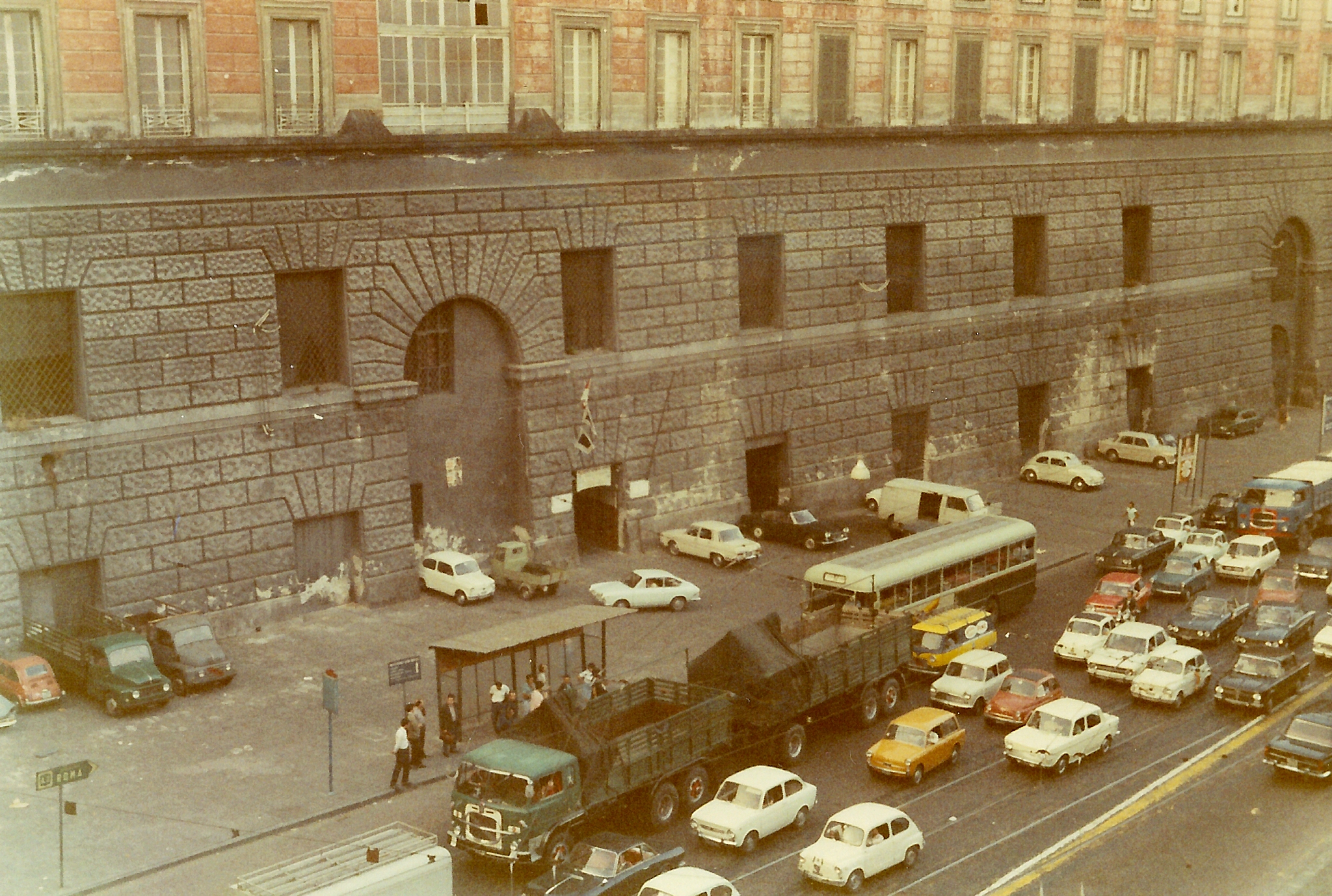
Il Palazzo Reale (Click for a larger image). The star indicates my window. You can see the dome of the Naples Galleria in the background.
Palace Entry, View 1 – Upstairs it was a lot fancier.
Palace Entry, View 2
Ballroom
But back to the basement for me. In 1969, my mother Margaret Draper was finishing up service as the assistant director for the United Seamen’s Service club in Cam Ranh Bay, Viet Nam. Her departure, like that of everyone else, was precipitated by the imminent fall of the South. Her next assignment was to become the director of the club in Naples. She invited me to come along for a year. I thought about it for 0.68 seconds, and gave her an enthusiastic “yes.” Below, I re-blog an article written by Jason Chudy in the Stars and Stripes on May 17, 2004. I hope he doesn’t mind; it’s a wonderful history of the club, written at the close of an era. Thereafter, we’ll go back in time a bit.
NAPLES, Italy — For more than 53 years, the Naples United Seamen’s Service Center hosted aircraft carrier and car carrier crews, cruise ships and even congressmen. Unfortunately, changes in location and time led to the center’s April 16 [2004] closure. But for the two-man staff of director Bill Moerler and long-time employee Daniele D’Ettore, as well as for the hundreds of thousands who stopped in during the center’s nearly 54 years, the memories will remain.
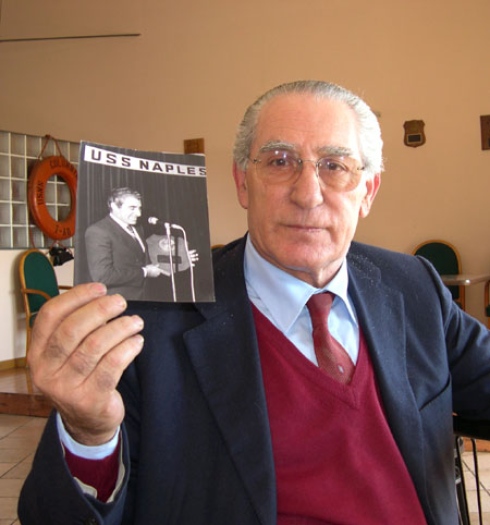
Daniele D’Ettore holds a photo showing him receiving a plaque for the United Seamen’s Service Center in Naples, Italy, during his time as director from 1974 until 1982.
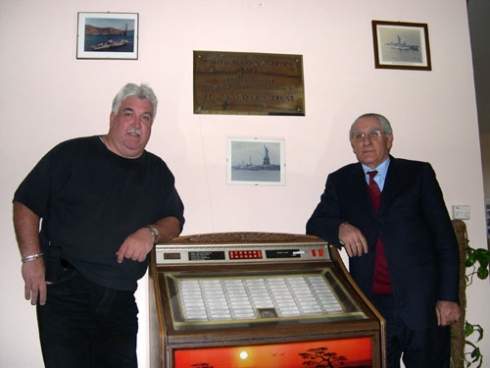
United Seamen’s Service Center director Bill Moerler, left, and long-time employee and former director Daniele D’Ettore lean against the center’s jukebox in Naples, Italy. The jukebox, like D’Ettore, has been serving center patrons for more than 50 years. D’Ettore, who’s done everything at the center from doorman to director in his 53 years of service, said that the jukebox has been with the center for as long as he has. The jukebox has original 45s featuring a wide range of music, from Roy Orbison to Michael Jackson.
Wisconsin Sen. Alexander Wiley mugs with sailor Lawrence Seliger and Army Cpl. Mark Seliger, constituents from Marathon, Wis., in this undated photo. Both sailor and senator alike visited Naples’ United Seamen’s Service Center, as well as many top Italian singers and musicians, and military and civilian officials.
“It was a hotbed of activity, almost standing room only,” said Cmdr. Jim Romano, chief staff officer of the Naples-based Military Sealift Command Europe. Romano first visited the center as a seaman apprentice in September 1973, returning more than a half-dozen times since. The center started out in the Galleria Umberto I in 1950 and moved to the former horse stables of the Naples Palazzo Reale (Royal Palace) a few blocks away the next year. Palazzo Reale, which was home to the Bourbon kings in the 1800s, became home to the center until 1997. Its location was an easy stroll from the Navy’s fleet landing. During its heyday, the club drew hundreds of people a night. When an aircraft carrier came to visit, thousands would pass through the doors each day. “Everyone talked about the seamen’s center,” said Romano. “Probably 90 percent of the sailors pulling into Naples … had been to the seamen’s center. It was the stopping place before we went out in town or where after … we’d finish up the evening.” Romano also visited Naples, and the center, with the aircraft carrier USS Forrestal in 1978. “Things were hard,” said D’Ettore about the carrier visits. “We’d finish about 3 or 4 o’clock in the morning when a carrier was in Naples.” D’Ettore has worked at the center for 53 years, doing everything from doorman to director. His wife, Elena, cooked in the center’s kitchen for 45 years, only hanging up her apron last month. Those carrier visits, Moerler said, could earn the center enough money to operate for three or four months. The center wasn’t only popular with the Navy. Visiting cruise ships would send over their bands and stage shows to perform. Hundreds of undated photos, many showing musicians and high-kicking dancing girls, sit in a box at the center. D’Ettore remembers many popular Italian singers performing at the club, too. Many visiting politicians and dignitaries also stopped in. For example, the center, in conjunction with the United Service Organizations, hosted President Clinton’s secretary of defense, William Cohen, and his wife for dinner.
Location is key
The center at Palazzo Reale was a top Naples nightspot for military and civilian alike, said Moerler. Though the general public couldn’t enter the club, a young woman on a sailor’s arm wouldn’t be denied admission. For many years, though, the city government wanted the center gone. One reason, Moerler said, was because of Naples’ desire to reclaim and restore Palazzo Reale. Another reason, although it was never publicly acknowledged, was that the center drew sailors and other mariners away from local businesses. Prices for beer and food were cheaper at the center because of its nonprofit status and low rent. In 1997 the government succeeded in their attempts and forced the center to move into the port itself. The move, which took them about three kilometers from the Navy’s fleet landing, eventually helped kill the center for good. During a visit by the aircraft carrier USS Enterprise and cruiser USS Gettysburg earlier this year, not one sailor stopped in. Not only had the center’s location changed, but also its clientele.
Changing times
“When I came in the service, you could work hard and play hard,” said Romano. “It was kind of an accepted thing. If you went out and had too much to drink … as long as you didn’t get in trouble … they put you back in your rack [bed] and if you got up the next morning and got to work, nothing was said.” Now, Moerler said, sailors and civilian mariners don’t drink like they used to, nor do they want to spend their short port visits in a bar. That time spent drinking could not only cost a lot of money, it could cost a career. Civilian mariners could lose their license for being intoxicated at work while military members can be reduced in rank for even a first infraction. Navy ships also don’t make port visits to Naples like they used to. In the past few years only a handful of ships have stopped in Naples, including only two aircraft carriers. Even the merchant ships have changed operating schedules. More time in port means less time at sea making money for their owners. Some ships aren’t even in port long enough for the crews to get off. And when mariners would stop in, they’d buy items that didn’t earn the center enough money to survive. So now, Moerler will move on to a seamen’s center in Germany and D’Ettore will run his family bar. Everything left in the club will be sold or moved to other centers. “I think it’s sad,” said Romano. “You always knew you could stop by and feel welcome. It was part of coming to Naples.”
———–
USS: Aiding seafarers The United Seamen’s Service was started in 1942 as a nonprofit, nonsectarian organization to provide health, welfare, education and recreational services to the men and women of the American Merchant Marine and seafarers of other nations. Since then, the USS has increased its customer base. It serves American seafarers and their family members, U.S. military and government civilians as well as seafarers of other nations and people working in the maritime industry. “We’re like a USO [United Service Organizations] for the Merchant Marine,” said Bill Moerler, Naples USS Center director. The service has eight centers worldwide: Casablanca, Morocco; Bremerhaven, Germany; Diego Garcia; Guam, Manila, Philippines; Pusan, South Korea; Okinawa, and Yokohama, Japan. Two USS centers in Genoa and Naples, Italy, have closed within the past year. The remaining centers provide recreation, phones, fax, mail and money order services, food and beverage sales, gift shops, small libraries and health articles. Books in the libraries are kept up to date by shipments from the USS-affiliated American Merchant Marine Library Association. Center personnel also provide an outreach program that brings USS services to seafarers aboard ships, in hospital or even jail. Both U.S. Public Law and Department of Defense regulations establish “cooperation with, and assistance to” the USS in support of its mission. The Navy’s Military Sealift Command Europe has close ties with the USS, serving as its liaison with the Naples military base. “Over many years MSC Europe, as with MSC in general, has had a special relationship with the USS,” said MSC Europe’s public affairs officer Ed Baxter. “They provide a good service, especially in places where a military infrastructure is not available,” he said about USS.
The Facilities
As mentioned, in 1950 the USS club moved to the basement of the Palazzo Reale in 1950. The area was used both as a stables and a storage area and supply depot for the palace – based on what I was told, at one point ships could come right up to the waterfront side of the building and discharge their cargo for easy access.
United Seamen’s Service – Naples – 1969 (Via Acton 18, in the Royal Palace basement)
One would enter the club by passing through the metal gates on the street level, and ascend to the first floor via a long stairway, passing storage rooms which were used for keeping supplies and sawdust (very useful for cleaning up after sailors who had had too much to drink.) The stairs led to the main entrance of the club.
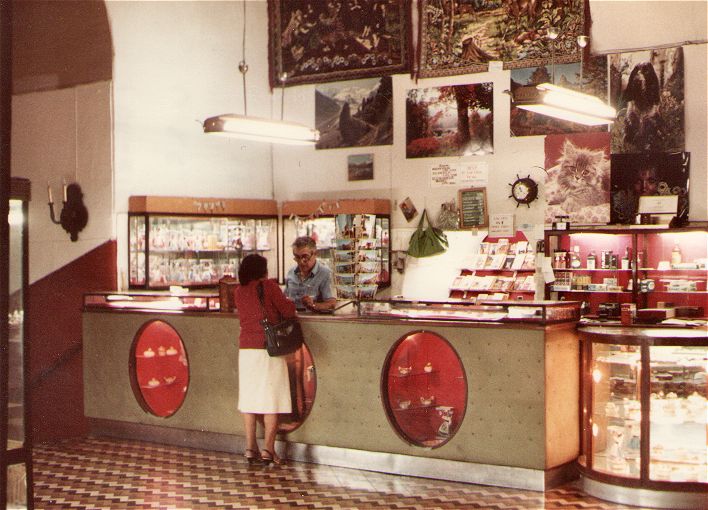
Daniele D’Ettore manning the Gift Shop in the 1980’s
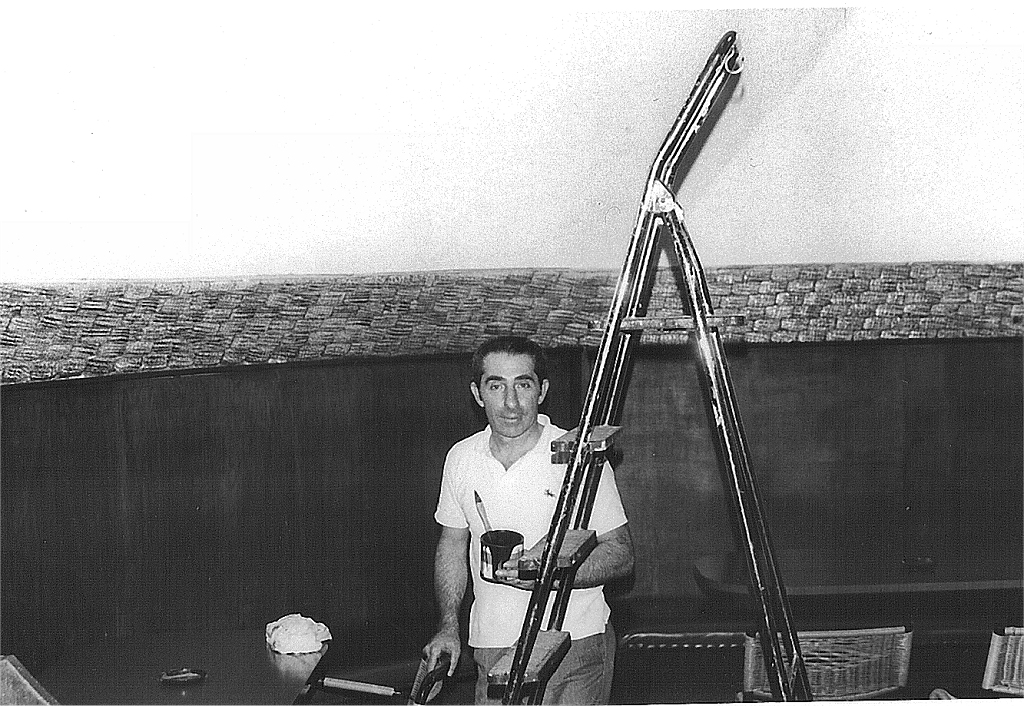
Looking back at the entrance from the library. Notice the 40-foot ceilings; painting those was fun for the staff.
Straight ahead was a lounge area and a small rotating library, where sailors and seamen were encouraged to borrow books and leave others that they had finished reading. About the only channels available on the TV were RAI1 and RAI2.
Turn left, and you’d find yourself in the main dining room/bar area: kitchen to the right, bar to the left.
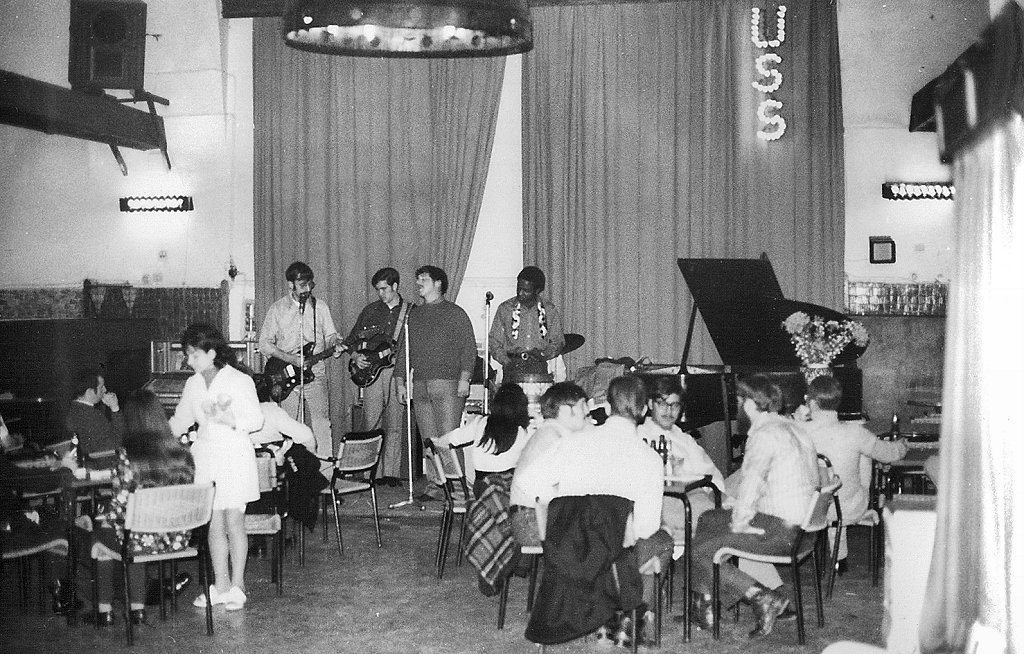
Music and dancing were common here.
The kitchen. Lots of good food came from here.
The menu. Prices had been altered to reflect changing economic conditions – some up, some down. At the time, the Lire was still at 624 to the dollar, which made 100 Lire about 16¢.
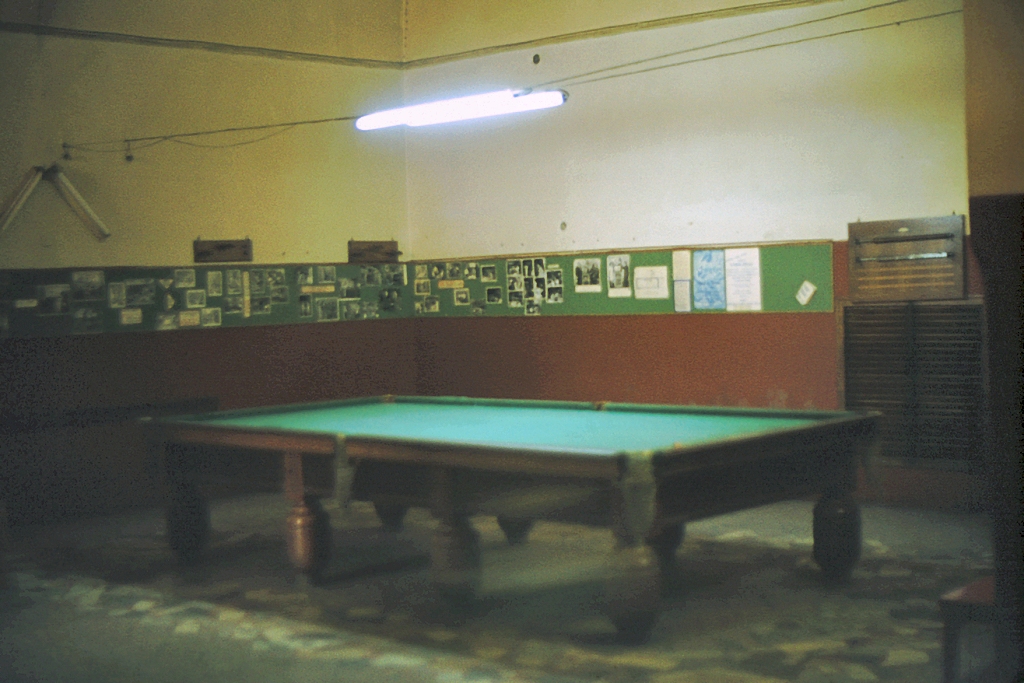
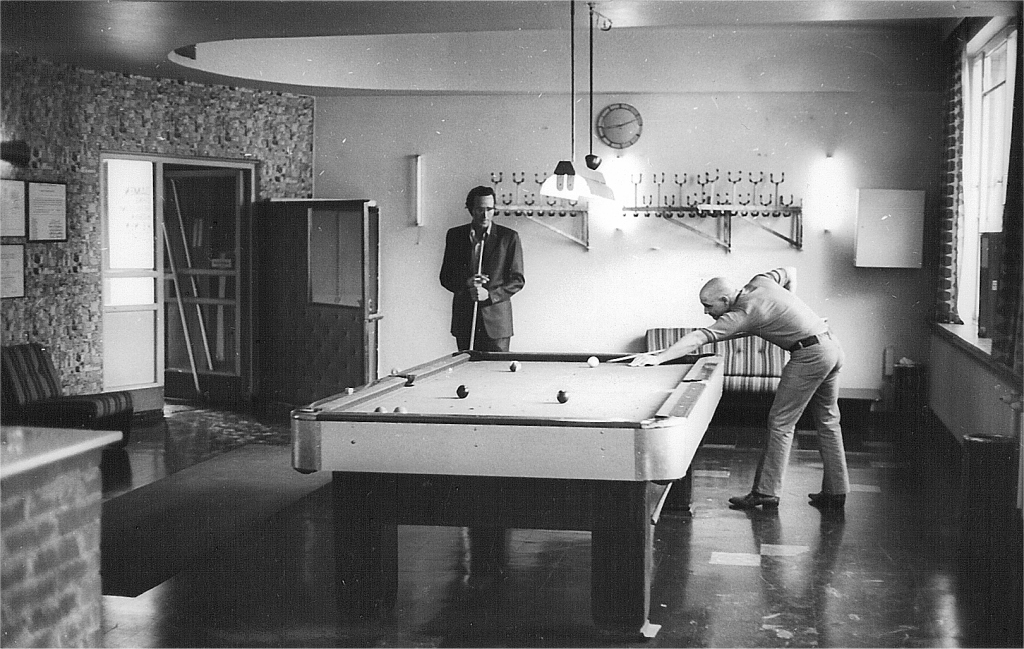
In the back, entertainment. This was a 14-foot snooker table. We once had to move it so that the floor around it could be repaired with terrazzo. It must have weighed 16 tons, and took at least a dozen hefty sailors to move.
Slot machines and other games were available.
All the way in the back of the club was a large party room which had been resurrected from long inactivity and spruced up. In between were sailor’s dormitories for emergency lodging, the manager’s apartment, and storage rooms.
The People
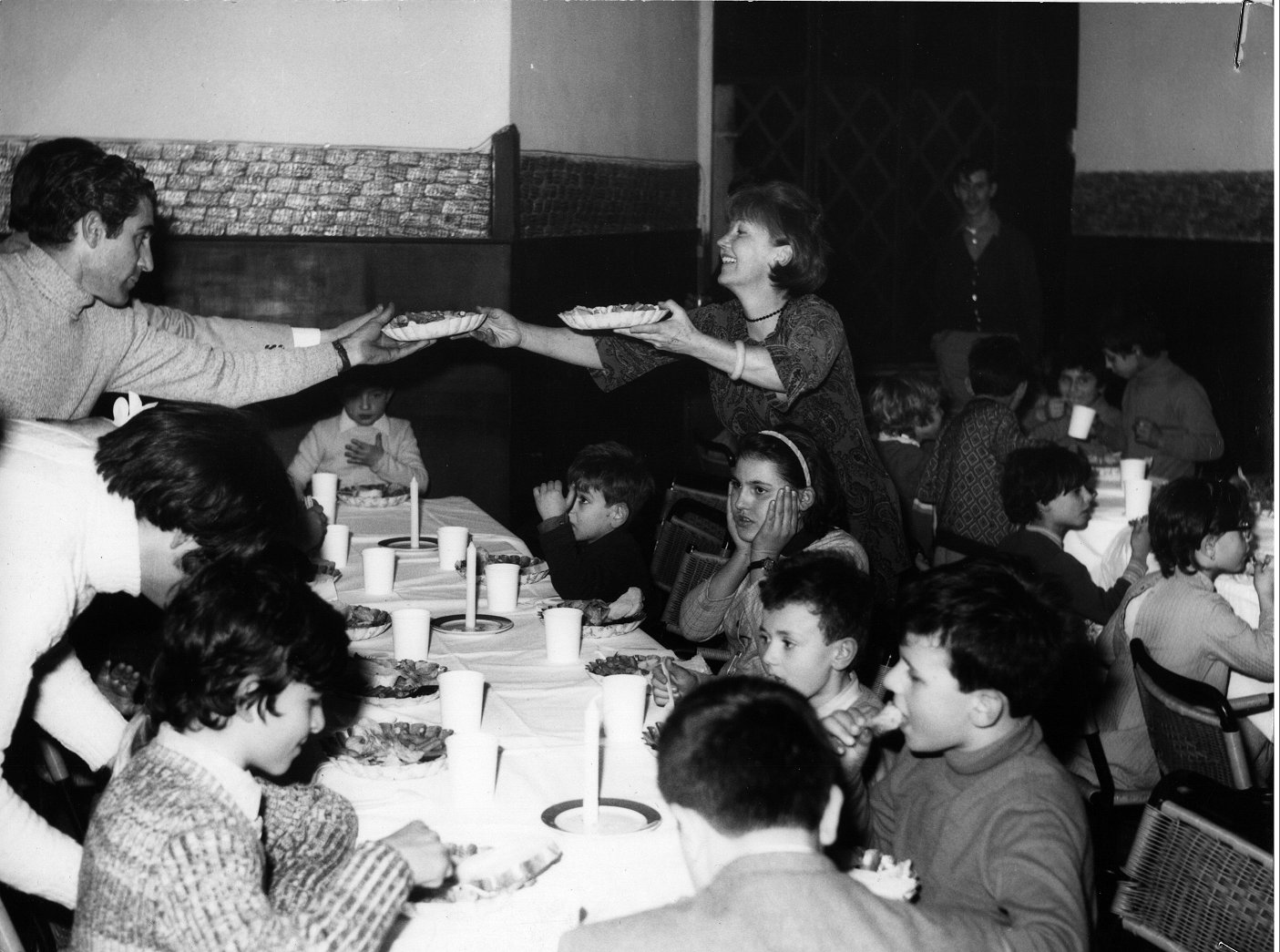
Daniele D’Ettore assists director Margaret Draper (right) in serving a party of local orphans hosted at the center.
Angela (waitress and bartender) and Elena D’Ettore in front of the phone booth Margaret had designed and installed.
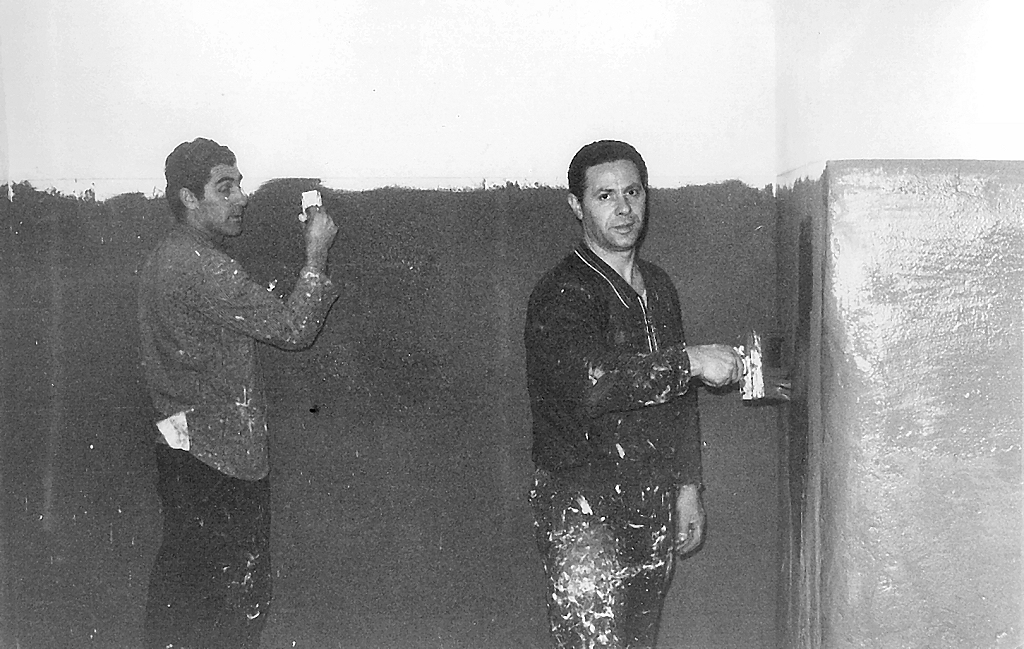
Daniele D’Ettore and Franco Molino painting one of the dormitory rooms.
Agostino Maiorano (Accountant) and Daniele D’Ettore in 1983
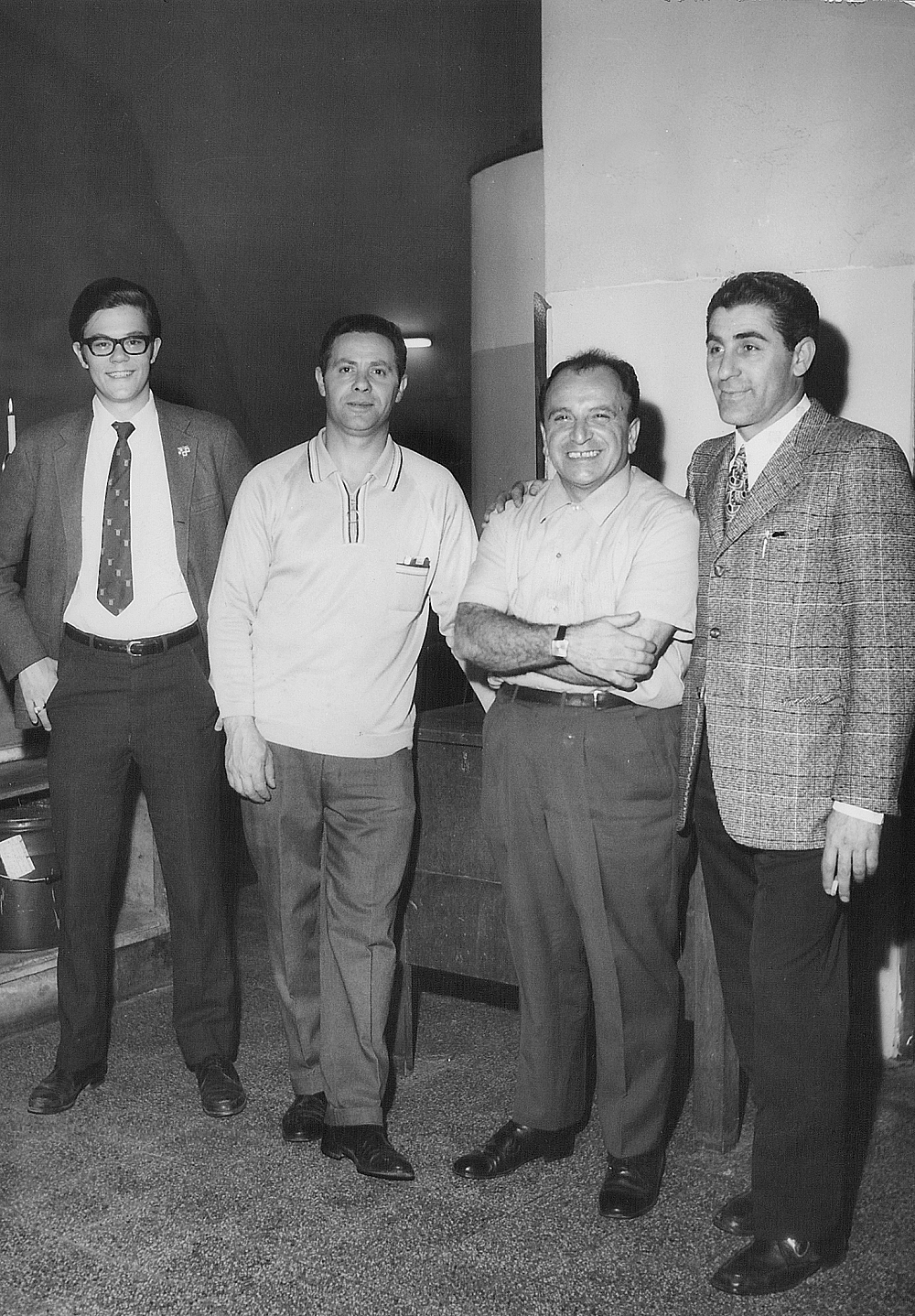
Some random bum off the street, Franco Molino, a friend or relative, and Daniele D’Ettore in 1970.
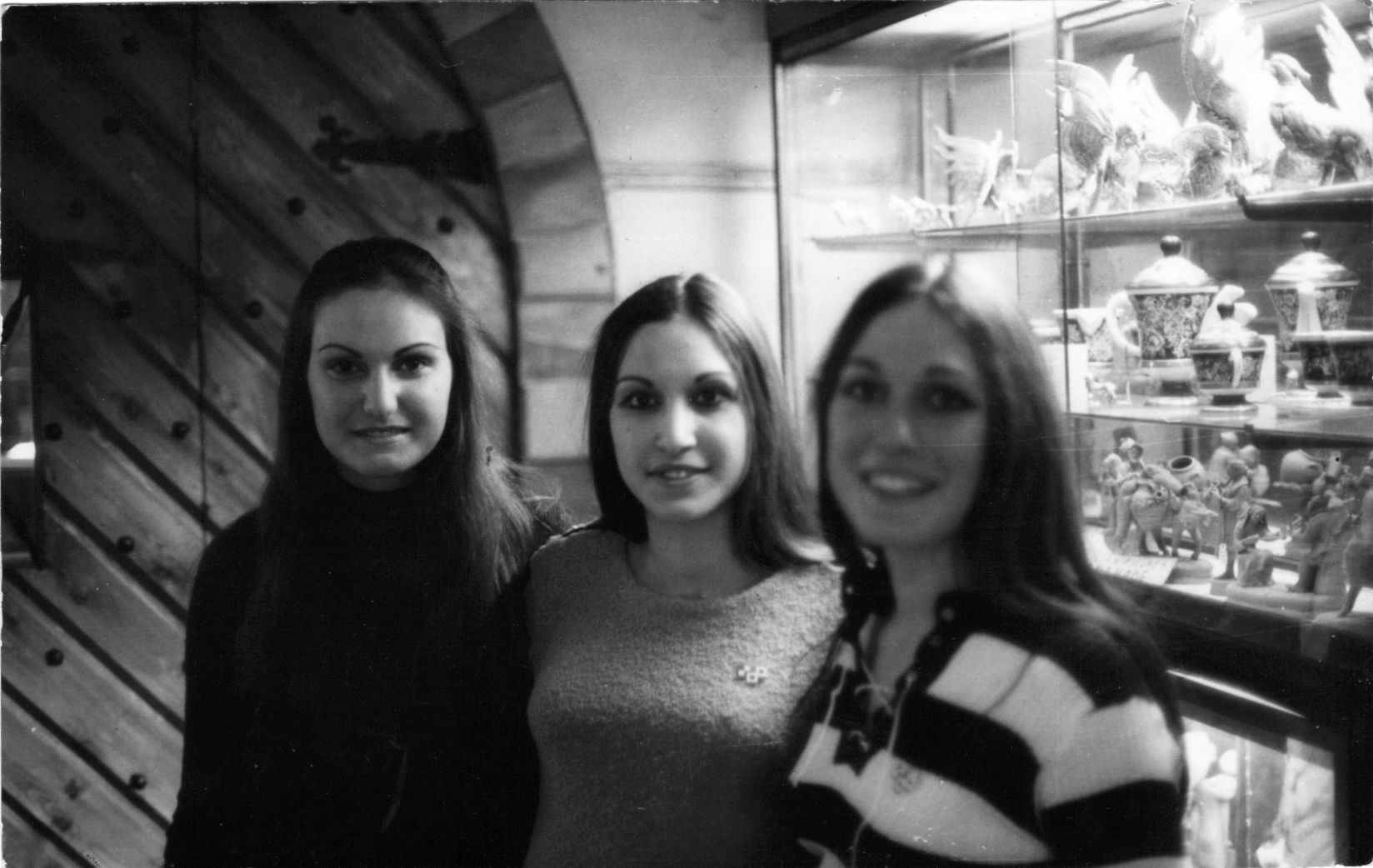
Three of our beautiful part-time hostesses: Luisa on the right, her sister Anna in the middle, and I can’t remember the name of the young lady on the left.
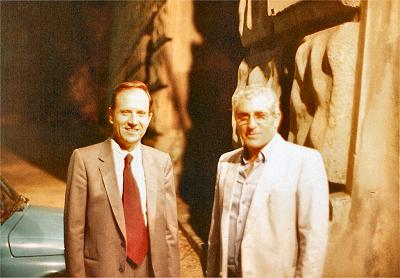
Maria Annella (volunteer interpreter) and Commodore A.J. Bartlett (Commander, Service Force 6th Fleet) talk to some random bum off the street. Background left, Edward J. Sette, Executive Director of the United Seamen’s Service.
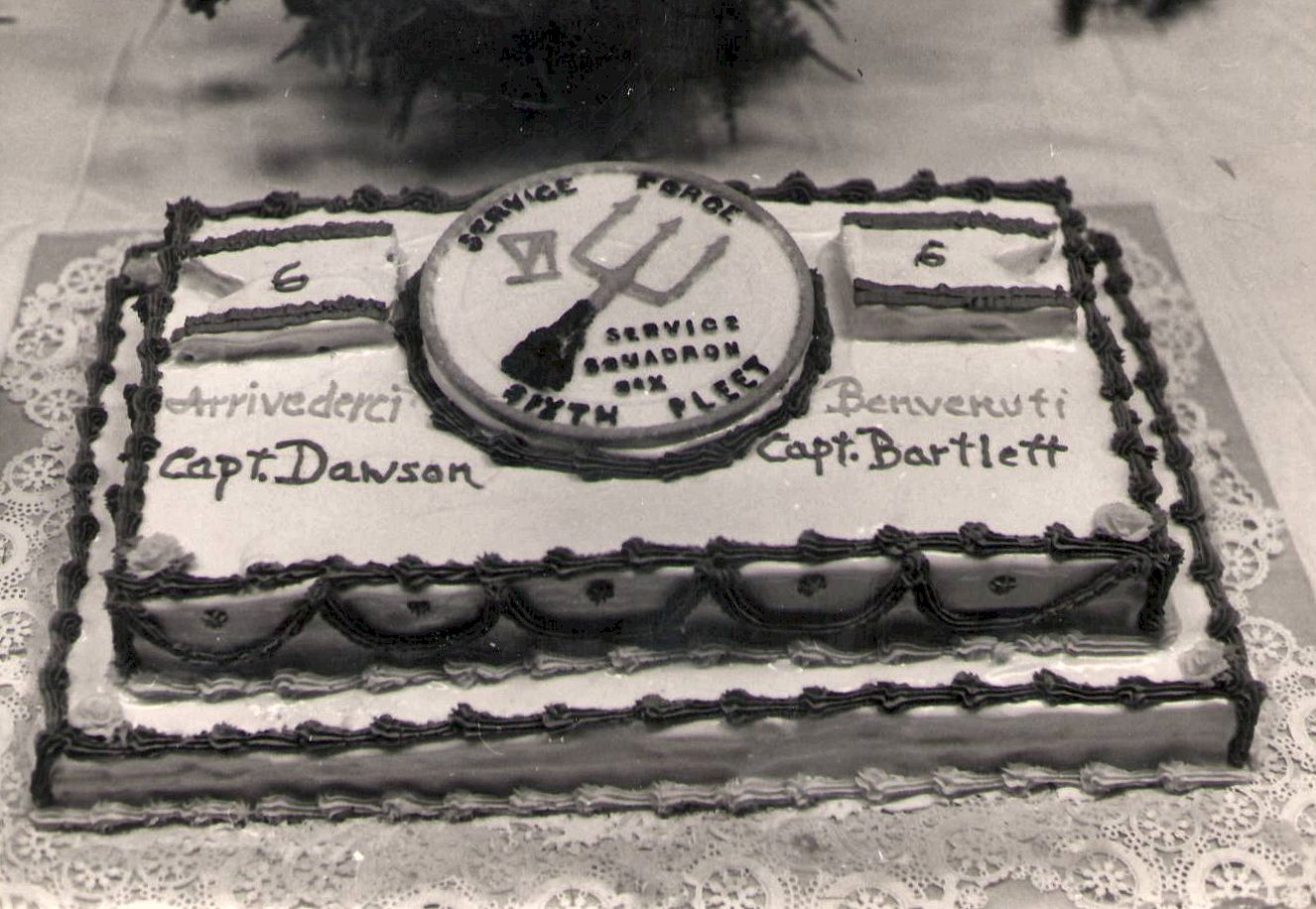
Change of command cake.
Daniele’s brother helps with the painting effort.
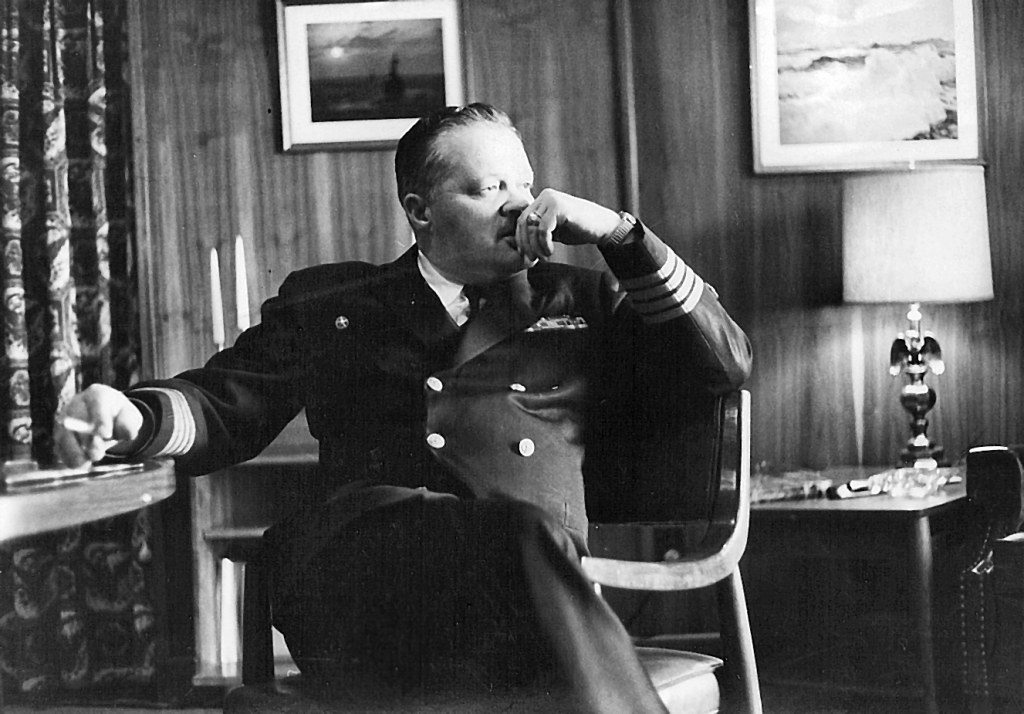
Captain James W. Hayes, USN. Captain of the USS Grand Canyon, AD-28, a destroyer tender which provided a large number of USS clientele from 1970 to 1971. The Grand Canyon was replaced by the USS Cascade, AD-16.
There were many others who worked and served and visited, but it would be impossible to list them all. What follows are some photos which I took during my tenure there in 1970 and 1971.
USS Cascade: Sailor Joe Harter repairs a movie projector
A ship’s band entertains
USS Cascade: Sailor Dan in the Wood Shop
USS Cascade: A sailor works in the machine shop.
The USS Cascade (AD-16) and her charges. These destroyer tenders were floating factories – if they couldn’t figure out how to repair or replace something, nobody could.
Crew of the USS Suprise (PG-97)
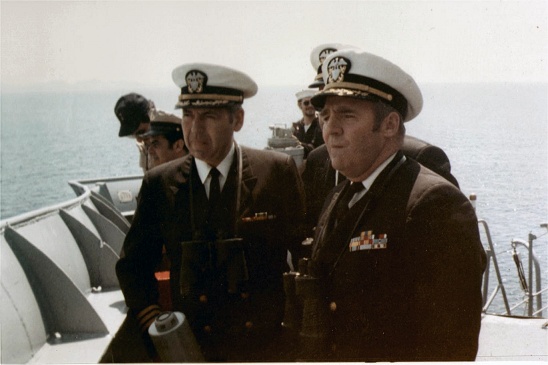
Left, Cdr. J. Norman Messer, Executive Officer of the USS Cascade, with Captain Robert Schniedwind.
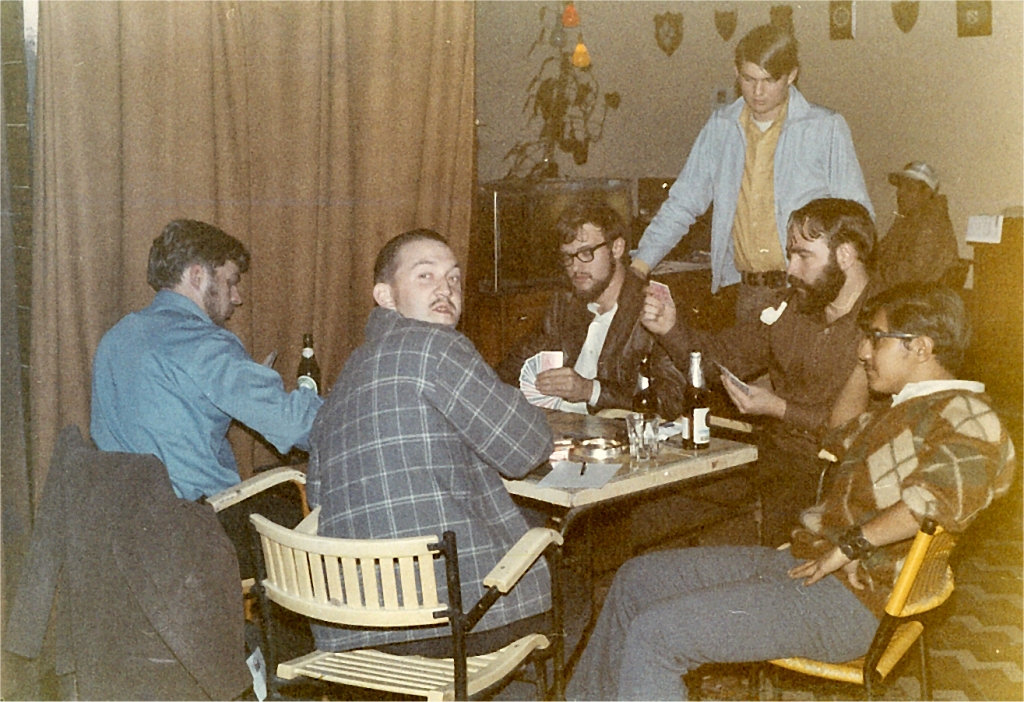
A card game in progress in the bar.
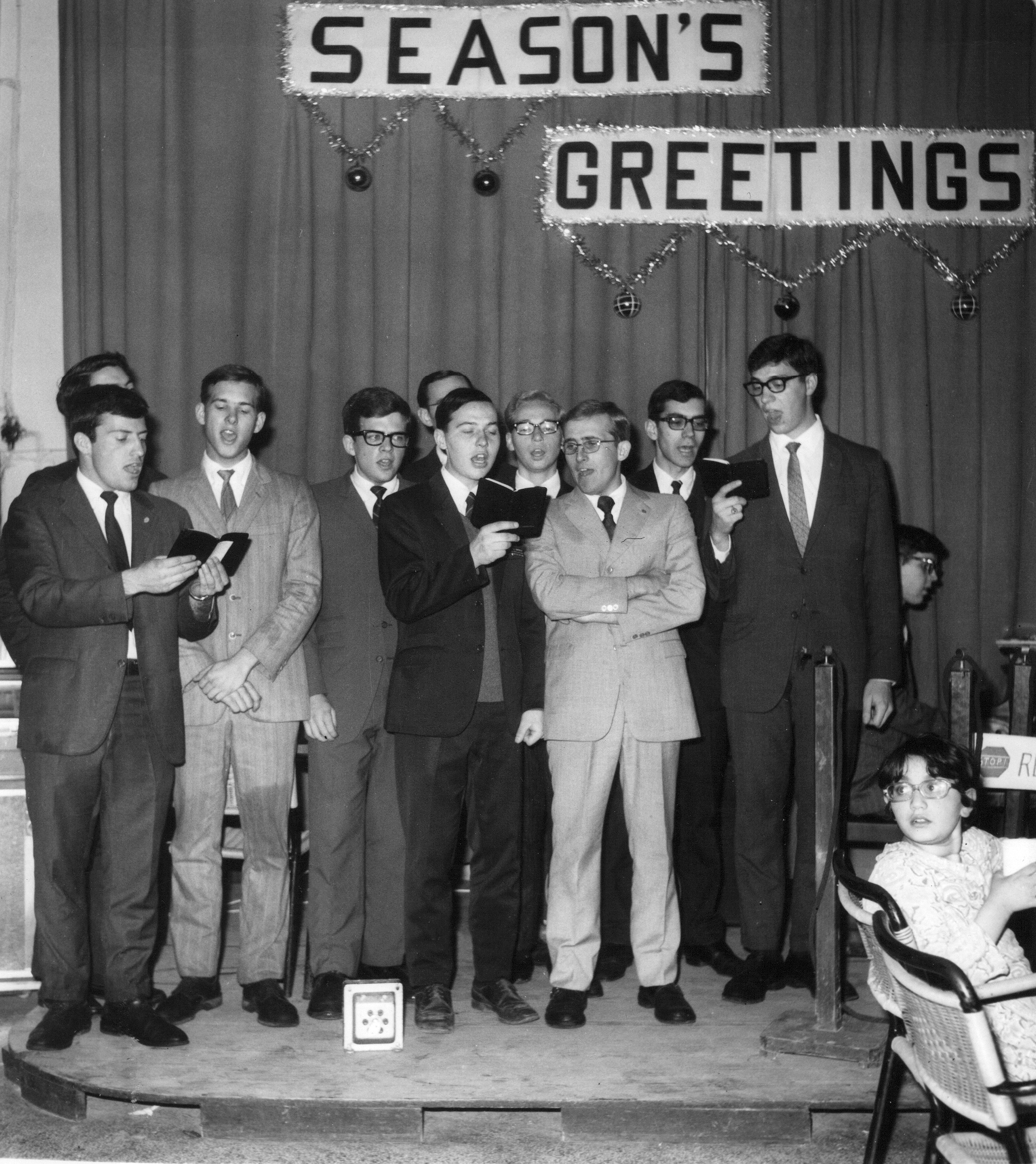
A contingent of elders from the Church of Jesus Christ of Latter-day Saints sings Christmas carols.
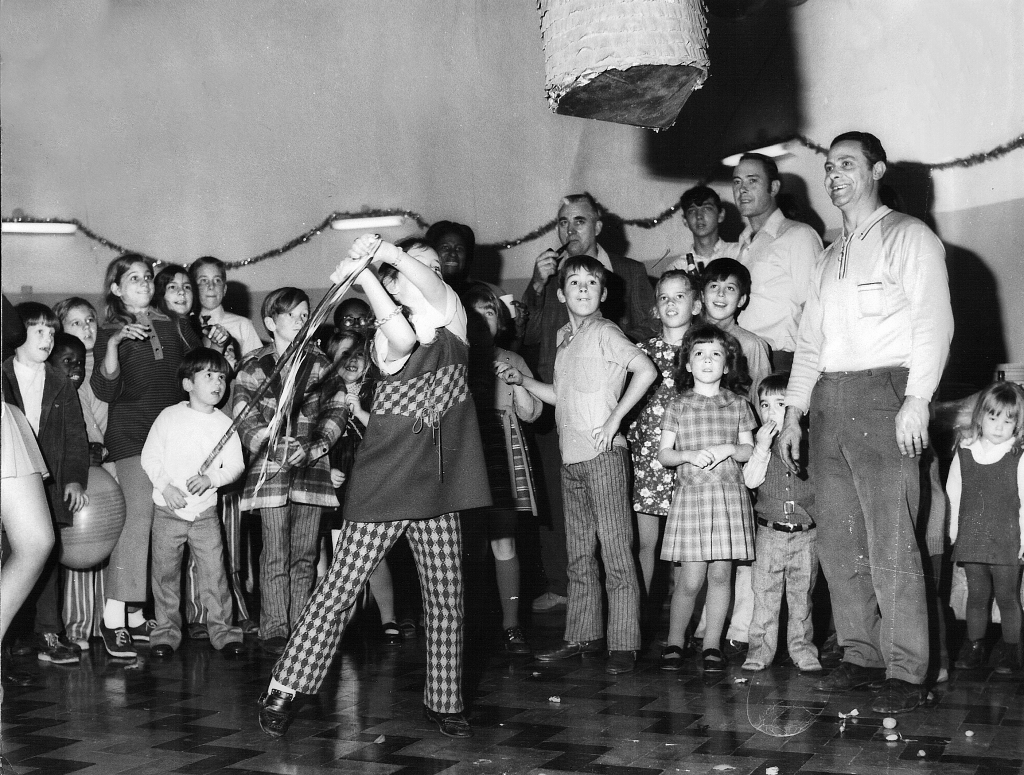
A children’s Christmas party at the center. Just one more whack…
I crammed a lifetime of experiences into that brief period – there are scarcely words to record them all, and this is but a sample of what went on.
Other Locations
The USS had many clubs throughout the world in wartime, and even as late as 1971 there were more open than exist today.
USS Cam Ranh Bay
Staff at Cam Ranh Bay celebrate the landing of Apollo 11.
USS Bremerhaven
Bar
Exterior
Advertisement on a building nearby
Pool Hall
USS Genoa
USS Genoa – Gift Shop
USS Genoa Director Ted Weaver
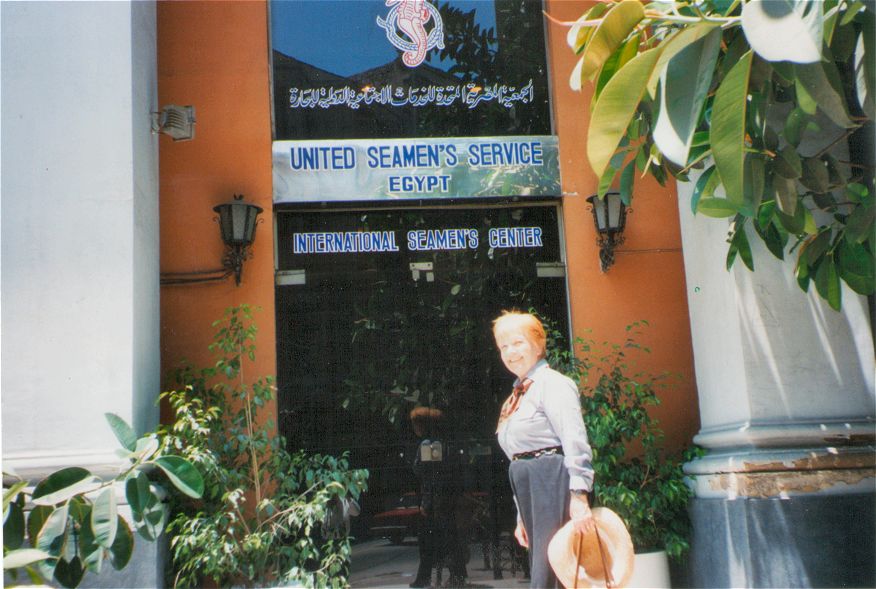
USS Egypt
Director Margaret Draper in front of the USS club in Alexandria which she created and launched over the course of 5 years
There are currently 7 centers operating, including Bremerhaven, Germany; Casablanca, Morocco; Diego Garcia, B.I.O.T.; Guam, M.I.; Naha, Okinawa, Japan; Pusan, Korea; and Yokohama, Japan. As long as there are seamen on the waters, it is hoped that the USS will be there to serve their needs.



























 Playing in the World Game
