Customer Service – It even sucked in 1750 BC

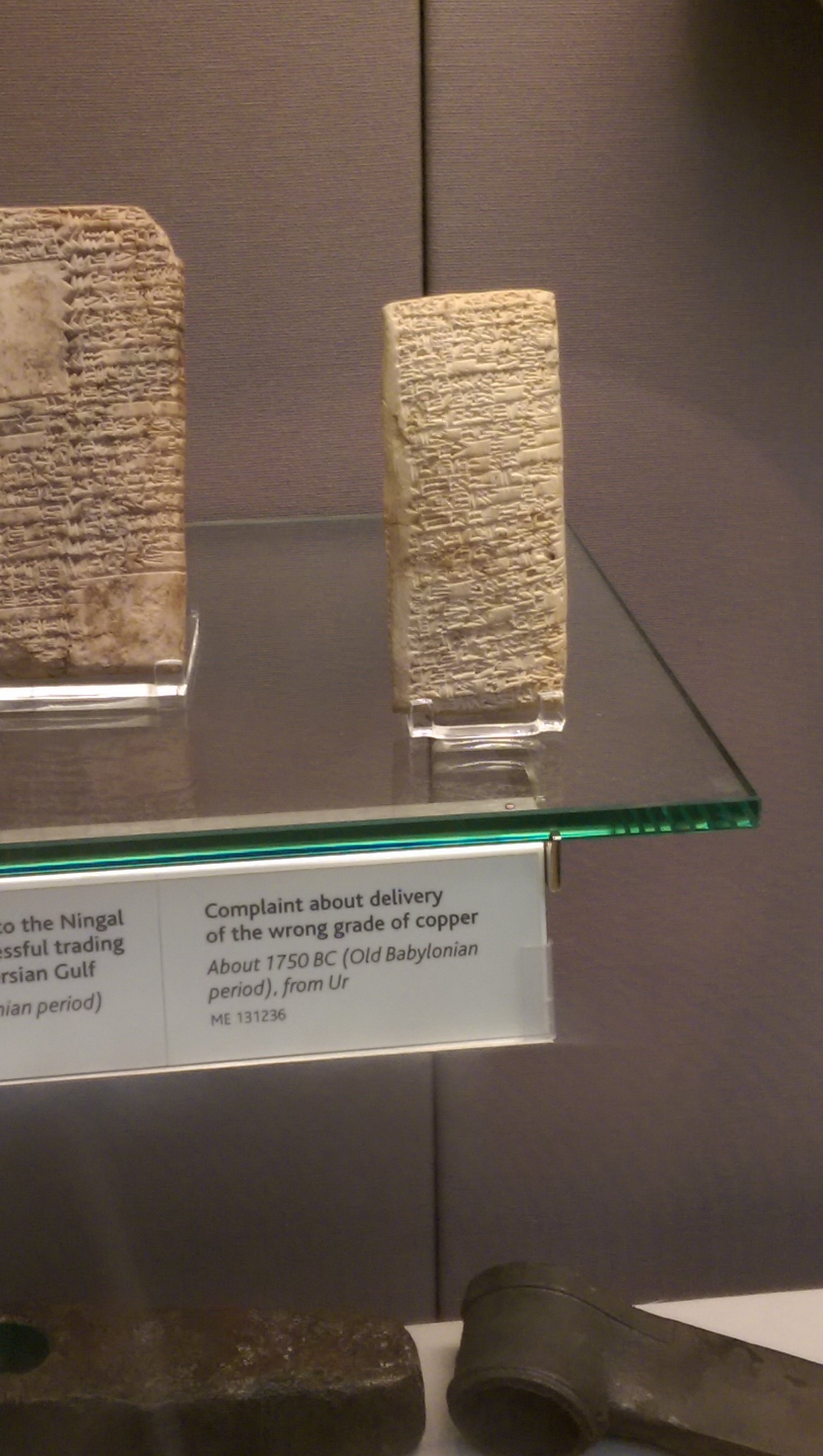
I saw this image pop up on reddit somewhere, and thought it was amusing in light of today’s challenges with companies like Comcast:

yyI3n5i

Well, of course I shared it round, and then people started asking me about the provenance. Stuff like this tends to go wild on places like Pinterest and Flickr, generally without attribution, so it took me a while to track down some relevant information about the piece.

According to the British Museum, this tablet is currently part of their collection; the description reads:

Clay tablet; letter from Nanni to Ea-nasir complaining that the wrong grade of copper ore has been delivered after a gulf voyage and about misdirection and delay of a further delivery; slightly damaged; 23 + 25 + 3 + 2 ll. Dated 1750 BC, Excavated/Findspot: Ur (Asia,Iraq,South Iraq,Ur (city – archaic))

A little more digging provided me with some intriguing information about the tablet itself, provided by redditor /u/labarna, who claims a PhD in Babylonian astronomy:

If you’re curious here’s the translation of the letter (emphasis mine). This is taken from Leo Oppenheim’s book “Letters from Mesopotamia“:

Tell Ea-nasir: Nanni sends the following message:

When you came, you said to me as follows : “I will give Gimil-Sin (when he comes) fine quality copper ingots.” You left then but you did not do what you promised me. You put ingots which were not good before my messenger (Sit-Sin) and said: “If you want to take them, take them; if you do not want to take them, go away!”

What do you take me for, that you treat somebody like me with such contempt? I have sent as messengers gentlemen like ourselves to collect the bag with my money (deposited with you) but you have treated me with contempt by sending them back to me empty-handed several times, and that through enemy territory. Is there anyone among the merchants who trade with Telmun who has treated me in this way? You alone treat my messenger with contempt! On account of that one (trifling) mina of silver which I owe(?) you, you feel free to speak in such a way, while I have given to the palace on your behalf 1,080 pounds of copper, and umi-abum has likewise given 1,080 pounds of copper, apart from what we both have had written on a sealed tablet to be kept in the temple of Samas.

How have you treated me for that copper? You have withheld my money bag from me in enemy territory; it is now up to you to restore (my money) to me in full.

Take cognizance that (from now on) I will not accept here any copper from you that is not of fine quality. I shall (from now on) select and take the ingots individually in my own yard, and I shall exercise against you my right of rejection because you have treated me with contempt.

This letter is quite interesting because it was actually excavated from Ur, so we have an approximate find spot, which is unfortunately somewhat rare for most cuneiform tablets.

It’s also interesting because of the mention of merchants who trade with Telmun. As far as we know Telmun (or Dilmun) was a polity in the Persian Gulf, probably near to if not located on the island of Bahrain. There was a certain type of merchant alik Tilmun (literally “one who goes to Dilmun”) who was associated with trade in the Persian Gulf. And not surprisingly (if you read the letter) copper was a major part of this trade network. Now it should also be said that there were many trade networks flowing into and out of Mesopotamia at this point and the trade through the Persian Gulf was just one facet of a larger network.

/u/labarna then also links to a pencil sketch of the tablet in question:

P414985_l

We are challenged to compare said sketch to the image of the tablet, and told that this passes for fun among those who study cuneiform. Intriguing indeed, doing such a comparison would give me a headache, and I have nothing but huge respect for those who can decipher such things.

It would be interesting to know the outcome of this particular trade dispute. if Ea-nasir was anything like Comcast, he would have sent back a clay tablet with the Bablylonian equivalent of “It sucks to be you.”

The Old Wolf has spoken.

It pays to shop around

Had a little accident with my oven a while back. The front glass got broken, and I went hunting around for a replacement part.

GE’s offering:

GE PartSelect

Are you out of your Vulcan mind? That’s extortion! Well, that was disheartening. Let’s see if we can find a competitor or aftermarket alternative.

PartsDirect

Well, Sears PartsDirect did a little better, but a bit more searching came up with this:

BlackDrive Glass

Why a black sheet is so much less expensive than a white one is totally beyond me, but I ended up saving over $300.00 just by settling for a black front instead of a white one, and the contrast looks very good.

The Internet makes comparison shopping so much easier than it used to be. Back in the day, the Yellow Pages and a telephone was all we had, and one was limited to a very local search. I’m grateful for the miracle.

The Old Wolf has spoken.

Sketches of Life in the Uintah Basin

Alice Woolf

Alice Bartlett Woolf, 1916-1997

Alice Bartlett Woolf, a painter, writer, master teacher, horse breaker, and story teller, was also a dear friend of my mother. While working on scanning my mother’s papers, I came across an article that Alice had submitted to the Utah Humanities Review for their first edition in October of 1947. I found it delightful, and thought it worth sharing here. I have provided a PDF version of the article for anyone who wants to download it. The essay gives a homey, affectionate and impartial look at Mormon communities in the first half of the 20th century; there is much to be envied in the lifestyle of these simple and sincere people.


SKETCHES OF LIFE IN THE UINTAH BASIN

Woolf, Alice B.
Utah Humanities Review
1 (October1947): 313–319.

 Expecting the mode of life and the people to be much changed, I was going “home” for a vacation in the red sand hills of northeastern Utah. As I turned my car north from U.S. highway 40, I was delighted to see again the small farms on either side of a very muddy and rutted road. Of course, I reasoned, the very structure of the farms, with outbuildings, Jackson-fork hay derricks, stackyards, and straw-covered. sheds couldn’t have all disappeared in the space of fifteen years. But what of the people? Had the innovation of elec­tric lights, radios and refrigerators changed their way of life? Did they still refer to a journey to Salt Lake, or some place other than the Uintah Basin as “outside”? Had the oil boom in the nearby town of Vernal urbanized them?

Woolf1

SUNDAY MORNING – Alice Woolf

 After several weeks in Uintah and Duchesne counties I concluded that life in general was much the same as it had been when I was a child of the sagebrush, happily riding my pony between prairie dog holes.

Of course, one may wonder why anyone should hope that small communities of people would not change; and after some thought, I decided that the people in the farm area to the south of the Uintah Mountains are, by and large, the happiest group I have ever known. I had been worried lest the “finer things” of civilization had made them unhappy with their lot, for to the casual observer the small farmer in the Uintah Basin has so many natural odds against him that it seems incredible that the country has ever been popu­lated. He has a constant battle with wind, sand, drouth, and grasshoppers. Getting water to the land has been a major problem since the land was homesteaded, and even today everyone donates time to the building of canals and ditches, in an effort to fight the desert dryness.

Main Street

MAIN STREET – Alice Woolf

 The main factor in this happiness the people enjoy, it seems to me, is the complete social integration of all members of the community. From birth, children go through the same experiences as their elders. They work or: the farms, go to church, visit the stores, listen to conversations, attend dances and all public social functions. Most of their parents did the same. Thus the group becomes tightly knit. Everyone in our own particular community (the nucleus of each community being the church, school, store, and post office) knows whether you were quiet or fiendish in church, how well you did your lessons in school, when you had your first date, how much a dozen you are getting for your eggs now that you are grown and farming for yourself.

One finds the people themselves tolerant and understanding with members of their own community, or of com­munities they would consider neighboring. They discuss the faults and failings of friends, as well as their good qualities, with joyous abandon. However, this ready acceptance extends only to the group. A stranger entering their midst – let’s say someone from “outside, ” perhaps Colorado or Wyoming – would receive a very reserved welcome from everyone, and it would take considerable good-will on the stranger’s part to draw any attention but the rather austere courtesy that is far from impolite, but leaves the atmosphere a little frigid.

Farm methods have improved somewhat in the last few years. There are more tractors and less broken-down teams. Nearly everyone has a car, and there are actually people in the farming district who are getting running water.

In dress the people are utilitarian rather than stylish. The men wear overalls and work shirts, and the women effect the typical “Utah” house dress and apron.

Country Store

COUNTRY STORE – Alice Woolf

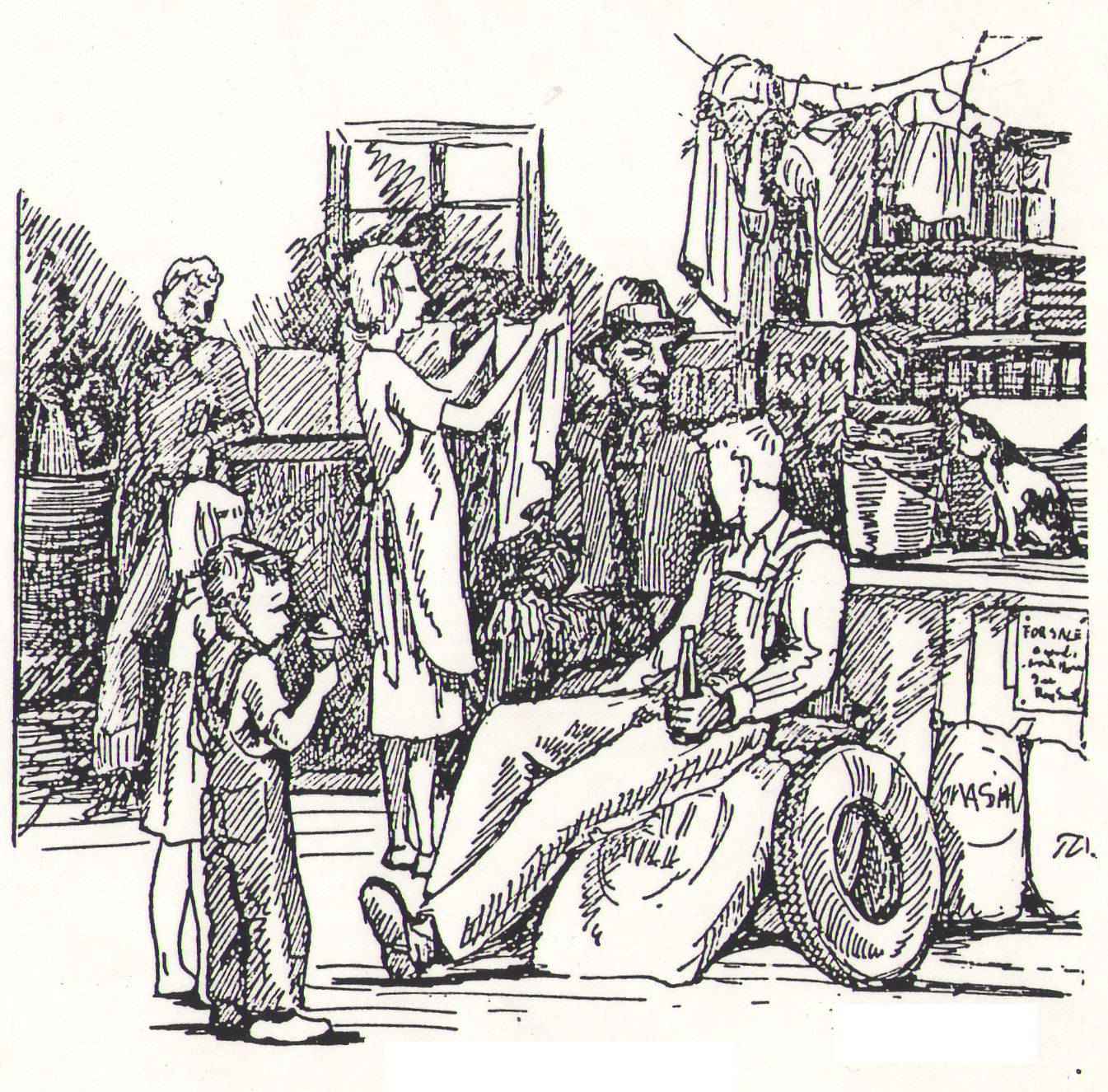
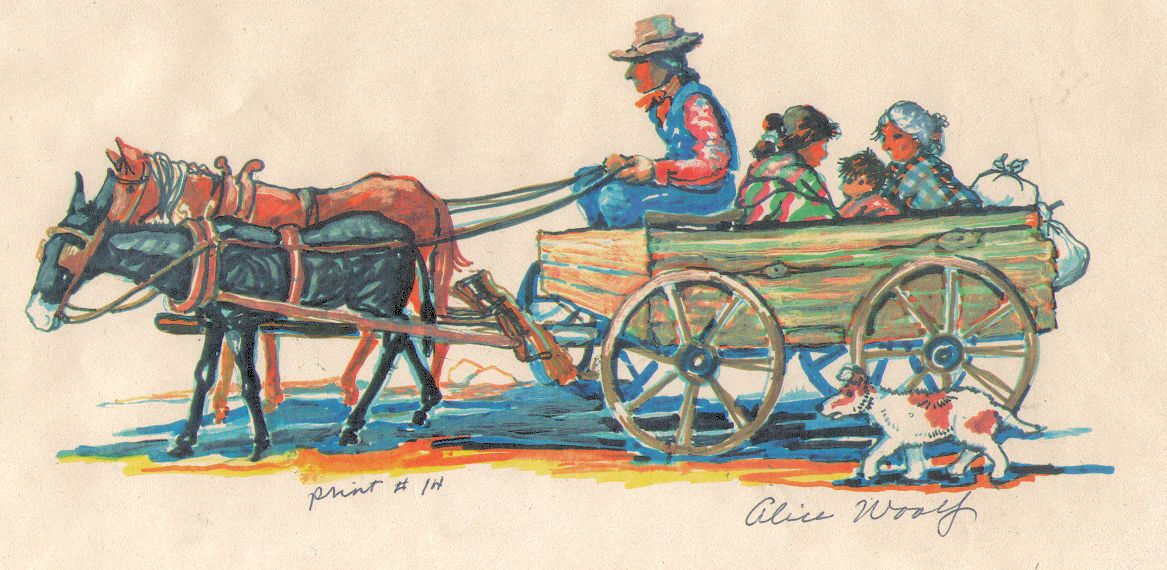
 In the series of sketches, I chose several pictures which depict the life of the people. The one entitled “Main Street” is actually a typical thoroughfare in rural life. The barbed wire fence in the background encloses a pasture that lies between the store and the school house. l would like to call attention again to the children, who, even though small, are becoming used to grown-up talk, and the exigencies of grown­up life.

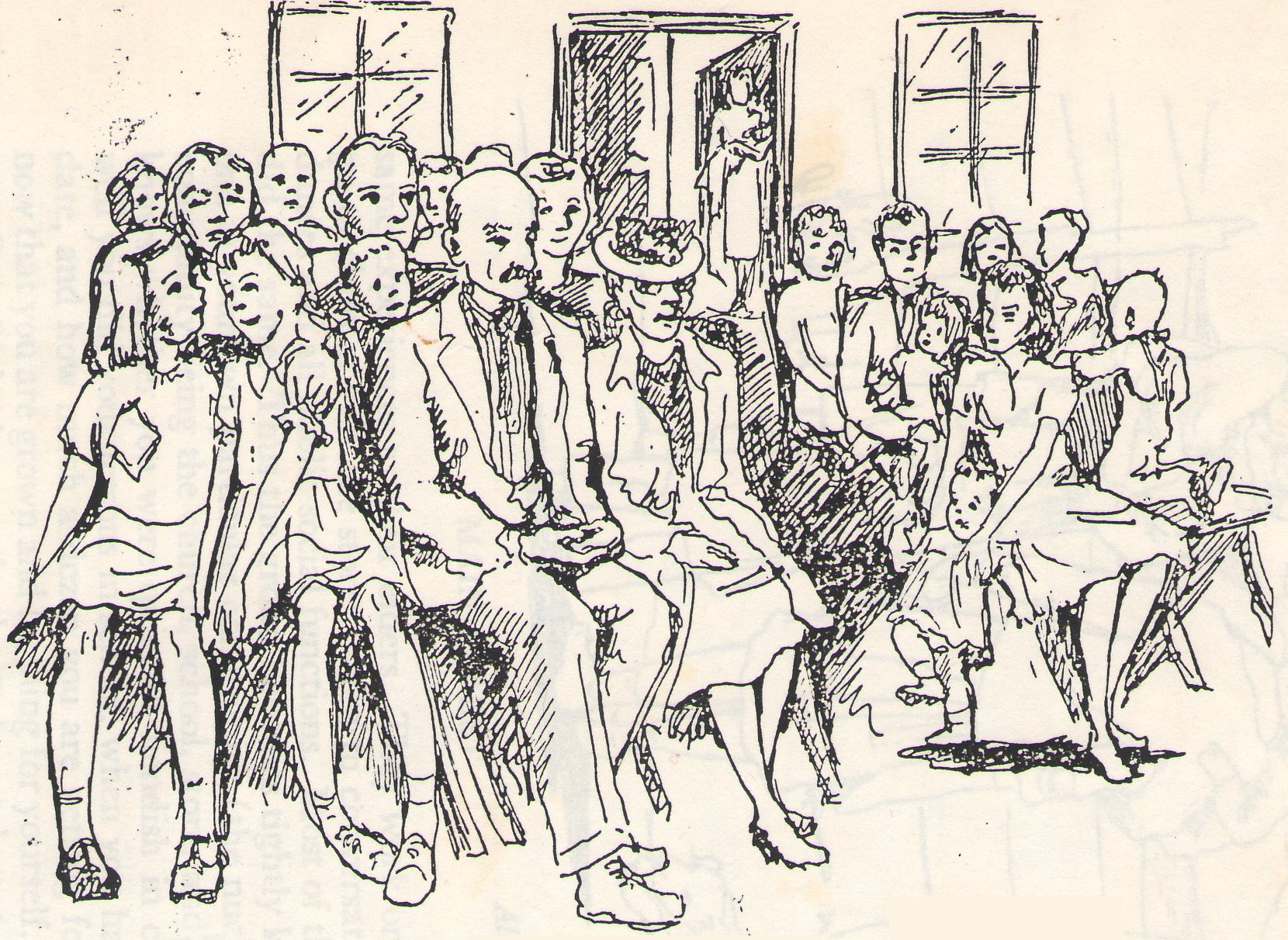
I have chosen two other sketches dealing with social pleasure. One is the interior of a typical rural store, where the people come partly to buy and partly to visit. There is nearly always a family or two in the store, the men, of course, discussing weather and crops, and the women doing exactly what visiting women have always done talking a mile a minute. The second sketch concerns a dance. This one happens to be at a Gold-and-Green Ball, but is a scene that might be sketched at any country’ dance. Unlike dances in the city, this one is not selective; everyone comes. Many come as “lookers-on.” They simply choose a scat and tend children and visit. The young women, both married and unmarried, come in delightful confections of pink and blue tulle, as “formal” as can be. Older children slick up in their Sunday best and dance or not as they feel inclined. The charm of the whole occasion is that everyone has a good time, the dancers dancing, the onlookers speculating about any new romances, and the children just being children. At midnight the three or four-piece orchestra plays “Home Sweet Home, ” and the hall is vacated, except for a few older boys who stay to put the chairs up for church next morning.

Gold and Green Ball

GOLD AND GREEN BALL – Alice Woolf

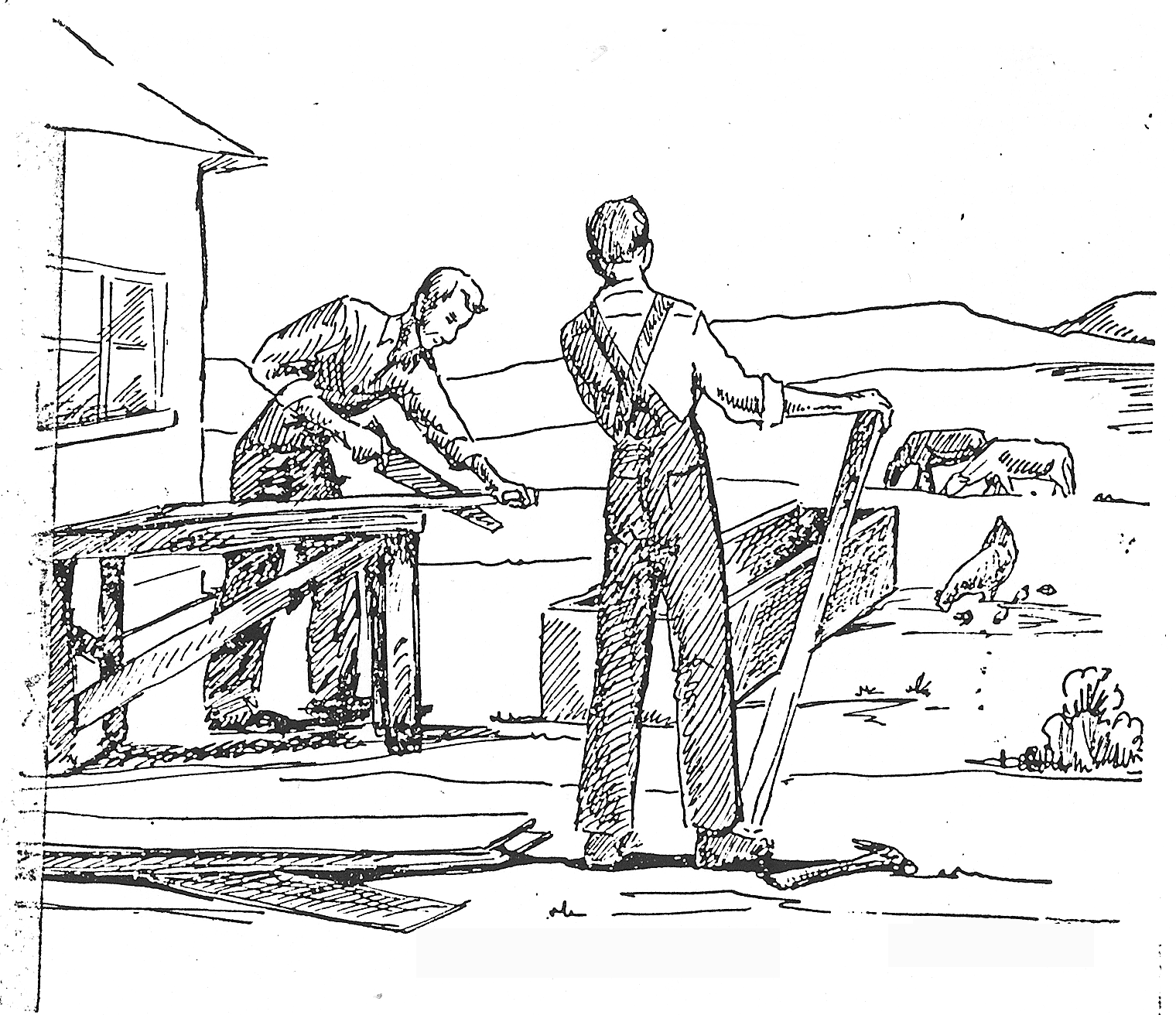
 When someone in the community dies, friends of the family build the coffin. This is looked on not so much as a distasteful task as a last kindly gesture toward the de­ceased, and even though neighboring towns have undertak­ing parlors, it is rare indeed that the dead are not cared for by their own friends.

Making coffins

MAKING COFFINS  – Alice Woolf

Sunday morning finds nearly everyone at church. If chores or housework keep people until past the starting time, they come late, expecting everyone to understand. Here again we see ail ages amalgamated together in the large general assembly. No one minds the general hubbub caused by the small children, least of all the people conducting the church service, who are very likely tending children of their own. Somehow everyone comes away from the church up­lifted spiritually, although an outsider might find the whole atmosphere confusing.

Last but not least is the sketch called “Saturday Night.” Never, in my return visit, did I fail to feel nostalgic as I walked into a warm kitchen and saw the tub on the floor and warm towels on the down-turned open door. If there is one thing above others that seems to cement family solidarity, it is the Saturday night bath. By the time everyone has par­ticipated in chopping wood and carrying water in prepara­tion, and has emerged clean and shining from a tin tub, all seems right with the world.

Saturday Night

SATURDAY NIGHT – Alice Woolf

 After spending several months in such an area, it is a little difficult to return even to the modestly urban life of Salt Lake City, as it is always hard to leave a peaceful life among happy people for a life that is more hectic and far less happy. Struggling with wood-chopping, water-carrying, and a cow-to-you milk supply is incidental when one has a joyful life. If one makes the slightest attempt to live within the group mores and customs his life can be an open book – ­read and accepted by all, good and bad alike; and he can of course help in accepting his acquaintances, good and bad alike. With such community solidarity, as long as one stays in the community, security and contentment are forever present.


Two prints of artwork by Alice WoolfAlice Woolfe Print 1 Alice Woolfe Print 2Alice and my mother were born in the same year; Alice passed five years before mother did, but they were lifelong friends, and I recall hearing many stories about her as I was growing up. I’m pleased to share this bit of Utah history which, thanks to Alice’s insights, has been preserved.

The Old Wolf has spoken.

The 2.6 million dollar watch

For a number of years I was involved in a marketing enterprise, and my sponsor enjoyed wearing a diamond-studded Rolex that he picked up for about half-price, a mere $125,000. I always wondered how much sense it made to wear that much money around on your wrist, but whatever floats his boat.

Then I discovered this:

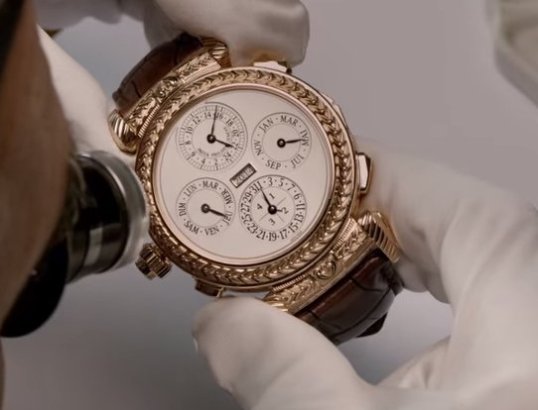
This video describes the design and manufacture of the Patek Philippe 5175R Grandmaster Chime Watch, which sells for $2.6 million… if the president of the firm thinks you’re worthy to own one. To celebrate the 175th anniversary of the firm, only seven were made, six of them to be sold to a very exclusive number of long-time collectors, the seventh to be displayed at the Patek Philippe Museum in Geneva.

Patek2

Now, Patek Phillippe is the zenith of the summit of the pinnacle of the watchmaking world to start with. They don’t let anything but perfection out of their factory doors. But this particular watch would make Jacquet-Droz blush with embarrassment and want to crawl into a hole for having produced such crude workmanship, and he was a world-class craftsman and a genius.

When I read the title of the video, I thought to myself, “why in the world would someone create, let alone buy, such an expensive watch? Well, the buyers will have their own reasons. But as for the creation… this is not merely a timepiece, this is art. People pay much more than a paltry 2.6 million for coveted artwork; remember that someone paid an estimated $259 million for Cezanne’s The Card Players.

Cezanne

Watch the video. You’ll see that this piece is lovingly crafted in the most excruciating detail by craftspeople who could rightfully be called national treasures. Designers, machine workers, watchmakers, artists, metallurgists, you name it – the skill and precision and absolutely insane devotion to a perfect product are visible here.

Movement

The movement before assembly

I’ll never be fortunate enough to hold a piece of art like this, and I’m not likely to see one in a museum either, so watching the video will have to suffice for me.

Patek 3

The Reverse Side

But from where I sit, this miracle of design and labor is worth every penny that the company charges for it.

Now, this whole adventure raises a few questions. Recently, redditor /u/mattertater calculated an estimate in raw dollars for how much it would take to end world hunger if every citizen of first-world countries contributed the same amount annually. (Thread with commentary)

With an approximate first-world population of 906,715,020 people, or 12.45% of the global population, the UN estimate of $30 billion annually works out to roughly $33.08 per year, or about 9¢ a day. For comparison’s sake, note that the US military, with an annual estimated budget of $640 billion, could come up with that amount all by itself by trimming 5% of its annual spending.

These are just some interesting raw numbers. It is understood that the problem of world hunger is much more than throwing dollars at it, involving as it does so many factors such as distribution chains, administration, corruption, agriculture, warfare, and countless others. But it’s intriguing to wonder if given the pressing problems of the world, owning a watch that costs this much money really makes sense. Still, on a much smaller scale, 8 people were willing to pony up $999.99 for the “I am Rich” app at the Apple Store before it was pulled down… and all it does is display a glowing, red gem which the rest of the world can’t have. Veblen goods have their appeal, usually for reasons of vanity.

The world is so full of a number of things…

The Old Wolf has spoken.

How to have a Merry Christmas

Well, according to one math professor, this is how it’s done:

  1. CodeCogsEqn
  2. CodeCogsEqn (1)
  3. CodeCogsEqn (2)
  4. CodeCogsEqn (3)
  5. CodeCogsEqn (4)

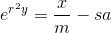
Funny. But all joking aside, Oxfam has come up with a practical formula for knowing whether or not you’re really enjoying the holidays, and it looks like this (and there’s no reason this wouldn’t work for Chanukkah as well):

formula-oxfam

That’s a bit more complex; here’s what it boils down to as a “word problem”:

“It’s great to see that ultimately, happiness at Christmas comes down to quite simple things, such as enjoying time off work to spend with friends and family.”

Key ‘happiness factors’ include:
• Number of calories consumed on Christmas Day (any more than 7,000 calories and you’ll be too stuffed to enjoy yourself)
• Amount of time off work (just one day off boosts happiness by 70%, with three weeks being the optimum amount)
• Centimetres of snow (15cm is ideal)
• Family arguments (more than five and happiness levels plummet)
• Number of hours spent trawling the shops for gifts (any more than 10 hours and shopping-induced stress sees happiness decline rapidly)
• Miles driven to see friends and family (0 miles is ideal, with 500 miles generating a 40% reduction in happiness levels)
• The number of gifts you receive has an impact on happiness (6 gifts gets you to optimum happiness levels), but….
• ….most crucially, how many gifts you give (even giving just one present makes a huge difference to happiness levels, increasing Christmas enjoyment by 50%).

To estimate your score, visit the original article. (But we need a bigger picture of the formula there.)

The Old Wolf has spoken.

Taking the High Road with a Scammer

Man-shouting-into-a-phone-012

Photo: Alamy

If you follow my blog, you’ll know it has become somewhat of a warning beacon against scams and frauds, which little crusade began after my own mother was scammed by cross-border fraudsters out of a large chunk of her savings.

Here, however, is an interesting article from The Guardian entitled “How I Talked a Scammer Into a Better Life Choice.”

Written by Amanda Willis, it describes her conversation with a Pakistan-based boiler-room worker who was trying to get her to download malware. The results were encouraging, and worthy of being shared. Her entire essay is definitely worth a read.

The tagline of the article is “Getting angry with fraudsters dehumanises them, but if we engage them in conversation we might be surprised by the results.”

Unfortunately, many scammers who are directly involved in criminal enterprises become frighteningly abusive when confronted with their scam, and I’m not sure I want to get involved with inviting that sort of negative energy into my life. But the principle at work here is the one found in Proverbs 25:21-22:

If thine enemy be hungry, give him bread to eat; and if he be thirsty, give him water to drink:For thou shalt heap coals of fire upon his head, and the Lord shall reward thee.

The Old Wolf has spoken

Consoles weren’t always so bad, come sit by the fire children and let me tell you a story. (Reposted from reddit)

This lovely bit of writing by /u/OneYearSteakDay over at reddit really resonated with me, because I lived through it from the other side of the age barrier. I have reposted it here with the author’s permission, and with the same gracious license I have bowdlerized it just a bit to make it suitable for all audiences (the original can be read here). I hope you enjoy it as much as I did. (Turn on the fire while you read it for some nice atmosphere.)

A glorious fire crackles¹ in TrueAudio nearby, blazing with 16.78 million shades of red and orange; the PhysX logs pop and break, falling apart to reveal the beautifully tessellated embers casting real time reflections against the mip mapped stone walls.

This story doesn’t start in 1984, that’s just when my part of the story begins. President Ronald Regan was in a vicious battle for the soul of planet Earth, When Doves Cry by Prince was at the top of the Billboard hit list, great films like Terminator left lines reaching around the street, and the home PC; the Macintosh 128k, was selling for the low, low price of just $2,495.00.

It was the most glorious of times, it was the bleakest of times. The foundations on which our great PCMR Empire is built were being formed, our first allies in the fight were the wealthy and the strong, those who could afford a home computer of their own. This is not their story, I cannot tell their story because I was not wealthy, I was not strong, I was a peasant and I loved it.

On my sixth Christmas in 1990 my parents got me my first gaming console: The Nintendo Entertainment System. I eagerly unwrapped the beautiful box and unpacked all the items. I pulled out the console and set it aside, I pulled out a mass of wires and confusion and handed them to my father, I pulled out a slim square with a picture of a man jumping over fireballs and a a duck, I pulled out a neon orange gun, finally I pulled out the last piece: A shiny gray block with four buttons and a cross on it. I had used a keyboard at school, but this strange gray block was much smaller, it was easier to hold, my six year old fingers could reach all the buttons and I was in love.

My father spent an hour that Christmas day trying to connect the Nintendo to the TV. (You youngins don’t know how good you’ve got it with HDMI and DPP! Try getting a semi corroded RF connector to communicate well with a TV that lost it’s set screws and then we’ll talk.) Once finally installed and connected I inserted the cartridge and pressed the power button.

GLORIOUS! The massive 24″ television screen displayed a beautiful image in 64 vibrant colors, speakers blazed amazing mono sound and I was enraptured. I pressed the button designated “Start” and the speakers let out a chime as I was thrown head first into World 1-1. I had played games the computer at school, but this was completely different! The school computers were slow, they didn’t play sound, and their screens had 62 fewer colors than this amazing NES. [Ed. Green or Amber and off. Off functioned as black.] It was obvious to me that Christmas morning that Computers were vastly inferior to this amazing piece of engineering attached to my TV screen.

The whole house came together to play. Mom and dad were as likely to get killed by a rebounding koopa shell as I was, dad was much better at shooting ducks than myself, but I was still better than mom. Much laughter was had as we tried to get used to this four button and a cross rectangle, when I ran right my entire body would lean with it, my hands jumped when Mario jumped, my heart raced when Mario fell, truly this rectangle was vastly superior to the keyboards I was used to at school!

As the years passed I acquired more games and more consoles and they were all adopted as members of the family. The Sega Genesis came next, and it was edgy, new, fast, a quantum leap beyond anything that the NES or school computers could offer. Sonic the Hedgehog could run over 700 miles per hourand my dad’s Chevette could only do 50 miles per hour down hill. Vectorman could shoot 3D blasts in any direction, Megaman on the NES could only shoot forward. Comix Zone had branching story paths and spectacular art, where as on the Nintendo there was only one path: Forward. The obvious technological improvements over the past were obvious. I was hooked.

Next came the stately SNES, my heart and soul, my bread and butter, my breath and blood. The SNES wasn’t more powerful than the Genesis exactly, but it has something the Sega didn’t: JRPGs. To this day I still have the Chrono Trigger cartridge with a New Game+ starting 120 hours in. To this day I still relish playing the opening level of Mega Man X3 when I got to play as Zero for the first time. To this day I still fawn over the beauty that is Yoshi’s Island.

sryoshi610

Seriously, game developers, a good art style will always trump good graphics. To this day I still regard Kirby Super Star as the quintessential Kirby game. To this day I love the SNES and all that came with it.

It was in 1999 that my family got our first computer. Check these specs:

  • 3gb hard drive
  • 32mb of ram
  • 28.8kbs modem
  • 550mhz Intel Pentium Processor
  • Integrated floppy disk drive
  • Integrated CD reader
  • Stereo sound

This computer was dope. The hard drive had more storage than anyone could ever need, the ram was excessive and never completely filled, the processor was blazing fast and thanks to the CD rom drive I was able to install the bundled games quickly and permanently. Truly it was glorious my brothers!

When I finally got the opportunity to try this new piece of technology the first thing I did was load up the included copy of Mechwarrior 2. (Someone remake this game please. Please. Please.) True 3-D, yo! No longer was I constrained to go forward or right, now I could go left, or backwards, or use my jump jets or….

“Wait, what’s this bluescreen with all the numbers? How do I get back to the game?”

I had played a lot of hard video games in my time, games that would mercilessly defeat me, games like Bucky O’hare, Mega Man 2, and Mega Man X2, but I’d never encountered a mechanic that would cause the entire screen to turn blue! I died so hard that I couldn’t even get back to Windows. I restarted the computer and tried again. This time I didn’t get a bluescreen, this time I got a popup window informing me that I had performed an “Illegal Operation” and then the computer shut down. Then an enemy used some attack on me that slowed down my whole computer and prevented my Mech from receiving input from my joystick. Then a crowd of enemies ambushed me and froze my screen while they killed me. Seriously, Mechwarrior 2 was harder than anything I had ever played before. I had never been hit so hard in Mega Man or Mario that I had to restart my NES! I played Mechwarrior 2 on and off for years, but I was never able to “win” the game because the enemies played so many dirty tricks on me.

Clearly PC gaming was not for me. I went back to my consoles and remember experiencing to many memorable experiences. I got a PSX and fell in love with games like FFVII, FFT, Mega Man X4, Vagrant Story and so many others, none of which had enemies that would force me to restart the console and all of which were extremely fun to play. I got an N64, which had the first controller I ever held with an analog joystick. This was revolutionary! A 3D controller for a 3D console, brilliant! Super Mario 64, no bluescreens, no slow downs, 3D, fast game play, no need for a PC. Then came Star Fox 64 and the invention of the rumble pack, a true killer app for home consoles! This was an amazing time to be a gamer, and I do feel a tinge of regret that many of our younger brethren didn’t have an opportunity to experience it first hand.

With the PS2 and Xbox things began to change. All of the sudden the perfect game play I had experienced on my perfect consoles began to slip. Sometimes the console would slow down, sometimes it would stop all together, sometimes it wouldn’t even start up the game I had put in. They both offered DVD playback, but that could damage the PS2 and the Xbox required a special adapter. They both offered connection to the internet, but the PS2 didn’t do it very well and the Xbox required a subscription. They both had save features, but the PS2 used an expensive 8mb memory card and the Xbox used it’s built in 10gb mechanical hard drive.

The Xbox was the last console I ever bought (except for the Wii, which I regard more as a toy than a gaming console) because the Xbox was the end of a generation for gamers. Because the Xbox came with a hard drive and an internet connection now publishers and developers could upload patches and new content on the fly. Because publishers and developers could fix games retroactively there was no longer the need to ship finished, quality checked games. More and more broken games began coming to the market and many gamers began to leave their consoles behind.

The increased complexity of the consoles themselves also caused problems. I feel bad for anyone who owned a first generation PS2 because the DVD readers broke constantly. I feel bad for anyone who had to get a replacement HDD for their Xbox because they had to pay money to lose their saves. (I don’t feel bad for anyone who owned a GameCube because you could fire that sucker out of a cannon into a volcano filled with angry flaming lava bees and it would still play any GC game you threw at it.)

Thus the Xbox killed the console as we old-timers knew it.

What you have to understand is that there was a time when consoles just worked; they were single purpose units, dedicated solely to playing video games without suffering from the overhead of an Operating System running complex hardware. The NES just played games, the SNES just played games, the Sega Genesis just played games, the N64 just played games, the PSX just played games, (and audio CDs, but we’ll leave that aside for the moment) and my friends, they were glorious! Because these games couldn’t be updated, fixed, patched, enhanced, rebroken, repatched, then forgotten they had to be released in working order with good game play. The idea of buying a broken game because Ubisoft will be fixing it soon anyway would be frightening and confusing to gamers of this era. And I am a gamer of this era.

Not long ago; only two generations past now, the console and the PC could coexist peacefully in the same home, each serving it’s respective purpose, each with it’s own strengths and weaknesses. Today “consoles” are nothing more than weak mini computers, and that is unfortunate because they could be so much more. Having seen both the zenith and the nadir of console gaming I can assure you that consoles have so much potential, but they’ll never realize that potential so long as they’re trying to be something they’re not. Like a feather weight fighter boxing the heavy weight champion, modern consoles have reached too far for their own good, and while strong in their own right they cannot win against this opponent.

And that children is why so many elders of the PC Master Race have gigabits worth of roms on their hard drives, burned ISO files of old PSX games sitting on the shelf, and choose to play Pokemon Red on their cell phones. There were good times, and there were great times, and that you may not get to experience them saddens me. The roots of the console tree are strong, the trunk is thick and sturdy, but the branches creak and crack under their own weight. You may live to see the day when this tree is nursed back to health, but first we must look back at what made the tree so strong in the first place.

The last of the logs pop as the hearth darkens, real time shadows dance about the stones, now defined by feathery ambient occlusion and the cooling shades of of 256RGB reds and yellows. I warm my hands over the few remaining embers and remember the days when Final Fantasy VII had the best graphics the world had ever seen and sigh.

TL;DR: Consoles used to be gaming machines, made for gamers to play video games. They were accessible, they were stable, they were affordable, they were powerful and they were fun. Then Xbox and everything bad now.

I can’t describe adequately how much this bit of writing pleased me, because I was one of those dads who struggled with rusty RF connectors as my oldest son got his first NES in around 1985. He could whup my honus at Mario 1 – I kept falling down those never-sufficiently-to-be-accursed pits, and rarely made it past 1.1 – but I was a better duck hunter.

This period of gaming indelibly affected me. My current phone ring is the Peloponessus segment from “Battle of Olympus.” I have a customized ring in case my ex ever calls me: “Still Alive,” from Portal. And sometimes I find myself whistling the theme song from “Bubsy.” As the author intimated, these were times never to be forgotten.

My thanks to /u/OneYearSteakDay for the wander through the mists of memory.


¹ Glorious fire located by /u/testsubject12a and /u/N0sc0p3dscrublord

The Original “Glasses for the Lazy”

Edit: If you’re just chancing across this post, be sure to read the delightful comments below by Janet Warner Reid, the oldest daughter of Clarence Warner.

83682934

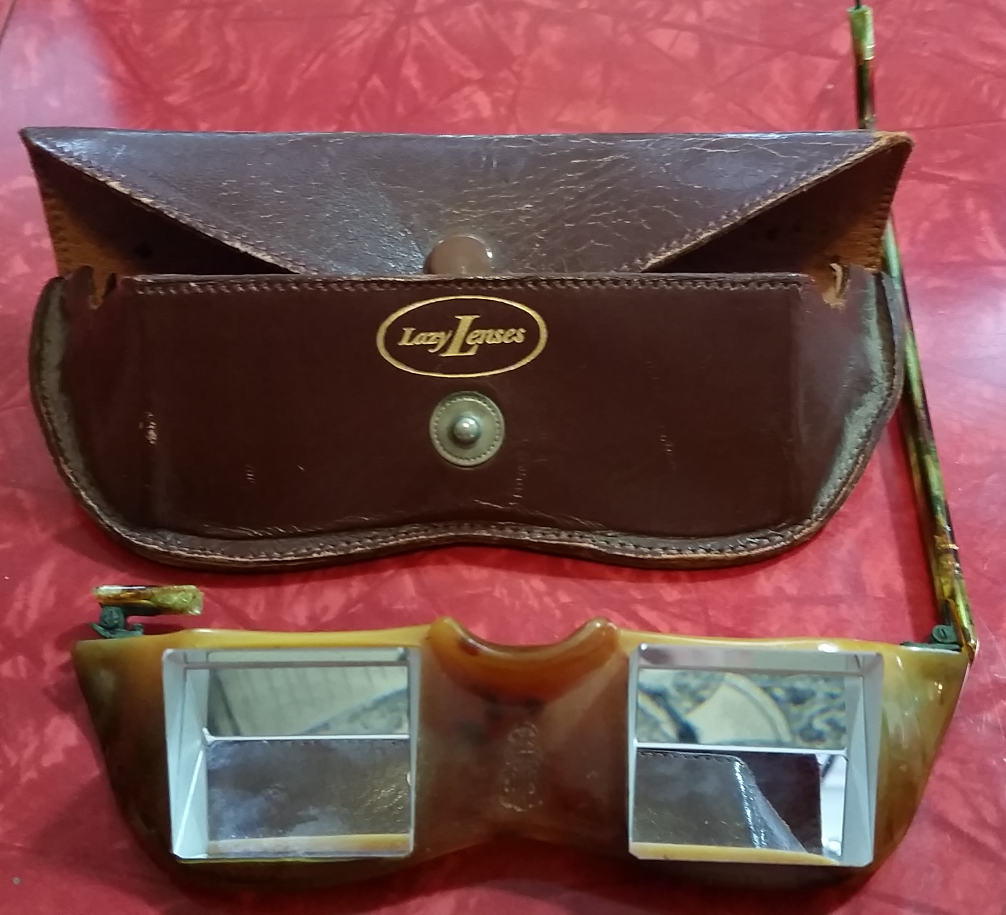
This image has been propagated all over the net by various content aggregators whom I will not mention here; I saw it in a collection of interesting tidbits shared with me by my good wife. At the New York Daily News I was able to find an attribution:

Caters News./ Published: 04/28/2014 12:58:23

What intrigued me about this image is that I have a pair made in 1951 which I inherited from my dad. One temple is missing and the remaining hinge is corroded closed, but these are the real McCoy.

Lazy Lenses

Look closely between the lenses and you’ll see this logo:

Logo

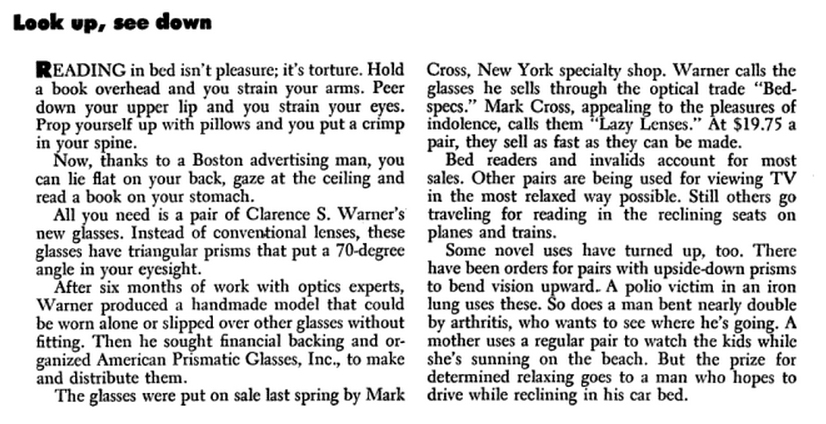
Mark Cross is a premier luxury leather goods company, and still going strong. If you want a $2500.00 fine leather men’s travel bag about the size of a laptop case, they’re just the company for you. Armed with the brand, I was able to come up with this:

changing times

Changing Times, The Kiplinger Magazine, October 1951, Page 38. For what it’s worth, Kiplinger is still in business as well.

Naturally, if there’s a good idea, you can be sure someone in China will make it for cheap.

specs

This pair is called Bed Prism Spectacles, made by a Chinese outfit and for sale via Amazon.com for $13.05. Given that the original set by Clarence S. Warner sold in 1951 for $19.95, the equivalent of $182.00 today, I’d say that’s a pretty good deal. Of course, it’s hard to tell the quality of these new knockoffs (and there are many, many versions out there), but I know the ones sold by Mark Cross were top-drawer.

The idea is great, but there are some drawbacks. If you’re nearsighted like me and wear glasses, they don’t work all that well. Contacts would be an obvious answer, but then one would need reading glasses for close-up work if you’re farsighted as well. Like me.

But I’ve had these in my treasure collection since 1989 when dad passed away, and it’s nice to know I have a pair of the originals, made by a company that makes only the best.

The Old Wolf has spoken.

How to Fight Rogue Debt Collectors

gty_telephone_robocalls_nt_120215_wmain

Reblogged from CNN – you can see the original article here. Written by By Jen Haley on Feb. 29, 2008

Reposting this because it’s a good article, and people need to know what their options are. Despite signs of a recovery in our economy – by Mogg’s holy grandfather it took long enough – many of us are still struggling, and debt collectors can be vicious and relentless.

Personal story: 15 years ago or so, I had my identity stolen. A lost insurance card that had my SS Number on it was picked up by a druggie in Florida, who promptly had ID made for himself in my name and started charging rent, phone bills, ambulance rides and all sorts of things, never intending to pay… and then the bill collectors started coming after me. It literally took four years to get the mess cleaned up: police reports, working with the three major credit reporting bureaus, fraud locks on my accounts, and almost daily calls from bill collectors who didn’t care what I was saying. I explained endlessly that I did not owe these debts, that I was the victim of fraud – one lady said, “I understand that the debt is not yours, but I’ll discharge it if you pay 50¢ on the dollar…” I wanted to slap her silly.

So if you find yourself in a bind, this article will help you understand what debt collectors can do, what they can’t, and how to fend off the unscrupulous ones.


Rogue debt collectors — how to fight them

By Jen Haley
CNN

(CNN) — If you’ve faced a financial catastrophe — an illness or job layoff — and you’ve fallen behind on some bills, you’re well aware that debt collectors are eager to collect those payments.

But some collectors go over the line, threatening to have the person arrested, making improper bank withdrawals, intimidating people and making harassing phone calls.

In one case a collector threatened to call a woman’s place of work “until she lost her job,” according to the National Consumer Law Center.

In another case, a collector threatened to send the police to the person’s workplace to arrest them, said Joe Ridout of Consumer Action.

The Better Business Bureau received a complaint about a debt collector contacting someone’s grandmother four-to-five times a day, using threats like, “if she dies, then her life insurance can pay this debt off.”

John Fugate, a Texas consumer attorney relates a story about a rogue debt collector. The debt collector told the “9-year-old child of my college friend, who is the victim of identity theft, that they were going to take her mommy away forever.”

Complaints about debt collection agencies are on the rise. The Federal Trade Commission said they received more complaints against debt collectors than against any other industry for at least the past three years. And for the past five years, complaints are up about 43 percent according to the Better Business Bureau.

Some of the most common complaints from consumers include collectors using vulgar language, trying to collect more than they’re owed, sharing the consumer’s debt information with friends and family or trying to collect extra fees, like late fees or court costs.

That’s not to say all debt collectors are resorting to these illegal tactics. ACA International is one of the largest credit and collection industry trade groups and it maintains a code of ethics that prohibits this kind of behavior.

And ethical debt collectors are necessary. According to a study cited by the company, the collection industry saved the average American household $351 in 2005. That is how much money households would have spent if businesses were forced to raise prices to cover bad debt. The bottom line here is that if you owe money, you should make every effort to pay off the debt.

Here’s some expert advice on how to fight back against unethical collectors. The Fair Debt Collection Practices Act requires that debt collectors treat you fairly. This doesn’t mean you won’t have to pay your legitimate debt. But here are some basic rights:

  • A debt collector cannot call you before 8 a.m. or after 9 p.m., unless you agree.
  • You cannot be contacted at work if the collector knows your employer disapproves.
  • If you don’t want to hear from a debt collector, write a letter telling them to stop. By law, they have to. Remember, the debt won’t go away and you can still be sued.
  • The debt collector can contact your attorney — if you have one. If not, your friends and family can be asked about how to get in touch with you.
  • A debt collector can’t misrepresent the amount of your debt.
  • A debt collector also cannot use profane or threatening language
  • Debt collectors can’t say that they will put a lien on your property or file a lawsuit unless the agency really means to do that and it’s legal.
  • Collectors can’t legally claim federal benefits, such as Social Security or your retirement accounts, like your IRA or 401(k).

Once you’re contacted by phone, you have the right to get a notice that outlines your debt, whom you owe money to, and what action to take if you don’t owe the money. Keep in mind that a debt collector can collect a debt owed by an ex-spouse. If the debt was incurred while you married, you are still liable for the debt after a divorce even divorce papers state the spouse is responsible for the debt.

If you’ve been contacted by a debt collector, but you don’t think you owe a debt, you must write a return letter stating that the debt is not yours within 30 days. Once a collector receives your letter, they should send you proof of the debt, such as a copy of the bill. Don’t be coerced into paying a debt you don’t owe. If you do pay just to get rid of the debt collectors, it’s an admission of guilt, and it will have a negative impact on your credit score.

Keep in mind that some debt has an expiration date. There is a limit to how long collectors can legally collect your debt. Generally this limit – called the statue of limitations – can range from three to 15 years according Ridout. Check with your state’s attorney general’s office to find out the limit in your state. You can find out who to contact at http://www.naag.org.

Sometimes debt collectors will try to collect on this old debt called zombie debt because it never goes away. Make sure you don’t accept a new credit offer from a creditor you never repaid. Once that creditor renews your credit relationship, the clock starts ticking all over again on your state’s statute of limitations.

If you think you’ve been treated unfairly by a debt collector, take action. File a complaint with the Federal Trade Commission at 877-FTC-HELP or go to http://www.ftc.gov. You should also contact your state attorney general’s office.

You also have the right to sue a debt collector in state or federal court within a year of the date the law is violated. A victory will allow you to recover money for the damages you suffered plus an additional amount up to $1,000. A group may also sue a collector and for damages up to $500,000, or one percent of the collector’s net worth, whichever is less.

And the federal government plays by slightly different rules. In 1996, Congress passed the Debt Collection Improvement Act which allows the government to take a portion of federal retirement, federal salary and Social Security benefit checks to cover non-tax debts owed to the government.

There are some debts that you can’t get rid of. If you don’t pay your federal student loans for example, debt collectors can garnish your Social Security wages and prevent you from renewing any state licenses according to Mark Kantrowitz of Finaid.org. Debt collectors can even dip into your tax refund. Other debts like past-due child support and federal tax liens tend to stick with you.


The Old Wolf has spoken.

The most peaceful monument I’ve ever seen

Cemeteries are peaceful places. For campaign managers, they are an abundant source of additional votes for their candidate:


26 - AddamsDowdForAlderman

Artist: Charles Addams

For genealogists, they are a rich source of family data:

William Draper Senior Tombstone - Incorrect Birthdate

Although one must be careful. This gentleman, my GGG-Grandfather, was actually born in 1774; whoever had the stone made obviously thought, “Ooh, wouldn’t it be cool if we said he was born in the year of independence!” And so it was written, and so it was done. Still, graveyards have given me much information and many leads that I otherwise would not have had.

(A parenthetical plug here for FindAGrave.com, a virtual cemetery containing millions of online memorials.)

Having spent many, many hours haunting various cemeteries in my home town and during my travels around the country, I came to appreciate them as places of peace and contemplation, and sometimes great poignancy.

Monument

This one, located in the Salt Lake City cemetery, makes me mist up every time I see it.

People or their families choose to create memorials in many different ways – just Google the images section for “unusual grave markers” for a selection. Some are bizarre, others frightfully clever.

Today on reddit, I saw another monument posted; it captured my heart immediately.

8fK4lye

Posted by /u/551100, this is the grave marker of Alfred Schnittke. Explained by /u/Rentiak:

“It’s a musical staff with a semibreve (the center bar) indicating a rest or pause in the music. The fermata (the half circle + dot at the top) indicates to hold the note (in this case the rest) as long as desired. The note should then be performed fortississimo (the three f’s at the bottom), meaning it should be performed extremely loudly/strongly.

So it’s an extremely loud/strong rest to be held as long as desired.”

Now that is resting in peace.

The Old Wolf has spoken.