Where the sidewalk ends

I share this because it pleases me. No other reason. There.

m30m2o0

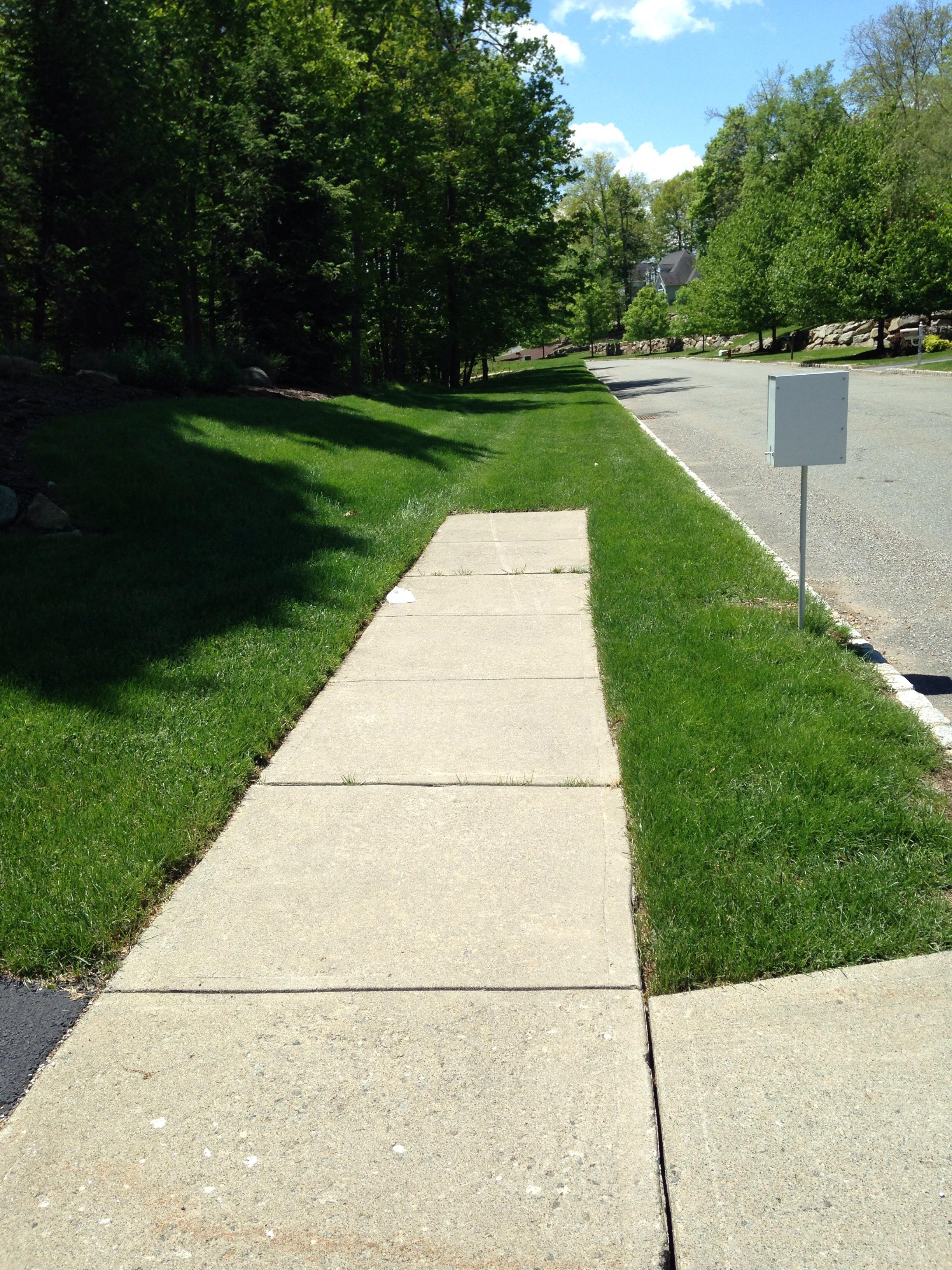
Over at reddit, user /u/corilee93 posted this picture, and /u/kilroylegend provided the reference. I have always loved the work of Shel Silverstein:

There is a place where the sidewalk ends
And before the street begins,
And there the grass grows soft and white,
And there the sun burns crimson bright,
And there the moon-bird rests from his flight
To cool in the peppermint wind.

Let us leave this place where the smoke blows black
And the dark street winds and bends.
Past the pits where the asphalt flowers grow
We shall walk with a walk that is measured and slow,
And watch where the chalk-white arrows go
To the place where the sidewalk ends.

Yes we’ll walk with a walk that is measured and slow,
And we’ll go where the chalk-white arrows go,
For the children, they mark, and the children, they know
The place where the sidewalk ends.

Shel Silverstein

The Old Wolf has spoken.

Mathematical Fiction Re-discovered on the Internet

I learned to love Science Fiction as a child; the first story I read was “Have Spacesuit, Will Travel,” by Robert Heinlein. I was hooked at once. Over the years I have read thousands of novels and stories, many of them remembered only in bits and snatches from decades ago.

Thanks to the Internet, many of my favorite stories have re-surfaced, indexed by the all-powerful Google – which makes this post somewhat meta in nature.

One such story was the delightful “MS Fnd in a Lbry“, written in 1961 by Hal Draper. My mother’s name was Draper, but this was a name adopted by the family to avoid anti-semitism, so there is unfortunately no relation.

Draper took a break from his life’s work of promoting Marxism, and wrote one science fiction story. The information explosion, and associated storage and retrieval problems, is humorously examined in this short story. (This story is also of historical interest, containing one of the earliest predictions of the Web.) The story originally appeared in the December 1961 issue of the magazine Fantasy and Science Fiction. Reprinted in Isaac Asimov and Janet Jeppson (eds) Laughing Space and Groff Conklin (ed) 17 Times Infinity.

All I did was search for “nudged quanta,” and there it was. And I thought to do it because of a photo I happened across at reddit, courtesy of /u/o0OIDaveIO0o, and then posted to Facebook:

euUzNT1

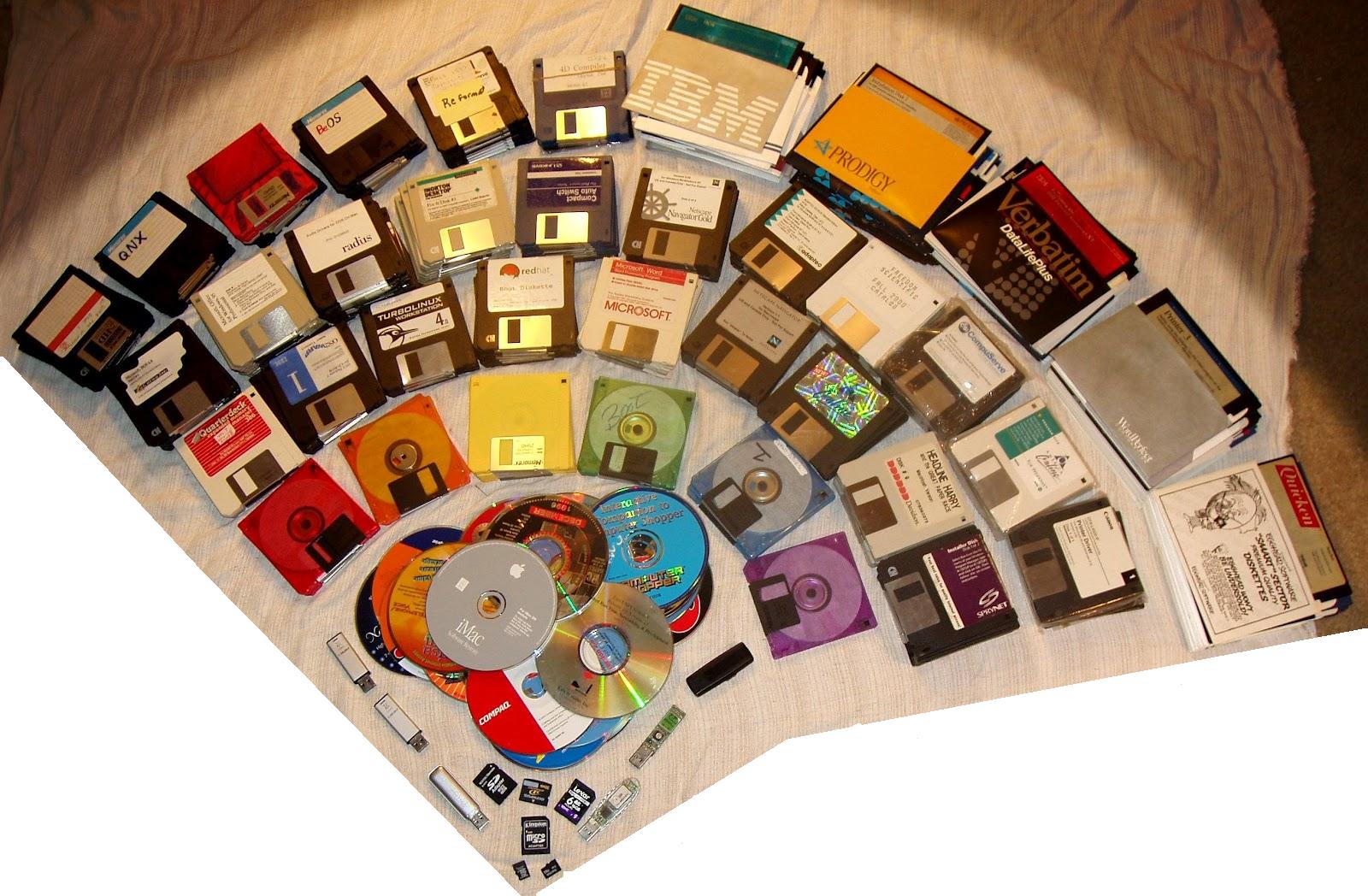
In just 25 years. One of the microcards at the bottom stores more than all the others combined. While not directly associated with Moore’s Law, the rapid progression of storage miniaturization has been mind-boggling, especially for those of us who lived through the early days of computers. Nowadays kids take massive storage like this for granted, but to see 16 gigabytes of data stored in a piece of plastic smaller than my fingernail simply boggles my mind, even though I used the technology daily.

CoreMemory03


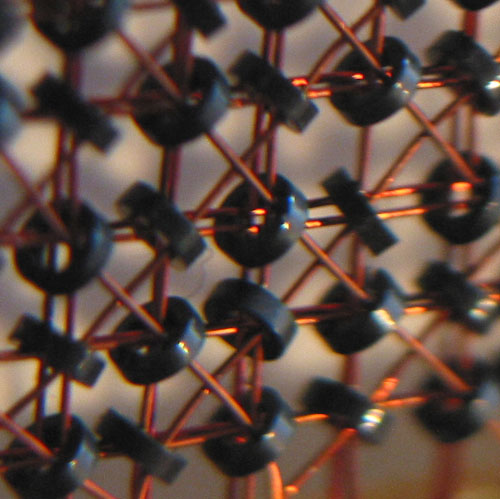
We’ve come a long way from An Wang’s 1955 patent for core memory – 1 bit per doughnut.

The Old Wolf has spoken.

Merged Books. Old, but eternal

A translator colleague first sent me this in 1999. It’s out on the net, but you have to know just what you’re looking for to find it. It is hard to find the right words to express how much I like this.

Mergematic books from the Washington Post Invitational: Readers were asked to combine the works of two authors and provide a suitable blurb. Back to the books.

The overall winner is also the Rookie of the Week:

Second Runner Up: “Machiavelli’s The Little Prince” Antoine de Saint Exupery’s classic children’s tale as presented by Machiavelli. The whimsy of human nature is embodied in many delightful and intriguing characters, all of whom are executed. (Erik Anderson, Tempe, Ariz.)

First Runner Up:

“Green Eggs and Hamlet”
Would you kill him in his bed?
Thrust a dagger through his head?
I would not, could not, kill the King.
I could not do that evil thing.
I would not wed this girl, you see.
Now get her to a nunnery. (Robin Parry, Arlington)

And the Winner of the Dancing Critter: “Fahrenheit 451 of the Vanities” An ’80s yuppie is denied books. He does not object, or even notice. (Mike Long, Burke)

Honorable Mentions:

“2001: A Space Iliad” The Hal 9000 computer wages an insane 10 year war against the Greeks after falling victim to the Y2K bug. (Joseph Romm, Washington)

“Curious Georgefather” The monkey finally sticks his nose where it don’t belong. (Chuck Smith, Woodbridge)

“The Hunchback Also Rises” Hideously deformed fellow is cloistered in bell tower by despicable clergymen. And that’s the good news … (John Verba, Washington)

“The Maltese Faulkner” Is the black bird a tortured symbol of Sam’s struggles with race and family? Does it signify his decay of soul along with the soul of the Old South? Is it merely a crow, mocking his attempts to understand? Or is it worth a cool mil? (Thad Humphries, Warrenton)

“The Silence of the Hams” In this endearing update of the
Seuss classic, young Sam I Am presses unconventional foodstuffs on his friend, Hannibal, who turns the tables. (Mark Eckenwiler, Washington)

“Jane Eyre Jordan”: Plucky English orphan girl survives hardships to lead the Chicago Bulls to the NBA championship. (Dave Pickering, Bowie)

“Nicholas and Alexandra Nickleby” Having narrowly escaped a Bolshevik firing squad, the former czar and czarina join a troupe of actors only to find that playing the Palace isn’t as grand as living in it. (Sandra Hull, Arlington)

“Catch 22 in the Rye” Holden learns that if you’re insane, you’ll probably flunk out of prep school, but if you’re flunking out of prep school, you’re probably not insane. (Brendan Beary, Great Mills)

“Tarzan of the Grapes” The beleaguered Okies of the dust bowl are saved by a strong and brave savage who swings from grapevine to grapevine. (Joseph Romm, Washington)

“Where’s Walden?” Alas, the challenge of locating Henry David Thoreau in each richly detailed drawing loses its appeal when it quickly becomes clear that he is always in the woods. (Sandra Hull, Arlington)

“Looking for Mr. Godot” A young woman waits for Mr. Right to enter her life. She has a looong wait. (Jonathan Paul, Garrett Park)

“Rikki Kon Tiki Tavi” Thor Heyerdahl recounts his attempt to prove Rudyard Kipling’s theory that the mongoose first came to India on a raft from Polynesia. (David Laughton, Washington) The Old Wolf has spoken

Book Review: Inferno (No spoilers)

the-abyss-1

It’s difficult to share a review of a book without giving anything away, and to say anything at all about Inferno might take the delight out of some tiny plot twist for someone else. All I can say is that I enjoyed this book immensely – it was a page-turner and no mistake; I started to read at about 2:00 PM, and finished around 11:30 that night. I found it a lot more plausible in story line than Angels and Demons or The Lost Symbol, and I got a huge amount of enjoyment out of the fact that I had been in all the cities where the action took place, spending a good deal of time in two of them.  Now I want to go back…  and I need to re-read La Divina Comedia. If it’s done well, this will be an outstanding movie. On that note, why they’re taking so long to turn Symbol into a movie is beyond me, unless they’re finding it too convoluted. Time will tell.

The Old Wolf has spoken.

The Life and Times of Maud Müller

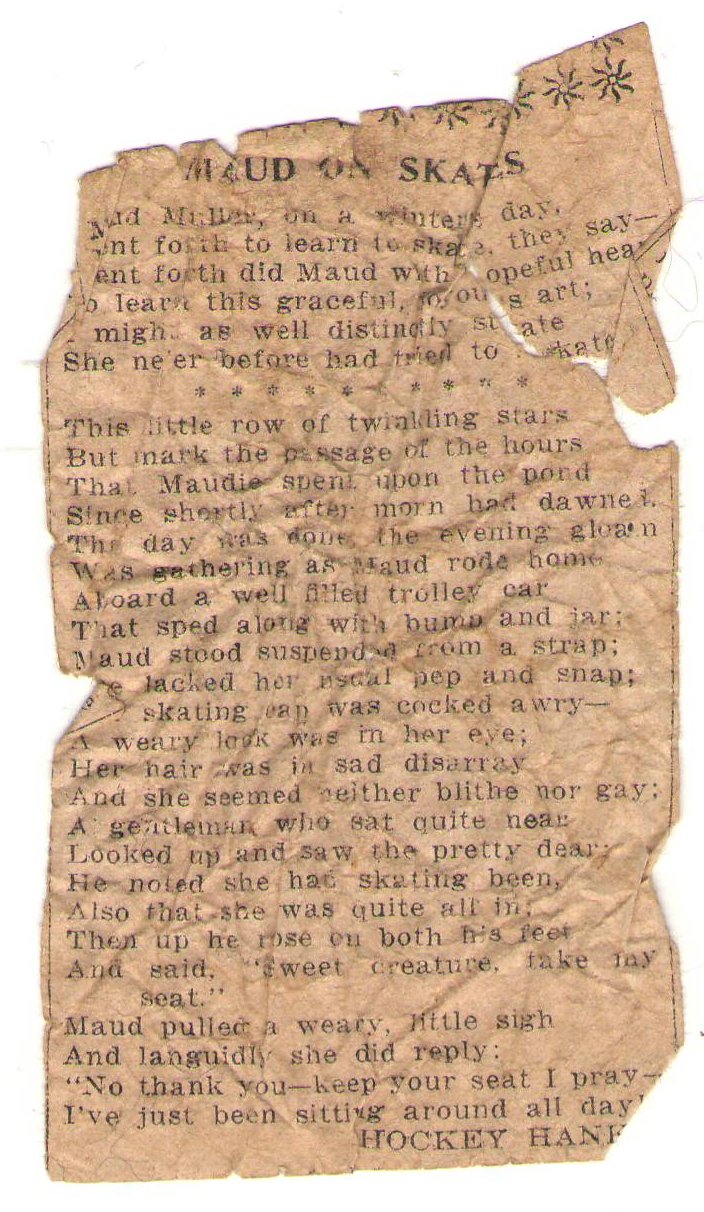
While perusing a children’s book which once had belonged to my wife’s stepfather (I was checking it out to see if it was worth keeping, but it was too badly deteriorated), a scrap of paper fell out – an old newspaper clipping. Old and wrinkled, it was almost like cloth, and turned out to be a humorous poem about a young lady named Maud Muller.
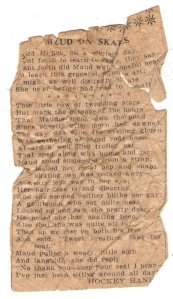
Maud Miller on Skates

What I discovered was that the original was written by John Greenleaf Whittier, which includes the famous tag line, “For of all sad words of tongue or pen, The saddest are these: ‘It might have been!’ ” It appears that the others I have found are the equivalent of “fan fiction,” but I share them with you anyway in the spirit of fun.

MAUD MÜLLER

by: John Greenleaf Whittier (1807-1892)

MAUD MÜLLER, on a summer’s day,
Raked the meadows sweet with hay.
Beneath her torn hat glowed the wealth
Of simple beauty and rustic health.

Singing, she wrought, and her merry glee
The mock-bird echoed from his tree.
But, when she glanced to the far-off town,
White from its hill-slope looking down,

The sweet song died, and a vague unrest
And a nameless longing filled her breast–
A wish, that she hardly dared to own,
For something better than she had known.

The Judge rode slowly down the lane,
Smoothing his horse’s chestnut mane.
He drew his bridle in the shade
Of the apple-trees, to greet the maid,

And ask a draught from the spring that flowed
Through the meadow across the road.
She stooped where the cool spring bubbled up,
And filled for him her small tin cup,

And blushed as she gave it, looking down
On her feet so bare, and her tattered gown.
“Thanks!” said the Judge, “a sweeter draught
From a fairer hand was never quaffed.”

He spoke of the grass and flowers and trees,
Of the singing birds and the humming bees;
Then talked of the haying, and wondered whether
The cloud in the west would bring foul weather.

And Maud forgot her briar-torn gown,
And her graceful ankles bare and brown;
And listened, while a pleasant surprise
Looked from her long-lashed hazel eyes.

At last, like one who for delay
Seeks a vain excuse, he rode away,
Maud Muller looked and sighed: “Ah, me!
That I the Judge’s bride might be!

“He would dress me up in silks so fine,
And praise and toast me at his wine.
“My father should wear a broadcloth coat;
My brother should sail a painted boat.

“I’d dress my mother so grand and gay,
And the baby should have a new toy each day.
“And I’d feed the hungry and clothe the poor,
And all should bless me who left our door.”

The Judge looked back as he climbed the hill,
And saw Maud Muller standing still.

“A form more fair, a face more sweet,
Ne’er hath it been my lot to meet.
“And her modest answer and graceful air
Show her wise and good as she is fair.

“Would she were mine, and I to-day,
Like her, a harvester of hay:
“No doubtful balance of rights and wrongs,
Nor weary lawyers with endless tongues,

“But low of cattle, and song of birds,
And health, and quiet, and loving words.”
But he thought of his sisters, proud and cold,
And his mother, vain of her rank and gold.

So, closing his heart, the Judge rode on,
And Maud was left in the field alone.
But the lawyers smiled that afternoon,
When he hummed in court an old love-tune;

And the young girl mused beside the well,
Till the rain on the unraked clover fell.
He wedded a wife of richest dower,
Who lived for fashion, as he for power.

Yet oft, in his marble hearth’s bright glow,
He watched a picture come and go:
And sweet Maud Muller’s hazel eyes
Looked out in their innocent surprise.

Oft when the wine in his glass was red,
He longed for the wayside well instead;
And closed his eyes on his garnished rooms,
To dream of meadows and clover-blooms.

And the proud man sighed, with a secret pain,
“Ah, that I were free again!
“Free as when I rode that day,
Where the barefoot maiden raked her hay.”

She wedded a man unlearned and poor,
And many children played round her door.
But care and sorrow, and child-birth pain,
Left their traces on heart and brain.

And oft, when the summer sun shone hot
On the new-mown hay in the meadow lot,
And she heard the little spring brook fall
Over the roadside, through the wall,

In the shade of the apple-tree again
She saw a rider draw his rein,
And, gazing down with timid grace,
She felt his pleased eyes read her face.

Sometimes her narrow kitchen walls
Stretched away into stately halls;
The weary wheel to a spinnet turned,
The tallow candle an astral burned;

And for him who sat by the chimney lug,
Dozing and grumbling o’er pipe and mug,
A manly form at her side she saw,
And joy was duty and love was law.

Then she took up her burden of life again,
Saying only, “It might have been.”
Alas for maiden, alas for Judge,
For rich repiner and household drudge!

God pity them both! and pity us all,
Who vainly the dreams of youth recall;
For of all sad words of tongue or pen,
The saddest are these: “It might have been!”

Ah, well! for us all some sweet hope lies
Deeply buried from human eyes;
And, in the hereafter, angels may
Roll the stone from its grave away!

(One Hundred Choice Selections. Ed. Phineas Garrett. Philadelphia: Penn Publishing Co., 1897.)

440px-Maud-Muller-Brown

John Gast, artist, after J.G. Brown

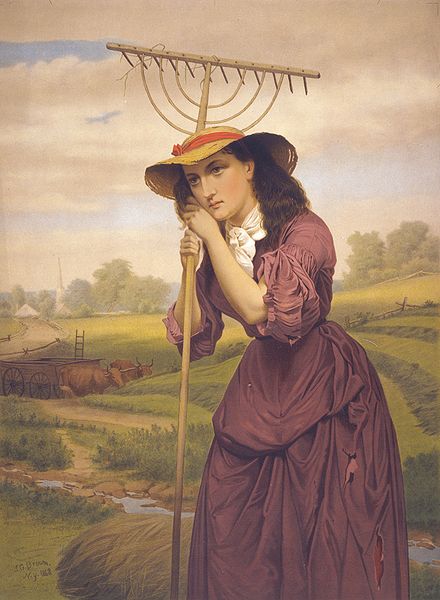
“Mr. Whittier’s statement of the origin of his poem “Maud Müller” is thus given. He was driving with his sister through York, U.S.A., and stopped at a harvest field to enquire the way. A young girl raking hay near the stone-wall stopped to answer their inquiries. Whittier noticed as she talked that she bashfully raked the hay around and over her bare feet, and she was fresh and fair. The little incident left its impression, and he wrote out the poem that very evening. “But if I had had any notion that the plaguey little thing would have been so liked, I should have taken more pains with it.” To the inquiry as to the title, Maud Müller, he said it was suggested to him, and was not a selection. It came as the poem came. But he gives it the short German pronunciation, as Meuler, not the broad Yankee, Muller.” (From Parodies of the works of English & American authors, Volume 5, p. 240)

MAUD MULLER IN WINTER

Maud Muller on a winter day
Went out upon the snow to sleigh.
Beneath her high heeled number six
Were a foot of hay and four hot bricks.
Singing she slode, and her merry glee
Shook the snow all off the tree.
“Wait till the clouds roll by!” she howled.
And as she passed the people scowled.
On her dexter side sat a fresh young dude
With his arm out of place as they sweetly slude.
But her howling died, and a vague distress
And a quart of snow filled the back of her dress.
For the reins were held in a careless hand,
And the basest drum in a parade’s band.
Went boom, bum, boom! And one cold day
A tandem left with an upturned sleigh.
Alas, for the dude! three cheers for the sleigh!
And hurrah for the chestnuts that ran away!
The saddest words at hier father’s door
Were these, “You needn’t cone back no more.”
The livery bill when he hied him thence
Was seventeen dollars and fifty cents.
-Boston Globe.

MAUD ON SKATES

Maud Muller, on a winter’s day
Went forth to learn to skate, they say –
Went forth did Maud with hopeful heart
To learn this graceful, joyous art;
I might as well distinctly state
She ne’er before had tried to skate.

* * * * *
This little row of twinkling stars
But mark the passage of the hours
That Maudie spent upon the pond
Since shortly after morn had dawned
The day was doen, the evening gloan
Was gathering as Maud rode home
Aboard a well-filled trolley car
That sped along with bump and jar;
Maud stood suspended from a strap;
She lacked her usual pep and snap;
Her skating cap was cocked awry –
A weary look was in her eye;
Her hair was in sad disarray
And she seemed neither blithe nor gay;
A gentleman who sat quite near
Looked up and saw the pretty dear;
He noticed she had skating been,
Also that she was quite all in’
Then up he rose on both his feet
And said, “Sweet creature, take my seat.”
Maud pulled a weary little sigh
And languidly she did reply:
“No thank you – keep your seat I pray –
I’ve just been sitting around all day!”
HOCKEY HANK

MRS. JUDGE JENKINS
[Being the only genuine sequel to “Maud Müller”)
By Bret Harte

“Maud Müller, all that summer day,
Raked the meadow sweet with hay;

But when he came, with smile and bow,
Maud only blushed, and stammered, “Ha-ow?”

And spoke of her “pa,” and wondered whether
He’d give consent they should wed together.

Old Muller burst in tears, and then
Begged that the Judge would lend him “ten;”

For trade was dull, and wages low,
And the “craps,” this year, were somewhat slow.

And ere the languid summer died,
Sweet Maud became the Judge’s bride.

But on the day that they were mated,
Maud’s brother Bob was intoxicated;

And Maud’s relations, twelve in all,
Were very drunk at the Judge’s hall.

And when the summer came again,
The young bride bore him babies twain;

And the Judge was blest, but thought it strange
That bearing children made such a change;

For Maud grew broad and red and stout,
And the waist that his arm once clasped about

Was more than he now could span; and he
Sighed as he pondered, ruefully,

How that which in Maud was native grace
In Mrs. Jenkins was out of place;

And thought of the twins, and wished that they
Looked less like the men who raked the hay

On Muller’s farm, and dreamed with pain
Of the day he wandered down the lane.

And looking down that dreary track,
He half regretted that he came back;

For, had he waited, he might have wed
Some maiden fair and thoroughbred;

For there be women fair as she,
Whose verbs and nouns do more agree.

Alas for maiden! alas for judge!
And the sentimental,—that’s one-half “fudge;”

For Maud soon thought the Judge a bore,
With all his learning and all his lore;

And the Judge would have bartered Maud’s fair face
For more refinement and social grace.

If, of all words of tongue and pen,
The saddest are, “It might have been,”

More sad are these we daily see:
“It is, but hadn’t ought to be.”

(From Parodies of the works of English & American authors, Volume 5, p. 240)
 

The Ultimate Portal

229671_186246791530158_1090605619_n

I can still hear the jingle from one of our local bookstores. It’s cheesy, but it stuck in my head, and I remember it because it’s so true.

♫ When you open a book from Deseret Book,
You open a wonderful door!
It leads beyond the things you see
On a journey of discovery… ♫

Books were my best friends growing up. I was small and introverted as a child, and books were wonderful, thrilling… and safe.

I cut my reading teeth on “Peanuts” at age 5, devoured books by Richard Scarry and Virginia Lee Burton, Gelett Burgess, Munro Leaf and many others; graduated to things by A.A. Milne and E.B. White and Robert Louis Stevenson; read The Hobbit in grade school (actually it was read to us), and stayed up all night for several nights running reading The Lord of the Rings in 1965 when it came out, the first time in my life I was unable to put a book down.

I wept through Saroyan’s The Human Comedy and Steinbeck’s Grapes of Wrath, and devoured my father’s collection of science fiction anthologies, which I later inherited, and still treasure. In college I became enamored of the realists – Twain, James, and Howells, among others, and although I choked on Thomas Hardy in high school, I shouted with glee on almost every page of The Mayor of Casterbridge when I re-read it (for pleasure!) four years later. Orwell, Huxley, Asimov, Salinger, Clarke, Camus, Sartre, St. Exupéry, Victor Hugo, Proust – oh, those long sentences! – and so many, many others… the list goes on forever.

Reading gave me a love of language, both my own and that of others. Some of my favorite examples of beautiful writing I have shared before. And the journeys I took in my imagination long before I ever set foot outside of my own country took me to the edges of the universe and back. To quote O. Henry again, from the aforementioned “A Municipal Report:”

“On the surface,” said Azalea Adair. “I have traveled many times around the world in a golden airship wafted on two wings – print and dreams. I have seen (on one of my imaginary tours) the Sultan of Turkey bowstring with his own hands one of his wives who had uncovered her face in public. I have seen a man in Nashville tear up his theatre tickets because his wife was going out with her face covered – with rice powder. In San Francisco’s Chinatown I saw the slave girl Sing Yee dipped slowly, inch by inch, in boiling almond oil to make her swear she would never see her American lover again. She gave in when the boiling oil had reached three inches above her knee. At a euchre party in East Nashville the other night I saw Kitty Morgan cut dead by seven of her schoolmates and lifelong friends because she had married a house painter. The boiling oil was sizzling as high as her heart; but I wish you could have seen the fine little smile that she carried from table to table. Oh, yes, it is a humdrum town. Just a few miles of red brick houses and mud and lumber yards.”

Azalea Adair knew: books are the ultimate portals.

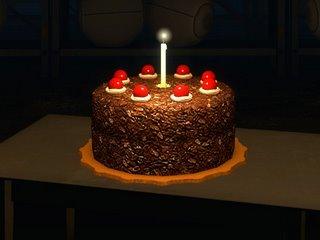
Portal Cake 2


And there’s so much more than cake to be had.

The Old Wolf has spoken.

Perspective

Perspective

Found at the Chicago Public Library. 

Books give you a better perspective on life.

Some wag over at Reddit posted this filk:

LreCOuB

It’s not a bad analogy. Books serve many functions. They make you smarter, increase your vocabulary, help you write better, improve your analytical thinking, reduce stress, bump your memory skills, broaden your horizons, help you see deeper into reality, and they can be a delightful escape from life’s challenges. The image above implies that books occasionally present a dark reality; “If it be true I am content to have paid the price–for the memory.”[1]

The Old Wolf has spoken.


[1] James, Henry, “The Real Thing.”

Happy Anniversary to me.

Wordpress

I am told that today is my 4th anniversary as a registered WordPress user, although I’ve only been keeping up this particular blog for just under a year now (I began on the 26th of April, 2012). I’ve appreciated the responses and input that I have gotten from my readers and look forward to continuing in the same vein, and perhaps even expanding my reach.

I have many  more essays percolating in the back of my mind, and will pour them out when they are ready. Actually, a lot of them are like cowboy coffee:

  1. Add 1 lb. coffee to a bucket of water.
  2. Set on the fire to boil.
  3. Toss in a horseshoe.
  4. When the horseshoe floats to the top, it’s ready.

Which reminds me of a poem that I have known for about 40 years. I will share with you here, for no other reason than that it occurred to me:

The Indispensable Man
(by Saxon White Kessinger)

Sometime when you’re feeling important;
Sometime when your ego’s in bloom;
Sometime when you take it for granted,
You’re the best qualified in the room:
Sometime when you feel that your going,
Would leave an unfillable hole,
Just follow these simple instructions,
And see how they humble your soul.

Take a bucket and fill it with water,
Put your hand in it up to the wrist,
Pull it out and the hole that’s remaining,
Is a measure of how much you’ll be missed.
You can splash all you wish when you enter,
You may stir up the water galore,
But stop, and you’ll find that in no time,
It looks quite the same as before.

The moral of this quaint example,
Is to do just the best that you can,
Be proud of yourself but remember,
There’s no indispensable man.

The Old Wolf has spoken.

Language to chew on

I have a collection of great American short stories that I treasure. It contains a wondrous plethora of some of the best writing I’ve seen collected anywhere, in one of my favorite genres. My son’s fiancée keeps a blog where she does some fine writing of her own, and I was moved to post a few samples of what I regard as “delicious” language as a comment to one of her entries. Because I thought things of this nature deserve wider exposure, I share it again here, somewhat expanded, and including my own summary to her.

Enjoy, or don’t – it’s all sausage to me.


“I stepped off the train at 8 P.M. Having searched the thesaurus in vain for adjectives, I must, as a substitution, hie me to comparison in the form of a recipe.

Take a London fog 30 parts; malaria 10 parts; gas leaks 20 parts; dewdrops gathered in a brick yard at sunrise, 25 parts; odor of honeysuckle 15 parts. Mix.

The mixture will give you an approximate conception of a Nashville drizzle. It is not so fragrant as a moth-ball nor as thick as pea-soup; but ’tis enough – ’twill serve.

I went to a hotel in a tumbril. It required strong self-suppression for me to keep from climbing to the top of it and giving an imitation of Sidney Carton. The vehicle was drawn by beasts of a bygone era and driven by something dark and emancipated.”

-O. Henry – “A Municipal Report”

“There were two kinds of high-blue weather, besides the winter kind which didn’t set him off very often, spring and fall. In the spring it would have a soft, puffy wind and soft, puffy white clouds which made separate shadows that traveled silently acorss hills that looked soft too. In the fall it would be still, and there would be no clouds at all in the blue, but there would be something in the golden air and the soft, steady sunlight on the mountains that made a man as uneasy as the spring blowing, though in a different way, more sad and not so excited.”

-Walter Van Tilburg Clark, “The Wind and the Snow of Winter”

“Valentine patters over and holds open a screen door warped like a sea shell, bitter in the wet, and they walk in, stained darker with the rain and leaving footprints. Inside, sheltered dry smells stand like screens around a table covered with a red-checkered cloth, in the center of which flies hang onto an obelisk-shaped ketchup bottle. The midnight walls are checkered again with admonishing “Not Responsible” signs and black-figured, smoky calendars. It is a waiting, silent, limp room. There is a burned-out-looking nickelodeon and right beside it a long-necked wall instrument labeled “Business Phone, Don’t Keep Talking.” Circled phone numbers are written up everywhere. There is a worn-out peacock feather hanging by a thread to an old, thin, pink, exposed light bulb, where it slowly turns around and around, whoever breathes.”

-Eudora Welty, “Powerhouse”

“The night was in windy November, and the blast, threatening rain, roared around the poor little shanty of Uncle Ripley, set like a chicken-trap on the vast Iowa prairie. Uncle Ethan was mending his old violin, with many York State “dums! ” and ” I gol darns! ” totally oblivious of his tireless old wife, who, having “finished the supper-dishes,” sat knitting a stocking, evidently for the little grandson who lay before the stove like a cat.

Neither of the old people wore glasses, and their light was a tallow candle ; they couldn’t afford ” none o them new-fangled lamps.” The room was small, the chairs were wooden, and the walls bare a home where poverty was a never-absent guest. The old lady looked pathetically little, weazened and hopeless in her ill-fitting garments (whose original color had long since vanished), intent as she was on the stocking in her knotted, stiffened fingers, and there was a peculiar sparkle in her little black eyes, and an unusual resolution in the straight line of her withered and shapeless lips.”

-Hamlin Garland, “Mrs. Ripley’s Trip”

“How [Tennessee met his fate], how cool he was, how he refused to say anything, how perfect were the arrangements of the committee, were all duly reported, with the addition of a warning moral and example to all future evil doers, in the Red Dog Clarion, by its editor, who was present, and to whose vigorous English I cheerfully refer the reader. But the beauty of that midsummer morning, the blessed amity of earth and air and sky, the awakened life of the free woods and hills, the joyous renewal and promise of Nature, and above all, the infinite serenity that thrilled through each, was not reported, as not being a part of the social lesson. And yet, when the weak and foolish deed was done, and a life, with its possibilities and responsibilities, had passed out of the misshapen thing that dangled between earth and sky, the birds sang, the flowers bloomed, the sun shone, as cheerily as before; and possibly the Red Dog Clarion was right.”

-Bret Harte, “Tennessee’s Partner”

“And with that effort, everything was solved, everything became all right: the seamless hiss advanced once more, the long white wavering lines rose and fell like enormous whispering sea-waves, the whisper becoming louder, the laughter more intensely maniacal.

“Listen!” it said. “We’ll tell you the last, the most beautiful and secret story-shut your eyes-it is a very small story-a story that gets smaller and smaller-it comes inward instead of opening like a flower-it is a flower becoming a seed-a little cold seed-do you hear” We are leaning closer to you”-

The hiss was now becoming a roar-the whole world was a vast moving screen of snow-but even now it said peace, it said remoteness, it said cold, it said sleep.”

Conrad Aiken, “Silent Snow, Secret Snow”


This is “graspy” language, language that must be chewed slowly, and savored, and lingered over, language that rolls around on the tongue and resists being swallowed, which bids you stay, and wait, and read again, before you force yourself to shoulder on to the next paragraph, and yet which calls you back and back and back again like a dessert which somehow never grows smaller in spite of how many bites you take. Language is yours, words are yours, make of them what you will, and if the dictionary or the thesaurus come up poor, make up your own. What’s good enough for Shaksper and Cummings and Hemingway and Joyce must surely be good enough for you.

The Old Wolf has Spoken