Language to chew on

I have a collection of great American short stories that I treasure. It contains a wondrous plethora of some of the best writing I’ve seen collected anywhere, in one of my favorite genres. My son’s fiancée keeps a blog where she does some fine writing of her own, and I was moved to post a few samples of what I regard as “delicious” language as a comment to one of her entries. Because I thought things of this nature deserve wider exposure, I share it again here, somewhat expanded, and including my own summary to her.

Enjoy, or don’t – it’s all sausage to me.


“I stepped off the train at 8 P.M. Having searched the thesaurus in vain for adjectives, I must, as a substitution, hie me to comparison in the form of a recipe.

Take a London fog 30 parts; malaria 10 parts; gas leaks 20 parts; dewdrops gathered in a brick yard at sunrise, 25 parts; odor of honeysuckle 15 parts. Mix.

The mixture will give you an approximate conception of a Nashville drizzle. It is not so fragrant as a moth-ball nor as thick as pea-soup; but ’tis enough – ’twill serve.

I went to a hotel in a tumbril. It required strong self-suppression for me to keep from climbing to the top of it and giving an imitation of Sidney Carton. The vehicle was drawn by beasts of a bygone era and driven by something dark and emancipated.”

-O. Henry – “A Municipal Report”

“There were two kinds of high-blue weather, besides the winter kind which didn’t set him off very often, spring and fall. In the spring it would have a soft, puffy wind and soft, puffy white clouds which made separate shadows that traveled silently acorss hills that looked soft too. In the fall it would be still, and there would be no clouds at all in the blue, but there would be something in the golden air and the soft, steady sunlight on the mountains that made a man as uneasy as the spring blowing, though in a different way, more sad and not so excited.”

-Walter Van Tilburg Clark, “The Wind and the Snow of Winter”

“Valentine patters over and holds open a screen door warped like a sea shell, bitter in the wet, and they walk in, stained darker with the rain and leaving footprints. Inside, sheltered dry smells stand like screens around a table covered with a red-checkered cloth, in the center of which flies hang onto an obelisk-shaped ketchup bottle. The midnight walls are checkered again with admonishing “Not Responsible” signs and black-figured, smoky calendars. It is a waiting, silent, limp room. There is a burned-out-looking nickelodeon and right beside it a long-necked wall instrument labeled “Business Phone, Don’t Keep Talking.” Circled phone numbers are written up everywhere. There is a worn-out peacock feather hanging by a thread to an old, thin, pink, exposed light bulb, where it slowly turns around and around, whoever breathes.”

-Eudora Welty, “Powerhouse”

“The night was in windy November, and the blast, threatening rain, roared around the poor little shanty of Uncle Ripley, set like a chicken-trap on the vast Iowa prairie. Uncle Ethan was mending his old violin, with many York State “dums! ” and ” I gol darns! ” totally oblivious of his tireless old wife, who, having “finished the supper-dishes,” sat knitting a stocking, evidently for the little grandson who lay before the stove like a cat.

Neither of the old people wore glasses, and their light was a tallow candle ; they couldn’t afford ” none o them new-fangled lamps.” The room was small, the chairs were wooden, and the walls bare a home where poverty was a never-absent guest. The old lady looked pathetically little, weazened and hopeless in her ill-fitting garments (whose original color had long since vanished), intent as she was on the stocking in her knotted, stiffened fingers, and there was a peculiar sparkle in her little black eyes, and an unusual resolution in the straight line of her withered and shapeless lips.”

-Hamlin Garland, “Mrs. Ripley’s Trip”

“How [Tennessee met his fate], how cool he was, how he refused to say anything, how perfect were the arrangements of the committee, were all duly reported, with the addition of a warning moral and example to all future evil doers, in the Red Dog Clarion, by its editor, who was present, and to whose vigorous English I cheerfully refer the reader. But the beauty of that midsummer morning, the blessed amity of earth and air and sky, the awakened life of the free woods and hills, the joyous renewal and promise of Nature, and above all, the infinite serenity that thrilled through each, was not reported, as not being a part of the social lesson. And yet, when the weak and foolish deed was done, and a life, with its possibilities and responsibilities, had passed out of the misshapen thing that dangled between earth and sky, the birds sang, the flowers bloomed, the sun shone, as cheerily as before; and possibly the Red Dog Clarion was right.”

-Bret Harte, “Tennessee’s Partner”

“And with that effort, everything was solved, everything became all right: the seamless hiss advanced once more, the long white wavering lines rose and fell like enormous whispering sea-waves, the whisper becoming louder, the laughter more intensely maniacal.

“Listen!” it said. “We’ll tell you the last, the most beautiful and secret story-shut your eyes-it is a very small story-a story that gets smaller and smaller-it comes inward instead of opening like a flower-it is a flower becoming a seed-a little cold seed-do you hear” We are leaning closer to you”-

The hiss was now becoming a roar-the whole world was a vast moving screen of snow-but even now it said peace, it said remoteness, it said cold, it said sleep.”

Conrad Aiken, “Silent Snow, Secret Snow”


This is “graspy” language, language that must be chewed slowly, and savored, and lingered over, language that rolls around on the tongue and resists being swallowed, which bids you stay, and wait, and read again, before you force yourself to shoulder on to the next paragraph, and yet which calls you back and back and back again like a dessert which somehow never grows smaller in spite of how many bites you take. Language is yours, words are yours, make of them what you will, and if the dictionary or the thesaurus come up poor, make up your own. What’s good enough for Shaksper and Cummings and Hemingway and Joyce must surely be good enough for you.

The Old Wolf has Spoken

“After reading this blog, you’ll think Shakespeare was a penny dreadful hack!”

Yup, that’s a “blurb”. We see them everywhere, but tend to notice them most on movie advertisements. We ignore them or laugh at them, but for better or for worse they influence our consumption habits.

zwei-komplette-romane

Seeing the blurb on this dime store pulp made me chuckle – “damned with faint praise” is the first thing that came to mind. You’d think they might have come up with something a bit more riveting, but what it shows is the absolute necessity in some editor’s mind that a blurb – any blurb – must grace the cover.

The word “blurb” itself was coined by American humorist Gelett Burgess, author of Goops and How to Be Them (you can see a sample here.)

FileGelett_Burgess

Burgess handed out a limited run of his book Are You a Bromide?  to a trade organization dinner, and the dust jacket included this image:

Blurbing

Blurbs are everywhere, and well-known authors are often solicited for blurbs about other books. The New York Times published “Riveting!’: The Quandary of the Book Blurb,” a series of essays on blurbing including a piece by Stephen King; the upshot is that blurbs are a necessary evil, but they can have a certain value. On the other hand, however, sometimes the writers should probably have stayed in bed.

In their famous parody Bored of the Rings, Harvard Lampoon lost no opportunity to make fun of blurbs themselves, publishing this page of blurbs in the front of their book:


“Much have I travelled in the realms of gold, and many goodly states and kingdoms seen; round many western islands have I been, which bards in fealty to Apollo hold. Oft of one wide expanse had I been told, which deep browed Homer ruled as his demesne. Yet never did I breathe its pure serene, till I heard Bored of the Rings speak out loud and bold!…”
JOHN KEATS, Manchester Nightingale

“This book… tremor… Manichean guilt… existential… pleonastic… redundancy…”
ORLANDO DI BISCUIT, Hobnob

“A slightly more liberal reading of the leash-laws would keep books like this off the stands. I don’t know how you’ll fare, but my copy insists on long walks around suppertime, bays at the moon, and has spoiled every sofa cushion in the place,”
WILMOT PROVISO, The Rocky Mountain Literary Round-Up

“0ne of the two or three books…”
FRANK O’PRUSSIA, Dublin Gazette

“Truly a tale for our times … as we hang suspended over the brink on a Ring of our own, threatened by dragons and other evil people, and, like Frito and Good­gulf, fighting a cruel Enemy who will stop at nothing to get his way,”
ANN ALAGGI, The Old Flag

“Extremely interesting from almost every point of view.”
PROFESSOR HAWLEY SMOOT, Oer Loosely Enforced Libel Law! 


Scott Adams, author of Dilbert, sponsored a reader contest to provide a blurb for his book Stick to Drawing Comics, Monkey Brain!; the grand prize winner was Nicolas Feia who came up with this gem:

“‘What a perfect companion for my afternoon milk bath,” I thought while picking up this little gem on my way home from work. Within the hour I had laughed myself into a neck-deep tomb of butter. My wife came in, sipping her eggnog, and topped me with meringue.”

The others, however, are good for a laugh as well.

Anyway,

“Keep reading this blog and you’ll soon see that Mark Twain has met his match!”
SIMPLOT Q. ANALEMMA, On the Rising Value of Badgers, Mushrooms and Snakes in the Modern Commodity Market

The Old Wolf has spoken.

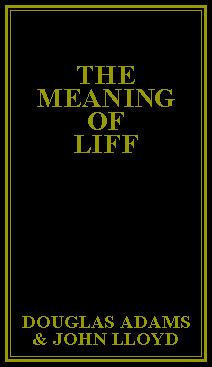
The Meaning of Liff

I first saw this gem in hardback in a shop in Oslo, and figured it would be online.

The Meaning of Liff by Douglas Adams and John Lloyd.

Not only the words are delightful, but the fact that they are so in touch with all these little scraps of life that hardly anyone ever talks about… There’s an expanded version also, but it doesn’t appear to have made it online yet.

A few examples:

LINDISFARNE (adj.)
Descriptive of the pleasant smell of an empty biscuit tin.

MALIBU (n.)
The height by which the top of a wave exceeds the height to which you have rolled up your trousers.

YEPPOON (n.)
One of the hat-hanging corks which Australians wear for making Qantas commercials.

The Old Wolf has spoken.

Children’s Poetry I have Loved, Part 5

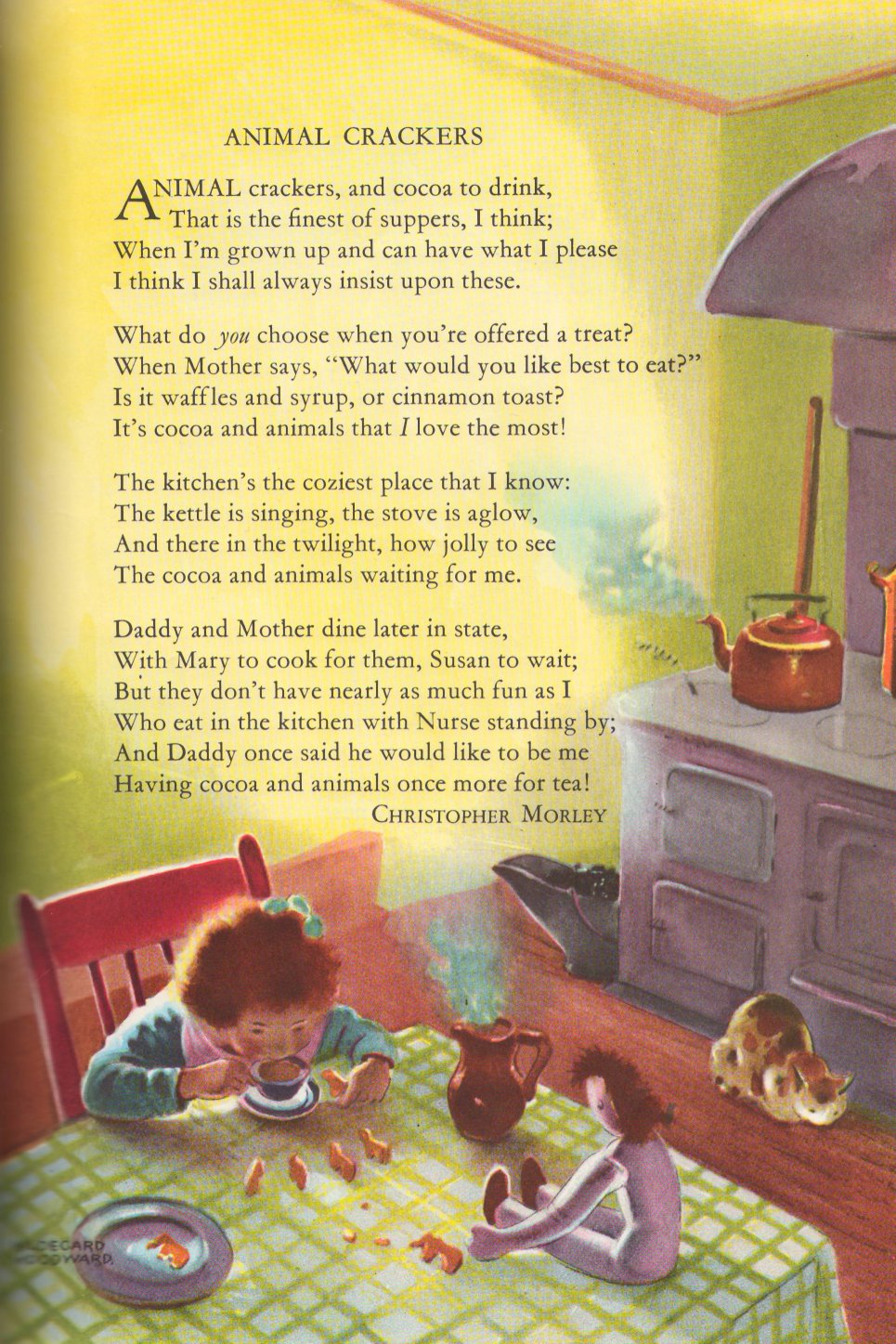
I love this one, and used to read it to my own children often. The illustration by Hildegard Woodward is delightful, and perfectly captures the sense of warmth and security imparted by the words. The illustration appears in Childcraft, Volume 1: Poems of Early Childhood, published by Field Enterprises Educational Corporation.

Animal Crackers

Animal Crackers

by Christopher Morley

Animal crackers and cocoa to drink —
That is the finest of suppers I think;
When I’m grown up and can have what I please
I think I shall always insist upon these.

What do YOU choose when you’re offered a treat?
When Mother says, “What would you like best to eat?”
Is it waffles and syrup, or cinnamon toast?
It’s cocoa and animals that I love most!

The kitchen’s the cosiest place that I know;
The kettle is singing, the stove is aglow,
And there in the twilight, how jolly to see
The cocoa and animals waiting for me.

Daddy and Mother dine later in state,
With Mary to cook for them, Susan to wait;
But they don’t have nearly as much fun as I
Who eat in the kitchen with Nurse standing by;

And Daddy once said, he would like to be me
Having cocoa and animals once more for tea!


Children’s Poetry I Have Loved, Part 3

Antonio

by Laura E. Richards

(This one had me rolling on the floor every time I read it)

Antonio, Antonio
Was tired of living alonio.
He thought he would woo
Miss Lissamy Lu,
Miss Lissamy Lucy Molonio.

Antonio, Antonio,
Rode off on his polo-ponio.
He found the fair maid
In a bowery shade,
A-sitting and knitting alonio.

Antonio1

Antonio, Antonio,
Said, “If you will be my ownio,
I’ll love you true,
And I’ll buy for you
An icery creamery conio!”

Oh, Nonio, Antonio!
You’re far too bleak and bonio!
And all that I wish,
You singular fish,
Is that you will quickly begonio.”

Antonio, Antonio,
He uttered a dismal moanio;
Then he ran off and hid
(Or I’m told that he did)
In the Antecatarctical Zonio.

Antonio2

Children’s Poetry I have Loved, Part 2

The Tale of Custard the Dragon

by Ogden Nash
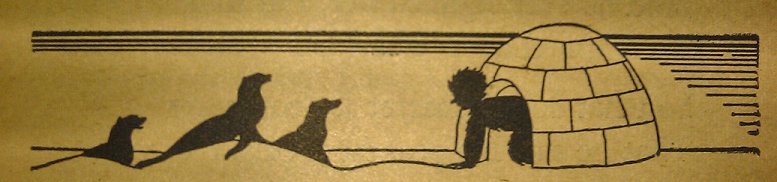
Silhouettes by Janet Laura Scott and Paula Rees Good
Published in 200 Best Poems for Boys and Girls, Whitman Publishing Company, 1938

Belinda lived in a little white house,
With a little black kitten and a little gray mouse,
And a little yellow dog and a little red wagon,
And a realio, trulio, little pet dragon.

Custard1

Now the name of the little black kitten was Ink,
And the little gray mouse, she called her Blink,
And the little yellow dog was sharp as Mustard,
But the dragon was a coward, and she called him Custard.

Custard the dragon had big sharp teeth,
And spikes on top of him and scales underneath,
Mouth like a fireplace, chimney for a nose,
And realio, trulio, daggers on his toes.

Belinda was as brave as a barrel full of bears,
And Ink and Blink chased lions down the stairs,
Mustard was as brave as a tiger in a rage,
But Custard cried for a nice safe cage.

Belinda tickled him, she tickled him unmerciful,
Ink, Blink and Mustard, they rudely called him Percival,
They all sat laughing in the little red wagon
At the realio, trulio, cowardly dragon.

Belinda giggled till she shook the house,
And Blink said Week!, which is giggling for a mouse,
Ink and Mustard rudely asked his age,
When Custard cried for a nice safe cage.

Custard2

Suddenly, suddenly they heard a nasty sound,
And Mustard growled, and they all looked around.
Meowch! cried Ink, and Ooh! cried Belinda,
For there was a pirate, climbing in the winda.

Pistol in his left hand, pistol in his right,
And he held in his teeth a cutlass bright,
His beard was black, one leg was wood;
It was clear that the pirate meant no good.

Belinda paled, and she cried, Help! Help!
But Mustard fled with a terrified yelp,
Ink trickled down to the bottom of the household,
And little mouse Blink strategically mouseholed.

But up jumped Custard, snorting like an engine,
Clashed his tail like irons in a dungeon,
With a clatter and a clank and a jangling squirm
He went at the pirate like a robin at a worm.

The pirate gaped at Belinda’s dragon,
And gulped some grog from his pocket flagon,
He fired two bullets but they didn’t hit,
And Custard gobbled him, every bit.

Custard3

Belinda embraced him, Mustard licked him,
No one mourned for his pirate victim
Ink and Blink in glee did gyrate
Around the dragon that ate the pyrate.

Belinda still lives in her little white house,
With her little black kitten and her little gray mouse,
And her little yellow dog and her little red wagon,
And her realio, trulio, little pet dragon.

Belinda is as brave as a barrel full of bears,
And Ink and Blink chase lions down the stairs,
Mustard is as brave as a tiger in a rage,
But Custard keeps crying for a nice safe cage.

Children’s Poetry I have Loved, Part 1

Posting Stevenson’s The Lamplighter reminded me that there are numerous other poems which stick in my memory from early childhood. When my mother passed away at the age of 94 in 2011, I found on her shelves a crumbling copy of Two Hundred Best Poems for Boys and Girls, compiled by Marjorie Barrows and published in 1930 and 1938. Printed on very non-durable paper, most of the book fell to dust when I tried to read it – but I immediately recognized it as a book that I loved from my earliest days. I was fortunately able to find an intact copy on Abebooks – it’s also yellowed and fragile, but complete. Just for fun, I thought I’d share some of my favorite youth poetry here, as the muse moves me, because it’s one thing that gave me a love of words and language from an early age.

Jonathan Bing’s Manners

Beatrice Curtis Brown

Jonathan Bing takes off his hat
Whenever he meets a Tabby-cat;
Jonathan Bing bows down to his toes
Whenver he passes a sheep he knows.
Oh, search from Paris to old Japan,
There’s none so courtly as Jonathan!

I’ve seen him murmer a “how-d’you-do”
To a tired forsaken dancing-shoe;
I’ve seen him lend his handkerchief
To a watering can that had come to grief;

I’ve seen him pat, without disdain,
An orphan goldfish who had a pain,
And he even lights a fire, I’m told,
To warm the air when the weather’s cold.

So what does it matter if people say
That he eats his peas in a vulgar way,
Or opens his mouth, to yawn, so wide
That twenty chickens could roost inside?
Oh, search from Paris to old Japan,
There’s none so courtly as Jonathan!

The Old Wolf has quoted.

The Lamplighter

458672_4577535208397_1543023668_o

Photo copyright ©2012 Jan-Edward Vogels

Y21yzOm

May be art of 5 people

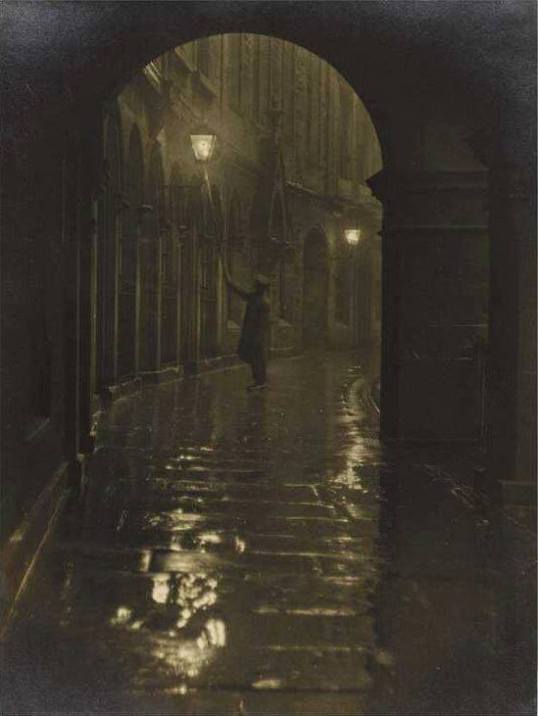
“The lamplighter.” Erik Henningsen (1855_1930)

RRq3wfh

Lamplighter, Victoria Terrace, Edinburgh, 1928. Photographer Unknown

The Lamplighter

My tea is nearly ready and the sun has left the sky;
It’s time to take the window to see Leerie going by;
For every night at teatime and before you take your seat,
With lantern and with ladder he comes posting up the street
Now Tom would be a driver and Maria go to sea,
And my papa’s a banker and as rich as he can be;
But I, when I am stronger and can choose what I’m to do,
O Leerie, I’ll go round at night and light the lamps with you
For we are very lucky, with a lamp before the door,
And Leerie stops to light it as he lights so many more;
And O! before you hurry by with ladder and with light,
O Leerie, see a little child and nod to him tonight!
-Robert Louis Stevenson

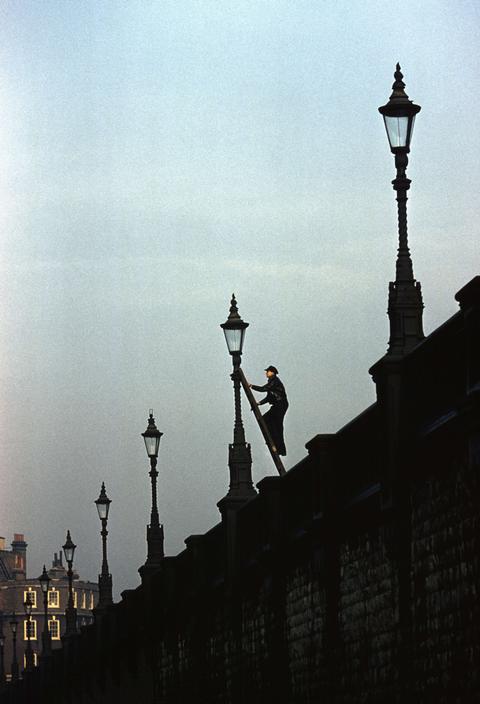
This poem, one of my favorites in A Child’s Garden of Verses, refers to the days when lamplighters would come around the streets of Edinburgh, lighting the gas lamps. As a child, Stevenson was an invalid (hence the reference to “when I am stronger”), and looking out of the window to see the lamplighter would be a bright spot in the lonely child’s day; to be noticed and nodded to would be exceptional.)

Leerie1

Leerie2

A Child’s Garden of Verses, Platt and Munk, 1929, illustrations by Eulalie

In a book that I wish everyone in the world could read, because it is filled with goodness and sadness and love and despair, and the kind of language that Eudora Welty and O. Henry and Walter Van Tilburg Clark knew how to use, language which not only conveys a message but which also fills the mouth – language which, like a finely aged beef or a vintage wine, deserves to be rolled around on the tongue and savored – William Saroyan wrote:


THE LITTLE BOY named Ulysses Macauley one day stood over the new gopher hole in the backyard of his house on Santa Clara Avenue in Ithaca, California. The gopher of this hole pushed up fresh moist dirt and peeked out at the boy, who was certainly a stranger but perhaps not an enemy. Before this miracle had been fully enjoyed by the boy, one of the birds of Ithaca flew into the old walnut tree in the backyard and after settling itself on a branch broke into rapture, moving the boy’s fascination from the earth to the tree. Next, best of all, a freight train puffed and roared far away. The boy listened, and felt the earth beneath him tremble with the moving of the train. Then he broke into running, moving (it seemed to him) swifter than any life in the world.
When he reached the crossing he was just in time to see the passing of the whole train, from locomotive to caboose. He waved to the engineer, but the engineer did not wave back to him. He waved to five others who were with the train, but not one of them waved back. They might have done so, but they didn’t. At last a Negro appeared leaning over the side of a gondola. Above the clatter of the train, Ulysses heard the man singing:

“Weep no more my lady, 0 weep no more today
We will sing one song for the old Kentucky home
For the old Kentucky home far away”

Ulysses waved to the Negro too, and then a wondrous and unexpected thing happened. This man, black and different from all the others, waved back to Ulysses, shouting: “Going home, boy-going back where I belong!” The small boy and the Negro waved to one another until the train was almost out of sight

Then Ulysses looked around. There it was, all around him, funny and lonely-the world of his life. The strange, weed-infested, junky, wonderful, senseless yet beautiful world. Walking down the track came an old man with a rolled bundle on his back. Ulysses waved to this man too, but the man was too old and too tired to be pleased with a small boy’s friendliness. The old man glanced at Ulysses as if both he and the boy were already dead.
The little boy turned slowly and started for home. As he moved, he still listened to the passing of the train, the singing of the Negro, and the joyous words: “Going home, boy-going back where I belong!” He stopped to think of all this, loitering beside a china-ball tree and kicking at the yellow, smelly, fallen fruit of it. After a moment he smiled the smile of the Macauley people-the gentle, wise, secret smile which said Hello to all things.

-William Saroyan, The Human Comedy


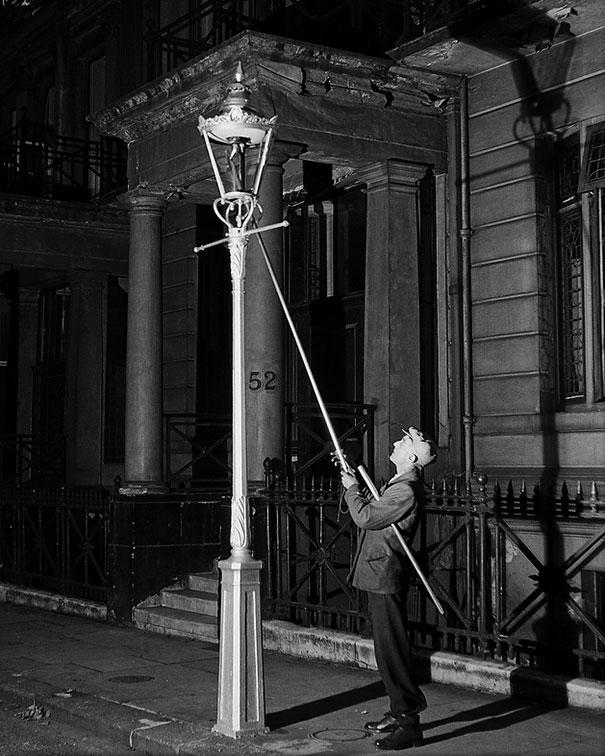
Apparently the profession lasted a lot longer than I had realized; the picture in London below is purported to have been taken in 1962, found at /r/historyporn.

eD88Pl7

Today as in the past, little children with their hearts full of innocence and wonder wave to the big people passing by; the delight that illuminates their faces on the rare occasion when someone takes the time to notice them, and wave back, or nod, or smile, or say hello, is large return on a small investment. Here’s a perfect modern example:

Notice the children.

The Old Wolf has spoken.

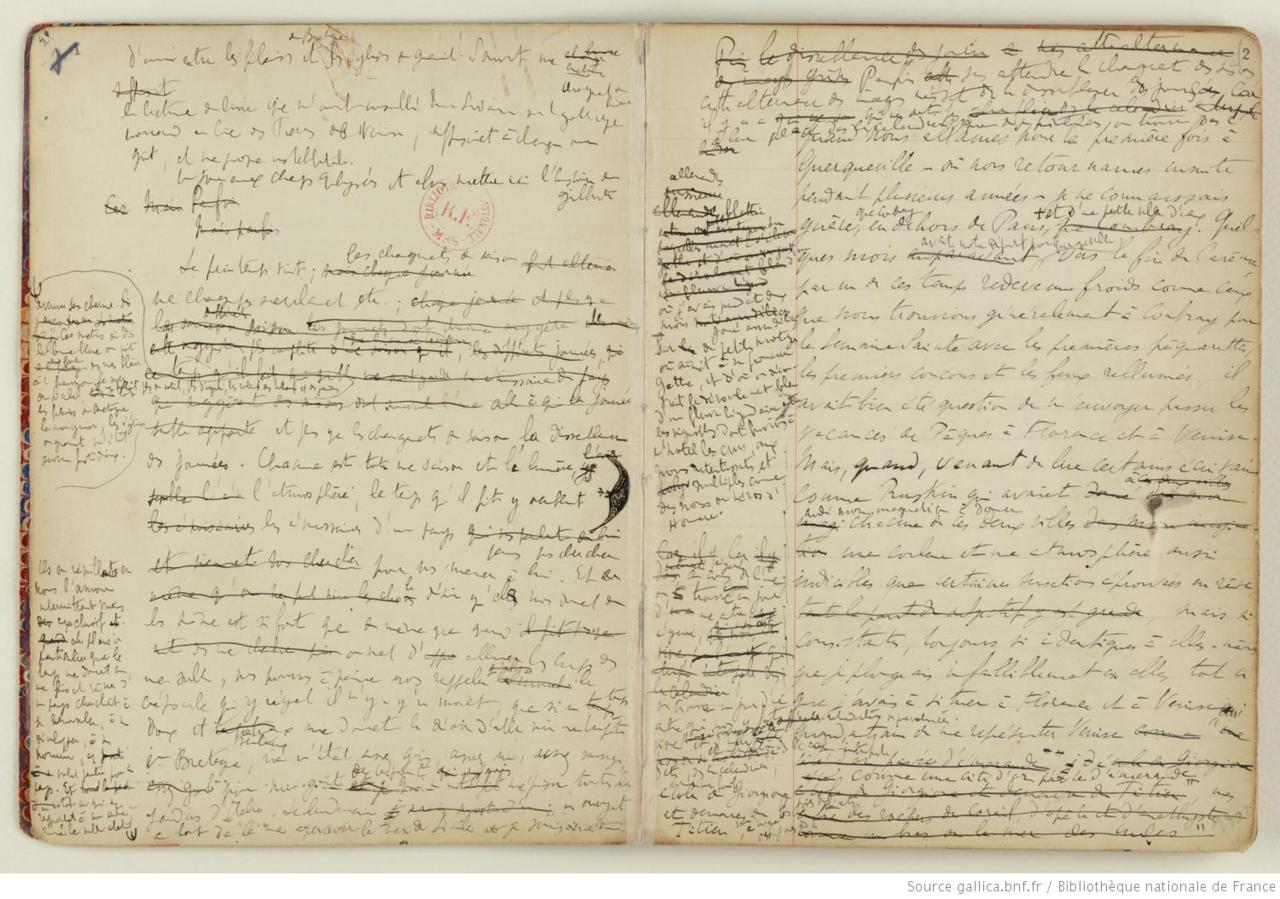
Proust: À la recherche de temps perdu

Original manuscript pages


Madeleines

Recipe courtesy of Marie-Thérèse Gohier

4          Eggs
½ C    Powdered Sugar
1 C      White Flour
1 tsp.   Baking Powder
¼ lb.   Butter
Salt

Allow the butter to soften.  Mix all ingredients together.  Pour into madeleine moulds, lightly greased or Teflon™ coated. (If you don’t have these, cupcake tins will work – fill each cupcake 1/2 full. But it’s blasphemy.)  Bake 15 minutes at 375°. Don’t open the oven until the 15 minutes are up.

Dust with powdered sugar and serve.

Makes 24.

The Old Wolf has spoken.

Disclaimer