The Chalk Mark

You’ve probably heard the story in various incarnations. An old Navy chief, an engineer, an auto mechanic – you name it – he’s called in to diagnose a problem with some sort of engine or device. He puts a chalk mark on the machine showing where to make the repair, and sends a bill for $10,000, most of which was for knowing where to put the mark.

I always thought this was an urban legend, it appears that there may be some truth in it, if an article at the Smithsonian is to be believed; obviously no source is above scrutiny, but I know that the Smithsonian does its best to be accurate, factual, and scientific in its reporting, hence I thought it was worth sharing.
Steinmetz

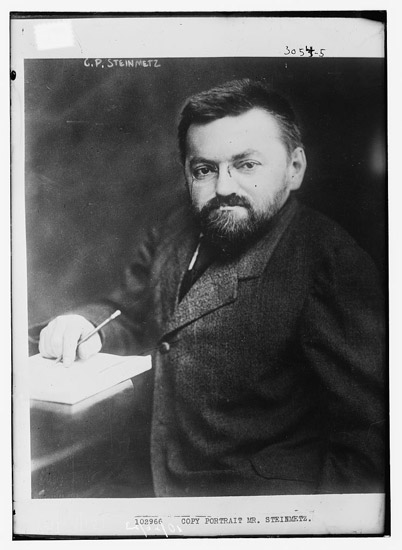
Charles Proteus Steinmetz circa 1915 – Wikipedia

From the Smithsonian Article:

Before long, the greatest scientific minds of the time were traveling to Schenectady to meet with the prolific “little giant”; anecdotal tales of these meetings are still told in engineering classes today. One appeared on the letters page of Life magazine in 1965, after the magazine had printed a story on Steinmetz. Jack B. Scott wrote in to tell of his father’s encounter with the Wizard of Schenectady at Henry Ford’s River Rouge plant in Dearborn, Michigan.

Ford, whose electrical engineers couldn’t solve some problems they were having with a gigantic generator, called Steinmetz in to the plant. Upon arriving, Steinmetz rejected all assistance and asked only for a notebook, pencil and cot. According to Scott, Steinmetz listened to the generator and scribbled computations on the notepad for two straight days and nights. On the second night, he asked for a ladder, climbed up the generator and made a chalk mark on its side. Then he told Ford’s skeptical engineers to remove a plate at the mark and replace sixteen windings from the field coil. They did, and the generator performed to perfection.

Henry Ford was thrilled until he got an invoice from General Electric in the amount of $10,000. Ford acknowledged Steinmetz’s success but balked at the figure. He asked for an itemized bill.

Steinmetz, Scott wrote, responded personally to Ford’s request with the following:

Making chalk mark on generator    $1.

Knowing where to make mark         $9,999.

Ford paid the bill.

The story fits well with what is known about Steinmetz, a mercurial genius of engineering. Unless we can get the plans for Professor Waxman’s time machine, there’s no way of verifying the story, but this iteration of it has a ring of truth.

The Old Wolf has spoken.
Why is it so hard to store energy?

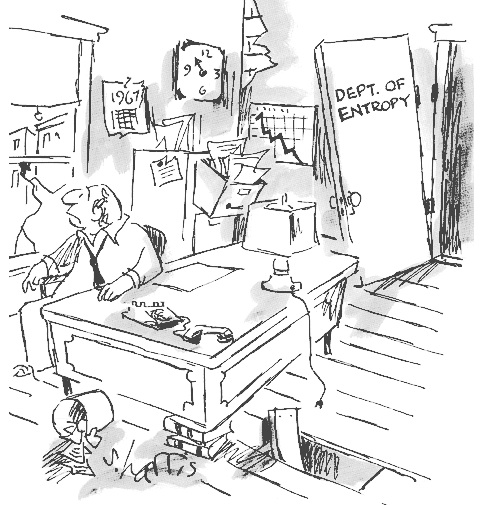
Entropy cartoon lg

Good question; and here’s a lovely answer by a redditor, /u/api.

The second law of thermodynamics, which basically says that energy is determinedly lazy. It would much rather dissipate itself as heat and go play with all the other free energy. Yay!

Take solar for example. When sunlight strikes the Earth you get heat and very little work, maybe moving some air around. Damn lazy energy. Picture it this way. Imagine a bunch of rocks sitting around on a flat desert playa. The sunlight striking them provides enough power to move them around. But it doesn’t happen. Despite how cool it would be if rocks ran around on their own, all that energy would rather just goof off. That’s the second law in a nutshell. It’s why most of the universe is boring.

Life disagrees, which places life — including ourselves and our extended phenotype of gadgetry — at stubborn odds to the second law. Living systems are nature’s slave drivers, grabbing free energy and trying to coax it into doing work with all kinds of contraptions like chlorophyll and PV cells and wind turbines. The definition of work is more or less “something statistically unlikely to happen by chance.”

Storing energy is hard for the same basic reason as catching it.

Let’s say you put out a PV panel. There’s a wire dangling from it. Stick it to your tongue. Ouch! Ok, no, don’t do that, most large PV panels produce about 200W and you’ll talk funny for a while. But the point is you’ve managed to catch some energy there, and to force it down a wire as a nice, neat, low entropy single file line of electrons. Now what?

You could use it right then and there, which is your most efficient option. You’ve already got it after all. But unfortunately you might want to watch porngoof off on Reddit write your great work of literature while the sun is down.

To store energy you’ve got to take energy and use it to coax some material substrate into doing something statical-mechanically very unlikely. How likely is it for megatons of water to spontaneously flow uphill? Not very. How about all the ions in a lithium cell spontaneously migrating to the same side of a gradient? Every rechargeable battery is basically Maxwell’s Demon: https://en.wikipedia.org/wiki/Maxwell%27s_demon

Think of it as herding cats at the molecular or quantum scale. You’ve got to grab every little molecule or atom or ion and say “you! go there!” All this cat herding gives ample opportunity for more of your precious energy (it’s lazy, remember?) to slip the yoke and migrate off as heat. Feel your battery while it charges. It gets warm.

We don’t love fossil fuels because they give us energy. Free energy falls from the sky, and while it’s hard to grab there’s quite a bit of it around. Do the math on how much solar energy falls on a square mile in a day and how much gasoline that translates into. It’s a lot. We love fossil fuels because they give us energy already stored in a very low entropy form that allows us to release it on demand. Too bad we don’t have an infinite supply of the stuff. We’ve gotten pretty good at using energy when we have it. Now we have to get good at storing it before we run out of carbon goop.

That and/or we have to figure out how to unlock the power stored in the atom without the problem of the power plants occasionally blowing up. Atomic energy is fossil fuel too, but it’s fossil fuel left over from cosmic events like supernovae and contains enough stored energy to power our little civilization for a very long time.

I recommend perusing the rest of the thread – there’s a lot of discussion on ancillary questions such as the prices/benefits of nuclear power.

We just need to keep working on the question. Fossil fuels are limited and filthy, and some day we’re either going to run completely out or have a nest so fouled that no one can live here.

The Old Wolf has spoken.

You don’t need people’s opinions on fact.

On May 6th, the government released the National Climate Assessment, 1250 pages long and authored by over 250 people.

iceberg

What kinds of people? Government-paid alarmists and corrupt scientists, right? A secret cabal of people who are raising a false alarm to discredit… well, you’ve heard all the counter-arguments, not one of which is worth the powder to blow it to Hell with.

Let’s look at some of what went in to this report: [1]

  • Users and stakeholders were engaged from the very beginning. Everybody could contribute: NGOs, farmer, industry, Native American nations. Many thousands of people consider this as their personal report and have embraced it.
  • The team included former Bush White House officials with climate science expertise who also functioned as lead authors.
  • There were reps from the petroleum and mining industries, economists, agronomists, fisheries experts, and city planners. There were experts that dealt first-hand with the aftermaths of Katrina and Sandy and the droughts and fires and power shortages and the spread of disease in the West.
  • Notice of every meeting was pre-published in the Federal Register, and anyone, any citizen or group at all, was welcomed to come and comment.
  • There was a several-month open review, during which anyone was welcomed to raise concerns or criticisms, and comments were abundant.
  • The report was reviewed by the National Academy of Sciences, which is firmly non-partisan.
  • Comments from all of these sources were incorporated to make the report better.
  • There was a public, traceable account for every key finding, so that anyone can look back and see how the finding was arrived at, what the studies were that it was based on, and, it is even possible to follow the account back to the original data for those studies.
  • The conclusions in the report represent a consensus of all of the authors and advisors.  The final vote to approve was unanimous.
  • The report is a product of not just NASA, but a consortium of 13 federal agencies called the US Global Change Research Program. NASA contributed substantially, but so did others, including NOAA/Department of Commerce, the Department of Energy, Department of the Interior, the Environmental Protection Agency, Department of Transportation, Health and Human Services, the Smithsonian, USAID, the Department of Agriculture, the National Science Foundation, the Department of Defense, and the Department of State. It was a combined effort of many, many people from both private and public sectors.

With all of these sources, with all of this transparency, with the wide diversity of contributors and opportunities for public input – not a restricted subset, but anyone could give input, I trust the results of this report implicitly. The results are incontrovertible. This is not just Al Gore grandstanding for political gain (although I think “An Inconvenient Truth” was right on the money, regardless of its underlying motivation) – this is science. And it works.

The Gallup Poll revealed that 1 in 4 Americans doubt the veracity of climate change. However, what the public thinks of established fact is irrelevant. Some people have such an overwhelming need to be right that they ignore indisputable facts. [2] But in the end, this opposition, despite how well-funded it is and for whatever reason, will fade. There may still be over 400 people in the world who believe the earth is flat, but what they believe changes nothing.
If you have any questions, visit the website. Explore it. Understand it. And do what you can to hold back the tide, even if the trend may be irreversible.
The Old Wolf has spoken.

[1] Source: A well-placed official who contributed heavily to the work involved, whom I trust implicitly.

[2] A story from a redditor, /u/RamsesThePigeon:

The year I was in third grade was one of the best and worst of my entire educational experience, and both of those extremes were because of the teacher I had. She was beloved by most of her students – the female ones especially – but had a habit of being passive-aggressive and saccharine towards more difficult pupils. She’d find (or invent) reasons to ignore difficult questions, offer vague threats about impending punishments, or make small efforts to turn classmates against one another. She was not an especially likeable educator, and she became a truly reprehensible one when she insisted that Jupiter was bigger than the sun.

At first, it seemed like a misunderstanding. Our class had just entered into an astronomy unit, and one of our activities was to construct a scale model of the solar system. The reference image we used came from a picture book, and in it, the sun had been reduced in size. The teacher had not noticed this fact, and was therefore operating under the mistaken assumption that Jupiter was our largest celestial neighbor.

Well, I knew better, and I tried to correct her. She replied to me with a tone of aloof dismissal, stating quite clearly that I was wrong. “That’s okay, though,” she said. “After all, you’re in school to learn new things.” Then she smiled sweetly, and I returned to my seat feeling thoroughly confused and frustrated. In the weeks that followed, I engaged in an all-out war against my teacher’s pseudo-science. My father, having heard everything from me, sent me to school with one of his college textbooks, hoping to turn the tide of the battle. My teacher refused to even look at it. “Class,” she said, rolling her eyes, “who can tell Max what the biggest object in the solar system is?”

My face was burning with anger and shame as every other student shouted “JUPITER!”

Things only escalated from there. I refused to back down, despite having been labeled as the class dunce. Each time the topic came up, I tried to offer my evidence… and each time, I was steadfastly opposed by everyone within earshot. Finally, after over a month of torment, our astronomy unit culminated in a field trip to the local planetarium. The show was a breathtaking adventure through our galaxy and the universe beyond, and it left me feeling infinitesimally small… yet strangely empowered. As the lights came up, our guide to the cosmos asked if there were any questions.

“Which is bigger,” I shouted, jumping to my feet, “Jupiter or the sun?!” My entire class sighed in frustration, my teacher barked at me to sit down, and the astronomer looked thoroughly confused.

“The sun, of course,” he scoffed.

A hush fell over the room. After a moment of utter silence, a girl named Melissa spoke up in a condescending tone. “Well, sir, we have a chart that says Jupiter is bigger.” The astronomer looked at her. He looked at my teacher. Then he looked at me with an expression of sympathy.

“Little girl,” he said, returning his attention to Melissa, “if you look at the picture again, you’ll see that the sun is being shown at a fraction of its actual size. Otherwise, it wouldn’t fit on the page.” His gaze moved to his next victim, who had slumped down in her chair so as to be almost as small as her students. “Your teacher should have told you that.”

Upon returning to our classroom, all the students crowded around our reference book. Sure enough, a tiny block of text explained that the sun had been scaled down in the illustration. I declared my triumph, having finally been vindicated. Nobody apologized, my teacher found new reasons to punish me, and I was treated with no small amount of scorn, but I didn’t care. From that day forward, I knew to never be afraid of asking questions, nor of standing up for facts in favor of fiction.

From that day forward – at least until it was taken away – I proudly wore my homemade dunce cap with a smug grin.

This was a teacher. Someone who should have known this bit of close-to-home science knowledge as surely as she knew 2 gozinta 4 two times. But somehow she was ignorant of this fact and clung to it tenaciously, at the expense of humiliating a dissenting student and indoctrinating an entire class with a blatant falsehood.


Gluten Sensitivity? Only if you *really* have Celiac disease.

IMG_1625a

I have reblogged this article from Business Insider for the benefit of those who can’t see the article with NoScript. Apparently this page embeds 16 tons worth of trackers and scripts. Note: There are more links in the original article which are worth following; I have included only two.

16Tons

Researchers Who Provided Key Evidence For Gluten Sensitivity Have Now Thoroughly Shown That It Doesn’t Exist

by Jennifer Welsh

In one of the best examples of science working, a researcher who provided key evidence of (non-celiac disease) gluten sensitivity recently published follow-up papers that show the opposite.

The first follow-up paper came out last year in the journal Gastroenterology. Here’s the backstory that makes us cheer:

The study was a follow up on a 2011 experiment in the lab of Peter Gibson at Monash University. The scientifically sound — but small — study found that gluten-containing diets can cause gastrointestinal distress in people without celiac disease, a well-known autoimmune disorder triggered by gluten.

They called this non-celiac gluten sensitivity.

Gluten is a protein composite found in wheat, barley, and other grains. It gives bread its chewiness and is often used as a meat substitute. If you’ve ever had “wheat meat,” seitan, or mock duck at a Thai restaurant, that’s gluten.

Gluten is a big industry: 30% of people want to eat less gluten. Sales of gluten-free products are estimated to hit $15 billion by 2016.

Although experts estimate that only 1% of Americans — about 3 million people — suffer from celiac disease, 18% of adults now buy gluten-free foods.

Since gluten is a protein found in any normal diet, Gibson was unsatisfied with his finding. He wanted to find out why the gluten seemed to be causing this reaction and if there could be something else going on. He therefore went to a scientifically rigorous extreme for his next experiment, a level not usually expected in nutrition studies.

For a follow-up paper, 37 self-identified gluten-sensitive patients were tested. According toReal Clear Science’s Newton Blog, here’s how the experiment went:

Subjects would be provided with every single meal for the duration of the trial. Any and all potential dietary triggers for gastrointestinal symptoms would be removed, including lactose (from milk products), certain preservatives like benzoates, propionate, sulfites, and nitrites, and fermentable, poorly absorbed short-chain carbohydrates, also known asFODMAPs. And last, but not least, nine days worth of urine and fecal matter would be collected. With this new study, Gibson wasn’t messing around.

The subjects cycled through high-gluten, low-gluten, and no-gluten (placebo) diets, without knowing which diet plan they were on at any given time. In the end, all of the treatment diets — even the placebo diet — caused pain, bloating, nausea, and gas to a similar degree. It didn’t matter if the diet contained gluten. (Read more about the study.)

“In contrast to our first study … we could find absolutely no specific response to gluten,” Gibson wrote in the paper. A third, larger study published this month has confirmed the findings.

It seems to be a “nocebo” effect — the self-diagnosed gluten sensitive patients expected to feel worse on the study diets, so they did. They were also likely more attentive to their intestinal distress, since they had to monitor it for the study.

On top of that, these other potential dietary triggers — specifically the FODMAPS – could be causing what people have wrongly interpreted as gluten sensitivity. FODMAPS are frequently found in the same foods as gluten. That still doesn’t explain why people in the study negatively reacted to diets that were free of all dietary triggers.

You can go ahead and smell your bread and eat it too. Science. It works.

Bitches. [1]
Note: While Celiac disease is a real and well-known condition, “gluten sensitivity” and eating gluten-free seems to be the latest fad, along with green coffee beans and garcinia cambogia


[1] With thanks to Richard Dawkins

Something Smells Rotten in Denmark… Oh Wait, it’s Danish Pastry

(Cross-posted from Livejournal entry of Oct. 12th, 2010)

♬ The sense of sight
Is what guides us right
When we go out on walks.
The sense of smell’s
The way you tell
That you need to change your socks. ♬
-Animaniacs, “The Senses”

Smell and taste are funny things. As anyone familiar with my Banquet from Hell could tell you, one man’s sweet savour is another woman’s “Jayzus Bejayzus Keep It Away!”

A lot of it’s chemical. How this molecule fits into that olfactory receptor or that taste bud. And how it all works is beyond me, given that some living creatures have noses jillionty-three times more sensitive than ours.

But it’s not all chemical. A lot of it goes on in our minds.

A case in point. One day in several years ago I walked into our bedroom, which we were keeping closed as we try to maintain it cooler than the rest of the house; at that time my mother, go ndéanai Día trocaire uirthi, was living with us, and at 94 she liked a warmer environment. I said to myself, “It smells like cat’s piss in here.” Impossible – while we now have three cats, at the time we had none, and we had been in the home for a month and a half. I racked my brain trying to figure out what was smelling so bad – it was making me ill.

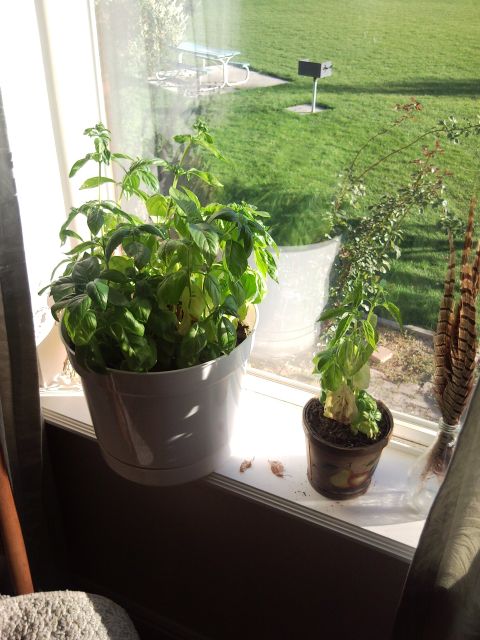
And then it struck me. We had two large basil plants in the windowsill, and they were getting the benefit of full Southern exposure. The room was filled with the odor of basil. And I love basil. And as soon as my mind had identified the odor, it no longer smelled like cat pee, or repulsive in any way. Same molecules. Same smell. Just a different frame of reference, and my room smelled like an herb garden.

158442_1000
Pesto waiting to happen

Would it be possible to re-frame one’s mindset so that evil humours are less offensive? Butyric acid is found in puke, but it’s also found in many cheeses. Nobody appreciates a technicolor yawn in public, but if you happen to be an honest to goodness turophile, the smell of a good, authentic European cheese shop is like unto ambrosia, and the smells are astonishingly familiar.

Mind you, some things are not worth the experiment. One of the last times I drove across the country in the spring, I passed through miles and miles of the most fragrant apple orchards in bloom that I have ever seen, followed by the most pungent – and literally lung-searing – stockyards I have ever had the misfortune to encounter. I don’t think I’d like to hang around and see if I could learn to appreciate that evil miasma.

Still, it was an interesting subject to think about. And now I’m craving a portion of gamalost.

The Old Wolf has spoken.

Wham, bam, tack Madam!

A recent article at BBC (and reported elsewhere as well) indicates that evidence for double-asteroid impacts on earth is growing more credible.

_73661565_73610855

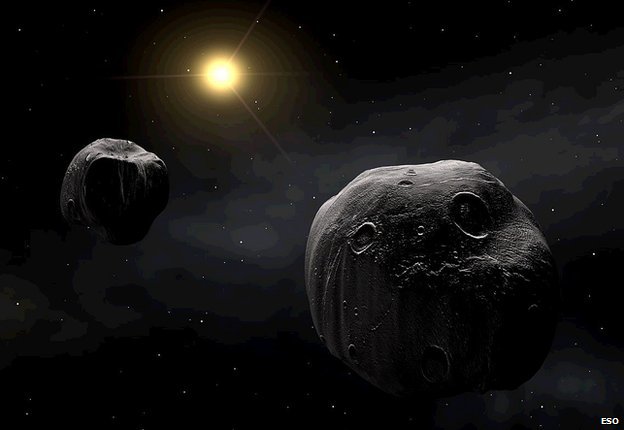
According to astronomers, around 15% of asteroids are binaries, with a smaller “moon” orbiting a larger body. These are formed when a rubble asteroid begins spinning so fast as the result of solar pressure that a portion of its substance is ejected, forming a small satellite.[1]

Several candidates for double impacts exist on earth – Clearwater Lakes in Quebec, Canada are one potential pair (below).

wcgss6crketpe9gn2tl6

It is obvious that any pair of craters must be the same geological age to be identified as a double-strike candidate. Now,  “Dr. Jens  Ormo and his colleagues studied two craters called Lockne and Målingen, which lie about 16km apart in northern Sweden. Measuring about 7.5km wide, Lockne is the bigger of the two structures; Målingen, which lies to the south-west, is about 10 times smaller.”

Dr. Ormo’s team dated the craters using chitnozoan fossils and determined that the Målingen structure and the Lockne crater are the same age, roughly 458 million years; it is hypothesized that these were formed as the result of a twin strike  in the Ordovician Period.

craters

Click through for another article at i09.

The more we know, the more we know that we don’t know. Science!

The Old Wolf has spoken.


[1] See the additional information provided in a comment by engastrobd below.

Freefall: Jerry Pournelle’s Review.

Flo Galaxy

Art: Mark Stanley. Background and color: The Old Wolf

I’ve mentioned Mark Stanley’s Freefall webcomic several times in this blog (just do a search, you’ll find the articles, but here’s one of my favorites).

I found a link to this article by Jerry Pournelle at the Freefall discussion forum, and was so impressed I felt I needed to share it. WARNING: If you decide to check out the strip before reading Pournelle’s review, start here. There is great value in working up to the current storyline climax, and not spoiling it. Unless, of course, you’re the kind who reads the last chapter of a mystery first, which is fine as well. Just saying.

I wrote this for another conference, but it occurs to me that while I have mentioned Freefall here before, it has been a while:

If you are not a fan of Freefall http://freefall.purr…100/fv00001.htm you ought to be.  Alas, it really will involve some time because it is a serial story, and the current panels are shocking — that is, they have a total surprise that I do not think many readers saw coming. I did not. And you should not see them before reading the rest of the story leading up to now.

The graphic novel — it has become as long as one — has as its premise that mankind has settled planets other than earth, and on one of them there is a population of a small number of humans and tens of millions of robots, all pretty well subject to Asimov’s three laws, only a lot of that is in my judgment better thought out than Isaac did.  The robots are highly intelligent and competent, but they are programmed to obey most human direct orders, and are very protective of humans.  This situation can be exploited by certain unscrupulous bureaucrats.

And into this mix comes Florence,  a Bowman’s Wolf, an artificially intelligent product of genetic manipulation, a genetic mixture of red wolf, dog and human genes with programming for artificial intelligence, born of a dog (St. Bernard) who was not her biological mother, and developing opposable thumbs, human speech, and the ability to walk on her hind legs although she runs much faster on all four legs. She wears clothes and has normal human modesty, and grew up in a household of humans, first as a pet then as — well, as an intelligent dog, then as a sibling. In theory she is the property of the human family. She has most of the powers of a real wolf and an IQ I would estimate at 140 or so.  She is a graduate engineer.

Also living on this planet is a single member of an alien species brought there as a stowaway from another planet — he is not artificially intelligent, he is intelligent, but he has nothing of the ethics and mores of a human and no human companionship. He is of a race of scavengers, and had thousands of siblings but he is probably the only survivor, and that because he stowed away on the human ship. He owns two robots and as owner he can give them direct orders.  One is a general purpose robot who likes him, and the other is his space ship which he managed to acquire as scrap and sort of get it running — but the ship considers him a danger to humans and hates him and would like to kill him but has been forbidden to do that.  It belongs to Sam.  Sam wears an environment suit which makes him appear sort of humanoid, but under that suit he is not humanoid at all.

All this happens in the first couple of dozen panels.  Sam acquires the Bowman’s wolf as his ship’s engineer. He does so by devious means, but she considers herself bound as a crew officer to be respectful to and obey the captain.  Only sometimes that would be disastrous and she’s pretty clever about playing logic games.

There are now two thousand four-panel pages of story, all relevant to the story line although some are not obviously so.  We are now reaching a climax, I think, and certainly the story has taken a surprising turn.  Meanwhile we have met many fascinating characters, including robot police who have to deal with humans, a veterinarian who sort of falls in love with Florence the AI wolf, a child who wonders if Florence and the vet will marry prompting Florence to be amused that the kid thinks all mammals have the same number of chromosomes, scheming officials who try to prompt a robotic war so they can get rich on scrap, and a great number of antics in which Sam acts quite morally for him == he is a scavenger, after all == but which drive the human authorities nuts. Especially since Sam is a very skilled thief, pickpocket, and jail breaker.

If you never heard of this you should try it: it may not be everyone’s cup of tea, but it’s the best of this kind of thing I know of. It is a combination of comedy of manners and some broad farce, and it mixes those elements well. It starts black and white but acquires better art and color at a couple of hundred pages (again four panels to a page).  It is now up to a couple of thousand and it will take you a bit of time to get from the beginning to where we are now, but I liked every episode I read.  I urge you NOT to skip ahead, and particularly don’t look at the current pages at all; catch up to them from the beginning. It will be worth it in my judgment.  The story is well developed and very logically constructed.  I’d like to see it win a Hugo.  It’s really good.

Recommended.

Be aware that the Freefall time line is mind-shatteringly slow. Day One begins on March 30, 1998; as of today, Florence has spent approximately three weeks on the planet’s surface. And for those of us who want to find out how the story ends, the three updates per week can be painful… but I’ve been hooked for over 10 years, and by Mogg’s tufted tail I am not giving up.

fc01829

If you don’t take my recommendation, take Pournelle’s… and enjoy.

The Old Wolf has spoken.

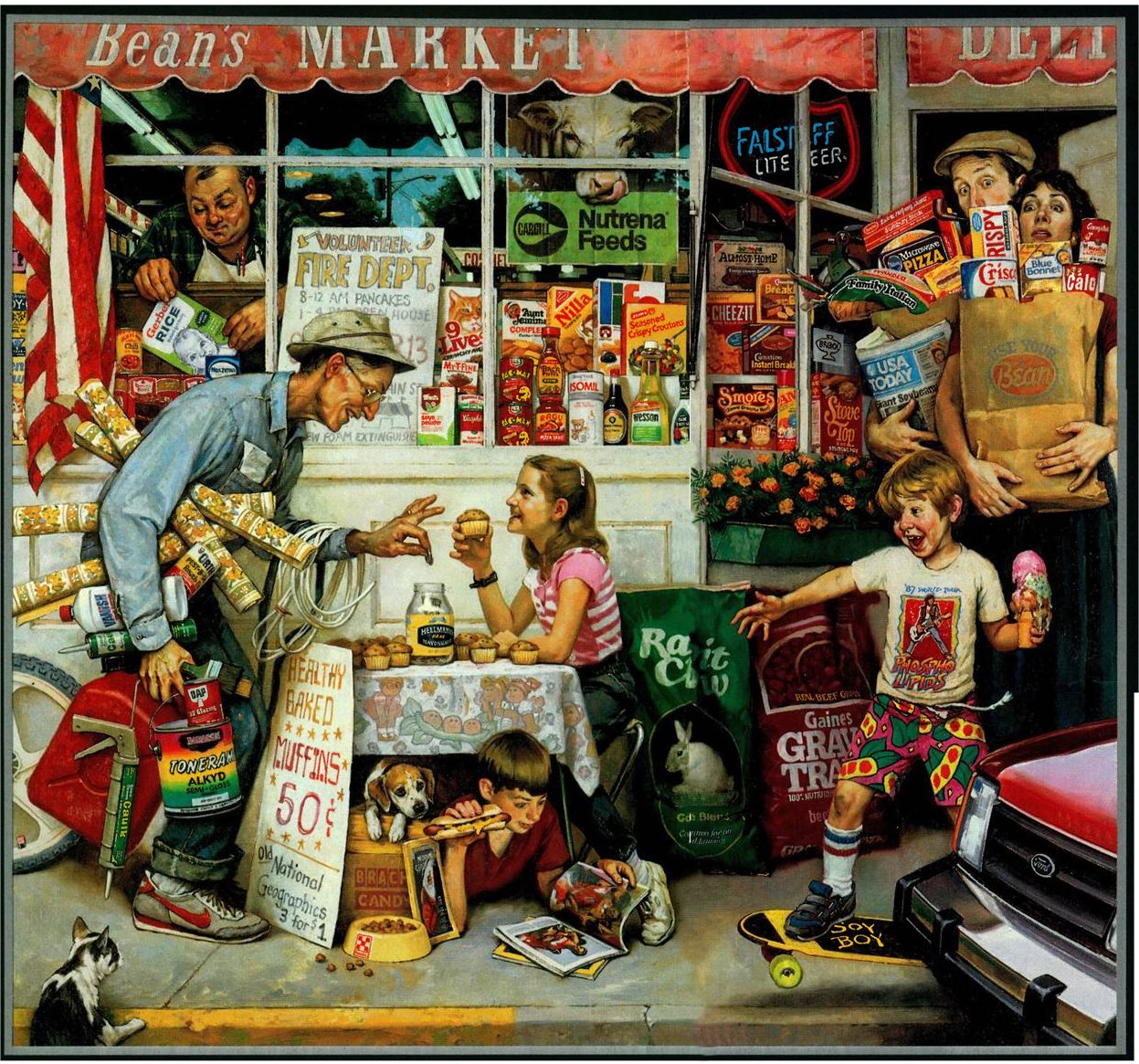
James Gurney: The Soy Bean

Soy Painting

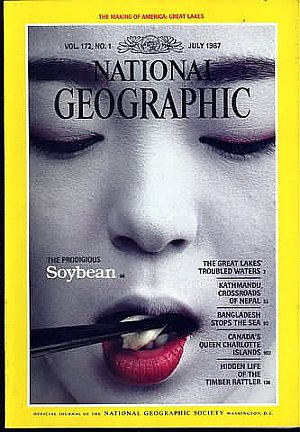
This lovely painting by James Gurney appeared in the July, 1987 edition of the National Geographic, long one of my favorite magazines since early childhood. I’ve had multiple collections of hard copy editions, gathered over the years and then given away when moving (they’re heavy!) and then gathered again. I recently scored a complete set on DVD that included everything up through the 90’s – it still runs on my XP virtual machine – so I was able to get rid of all but the few special editions I wanted to keep.

backissues

Gurney managed to get dozens of things based on soy into his painting; about the only thing I haven’t spotted is nattōThe photo of the painting came with the following caption:

Invisible ingredient in countless products, the soybean plays an amazingly pervasive role in everyday life. Artist James Gurney included more than 60 soybean-related products in this painting, done in the style of Norman Rockwell. He not only called on neighbors and friends for models, but also portrayed himself and his wife emerging from the store, startled by a skateboarding boy carrying a cone of tofu “ice cream”; the boy’s shorts-like the tablecloth-bear a bean-pod motif.

The bags the couple carry, the store-window and sidewalk displays are replete with items that have a soybean connection

Cardboard, glues, and animal and human foods are commonplace soybean products. The sidewalk customer’s caulking, paint, wallpaper, gasoline, and the muffin he buys all owe a debt to soy-as does the bicycle tire.

The beer sign reflects the use of soy meal in the brewing process. The fire extinguisher uses soy protein in its foam. And pre-1981 National Geographics were printed on soy-lecithin-lubricated presses. The car symbolizes an experimental one built with soybean plastic by Henry Ford. The artist’s final tribute: He used soy-based paint.

There’s a lot of conflicting information out there regarding the health benefits or detriments of soy; it’s hard to know who’s right at this point in time, but I’ll keep enjoying my tofu and other fermented soy products.

In the meantime, I thought I’d share this delightful and intriguing work of art.

The Old Wolf has spoken.