Please do not share from these 10 Websites or Facebook Pages

This is a condensation of an excellent article from DawnsBrain. I’ve summarized the ten here for easy consumption, but her complete article is worth a read.

DBRielly_LovePotionsAndSnakeOil

☛ TL;DR – these websites promote pseudoscientific woo¹, and are dangerous in that they lead people to shun and be afraid of science-based health and medicine. ☚

10) Alex Jones

Mr. Jones uses a ton of hyperbole, conspiracy theories, and a loose connection to reality, to whip up fear and loathing in his audience.

9) The Food Babe

Ms. Hari, the “Food Babe”, parrots Dr. Mercola and cobbles together cherry-picked blurbs from questionable studies and Wikipedia. She uses the term “investigation” to excuse the fact that she often gives medical advice without having any education in the life sciences. She picks the weirdest ingredients to go after.

#8 Eat Clean. Train Mean. Live Green.

Ms. McDonald mixes some common-sense dietary advice with a shot of “detox” and disordered eating, GMO and fluoride fearmongering, and pondering about chemtrails. She even claims that honey is medicine. Proof that even registered dietitians can be wacko.

#7 Dr. Joseph Mercola

Dr. Mercola, by virtue of his credentials and large fanbase, is possibly one of the most dangerous people on Facebook. Because he generates fear around science-based medicine, he discourages people from seeking real help for illness. He also scares people away from vaccinations, fluoride, GMO food, pasteurized dairy, and dental fillings. But you know, buy his line of supplements and all will be well.

#6 Prevention Magazine

Everyone that promotes “natural cures” above all else seems to jump from one cure-all to another. WebMD specifically states that there is insufficient evidence for at least three items on their list.

#5 NaturalNews.com

NaturalNews.com is arguably the most balls-to-the-wall looniest page on Facebook. They have never met a conspiracy theory they don’t love.

#4 Collective Evolution

All the misinformation, all the time.

#3 MindBodyGreen

The “conversations about health” are decidedly in favor of “natural remedies” that are not supported by scientific research. People who waste their time mucking about with ineffective alternative treatments often die much sooner.

#2 Spirit Science

Most of their posts are harmless new-agey spiritual stuff and kookiness. But sometimes they veer into unsupportable natural remedies and outright pseudoscience.

#1 The Mind Unleashed

They’re a good example of slipping in a bit of bullshit here and there amongst the standard viral Facebook stuff. There’s a theme of immature hippy-style mistrust of any and every authority. What are you rebelling against? What have you got?

Bonus Post

Ernest Hemingway coined the term Crap Detector to refer to the little mechanism that ought to be working inside each person’s brain.

The most certain way to develop this ability to discern truth from baloney is education. In particular, an education in science will help protect you from the charlatans and cranks of the world.

I highly recommend starting with one of the many free online resources, such as Crash Course: Biology, Crash Course: Chemistry, and Crash Course: Anatomy and Physiology.

Bonus 2:

Dawn did not mention him, but I personally would add Mehmet Oz to the list. A sad case of a classically-trained physician who has sold his reputation for a mess of pottage, and in his quest to find natural remedies has devolved into a pitchman for the most ridiculous and worthless products known to man.

Disclaimer: Even with education in the hard sciences, it’s wise to remember that not everything is known that can be known. Aspirin is a direct outgrowth of historical use of willow bark to treat fevers. I have a strong conviction that there are literally countless chemical compounds out in nature that remain to be discovered that can have beneficial effects on human health and disease… but most of them have not been discovered yet.

Heath and wellness is soon to be, if it’s not already, a trillion-dollar industry – and everyone and their dog wants a slice of that pie. Trouble is, most of those dollars will be made selling bullcrap to the ignorant. There are very few exceptions.

The Old Wolf has spoken.


¹ Woo is a term used among skeptical writers to describe pseudoscientific explanations that have certain common characteristics.

If they’re willing to spam you, think twice. No, think three times.

Spam is one of the plagues of the 21st century. Despite feeble efforts of government regulatory bodies (think CAN-SPAM act, which resulted in an increase of spam), spammers continue their tactics. In the second quarter of 2013, per Kaspersky, spam comprised 70.7% of all email sent globally.

All you have to do is look at the kind of things caught by your spam filters to get an idea of the reputability of companies who are willing to spam you – porn, get-rich-quick offers, penis/breast enlargement, Canadian pharmacies (typically run by
Russian crime syndicates), diploma mills, real-estate swindles, wrinkle creams, hair-regrowers, insurance fraud, worthless supplements, cable/satellite/internet/TV scams, weight loss “miracle pills,”… the list goes on and on.

The trouble is – spam is profitable. People answer ads, buy products that they don’t need and that don’t work, and spammers make money.

Granny-Grandma-Internet-old-people

But there’s a reason that spam is also called “junk email” – and that’s because almost everything offered to you by spammers is just that – junk. It’s worthless, and probably worse than worthless – it could end up costing you lots of money and frustration. You would think this goes without saying, but obviously it doesn’t.

Let’s look at an example, arrived freshly steaming in my junk folder today:

CHW

First off, the mail consists of an image, which makes it hard for spam filters to tag it. Anyone who works hard to defeat built-in and ISP protections against spam probably has the ethics of a honey badger.

This particular ad touts a “home warranty service,” which is really nothing more than a pre-paid service contract on home appliances and infrastructure. But what does the Better Business Bureau have to say about CHW?

Government Actions

New Jersey Division of Consumer Affairs Complaint
Date of Action: 7/28/2014
The following describes a pending government action that has been formally brought by a government agency but has not yet been resolved. We are providing a summary of the governments allegations, which have not yet been proven.

On July 28, 2014, the New Jersey Division of Consumer Affairs filed a Complaint in Superior Court in Middlesex County against CHW Group, Inc., d/b/a “Choice Home Warranty,” an Edison-based company that allegedly induced consumers to buy “comprehensive” coverage for crucial home systems and appliances, and then denied consumers’ claims for repair or replacement through the use of deceptive tactics. As a result, consumers who paid hundreds of dollars for CHW’s “home warranties” – which are actually residential service contracts – were forced to pay out-of-pocket for air conditioning, refrigerator, or other repairs that allegedly should have been covered under their “warranties” with CHW.

As set forth in the State’s complaint, filed by the Division of Law on behalf of the Division of Consumer Affairs:

CHW and its principals often denied claims based on consumers’ supposed failure to properly maintain their covered home systems or appliances. The defendants also often denied claims based on supposed pre-existing defects. The company denied claims even when technicians declared that the covered home systems or appliances had been properly maintained, and/or had failed for reasons not related to poor maintenance or pre-existing problems.

As a way of denying claims, the defendants on many occasions demanded that the consumers provide years’ worth of records to prove they performed regular maintenance on the covered items. These denials were issued despite the fact that CHW’s residential service contract does not state that the company can demand maintenance records from consumers.

Additionally, when consumers requested specific explanations for their denial of claims in writing, CHW on many occasions failed or refused to provide written explanations.

CHW also promised consumers that if covered items could not be repaired, the company would replace them. However, when consumers needed to replace covered items, the company often required consumers to accept cash “buy-outs.” These “buy-outs” were hundreds of dollars less than the consumers’ cost to replace the items.

CHW also repeatedly failed to deliver on its promises for prompt service. In several cases this was because the company failed to pay its contracted technicians.

CHW’s residential service contract states that, upon receiving a request for service, the company will contact a local technician within two days during normal business hours and four days on weekends and holidays. However, CHW did not have contracted technicians in some areas. Consumers in those areas had to find their own technicians, then pay the technicians directly and seek reimbursement from CHW. On other occasions, contractors sent to consumers’ homes by CHW turned out to be unlicensed and/or uninsured.

The State’s Complaint ultimately requests that the Court, among other things, find that the defendants violated the Consumer Fraud Act and Advertising Regulations; order defendants to pay consumer restitution; declare CHW’s residential service contracts with consumers to be null and void; and impose civil penalties.

For more details go to:
http://nj.gov/oag/newsreleases14/pr20140728a.html

In response to these charges, the business provided the following statement:

“We are disappointed that the State has chosen to file this lawsuit. We unequivocally dispute the allegations, intend to vigorously defend against them, and are confident that we will ultimately prevail. Choice Home Warranty has fielded thousands of warranty claims from our customers, resulting in claims payments of tens of millions of dollars. In fact, many of the complaints referred to by the Attorney General’s office, were resolved long ago, to the satisfaction of the consumer.”

This particular suit is ongoing, and allegations have not been proven… but the number of complaints, roughly 300 per year, is probably a pretty good indication that not all is well. I return again to the simple fact that this company is willing to advertise via spam, always a huge red flag in my book.

Have a look at a gripe posted at complaintsboard.com on 3/20/15, yesterday as of this writing:

Every time I called, they sent someone out. I paid the $45, only to find out a repair wasn’t covered. Then, my washing machine was acting up. Replacing the mother boards was more than what the machine was worth. They opted to send me a check for $300. That was a month ago – currently, no check. I then had another claim, and again, it wasn’t covered. So I told them that since they don’t cover items for my home, I wanted to cancel. I received a call last week stating that since I cancelled, they wouldn’t send the $300 check. I told that person that I filed the Washing Machine claim over a month ago, and that check should have already been issued and mailed. He hung up on me. So, I have been emailing CHW about the status of my account and check and received nothing. Then, just now, I called CHW customer service and asked who the President and CEO is, and they put me on hold and never came back on the phone. I want to file a formal complaint. Make sure to have my account closed and have that $300 check which I am entitled to. Horrible, horrible bait and switch and God awful Customer Service.

Here’s one from Ripoff Report:

Our A/C compressor stopped working. It is 17 years old (we bought the home less than 6 months ago) and choice thinks it should last 18 years. They call it “premature failure” which is not due to normal wear and tear, so they denied the claim. They advertise that they will cover your appliances no matter how old. Don’t believe it! Their exclusions are general enough that they can deny any claim.

So you pay to sign up, you pay $45.00 for a service call, and often you are told that the repair isn’t covered… this echoes the kind of allegations leveled by the New Jersey Division of Consumer Affairs. And when you try to get a complaint resolved and get the kind of “customer service” related above, you know you are dealing with a company that doesn’t give a rat’s south-40.

Before you even consider dealing with a company that spams you, no matter how appealing the offer may look, do some research.

In the interest of full disclosure, and the Internet being what it is, the presence of a complaint anywhere does not guarantee that a company is malfeasant or dishonest. But as you are doing your research, look for patterns. If there seems to be an abundance of complaints across multiple sites, you might want to look elsewhere. Also, the BBB is in business to make money, and companies can purchase accreditation with them, so being accredited with the BBB is also not a guarantee of ethicality.

As always, please watch over your loved ones – especially the elderly and vulnerable. Educate them to stay away from spam offers if they have access to email.

The Old Wolf has spoken.
The Incredible Onslaught of Scamming Telemarketers

robo-call

  • “Hi, this is Rachel from Credit Card Services!”
  • “Hello, Seniors! Because you have been referred by a friend, we have a Medical Alert System for you free of charge!”
  • “It is critical that we speak to the business owner today! Our records indicate that you have not claimed your Google+ Listing!”

Some of these scams have been around for a long time; back in 2012, the FTC settled with five defendants for running the “Ann from Credit Card Services” scam, but like the mythical Hydra, for every head you cut off, two more grow in its place. It’s infuriating; my phone has long been on the national DNC register, but that tool seems to have about as many teeth as the CAN-SPAM act, meaning virtually zero. The Medical Alert scam appears to have ramped up during the last month despite being on the FTC’s radar for over two years.

At this point there is very little that the average consumer can do directly to stop the flood. But there are things you can do to reduce your own frustration level, and some which, over time, may help the authorities to take action against these scammers.

  • Report unwanted phone calls to the FCC, especially if you are on the Do Not Call list.
  • Make a note about the number that called you at 800Notes.com so that others can be aware of which numbers are being used by scammers. Most of these spoof their Caller ID anyway, but it’s just one more piece of the puzzle that investigators can use.
  • Call or write your Congressperson. If they get enough people complaining about this, they’re more likely to lend their weight to an effort to eradicate the scum.
  • Add all scam/robocall/hangup numbers to your “reject list.” This will cut down on the number of calls you even are aware of.

In the meantime, remember what the FTC tells consumers:

If you get a call with a recorded sales message and you haven’t given the company your written permission to call, the call is illegal. Since the call itself is illegal, you can bet the offer is a scam

Be careful out there and watch over your vulnerable loved ones.

The Old Wolf has spoken.

One News Story – Twelve Clickbait Ads

The image below was assembled from Newser.com. I’ve mentioned this before, but it seems that sponsored ad placement like has risen to the level of the absurd.

bullshit

Every one of these ads is clickbait and leads to some sort of deceptive or disreputable website, things like Lower My Bills, Pimsleur Appraoch, snake oil peddlers, things like that. Twelve scummy ads for a single news article? Even if you need to place ads, one would think you could choose more reputable businesses to promote than these deceptive, barely-legal scams.

It’s getting more and more difficult to navigate the web for substantive content witnout being bombarded with things like this, hard-coded ads that AdBlocker won’t wipe out. But one thing is certain – you should never click on ads like this; you’ll only be taken to a site that wants to get your money and/or information, and doesn’t care how they do it.

The Old Wolf has spoken.

The Next “Miracle Weight Loss Herb” – Caralluma Fimbriata

According to Wikipedia, caralluma ascendens, another name for caralluma fimbriata, is an edible form of cactus used throughout the Indian subcontinent as an appetite suppressant, or so-called “famine food.”

Leave it to the snake-oil hawkers to turn this into the next big thing they can make a few bucks on.

Got an email today from a “friend,” one whose email account or information had been compromised:


From: Redacted

To: store-news@amazon.com, ChaseNotification@emailonline.chase.com,

…snip… pmlncc@kkwl.ac.th, mrs.phillipjones@live.com

Subject: [Redacted]

Hi! How are you?

It works! http://nationalbranding.com/probably/dead.php

[Name Redacted]


These spoofed emails are so transparent at this point that I can smell the fraud before I even open them. But, in the interest of public service, I follow these links to see what new scam is being perpetrated on the general public.

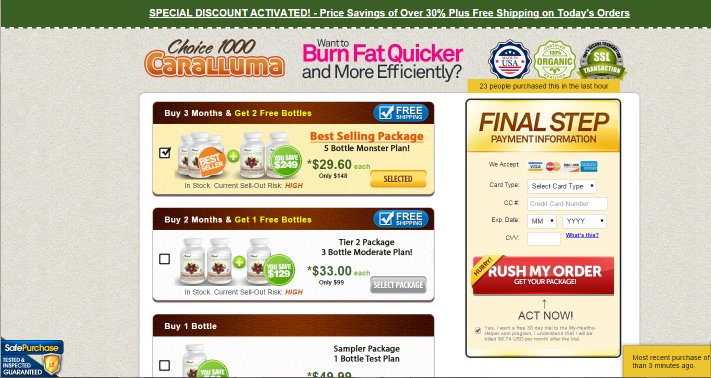
Today’s bowl of steaming camel ejecta led me to a website hawking caralluma, the new New NEW weight-loss miracle.

Landing

This is the same kind of affiliate marketing effluence that I have described elsewhere (just do a search at this blog for garcinia cambogia, for example).  Notice the tiny print below “ACT NOW!” that obligates you to a monthly $10.00 charge. But in the end, they’re less concerned with selling you their product as they are about getting your information which in the long run is much more valuable to them than a single sale.

Smell the foul rot of desperation as we proceed through the following screens:

Hook7

The first come-on is BOGO. If we don’t fall for that, we get this:

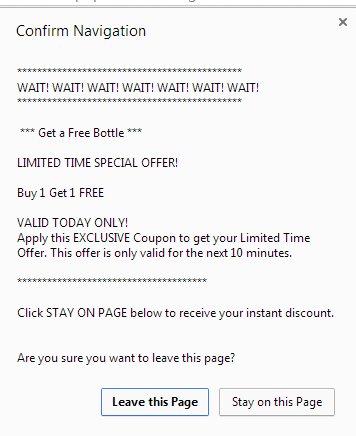
Hook1

Wait wait wait! OK, what now?

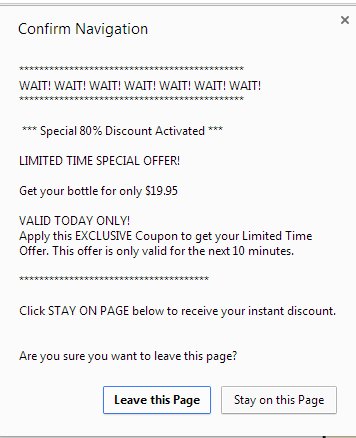
Hook2.jp

One of 50 customers, huh? Wow, I must really be special. But I guess I’m not really interested after all.

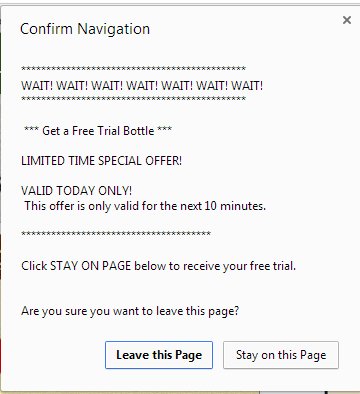
Hook3

Wait wait wait! Wow, a free trial bottle, and the offer is good for only 10 minutes! Shall we look and see?

Hook4

Now this is a wondrous thing. Instead of caralluma, I’ve been sent to a page to order garcinia cambogia. Looks like the affiliate marketer forgot to update his previous campaign.

Hook5.jp

More desperation.

Hook6

Now the bottle is free, and I only have to pay 99¢ for shipping. But remember, I’m still providing my credit card information, and obligating myself to that $10.00 per month “subscription.” Once these drones have your financial information, they are in a position to bill you for anything they want, or sell your credit card and personal information to other scumsuckers.

It’s all garbage, poorly-crafted but sadly effective affiliate marketing for products that have little or no value, or worse, are actually detrimental to your health.

Be careful out there.

The Old Wolf has spoken.

Another “Domain Registration” Scam

Edit: 5/26/2025 – Still going on. Mail received from “Domain Name Services” in Buffalo, NY. They want $265.00 for a 5-year renewal

Here’s some junk email that showed up this morning:

ATTENTION: IMPORTANT NOTICE
Domain SEO Service Registration Corp.
Order#: 780438
Date: 12/14/2014

EXPIRATION NOTICE

DOMAIN: [redacted]

Notification Offer
EXPIRATION DATE: 12/22/2014

Bill To: [Redacted]
Domain Name: [Redacted]
Registration SEO Period: 01/05/2015 to 01/05/2016
Price: $64.00
Term: 1 Year

SECURE ONLINE PAYMENT

Domain Name: [Domain Name Redacted]
Attn: [Owner Name Redacted]

This important expiration notification notifies you about the expiration notice of your domain registration for [edited.com search engine submission. The information in this expiration notification may contain confidential and/or legally privileged information from the notification processing department of the Domain SEO Service Registration. This information is intended only for the use of the individual(s) named above.
If you fail to complete your domain name registration [edited].com search engine service by the expiration date, may result in the cancellation of this domain name notification offer notice.

PLEASE CLICK ON SECURE ONLINE PAYMENT TO COMPLETE YOUR PAYMENT.

Failure to complete your domain name registration [redacted] search engine service process may make it difficult for customers to find you on the web.

CLICK UNDERNEATH FOR IMMEDIATE PAYMENT

PROCESS PAYMENT FOR
[Domain Redacted]
SECURE ONLINE PAYMENT
ACT IMMEDIATELY

This domain registration for [Domain Redacted] search engine service notification will expire 12/22/2014.

Instructions and Unsubscribe Instructions:

You have received this message because you elected to receive special notification offers. If you no longer wish to receive our notifications, please unsubscribe here or mail us a written request to Domain SEO Service Registration Corp., 5379 Lyons Rd. 452, Coconut Creek, FL 33073. If you have multiple accounts with us, you must opt out for each one individually in order to stop receiving notifications notices. We are a search engine optimization company. We do not directly register or renew domain names. We are selling traffic generator software tools. This message is CAN-SPAM compliant. THIS IS NOT A BILL. THIS IS A NOTIFICATION OFFER. YOU ARE UNDER NO OBLIGATION TO PAY THE AMOUNT STATED UNLESS YOU ACCEPT THIS NOTIFICATION OFFER. Please do not reply to this email, as we are not able to respond to messages sent to this address.

Notice several things about this garbage:

  1. The emphasized text in the spam disclaimer, written in tiny, gray print so as to be ignored, states clearly that you are signing up for worthless services, not domain registration. This shows the blatant deception being perpetrated here.
    disclaimer
  2. It’s designed to look like an invoice. There are, sadly, many unwitting office managers and secretaries and even executives who will take one look at this, pay the invoice, and kiss their money goodbye.
  3. The “registration service” being offered comes from http://www.domainrseo.net/, which has been flagged by Web of Trust (WOT) as Phishing, Scam, Potentially illegal, Misleading claims or unethical, and Spam site. The two posted comments are informative:

User Carl Legg posted on 11/29/2014

WARNING: New Internet scam out of a shoebox office in Florida. Called Domain SEO Service Registration Corp. It’s the same, tired old false flag operation.

1.) Perpetrator looks up domain names (owner contact information is public)
2.) Perpetrator e-mails domain-name owner with an official looking “Payment Notice”
3.) Threatening “expiration” deadlines are made in the Payment Notice
4.) Payment notice written in legal-technical gobbledegook to scare people into paying.

The perp makes it look like you are renewing your domain name, but in reality, and through some seriously twisted use of English language (that leaves one’s head swimming), you are signing up for one year of expensive search-engine optimization. Many people would not understand this, and the perp wants it that way.

Registered in Florida, but likely owned by a Hong Kong firm? Hard to tell. Here’s the registration data:

Florida Profit Corporation DOMAIN SEO SERVICE REGISTRATION CORP.
Filing Information Document NumberP14000093458
FEI/EIN Number NONE Date Filed 11/17/2014 State FL Status ACTIVE
Office/Director/Agent: TAUBERT, MATTHIAS (Matthias Taubert)
Principal Address 5379 LYONS RD. (452), COCONUT CREEK, FL 33073″

User eden-g posted on 11/29/2014
“Scam site engaged in misleading illegal activity owned by Chinese criminal Zhu Bing.”

I can’t speak to the source of the name in the second comment, but whoever is behind this scam is a dirtbag.

Be very careful out there. Domain registration scams are rampant, SEO firms are, for the most part, offering useless and expensive services, and most unsolicited commercial email is deceptive.

The Old Wolf has spoken.

Is this the future of vending?

An article at The Telegraph talks about a new kind of vending machine that is starting to be seen:

The world’s first vending machine with facial recognition technology has been unveiled, and it could refuse to vend a certain product based on a shopper’s age, medical record or dietary requirements.

I was immediately reminded of this bit of whimsy which, while funny, is very disturbing in its implications:

What would happen if vending machines started presenting us with screens like this?

Smart Vending

Two forces are at work here: HIPAA privacy requirements which have burdened the medical establishment with hippopotamic and time-consuming (but perhaps necessary) paperwork and procedures, and the free availability of information as demonstrated by the recent hack at Sony, only one of many over the last years.

I’m not really sure which way this trend is going to go, or what my grandchildren will see; I can only hope it doesn’t devolve in the direction of telescreens and thoughtcrime.

Orwell Quote 1984.

With thanks to my colleagues at Cheshire Academy – from the Drama Club’s presentation of “1984.”

While I’d like to think that this is just satirical drivel, there are undeniably Orwellian trends taking place in our society today, witness the massive spying on American citizens by government agencies which were revealed by Edward Snowden. It is my hope that this trend can be reversed.

This is all rather heavy and depressing and far removed from vending machines… or is it?

The Old Wolf has spoken.
Supplements: The Good, the Bad, and the Ugly

I’ve written here multiple times about medical snake oil.

DBRielly_LovePotionsAndSnakeOil

Green coffee extract (debunked), garcinia cambogia, forskolin, caralluma, you name it: It’s all smoke and mirrors… but that doesn’t stop Dr. Oz and others from making a fortune promoting it. What’s next, portland cement?

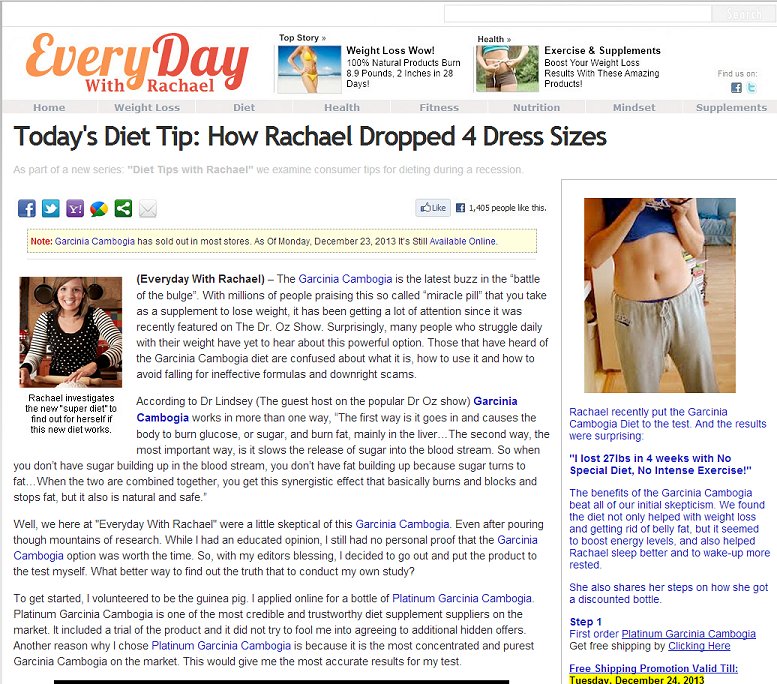
On that note, have a look at the two following screen captures. The first, hawking Garcinia Cambogia, I published on 23 December 2013, about a year ago. The second, shilling for Forskolin, came from a spam link that showed up in my email yesterday. The third was added as an edit on August 21, 2015.

rachael

rachael2

rachael3

Edit: The last one, above, was harvested from a spam email received on 8/21/2015, two years after the first one above. The affiliate marketers just recycle the same old text with another “new miracle.” Do you really trust yourself to do business with people like this?

If you look at the body text of all three samples, you’ll see it’s essentially identical copy. What you see here is a good example of the dark side of affiliate marketing, which you can read about in detail over at The Atlantic. One salient quote:

The downside to affiliate marketing is its astonishing rate of fraud. Because affiliates put up their own money to pay for ads pushing these products, they have a strong incentive to dupe consumers, so they can recoup their investment. If you’ve ever clicked an ad or a “sponsored link” about, say, a spectacularly effective new weight-loss scheme, which then leads you to a fake news article (or “farticle,” in the industry parlance) filled with sketchy scientific findings and constant entreaties to buy a product “risk free,” then condolences are in order: you’ve likely stumbled into some affiliate’s trap. “Affiliates are the most creative bunch of people you’re ever going to find, because you’ve got 5,000 people promoting the same product, and they’re all trying to get an edge,” Jim Lillig, an Illinois-based affiliate-marketing strategist, told me. “So of course you’re going to have people pushing the envelope. Some will do anything and everything to promote a product they think they can make money with.”

What brought this on today is that while waiting for “Mockingjay, Part 1” to begin at our local theater in Payson, Utah, I saw an advertisement for a product called Q96. This has been and is being marketed in Canada and now the US as a natural product that allows people with severe mental disorders to stop taking their meds – and that’s just wrong. A little research turned up a comprehensive article at Salt Lake City Weekly, which is not terribly complimentary about Utah or Mormons when it comes to the MLM and nutritional supplement industry, but which tells the story of Q96 in a straightforward and reasonable way.

Now I need to clarify something: I’m not anti-vitamin or anti-natural-remedy by nature. Look at aspirin; if it weren’t for the efficacy of willow bark in reducing fevers, people might never have done further research to isolate the active ingredient. I strongly believe that many herbs, roots, and natural substances have beneficial properties, some which have not been discovered yet. But when I take something, I want there to be science behind it, or at least a proven track record among users for a given benefit.

There’s a really good article at Consumer Reports which lists 12 ingredients we would probably be better off not messing with, as well as a few old standbys that are most likely beneficial. For a quick reference, the ones to avoid are:

Aconite, Bitter Orange, Chaparral, Colloidal Silver, Coltsfoot, Comfrey, Country Mallow, Germanium, Greater Celandine, Kava, Lobelia, and Yohimbe.

Beneficial supplements are:

Cranberry, Fish Oil, Glucosamine, Lactae, Lactobacillus, Psyllium, Pygeum, SAMe, St. John’s Wort, and Vitamin D.

Further information and greater details can be found at the CR article.

My wife grows comfrey to make tea out of; she’s an herbalist and swears by it. For now, I’ll be chary about using it until there is more science on the subject. Tragically, herbs cannot be patented, and so there is no incentive for science to do a lot of research on natural substances like this unless someone funds the study.

I’ve written previously about my own ideas about how to proceed with weight release at the end of this article about the Açaí Berry: low-glycemic eating, exercise, and high quality vitamins and minerals. There are not many companies out there that offer really good supplements that meet all the requirements of completeness, availability, purity, potency, and safety – only about five that I know of – but there is certainly a lot of junk out there that will do you just about as much good as eating pebbles.

Do your research, and watch out for those who would love to separate you from your money and give nothing, or even harm your health, in the process.

The Old Wolf has spoken.

Brand Imitation – the Sincerest Form of Marketing

Cross-posted from LiveJournal

We’ve all seen them on the shelves, usually down at floor level. Oatie-O’s, Fruity Hoops, Crisp Rice. Store brands trying to cash in on decades worth of marketing by the big boys.1

Depending on your locality, you can find over 50 knock-off brands of Dr Pepper™.

Dr Pepper Clones

As a general rule, these knock-off brands are the abomination of desolation. Mr. Pibb, for example, Coca-Cola’s ubiquitous knockoff of the Doctor, tastes like something wrung from a very ill moose – and yet if you go to a restaurant whose nuts are being tightly squeezed by the Coke™ conglomerate, that’s all you can get. ²

In the case of cereals, the clones sometimes come close, but almost never approximate the quality of the real thing.

Until now.

I’m particular about my cereal. Just about the only one I eat on a regular basis is Quaker’s Life™. I’ve been loyal since it came out in 1961. When it was reformulated in 1998, I was one of many consumers who complained, prompting Quaker to revert to its original formula. So when my better half brought home a box of a new concoction by Kroger called “Living Well,” my thoughts turned darkly to glowing braziers and hot coulters.


(Image from Drawn and Quartered by Charles Addams)

How could they? Like Dr Pepper™, Life™ is unique, with no real head-to-head competition. No one had ever tried to clone it before, and this effort couldn’t possibly be worth the powder to blow it to Hell with. Could it?

Here’s the scary part: Kroger nailed it. Either they have a mole inside Quaker, or they’re buying Life™ in brobdingnagian quantities and repackaging it. Taste, texture, smell, looks – I’d be hard-pressed to tell the difference. It’s that good.

What’s a loyal consumer to do? The driving factor in this economy, I fear, will be price. If Life™ costs $3.00 a box, and I can find Living Well™ on the shelf for $2.50, I’m afraid the clone will win. If, on the other hand, the prices are equivalent or just pennies apart, I’ll go for the real thing.

Sorry, Quaker.


Footnotes:

1 Some particularly egregious examples of cereal knockoffs can be found at The Cheapass Cereal Hall of Fame

² Edit on New Year’s Day 2019: It’s gotten better since I last posted. Here in Maine, Hannaford carries it’s own version of Dr Perky and the diet one as well, and they’re pretty acceptable – and half as expensive as the real thing.

“Content from the Web”

Most websites have them. Clickbait links that are randomly generated by affiliate marketing programs like Google’s AdSense. Here’s an example from one of my favorite news aggregators, Newser.com:

Content

This isn’t content; every single one of these are advertisements, and direct users to deceptive or disreputable websites.

These links lead to the following websites, from left to right and top to bottom:

1) Instantcheckmate.com: Flagged by WOT for spam and scam. Sample comment: “Started receiving huge amounts of spam immediately after they got my email. Luckily I did not give my credit card details to these scammers!

2) TotalLifeGuru selling a product called Test X180 Ignite. Your “free sample” will cost you $4.99 S&H, for which payment you will be required to provide your credit card information. Per their terms and conditions, you will automatically be enrolled as a “member” in their Test X180 Ignite VIP Membership Program. As a reward, 18 days later, and every 30 days thereafter you’ll get a new supply for only $79.95 plus $4.99 S&H plus tax. And you can be very, very sure that this program is either impossible or ferociously difficult to cancel. But they have your credit card, and those charges will keep coming, and coming, and coming, just like the Energizer Bunny.

3) Again, TotalLifeGuru recommending a penny auction site called Quibids. Flagged by WOT for scam, misleading claims or unethical, poor customer service experience, and others. Penny auction sites are a guaranteed money loser for all but a very few. From the AARP website:

“That $30 camera represents 3,000 bids. At a dollar a bid, the website could take in $3,000 on that auction item; not a bad haul for a $600 camera. However, even if you are the winner, you will likely end up paying more than the final sale price, depending on how many bids you submitted along the way. For example, if you placed 100 bids at a dollar each, your out-of-pocket will be $130. Still a good deal, but not as fantastic as it might appear at first.”

4) Weekly Financial Solutions recommending a loan program called “EasyLoanSite,” with the headline ”

Little-Known Government Lending Program Offers Ridiculously Low Mortgage Rates!

EasyLoanSite functions much the same way as “Lower My Bills;” in other words, they will gather as much personal information from you as you are willing to provide, “recommend” a few mortgage loan affiliates, and sell your information to every marketer in the world and a few on Rigel V. A sample comment over at ripoffreport.com

Filled out all the requested information to get an estimate of what I would save by refinancing my mortgage…when I get to the final screen they say “sorry we’re not able to help you but here’s a list of mortgage companies (ads) we recommend you contact.”

5) Again, TotalLifeGuru selling a product called Probioslim. Your “free sample” will cost you $2.99 S&H, for which payment you will be similarly required to provide your credit card information. Per their terms and conditions, you will automatically be enrolled as a “member” in their Probioslim VIP Membership Program (sounds very similar to the program mentioned above in No. 2.) Similarly, 18 days later, and every 30 days thereafter you’ll get a new supply for only $69.95 plus $4.99 S&H plus tax. The most unsettling part of this agreement is as follows:

I understand that this consumer transaction involves a negative option and that I may be liable for payment of future goods and services under the terms of the agreement if I fail to notify the supplier not to supply the goods or services described.

This is legalese authorizing the company to bill you for future shipments, even if you failed to read the fine print. Companies that operate in this manner have the ethics of a hungry honey badger, and should never be dealt with. Their products are also, in all likelihood, ineffective garbage with no discernible value.

6) Leads you to a long, noisy whiteboard presentation for Pimsleurapproach.com, about which I have already written on two occasions. The Pimsleur approach as marketed by Simon and Schuster is great. I love it as a springboard into a language. Pimsleurapproach.com, however, uses the same ghastly marketing techniques of offering you a cheap intro, followed by a membership program that will send you a new “evaluation” course every 60 days, for each of which you will be billed only four easy installments of $64.00 unless you cancel – which will be very hard to do. This bottom-feeder company thrives on those who don’t read the fine print and who won’t understand why their credit card is being billed for so much and so often.

7) One more TotalLifeGuru shill page for a vitamin called “GetAwayGrey.” A mix of common ingredients mixed with wild claims, this vitamin compound claims to reverse grey hair.

bullshit1

Stay away from such rubbish. It’s like taking sugar pills, but very expensive ones: $29.95 plus S&H for a month’s supply of worthless trash.

8) Lastly, another TotalLifeGuru web page hawking Kerafiber, junk you put on your head to minimize the look of balding. A recent user review at Amazon:

Clumpy, powdery and a waste of money. Would never leave the house with this on. Nothing natural looking about it.

At least this website doesn’t sign you up for a recurring and annoying autoship program without your consent. Regarding TotalLifeGuru, I wonder how many junk products his website shills for, and how much they get for redirecting traffic to these worthless products?

The bottom line is that every one of these “Content from the Web” links are worthless, deceptive and, to my way of thinking, unethical. Companies that value their reputation would do well to stay away from programs that inject such garbage onto their websites.

The Old Wolf has spoken.