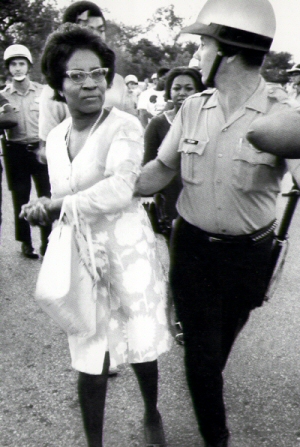
Clara Luper

Clara Luper, an Oklahoma history teacher, ordered thirteen Cokes at Katz Drugstore in Oklahoma City on August 19, 1958 for herself and twelve children, ages 6 to 17. Lunch counters in Oklahoma, like much of the South, were segregated. This wasn’t just a request for drinks, but a request for civil rights.

Waitresses ignored them. Other patrons did not: leaving the restaurant, pouring drinks on them, cursing at them.  The group left after a few hours without their drinks. They returned the next day and were served their Cokes, and burgers, too.

“Within that hamburger was the whole essence of democracy.” – Clara Luper

Note: This took place a year and a half before the much more famous sit-in at the Greensboro (NC) Woolworth’s on February 1, 1960. Luper would continue her fight to desegregate public spaces in Oklahoma City. She was arrested 26 times between 1958 and the passage of Oklahoma law to desegregate. (Passed two days after the Civil Rights Act.)


Found at Frog Blog

The Empty Court: A Guest Essay

A friend of mine posted this essay on Facebook, and in light of the Black Friday madness taking place last night and today, I thought it well worth sharing.


As I was reading over the Gospel text for today (Luke 19:45-48, where Jesus cleanses the Temple), I was struck by a certain irony.

Just before this event, Jesus comes in sight of Jerusalem and weeps over it, since “If this day you only knew what makes for peace—but now it is hidden from your eyes. . . . [Your enemies] will smash you to the ground and your children within you . . . because you did not recognize the time of your visitation.” He then proceeds to enter the temple, where he finds the court of Gentiles has become a marketplace, not a place of prayer for the nations.

The temple authorities must have had a natural impulse. The court was nearly empty because, although this open expanse of over 20 acres had been reserved for the nations to come and pray to God, most of the peoples of the world neither knew or cared that it was for them. It was a vacuum, begging to be filled. There was a need to provide those who did come to the temple with pure animals for sacrifice, and the proper coins (without engraved images of humans or deities) for use in the temple. A vacuum, and the need that could fill it—the temple authorities put the two together very neatly. With only one problem. There was no room left for the original purpose, and so Jesus came along to restore this part of the world to its intended purpose.

In filling the court, the authorities had shown that they did not know “what makes for peace,” which is leaving room, being empty for God. They soon would show they did not “recognize the time of their visitation,” by killing God’s messenger, his own Son. Even though God had “pitched his tent” in their midst for a thousand years, from the time of David and Solomon, they still had not learned enough to know God or God’s peace.

However, lest we jeer at such foolishness, let us note this irony. Christmas commemorates our own hour of God’s visitation, not one thousand years ago now, but nearly two thousand. Decades ago it was taken over by the marketplace. Now it seems as if Thanksgiving is likewise vanishing under our worship of buying and selling to serve the almighty Dollar. Thanksgiving was begun as a day of peace and prayer to give thanks to God, an empty expanse that the merchants could not resist filling, with turkey for the feast, with football to entertain us, and with deals to entice us into the stores and malls. The temple authorities filled one court with their marketplace. It seems to me that we are very near to filling two holidays with our marketplace.

If the temple authorities were fools, does this mean that we are at least twice the fools?

-Boniface Muggli, osb


Father Boniface lives and works at Assumption Abbey, a Benedictine monastery in Richardon, ND.

Re-thinking chocolate

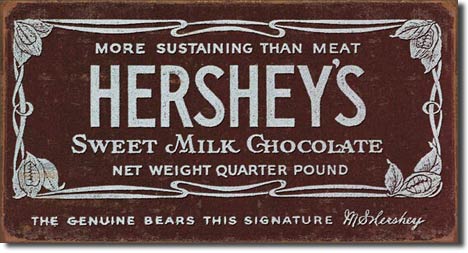
I’ve mentioned chocolate before. It’s one of my favorite things in all the world, and when I die, I’m probably going to the Cholesterol Kingdom.

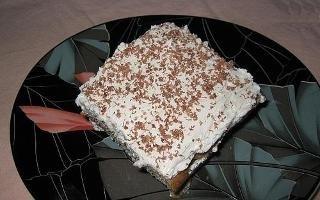
There’s Sachertorte from Vienna:

If you’re in Brazil, you can get death-star chocolates more deadly than the plasma bolts of a Sith lord:

(pause for culinary orgasm)

L’Italia in Harrisonburg, VA used to serve the most incredible chocolate marquese, sadly now discontinued:

and Piccolo Angolo in New York City, my favorite restaurant in all the whole wide world, offers up an amaretto tiramisu that stops your heart just to look at it.

Now that my heart rate has returned to normal, it’s time to point out that there is some disturbing news bubbling up to the surface about chocolate, one which I need to consider seriously. Most everyone knows about blood diamonds, but few people know about child-labor chocolate.

The Wikipedia article gives a general background, and this petition outlines some of the ongoing questions. Neither of these sources cover the entire issue, and I don’t advocate signing the petition just because it’s out there – but I have been prompted to do more research and see what the current situation really is. If I had to cut back my chocolate consumption to make sure I’m not being part of the problem, my body would probably thank me for it. But I’d sit in the middle of the floor and cry.

The Old Wolf has *burp* spoken.


Safety or Paranoia?

The sad news has arrived that Buckyballs and Buckycubes will be no more.

Thanks to the douchebag wise attorneys at the Consumer Products Safety Commission and their relentless thirst for billable hours, the makers have thrown in the towel, and will not be making any more of these amazing and entertaining devices. Glad I got me a set when the getting was good. If you want some, head over to their website and order now before this little bit of history is gone.

Yes, these are not for children. Yes, the warnings on their website and packaging and instructions are loud and brash. And yes, there have been some injuries requiring surgery as adults have ignored the warnings. Yet, somehow, the following things continue to be sold:

  • Axes
  • Fireworks
  • Guns
  • Nitric Acid
  • Replica katanas
  • Chain saws
  • Skil saws
  • Ginsu knives
  • Plastic shopping bags

and a whole host of other things that, given to a child, could be wildly dangerous or fatal.

What’s going on here?

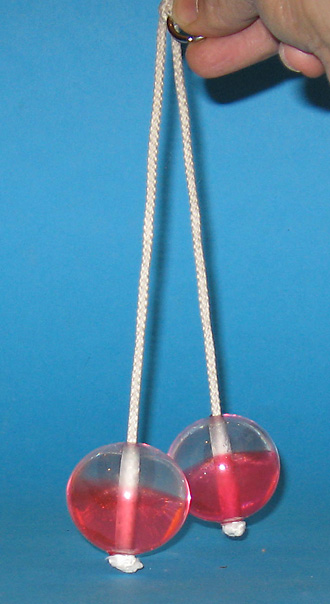
I remember another toy that vanished early on – click-clack balls.

Sort of a 20th-century version of the old paddleball toy, these could be both entertaining (because it was devilishly hard to get them going) and maddening (because of the noise.) Unfortunately, if you didn’t do it right, those hard little glass balls could whip around and give you a good solid whack on your wrist, or pinch your fingers. Worse, if you got them going hard enough and long enough, they could shatter with the surprising effect of a fragmentation grenade. The video below shows them in action:

Later versions were made of rubber or plastic, but as far as I know they are still banned here.

Other banned toys included a Gilbert atomic energy laboratory (1951)

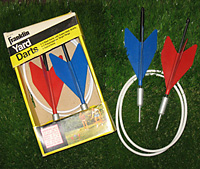
which allowed young people to operate their very own cloud chamber, or lawn darts

which allowed people of all ages to put each other’s eyes out and perforate various body parts.

So the question is raised, where do you draw the line?

Common sense would dictate that when something is marketed as a toy and targeted at children, if it causes bodily injury from normal use (lawn darts racked up over 7,000 incidents), it’s probably not a good idea. But if something is marketed as destined for adults, and children are hurt because of rampant stupidity, does that mean that a product should be persecuted into oblivion? Nowadays, a single case of harm means that the personal injury attorneys come from the voodvork out, but it was not always so. Something had to be pretty egregious to get government action going.

Here are some other things that are difficult to find nowadays:

Jungle Gym

See-saw (or teeter-totter, depending on where you grew up)

Basic playground slide (a low one – there were higher ones as well)

Swingset

Merry-go-round

I played on each of these regularly, and somehow survived without the tender attentions of an attorney. I fell off of them, was flung off of them, swung around on them, got my cojones smashed on them, bonked my head on them, scraped knees on them, and never once told my mother that I was entitled to compensation. When my oldest son fell off a jungle gym and broke his arm in the early 80’s, it was an “oh well, huh” type of event – he got a blue cast, was cool for a few weeks, and survived to be an awesome young man. Today, you’re lucky if you can find a playground worthy of a child’s attention – all of them dumbed down to the level of a McDonald’s playland.

I blame the growing litigiousness and entitlement mentality of our society: people willing to sue at the drop of a hat, and attorneys encouraging them to do so. The CPSC still has a valid function, because people will also try to market anything that turns a buck and providing our kidlets with lead-painted toys and chokables is still rather not done. But that doesn’t mean every item that could cause harm to a child, especially when it’s prominently and forcefully advertised as being for adults only, should be hounded out of existence.

The death of common sense saddens me.

The Old Wolf has spoken.


When one is completely empty inside

Over on Facebook, I got a pointer to a blog post in Norwegian. Now, my Norwegian is hqiz; I studied intensively for 3 months before staffing a seminar for Klemmer and Associates in Asker, Norway, in November of 2008, and it helped me get around and interact with the students, but we’re talking survival. But it’s enough that I could understand the article, and with the help of online resources I worked my way through it enough to determine that it needs to be shared. What follows is my own effort at putting this moving post into English. It’s not perfect by any means, but I think it captures the spirit of what was said.


Tonight my daughter [1], age 7, told me that one of the seventh graders at her school had been bothering her. He pushed her and said something that made her sad.
– Well, what did he say? I asked.
– He called me  …n … he called me … a nigger,‘ [2] said my daughter, with downcast eyes.

My daughter never has downcast eyes. She tends to face the world with clenched fists and a huge smile, but now it looked as though she were ashamed of something. Something in me sank, not particularly because of the n-word, but because of my daughter’s uncharacteristic body language. But I replied in the same tone as I usually do when she talks about things that have happened; I tried to get all the facts on the table before I reacted.

– Do you know what “nigger” means? I asked.
– No, admitted my daughter. Then she took a breath and looked up at me:
– But I knew it meant something bad!
– How did you know that?
– Because he said it in such a mean,  teasing way. And because I was completely empty inside.

That description of being subjected to derogatory remarks was so spot-on that I felt pretty empty inside, too. But my daughter sat there and waited for an answer and an explanation. I took a deep breath and tried to explain. That “nigger” is a word that gets used on people with brown skin, who come from Africa or look like they come from Africa.

– Like  me? So he can SAY that? She widened her eyes and I felt like I had drowned a sack of kittens. I went on to say that word was common in the old days, but it is not used very often anymore. I explained that many people, especially adults and old people, use it without meaning anything bad by it, and without wanting to hurt anyone. They just have not kept up with the times.

But I told her that there are some people who use the word on purpose, to be mean, and that she probably was right, that this particular boy belongs to the latter group. These people tend to stand out.

And I said that no one has the right to call someone something that makes them completely empty inside, whatever that word means. But still, there are many people that say things just to make others sad. And sometimes people say things without wanting to make others sad, but they feel sad anyway.

We had a pretty long chat on the sofa, and another after that evening’s bedtime story session was finished. We discussed what is okay to say to others and what is not okay, and why. We talked about what we should say if we have accidentally made someone else feel empty inside, and what we should say if others are doing it to us. And whether it’s worse if someone we like and love says insensitive things to us. For this unknown boy was, after all, no one of consequence in my daughter’s life, but still, Mommy.

Actually, I had plans to use to use my personal development time this evening watching the zombie series and other fun things, but I ended up pondering a bit instead. Pretty loose and fragmented, I must confess, for mentally I’m dangerously close to zombie level right now. But let me think out loud anyway (after all it is my blog, so I can do what I want): Everyone agrees in principle that saying things to be mean is not allowed. The specific episode my daughter told me about obviously falls into that category. But people who say such things – where do they get this from? And where does one draw the line? There is no agreement.

Not so long ago I had a chat with some of my students at school. They have a pretty rough tone in the classroom, and several have responded that put-downs run pretty freely in the group. Among other things, it happens too often that something is characterized by derogatory prefixes such as Paki, whore- and homo- (for example, “homo music”, i.e. music that any talented guy with normal gender identity would consider worth listening to). The students themselves couldn’t get it through their heads that there was a problem here. We’re just kidding! We only say it to people who can take it, who are in on the joke!

It’s clear that kidding around with friends is fine. But the boundaries of humor are delicate and indistinct. The words we use have so many fine distinctions. One man’s fun banter can be another man’s nightmare. I didn’t mean any harm by it, we pout, as though that should make everything all better. By no means do we want to descend into an “I feel insulted” tyranny, where anyone’s negative feelings about some experience should determine the norm for everyone else’s behavior. But we do need to be crystal clear that every time we choose to say something hurtful (or refrain from saying something nice) to or about someone, we make a choice that affects everyone around us.

What about the person who is not in on the joke? The one who laughs uncomfortably, because he or she doesn’t want to be labeled killjoy or a first-class whiner? And what about the guy who happens to share the same classroom (or break room or dinner table) with two others “jokingly” using derogatory names for each other? He is not a direct recipient of Jesus Christ, you are so fucking gay, man! He’s not really involved at all, but sitting in the same room, he suddenly becomes completely empty inside. And no one says anything about it. So he’s completely empty, all alone.

It is never okay for anyone to be completely empty inside.


Notes

[1] The original Norwegian is “Lillesøster” (Little Sister)

[2] Nigger is the best translation available here. The original Norwegian is neger (negro), in this case used as a derogatory term, but it should be clearly stated here that the word doesn’t carry the immense cultural weight that it does here in the United States.

The Old Wolf has spoken.

A Little Girl Called me a Terrorist

Ela has asked that we spread her message. I am honored to do so. Her original post is at imperfectwriting.tumblr.com

I went to the mall, and a little girl called me a terrorist.

My name is Ela.  I am seventeen years old.  I am not Muslim, but my friend told me about her friend being discriminated against for wearing a hijab.  So I decided to see the discrimination firsthand to get a better understanding of what Muslim women go through.
My friend and I pinned scarves around our heads, and then we went to the mall.  Normally, vendors try to get us to buy things and ask us to sample a snack.  Clerks usually ask us if we need help, tell us about sales, and smile at us.  Not today.  People, including vendors, clerks, and other shoppers, wouldn’t look at us.  They didn’t talk to us.  They acted like we didn’t exist.  They didn’t want to be caught staring at us, so they didn’t look at all.
And then, in one store, a girl (who looked about four years old) asked her mom if my friend and I were terrorists.  She wasn’t trying to be mean or anything.  I don’t even think she could have grasped the idea of prejudice.  However, her mother’s response is one I can never forgive or forget.  The mother hushed her child, glared at me, and then took her daughter by the hand and led her out of the store.
All that because I put a scarf on my head.  Just like that, a mother taught her little girl that being Muslim was evil.  It didn’t matter that I was a nice person.  All that mattered was that I looked different.  That little girl may grow up and teach her children the same thing.
This experiment gave me a huge wakeup call.  It lasted for only a few hours, so I can’t even begin to imagine how much prejudice Muslim girls go through every day.  It reminded me of something that many people know but rarely remember: the women in hijabs are people, just like all those women out there who aren’t Muslim.
 Please help me spread this message.  Treat Muslims, Jews, Christians, Buddhists, Hindus, Pagans, Taoists, etc., exactly the way you want to be treated, regardless of what they’re wearing or not wearing, no exceptions.  I don’t know that the world will ever totally wipe out prejudice, but we can try, one blog at a time.

As I quoted in my post about John Howard Griffin, as a black man Griffin recorded experiences that were hauntingly mirrored by Ela’s words: “I got off and began walking along Canal Street in the heart of town… I passed the same taverns and amusement places where the hawkers had solicited me on previous evenings. They were busy, urging the white men to come in and see the girls. The same smells of smoke and liquor and dampness poured out through half-open doors. Tonight they did not solicit me. Tonight they looked at me but did not see me.” (From Black Like Me).

Ela said, “The mother hushed her child, glared at me, and then took her daughter by the hand and led her out of the store.” She had experienced her own version of “the hate stare.”

Ela said, “It didn’t matter that I was a nice person.  All that mattered was that I looked different.” Griffin reported that he discussed his project with the FBI before beginning. He asked them, “Do you suppose they will treat me as John Howard Griffin, regardless of my color – or will they treat me as some nameless Negro, even though I am still the same name?” The response: “You’re not serious, one of them said. “They’re not going to ask you any questions. As soon as they see you, you’ll be a Negro and that’s all they’ll ever want to know about you.”

50 years later, and we have made so little progress. Huge honor to Ela for taking her own journey into a different culture and bringing to light the prejudices and fears that still plague us.

The Old Wolf has spoken.

Op-Ed: Cycling

An article at CNN today proclaims “Armstrong doping scandal casts shadow over cycling.” Without going into a long, drawn-out analysis, of which you can find many on the web, I present here a few thoughts on the subject from no less a reliable source than my own rather limited brain.

  1. Doping appears to have been endemic to cycling for a long time. That said, it should be remembered that banned substances don’t make you a superman, they just give you a competitive edge in a sport where seconds count. A lot of people made some lousy choices “because everyone was doing it,” but nothing should take away from the fact that Mr. Armstrong and his colleagues were incredible, driven athletes who spent agonizing hours, months, and years in training and against incredible odds.
  1. Sponsors are fleeing in droves, if only to protect their own bottom line from the taint of guilt by association, but they will be back when the sport has cleaned house.
  1. Livestrong has done incredible things in the support of those suffering from cancer. The errors of the man should not take away from the successes of the foundation.
  1. Cycling will survive. The microscope now trained upon the sport is a sure guarantee that steps will be taken to purge the doping culture, dial back the expectations about 10%, and rebuild the sport on a clean footing. Rabobank stated, “We are no longer convinced that the international professional world of cycling can make this a clean and fair sport. We are not confident that this will change for the better in the foreseeable future,” but that’s corporate weasel-speak for “we’re covering our own asses.”

Ceteris paribus, there may not be another Lance Armstrong waiting in the wings at the moment, but given the history of sports in general, I have no doubt there will be another champion before too long, one who can make both spectators and sponsors sit up and take notice. It may be a long road back, but long roads, with lots of hills, are what these athletes are used to.

The Old Wolf has spoken.

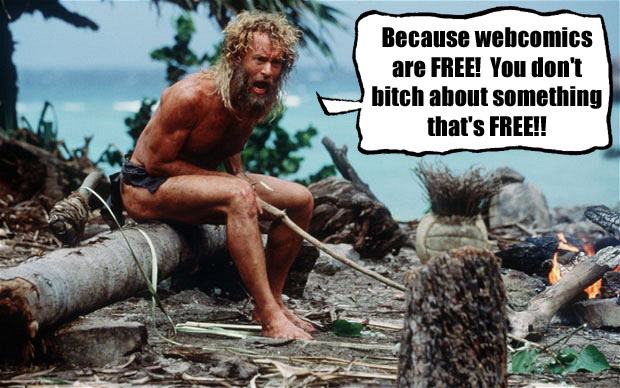
Funny business: Because they’re free!

Ever since everyone in my elementary school class was taught how to read The Herald Tribune (go ndéanai Dia trócaire air), way back in 1961 or so, I have loved the daily funnies. I remember waking up early when I was in high school, heading for a local coffee shop, and starting my day with a cup of coffee and The Waterbury Republican.

There were all kinds of funnies, and I had my favorites, which I assiduously saved for last each day.
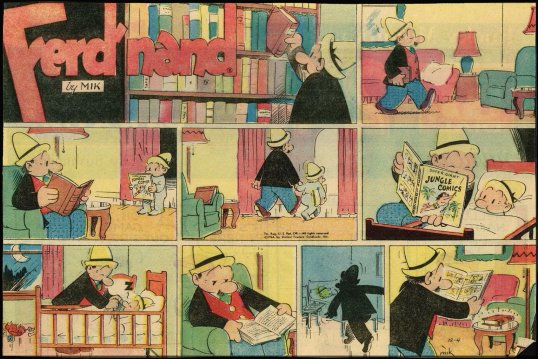
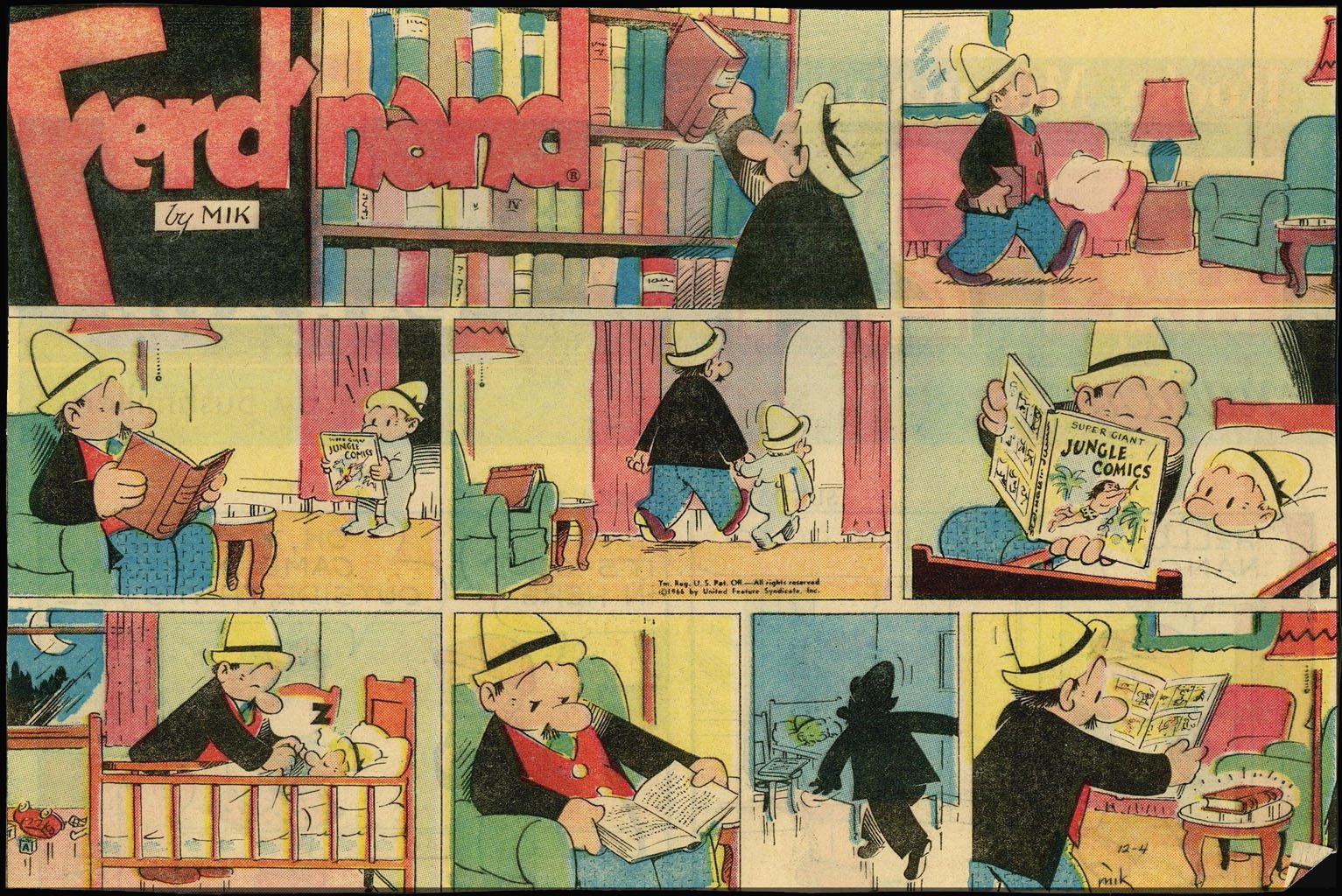
Ferd’nand by Mik (found at mydelineatedlife.blogspot.com)

Dondi, by Irwin Hasen. Found at Mr. Blog’s Tepid Ride

And my all-time favorite:

Rick O’Shay, by Stan Lynde.

Other strips, the soap operas like Mary Worth and Apartment 3-G, did nothing for me and I just skipped over them.

Remember that, there’s going to be a test.

Finally, when the newspapers ceased to be practical because of the internet (around 2002 for me) I became a fan of webcomics.

Webcomics are great. They are directly responsible for my hooking up with my wife, whom I love with all my heart and soul (even though she scared the living daylights out of me this morning at 3 AM and we hates her, hates her, hates her forever precious), and I’ve had to be selective about which ones I read, because there are thousands of them out there, and so many of them are top-drawer.

Some strips have discussion fora attached, one of which was how I met above-mentioned beloved wife (who is still in the doghouse). Most forum participants enjoy discussing and speculating about each day’s strip and upcoming plot possibilities, as well as an entire universe of random topics that crop up; indeed, a forum can become a living community. But there’s a strange phenomenon that afflicts these virtual villages: some people take up residence for the express purpose of being critical of the subject matter. Like the poor degenerate I mentioned in this post, they plunk themselves down and blow raspberries at the strip and its creator, day after day, without end.

Now, some of these people are just trolls, but there seems to be another phenomenon operating here. Like people who leave a religion and then spend the rest of their lives complaining about it, these netizens seem incapable of finding joy in anything positive, but must needs expend their energy complaining about something they hate. For the love of Mogg and his entire holy family, with thousands of webcomics out there, where is the value in reading something that annoys you? Coming back to my newspaper days, I can equate this phenomenon with my taking the time to hand-write a letter to the editor complaining about how boring and insipid I found Mary Worth, and threatening the artist with bodily injury and death. Every day.

A particularly egregious example of this sort of inanity is found at the “Bad Webcomics Wiki” (no link provided):

Essentially it’s nothing more than one man’s cesspool of hate and piss; the author is flat-out miserable, and assuages his pain by inflicting his misery on the rest of the world.

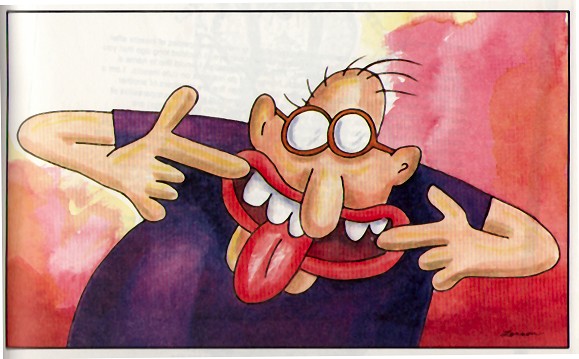
It’s not only the forums, either – artists get direct hate mail from readers, and it appears that this was even the case before the advent of the internet. Gary Larson’s The Pre-History of the Far Side contains some absolutely choice correspondence from people who found his cartoons offensive in some way or another. His response, in addition to mocking them in a published work, was

Teresa Burritt, the authoress of the offbeat Frog Applause, regularly posts hate mail from people, and recently blogged about it; I count a number of cartoonists among my personal friends, and some of them have shared correspondence with me that would either curl your hair or amuse you no end, depending on how you looked at it. Most of these artists take this sort of impotent vitriol in stride, and either ignore it or make a point of mocking it publicly to further enrage their detractors. Others I am acquainted with have a hard time with the sound and fury, and I hope they can get to a point of tranquility where they don’t allow the noisy idiots to dampen their spirits.

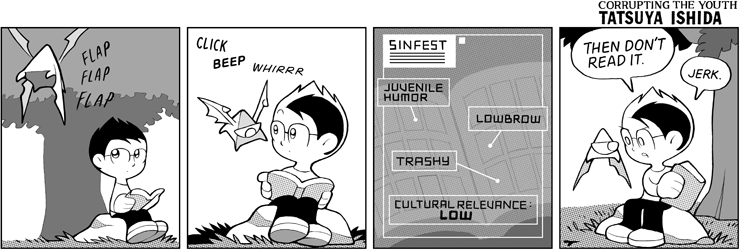
This whole essay was spawned by today’s Sinfest, by Tatsuya Ishida,

and another creation by Paul Taylor, author of the inimitable Wapsi Square:

The whole point here, which I recommend warmly to everyone who ever read a webcomic that they didn’t care for, is this:

Life is far too short to waste your time on such negative energy. If you read something you don’t like, for the love of Mogg’s holy grandmother, just ignore it. Better yet, find something positive to do – anything at all – and do it. As Artemus Ward said to the orfice-seekers pestering Abraham Lincoln:

“Go home, you miserable men, go home & till the sile! Go to peddlin tinware — go to choppin wood — go to bilin’ sope — stuff sassengers — black boots — git a clerk-ship on sum respectable manure cart — go round as original Swiss Bell Ringers — becum ‘origenal and only’ Campbell Minstrels — go to lecturin at 50 dollars a nite — imbark in the peanut bizniss — write for the Ledger — saw off your legs and go round givin concerts, with techin appeals to a charitable public, printed on your handbills — anything for a honest living, but don’t come round here drivin Old Abe crazy by your outrajis cuttings up!”

A better sermon I have never heard.

The Old Wolf has spoken.

Comments are closed for this topic.
Stuff

I’m a packrat. I freely admit it. However, lately I’ve come to start calling myself an “archivist” – it sounds much more respectable; and there can be value in preserving things for posterity.

A recent series of photographs by Huang Qingjun, however, makes me wistful for the simplicity that some people live with. Well, almost.

Said Huang:

“The idea for the series about people’s material goods, now called Jiadang (Family Stuff), came in 2003 with some photos he took for the magazine Chinese National Geography. But the project didn’t really get under way until three years later, when Huang started travelling around China looking for suitable places and people.

“Most people thought what I was proposing was not normal. When I explained I wanted to set up a photo, that it would involve taking everything out of their house and setting it up outside, that took quite a lot of explaining,” he says.

“But almost all of them, when they realised what I was trying to do, they understood the point.”

These captivating images raise the question: How much 家当 (jiadang) do we really need? So many of us are accumulating things far beyond our needs, in a mad rush to die with the most toys. While I could surround myself with gewgaws and gimcracks (especially in my kitchen) until I had no more place to live, I do understand that 99.9% of it would be useless if it ever came to living without electricity or in, say, 350 square feet of space.

Leonardo Da Vinci once said that simplicity was the ultimate in sophistication. Less stuff means less work taking care of it, dusting it, and moving it; less money spent on acquiring it; and more time to pursue the only thing we can really take with us – relationships.

Am I going to “sell all that I have, and give to the poor” tomorrow? No, not bloody likely – I’m an addict and I know it. But I will be more careful in future, and will bend my will toward offloading as much of it as I can possibly bear to part with.

My thanks to Huang xiansheng for a wonderful glimpse into an unburdened life.

Read more and see more images at the BBC.

The Old Wolf has spoken.

Sexism, 1959-style

Not too much to say about this classic video, other than it’s a small first step in overcoming deeply-entrenched male attitudes toward women in the workplace. While it seems laughable to watch today, it was produced in deadly earnest. I’d like to think we’ve come a long way since then; yet while progress has definitely been made, there’s still a lot of good-ol’-boy stuff going on in the 21st century. Perhaps it’s time for someone like Steven Spielberg to produce an updated version.

The Old Wolf has spoken.