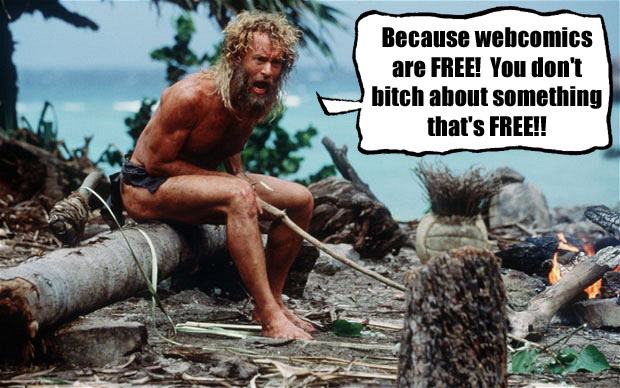
Funny business: Because they’re free!

Ever since everyone in my elementary school class was taught how to read The Herald Tribune (go ndéanai Dia trócaire air), way back in 1961 or so, I have loved the daily funnies. I remember waking up early when I was in high school, heading for a local coffee shop, and starting my day with a cup of coffee and The Waterbury Republican.

There were all kinds of funnies, and I had my favorites, which I assiduously saved for last each day.

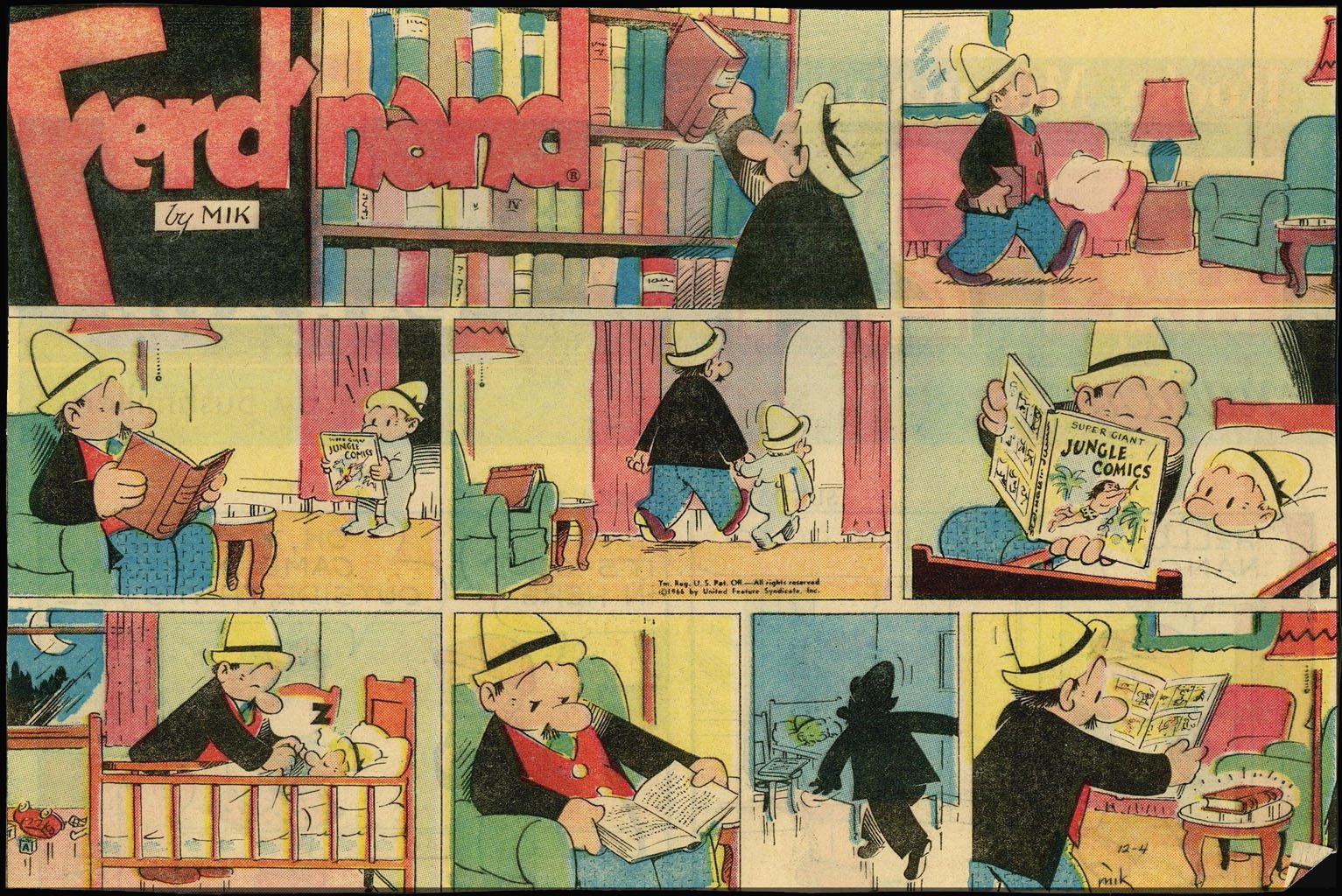
Ferd’nand by Mik (found at mydelineatedlife.blogspot.com)

Dondi, by Irwin Hasen. Found at Mr. Blog’s Tepid Ride

And my all-time favorite:

Rick O’Shay, by Stan Lynde.

Other strips, the soap operas like Mary Worth and Apartment 3-G, did nothing for me and I just skipped over them.

Remember that, there’s going to be a test.

Finally, when the newspapers ceased to be practical because of the internet (around 2002 for me) I became a fan of webcomics.

Webcomics are great. They are directly responsible for my hooking up with my wife, whom I love with all my heart and soul (even though she scared the living daylights out of me this morning at 3 AM and we hates her, hates her, hates her forever precious), and I’ve had to be selective about which ones I read, because there are thousands of them out there, and so many of them are top-drawer.

Some strips have discussion fora attached, one of which was how I met above-mentioned beloved wife (who is still in the doghouse). Most forum participants enjoy discussing and speculating about each day’s strip and upcoming plot possibilities, as well as an entire universe of random topics that crop up; indeed, a forum can become a living community. But there’s a strange phenomenon that afflicts these virtual villages: some people take up residence for the express purpose of being critical of the subject matter. Like the poor degenerate I mentioned in this post, they plunk themselves down and blow raspberries at the strip and its creator, day after day, without end.

Now, some of these people are just trolls, but there seems to be another phenomenon operating here. Like people who leave a religion and then spend the rest of their lives complaining about it, these netizens seem incapable of finding joy in anything positive, but must needs expend their energy complaining about something they hate. For the love of Mogg and his entire holy family, with thousands of webcomics out there, where is the value in reading something that annoys you? Coming back to my newspaper days, I can equate this phenomenon with my taking the time to hand-write a letter to the editor complaining about how boring and insipid I found Mary Worth, and threatening the artist with bodily injury and death. Every day.

A particularly egregious example of this sort of inanity is found at the “Bad Webcomics Wiki” (no link provided):

Essentially it’s nothing more than one man’s cesspool of hate and piss; the author is flat-out miserable, and assuages his pain by inflicting his misery on the rest of the world.

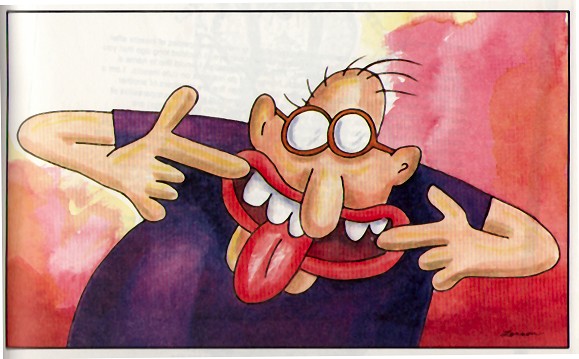
It’s not only the forums, either – artists get direct hate mail from readers, and it appears that this was even the case before the advent of the internet. Gary Larson’s The Pre-History of the Far Side contains some absolutely choice correspondence from people who found his cartoons offensive in some way or another. His response, in addition to mocking them in a published work, was

Teresa Burritt, the authoress of the offbeat Frog Applause, regularly posts hate mail from people, and recently blogged about it; I count a number of cartoonists among my personal friends, and some of them have shared correspondence with me that would either curl your hair or amuse you no end, depending on how you looked at it. Most of these artists take this sort of impotent vitriol in stride, and either ignore it or make a point of mocking it publicly to further enrage their detractors. Others I am acquainted with have a hard time with the sound and fury, and I hope they can get to a point of tranquility where they don’t allow the noisy idiots to dampen their spirits.

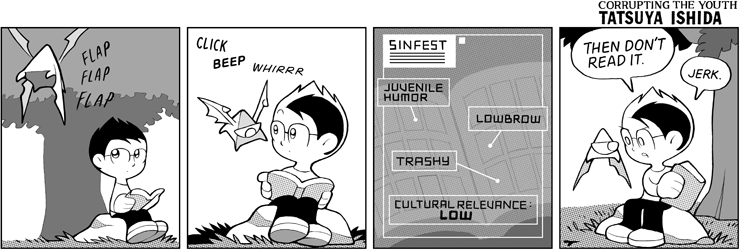
This whole essay was spawned by today’s Sinfest, by Tatsuya Ishida,

and another creation by Paul Taylor, author of the inimitable Wapsi Square:

The whole point here, which I recommend warmly to everyone who ever read a webcomic that they didn’t care for, is this:

Life is far too short to waste your time on such negative energy. If you read something you don’t like, for the love of Mogg’s holy grandmother, just ignore it. Better yet, find something positive to do – anything at all – and do it. As Artemus Ward said to the orfice-seekers pestering Abraham Lincoln:

“Go home, you miserable men, go home & till the sile! Go to peddlin tinware — go to choppin wood — go to bilin’ sope — stuff sassengers — black boots — git a clerk-ship on sum respectable manure cart — go round as original Swiss Bell Ringers — becum ‘origenal and only’ Campbell Minstrels — go to lecturin at 50 dollars a nite — imbark in the peanut bizniss — write for the Ledger — saw off your legs and go round givin concerts, with techin appeals to a charitable public, printed on your handbills — anything for a honest living, but don’t come round here drivin Old Abe crazy by your outrajis cuttings up!”

A better sermon I have never heard.

The Old Wolf has spoken.

Comments are closed for this topic.

Stuff

I’m a packrat. I freely admit it. However, lately I’ve come to start calling myself an “archivist” – it sounds much more respectable; and there can be value in preserving things for posterity.

A recent series of photographs by Huang Qingjun, however, makes me wistful for the simplicity that some people live with. Well, almost.

Said Huang:

“The idea for the series about people’s material goods, now called Jiadang (Family Stuff), came in 2003 with some photos he took for the magazine Chinese National Geography. But the project didn’t really get under way until three years later, when Huang started travelling around China looking for suitable places and people.

“Most people thought what I was proposing was not normal. When I explained I wanted to set up a photo, that it would involve taking everything out of their house and setting it up outside, that took quite a lot of explaining,” he says.

“But almost all of them, when they realised what I was trying to do, they understood the point.”

These captivating images raise the question: How much 家当 (jiadang) do we really need? So many of us are accumulating things far beyond our needs, in a mad rush to die with the most toys. While I could surround myself with gewgaws and gimcracks (especially in my kitchen) until I had no more place to live, I do understand that 99.9% of it would be useless if it ever came to living without electricity or in, say, 350 square feet of space.

Leonardo Da Vinci once said that simplicity was the ultimate in sophistication. Less stuff means less work taking care of it, dusting it, and moving it; less money spent on acquiring it; and more time to pursue the only thing we can really take with us – relationships.

Am I going to “sell all that I have, and give to the poor” tomorrow? No, not bloody likely – I’m an addict and I know it. But I will be more careful in future, and will bend my will toward offloading as much of it as I can possibly bear to part with.

My thanks to Huang xiansheng for a wonderful glimpse into an unburdened life.

Read more and see more images at the BBC.

The Old Wolf has spoken.

Sexism, 1959-style

Not too much to say about this classic video, other than it’s a small first step in overcoming deeply-entrenched male attitudes toward women in the workplace. While it seems laughable to watch today, it was produced in deadly earnest. I’d like to think we’ve come a long way since then; yet while progress has definitely been made, there’s still a lot of good-ol’-boy stuff going on in the 21st century. Perhaps it’s time for someone like Steven Spielberg to produce an updated version.

The Old Wolf has spoken.

Baby’s First Baby: Not what you think

Some time ago I came across this monstrosity of a toy – obviously from China, and rating about 9.85 on the “what the hqiz?” scale:

This is real. It’s not  a Photoshop. And I wonder what kind of mushrooms they’re selling at the Chinese markets these days.

Today I stumbled across a similar offering and immediately despaired of humanity.

The good news is, this isn’t real – but rather a work of art with a message, by artist Darren Cullen.

Cullen says over at his blog,

“It seems like the majority of commentators have misunderstood my intentions however and decided I’m making a comment on reality tv shows exploiting teen pregnancies. I’m not. It’s about the way these toys intrinsically train girls to have and care for children while they are still only children themselves. If you look in any toy catalogue the girls section is wall-to-wall babies and prams, make-up kits, kitchen sets and hoovers. We complain that children are growing up too quick, getting pregnant too early, when the only toys we give them teach kids to act like adults and prepare to have babies. It’s goes without saying that teaching young girls that these are the type of things which adult women should and do concern themselves with is also a very narrow definition of womanhood.”

This is a message I can get behind.

The Old Wolf has spoken.

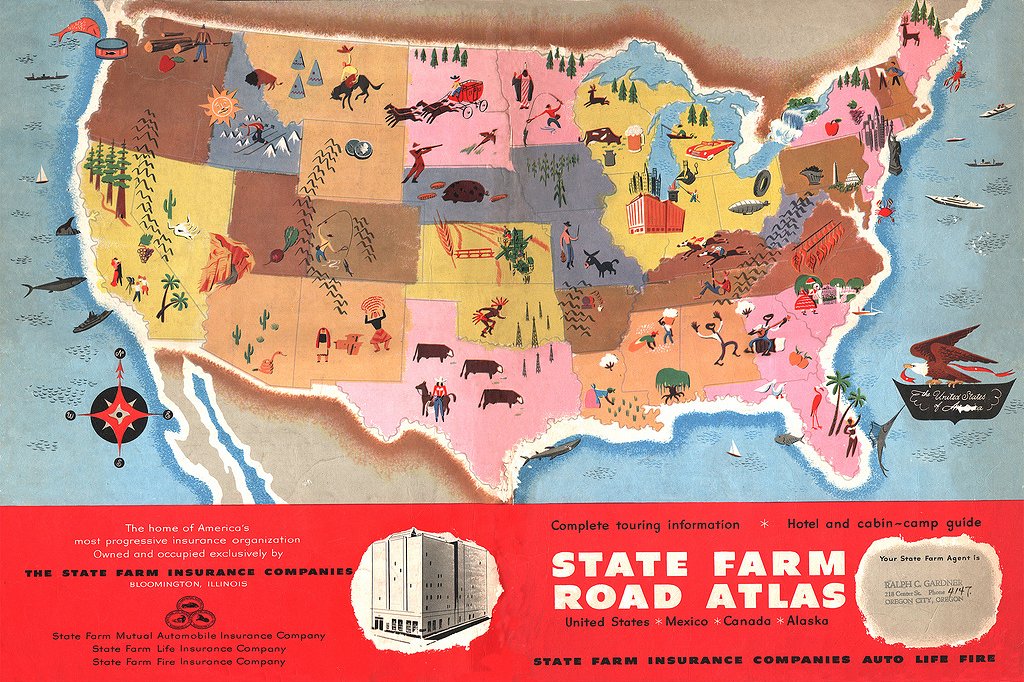
State Farm Road Atlas, 1950

Utah gets nothing but sugar beets (now a defunct industry.) Colorado gets a mint, Montana gets Injuns, the South gets nothing but happy darkies workin’ in the fields. Pretty sad map all the way around, if you ask me; even discounting the racism, it doesn’t even highlight the best things each state has to offer.

I’d like to think we’ve come a bit farther than this.

The Old Wolf has spoken.

The Troll, 1820’s version

Some time ago I posted about internet trolls, familiar to anyone who frequents forums and discussion groups. Indeed, one of the net’s most prolific and unsavory trolls was recently outed by Gawker (I’m not posting the link because it’s a pretty sordid story, but it’s out there if you’re interested.) Today I happened across a description of this kind of behavior from the early 19th century, which I thought was interesting – Trolling is not new, and apparently the only thing that has changed is the medium.

This litigious humour is bad enough: but there is one character still worse — that of a person who goes into company, not to contradict, but to talk at you. This is the greatest nuisance in civilised society. Such a person does not come armed to defend himself at all points, but to unsettle, if he can, and throw a slur on all your favourite opinions. If he has a notion that anyone in the room is fond of poetry, he immediately volunteers a contemptuous tirade against the idle jingle of verse. If he suspects you have a delight in pictures, he endeavours, not by fair argument, but by a side-wind, to put you out of conceit with so frivolous an art. If you have a taste for music, he does not think much good is to be done by this tickling of the ears. If you speak in praise of a comedy, he does not see the use of wit: if you say you have been to a tragedy, he shakes his head at this mockery of human misery, and thinks it ought to be prohibited. He tries to find out beforehand whatever it is that you take a particular pride or pleasure in, that he may annoy your self-love in the tenderest point (as if he were probing a wound) and make you dissatisfied with yourself and your pursuits for several days afterwards. A person might as well make a practice of throwing out scandalous aspersions against your dearest friends or nearest relations, by way of ingratiating himself into your favour. Such ill-timed impertinence is ‘villainous, and shows a pitiful ambition in the fool that uses it.’ – William Hazlitt, “On the Conversation of Authors,” 1820

Found at Futility Closet

The Old Wolf has spoken.


Brand Retconning

Over time, a number of corporate logos and personages have undergone subtle and not-so-subtle shifts in image to reflect changing social attitudes. Retroactive continuity (retcon for short) is the alteration of previously established facts in a fictional work, most often used in the comic book universe. What follows are a few brands who have re-worked their logos or spokespeople.

Aunt Jemima

This is one of the first brand updates that I recall being aware of.

This ad was from 1909. and Auntie looks like Al Jolson.

This 1925 ad shows a “mammy” looking more like an animated cartoon caricature, more clearly visible in the enlargement below.

The Aunt Jemima I remember looked cuddly and plump and just like the nanny you’d love to have:

And mm-mm! Don’t she make dat good fried chicken, too. The company was obviously trying to present an image of down-home, antebellum comfort, which in the 50’s still seemed totally à propos in the American psyche. As it happened, I did have two African-American nannies when I was growing up; Edith did make killer fried chicken, and also taught us how to make our own soap with animal fat and lye which had been leached from ashes. Nice lady, and sharp as a tack.

There was another one that I recall – she looked a lot like the plump Jemima, but wasn’t anything like the image. I don’t recall her name, but she chased me around the house with an ashtray, and that was the last time I ever saw her.

In 1968, Auntie got a makeover – she shed a bunch of weight and they lightened her up considerable. By the 60’s, the civil-rights movement was in full-swing, and the black mammy image wasn’t going to go over well with a large part of America’s population. Still, there were conflicting attitudes within the black population as well: hair straightening and skin lightening were popular, as though it somehow made a difference in social acceptance or self image.

Finally, in 1989 Aunt Jemima shed her scarf to reveal a natural hairdo and earrings.

A brand is a powerful thing. People have been buying Aunt Jemima products for almost 120 years, and a company would be loth to give up that kind of brand exposure. It seems to me, though, that clinging to the name and logo, even though updated, falls into the same zone as naming sports teams things like the Braves and the Redskins; it might be time for a complete rebranding, much the way Esso became Exxon, or U.S. Steel became USX. (Not that the letter X has any special value – I don’t know how likely I’d be to buy Nxxoxxi Pancakes. I make my own from scratch, anyway.)

The Campbell Kids

This one is unusual. The original kids were designed by Grace Drayton in 1904, and they were strong with the force through the 20’s, when their popularity tapered off. In the 50’s the kids were revitalized, had their own TV show, and have been part of the Brand ever since. The first image is from 1930, the second from the 50’s, and the kids are just as plump and well-fed as a Reubens painting. In 1984, the kids got a baryatric re-work, as seen in the third image above – but it’s not easy to find any pictures of the re-designed twins out there – it’s almost as if they have been scrubbed from the net.

Quaker Oats

Larry, the smiling Quaker so familiar to oatmeal lovers, was given a makeover in 2012 in order to keep the 135-year-old Quaker brand “fresh and innovative,” according to the company. The changes were subtle – a bit less hair, about 5 lbs off the face, and a few wrinkles gone – but he does look a tad younger and healthier than he used to.

All of these changes make a certain type of sense. Racial attitudes change, and people are becoming far more health-conscious. But the next one seems to come from somewhere out beyond Pluto (which is still a planet), if you get my drift.

Minnie Mouse

Apparently, Barney’s department store is not satisfied to use Minnie Mouse as she normally looks in a Lanvin dress… so they’ve resurrected Heroin Chic for the occasion.

What? The? Hqiz?

This insult to the whole concept of body image (apparently only 5’11”, size zero looks good in Lanvin) has prompted a petition over at change.org entitled “Leave Minnie Mouse Alone,” which at the time of this writing almost 90,000 people have signed. From the petition website:

According to sources cited on the non-profit National Association of Anorexia and Associated Eating Disorders website:

  • 47% of girls in 5th-12th grade reported wanting to lose weight because of magazine pictures.
  • 69% of girls in 5th-12th grade reported that magazine pictures influenced their idea of a perfect body shape.
  • 42% of 1st-3rd grade girls want to be thinner.
  • 81% of 10 year olds are afraid of being fat.

Girls have enough pressure to be thin, now the beloved Disney mouse of their childhood has to add to the message that the only good body is a tall, size 0 body? Enough already. Let’s give girls a chance to celebrate the actual bodies they have instead hating them for not fitting into a Lanvin dress. Then maybe enough girls will get together and demand dresses that look good on their actual, non-digitally altered bodies and designers will just have to become talented enough to design a dress that looks good on them.

For what it’s worth, Minnie is not the only character to be violated in this manner:

Daisy Duck as a starving Barbie

Goofy looking like nothing more than an “Axe” model.

Really, Barney’s. How in thunder did something like this ever pass muster? And who at Disney greenlighted this use of their characters? I can only think that the executives themselves were smoking something.

The Old Wolf has *gag* spoken.

Useless products from a bygone era

Striptease Tie

The Nothing Box. I always wanted one of these, but the fact that it died hard after a year put me off.

The Pet Rock

The Invisible Dog – another brilliant idea from the 70’s.

Pogs. Originally the stopper for a glass bottle of milk – today the perfect example of a collecting craze created by marketing and based on nothing. Happily, short-lived.

Original pog.

Cigarettes, grammar, failed marketing, and everything.

Back in the day, tobacco companies could advertise, and advertise they did. Everywhere. Subways, buses, magazines, radio, television, courtesy packs on airplanes, you name it. The more powerful ads drove the more powerful brands. The Marlboro man was everywhere:

Rugged, strong, and healthy – notice the absence of the Surgeon General’s warning on this example from the 60’s.

But in those days, tobacco execs would go on national television and swear that tobacco wasn’t harmful, even to pregnant women (many of whom actually preferred smaller babies)…

… which babies were also used to hawk tobacco products.

Of course, now we know more than we did then:

But this is now, and that was then.

Two of the more popular cigarette campaigns actually capitalized on bad grammar:

This slogan was routinely held up by prescriptive grammarians as an example of abominable usage: “like,” they said, is a preposition governing nouns and noun phrases, and should never be used as a conjunction introducing an adverbial clause. “Winston tastes good as a cigarette should,” intoned the English teachers, was the only acceptable form. Naturally, the ad execs picked up on the furor and capitalized on it:

Not to be left out of the action, MAD magazine put this on the back of their January 1971 issue, which shows that many folks were quite aware of the dangers of smoking, thank you, even while the Tobacco execs were perjuring themselves on the national scene.

In fact, “In December 1952 [Reader’s Digest] published “Cancer by the Carton“, a series of articles that linked smoking with lung cancer. This first brought the dangers of smoking to public attention which, up to then, had ignored the health threats.” (Wikipedia) An interesting article summarizing the history of tobacco and health concerns can be found at CNN Interactive.

Popular stars shilled for tobacco on a regular basis – it seems so bizarre to watch Granny Clampett and Jane Hathaway discussing the merits of Winston, but it’s amusing to see how they worked the grammar issue in at the end in a Madison Avenue “double whammy”.

The Flintstones got into the act as well:

I confess with some shame that tobacco contributed to putting bread in my mouth for some time; mother functioned as a spokeswoman for Camel cigarettes for a year.

But when it came to using bad grammar, Winston was hardly the only offender – Tareyton’s campaign confused nominative and oblique to good effect in their highly successful slogan, “Us Tareyton smokers would rather fight than switch.”[1]

Despite the peccadillo – it seems that cigarette ads thrived on controversy – this particular advertising campaign was wildly successful in the 60’s, and pushed Tareyton’s popularity close to the top of the charts.

But not all products, even those from the makers of successful brands, were an instant hit.

Back in 1966, when I was 15, I was on one of my semi-regular visits to my mom’s brother in Salt Lake. We took a trip up to Idaho to see some additional relatives, and I remember spending some time in a tobacco warehouse, helping to run cartons of cigarettes through the tax-stamp machine. (Had the government gotten wind of our little diversion, the owner could have been shut down, but oversight was lax and attorneys less numerous in those days.) While I was working there that day, I noticed something unusual – a carton of Tennyson cigarettes, which I had never before heard of.

Now, the more astute among my readers will be asking themselves, “What does a 15-year-old know from tobacco?” As it happens, even at that tender age I was somewhat of a tobacco connoisseur. I had started smoking in high school, finding that it was a gateway to a certain level of acceptance, for as little as that was worth. And I parlayed my small bit of social coin into a minor fortune by becoming a user of odd and revolting brands.2 (In Connecticut, the legal age for tobacco was 16, but even before that I had no end of “friends” who would procure for me in exchange for a small consideration.)

Strong and with a different flavor than American standards.

Oval cigarettes. Cute gimmick, but nothing special otherwise.

Absolutely foul. If I had these, I was guaranteed nobody would bum off me.

Tasted just about like smoking a cow pie. Or so I imagine.

Had kind of a fruity taste, unlike anything else I had ever smoked. Meh. However, Lark’s claim to fame was their commercial, the 1960’s version of Google Street View – the Lark truck would run around different places with a TV camera on the back, blaring the William Tell Overture, and asking people, “Show Us Your Lark Pack!” I saw this truck run down 1st Avenue in Manhattan one day; even if I had had a pack of Larks on me, I decided that discretion would have been the better part of fame, since I was still underage in New York.

[Edit: I had a copy of the commercial in question here, which I had posted at YouTube. Even though it was listed as public domain under a Creative Commons license, it appears that the brand is still owned by Trademarks LLC. The video was removed at YouTube, but for some odd reason still played here. In light of some communication with the above-mentioned company, I have removed the video. Unless it is taken down elsewhere, however, you can still see it here (3rd one on the list).

Now, since we’re on the subject of advertising in general as well, I nominate Salem cigarettes for the most insidious commercial ever devised. As a linguist who has studied close to 20 languages over the course of my life (although I don’t claim to speak them all), I can tell you that anything you produce will remain in your memory much longer than anything you hear. When learning a language, speaking is much more powerful than listening; they are different skills, yes, but the first cements things in your memory a lot longer than just hearing them, even multiple times. The following ad is much like getting up at 3:00 AM in the home of a musician, and playing only the first five notes of “Shave and a haircut” on the grand piano. It’s a guarantee that an irritated and foggy victim will stumble down the stairs to finish the “two bits” part before being able to go back to sleep.[3]

Unfortunately, despite these commercials being ancient, many of them have been taken down on copyright grounds. But go here and advance to 6:40, and you’ll get one of the ads that I’m referring to. Unless you are some kind of superhuman being, you will finish the line, and you will sing the brand name in your head. There is no escape.

There were others. I knew every brand on the market, and some that weren’t. I even rolled my own for a while, although not very skillfully, but when I couldn’t get these, I’d smoke anything I could get my hands on. My mother smoked Carltons (why bother, I wondered?) and when I’d cadge hers, I ripped the filter off; ultimately I settled on Luckies as my brand of choice. And of course, in the process, I became a 3-pack-a-day man by the time I was 18. The end of that story is that I quit, cold turkey, that year and never looked back – but my lungs paid a lifetime price.

So that brings us back to Tennyson, and by now I think you’ll understand why it caught my eye. A brand I didn’t know about? Intriguing! But in those days, there was no Internet, and such arcane knowledge was not to be found anywhere. Only later, thanks to the miracle of the Intertubez, was I able to dig up a bit of history, but even today what’s out there is pretty sparse.

In 1966, Tennyson launched a fairly comprehensive media blitz to publicize their new brand. I’m not sure why Tareyton simply didn’t choose to introduce a menthol version of their already-famous brand.[4]

I even remember the jingle. I began to wonder later if I had imagined it, but fortunately the original sheet music which was submitted to the legal process was conserved:


So I’m not senile after all. I may be crazy, but that’s different. As a final bit of curiosity, I also found this:

Same package, same font, same look as Tareyton – but nary a whit of information to be found about what these are, or when or where they were sold. Possibly a European version of Tareyton? One clue:

This has been a bit of a ramble, but I got a good bunch of things out that I won’t have to worry about later (‘Now where did I archive that?’)

The Old Wolf has rambled.


1 In case you’re wondering, it should be “We Tareyton smokers.”

2 Plus ça change, plus ça reste la même chose. Visit The Old Wolf’s Banquet from Hell.

3 Brooke McEldowney, both a very gifted musician and a supremely talented artist who does the webcomics 9 Chickweed Lane and Pibgorn, riffed on this twice. In the first one, Edda and her mother Juliette engaged in this very exercise here; the second, where poor Seth is tormented by his ballet company, is here.

4 As it happens, such a thing exists, even though I only found out about it later as I was researching the topic. Never once did I see these in stores.