Don’t send in the clowns… give them love.

The recent and tragic passing of Robin Williams has spawned a flurry of tributes and analyses, and many of these focus on the issue of mental health. That’s not a bad thing, but it’s unfortunate that it takes the death of a beloved actor to focus the public’s ephemeral attention on an ongoing problem. At the same time, it’s not like the issue has been unknown or has been being ignored all this time; my very first encounter with the issue of depression came from the classic poem:

Whenever Richard Cory went down town,
We people on the pavement looked at him:
He was a gentleman from sole to crown,
Clean favored, and imperially slim.

And he was always quietly arrayed,
And he was always human when he talked;
But still he fluttered pulses when he said,
‘Good-morning,’ and he glittered when he walked.

And he was rich – yes, richer than a king –
And admirably schooled in every grace:
In fine, we thought that he was everything
To make us wish that we were in his place.

So on we worked, and waited for the light,
And went without the meat, and cursed the bread;
And Richard Cory, one calm summer night,
Went home and put a bullet through his head.
– Edwin Arlington Robinson

When I read this poem for the first time (probably around 9th grade, which would have been 1964) I thought, “How could someone so rich and powerful and enviable do that?” Then I lived with depression for 30 years. Not mine, but someone else’s, and I learned that this is not something that is tied to external circumstances, and it’s not just something you “get over.” No matter how hard some people work, no matter how much therapy, no matter how many meds, that blackness just doesn’t  go away. You can’t regrow a leg by thinking about it, you don’t make ALS disappear just because you want it to, and depression is just the same. And sometimes it just hurts too badly to keep going.

In 1967, Dave Berg wrote “The Lighter Side of the Mating Game” for MAD magazine. He had his finger on the pulse of the insecure comedian:
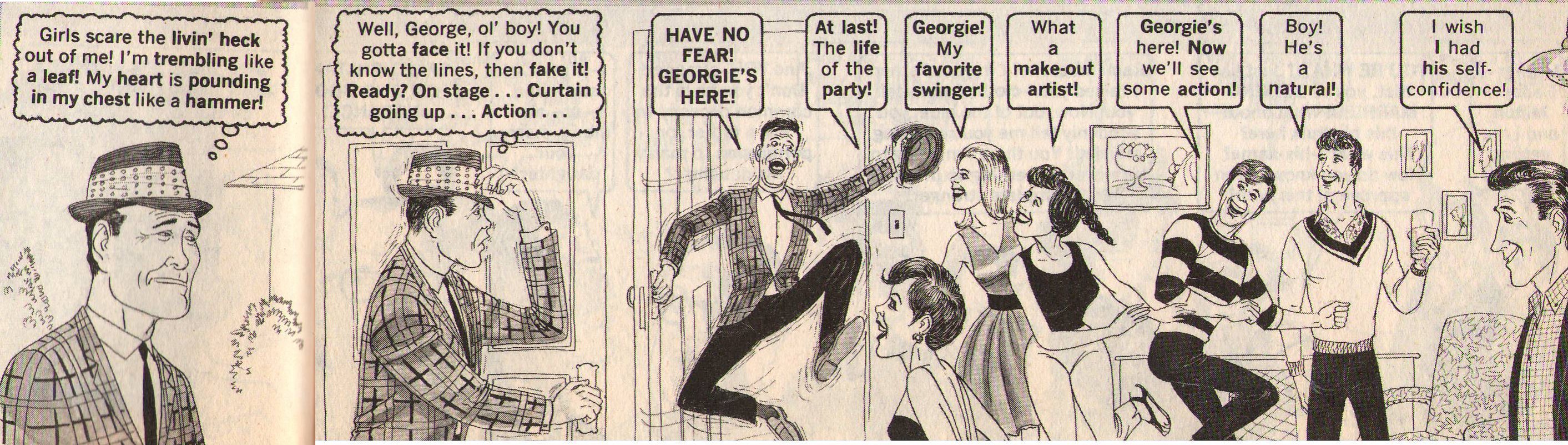
Dave Berg Georgie


A much darker, but no less accurate summation was created by Nicholas Gurewitch, the creator of the Perry Bible Fellowship:
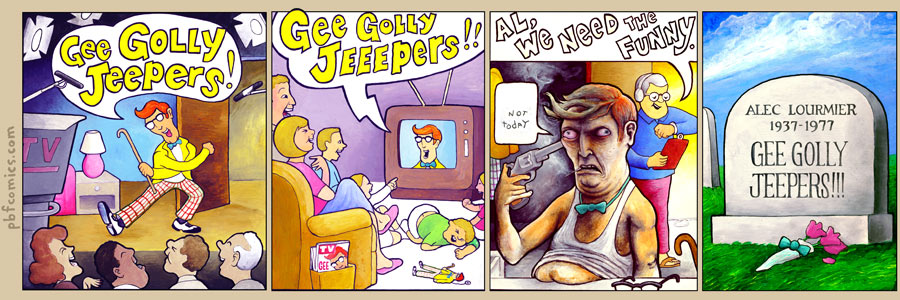
Perry Bible Fellowship - We Need the Funny


In a recent ABC News article, Dr. Rami Kaminski, a professor of psychiatry at Columbia University School of Medicine was quoted as saying, “The reason so many comedians are at risk for mental illness is because being funny is not the same thing as being happy.”  He also said he believes many comedians mine humor as a way to escape depression and anxiety.

Several articles and blogs which appeared pursuant to Williams’ death are worth reading:

The Death of Robin Williams, And What Suicide Isn’t – Elizabeth Hawksworth

Robin Williams’s death: a reminder that suicide and depression are not selfish – Dean Burnett at The Guardian

David Wong, over at Cracked.com, wrote a savagely honest article about the relationship between comedy and internal suffering (he’s a humorist himself, and  speaks from experience, although this is obviously only one scenario, and doesn’t apply to all cases):

  1. At an early age, you start hating yourself. Often it’s because you were abused, or just grew up in a broken home, or were rejected socially, or maybe you were just weird or fat or … whatever. You’re not like the other kids, the other kids don’t seem to like you, and you can usually detect that by age 5 or so.
  2. At some point, usually at a very young age, you did something that got a laugh from the room. You made a joke or fell down or farted, and you realized for the first time that you could get a positive reaction that way. Not genuine love or affection, mind you, just a reaction — one that is a step up from hatred and a thousand steps up from invisibility. One you could control.
  3. You soon learned that being funny builds a perfect, impenetrable wall around you — a buffer that keeps anyone from getting too close and realizing how much you suck. The more you hate yourself, the stronger you need to make the barrier and the further you have to push people away. In other words, the better you have to be at comedy.
  4. In your formative years, you wind up creating a second, false you — a clown that can go out and represent you, outside the barrier. The clown is always joking, always “on,” always drawing all of the attention in order to prevent anyone from poking away at the barrier and finding the real person behind it. The clown is the life of the party, the classroom joker, the guy up on stage — as different from the “real” you as possible. Again, the goal is to create distance.

You do it because if people hate the clown, who cares? That’s not the real you. So you’re protected.

The full article is rather coarse so I don’t quote most of it here, but if you’re not offended by such things, you can visit the source.

For me, the takeaway from all of this is that much more needs to be done in the area of treating mental illness. When people get sick, they visit a doctor without hesitation. But let a person suffer from depression, and it’s usually hidden away in the closet and discussed in hushed whispers using euphemisms like “chemical imbalance.” Those who suffer usually manage to function in society, but are rarely free of judgment; most often heard from others who have no clue are things like “happiness is a choice, just snap out of it.” This and about 100 other platitudes, things that are never helpful to say to someone with depression, can be found at PsychCentral.

The other important point is that there is nothing that you can do for a friend or loved one who suffers from the blackness. Depression is still poorly understood, and there is no “cure.” The same source above provides a list of things that can be done, but this list – while accurate – is highly clinical and omits the two most important things you can do: Love and accept. People with depression need a community of friends who can provide support and acceptance without judgment. Even this won’t make the blackness go away, but it’s the best thing friends and family can offer.

In conclusion, two beautiful tributes to the life of Robin Williams:

Patch Adams: ‘Thank You for All You’ve Given This World Robin, Thank You My Friend’

The Old Wolf has spoken.

Comcast: they’re as evil as you thought they were

75804

Recently a sound file has gone viral, in which a Comcast customer “service” rep brutally disallows a customer from disconnecting his service. It’s painful to listen to.

In the wake of this event, a redditor who used to work for Comcast explained pretty clearly why agents have a financial incentive to do this, and why Comcast has such a deservedly bad reputation. Read the post and judge for yourself:

edit: I think this thread (the OP) got removed/deleted from /r/television[1] … interesting.

I’ve been an employee of Comcast for almost the last 9 years, as an SBA in BI, NE&TO, Customer Service and Marketing. I worked for Comcast Corporate (meaning the headquarters in Philly) so I dealt with all of our divisions and regions for the US, because of my position I was frequently in budget/planning meetings and was handling data for subscribers for the same, I’ve seen down to the penny the monthly earnings for years, I know how much goes to tax, how much is pure profit, I know what the total payroll cost for the company is, etc – I wasn’t a high level executive or anything, I’m a data analyst, I analyze [things]. I left the company a few months ago, so I’m not really worried about saying anything here (I also never signed anything requiring me not to disclose anything I’ve said or am about to say.)

When you call into the IVR (the 1800 comcast that makes that annoying clicking noise) and you answer the prompts (1 for cable tv, 2 for high speed internet, etc and then 1 for new service or 2 for a problem etc etc) you get routed to a specific department.

When you call in to disconnect, you get routed to the Retention department, their job is to try to keep you. The guy on the phone is a Retention Specialist (which is just a Customer Account Executive who takes primarily calls from people disconnecting their service.)

If I was reviewing this guys calls I’d agree that this is an example of going a little too hard at it, but here’s the deal (and this is not saying they’re doing the right thing, this is just how it works). First of all these guys have a low hourly rate. In the states I’ve worked in they start at about 10.50-12$/hr. The actual money that they make comes from their metrics for the month which depends on the department they’re in. In sales this is obvious, the more sales you make the better you do.

In retention, the more products you save per customer the better you do, and the more products you disconect the worst you do (if a customer with a triple play disconnects, you get hit as losing every one of those lines of business, not just losing one customer.) These guys fight tooth and nail to keep every customer because if they don’t meet their numbers they don’t get paid.

Comcast uses “gates” for their incentive pays, which means that if you fall below a certain threshold (which tend to be stretch goals in the first place) then instead of getting a reduced amount, you get 0$. Let’s say that if you retain 85% of your customers or more (this means 85% of the lines of businesses that customers have when they talk to you, they still have after they talk to you), you get 100% of your payout – which might be 5-10$ per line of business. At 80% you might only get 75% of your payout, and at 75% you get nothing.

The CAEs (customer service reps) watch these numbers daily, and will fight tooth and nail to stay above the “I get nothing” number. This guy went too far, you’re not supposed to flat out argue with them. But comcast literally provides an incentive for this kind of behavior. It’s the same reason peoples bills are always fucked up, people stuffing them with things they don’t need or in some cases don’t even agree to.

Comcast wasn’t always that bad, I watched the steady decline over the years I was there – and the attitude that is pervasive in customer service flowed over into the other departments like a cancer. There is a giant propaganda machine at Comcast focused on the employees, they send out emails and brochures and have the bigwigs come in to talk about things like why net neutrality is bad and encourage the company (via emails to every employee) to speak out against it.

I left because the culture there is disgusting, there is nothing redeemable about the behavior, and it’s just headed in a worse direction. The people who try to advocate for customers are liquidated.

I say it as a loyal Comcast employee for almost a decade, if you have Comcast – get out now, you’re just wasting your money. They’re going to increase your bill 3-5% twice a year, it’s part of the annual budgeting process even though our costs actually go down. The internet business (as in, high speed customers) is almost purely profit, and it’s turned down on purpose like everyone here already knows. Comcast has DOCSIS 3 capabilities and the infrastructure to support it in most major areas (this means gigabit speeds, by the way) – it can be activated simply by pushing the proper bootfiles out to the modems. This can be evidenced anywhere they have competition, they can respond overnight.

If there’s not a serious change in legislation or regulation, I don’t see a light at the end of the tunnel.

(take this with a grain of salt, I’m not going to post anything personally identifiable, if you don’t believe me – you don’t have to. edit: Not that it’s really proof, but here’s a post[2] a year ago where I respond specifically mentioning that I’m a Comcast employee (at the time) )

edit: adding a TL;DR

TL;DR – Comcast provides heavy incentives for this kind of behavior, it’s been on a steady trend heavily towards this for years, the entire corporate culture is toxic and there is a pervasive ‘us against them’ attitude. Also the profit margin is insanely big. You shouldn’t do business with Comcast.

Of course, Comcast is publicly apologetic, but one would expect no different.

This is pretty scary. /u/txmadison’s comment about regular billing increases is spot-on; I’ve been a Comcast customer for over 15 years, and my bill has more than doubled since I first signed up. I also need to check my bill carefully to see if they’re stuffing spurious charges on there. I definitely need to make a change, but my disincentives are two:

  1. My area has limited options; 20 miles to the north, Google Fiber is doing big business, but not in my town *weeps bitterly
  2. I’m not that excited to change my email address, which I’ve had for over 15 years.

That said, I think the time has come. I don’t like the idea of being systematically abused by a corporation that has so little regard for its customers.

The Old Wolf has spoken.

It’s groovy, man, groovy…

englishiscrazy

Edit: Corrected attribution. Not sure where the “R. Bell” came from.

I just read an article over at the Spectrum entitled “The English language is state of in demise” (sic) in which writer Dan Murphy laments the abysmal condition of our language among modern speakers, largely thanks to the ubiquitous text/chat/Twitter/Facebook phenomenon. As to the headline itself, I don’t know if that’s just a terribly ironic typo or whether I’m missing something.

Regardless (or irregardless, depending on which side of that argument you happen to fall), the article reminded me of this little piece; the terminology is more at home in a beatnik coffee shop and has largely ceased to have meaning in the 21st century, but you will find it familiar enough to get the drift. I thought it was worth sharing.

Psychedelirium Tremens

By Jane Goodsell, printed in the April 18, 1969 Congressional Record

Remember when HIPPIE meant big in the hips
And a TRIP involved travel, in cars , planes and ships?
When POT was a vessel for cooking things in
And HOOKED was what grandmother’s rug might have been?
When FIX was a verb that meant mend or repair
And BE IN meant simply existing somewhere?
When NEAT meant well-organised, tidy and clean
And GRASS was a ground cover, normally green
When lights and not people were TURNED ON and off
And the PILL might have been what you took for a cough!
And CAMP meant to quarter out-doors in a tent
And POP was the way that the weasel went?
When GROOVY meant furrowed with channels and hollows,
And BIRDS were winged creatures like FINCHES and SWALLOWS?
When FUZZ was a substance that’s fluffy like lint,
And BREAD came from bakeries, not from the mint?
When SQUARE meant a 90-degree angled form
And COOL was a temperature not quite so warm?
When ROLL meant a bun, and ROCK was a stone,
And HANG_UP as something you did to the phone?
When FUZZ was a substance that’s fluffy like lint,
And BREAD came from bakeries, not from the mint?
When SQUARE meant a 90-degree angled form
And COOL was a temperature not quite so warm?
When ROLL meant a bun, and ROCK was a stone,
And HANG_UP was something you did to a phone?
When JAM was conserves that you spread on your bread
And CRAZY meant barmy, not right in the head?
When CAT was a feline – a kitten grownup
And TEA was a liquid you drank from a cup?
When SWINGER was someone who swung in a swing
And PAD was a soft sort of cushiony thing?
When WAY OUT meant distant and far, far away?
And a man couldn’t sue you for calling him GAY
When DIG meant to shovel and spade in the dirt
And PUT-ON was something you did with a shirt?
When TOUGH described meat too unyielding to chew
And MAKING A SCENE was a rude thing to do?
Words once so sensible, sober and serious
Are making the FREAK SCENE quite PSYCHEDELIIOUS
It’s GROOVY MAN GROOVY But English it’s not
Me thinks that our language has gone straight to POT….

For those of you born long, long after Haight-Ashbury was the scene, a couple of glosses:

Hang-up: problem, neurosis
Crazy: awesome
Tea: weed
Pad: your home, where you crash
Way out: awesome (or, if you’re from Boston, “wicked pissah”)
Birds: girls
Fuzz: The police
Dig: understand[1]

The Old Wolf hath goodly spoke.


[1] It has been suggested that “Do you dig it” has a connection to the Gaelic “An dtuigeann tu” (do you understand), which on the other side of the pond morphed into “do you twig it?”

Thanks for the compliment. Not

Comment posted in my blog a few days ago:

Hiya very nice web site!! Man .. Beautiful .. Wonderful .. I’ll bookmark your website and take the feeds also? I’m satisfied to search out so many useful information right here in the put up, we need develop extra strategies on this regard, thank you for sharing. . . . . .

Who the hqiz writes these blog spam comments? They all sound like they were crafted by schoolchildren from Kazakhstan. And the links in those comments? They invariably ead to an entire linked community of scammy, scummy, spammy, and R-rated (to attract more attention) websites promoting various and sundry snake-oil weight loss products, cheap knockoff goods, pornography, or any number of other unsavory enterprises. Here’s another one:

After I originally left a comment I appear to have clicked the -Notify me when new comments are added- checkbox  and from now on every time a comment is added I recieve 4 emails with the same comment. Perhaps there is a way you can remove me from that service? Thanks!

Seriously, people (and I use that term very loosely), can’t you think of a better way to make a living than spamming other people’s blogs for links to your barely-legal enterprise? I enjoy sending your comments to the trash.

commentspam-399x400

The Old Wolf has spoken.

The 5-Cent Restaurants

5-cent

Found at /r/historyporn, posted by /u/onlysame1

A wonderful explanation and sources were provided by /u/my_interests:

tl;dr: This wasn’t just an ordinary restaurant, it was was part of a charity to provide the poor and unemployed with hot meals. The meals were subsidized by the donations to the charity. They served many thousands of meals per day.

The People’s Restaurants were conceived of and operated by a charitable organization[1], the Industrial Christian Alliance, in 1893 to help feed the poor and the unemployed. J.P. Morgan[2] himself sat on the Board of Directors of the organization.

To eat at a Five-Cent restaurant, one needed a nickel or a meal ticket, which could be provided for free[3] (PDF), or purchased at People’s Restaurant headquarters (100 tickets for $5) often purchased by good Samaritans and churches to give away to the less fortunate. The restaurants had a capacity to serve 1,000 – 2,000 meals per day and were open from 7am to midnight.

The Peoples Restaurant started with a single lodging house and restaurant at 170 Bleeker Street[4] (which is now a Mexican restaurant[5]) and expanded eventually joining with other organizations[6] such as the Merchants’ General Committee to help grow and open additional restaurants and grocery stores.

By December 1894 they had grown and had the capacity to provide 25,000 meals per day[7]  According to this New York Times article[8] (PDF) from January 26, 1894 on average the restaurant was serving 1,000 – 1,300 meals per day and increasing.

Though they did much good, it wasn’t without controversy[9]. The 5-cent restaurants were popular and received a lot of press coverage. Other charities claimed that people from outside of New York City, hearing about how well the poor are taken care of, began to come to New York City to live.

According to this source[10], in total nine People’s Five-Cent Restaurants were opened in various parts of New York City, though these were the only confirmed addresses I could find.

Sources[14] 

These restaurants remind me of the Viennese W.O.K establishments, about which I have written previously.
The Old Wolf has Spoken.


You don’t need people’s opinions on fact.

On May 6th, the government released the National Climate Assessment, 1250 pages long and authored by over 250 people.

iceberg

What kinds of people? Government-paid alarmists and corrupt scientists, right? A secret cabal of people who are raising a false alarm to discredit… well, you’ve heard all the counter-arguments, not one of which is worth the powder to blow it to Hell with.

Let’s look at some of what went in to this report: [1]

  • Users and stakeholders were engaged from the very beginning. Everybody could contribute: NGOs, farmer, industry, Native American nations. Many thousands of people consider this as their personal report and have embraced it.
  • The team included former Bush White House officials with climate science expertise who also functioned as lead authors.
  • There were reps from the petroleum and mining industries, economists, agronomists, fisheries experts, and city planners. There were experts that dealt first-hand with the aftermaths of Katrina and Sandy and the droughts and fires and power shortages and the spread of disease in the West.
  • Notice of every meeting was pre-published in the Federal Register, and anyone, any citizen or group at all, was welcomed to come and comment.
  • There was a several-month open review, during which anyone was welcomed to raise concerns or criticisms, and comments were abundant.
  • The report was reviewed by the National Academy of Sciences, which is firmly non-partisan.
  • Comments from all of these sources were incorporated to make the report better.
  • There was a public, traceable account for every key finding, so that anyone can look back and see how the finding was arrived at, what the studies were that it was based on, and, it is even possible to follow the account back to the original data for those studies.
  • The conclusions in the report represent a consensus of all of the authors and advisors.  The final vote to approve was unanimous.
  • The report is a product of not just NASA, but a consortium of 13 federal agencies called the US Global Change Research Program. NASA contributed substantially, but so did others, including NOAA/Department of Commerce, the Department of Energy, Department of the Interior, the Environmental Protection Agency, Department of Transportation, Health and Human Services, the Smithsonian, USAID, the Department of Agriculture, the National Science Foundation, the Department of Defense, and the Department of State. It was a combined effort of many, many people from both private and public sectors.

With all of these sources, with all of this transparency, with the wide diversity of contributors and opportunities for public input – not a restricted subset, but anyone could give input, I trust the results of this report implicitly. The results are incontrovertible. This is not just Al Gore grandstanding for political gain (although I think “An Inconvenient Truth” was right on the money, regardless of its underlying motivation) – this is science. And it works.

The Gallup Poll revealed that 1 in 4 Americans doubt the veracity of climate change. However, what the public thinks of established fact is irrelevant. Some people have such an overwhelming need to be right that they ignore indisputable facts. [2] But in the end, this opposition, despite how well-funded it is and for whatever reason, will fade. There may still be over 400 people in the world who believe the earth is flat, but what they believe changes nothing.
If you have any questions, visit the website. Explore it. Understand it. And do what you can to hold back the tide, even if the trend may be irreversible.
The Old Wolf has spoken.

[1] Source: A well-placed official who contributed heavily to the work involved, whom I trust implicitly.

[2] A story from a redditor, /u/RamsesThePigeon:

The year I was in third grade was one of the best and worst of my entire educational experience, and both of those extremes were because of the teacher I had. She was beloved by most of her students – the female ones especially – but had a habit of being passive-aggressive and saccharine towards more difficult pupils. She’d find (or invent) reasons to ignore difficult questions, offer vague threats about impending punishments, or make small efforts to turn classmates against one another. She was not an especially likeable educator, and she became a truly reprehensible one when she insisted that Jupiter was bigger than the sun.

At first, it seemed like a misunderstanding. Our class had just entered into an astronomy unit, and one of our activities was to construct a scale model of the solar system. The reference image we used came from a picture book, and in it, the sun had been reduced in size. The teacher had not noticed this fact, and was therefore operating under the mistaken assumption that Jupiter was our largest celestial neighbor.

Well, I knew better, and I tried to correct her. She replied to me with a tone of aloof dismissal, stating quite clearly that I was wrong. “That’s okay, though,” she said. “After all, you’re in school to learn new things.” Then she smiled sweetly, and I returned to my seat feeling thoroughly confused and frustrated. In the weeks that followed, I engaged in an all-out war against my teacher’s pseudo-science. My father, having heard everything from me, sent me to school with one of his college textbooks, hoping to turn the tide of the battle. My teacher refused to even look at it. “Class,” she said, rolling her eyes, “who can tell Max what the biggest object in the solar system is?”

My face was burning with anger and shame as every other student shouted “JUPITER!”

Things only escalated from there. I refused to back down, despite having been labeled as the class dunce. Each time the topic came up, I tried to offer my evidence… and each time, I was steadfastly opposed by everyone within earshot. Finally, after over a month of torment, our astronomy unit culminated in a field trip to the local planetarium. The show was a breathtaking adventure through our galaxy and the universe beyond, and it left me feeling infinitesimally small… yet strangely empowered. As the lights came up, our guide to the cosmos asked if there were any questions.

“Which is bigger,” I shouted, jumping to my feet, “Jupiter or the sun?!” My entire class sighed in frustration, my teacher barked at me to sit down, and the astronomer looked thoroughly confused.

“The sun, of course,” he scoffed.

A hush fell over the room. After a moment of utter silence, a girl named Melissa spoke up in a condescending tone. “Well, sir, we have a chart that says Jupiter is bigger.” The astronomer looked at her. He looked at my teacher. Then he looked at me with an expression of sympathy.

“Little girl,” he said, returning his attention to Melissa, “if you look at the picture again, you’ll see that the sun is being shown at a fraction of its actual size. Otherwise, it wouldn’t fit on the page.” His gaze moved to his next victim, who had slumped down in her chair so as to be almost as small as her students. “Your teacher should have told you that.”

Upon returning to our classroom, all the students crowded around our reference book. Sure enough, a tiny block of text explained that the sun had been scaled down in the illustration. I declared my triumph, having finally been vindicated. Nobody apologized, my teacher found new reasons to punish me, and I was treated with no small amount of scorn, but I didn’t care. From that day forward, I knew to never be afraid of asking questions, nor of standing up for facts in favor of fiction.

From that day forward – at least until it was taken away – I proudly wore my homemade dunce cap with a smug grin.

This was a teacher. Someone who should have known this bit of close-to-home science knowledge as surely as she knew 2 gozinta 4 two times. But somehow she was ignorant of this fact and clung to it tenaciously, at the expense of humiliating a dissenting student and indoctrinating an entire class with a blatant falsehood.


Ripley’s Believe It or Not – Phineas Gage

I have always loved Robert Ripley. As time has gone on, the stories he has reported have been expanded upon and documented; some have proven to be misunderstandings, but very rarely if ever was anything shown to be an outright fraud. The case of Phineas Gage is well-documented; here a comparison of what Ripley reported and information available on the Internet today.

Gage


From Ripley’s Believe It or Not, Two Volumes in One, Simon and Schuster, 1934

The American Crow-Bar Case

Phineas P. Gage, aged twenty-five, a foreman on the Rutland and Burlington Railroad, was employed September 13, 1847, in charging a hole with powder preparatory to blasting. A premature explosion drove a tamping-iron, three feet seven inches long, 1 1/4 inches in diameter, weighing 13 1/4 pounds, completely through the man’s head.

Despite this terrible injury young Gage did not even lose consciousness. he made a complete recovery and lived many years afterward.

The crow-bar entered the left side of the face, immediately anterior to the inferior maxillary and passed under the zygomatic arch, fracturing portions of the sphenoid bone and the floor of the left orbit. It then passed through the the left anterior lobe of the cerebrum, and in the median line, made its exit at the junction of the coronal and saggital structures, lacerating the longitudinal sinus, fracturing the parietal and frontal bones and breaking up considerable of the brain. The patient was thrown backward and gave a few convulsive movements of the extremities. He was taken to a hotel almost a mile distant. During the transportation he seemed slightly dazed, but not at all unconscious. Upon arriving at the hotel he dismounted from the conveyance, and without assistance walked up a long flight of stairs to the hall where his wound was to be dressed.

Dr. Harlow saw him at about six o’clock in the evening, and from his condition could hardly credit the story of his injury, although his person and his bed were drenched with blood. His scalp was shaved and coagula and debris removed. Among other portions of bone was a piece of the anterior superior angle of each parietal bone and a semicircular piece of the frontal bone, leaving an opening 3 1/2 inches in diameter. At 10 P.M. on the day of the injury Gage was perfectly rational and asked about his work and after his friends. His convalescence was rapid and uneventful.

Professor Bigelow examined the patient three years later, and made a most exceelent report of the case, which had attained world-wide notoriety. Bigelow found the patient quite recovered in his faculties of body and mind, except that he had lost the sight of the injured eye.

The original crow-bar, together with a cast of the patient’s head, was placed in the Museum of the Harvard Medical School, Brookline, Mass., where it is still on exhibition. Ref.:Boston Medical and Surgical Record (1848).

This particular entry fascinated me as a child. Now, of course, we know more: instead of making a complete recovery, Gage’s personality changed; he became “erratic, irritable, and profane,” his friends called him “no longer Gage,” and he died of seizures around 12 years after the accident. Two very interesting and in-depth accounts of Gage and his injury can be read at Slate.com and Interiorpassage.com, and the Wikipedia article is detailed and impartial. While some of the reported facts about Gage and his injury have been distorted over time, the fact remains that he survived an astonishingly devastating brain injury by 12 years and his accident provided medical science with an opportunity to study the relationship between brain trauma and personality change.

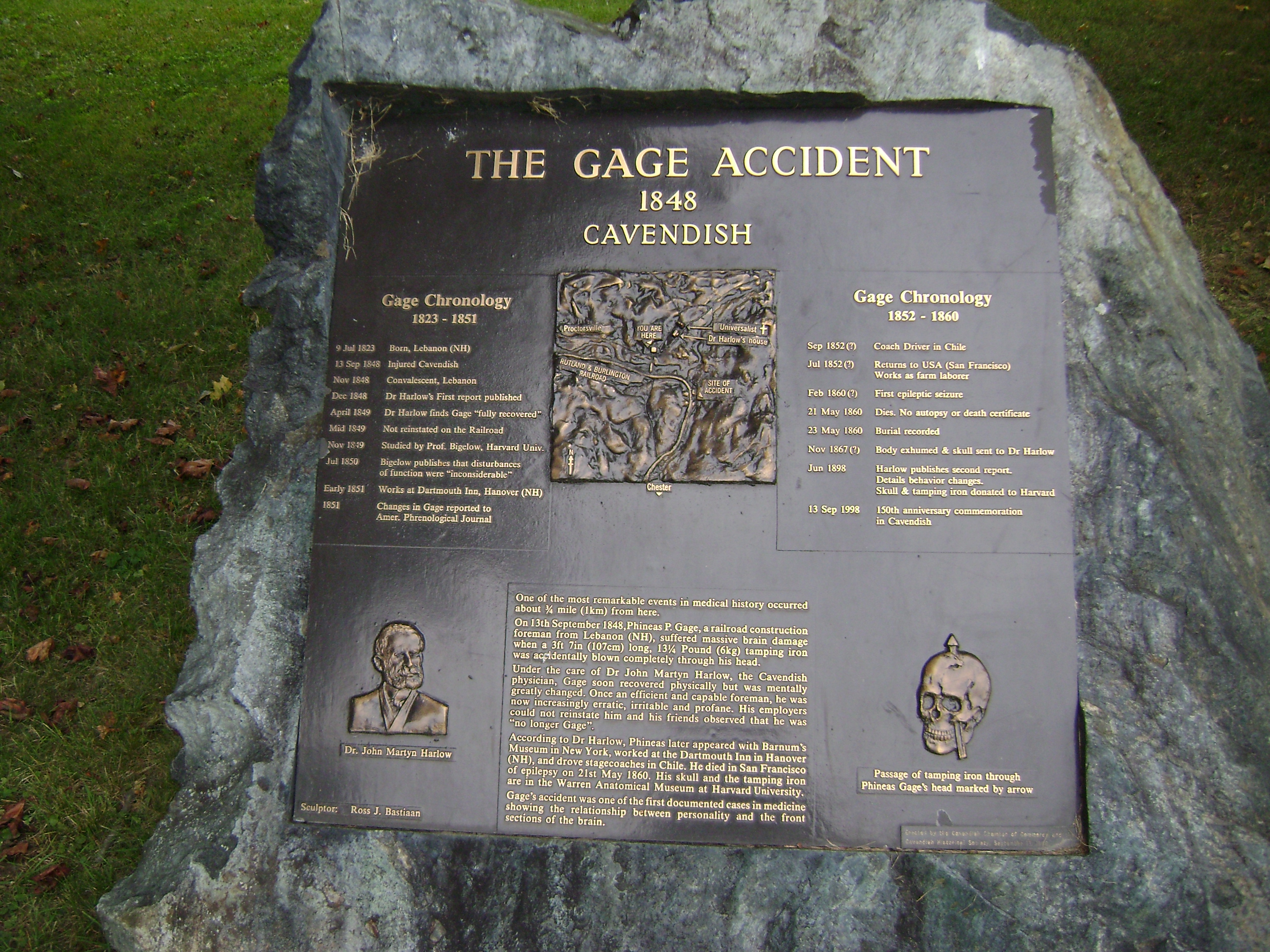
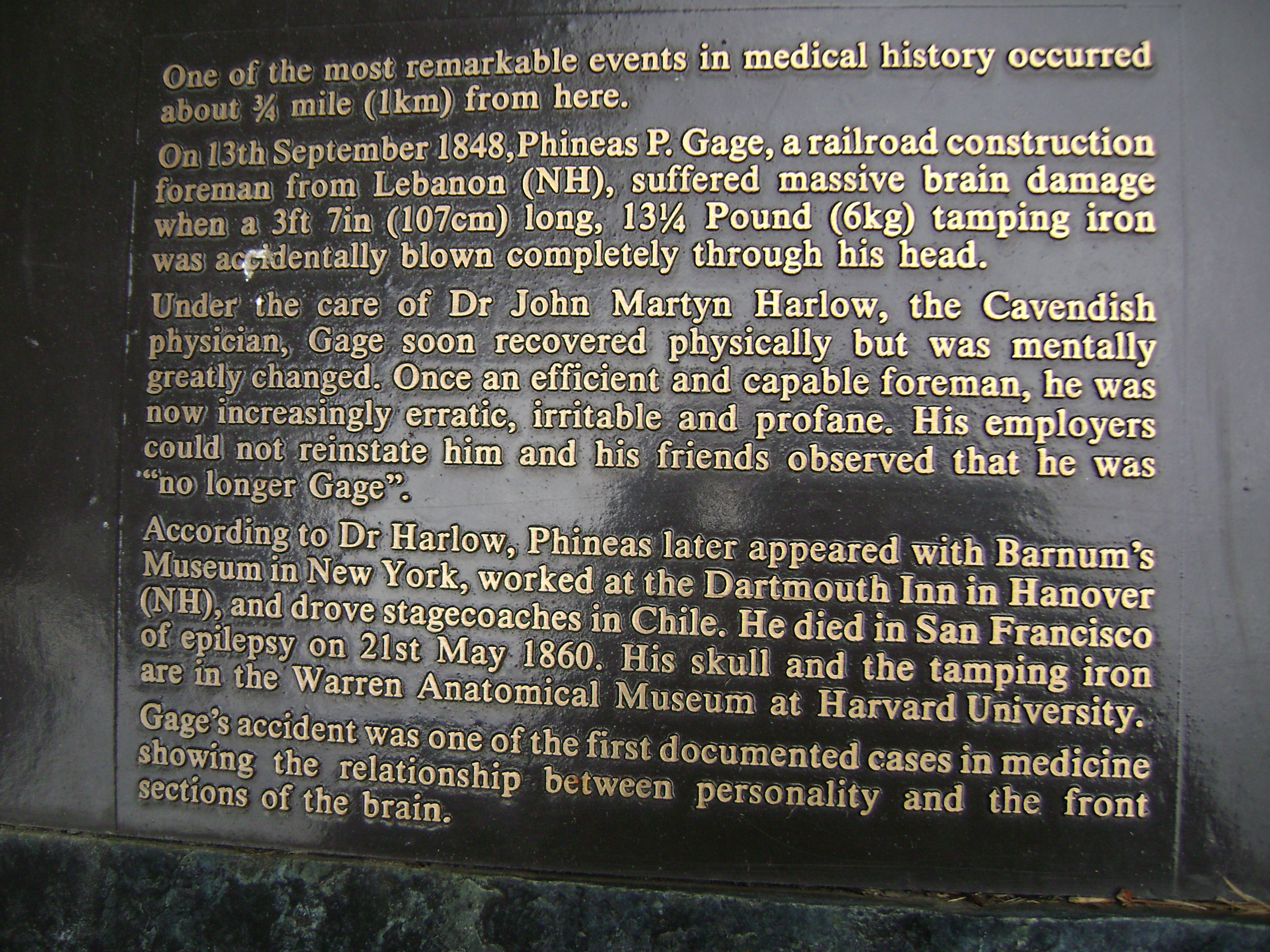
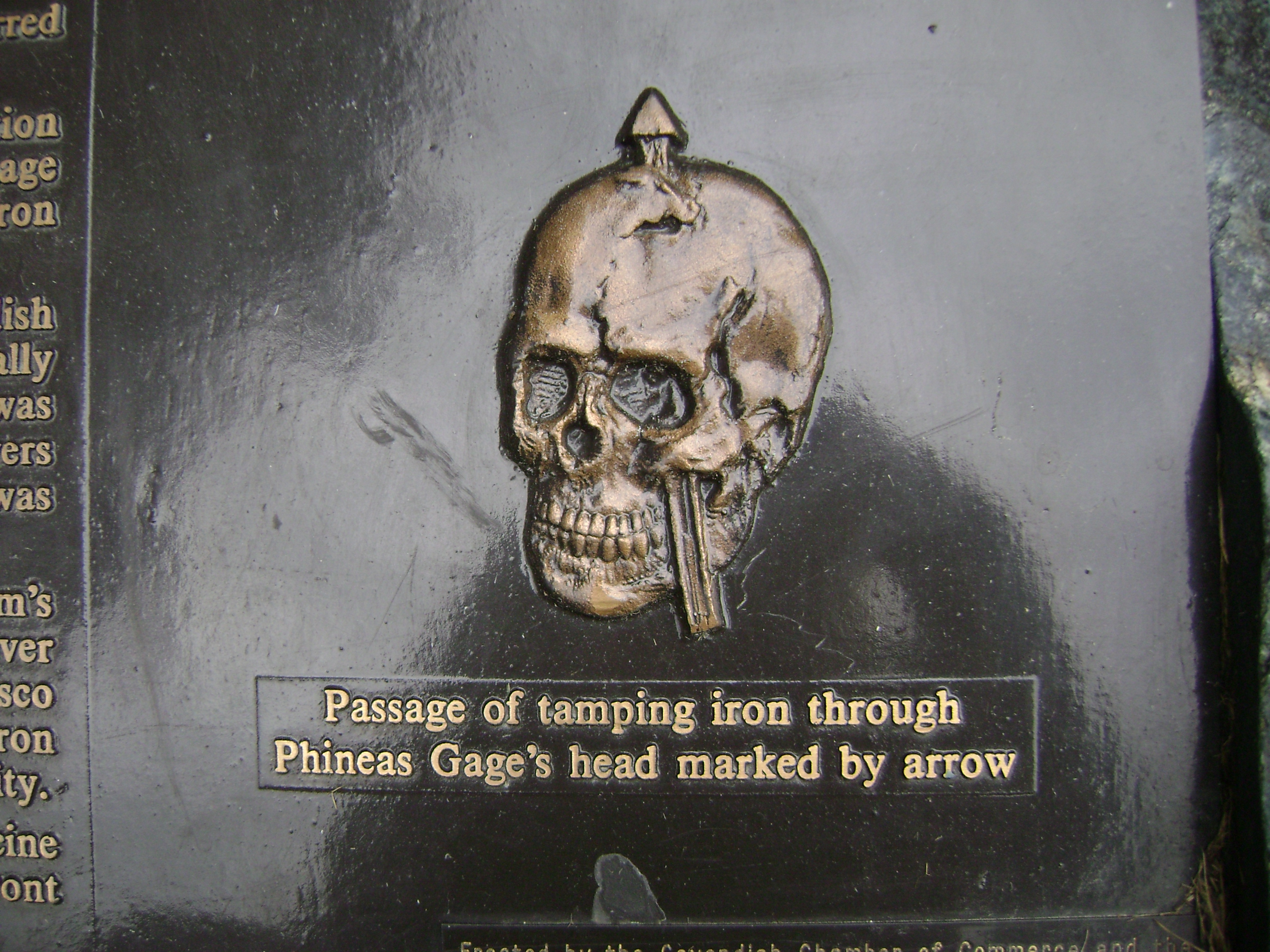
As related in the article at interiorpassage, there is a monument to Gage’s accident at Cavendish, Vermont – the following images (mercilessly ripped from the original article) are revelatory:

DSC01279

DSC01286

DSC012781

Here is an intriguing video about Gage’s experience:

Once again, the Internet provides more information than was available almost 100 years ago; the more time passes, the more accurate such historical accounts become. Ripley did his best, but was limited by what was available in his time. There are still some amazing wonders and curiosities to be found in his books and musea around the country.

The Old Wolf has spoken.

Movie Review: Monuments Men

I had heard good things about this film from some people I trust, so today the Bean an Tí and I went to see it. Remember that Rotten Tomatoes accorded it only 33% fresh, which is a pretty abysmal rating.

You know what? To Pluto1 with the critics. To Pluto2 with anyone who was paying more attention to the fine details of cinematography. And to Pluto3 with anyone who thought this film stunk. It was wonderful.

I loved the cast; they were wonderful together. I loved the story; it was uplifting and inspiring despite the transitory sadness. And it reconfirmed in my mind that the incalculable evil and darkness that the National Socialists represented encompassed every aspect of their lives; to them, nothing human, nothing of beauty, nothing of decency had any value in their sick and twisted ideology – and they were most definitely worth sacrificing to defeat.

Was this film superb in every way? No, parts of it were pretty vanilla – but it worked well to get its message across, and I’m well-pleased that I saw it.

Rating: 8Stars 8 Stars out of 10.


1. Still a planet.
2. Always was, always will be.
3.

Nine Planets Thumb

First Contact

Back before December 2010, there were comment pages attached to Brooke McEldowney’s “9 Chickweed Lane” and “Pibgorn” webcomics. Over the course of several years, a lively and thriving community sprang up on these discussion boards known unofficially as the Couch of Confusion, or the Order of the Couch (mostly because Brooke’s story lines could get quite convoluted before their final resolution.) There were over 100 of us, and between 2008 and the present I have met a dozen or so in person as I traveled around the country on various trips. They were most pleasant encounters. [1]

On May 13 of 2009, I posted at my Livejournal that I was taking a road trip from Utah to New York, then to Portland, Maine, and finally to West Virginia, where some friends of mine had engaged me (begged, pleaded and whined bitterly is more like it) to care for their 180-acre sheep ranch while they took a belated honeymoon to Hawaiʻi. I mentioned that I looked forward to meeting with anyone who happened to be close to my route, as I had done before.

A lovely lady named ToniAnne, whose posts I had long enjoyed – she was witty, clever, well-informed and had good ideas and sound opinions – wrote the following:

(Anonymous)
May. 13th, 2009 06:41 pm (local)
Don’t be a stranger… just be strange!
Hi!
I see that Gap Mills, WV is 132 miles south mostly of where I am in Harrisonburg,VA if you will be driving anywhere near where I am I’d enjoy meeting you in RL.
I used to live up the road a piece from Port up in Auburn. Have you ever had a Needham a Maine candy special. I think you’ve heard of Moxie.
Drop me a line at [email redacted] I am in Florida at the moment but will be returning late on the 15th..from Richmond on 64 then 81.
or call after the 15th- [phone redacted]
I’d cook you a meal but I don’t have the ingredients for haggis.. it would have to be something more mundane.
Have a good and safe trip.
ToniAnne

Well, stop I did, and we had a wonderful visit. There’s a lot more to tell, but long story short: in May we will be celebrating our fourth anniversary. I just happened to cross this first one-on-one communication, and was pleased that it had been archived. Brooke’s forum was the vehicle for our crossing paths, but our first meeting was all her fault… and I’m eternally grateful she piped up.

The Old Wolf has spoken.

———————-

[1] Unfortunately and incomprehensibly, McEldowney’s work attracted an infestation of internet trolls who delighted in spewing, as Twain would say it, “the ignorantest words” and pictures; despite noble efforts by GoComics, Brooke requested that the comment features on his comics be disabled. Unfortunately, the disabling happened before any word of explanation could be offered, and a number of people were grossly offended by Brooke’s “disrespect” for his readers, which of course wasn’t the case at all, but the upshot was that our little community lost much of its cohesiveness, although it continues elsewhere in a much reduced form. To everything there is a time and a season, and while it lasted, this was a wonderful one.

TV: It’s all smoke and mirrors

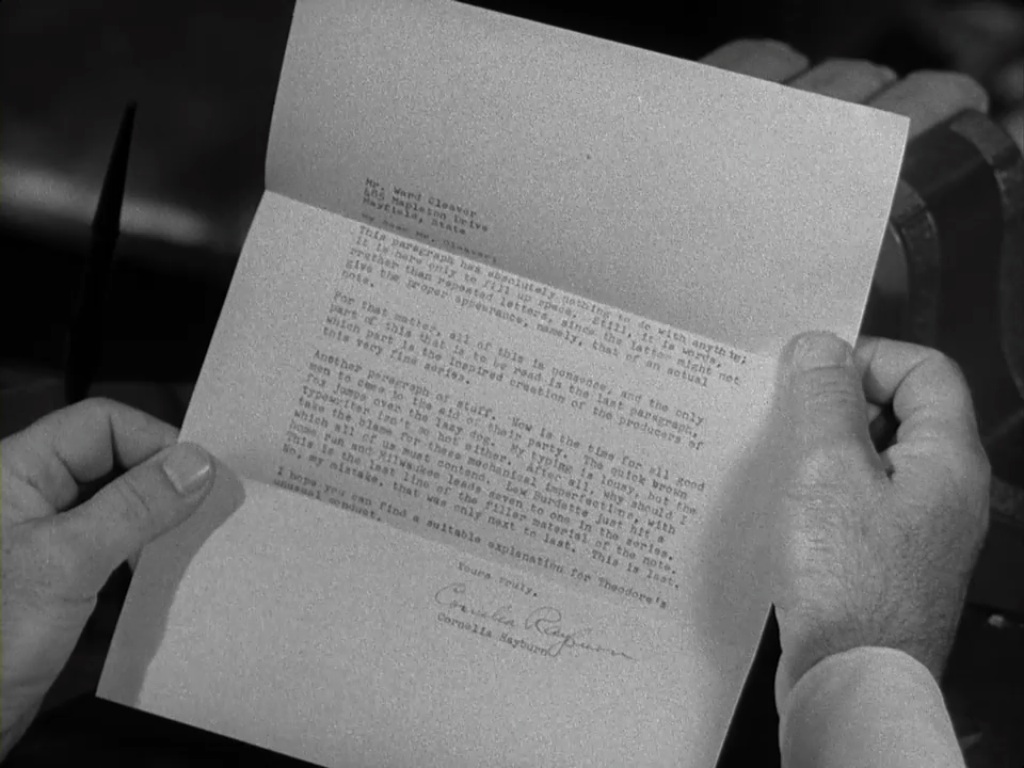
A humorous item from the past: If you’ve ever wondered what’s actually on a letter or document that someone in a TV show is reading, here’s a good example from “Leave it to Beaver” (Season 2: Episode 6 “Her Idol,” at time stamp 18:35)

Beaver Letter

Mr. Ward Cleaver
435 Mapleton Drive
Mayfield, State

My Dear Mr. Cleaver,

This paragraph has absolutely nothing to do with anything; it is here only to fill up space. Still, it is words, rather than repeated letters, since the letter might not give the proper appearance, namely, that of an actual note.

For that matter, all of this is nonsense, and the only part of this that is to be read is the last paragraph, which part is the inspired creation of the producers of this very fine series.

Another paragraph of stuff. Now is the time for all good men to come to the aid of their party. The quick brown fox jumps over the lazy dog. My typing is lousy, but the typewriter isn’t hot either. After all, why should I take the blame for these mechinal imperfections, with which all of us must contend. Lew Burdette just hit a home run and Milwaukee leads seven to one in the series. This is the last line of the filler material of the note. Oh, my mistake, that was only next to last. This is last.

I hope you can find a suitable explanation for Theodore’s unusual conduct.

Yours truly,
Cornelia Rayburn

Ja ja, so ist das Theater, mein Lieber. Nichts als Illusion.

The Old Wolf has spoken.