
Early suburb of Chicago, looking due east up West Arthur Avenue toward North Clark in the Rogers Park neighborhood.
Early suburb of Chicago, looking due east up West Arthur Avenue toward North Clark in the Rogers Park neighborhood.
Eve’s Wireless, from the Pathe Vaults.
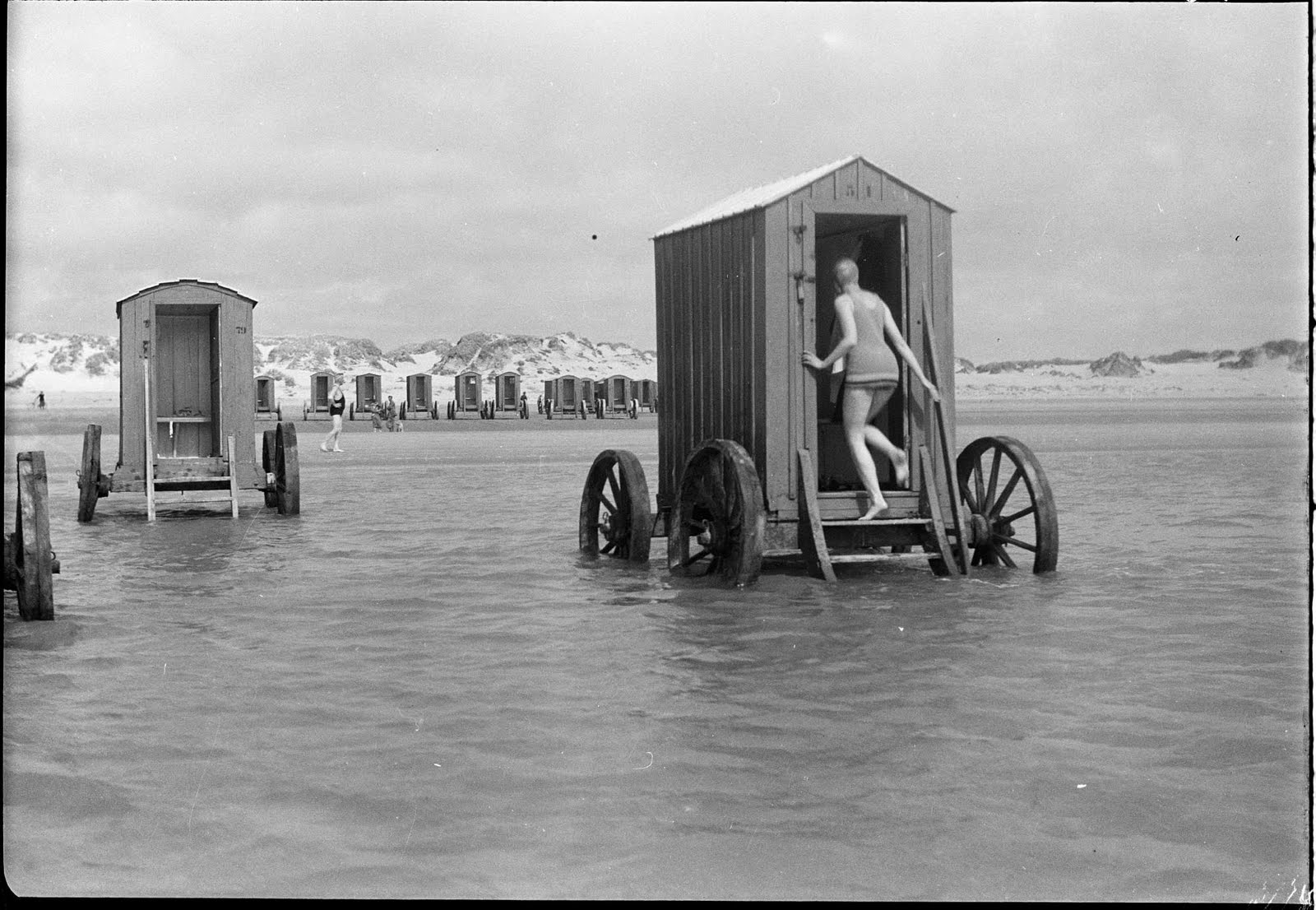
A Bathing Cart was a wooden locker room on two or four wheels that was pulled into the water. In the 18th and 19th centuries it offered women an opportunity to swim in the ocean unseen, in a morally proper manner. At that time it was considered indecent and offensive for a woman to bathe within sight of men, even though the then-common swimwear covered a lot more than it does today.
I have to admit I rarely go swimming any more.

Women bathing in burqas in Aqaba, Jordan.
While the modesty of centuries past seems rather more in line with what is common in parts of the Middle East today, I have searched the thesaurus in vain for words to charitably describe what passes for bathing attire nowadays; expensive dental floss is what comes to mind.
Somewhere there has to be a happy medium between extremist prudishness and a beach party sponsored by Cosmo. Sadly, my opinion will have scant effect on the trends of the world, and I’m almost glad I won’t be around to see what fashions look like (or don’t) in 50 years.
The Old Wolf has spoken.
A visit to the Ripley museum in St. Augustine, Florida, got the wheels turning a bit, and when I saw this article in the Wall Street Journal, I wanted to get a few thoughts down before they… squirrel!
Where was I? Oh, yeah. When I was a kid, I loved the Believe it or Not books. I remember poring over them with intense fascination… sort of like I would do today with Wikipedia or TVTropes (be warned, that’s a timesink!) Ripley was a source of the odd, the incredible, and the fascinating.

The largest Erector Set structure: a scale model Ferris wheel, two stories tall.
Ripley’s odditoria are full of intriguing things, and I enjoyed the visit to the one in St. Augustine, but it struck me that what passed for odd back in the day now seems a bit banal. With access to modern media and the shrinking of the world with speedy and effortless travel, the average American has probably become somewhat jaded; add to that the fact that as time passes, some of Ripley’s oddities (like the Iron Maiden, for example) have been called into question regarding their historical authenticity.
Ripley was a showman, but in my experience he never tried to deceive. Everything he reported on was legitimate, at least as he understood it in his day. And his daily cartoons must have been a source of wonder and amazement for people like Ma and Pa Ripley, living in their rattletrap cabin on the windswept Iowa plain (borrowing a riff from Hamlin Garland, here); folks who never got more than 100 miles from their farm in all their lives would scratch their heads in consternation at the thought of a Chinese guide with a candle in his head.

Small wonder that his cartoons were so popular.
Good thing they never caught sight of this gentleman:

Nowadays, 5 seconds with Google can find stuff in the real world that makes most of Ripley’s items seem as common as Wonder bread, and a lot of it absolutely redlines my Weird-o-Meter. But I still enjoy going through my old Believe it or Not books – it’s not hard to recapture the sense of wonder I had as a child as I read about the strange things one could find in the world.
The Old Wolf has spoken.

A recent article over at Slate examines the phenomenon of the one-hit wonder in the art world. While Munch does not fall into this category, The Scream is doubtless his best-known work. The article continues with an analysis of why this painting, which recently sold for a record $120,000,000 at auction, has been so popular over the years. The executive summary: it continues to terrify us. “After a century of mechanization and generally advancing secularism, The Scream continues to resonate because the inner turmoil it depicts remains part of the human condition.” As to its purpose, Munch noted that “that he’d created an image for a godless age, as people struggled to understand their place in a world without divine purpose.”
Not being a student of art history, I never knew that last little bit. Yet somehow, looking at the image, it makes sense. If you believe that the universe has no underlying purpose, that humanity and all else is the result of random evolution of hydrogen atoms into order, the madness of society could indeed leave a person feeling much like the faceless symbols of fear we see in the painting. On the other hand, my experience of people of faith is that they are less apt to respond in that manner; those who look beyond themselves for answers are more apt to leave the unanswered questions to God and find peace in a conviction that in some way, shape or form the universe is in good hands despite the inherent unfairness and difficulty of life.
To be fair, I know many humanists who live lives of fulfillment, contribution and purpose, and who work to lift the human condition without falling into psychotic fugues of terror. What I’m relating here applies more to myself than anyone else – I know that if it weren’t for my faith in a divine plan of happiness, I would probably spend my time screaming like the dude on the bridge.
The Old Wolf has spoken.
Thus proclaims solemnly an article in the LA times. I laughed hard when I thought about my humanist friends frantically searching for this button on their keyboards:

It has long been known that independent thought and religious beliefs don’t blend well, but I can’t read an article like this without considering its implications, simply because I’m a person of faith who seeks truth wherever it can be found.
The vastness and complexity of our universe, from the macro to the micro scale, virtually gobsmacks me. I can’t contemplate the awesomeness of the cosmos or the incredible harmony of what happens at the subatomic level (and mind you, I’m looking at all of this from almost a layman’s perspective because I can’t do the math) without going back to my pinball days for an analogy:

At the same time, I am unable to contemplate this same vast complexity and wrap my head around the concept of hydrogen atoms evolved to consciousness, with all due respect to Carl Sagan, who I think was a worthy purveyor of humanism.
The thing is – occam’s razor notwithstanding – science doesn’t explain it all for me. As deep as we’ve gone, as far out as we’ve peered, we haven’t even begun to scratch the surface of the cosmic repository of knowledge, and there are some areas that science and faith just can’t touch. Faith won’t explain dark energy or find a Higgs Boson, and science will never quantify Beethoven, Frida Kahlo or Maya Angelou.
We get into trouble when we try to look at the universe in terms of either/or, when we have the option of seeing it as both/and. Doing the former gets us into trouble on both sides of the fence.

The error on the right neglects to account for things which have been proven beyond all reasonable doubt; the error on the left (which is only implied,) is for scientists to insist that the absence of proof of something equates to its nonexistence. Both errors are fatal, and lead to untenable positions.
“But there’s no empirical proof whatsoever for the existence of metaphysical phenomena, therefore we can’t factor them in,” says the scientist. This is why I absolutely love the novel Contact: Ellie Arroway was left with no proof that what she had experienced was real, yet despite the machinations of the scientific world to deny what could not be proven, she would go to her grave with a sure knowledge of what had happened to her was real. Joseph Smith, the Latter-day Saint prophet, said much the same: “I had seen a vision; I knew it, and I knew that God knew it, and I could not deny it, neither dared I do it.” For him, his experience was real, and all the opposition in the world could not change that; he went to his death for the sake of his convictions.
While I’m not sure that by studying one small facet of the universe for long enough will lead to a comprehension of totality as some Eastern philosophies hold, I warn against the danger of drawing false conclusions because one is not able to see totality. The following illusion is a case in point:
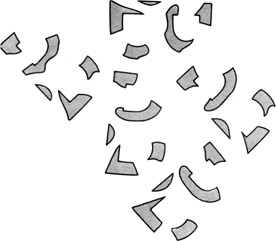
If you don’t know what you’re looking at – and in this case, even if you do – it’s very hard to discern the totality of the picture. If, however, you look at the picture another way,

reality takes on a different look altogether.
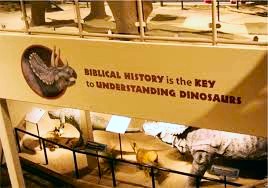
Thus in one sense, I agree fully with the headline of the article. When science tries to look at religion and cram it into the grand unified theory it fails miserably, and religion comes up poor. As a result, many people who were raised in households of faith simply allow their spiritual walk to fall by the wayside because it doesn’t fit within the body of scientific knowledge, and they effectively shut the door to half of the human experience. Conversely, when religion tries to make scientific fact conform to pre-defined conclusions, we get things like this:
I do believe that all truth can be circumscribed into one great whole. Even the disciple Paul, for all his faith, knew that our vision and our knowledge on this earth is sorely limited, saying, “For now we see through a glass, darkly; but then face to face: now I know in part; but then shall I know even as also I am known.”
The more we look at the puzzle, the more pieces we will be able to fit in. As for me and my house, I refuse to try to solve the puzzle by looking at only half the pieces, and pretending the other half really belongs to a different picture.
The Old Wolf has spoken.
A haunting photo essay over at Business Insider shows images of towns inside the quarantine zone around the Fukushima Dai-Ichi nuclear plant that suffered catastrophic failure after the March 2011 earthquake and tsunami.

In some ways, these pictures these pictures moved me more than the videos of the utter devastation around Sendai. It may be possible at some point for people to reclaim their homes, businesses, and lives – but radioactivity is nasty business, and as this post from PRI explains, the well-meaning officials of Japan are sailing in uncharted waters. Some of these areas may end up looking like the ghostly remains of Pripyat; only time will tell.
My heart continues to resonate with the Japanese people in the spirit of 2011’s kanji of the year, 絆 – kizuna, or “bond.” May they have strength for their forward journey.
The Old Wolf has spoken.
MIT Economist Daron Acemoğlu in a paper dated April 2012 lays out a number of predictions for the world that his grandchildren (and mine) will inherit. Unfortunately the original text is behind a paywall, but Business Insiderkindly lays out the gist of the scholarly work in terms that this poor lay mind can understand, with some pretty cool images.A condensed list, with some of my own thoughts (in blue), follows:
1) Global pollution will get much worse.
Industrialization in China means that CO2 emissions and climate change could get much worse. The only way to slow this down would be a mass transfer to clean energy…a tall order that would be nearly impossible without a global agreement. Clean energy doesn’t have enough market share to thrive now, and more pollution could lead to destruction.
This is a given, unless radical steps are taken. People are still too busy looking towards technology for a solution, hoping Jesus comes down and cleans things up, or not giving a rat’s south-40 because they’re making money hand over fist to give any serious consideration to exercising anything like self-restraint. Like Acemoğlu, I don’t hold out much hope for improvement as long as responsible stewardship of our planet cuts into the bottom line. I love Stan Lynde’s take on the matter.
2) Islamic regimes will fall.
Young people in countries including Egypt, Syria and Saudi Arabia are increasingly aware of the control the government has over their lives. People’s sense of political change will lead to more widespread excitement and retaliation. As change takes over the region and women and minorities fight for their rights, using religion for social control will stop.
This is a good thing. I have no quarrel with Islam; but oppressive Islamic regimes that foment hatred and advocate the fall of the Western world have no place in a civilized world. In fact, I’d love to see the end of all religious-based radicalism, in favor of a world where people can exercise the best qualities of their own beliefs in order to build a world that works for everyone, with no one left out.
The Golden Rule in 13 Major Faiths
A beautiful video by the Humanity Healing Network
3) War could go away.
International and civil wars have declined in the past 60 years, and that trend will continue into the next century. As enlightenment continues and international organizations protect against war, these conflicts will greatly slow down. Groups like the U.N. facilitate discussion between nations and could prevent a repeat of the Cold War. According to Acemoglu, we very well could have a peaceful century.
There is very little to add to this one. War bites the wax tadpole.
4) The rebirth of US manufacturing.
Workers in China and the Philippines are starting to demand higher wages, which gives companies less incentive to outsource labor. This means that globalization will slow down and companies will be more likely to seek domestic workers. They are also going to be less likely to forge bonds with new countries because trade policies are too stringent.
Anything that brings manufacturing jobs back to the USA is in the positive column as far as I’m concerned… but the issue of trade unions will need to be addressed. As for me, I have mixed feelings, because both sides of the debate make some valid points.
5) People will have longer and healthier lives.New technology, drugs and vaccines will mean that the children of the future will live longer than their parents did. Disease will decline, and the global economy could boom. Advanced nations will step up and offer services to struggling countries in Asia and Africa.
Technology is good, but humanity needs to take a good hard look at the quality of life offered by heroic measures, and the societal costs involved. The question comes into much sharper focus when it’s the long-term care of a critically ill or failing loved one which is in question. Is it worth spending hundreds of thousands of dollars to keep Uncle Joe alive for 5 months, when he doesn’t even know who is talking to him? There are no simple answers.
6) Robots will replace manufacturers and farmers.
As technology advances. manufacturing, farming and manual jobs will be phased out. These workers will be replaced by computers and robots. This could either send billions of laborers into poverty or lift them into better jobs and a new income class.
One thing this will do, if it ever comes to pass, is radically reduce the need for immigrant labor in this country. The vast majority of illegals who cross our border do so to feed America’s appetite for cheap produce. Dry up the demand, and the supply will automatically dwindle. As it turns out, it seems that the trend may be reversing itself anyway.
The End of Family Farms–The New Politics of Food
Net Migration from Mexico Falls to Zero—and Perhaps Less (Pew Hispanic Center Report, 04-23-2012)
7) The middle class will keep diminishing
Better technologies will help the rich make better profits. Meanwhile, as Chinese workers require higher wages, demand for cheap labor will increase. This means that economic growth will become increasingly uneven and the gap between the haves and have-nots will be greater than ever.
A friend of mine who lives in Manhattan (NYC) has told me that the middle class has been virtually priced out of the city, and from what I can see, he’s right. The recent attention paid to the Occupy movement at least underscores the fact that the rich are getting richer and the rest of us are falling farther behind. To see this trend accelerate does not bode well for the economics of the world my grandchildren will inherit.
8) The global economy will prosper.
China will continue to grow and new regions in Asia and Africa will start to develop. This could leave to a better quality of life. But we can’t count on developing nations to spearhead all growth: the top-consuming regions like the U.S. and Europe will have to iron out their economic problems for growth to be sustained.
Sort of goes along with No. 4 above. “Made in America” needs to regain its place in the world of manufactured goods if our nation is to return to strength and prosperity. As consumers, we can do our part by seeking out and patronizing companies who provide goods and services that we need, rather than automatically going for the cheapest imported option we can find. Yes, it may cost a bit more up front, but the benefits will be worth the sacrifice if we were willing to do it.
Find “Made in America” companies
9) We’ll have automated cars.
Much like this century, the next 100 years will have see a host of technological inventions ranging from automated cars to better medications. There is little evidence we are running out of innovations and the landscape will continue to change as drastically as it has so far.
I’m still waiting…
10) Democracy will recede.
Democracy is under attack in the U.S. The gap between the rich and the poor is widening and money is necessary to exert political power. Meanwhile, citizens all over the world have praised China’s authoritarian model. This means that the individual rights revolution could reverse or stop.
Our constitution hangs by a thread at the moment. Plutocracy, vetocracy, kakistocracy… call it what you will, our country is far from what the founding fathers envisioned, if I read our fundamental documents aright. Rather than being the republic which they gave us, and which we were not able to keep, we have devolved into a society of the poor, run by the rich and for the rich. A nation divided against itself cannot long endure. I am encouraged by the voices being raised around the nation, calling for an end to economic imbalance, and hope my posterity will play an active rôle in restoring our country to a place of honor.
The Old Wolf has spoken.
Back in August of 2006 I began a chronicle of my journeys through this green earth over at Livejournal. I’ll probably keep that journal up as my main place to post, because I like its features – and I also have some personal reasons for supporting its existence.
Recently, however, I encountered this graphic by Randall Munro over at XKCD which gave me pause:
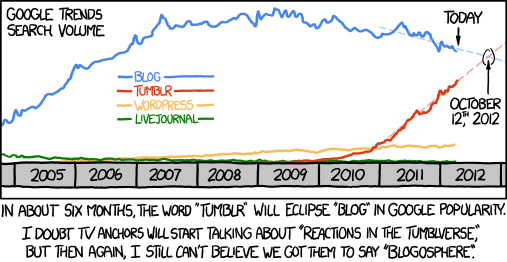
… and from past experience I realized that he’s absolutely right – LJ just doesn’t get the exposure that a standard blog does.
While most of my logorrhea I write for myself and myself alone, there are things I think are important enough to share with the world at large, hence the creation of this blog; some of the material here will be original, other posts will come from previous Liverjournal entries. May what you find here please you.
The title of this blog comes from R. Buckminster Fuller’s concept of the World Game, to wit:
“Make the world work for 100% of humanity, in the shortest possible time, through spontaneous cooperation, without ecological damage or disadvantage to anyone.”
It is a philosophy which I have adopted, and which I will be working to implement for the rest of my existence. It is the core of my 500-year plan. Another great man, Brian Klemmer, whom I was counted privileged to consider a mentor while he was yet alive, expressed much the same goal when he made it his life’s work to build “bold, ethical leaders who will build a world that works for everyone, with no one left out.”
Our world needs help. Everywhere we look, we see strife, confusion, aimless existence, corruption, malfeasance and hopelessness. Yet everywhere we look, we can also find goodness, honor, strength, integrity, creativity, perseverance, trust, and random acts of brightness. And we see what we choose to see. There are people out there working hard to make a difference in the lives of others, and raise the human condition; that’s the club I want to belong to.
John Denver included the song “World Game” on his “It’s About Time” album, and it expresses the same ideas:
♬ I want to play in the World Game
I want to make it better it’s ever been before
I want to play in the World Game
I want to make sure everybody knows the score
About using less, doing so much more ♬
Life is a journey, made up of multiple excursions. Jenkin Lloyd Jones put it wonderfully when he said,
“Anyone who imagines that bliss is normal is going to waste a lot of time running around shouting that he has been robbed.
“[The fact is] most putts don’t drop. Most beef is tough. Most children grow up to be just people. Most successful marriages require a high degree of mutual toleration. Most jobs are more often dull than otherwise. …
“Life is like an old-time rail journey—delays, sidetracks, smoke, dust, cinders and jolts, interspersed only occasionally by beautiful vistas and thrilling bursts of speed.
“The trick is to thank the Lord for letting you have the ride.”
I do. I am grateful. And in recognition of all the wonder and bounty that has been mine in my life, I have adopted the following Tibetan prayer as a motto.

May I become at all times, both now and forever
A protector for those without protection
A guide for those who have lost their way
A ship for those with oceans to cross
A bridge for those with rivers to cross
A sanctuary for those in danger
A lamp for those without light
A place of refuge for those who lack shelter
And a servant to all in need.
The Old Wolf has spoken.


 Playing in the World Game
