Are people “good” or “bad” at math?

math

Over at Quartz, writer Allison Schrager says no. I originally spotted her article over at Newser, which summarized it this way: “Think You’re ‘Bad at Math’? You’re Just Being Lazy.

While there are some good points in the article, I feel as though her conclusion is flawed.

Yes, math is difficult – especially when you get up into the higher levels. To learn it requires intellectual rigor, patience, discipline, and hours and hours of repetition. I remember this passage from the first science fiction book I ever read as a child, Heinlein’s Have Space Suit, Will Travel:

“Anybody who thinks that studying Latin by himself is a snap should try it.

I got discouraged and nearly quit-then I got mad and leaned into it. After a while I found that Latin was making Spanish easier and vice versa. When Miss Hernandez, my Spanish teacher, found out I was studying Latin, she began tutoring me. I not only worked my way through Virgil, I learned to speak Spanish like a Mexicano.

Algebra and plane geometry were all the math our school offered; I went ahead on my own with advanced algebra and solid geometry and trigonometry and might have stopped so far as College Boards were concerned-but math is worse than peanuts. Analytical geometry seems pure Greek until you see what they’re driving at-then, if you know algebra, it bursts on you and you race through the rest of the book. Glorious!”

I loved that story when I read it at age 10, and I still love it today, but I’m bitterly disappointed that I never had that breakthrough that the story’s protagonist experienced. I did fair to middling through high school in algebra, geometry, trigonometry and analytical geometry, but I was always doing it like a cook follows a recipe – it never burst on me, and I never saw what they’re driving at. So when I hit college with dreams of being a doctor, and discovered that in order to pursue a chemistry major I would have to take all the concomitant calculus courses, that was all she wrote. It was worse than pure Greek, because that’s a subject I did well in.

Mastering a foreign language is no piece of cake either, and yet for some reason I can master enough of a foreign language to become reasonably fluent in 3 months, whereas learning even the rudiments of calculus has eluded me for over 40 years. The disappointment stems from the fact that I love the world of science, and mathematics is the key that unlocks the door to understanding – a door through which I will only ever be able to peer through a keyhole to where the big boys and girls are playing.

This is music to my ears…

“Per me si va ne la città dolente,
Per me si va ne l’etterno dolore,
Per me si va tra la perduta gente.
Giustizia mosse il mio alto fattore:
Fecemi la divina podestate,
La somma sapienza e ‘l primo amore.
Dinanzi a me non fuor cose create
Se non etterne, e io etterno duro.
Lasciate ogne speranza, voi ch’intrate”.
(from Dante’s Divina Commedia)

whereas this makes my mind shut down completely:

75038c7606574331ab8f06be8e78f9df

Kepler’s equation for calculating orbits

Old_Wolf_Tilt

And all we’re talking about here is limits, let alone the really weird things. To a scientist, this is really simple stuff.

My own experience has demonstrated to me that each person born has gifts and abilities unique to them. As no two snowflakes are a like, as no two stars have identical magnitudes or compositions, so no two people have the same talents. For me, math is terribly difficult, and language is uncannily easy.

mathjoke3

As a result, the formula above is the only bit of calculus that I have ever been able to memorize – and I’ll never forget it.  Don’t get me wrong – I can’t evaluate it, even though I’m told by smarter friends that both sides equal ⅓; no, I remember it because it’s a limerick. [1]

Integral zee squared dee zee,
From one to the cube root of three,
Times the cosine
Of three pi over nine,
Equals log of the cube root of e.

Lakshmi

Here is a drawing done by my daughter, who has never had an art lesson in her life. This is a gift that springs from within her.

Where I agree with Ms. Schrager is that despite the difficulty, if I worked at it long enough and hard enough, I could master it. But somewhere else there is a brilliant mathematician who trembles in terror at the thought of trying to learn Italian, because he or she knows that it would almost take more effort than it is worth.

In conclusion, I would retitle Ms. Schrager’s article to read: “Yeah, math is hard – but it’s worth the effort.”

The Old Wolf has spoken.


[1] I have hundreds of limericks rattling around in my skull. Unfortunatly,

A limerick packs rhymes anatomical
Into verses quite economical
But the good ones I’ve seen
So seldom are clean
And the clean ones so seldom are comical.

16 things you should do at the start of every workday

Reblogged from Forbes, without the annoying slideshow.

whatever


You can do better than this!

16 Things You Should Do at the Start of Every Work Day

The first few hours of the work day can have a significant effect on your level of productivity over the following eight—so it’s important you have a morning routine that sets you up for success. With the help of career and workplace experts Lynn Taylor, David Shindler, Michael Kerr, Anita Attridge, Alexandra Levit and Michael “Dr. Woody” Woodward, I compiled a list of 16 things all workers should do when they get to work each morning.

Arrive on time.

This may be obvious to most people—but some don’t realize that showing up late can not only leave a bad impression, but also throw off your entire day. “Getting in on time or a little early helps your mindset for the day and helps promote a feeling of accomplishment,” says Lynn Taylor, a national workplace expert and author of Tame Your Terrible Office Tyrant.

Take a deep breath and meditate.

“Literally,” says Michael Kerr, an international business speaker, author and president of Humor at Work. “And do something to focus in on the here and now.” Many people come into work harried because they don’t leave enough time at home to deal with “home stuff,” he says, “and then they’ve barely survived another horrendously stressful commute, and then they dive into the madness.” Slowing down, taking a moment to pause, and creating a routine around centering yourself can work wonders, he adds.

Michael “Dr. Woody” Woodward, PhD, organizational psychologist and author of The YOU Plan, says after the deep breath, give yourself a few minutes to meditate and get settled in.“This is a good way to set the tone of the day,” he says. “Don’t allow yourself to be bum rushed by frantic co-workers lost in their own confusion. It’s not unusual to wake up to a long backlog of e-mails just screaming for your attention. The challenge is taking a moment for yourself before diving head first into your day.” He says there is a tremendous power in mediation when it comes to settling your mind. “Starting off your day right is really about setting your own tone and meditation is a great way to begin.”

Eat a proper breakfast.

“Breakfast truly is the most important meal of the day to help us down the path of not only being more physically fit, but also to have the mental energy needed to tackle your workday,” Kerr says.

Start each day with a clean slate.

You may have to attend to projects or discussions that rolled over from the previous afternoon—but try to treat each day as a fresh one, says David Shindler, founder of The Employability Hub and author of Learning to Leap. “Leave any crap from yesterday behind, tap into what’s happening at the outset of the day, get organized and ready or hit the ground running, if that’s what is needed,” he says.

Don’t be moody.

You’ll want to pay attention to your mood and be aware of its effect on others. “First and last thing in the day is when emotional intelligence can have the greatest impact,” Shindler says. So if you’re not a “morning person,” try to suck it up and have a positive attitude when you arrive at the office. Grab a second or third cup of coffee, if that’s what it takes.

Kerr agrees. “Your first hour at work can set your ‘attitude barometer’ for the rest of the day, so from a purely emotional point of view, I think it’s an important part of the day,” he says. “One morning grump can infect an entire team and put everyone on the wrong footing.”

Organize your day.

The first hour of the work day is the best time to assess priorities and to focus on what you absolutely need to accomplish, Kerr says. “Too many people get distracted first thing in the morning with unimportant activities such as diving right into their morass of e-mail, when there may be a whole host of more important issues that need dealing with.” Make a to-do list, or update the one you made the previous day, and try to stick to it. However, if your boss has an urgent need, then it’s OK re-shuffle your priorities within reason, Taylor adds.

Anita Attridge, a career and executive coach with the Five O’Clock Club, a career coaching organization, says when you prepare your morning to-do list, determine what must be done today and what can be completed tomorrow, and prioritize accordingly. “Also determine your peak working time and plan your schedule accordingly,” she says. “Use your peak time each morning to do the most important tasks.”

Be present.

Even if you’re not a morning person, you need to be awake when you get the office. Especially if you’re in a leadership position, it’s critical to be present, mentally and physically, and to communicate. “One of the biggest office pet peeves I hear from employees is about how their immediate supervisor just blows by them in the morning without so much as a smile,” Kerr says. “Taking the time to connect with your team members is essential, and doing the seemingly small things–making eye contact, smiling, asking them about their night, and checking in on what they may need help with–helps you as a leader take the pulse of the team, and helps set the tone for all the employees.”

Check in with your colleagues.

“A quick 5 to 10 minute team huddle can also be an effective way for many people to start their day,” Kerr says. Make it a short meeting, with no chairs, have everyone share their top goal for the day, and share any critical information the rest of the team absolutely needs to know, he says. “Doing the huddles helps people focus and more importantly, connects everyone with the team. And by sharing your goals for the day publicly, the odds of achieving them rise substantially.”

Organize your workspace.

Clearing off the desk and creating a neat workspace sets a tone for the rest of the day, says Alexandra Levit, the author of Blind Spots: The 10 Business Myths You Can’t Afford to Believe on Your New Path to Success. It can also help avoid confusion. “While most communications are through e-mails and texts, if your boss or co-worker stopped by looking for you and left a sticky note about a last-minute meeting occurring in ten minutes, and it’s sitting on a mound of mail or papers, you’re already behind the eight ball,” Taylor says. “Also, for many, it’s difficult to think clearly, easy to forget important reminders, and just plain stressful if you feel you’re fighting the battle and the tornado of mail or paper is winning.” Ideally, you’d clear whatever you can out the night before so you can have a fresh start before you even turn on your computer in the morning. But if not, make sure clearing your desk takes precedence over things like checking e-mails and chatting with co-workers in the morning.

Remind yourself of your core purpose at work.

“As corny or as trite as this may sound, I’d suggest that you take a moment each morning to remind yourself of your core purpose at work,” Kerr says. Connecting to a sense of purpose is one of the most powerful motivators there is, and taking just a moment each day to reconnect to what truly matters in your job and what you are ultimately trying to achieve and for whom, can help you feel more motivated and help you focus on the priority areas in your work.

Don’t be distracted by your inbox.

This one is difficult for most people—but the experts agree that you shouldn’t check your e-mail first thing in the morning. If you do, only read and respond to messages that are urgent. “Priority-scan your inbox,” Taylor says. “Not all e-mails were created equal. Hone your ability to quickly sift the wheat from the chaff and address what must be answered on an urgent basis.” Attridge agrees. “Only respond immediately to the urgent messages so that you control your morning activities.” There will be time during the day to respond to the less urgent e-mails.

Why must you put off checking e-mails? “For far too many people, e-mail and the web can serve as huge timewasters and distracters, particularly in the morning,” Kerr says. “Once you start checking e-mails, it’s a click away from watching the funny video someone forwarded you, which then sucks you into the abyss: checking the sports scores on line, the news headlines, the stocks, et cetera, and before you know it you’ve been watching a cat play the drums for twenty minutes and, like a poorly planned Oscars ceremony, your entire schedule is already thrown off before you’ve even begun your day.”

Listen to your voicemail.

Most people jump on the computer and ignore their phone. “While office voicemail is indeed becoming antiquated as people rely more on personal cell phones, Blackberrys and e-mail, some people do leave voice messages, and if you ignore them, you could miss something important,” Levit says.

Place important calls and send urgent e-mails.

If you know you need to get in touch with someone that day, place the call or send the e-mail first thing in the morning. If you wait until midday, there’s a greater chance you won’t hear back before you leave the office. “There’s nothing more frustrating that trying to complete something and not having access or answers from people you need because your day time hours were lost on other matters,” Taylor says. “If you have your questions ready and your e-mails fired off during early peak hours, by the end of the day you should have what you need.”

Take advantage of your cleared mind.

“Many people feel that their brains function best in the morning, and that morning is when they are most creative and productive,” Kerr says. “Consider whether you are making the best use of your brainpower and plan ‘high brain’ activities in the morning.”

Plan a mid-morning break.

“This is the time to assess where you and take time to revitalize yourself so that you can keep your momentum going,” Attridge says.

An Autumn hike

I’m out of shape.

Old_Wolf_Cry

It’s been over three years since I was approaching marathon distance on my hikes in the Uintahs – life took a couple of hairpin turns for me and that put a bit of a kink in that goal, but lately I’ve been doing more walking and it’s my intention to get back into the habit.

Yesterday I took a walk up the side of the hill toward Mollie’s Nipple (the green ball below) which I attained in July of 2011 via a different, longer route (up the back ridge); I only made it up the side about 1,000 feet before my energy ran out, but it was a good climb just the same.

walk

3.48 miles

Followed the canal until I found a place to cross and headed up the face of the hill. By the time I got up there, the sun had crested the mountains and the slope up to the next level was warm and bathed in sunlight, so I stuck around a while enjoying the warmth before heading back down. Next time I go this route I think I’ll go up the shoulder instead of the face, it may be a bit easier.

Some shots from the  trek:

IMAG2780

The Payson temple framed by wildflowers.

184440_1000

Comparison shot of the temple location taken in July of 2011

IMAG2787

Skeletons. A fire came over the ridge in 2008 and threatened homes in the valley; there are still reminders everywhere. It will take decades for the mountain to recover.

IMAG2788

A patch of color

IMAG2790

A sage field

IMAG2789

Another kind of skeleton

 IMAG2778

Sunrise over Spring Lake

It’s sad in a way to see the summer coming to an end, but Autumn in Utah can be a beautiful season.

The Old Wolf has spoken.

Rome: La Vespa

SHORPY_02794u


July 1955. “Rome, Italy. Coverage focuses primarily on people, places and historical monuments.” From photos by Philip Harrington for the Look magazine article “Can Catholics Separate Church and State?”

Found at Shorpy.

Joe Vespa


My father on a Vespa in Calabria around 1939. These little scooters were ubiquitous in Italy.

The Old Wolf has spoken.

Rutland, Vermont: ca. 1905

SHORPY_4a18772a

Center Street in Rutland. Notice the eatery on the right: “U Want a Lunch:” prescient spelling.
8×10 glass negative, Detroit Publishing Co.

The trees are barren and coats are being worn; it’s cold, but there’s no way of telling just what season we’re seeing here. But it’s a charming picture; I love old photographs like this.

The Old Wolf has spoken.

Dear web developers: Don’t do this

I often grab bits of text from news websites and other places of interest to quote at this blog. I always give credit to the source if it’s known, so this fairly recent development gets under my skin. Many websites now append a bit of text to anything that’s copied, like this:


“Frozen in time: The occupants of this abandoned farm house are long gone, but their belongings remain; from the paintings hanging on the walls to the neatly made bed”

Read more: [Some URL here]
Follow us: @MailOnline on Twitter | DailyMail on Facebook


See that blue stuff up there? I didn’t request it. I’m just going to delete it. It’s annoying, something along the lines of blinking text, forced social logins, popup ads, and back-button disable.

Weeaboos

The Old Wolf has spoken.

Do as I say, not as I do

I’ve mentioned this before,[1] but today I happened across a great example of what not to do on a website, right after telling your readers that it’s nasty.

Irony


MarketingProfs apparently don’t take their own advice. If you’re a web developer, don’t do this. I’ll leave your website in about 0.67 seconds.

The Old Wolf has spoken.


[1] Be sure to read the followup to this article as well.

Doc Rat: Silly and Serious

Earlier I wrote about Wapsi Square by Paul Taylor; today I’d like to share another webcomic which has long delighted me, to wit, Doc Rat by Jenner.

Jenner (a pseudonym) is a real-live physician from down under, and he works his professional experience into a long-running – 7 years now – story about Doctor Rat and his practice. Recently he tossed out a contest in which he asked his fans to write him about why they enjoyed the strip; today in the mail I received a wonderful bit of treasure, one of his original strips, having been selected as one of his five winners.

DocRat original art

For me, this is a Big Deal. I love supporting the artists whose work I enjoy, directly or indirectly, and to have a bit of their handiwork on my wall is like icing on the cake. I’m very grateful to Doc Jenner for his kindness, which included a warm and personal letter.

The strip fluctuates between gag-a-day format (often involving some horrid pun or other):

a ligator

Groan…

Four Black Skulls

“Four black skulls” – I love that…

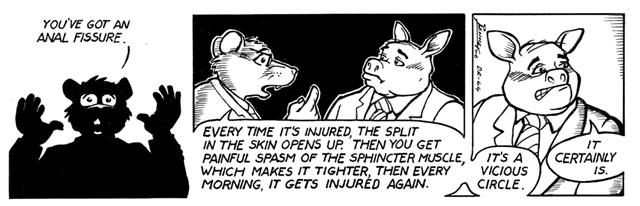
Anal Fissure

I concur

ProstateExam

Every time

20110210

Drug marketing is given no quarter

and extended arcs dealing with the life and challenges of Doctor Rat, his friends, associates, and patients:

Doc Rat 20090213

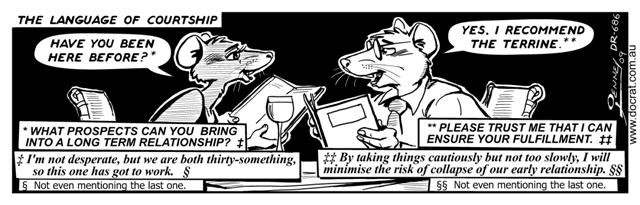
Many of these stories are out-and-out tearjerkers; well-written, current, and relevant to events and issues of the day. I even used one to communicate my feelings to my then-intended and now-wife:

Doc Rat - Courtship

With seven years of daily strips behind him, there are over 1800 Doc Rat strips to enjoy; the link I provided above is to the start of the series. Jenner’s website is undergoing an upgrade, and his developer has run into a few difficulties, so the site is a bit slow at the moment; fortunately for devotees, there are 10 Books available for purchase, with both Australian and USA prices.

docrat-books

There are thousands of webcomics available, but given time restrictions one has to be selective. This is one of a handful that I look forward to on a daily basis, and I recommend it without hesitation.

The Old Wolf has spoken.

“He who saves one life saves the world entire.”

Nicholas_Winton_in_Prague

On the eve of World War II, Sir Nicholas Winton organized the rescue of 669 mostly Jewish children from German-occupied Czechoslovakia. While Sir Nicholas gives credit to many others who helped in the rescue effort and endured even greater dangers than he, the UK press dubbed him the “British Schindler.” There is no question that his efforts were pivotal in the saving of many lives.

In 1988, the BBC aired an episode of “That’s Life,” a program that fluctuated between humorous pieces and deadly serious issues. The clip below features Sir Nicholas and an entire audience of people who, directly or indirectly, owed their lives to him.

Hankies at the ready!

The Old Wolf has *snif* spoken.


The title of this post, by the way, is a quote from “Schindler’s List.” It was derived from the Talmud:  “Whoever destroys a soul, it is considered as if he destroyed an entire world. And whoever saves a life, it is considered as if he saved an entire world.”

-Mishnah Sanhedrin 4:9; Babylonian Talmud Tractate Sanhedrin 37a

Behind the “Do Not Enter” Signs

Dutch photographer Niki Feijen specializes in urban exploration; capturing boarded-up buildings and decaying farm houses. His images reveal furniture and clothes that remain in decaying homes where owners have long since departed.

article-2316987-198AAFE9000005DC-376_964x639

Layers of blankets remain on the bed in the empty farmhouse, which is still surrounded by crosses and statues of Jesus belonging to its former owner

article-2316987-198AAE66000005DC-624_964x634

Frozen in time: The occupants of this abandoned farm house are long gone, but their belongings remain; from the paintings hanging on the walls to the neatly made bed.

For more such haunting images and further information, visit MailOnline, or Niki Feijen’s own website.

The Old Wolf has spoken.