A message to my evangelical brothers and sisters

Written by a mainstream Christian, Kate Penney Howard on Facebook. I am immeasurably grateful for this post.


“In recent weeks, I’ve watched a troubling pattern emerge online. Whenever a news story mentions the horrific attack in Grand Blanc, there’s an inevitable chorus of voices “correcting” the record: “Actually, Mormons aren’t Christians.”
Let me be clear: This is gatekeeping, and it needs to stop.
One of the most dangerous temptations of religious life is the urge to define who’s “in” and who’s “out.” When we appoint ourselves as arbiters of authentic faith, we’re not protecting orthodoxy. We’re playing God.
The Latter-day Saints call themselves Christians. They center their faith on Jesus Christ. It’s literally in the name of their church. They believe Jesus is the Son of God, that he died and was resurrected, and that salvation comes through him. They read the Bible, gather for worship, sing hymns, pray to God, and seek to follow Christ’s teachings about love, service, and redemption.
I know a LOT of LDS folk and I have to say, they give me a run for my money in the being kind and graceful department.
Do they have different theological perspectives than me? Absolutely. So do Quakers. So do Catholics. So do Methodists and Presbyterians and Episcopalians. So do Catholics and Orthodox Christians. So do Pentecostals. So do Seventh-Day Adventists. So do Unitarians. The body of Christ has always contained multitudes.
Exclusion has consequences.
We cannot talk about denying Latter-day Saints the label “Christian” without acknowledging the violent history behind such rhetoric. In the 19th century, largely at the urging of preachers in the Restoration Movement (that’s us, my DoC friends), and Presbyterians, Baptists, and Methodists, Mormons were driven from state to state, their homes burned, their communities terrorized, and sometimes killed. Missouri’s governor issued an extermination order against them in 1838. Joseph Smith was murdered by a mob.
And throughout this persecution, one of the accusations hurled at them was that they weren’t “real Christians,” that they were dangerous heretics who deserved what they got.
When we casually exclude LDS individuals today, we echo that violent history. We may think we’re making a theological point, but we’re perpetuating a legacy of exclusion that has caused real harm to real people.
Rather than obsessing over differences, let’s consider what Latter-day Saints share with the wider Christian tradition:
We worship the same God and proclaim the same savior.
We share sacred scripture in the Bible
We practice baptism and communion
We value prayer, worship, and community as essential to faith
We believe in serving others and caring for those in need
We affirm that Christ’s resurrection offers hope and new life
We gather to worship and encourage one another
We seek to follow Christ’s example of love and compassion
These aren’t minor overlaps. These are the heart of Christian faith.
Do I think they are perfect? No, I do not. However, neither is my tradition and neither is yours.
Here’s what troubles me most about the “Mormons aren’t Christians” crowd: the stunning confidence that their interpretation of Christianity is the only valid one. As if two thousand years of Christian diversity, debate, and development can be boiled down to a checklist, and anyone who doesn’t tick every box gets expelled.
The early church argued about whether Gentiles could be Christians without first becoming Jewish. They debated the nature of Christ for centuries. They split over the filioque and papal authority. We built this country on religious freedom. Why do we think it’s suddenly our job to kick people out?
I’m not suggesting all theological distinctions are meaningless. I’m not saying differences don’t matter. I’m saying that deciding who gets to claim the name “Christian” isn’t our call to make.
If someone says, “I follow Jesus Christ,” who am I to say they don’t? What profound arrogance would that require?
Instead, let’s practice some humility. Let’s recognize that God is bigger than our theological boxes. Let’s acknowledge that throughout history, the people who were absolutely certain about who was “in” and who was “out” have often been on the wrong side of justice.
The Latter-day Saints have been our neighbors, our colleagues, our fellow seekers of truth. They have fed the hungry, clothed the naked, and loved their neighbors. They have raised families, built communities, and tried to live out their faith with integrity.
They call themselves Christians. That’s enough for me.
But, Pastor Kate. We know you. We know you have strong feelings about some things, like the ordination of women and the safety of LGBTQIA believers. I do. I do have those strong feelings. And I also know that several LDS folk, including a Bishop, have kindly asked me if I would be open to talking to them about these two issues. And I did. And I could tell their ears were hearing me. I think there’s hope that we’ll agree on more things.
Maybe instead of asking “Are Mormons really Christians?” we should ask: “What kind of Christians are we being when we spend our energy excluding others instead of living out Christ’s radical love?”
Jesus said, “By this everyone will know that you are my disciples, if you love one another” (John 13:35). He didn’t say, “Everyone will know you’re my disciples if you have perfect theology.” He didn’t say, “Prove your faith by drawing the boundaries tightly.”
He said: Love one another.
The tent of God’s love is bigger than we imagine. Let’s stop trying to make it smaller.”


This is so comprehensive and well-written that it defies theological dispute.

The Old Wolf has spoken.
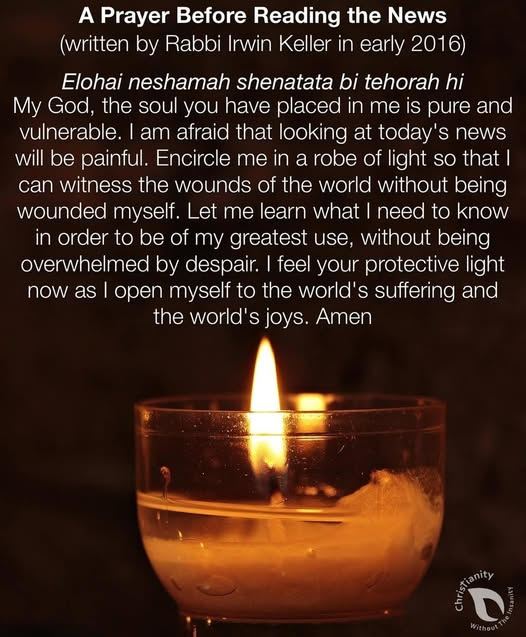
A prayer of peace for these troubled times.

I found this beautiful and comforting. “Elohai neshamah shenatata bi tehorah hi” is the beginning of a traditional prayer recited upon awakening – it translates roughly as “God, the soul You have given me is pure.”

For some background, the full Hebrew prayer is below, found here:

Elohai n’shamah shenatata bi t’horah hi.My God, the soul You have given me is pure.
Atah v’rataH,For You created it,
atah y’tzartaH,You formed it,
atah n’fachtaH bi,You made it live within me [breathed it into me].
v’atah m’shamraH b’kirbi,And you watch over / preserve it within me,
v’atah atid lit’laH mimeni ul’hachaziraH bi leatid lavo.and/but one day, You will take it from me and restore it in the time to come.
Kol z’man shah-n’shamah b’kirbiAs long as the soul is within me,
modeh/modah ani l’fanecha¹I will give thanks to Your face/presence
Adonai elohai veilohei avotai,My Lord God of Gods of the generations before me,
she’atah hu ribbon kol ha-ma’asim,to You who are the power of good deeds,
mosheil b’chol ha-b’riot,the Ruler of all creatures,
adon kol ha-n’shamot.the Master Craftsman of every soul.
Baruch atah Adonai, ha-machazir n’shamot ha-meitim.Blessed are You God, giving souls to the dead.

It is interesting to me that this prayer by Rabbi Keller reflects a core plot point in The Chosen, the seminal novel by Chaim Potok. In it, one of the protagonists is raised by his father, a rabbi, in silence (i.e. without non-essential communication or fatherly affection). The father later goes on to explain:

“Ah, what a price to pay…. The years when he was a child and I loved him and talked with him and held him under my tallis when I prayed…. ‘Why do you cry, Father?’ he asked me once under the tallis. ‘Because people are suffering,’ I told him. He could not understand. Ah, what it is to be a mind without a soul, what ugliness it is…. Those were the years he learned to trust me and love me…. And when he was older, the years I drew myself away from him. ‘Why have you stopped answering my questions, Father?’ he asked me once. ‘You are old enough to look into your own soul for the answers,’ I told him. He laughed once and said, “That man is such an ignoramus, Father.’ I was angry. ‘Look into his soul,’ I said. ‘Stand inside his soul and see the world through his eyes. You will know the pain he feels because of his ignorance, and you will not laugh.’ He was bewildered and hurt. The nightmares he began to have…. But he learned to find answers for himself. He suffered and learned to listen to the suffering of others. In the silence between us, he began to hear the world crying.

This novel, and this passage in particular, always touched me deeply. I was moved to hear the sentiment expressed in a modern prayer for peace, but also for compassion and compassionate action.

The Old Wolf has spoken.

Footnotes:

¹ This line reflects the prayer Modeh/Moda ani, which is recited upon awakening and before getting out of bed. “As this prayer does not include any of the names of God, observant Jews may recite it before washing their hands.” In Talmudic times, Jews traditionally recited Elohai Neshamah upon waking. The prayer was later moved to the morning synagogue services. (Wikipedia)

Mission Triumphant

Mission Triumphant
by Joan Bills

At a council assembled in Heaven,
Where presided the great magistrate,
Came the spirits in anticipation
To make plans for their second estate.
Each was given his own special mission,
And a talent to use and display;
And with joy each received his assignment
With instructions to keep faith and pray.

Now one spirit transcended the others
So outstanding in talent and grace;
So majestic in stature and bearing
With a light in his angelic face.
And the magistrate turned to address him:
“Lo, your mission is unlike the rest;
They are going to earth to be tested,
But, my son, you are going to test.

You will sift out the hearts of my people,
You will test them for true charity;
What is done to the least of my Children,
That is the measure they mete out to me.
You will challenge the faith of your loved ones,
And the stranger you meet on life’s way;
You will undergo great tribulation,
And your spirit will feel deep dismay.

When your sojourn on earth is completed,
And your message imparted to men,
Then, as humble and pure as you left Me,
You’ll return to my presence again.”
For a moment the spirit was troubled,
Ere the conflict within him had won,
Then he spoke, “I am willing, Dear Master,
For Thy will and not mine shall be done.”

Now the time had arrived for departure,
And the spirits were ready to go;
But one paused at the throne of the Father
And spoke in a voice sweet and low,
“Hold my hand so I won’t be afraid, Lord,
I am eager to go down to earth.”
So, with God’s hand in his, he departed,
And entered the channels of birth.

On a bright golden day in October
All our family was radiant with joy,
For heaven had sent a choice spirit
In the form of dear baby boy.
How excited I was on that morning
As I ran to my schoolmates and cried,
“Oh, guess what, I’ve a new baby brother!”
And my small heart was bursting with pride.

How his hair was the color of Autumn,
He had brown eyes and rose-petal skin;
Through those eyes we were often permitted
A quick glimpse of the angel within.
Thus, joy lingered awhile in our cottage,
And my father would whistle a tune.
My mother would scour and polish
And would smile at her baby and croon.

Happiness was short-lived in our household,
For grave sorrow stole in at the door.
My father’s gay whistling faltered,
And my mother’s sweet voice sang no more.
Our baby was entering boyhood,
And his strong body grew as it should,
But the mind did not function correctly,
And we soon knew that it never would.

For the rest of his life he was destined
To remain a perpetual child;
He would laugh and then cry like a baby,
With emotions subdued, and then wild.
My dear parents dreams were now shattered,
And their fond hopes reverted to grief;
They discarded the plans for his future,
And their heartache could find no relief.

But as time passed we learned to accept it;
We would all laugh together and play;
And my brother was petted and pampered,
And usually given his way.
And his physical growth still continued
All according to natural plan,
And his body received strength and passion
While developing into a man.

And society must have its way now,
So our darling was taken away.
He was placed in a state institution
Where the rest of his life he must stay.
I prayed day and night for my brother,
And in mercy, God answered my prayer,
For one evening I knelt at my bedside
And received inspiration while there.

My dear brother and those who live with him
Are fulfilling a mission sublime,
And they will return to the Father
To receive crowns of glory, in time.
In the meantime, they’re not being tested–
It is WE who are taking the test;
And in serving the least of God’s Children
We truly are serving the best.

How dare we presume to neglect them,
And leave them alone to their fate.
Those Children should dwell in a palace,
To be served by mankind while they wait.
We should deem it an honor to know them,
And to do everything that we can
To comfort, to love and protect them,
They should not be forgotten by man.

Even though there are those who will shun them,
There are those who will bless them with love;
And I, somehow, am sure that our actions
Are now being recorded above.
So I no longer fear for my brother,
For I know, though I don’t understand,
That he’ll travel life’s highway in safety,
For his God is still holding his hand.

The Old Wolf has spoken

Can you think of anything stupider to fight about?

Cross-posted from LiveJournal

Arguing about the nature of the Flying Spaghetti Monster. If you’ve been touched by his noodly appendage, this is not supposed to happen.

An experience interacting with a rather un-Christian biblical apologist some time ago left me somewhat unsettled, and I wasn’t able to think about much else for a couple of days. The thing that unsettled me the most was that despite my best intentions, I felt myself being dragged into the fray.

Additional research on the internet has led me to a plethora of websites of every possible permutation.

  • Atheists vs. Apologists
  • Evangelicals vs. non-orthodox Christians
  • Muslims vs. Jews
  • Muslims vs. Christians
  • Jews vs. Gentiles
  • Secular humanists vs. Believers
  • Mormons vs. Atheists
  • Evangelicals vs. Mormons
  • Bible-believing Christians vs. Jehovah’s Witnesses
  • Scientologists vs. Everybody
  • 7th-Day-Adventists vs. …

You get the picture. Choose one from column A, and one from Column B, and you’ll be able to find it out there.

Incredible amounts of time, effort, indignation, anger and outright hatred are being spent in attempts to prove, by logic, or reason, or scripture, or exegesis, or tradition, that which is virtually unprovable – hence the cartoon above, which I created more for my own benefit than anyone else’s. And it all comes down to the most basic of human addictions, the addiction to being right.

Of course, none of this is new. It’s only that the internet era gives us fingertip access to the full spectrum of human maladjustment and brings it into clearer focus. People have been killing each other for their differences, religious and otherwise, since the dawn of time [be careful, that link is a bit grim]- and since the same epoch, there have been those who have risen up against the madness.

I remember back in the late 60’s and early 70’s when Vietnam was in full swing, a popular bumper sticker read, “What if they gave a war and nobody came?”, and that led me to an odd thought. My own faith holds out that before Christ comes again, the earth has to be made ready for his coming. Part of this involves preaching the Gospel to every nation, kindred, tongue and people, which is why almost everywhere you go, you see our young missionaries out spreading the word.

That’s well and good, but what’s the ultimate point of that Gospel? Imagine with me for a moment that the earth was divided into only two nations, Exegetia and Harmonia.

The Republic of Exegetia consisted of three billion people. 99% of those belonged to a single faith – the “correct” one, whatever that happened to look like. Other than that, things were pretty much the same way they are now.

In Harmonia, there were also three billion people, of all different persuasions, religious and secular – and it was not uncommon to find a mosque and a synagogue built next to each other, right across the street from a Hindu temple, an Anglican chapel, and a chapter of the Harmonian Humanist Society.
While not everyone was rich, there were no poor, because everyone believed in a society where everyone wins.
People didn’t covet one another’s goods.
People didn’t lie, or steal, or rob, or murder, or slander or persecute one another.
People lived simply, so that everyone could simply live.
People respected their environment, and did all they could to be good stewards of the only planet they had to live on.
People were kind, and loving, and charitable.
Lawyers and judges were out of work, because nobody wanted to sue anyone else.

If you were God, which nation would you want to walk with? “Wait, wait, God loves everyone, he’s not a respecter of persons!” Well, you’re right but you get my point, which is:

“In the end analysis, God cares less about which Church you belong to, or don’t, than how you’re treating your fellow man.”

This, then, is the Ecumenism that I support. It has nothing to do with the various faiths trying to become like one another. It has nothing to do with everyone joining the “First Church of Blah Unsalted Farina”. It has to do with each one of us, regardless of our walk in life, reaching out to every member of humanity and doing our best to create an entire planet where everyone wins, and helping every other member of our species to make it across the finish line.

Utopia won’t come cheap. Given human nature, there will always be poor folk, there will always be those who don’t obey the rules, there will always be illness, natural disasters and everything else that makes our world a challenge to live in. But what if we were to make it even halfway to that glorious goal? Wouldn’t that be better than maintaining the status quo?

The more time goes on, the more I become committed to bringing people to Christ (which is my particular walk) by raising the human condition, rather than worrying about what they wear, which scriptures they read or which direction they face to pray – or if they even pray at all. I may be the only book of scripture that some people ever read.

Just saying that could get me heaved out of my own faith by certain people.

I’ll take my chances.

The Old Wolf has spoken.

Twisting reason – the false logic of desperate atheists and insecure believers

This image recently popped up on my Facebook feed, and I found it disturbing.

11044560_10153100276521605_6200623964597898679_n

Accompanying the image was the exposition,

“He either exists but can’t, in which case he’s not omnipotent, or he exists but won’t, in which case he’s not benevolent, or he plain and simply doesn’t exist.”

I’ve seen that before elsewhere; there’s a fallacy in there, one which many atheists seem to miss. I am reminded of a young Corrie Ten Boom, who asked her father what “sexsin” was. The father kindly asked her to carry his suitcase; upon trying, she found it far too heavy. He explained to her that like suitcases, some knowledge was too heavy for a child to carry, and asked her to trust him with it until she was older. She was satisfied.

Humanists who are bound and determined to disprove the existence of God, and show by demonstration that people of faith are fools, or benighted, or willfully stupid, often do so by attempting to shove God into a human box, as if they in their wisdom understand all there is to know about the human experience. They smugly postulate that if they would do X and God doesn’t, therefore God does not exist. I recall another recently-posted quote from Tracie Harris:

“You either have a God who sends child rapists to rape children or you have a God who simply watches it and says, ‘When you’re done, I’m going to punish you.’ If I could stop a person from raping a child, I would. That’s the difference between me and your God.”

Now this particular quote was directed at a degraded evangelical turd who put out there that raped children are “evil” and hence deserving of whatever they get; it’s easy to understand why in the heat of outrage over such an ignorant premise that someone might say something of that nature. But the quote annoyed me because it sets up the same false dichotomy – that God is somehow equal to humans and subject to the same rules and logic as humans are.

The picture itself is a perfect example of this compulsion by the atheist community to belittle people of faith at every turn. Showing the amazing and impressive ability of technology to improve the lives of people and raise the human conditon is a wonderful thing. Turning around and attaching a cheap shot at people of faith detracts from the message.

The same argument can be applied to people of faith, and most particularly evangelical Christians who condemn every unbeliever and agnostic (as well as the rest of the believing community who don’t happen to believe in exactly their version of whatever) to an eternal Hell, as though they had the authority to do so.

Oh & that’s why science has cured cancer right? I (along with a few other friends) prayed over someone who had pollups (sic) & the next week (without any medication) his pollups were gone.. I don’t see science doing that. The only reason some science works is because God wills it to. Science can’t heal a broken heart, nor can it comfort those who need comfort or save your soul or give you eternal life. When you die, you call out to science… & see where you end up. Until then I’ll be praying for all of you who are unsaved.

This quote is filled with so much wrong that I don’t know where to begin, so I’ll just let it speak for itself.

Now, the picture above was posted by an intelligent and respected friend. He, and everyone else, is free in this world to believe in something metaphysical or not.But in the name of whatever you consider holy, be it some deity or the amazing power and creativity and goodness that can be found in humanity, stop taking pot shots at each other. It helps nothing, it convinces nobody, and it just ends up polluting the social environment and making everyone who does so look petty and vindictive.

Mohandas Gandhi is reputed to have said, “Be the change that you wish to see in the world.” This is good advice, regardless of which side of the theological issue you happen to fall on.

The Old Wolf has spoken.2


1 Oh, wait, I’m forgetting about people who flog and decapitate unbelievers. Well, in most places in the civilized world, then.

2 I hate theological/political/scientific debates. As a result, I have disabled comments for this post. If you have a position to espouse, post it in your own blog. If it has merit, if it lifts me and inspires me to do better and help others and raise the human condition even more, I’ll consider it.

‘Tis the Gift to be Simple – A Visit to Sabbathday Lake

IMAG2676

Shaker barn

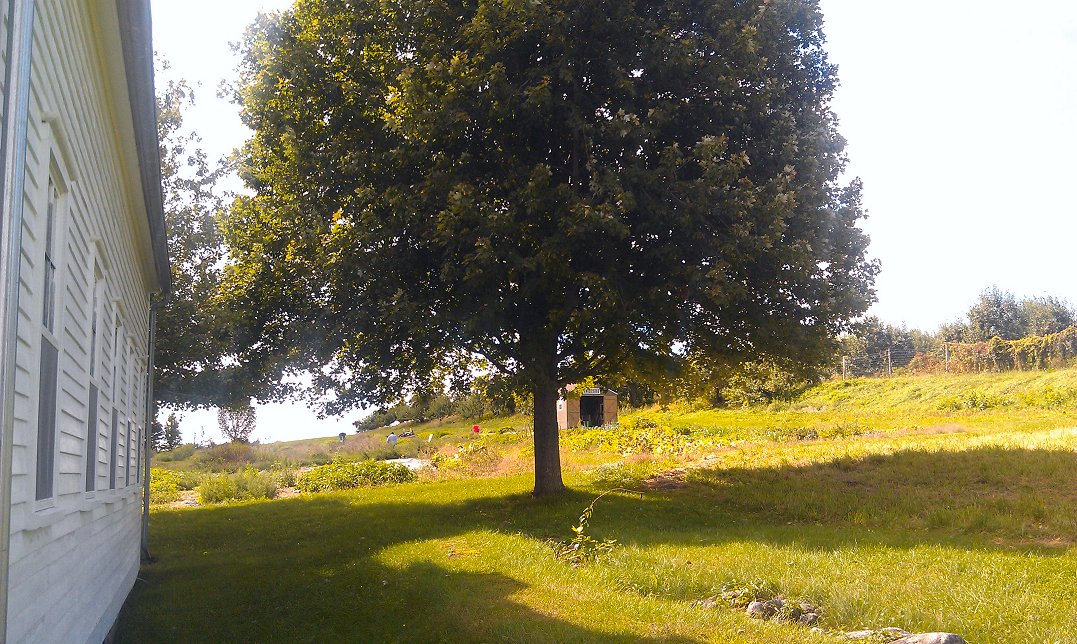
Off Maine Street at the crest of a rolling hill, just northwest of New Gloucester, Maine, one finds a tidy settlement of white clapboard houses nestled around a quiet road. If one had not seen the signs, one would not know that this is the last surviving active settlement of Shakers, which now consists of three members.  During a recent vacation trip to Maine to visit my wife’s mother and her family there, we spent some time getting to know this peaceful settlement, largely run by a cadre of volunteers known as “Friends of the Shakers,” who help the last members of the order keep their lifestyle going.

Shakers1

Map and key of the Shaker settlement, from the historical landmark website.

earth

Google Earth capture of the Shaker settlement.

IMAG2679

The Girl’s Shop

We were taken on an hour-long tour (which seemed all too short, given the amount of things there were to see) by a friendly  volunteer; we were able to visit the meetinghouse and the ministry’s shop; had we asked for “Tour B,” we would have seen the Girls’ Shop instead of the ministry’s shop. We’ll have to go back next year and do that one.

Sadly, photography inside the buildings was prohibited, because there were 101,000 wonders that I would have loved to record. But it was fascinating to sit in the meetinghouse where men and women would enter by separate doorways, visit the living quarters of the traveling elders and eldresses who formed the upper levels of Shaker leadership, and see a number of places where they worked at creating simple but extremely beautiful (as well as utilitarian) objects for their daily needs.

We learned of a number of Shaker inventions, among which were those little wobbly casters that people put under school chairs, knowing that folks like to rock back on them; the Shaker version was made of wood, and I’ll be dipped if I know how it was done. We also saw beautiful examples of their handicraft, including cabinetry, chairs, tables, clothing, boxes, pegs for hanging everything on, as well as the functional architecture of their buildings. The books… oh, the books. I would have paid large money to be able to examine some of the volumes that were displayed in desks and cabinets around the buildings.

IMAG2681

Volunteers working in the herb garden

IMAG2682

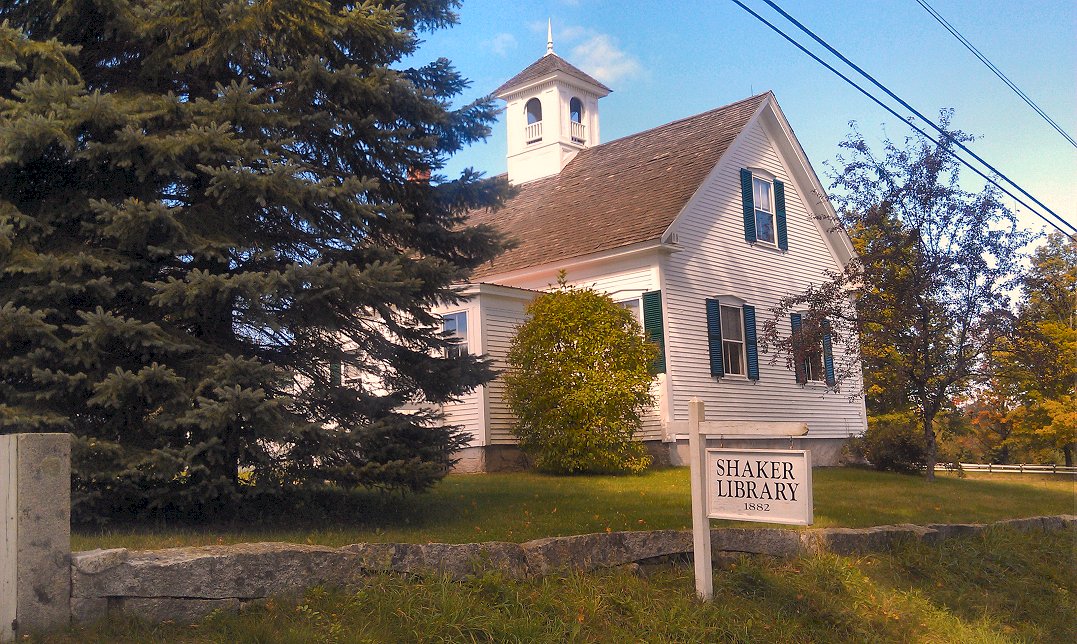
The Shaker Library, back view

IMAG2683

Shaker Library, front view. With an advance appointment, one can visit this building. Next time.

IMAG2684

The Girls’ Shop, front view.

IMAG2685

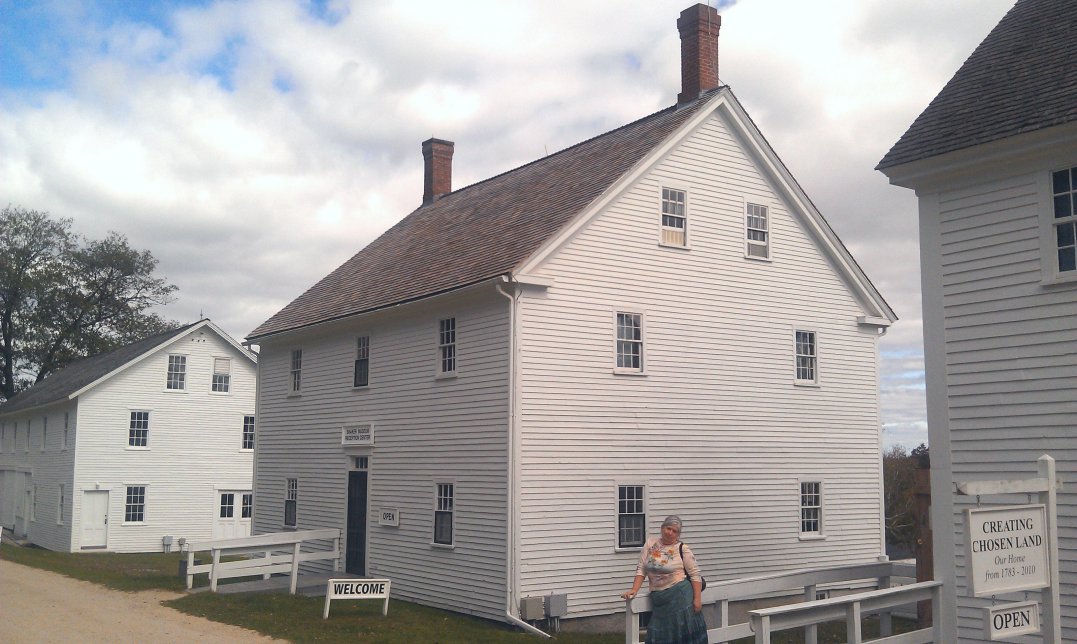
Meetinghouse, built in 1794, and ministry’s workshop.

IMAG2686

The Herb Garden

ToniAnneShakerSmall

My wife (the Goodwoman of the House) in front of the museum office, which used to be the boys’ shop; exhibit museum on the right, formerly the spinhouse.

After the tour and visiting the museum, we spent (too much) time in the Shaker Store (formerly the Trustees’ Office; the trustees were members of the order who dealt with the outside world and were in charge of temporal matters, and often only associated with the rest of the community during worship services.) We bought some lovely yarn (I’m planning a nice fair-isle hat), some herbs, and a few books.

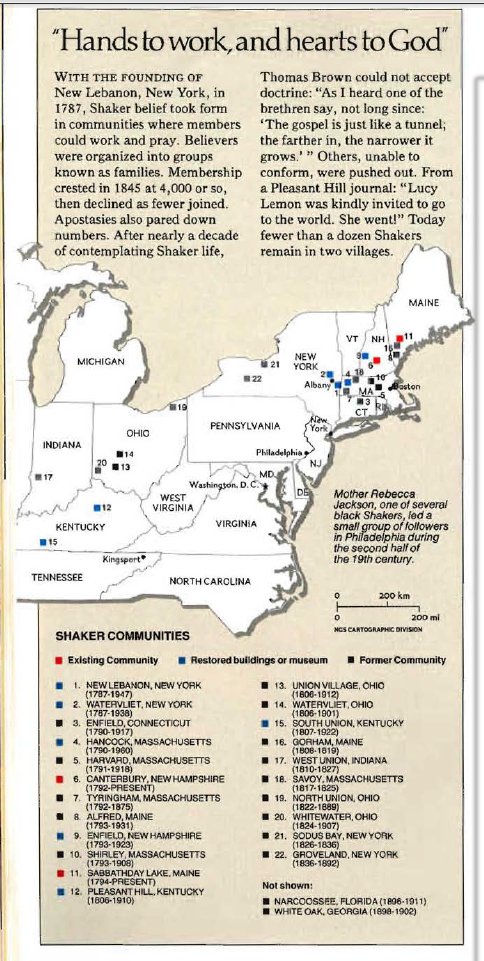
Much can be learned about the Shaker faith and history at their official website; theirs is a story of quiet faith, diligence, and devotion which has weathered many changes in the world around them. Their motto, “Hands to Work and Hearts to God” has essentially defined their way of life, although it is not their devotion to celibacy that has ultimately fueled their decline, but rather the concept of community over individualism. A well-written article in the September 1989 issue of National Geographic entitled “The Shakers’ Brief Eternity” presents a respectful and intimate look at their history and their present.

Map.jp

This map from the National Geographic article shows past and present Shaker communities; in 1989, there were two dozen members in two working settlements, the one at Canterbury, NH having since ceased operation with the death of its last member, Sister Ethel, in 1992. (Bangor Daily News, Sep 9, 1992). Despite the devotion to God, there was philosophical disagreement between the communities at Canterbury and Sabbathday Lake; a 1988 article from the Los Angeles Times summarizes the essential point of division:

In 1957, after months of prayer, the three Eldresses [of Canterbury] — Gertrude, Emma and Ida — decided to close the covenant to membership.

In the past 10 years, three men and a woman in their 20s and 30s have become residents of the community at Sabbath Day Lake, but Eldress Bertha does not recognize them as members.

“To become a Shaker you have to sign a legal document taking the necessary vows and that document, the official covenant, is locked up in our safe,” she said. “Membership is closed forever.

“We must live true to our faith and must follow what our leaders say. Our leaders decided it was over, done with. It is sad, but Mother Ann predicted that in time you would be able to count the members on the fingers of your two hands and then the Shakers would be no more. This is where we are now. . . .”

There were words; there were actions. For a while, Canterbury cut Sabbathday Lake off from community funding; after negotiations by their respective legal teams, access was restored. The National Geographic article stated,

Canterbury Shakers accept the quiet ending. They believe Shaker values will endure but in different form. Canterbury slowed down decades ago. Sabbathday Lake chooses a more energetic path. There are sheep to be tended, herbs to be dried, a fence to be mended, meals to prepare. Those seriously interested in the life are sometimes invited to try it. Some stay; some don’t.

The author of the National Geographic article related,

The territory separating the two villages is a minefield of hard feelings. I had been cautioned not to mention my Canterbury visit to SabbathdayLake and vice versa. I ignored the advice with predictable results. At Canterbury there had been a silence when I mentioned Sabbathday Lake. It was an unpleasantness to be swept under the table. At Sabbathday the rancor is blunt, the hurt palpable. “They say Sabbathday was always the least of Mother Ann’s children in the East,” Sister Mildred observes.

While Canterbury functioned, the feelings were hard on both sides. Now that Sabbathday Lake is the last remaining community, memories and feelings may endure, but anyone who will is welcome to explore and embrace Shaker life. According to the tour guides there, the community receives somewhere in the area of two inquiries a week. However, the mean age of the three surviving Shakers is 65, and a fourth member left the community some years ago after he fell in love; the way of the “three C’s” – Celibacy, Community Property, and Charity – is not an easy one to follow.

I was delighted to explore the lives and history of these gentle people. I learned that the Shakers invented one of the first perma-press cloths in existence; that their blue wood stain lasts almost forever; that the finials on their chairs are all different, depending on which community made them; that they wove cloth out of fine wood strips to cover their boxes and other artifacts; and that they were skilled in just about every area needed to be self-sufficient. I look forward to my next visit, and hope that I can learn even more about them in the meantime.

What is the future of the Shakers? No one knows, but the last members put their trust in God as their community has always done.  In a 2006 article in the Boston Globe, Brother Arnold Hadd is quoted as saying,

“I don’t know the mind of God. However, I do believe that if we live in faith – as we do – that, as we have been called and chosen, there will always be others who will also be called and chosen to this life. So, our intention is that there will be more Shakers.”

pho_5x

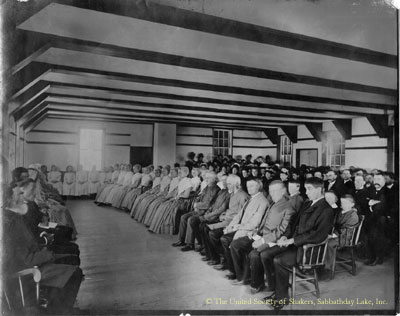
A view of Shaker Meeting from 1885. A photographer from the Poland Spring Hotel took this image. The Shakers are seated in the front benches. The spectators and guests from the Poland Spring Hotel are in the back rows. The women’s entrance can be seen at the back; the men’s entrance is just outside the right frame of the photo. In earlier days, a stairway existed at each end of the hall leading to separate living quarters for the traveling elders and eldresses of the ministry. Collection of the United Society of Shakers, Sabbathday Lake, Inc.

pho_7x

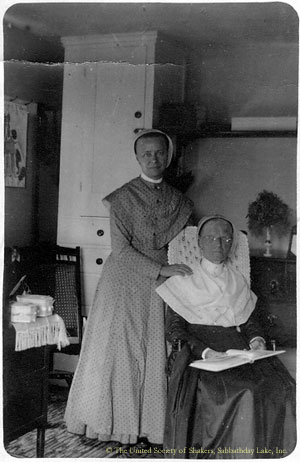
Eldress Elizabeth Haskell (left) and Eldress Harriet Goodwin (right) pictured in their fancy goods workroom at the Ministry’s Shop at Sabbathday Lake in 1899. Collection of the United Society of Shakers, Sabbathday Lake, Inc.

6733

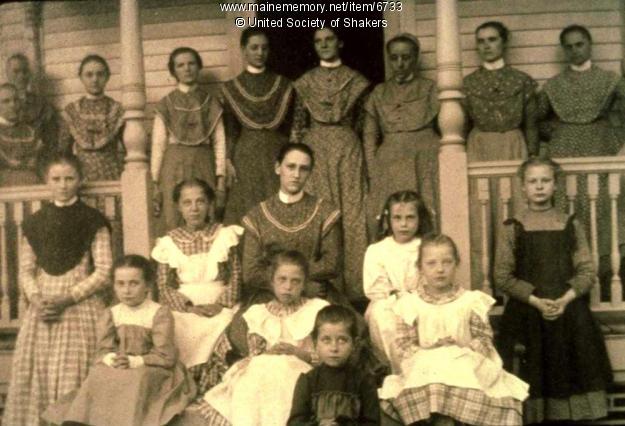
Sisters and girls, Sabbathday Lake Shaker Village, ca. 1902
Pictured from left are, back row, Sisters Clara Stewart, Amanda Stickney, Mamie Curtis, Katherine McTigue, Lizzie Bailey, Laura Bailey, Sarah Fletcher, Jennie Mathers, Ada Cummngs and Claire Chace. In the front row, from left, are Rosamond Drake, Ethel Corcoran, Grace Freeman, unidentified girl, Irene Corcoran, Iona Sedgley, unidentified girl, Emma Soule and Emma Freeman. Although organized as celibate religious communities, Shakers still made provisions for the raising of children. By this time, most of the children who entered the community were orphans. They were placed in either the Girls’ Shop or Boys’ Shop, apart from the adults in the Dwelling House. Caretakers looked after the children, supervising their education, work and play. The group is on the front porch of the Girls’ Shop, Sabbathday Lake Shaker Village.
From Maine Memory Network.

‘Tis the gift to be simple, ’tis the gift to be free
‘Tis the gift to come down where we ought to be,
And when we find ourselves in the place just right,
‘Twill be in the valley of love and delight.
When true simplicity is gain’d,
To bow and to bend we shan’t be asham’d,
To turn, turn will be our delight,
Till by turning, turning we come ’round right.

“Simple Gifts” was written by Elder Joseph Brackett while he was at the Shaker community in Alfred, Maine.

The Old Wolf has spoken.