A message to my evangelical brothers and sisters

Written by a mainstream Christian, Kate Penney Howard on Facebook. I am immeasurably grateful for this post.


“In recent weeks, I’ve watched a troubling pattern emerge online. Whenever a news story mentions the horrific attack in Grand Blanc, there’s an inevitable chorus of voices “correcting” the record: “Actually, Mormons aren’t Christians.”
Let me be clear: This is gatekeeping, and it needs to stop.
One of the most dangerous temptations of religious life is the urge to define who’s “in” and who’s “out.” When we appoint ourselves as arbiters of authentic faith, we’re not protecting orthodoxy. We’re playing God.
The Latter-day Saints call themselves Christians. They center their faith on Jesus Christ. It’s literally in the name of their church. They believe Jesus is the Son of God, that he died and was resurrected, and that salvation comes through him. They read the Bible, gather for worship, sing hymns, pray to God, and seek to follow Christ’s teachings about love, service, and redemption.
I know a LOT of LDS folk and I have to say, they give me a run for my money in the being kind and graceful department.
Do they have different theological perspectives than me? Absolutely. So do Quakers. So do Catholics. So do Methodists and Presbyterians and Episcopalians. So do Catholics and Orthodox Christians. So do Pentecostals. So do Seventh-Day Adventists. So do Unitarians. The body of Christ has always contained multitudes.
Exclusion has consequences.
We cannot talk about denying Latter-day Saints the label “Christian” without acknowledging the violent history behind such rhetoric. In the 19th century, largely at the urging of preachers in the Restoration Movement (that’s us, my DoC friends), and Presbyterians, Baptists, and Methodists, Mormons were driven from state to state, their homes burned, their communities terrorized, and sometimes killed. Missouri’s governor issued an extermination order against them in 1838. Joseph Smith was murdered by a mob.
And throughout this persecution, one of the accusations hurled at them was that they weren’t “real Christians,” that they were dangerous heretics who deserved what they got.
When we casually exclude LDS individuals today, we echo that violent history. We may think we’re making a theological point, but we’re perpetuating a legacy of exclusion that has caused real harm to real people.
Rather than obsessing over differences, let’s consider what Latter-day Saints share with the wider Christian tradition:
We worship the same God and proclaim the same savior.
We share sacred scripture in the Bible
We practice baptism and communion
We value prayer, worship, and community as essential to faith
We believe in serving others and caring for those in need
We affirm that Christ’s resurrection offers hope and new life
We gather to worship and encourage one another
We seek to follow Christ’s example of love and compassion
These aren’t minor overlaps. These are the heart of Christian faith.
Do I think they are perfect? No, I do not. However, neither is my tradition and neither is yours.
Here’s what troubles me most about the “Mormons aren’t Christians” crowd: the stunning confidence that their interpretation of Christianity is the only valid one. As if two thousand years of Christian diversity, debate, and development can be boiled down to a checklist, and anyone who doesn’t tick every box gets expelled.
The early church argued about whether Gentiles could be Christians without first becoming Jewish. They debated the nature of Christ for centuries. They split over the filioque and papal authority. We built this country on religious freedom. Why do we think it’s suddenly our job to kick people out?
I’m not suggesting all theological distinctions are meaningless. I’m not saying differences don’t matter. I’m saying that deciding who gets to claim the name “Christian” isn’t our call to make.
If someone says, “I follow Jesus Christ,” who am I to say they don’t? What profound arrogance would that require?
Instead, let’s practice some humility. Let’s recognize that God is bigger than our theological boxes. Let’s acknowledge that throughout history, the people who were absolutely certain about who was “in” and who was “out” have often been on the wrong side of justice.
The Latter-day Saints have been our neighbors, our colleagues, our fellow seekers of truth. They have fed the hungry, clothed the naked, and loved their neighbors. They have raised families, built communities, and tried to live out their faith with integrity.
They call themselves Christians. That’s enough for me.
But, Pastor Kate. We know you. We know you have strong feelings about some things, like the ordination of women and the safety of LGBTQIA believers. I do. I do have those strong feelings. And I also know that several LDS folk, including a Bishop, have kindly asked me if I would be open to talking to them about these two issues. And I did. And I could tell their ears were hearing me. I think there’s hope that we’ll agree on more things.
Maybe instead of asking “Are Mormons really Christians?” we should ask: “What kind of Christians are we being when we spend our energy excluding others instead of living out Christ’s radical love?”
Jesus said, “By this everyone will know that you are my disciples, if you love one another” (John 13:35). He didn’t say, “Everyone will know you’re my disciples if you have perfect theology.” He didn’t say, “Prove your faith by drawing the boundaries tightly.”
He said: Love one another.
The tent of God’s love is bigger than we imagine. Let’s stop trying to make it smaller.”


This is so comprehensive and well-written that it defies theological dispute.

The Old Wolf has spoken.

For the Ward Clerks out there

If you happened to be a member of the Church of Jesus Christ of Latter-day Saints in the ’60s and were ever called as a Ward Clerk, or one of the assistant clerks – Historical, Financial, or Membership – you may remember the old Adler 200 typewriters.¹

Long before the advent of computers or word processors or even IBM Selectrics or Daisy-wheel typewriters, Adler was the go-to brand if you wanted a typewriter with an unusual font. I don’t know how many Adlers the Church of Jesus Christ of Latter-day Saints purchased over time, but I’d bet they kept a lot of factory workers and typewriter repair personnel in business for decades.

The LDS Adler had a specific keyboard layout, as well: you didn’t have to shift for numbers (because they were used mostly for entering financial records) and symbols were on additional keys.

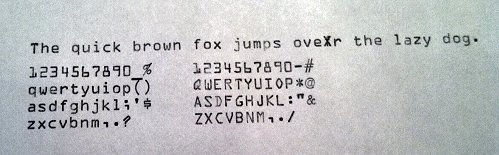
The font that came with these machines was OCR-A, a font created in 1968, in the early days of computer optical character recognition, when there was a need for a font that could be recognized not only by the computers of that day, but also by humans.” (Wikipedia) It looked like this:

In the case of financial donations, members would fill out donation slips (being admonished to always write their names the same way each time):

and clerks would painstakingly transcribe these slips onto a ledger sheet on the typewriter, which was then sent by snail mail to headquarters where the records were scanned and entered into mainframe databases. Other information was also recorded using these machines, which were built like Sherman tanks, and like a Timex watch they would “take a lickin’ and keep on tickin.”

Ward clerks often served for extended periods of time; whereas service callings in the Church today generally only last a few years, back in the day it was not uncommon for a clerk to serve for decades, especially if he did a good job.

The Ward Clerk

He kept the minutes, typed each note,
And put them in the file.
The membership he knew by rote;
He labored with a smile.

The ordinations, births and deaths
He faithfully recorded
For forty years, until at last
He went to be rewarded.

The people he had known so well
Turned out to shed a tear,
And pay respect to this good man,
Gone to another sphere.

But as the choir rose to sing,
They saw with consternation
The good man from his coffin step
To count the congregation!

-Author Unknown

It is said in the navy that the Captain may command the ship, but the E-7’s (Chief petty officers) keep the show running. Much the same could be said about a ward or branch of The Church of Jesus Christ of Latter-day Saints; the Bishop or Branch President may be in charge, but the ward clerks keep the wheels greased and everything running smoothly so the leaders can focus on ministering rather than administering.

The Old Wolf has spoken.

Footnotes

¹ The typewriter photos used in this post are from typewriter hunter Jake Fisher at the Typewriter Database.

The Purpose of Life

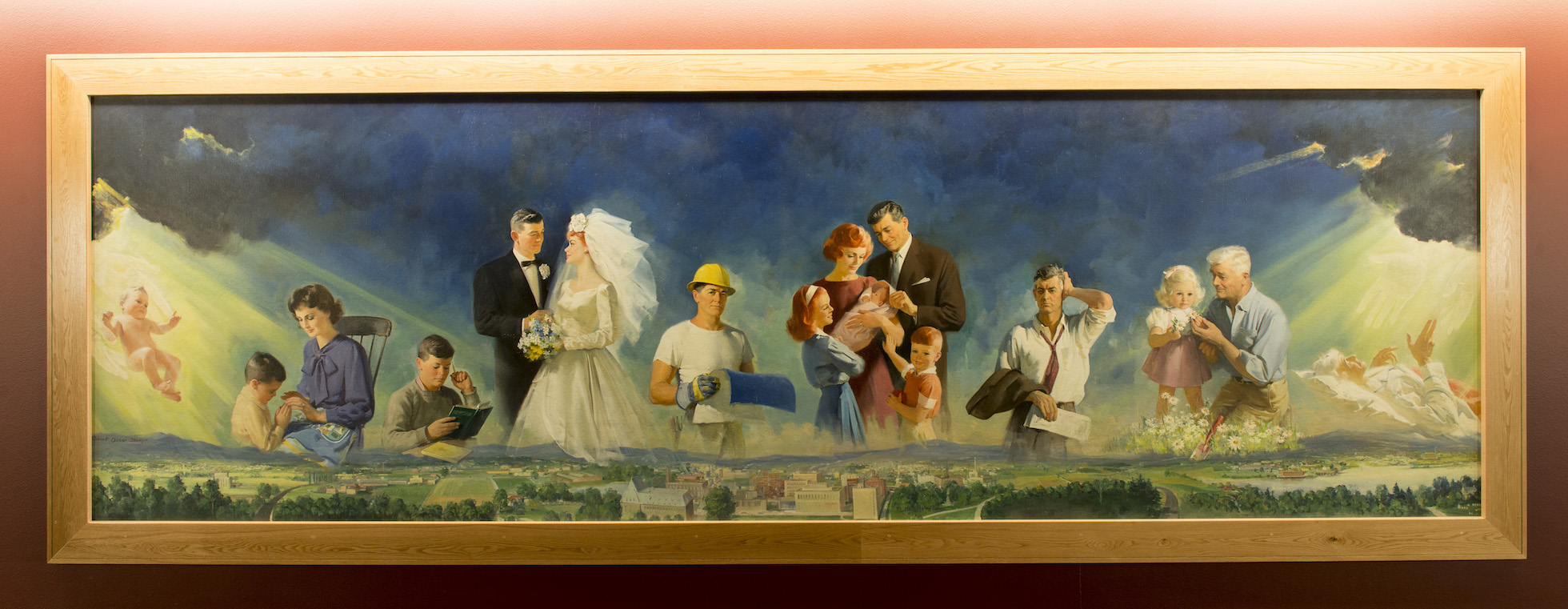
For the longest time, in the South visitor’s center of the Church of Jesus Christ of Latter-day Saints in Salt Lake City, hung the following mural by Robert Oliver Skemps (click the image for a larger view):


New I-Center Mural

It depicts God’s plan for our existence on earth, a probationary period during which we  have the opportunity to obtain a physical body to experience life’s blessings and challenges, and be tested to see if we will exercise our free agency to choose good or to choose evil. From left, the seminal events in our life are birth – our arrival in this world from our previous existence with God; instruction in the home; education; marriage; work; family; adversity; fulfillment; and finally death – our return home to the God who gave us life.

It’s a beautiful painting, but at some point the Church decided that it had a “dated” look – it definitely looks like something out of the 50s, and was originally commissioned for display at the New York World’s Fair in 1964. After being removed from Temple Square, the painting was sent to the Hyde Park Chapel in London where it hung for many years, until it was carefully removed by Scott M. Haskins and lovingly restored. It is now displayed at Brigham Young University Idaho.

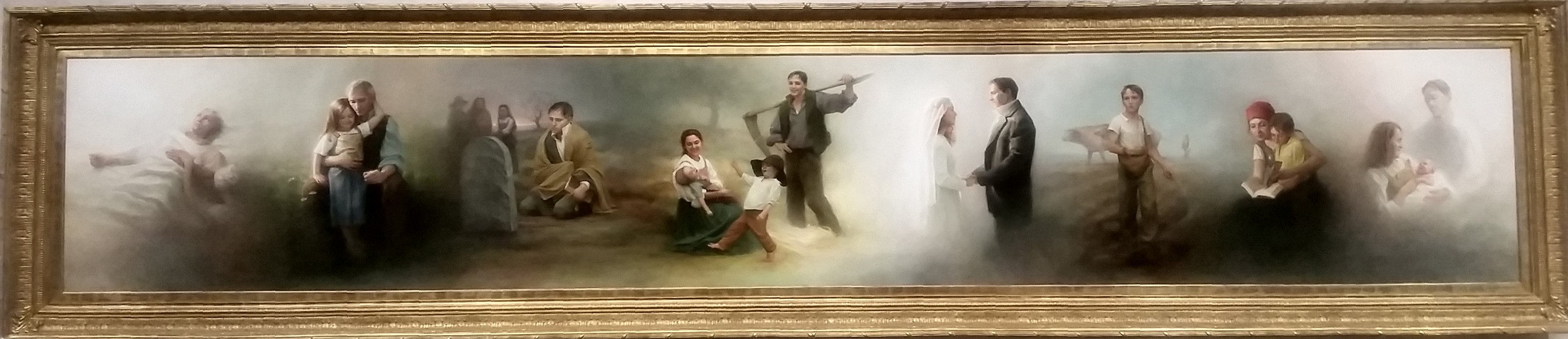
Taking its place in the visitor’s center was a new version by Joseph Brickey. In a communication with me, he mentioned his challenge in “updating” such an iconic painting. Church authorities wanted the same painting with modern attire, and Mr. Brickey indicated that he solved the problem by advocating for “metadating” instead – that is, going backward in time to a pioneer setting that would be timeless and resonate with people of any generation.

I was able to go home to Salt Lake early this month, and took this picture (potato quality because it was shot with my ancient Galaxy S5, but good enough to give you the idea – click the image for a larger view:)


Purpose of Life Painting 2

The message – this time presented from right to left – remains the same, but the pioneer motif definitely seems more appropriate to past, present, and future.

As mentioned in this blog post, there is another version of this mural, also by Robert Oliver Skemps, depicting the purpose of life with Asian models, which hung in the visitor’s center of the Hawaiʻi temple. I once saw a thumbnail of it, but have been unable to locate it again. It was salvaged during the demolition/reconstruction of that visitor’s center, but I’m not sure if it was ever acquired by the Church. If it is ever restored, I’ll do my best to get it up here.

The Old Wolf has spoken.

The Deseret Alphabet remembered

I have written about the Deseret Alphabet before, in a somewhat unusual context – today I came across a nostalgic article at the Deseret News commemorating this bit of linguistic whimsy. It appears to have begun development as early as 1847, which would make it closer to 170 years old.

lark is up

The poem above, from the Deseret Second Book (page 31), reads as follows:

The lark is up to meet the sun,
The bee is on the wing;
The ant its labor has begun,
The woods with music ring.

And shall I sleep while beams of morn
Their light and glory shed?
For thinking beings were not born
To waste their time in bed.

Clearly the authors of these primers were not above a bit of plagiarism; the first stanza of this poem is by William Holmes McGuffey (1800–73)

The original second stanza reads,

Shall birds, and bees, and ants, be wise,
While I my moments waste?
O let me with the morning rise,
And to my duty haste.

McGuffey’s Eclectic Primer, newly rev., lesson 81, p. 54 (1849).

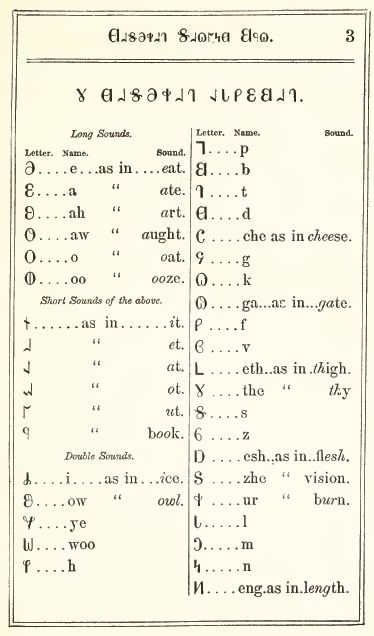
The transliteration of the Deseret Alphabet:

Deseret Alphabet

In the course of a study of Deseret as part of my MA in linguistics, I discovered that it had an added and unplanned benefit; reading the journals of Brigham Young, some of which had been transcribed into Deseret Alphabet during the days of enthusiasm for the project, I discovered that these manuscripts served as a window into the dialect and pronunciation of the scribes of the day. Since people transcribed the English they way they pronounced it, one could not only determine that various volumes were transcribed by different people, but also have a fair idea of what they sounded like when they spoke.

𐐜 𐐄𐐢𐐔 𐐚𐐃𐐢𐐙 𐐐𐐈𐐞 𐐝𐐑𐐄𐐗𐐤.

My Lifelong Wrestle With Mormonism

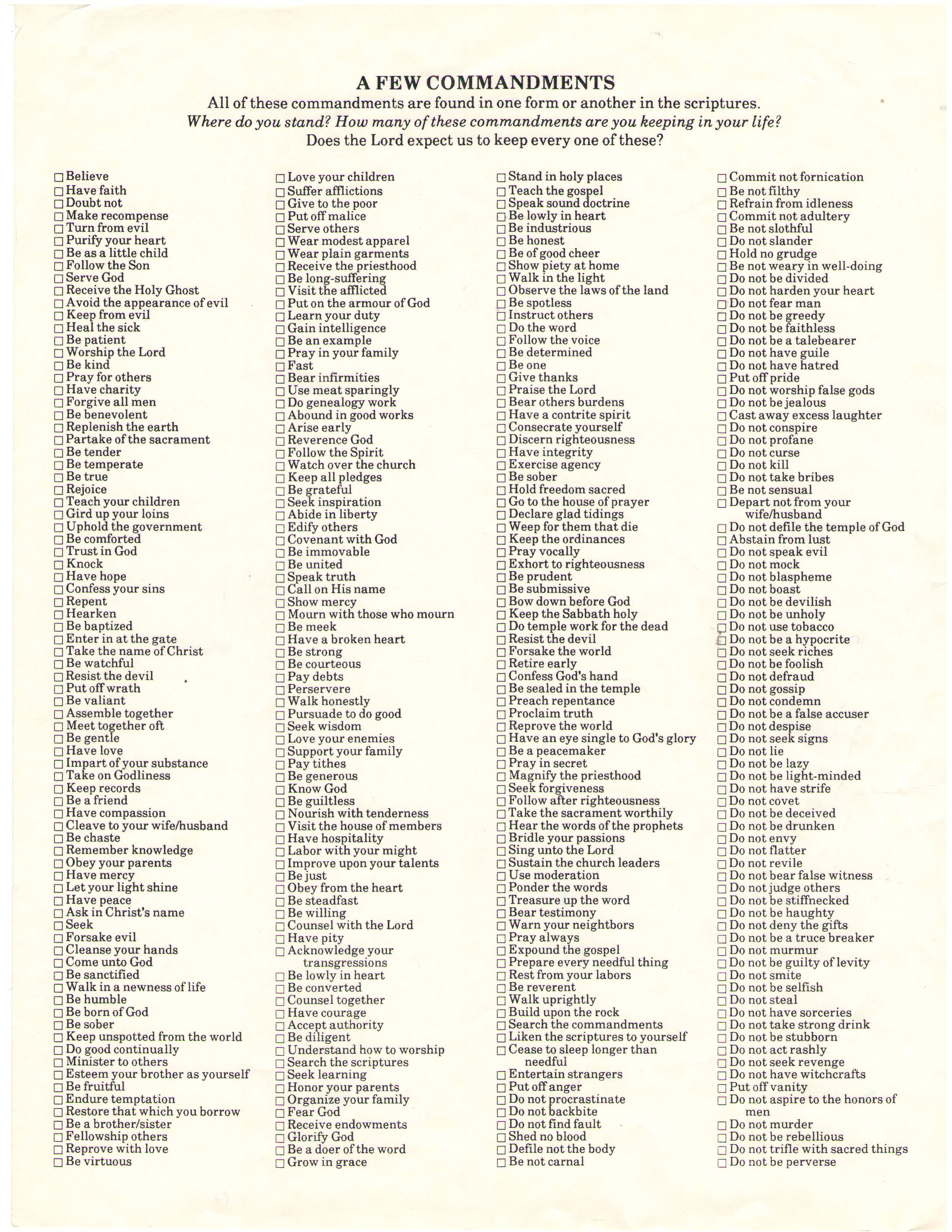
An insightful and poignant essay, very much worth sharing. His second list is much like one I saw decades ago, compiled by a good friend of mine, Dru White:

A Few Commandments

The Old Wolf has reblogged; be sure to read the full post below.

Kate's avatarRelationship Refinery

Since I’ve at times been grumpy, tired, the bad kind of opinionated, and wrong about things, I haven’t felt like I’m the right person, in the right moment, with the right amount of faithfulness to be the giver of the things I’ll discuss below.

I’m not a theologian or doctrine ninja. I’m not extremely well-versed in scripture and I haven’t always been on the straight and narrow path.

View original post 2,440 more words