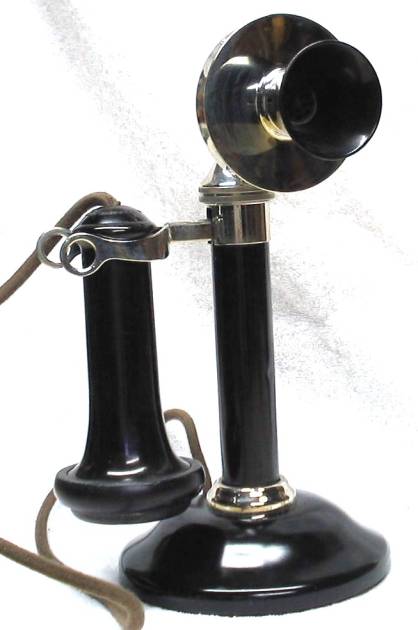
Telephones of Tomorrow – as seen from 1957

Surprisingly accurate predictions, despite a few misses (tape-recording of calls, for example).


TELEPHONES OF TOMORROW

by J. R. Pierce

Condensed from The Atlantic Monthly (December, 1957)
The telephone network is the nervous system of our civilization, carrying messages of demand and direction, of pain and pleasure, to collective enterprises and to individuals alike. The telephone itself is a mere end-organ which enables any of us to make use of billions of dollars worth of complex switching and transmission equipment.

A new car is a complete means of transportation, but a new telephone can be only a small alteration in a massive electronic organism that seems to change with glacial slowness. For this reason it is far easier to see what sort of advances in telephony are technologically possible than to say when they may actually take place, and I doubt if anyone can make detailed predictions concerning the future.

Nevertheless, we are in a period of change. Phones now come in colors and in several new shapes. New services are available. We should expect many new things in the future. What may they be?

Let us consider first the field of new services. A friend of mine told me recently that he would like to turn off his phone while he is working on a novel. I explained to him that just disconnecting the bell would lead to repeated but uncompleted calls for which the telephone company would pay. There would be complaints that his phone was out of order. To all of this he agreed, but he asked if he couldn’t just throw a switch and have something in the telephone office say, “This telephone is not out of order; the subscriber has voluntarily disconnected the ringing signal.”

The suggestion seemed a sensible one, but I had to tell him that it was impractical at present. The reason lies at the heart of the possibilities and difficulties of any new services that might be valuable.

Fundamentally, an automatic switching system performs two functions. It interprets the dial signal as a demand for a certain telephone connection, and it sets up the desired talking path. The first function, that of interpreting the dial signal, might be thought of as a mental function, and the other, that of establishing a talking path, as a muscular act.

In the first sort of automatic switching system, the brains are of a very limited type. Further, in this step-by-step kind of switching system, the brains are scattered all through the body, like the complicated ganglia of dinosaurs, which were sometimes larger than the lump of nervous tissue in the skull. One can teach a step-by-step switching system to do even one new thing only by the most drastic and expensive surgery.

Common-control systems, which first appeared in 1921, represent a tremendous evolutionary advance. In them, a ”brain” carefully records the dial signal and then deliberates on what to do. When it has decided, it sets up the talking path by using physically separate equipment.

At present, the most advanced switching systems in use are composed primarily of relays, though a few vacuum tubes and transistors have been grafted onto them. However, work is progressing on switching systems made up of tiny transistors, which operate thousands of times as fast as relays. Such an electronic switching system will have a quick, subtle, and adaptable brain which can be taught many new tricks.

Electronic switching has opened our eyes to all sorts of new services which are technically possible, whether or not they ever come into actual use. Among these is certainly the phone-disconnect notice my friend wanted.

Other possibilities include the ability to dial a selected group of telephone numbers by setting a pointer, or by one or two pulls of the dial (by pushing one or two buttons, if pushbuttons replace dials); a central answering and recording service, in which there is no special equipment on the subscriber’s premises; ways of breaking into a busy connection in case of an emergency; and a host of other possibilities.

Which among these will come into being and when they may be available, no one can tell, but electronic switching will make them easy.

By using transistors, it has been possible to put a radio receiver as good as that used in mobile telephony into a case little larger than a pack of cigarettes, and which includes batteries for four days of continuous operation. If a person carries such a receiver with him in the city, it is possible to signal him selectively by making his receiver—and only his —buzz when he is wanted on the telephone. He can then go to the nearest phone and call to see what the message is. Indeed, commercial radio-paging services are in operation in some cities, and the telephone companies are trying them out.

Does this assure a two-way phone in your car or perhaps even in your pocket? Technically, it makes such things very near. By using transistors, we can build a tiny receiver which can operate 24 hours a day without a noticeable drain on a car’s batteries. Including a suitable transmitter, the whole car telephone could fit into the glove compartment or be incorporated with the radio. Further, pocket telephones are not technically absurd.

Will NEXT year’s car come equipped with a telephone as well as a radio? Not unless something changes. And that something has nothing to do with the technological limitations of ft radio, nor is it a matter within the control of the telephone companies.

Of the radio frequencies which are suitable for mobile telephony, those which extend from perhaps 50 to 890 megacycles, the government has allocated roughly 50 percent to ultra-high-frequency television, 7 percent to ordinary television, 25 percent for government use, 4 percent for amateur radio, 4 percent for FM, and only one-third of 1 percent for all mobile telephony. The continued assignment of these frequencies to other uses could keep the telephone out of your car, plane, or pocket, however great our technical know-how may become.

There will still be telephones in your home and office, however, and these are bound to become better in a number of ways. Indeed, one ambition which has been often expressed is to make the telephone so good that telephoning will be as satis- factory as a face-to-face meeting.

Partly, what is called for is a better voice signal. A good telephone call is perfectly intelligible, but hardly hi-fi. However, for special uses, such as conference use, a higher quality of speech can be provided by means of special circuits.

Of course, if we are to confer satisfactorily by telephone, we will have to transmit pictures as well as speech. Television transmission facilities are available, but they are at present too costly for anything but very important conferences or very large meetings. For some reason, however, they haven’t been used much for either.

I feel certain some day pictures will be sent not only in connection with conferences but in connection with some telephone calls as well. A couple of years ago the Bell Laboratories experimented with a device called Picturephone, which sent a series of still pictures, one a second, over an ordinary telephone connection. However, the pictures proved too fuzzy to be of any real use. Perhaps a picture intermediate in quality between Picturephone and present-day television is called for.

To provide picture transmission to telephone users, new and more economical ways of sending electrical signals must be developed. Happily, great advances have been made in the electronic art of signal transmission. One of these is the transistor, which in amplifying a signal uses much less power than a vacuum tube. In fact, the power consumed by a transistor amplifier can be sent over the same wires used to carry the signal itself.

Another advance is a new way of sending signals over wires, called pulse-code modulation. Ordinarily, we send a voice or picture signal as a smoothly but rapidly varying electric current which must be transmitted and amplified repeatedly with no distortion. However, a way has been found of representing such signals as sequences or patterns of off-on pulses. Such pulses can be amplified simply and cheaply without any degradation in the ultimately reproduced voice or picture.

Further, such signals can be sent great distances through pipes called waveguides. They can travel as electromagnetic radiation having a frequency perhaps 50 billion cycles per second through thousands of miles of a metal tube around 2 inches in diameter.

I believe that ultimately such transmission by means of off-on pulses will make television as an accessory to the telephone economically possible, for some uses at any rate.

Such electrical pulses as I have mentioned above are the natural language of computers and business machines. These electronic brains have never used pen and paper, nor human speech. They write upon and read from magnetic tape in a language consisting of sequences of pulses. One can speak to them or hear from them, control them or be controlled by them at a distance, by transmitting such pulses by wire or radio. Sometimes such machines translate their internal language of pulses into printed English characters, but this is merely for the benefit of their human associates.

We usually think of such machines as huge giants chattering away at a superhuman rate. Indeed, they do talk back and forth over communications channels, but the world of tomorrow will be full of a host of electronic machines of all degrees of size and complexity. In fact, today’s teletypewriter is an early member of that race. Cash registers and other business machines often punch a record of their operations and conclusions into paper tape, which can be transmitted electrically from point to point.

Future machines will almost certainly record on and be operated from magnetic tape. We can imagine a time when small machines in stores and offices will store up a tape record of each day’s operations. Then a big machine at a bank or an accounting service will call the little machines up during the night and record what happened during the day.

I like to think of a time when each secretary’s typewriter will produce a magnetic record as well as the usual typescript, a record which can be filed, reproduced, sorted over, or transmitted to some distant concern by quick electronic means. Indeed, an experimental device the size of a typewriter has already been built which will transmit text recorded on a magnetic tape over a telephone circuit at a rate of about 800 words a minute.

I see communication between machine and machine and between man and machine as an important part of the business of the’ telephone companies in the not-distant future.

Beyond this there are more distant and less concrete possibilities. .The design, construction, and installation of the transatlantic telephone cable, in which 104 delicate and precise vacuum-tube amplifiers function on the bottom of the ocean, beyond the reach of human adjustment or repair, was an engineering feat of a scope comparable with that of establishing an artificial satellite.

In the future we may have manned as well as unmanned satellites, established in their orbits for scientific or military reasons. If manned satellites come to be, they will provide valuable radio relay sites for spanning the oceans with television as well as voice. Perhaps later on we will have to face the problem of communicating with men on the moon, or on Mars.

—–

Calculations show that the electronic techniques used in the telephone system will do even this job. But when will men go to Mars? And will they perhaps go there to get away from the ever-present and insistent telephones?

—–

An electrical engineer, John Robinson Pierce took his B.S. from California Institute of Technology in 1933 and his Ph.D. three years later. He then joined the Bell Telephone Laboratories where he has risen to be director in research of electrical communications.


What’s next? Will our own predictions of what is likely 60 years from now seem equally quaint, or will the imagination of today’s soothsayers prove more accurate? Given the exponential development of technology within my own lifetime, I think it’s safe to say much of what my grandchildren’s grandchildren will see has not yet even been dreamed of.
What a brave new world that will be… if we survive.

The Old Wolf has spoken.

The Bathing Cart

A Bathing Cart  was a wooden locker room on two or four wheels that was pulled into the water. In the 18th and 19th centuries it offered women an opportunity to swim in the ocean unseen, in a morally proper manner. At that time it was considered indecent and offensive for a woman to bathe within sight of men, even though the then-common swimwear covered a lot more than it does today.


I have to admit I rarely go swimming any more.

Women bathing in burqas in Aqaba, Jordan.

While the modesty of centuries past seems rather more in line with what is common in parts of the Middle East today, I have searched the thesaurus in vain for words to charitably describe what passes for bathing attire nowadays; expensive dental floss is what comes to mind.

Somewhere there has to be a happy medium between extremist prudishness and a beach party sponsored by Cosmo. Sadly, my opinion will have scant effect on the trends of the world, and I’m almost glad I won’t be around to see what fashions look like (or don’t) in 50 years.

The Old Wolf has spoken.

Disclaimer

Technology, 50’s style

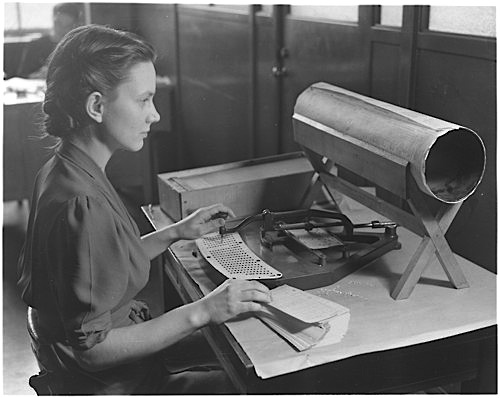
Woman operating a card puncher, ca. 1950

This is a card puncher, an integral part of the tabulation system used by the United States Census Bureau to compile the thousands of facts gathered by the Bureau. Holes are punched in the card according to a prearranged code transferring the facts from the census questionaire into statistics.

Found at the National Archives

If my experience as a NRFU enumerator for the 2010 census was any indication, they probably are still using a few of these in back rooms somewhere…

Disclaimer

Hidden Street Art

Recently seen on Teresa Burritt’s Frog Blog:

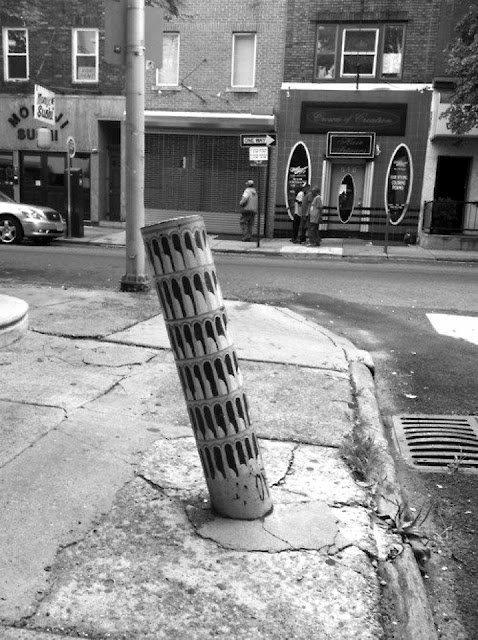
I loved this picture. Checking around, I found that the image had been posted and pinned repeatedly, but there was no source or location given, so I did a little sleuthing.

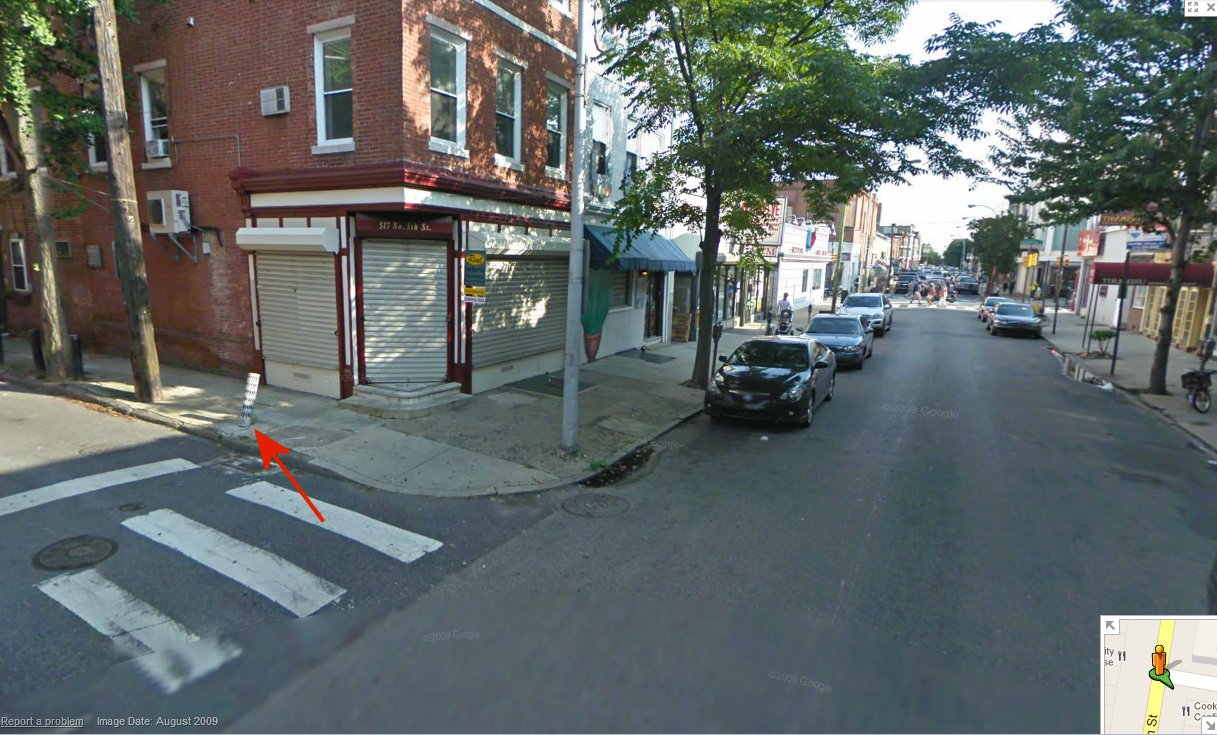
Very few clues were available, although at first I thought it might be somewhere in New York. The sushi restaurant’s name was obscured, and the neighboring shop’s sign was difficult to read, but I tried Momoji and found a few hits. I was able to find one in Philadelphia on South 5th street. Google Street View showed that it had changed hands and is now called Niji Sushi house,

But the shop two doors down looked very familiar. Sure enough, Crown of Creation is also on South 5th Street in Philly:

Turning around, I saw something that looked very familiar:

Mission accomplished. Our leaning tower of Pisa is on the corner of South 5th Street and Gaskill Street in Philadelphia. Instead of a sagging pole, some enterprising street artist saw something else, and with a little paint created a tiny wonder, one of the many joys of urban life that is there for people with eyes to see. And Street View is awesome.

Another view:

The Old Wolf has spoken.

Disclaimer

Ripley: B’gosh, I’ll jest swan to Guinea!

A visit to the Ripley museum in St. Augustine, Florida, got the wheels turning a bit, and when I saw this article in the Wall Street Journal, I wanted to get a few thoughts down before they… squirrel!

Where was I? Oh, yeah. When I was a kid, I loved the Believe it or Not books. I remember poring over them with intense fascination… sort of like I would do today with Wikipedia or TVTropes (be warned, that’s a timesink!) Ripley was a source of the odd, the incredible, and the fascinating.

The largest Erector Set structure: a scale model Ferris wheel, two stories tall.

Ripley’s odditoria are full of intriguing things, and I enjoyed the visit to the one in St. Augustine, but it struck me that what passed for odd back in the day now seems a bit banal. With access to modern media and the shrinking of the world with speedy and effortless travel, the average American has probably become somewhat jaded; add to that the fact that as time passes, some of Ripley’s oddities (like the Iron Maiden, for example) have been called into question regarding their historical authenticity.

Ripley was a showman, but in my experience he never tried to deceive. Everything he reported on was legitimate, at least as he understood it in his day. And his daily cartoons must have been a source of wonder and amazement for people like Ma and Pa Ripley, living in their rattletrap cabin on the windswept Iowa plain (borrowing a riff from Hamlin Garland, here); folks who never got more than 100 miles from their farm in all their lives would scratch their heads in consternation at the thought of a Chinese guide with a candle in his head.

Small wonder that his cartoons were so popular.

Good thing they never caught sight of this gentleman:

Nowadays, 5 seconds with Google can find stuff in the real world that makes most of Ripley’s items seem as common as Wonder bread, and a lot of it absolutely redlines my Weird-o-Meter. But I still enjoy going through my old Believe it or Not books – it’s not hard to recapture the sense of wonder I had as a child as I read about the strange things one could find in the world.

The Old Wolf has spoken.

Disclaimer

The Scream: Symbol of a godless age

A recent article over at Slate examines the phenomenon of the one-hit wonder in the art world. While Munch does not fall into this category, The Scream is doubtless his best-known work. The article continues with an analysis of why this painting, which recently sold for a record $120,000,000 at auction, has been so popular over the years. The executive summary: it continues to terrify us. “After a century of mechanization and generally advancing secularism, The Scream continues to resonate because the inner turmoil it depicts remains part of the human condition.” As to its purpose, Munch noted that “that he’d created an image for a godless age, as people struggled to understand their place in a world without divine purpose.”

Not being a student of art history, I never knew that last little bit. Yet somehow, looking at the image, it makes sense. If you believe that the universe has no underlying purpose, that humanity and all else is the result of random evolution of hydrogen atoms into order, the madness of society could indeed leave a person feeling much like the faceless symbols of fear we see in the painting. On the other hand, my experience of people of faith is that they are less apt to respond in that manner; those who look beyond themselves for answers are more apt to leave the unanswered questions to God and find peace in a conviction that in some way, shape or form the universe is in good hands despite the inherent unfairness and difficulty of life.

To be fair, I know many humanists who live lives of fulfillment, contribution and purpose, and who work to lift the human condition without falling into psychotic fugues of terror. What I’m relating here applies more to myself than anyone else – I know that if it weren’t for my faith in a divine plan of happiness, I would probably spend my time screaming like the dude on the bridge.

The Old Wolf has spoken.

The Rise and Fall of Brick and Mortar

A recent article in the LA Times reports that Target has stopped selling Amazon kindles, apparently as punishment for Amazon’s push to get people to us other stores as a showroom for their own products, even going as far as to offer a 5% discount for ship-jumpers.

This is typical corporate thinking – penny wise and pound foolish. They are depriving themselves of a revenue stream, hoping to dissuade consumers from comparison shopping, and simply stated, it won’t work.

I do this all the time, and I don’t have a Kindle. I have an HTC Incredible 2, with a great little barcode scanner app, and if I see something in a store I will always do the online comparison unless I’m just out for something I need right at the moment. This is the new reality, and rather than respond with knee-jerk actions like Target (or the TSA, when it comes to that), stores will simply need to adjust.

It may mean carrying a smaller inventory at the storefront, and offering Amaz0n-comparable discounts for items purchased online. It may mean stores become more showroom than retail outlet, with merchandise that customers can inspect and then order on the spot by scanning a QR code. It may mean something else altogether. But whatever it means, stores need to come to grips with the phenomenon, rather than assume that some chuckleheaded response will make the problem go away.

The Old Wolf has Spoken

Karma

This is the all-time favorite post from over at NotAlwaysRight.com. It can be amusing, and it can be depressing at the same time – sort of like Dilbert… you know, so true it hurts.  But I share this one here because I love the ending of the story.

We reap what we sow.


Every (Bad) Crowd Has A Silver Lining

(When I was in college, I used to work in the cafeteria. On this day, two girls are making fun of a third.)

Mean Girl #1: “Oooooh, a hamburger? So much for that diet.”

Mean Girl #2: “Are you kidding? She’s never been on a diet in her life!”

(The third girl who they are talking to is, for the record, very nice looking.)

Girl #3: *taken aback* “I…I worked out today. I need the protein.”

Me: “Come on, leave her alone. She can eat whatever she wants!”

Mean Girl #1: “Yeah, I guess you don’t have to worry about what you eat if you’re already fat and ugly!”

(One of my coworkers has been listening from a distance. He walks over, looks all three girls up and down, and then turns to the third.)

Coworker: “Excuse me, miss, but do you think I could get your phone number?”

Girl #3: “Are you serious?”

Coworker: “Completely! Who wouldn’t want a date with a beautiful girl who knows how to take care of herself?”

(This was five years ago. I’m going to be the best man at their wedding.)


The Old Wolf has spoken.

Dear Nutella™…

Spett.le Ferrero,

I just received word that I am eligible to participate in the recently settled class-action lawsuit filed by Athena Hohenberg and her army of lawyers. While the prospect of getting a few bucks for nothing more than the effort of filing an electronic form is tempting, particularly in this economy, I respectfully decline to do so.

I regret that things went down this path. Corporate vigilance is important, but this lawsuit is a clear example of attorneys hungry for billable hours taking on what they see as a deep pocket, for no other reason than personal enrichment. To say that these leeches are concerned with public health is like saying that the fox is concerned with the welfare of the hens. I see nothing misleading in your contention that a bit of Nutella™ spread on a lovely slice of whole-grain bread is no less healthy than the same bread with honey, and perhaps even more so.

I’ve been loving Nutella™ since I discovered it in Europe decades ago, and I have probably bought at least a case of the stuff since 2008. I’ve enjoyed every bite, and you don’t owe me a dime.

Distinti saluti.

The Old Wolf has spoken.

Thinking can undermine religious faith, study finds

Thus proclaims solemnly an article in the LA times. I laughed hard when I thought about my humanist friends frantically searching for this button on their keyboards:

Image

It has long been known that independent thought and religious beliefs don’t blend well, but I can’t read an article like this without considering its implications, simply because I’m a person of faith who seeks truth wherever it can be found.

The vastness and complexity of our universe, from the macro to the micro scale, virtually gobsmacks me. I can’t contemplate the awesomeness of the cosmos or the incredible harmony of what happens at the subatomic level (and mind you, I’m looking at all of this from almost a layman’s perspective because I can’t do the math) without going back to my pinball days for an analogy:

Image

At the same time, I am unable to contemplate this same vast complexity and wrap my head around the concept of hydrogen atoms evolved to consciousness, with all due respect to Carl Sagan, who I think was a worthy purveyor of humanism.

The thing is – occam’s razor notwithstanding – science doesn’t explain it all for me. As deep as we’ve gone, as far out as we’ve peered, we haven’t even begun to scratch the surface of the cosmic repository of knowledge, and there are some areas that science and faith just can’t touch. Faith won’t explain dark energy or find a Higgs Boson, and science will never quantify Beethoven, Frida Kahlo or Maya Angelou.

We get into trouble when we try to look at the universe in terms of either/or, when we have the option of seeing it as both/and. Doing the former gets us into trouble on both sides of the fence.

Image

The error on the right neglects to account for things which have been proven beyond all reasonable doubt; the error on the left (which is only implied,) is for scientists to insist that the absence of proof of something equates to its nonexistence. Both errors are fatal, and lead to untenable positions.

“But there’s no empirical proof whatsoever for the existence of metaphysical phenomena, therefore we can’t factor them in,” says the scientist. This is why I absolutely love the novel Contact: Ellie Arroway was left with no proof that what she had experienced was real, yet despite the machinations of the scientific world to deny what could not be proven, she would go to her grave with a sure knowledge of what had happened to her was real. Joseph Smith, the Latter-day Saint prophet, said much the same: “I had seen a vision; I knew it, and I knew that God knew it, and I could not deny it, neither dared I do it.” For him, his experience was real, and all the opposition in the world could not change that; he went to his death for the sake of his convictions.

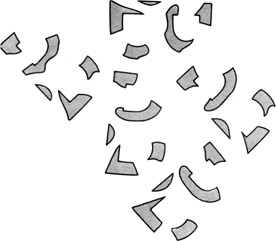
While I’m not sure that by studying one small facet of the universe for long enough will lead to a comprehension of totality as some Eastern philosophies hold, I warn against the danger of drawing false conclusions because one is not able to see totality. The following illusion is a case in point:

Image

If you don’t know what you’re looking at – and in this case, even if you do – it’s very hard to discern the totality of the picture. If, however, you look at the picture another way,

Image

reality takes on a different look altogether.

Thus in one sense, I agree fully with the headline of the article. When science tries to look at religion and cram it into the grand unified theory it fails miserably, and religion comes up poor. As a result, many people who were raised in households of faith simply allow their spiritual walk to fall by the wayside because it doesn’t fit within the body of scientific knowledge, and they effectively shut the door to half of the human experience. Conversely, when religion tries to make scientific fact conform to pre-defined conclusions, we get things like this:

Image

I do believe that all truth can be circumscribed into one great whole. Even the disciple Paul, for all his faith, knew that our vision and our knowledge on this earth is sorely limited, saying, “For now we see through a glass, darkly; but then face to face: now I know in part; but then shall I know even as also I am known.”

The more we look at the puzzle, the more pieces we will be able to fit in. As for me and my house, I refuse to try to solve the puzzle by looking at only half the pieces, and pretending the other half really belongs to a different picture.

The Old Wolf has spoken.

Disclaimer