Scott Adams: Clairvoyant.

On February 27, 1994, Scott Adams published this Dilbert strip:

23662.strip.sunday

Almost 20 years later, we have this news article about Tesco’s:

Work is Becoming More Like Prison As Some Workers Forced to Wear Electronic Bands That Track Everything They Do (Including Bathroom Breaks)

Grocery giant TESCO has strapped electronic armbands to their warehouse workers to measure their productivity.

The human body, with its need for rest, nutrition and hydration, is such an inefficient tool for capitalist production. But while machines are unlikely to replacehuman workers anytime soon, new technologies can deftly strip workers of their humanity!

The Irish Independent reports that grocery giant TESCO has strapped electronic armbands to their warehouse workers to measure their productivity, tracking their actions so closely that management knows when they briefly pause to drink from a water fountain or take a bathroom break. These unforgivable lapses in productivity impact workers’ performance score, which management then apparently uses to terrify them into working faster.

(Click through for the full article.)

The Dilbert cartoon seemed absolutely terrifying because of its impossibility… now that employers have begun stripping the last shred of dignity from their workers, I really don’t know how much lower humanity can sink.

I am beyond astonished. 

The Old Wolf has spoken.

Beware the Stealth Install

I get a lot of use out of a program called Free Studio from DVDVideoSoft. I really appreciate their product, and I get to use it for nothing, so I have no axe to grind with this company – but they get to be the teacher in the moment.

They have a cluster of products that operate under the Free Studio Manager head, and periodically one of them will update. Every time I download and install a newer version, I have to be careful that I don’t install something that I don’t really want, commonly known as crapware or foistware.

Here’s the first menu that I see:

stealth1

Notice that the “Express” option is going to give me the AVG toolbar. Now, in this case again, that’s not necessarily a bad thing. I used AVGFree for years before migrating to MS Security Essentials (the latter program uses far less overhead), and was very happy with it – I never had a single infection in all the years I was using it. But I just don’t use toolbars, so I didn’t want this one.

In order to decline the install, one has to hit the “Custom” radio button – but notice that it’s greyed out, which will cause some people to miss it, and others to think it’s been disabled. It is, however, completely functional.

stealth2

Clicking the “Custom” button allows you to uncheck all the options for AVG and continue. But we’re not done – there’s another menu to get past first.

stealth3

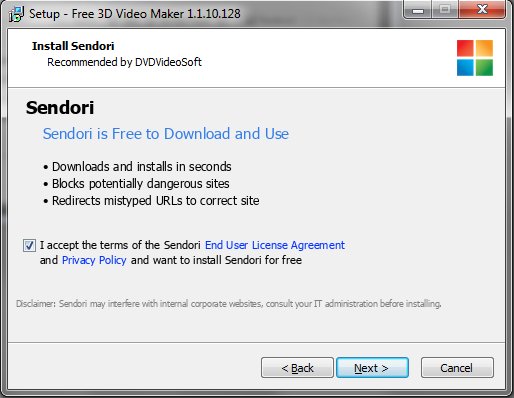
I have no idea what Sendori is, other than some sort of security program, but I don’t care to install it – so I have to uncheck the “I accept” statement, and hit next. At last my program installs.

I get that DVDVideoSoft needs to monetize their product in some way, so again I’m not really complaining – but be sure that you carefully read all the menu options you are presented with when installing sofwtware – even the stuff that you have bought and paid for. Particularly annoying is any program that wants to install the “Ask” toolbar – it will also infect your browsers, change your homepage, alter your default search engine, and your default keyword search options. Oracle is a major offender here; fortunately, Java is less and less needed for anything useful. If you want to go the second mile, there’s a Change.org petition asking Oracle to stop bundling this piece of crapware with its products.

So just be careful… it’s a jungle out there.

EDIT: Click through for another superb article about this sleazy technique.

The Old Wolf has spoken.

Faites-vous du remue-méninges?

From Vie Moderne, date unknown

(This article is in French. The title translates as “Do you brainstorm?”)

Pursuant to my previous post, I provide here a list of French terms for the broadcast industry which are recommended to replace their English counterparts. I’d be curious to know how well they have done in exterminating these heathen terms from their vocabulary over there, or if they still have people using English terminology on a regular basis.


Une liste de nouveaux termes et expressions destinés à remplacer les mots étrangers fréquemment employés dans le domaine de l’audiovisuel et de la publicité a été publiée au Journal Officiel, le 18 février dernier.

Ces néologismes seront obligatoirement utilisés à compter d’un délai de trois mois suivant la publication de cet arrêté dans les décrets, circulaires, diplômes, instructions émanant des ministres et des fonction­naires de l’Etat placés sous leur autorité.

Un délai plus long, six mois, est accordé pour l’utilisation de ces néologismes dans les correspondances “et documents des ad­ministrations; dans la rédaction des con­trats et marchés avec l’Etat; dans les édi­tions ou rééditions des ouvrages de renseignement, de formation ou de recher­che utilisés dans les établissements dépen­dant de l’Etat, soumis à son contrôle ou bénéficiant de son concours financier.

Voici ci-dessous une liste partielle de ces mots nouveaux choisis parmi les termes les plus souvent utilisés (les lettres « A » ou « P » Indiquent le domaine dont relèvent ces mots: Audiovisuel ou Publicité)

Achat groupe (n.m.) – Package. (A)
Achat d’un ensemble de programmes à un même vendeur.

Aguiche (n.f.) – Teaser. (P)
Phase initiale d’une campagne publicitaire se présentant sous forme d’énigme destinée à inciter et à maintenir l’attention du public.

Amplificateur de sonorisation – (n.m.) Public address amplifier. (A)

Baladeur (n.m.) – « Walkman ». (A)
La terme « walkman », qui est une mar­que déposée, ne doit pas être utilisé.

Bande vidéo (n.f.) – Video-tape. (A)

Bande vidéo promotionnelle (n. f.) Video clip. (P)
Court programme réalisé à l’aide de moyens techniques perfectionnés, pour mettre en valeur un sujet donné.

Base de campagne (n.f.) – Copy platform. (P)
Ensemble de réflexions qui permet de passer à la réalisation d’une campagne publicitaire.

Cabiliste (n.m.) – Cableman. (A)

Cadreur (n.m.) – Cameramen. (A)

Carton publicitaire (n.m.) – Display. (P)

Ciné-parc (n.m.) – Drive-in cinema. (A)

Commanditaire (n.m.) Sponsor. (P)
Personne physique ou morale qui sou­tient l’organisation d’une manifestation, financièrement ou au moyen de presta­tions de services, afin d’obtenir la con­trepartie des effets publicitaires.

Commanditer (v.tr.) – To sponsor. (P)

Crayonné (n.m.) – Simple lay-out, rough lay­out, rough. (P)

Débordement (n.m.) – Overlap. (P)

Distribution artistique (n.f.) – 1. Casting; 2. Cast. (A)

Document (n.m.) – Artwork. (P)

Embargo (n.m.) . Release. (A)
Délai à respecter avant de diffuser une information ou un programme .

Evanouissement (n.m.) – Fading. (A)
Diminution momentanée de la puissance d’une onde radio-électrique au point de réception, pouvant aller jusqu’à sa disparition totale.

Fondu (n.m.) – Fade out. (A)

Gros plan (n.m) – Close-up. (A)
Journalisme électronique (n.m.) – Electronic news gathering (E.N.G.). (A

Maquette (n.f.) – Advanced lay-out. (P)

Média (n.m.) – Media.
Note: Le pluriel est médias.

Médialogie (n.f) Etude des médias

Médialogue (n.f.) Spécialiste en médialogie.

Parrainage (n.m.) : Sponsoring. (P)

Présentoir (n.m.) – Merchandiser. (P)

Prêt-à-monter (n.m.) – Kit. (A)

Publicitaire (n.m. ou adj.) – Advertising person. (P)

Publipostage (n.m.) – Mailing. (P)

Remue-méninges (n.m.) – Brain-storming. (P)

Retour en arrière (n.m.) – Flash-back. (A)

Radiocassette (n.f.) – Radiorecorder. (A)

Régisseur de distribution (n.m.) – Casting director. (A)

Sonorisation (n.f.) – Public address. (A)

Sonal (n.m.) – Jingle. (A)
Message ou élément de message diffusé sur les médias audiovisuels, généralement fondé sur un thème musical répétitif et destiné à provoquer un réflexe de reconnaissance.

Souche (n.f.) . Master. (A)
Bande magnétique originale de montage

Suramplificateur (n.m.) – Booster. (A)
Amplificateur de puissance supplémen­taire, notamment pour un véhicule automobile.

Stylicien -ne (n.m. ou f.) – Designer (P)

Stylique (n.f.) – Design. (P)

Styliste (n.m. ou 1.) – Stylist. (P)
Il peut être à la fois, ensemblier, ac­cessoiriste et costumier.

Télévision à péage (n.f) – Pay-T.V. (A)

Test aveugle (n.m.) – Blind test. (P)
Test de comparaison entre deux ou plusieurs produits anonymement présentés.

Test d’évaluation (n.m.) – Copy testing (P)
Procédure destinée à déterminer les réac­tions d’une clientèle visée face à un message ou à une série de messages publicitaires.

Test du lendemain (n.m.) – Day after recall. (P)
Mesure de l’impact d’un message publicitaire vingt-quatre heures après sa diffusion.

Travail da terrain (n.m.) – Field work. (P)

Le big flap over franglais (ca. 1974)

Extracted from a Life magazine comment column. Given Pompidou’s term of office, this would have been pre-1974.

Le big flap over franglais

Holdup

The French worry about three things: their food, their livers and their language. The current language flap–there’s always a current language flap–is (as usual since World War II) about the creeping American­ization of the mother tongue. This has resulted in the hybrid speech the French call franglais. Early this year President Pompidou, seeking “a way for us to distinguish ourselves from the U.S.,” authorized a slew of com­mittees to draw up a master list of gov­ernment-approved Americanisms. Unapproved words are henceforth forbidden to any government official in any decree, circular, instruction, letter or other document, including a lunch order for un sandwich. The de­cree contained not one word of fran­glais, which was what we Americans call a tour de force.

In Paris recently, curious to see how the Battle of Franglais was going out­side the government, I called my friends the Duponts (the Bridges).

“Come at l’heure du cocktail (cocktail time),” they told me. “We can’t go out. It’s hard to find un baby­sitter. ”

“Fine,” I said. “O.K.,” they said.

Passing a café (French) where the customers were crowded around les flippers (the pinball machines), I reached their home in un building (apartment house) de grand standing (not a tall but a luxury building). Le building was between un drugstore (oriental bazaar more than a drug­store) and un pressing (the cleaners). Nearby, les bulldozers were tearing up the street for un parking (parking lot).

I rang the bell. My friend Brigitte greeted me in un teeshirt, un sweater and un blue-jean.

“It’s le style hippie,” she said.

I

stepped into le hall, which led into le living (specifically, a living room and dining area combined), which led into une kitchenette. There was also a bedroom. Sounds of le rock were emanating from le pick-up (phono­graph). There were some glasses on le bar and un shaker. Brigitte was working on a photo album.

“Passez-moi le Scotch,” she asked. I passed her a bottle and a glass. “Non, non, ma chere. Le Scotch Tape. That’s le whiskey (Scotch).”

Her husband, un reporter for a French paper, arrived and took off son duffel-coat. He greeted me with un shake-hand. “Sorry I’m late,” he said, “but I was delayed by un flash (ur­gent bulletin). Then my car wouldn’t work properly. Trouble with le start­er (the choke). Tomorrow I’m to do une interview of une cover girl (mod­el) who has beaucoup de sex-appeal.”

A few friends dropped by.

“Have you read le best seller, Love Story?” one asked, conversationally.

“It was also a best seller in the U.S.,” I pointed out. “Actually, I’m a fan of French cuisine.”

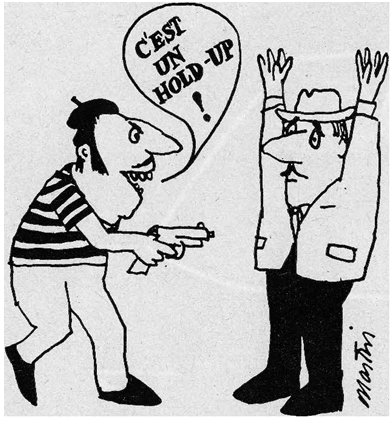
“It’s terrible,” said the French­man. “I hardly had time for un sand­wich for le lunch. Le snack bar and le self-service (cafeteria) were both crowded. And so expensive. Un vrai hold-up (what a gyp)! I would have preferred un bifteck et des frites (beefsteak and French fries) or du rosbif (roast beef). I had only des toasts for breakfast.”

“I am in les public relations for la Générale Motors,” said one of the guests. “Part of le management. I used to be in le marketing but I would have preferred un job in l’engineering.”

“What do you do in your spare time?” I asked, sinking fast.

“J’adore faire du shopping for les gadgets. It’s really mon hobby.”

Another guest volunteered that he liked sports. “Le week-end, then I have time to watch un match de foot. I like le golf and le basket (basketball), but especially le foot (football, that is, soccer in France). Some players really know how to shoot (kick) the ball. It’s not du bluff. Occasionally, I like un cinema underground (avant-­garde movie).”

“Enjoy a vacation lately?” I stammered.

“Skiing is impossible at this time of year,” he said, sipping his drink. “Too many people waiting to go up les ski­lifts. Then in the evening if you enjoy le dancing, you’re too tired to ski.”

Feeling dazed, I left à l‘anglaise, which to a Frenchman means to take English leave but which in English means to take French leave.

by Marie-Claude Wrenn

Ms. Wrenn is une free-lance of French extraction. 


Le vieux loup à parlé (in some language or other).

Pimsleur Approach: Still at it

Every now and then something goes squirrely on a website that I’m viewing, so I fire up my other browsers to see if it’s a coding issue. Firefox and Chrome both have Adblock Plus installed, so I never see affiliate marketing or sponsored ads, but Internet Explorer is not so endowed. This morning I encountered this:

Shocking Linguistic Video

I have blogged in detail about pimsleurapproach.com (I recommend the original article), but their deceptive advertising campaign continues, so I felt moved to put up another warning.

Note: The same caveat applies here – I’m not talking about the Pimsleur method, currently owned by Simon and Schuster, which I happen to think is quite effective for obtaining some basic proficiency in a language; I’m talking about affiliate marketers like this outfit, whose slick website and deceptive marketing campaigns trick countless consumers into buying products they don’t want and never ordered.

Red Flags – if you see any of these marketing techniques, run the other way without looking back. Commercial concerns that use them have fewer scruples than a hungry weasel in a hen house.

  1. Attention grabbers. The words “shocking” or “one weird trick,” or other similar things.
  2. Limited availability” – People find objects and opportunities more attractive to the degree that they are scarce, rare, or dwindling in availability.
  3. As seen on Oprah/PBS/Forbes/CNN, etc. – People are more willing to follow the directions or recommendations of a communicator to whom they attribute relevant authority or expertise
  4. Large print / Small print – The Pimsleur Approach advertises 8 lessons for $9.95, with a 30-day money-back guarantee. What many people don’t see is their small-print, gray-type footnote box and “key facts” popup, which say that one month after your initial order, you will receive a new course every 60 days (always with a 30-day money-back guarantee), for which you will cheerfully pay $264.00. Most of the abundant complaints found at boards like Ripoff Report come from people who didn’t read the fine print, unauthorized charges to their credit cards, rude and aggressive customer service agents who threaten your credit rating, and difficulty obtaining a refund because of the way that the company times their shipments.
  5. Browser Hijacking – If you get on to a page and click your “back” button, you may get one of these:


PimsleurPopup

This tactic screams “unethical.” Next to blinking text on a website (which you notice you almost never see any more) it’s one of the most hated advertising techniques out there, along with popups and popunders. If you see it, the company is saying to your face, “we don’t give a rat’s south-40 about you, we just want your money.”

There’s nothing wrong with the Pimsleur Method and the courses published by Simon and Schuster. I’ve used several of them successfully as a springboard into further study, and they can be fun and enjoyable, especially if you’re on the road. Many libraries have multiple copies which you can check out for free, and if you want the courses, go directly to Pimsleur’s website, or to Amazon where you can find many of these courses at a substantial discount. Just stay away from pimsleurapproach.com, unless you want to deal with a company whose principal goal is to separate you from your money at any cost.

The Old Wolf has spoken.

Dublin’s Misery Hill

Misery Hill

(Photo from An t-Oileán)

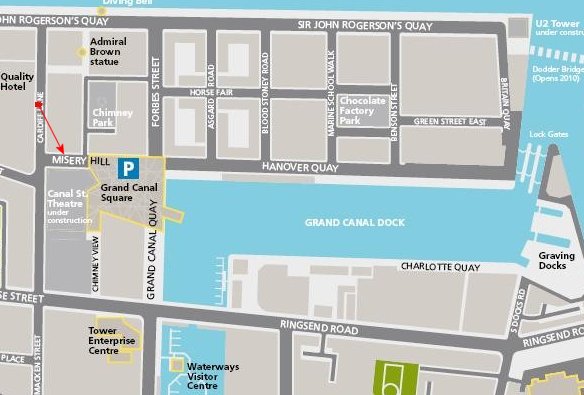
The street running along the side of Dublin’s Grand Canal Square is Misery Hill, which has a rich history.

“Back in the 1700s, the place was aptly named, as it was the site of a gallows where pirates and thieves came to a gruesome end. Public executions took place here into the nineteenth century and it is reputed that, on September 17th 1803, two of Robert Emmet’s men were hanged on Misery Hill. Before that in Medieval times, people with leprosy and other skin conditions, who could not afford to stay in the hospice on Lazar’s Hill ( now known as Townsend Street), would move on to Misery Hill, as a bell tolled to warn the citizens that the ‘unclean’ were on their way out of the city.”[1]

Other sources indicate that as the leper was walking along the roads, one guardian would toll a bell, and the other would carry a 40-foot pole to warn others of a safe distance to approach, hence the origin of the phrase “I wouldn’t touch him with a 40-foot pole.” (Here in the USA, we shortened our pole to 10 feet, it would seem.)

Interestingly enough, before locating Mr. Buck’s blog entry, I had a challenge finding the precise location of Misery Hill – it doesn’t show up on Google Maps or Google Earth. A map published by ESRI was the only one that actually showed Cé Hanover turning into Misery Hill:

Misery2

Location of Misery Hill in Dublin

Misery Hill

Marker of Local Interest during construction.

Aerial-rendering-of-site-c-Lafferty-Design-Studio-plusMOOD

Architect’s rendering of Grand Canal Square, showing Misery Hill incorporated into the square’s design.

Certainly a much more pleasant place now than it was then.

Edit: Although, being in Ireland, it can surely be properly wet and miserable.

The Old Wolf has spoken.


[1] An Irish Town Planner’s Blog

Old Color Photos of Ireland, 1913

These images, which represent the first ever colour photographs taken in Ireland, were taken in 1913 by two French women, Marguerite Mespoulet and Madeleine Mignon-Alba, who used newly available autochrome colour plates.

See the full collection at An t-Oileán.

Haunting and stark, these photos made me think of An Béal Bocht by Myles na gCopaleen (Brian Ó Nualláin). While that book poked mighty fun at the Gaelic mentality and condition, there is no hiding the fact that life for the native Irish was hard, wet, and penurious, and these photographs illustrate the reality of a “terrible beauty.”

wze9Z

This could well be “an Seanduine Liath” with Michelangelo and little Bonaparte O’Coonasa

Their likes will never be there again.

The Old Wolf has spoken.


Fruit = Love

Mango

Mango. Doubtless the irresistible fruit that hung from the tree of knowledge. Delicious and desirable.

Fresh Figs

Fresh figs. Jesus was so torqued that he couldn’t get some of these that he went all medieval on the tree that wouldn’t pony up. The only figs I ever knew as a kid were the dried kind, and of course Fig Newtons. The fresh ones come close to ambrosia.

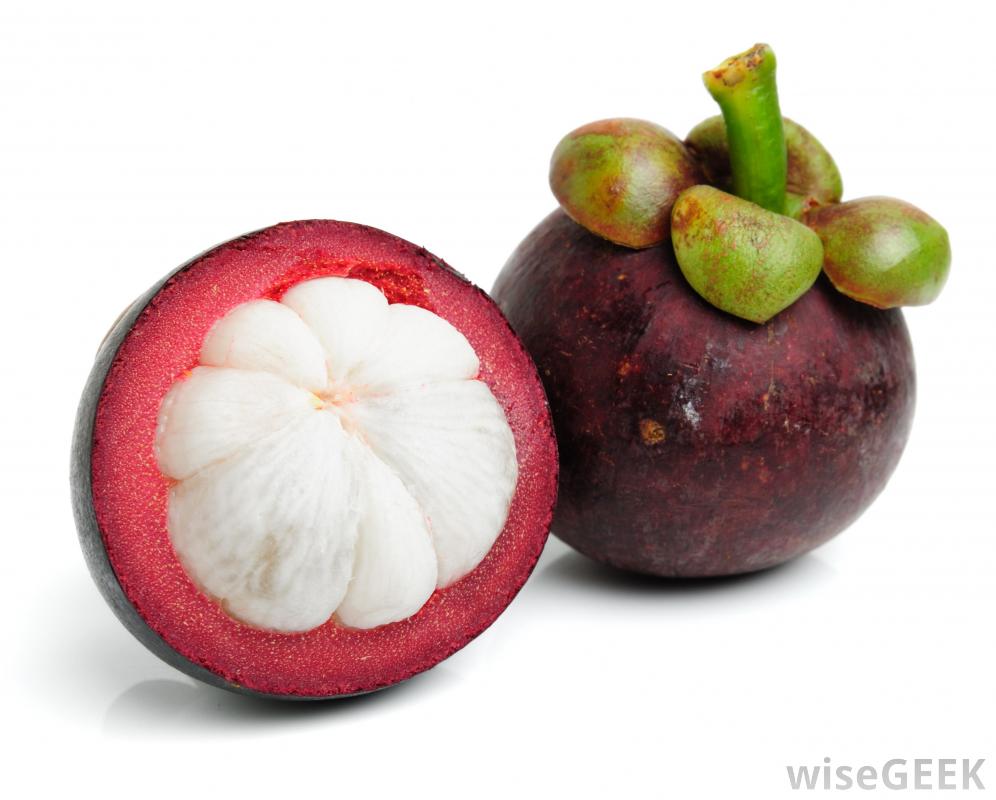
Mangosteen

Mangosteen. Down in Kinshasa they call this “the most thrown fruit in the world.” The center is all sweetness and light, and they are just the right size for hucking at someone.

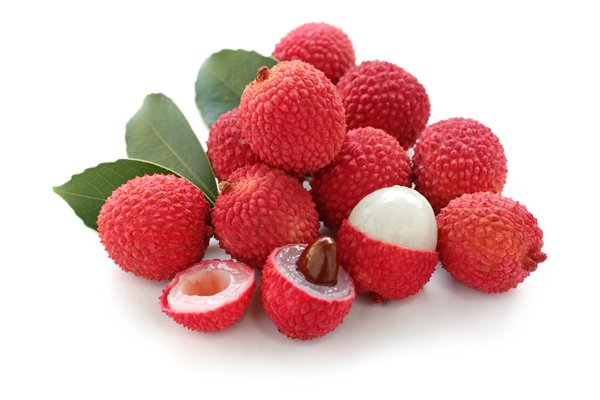
lychee

Lychee nuts. First experienced these in Chinatown in the 1950’s, in New York, but never had really good ones until I spent some time in Australia with a mate of mine – he picked up some fresh ones in the market. These fruits are extremely volatile – if you’re not careful, they will evaporate even before you can get them home.

url


Lastly, a fruit I have never tried, but would love to – the jabuticaba, a Brazilian tree that grows its fruit on its trunk. Supposedly wonderful for eating, for making wine (I’m told the fermentation begins three days after the fruit is picked), and with strong antioxidant and health properties.

The Old Wolf has spoken.
Quaker Puffed Rice: Shot from Guns!

Rice

Advertising is insidious. For a perfect example, check the section on Salem cigarettes in this post. In the same way as my parents’ generation could not listen to the William Tell Overture without shouting “Hi-o Silver!”, I am unable to listen to the 1812 Overture by Tchaikovsky without thinking of Quaker Puffed Rice.

Berg

With thanks to Dave Berg

Sadly, no examples of the famous Quaker commercial appear to be extant on the internet. However, the ad featured music from the 1812 overture, of which some versions use actual cannon. The screen would be filled with images of puffed rice flying out of cannons as the music boomed in the background.

Here’s an older ad that highlighted the technique without the use of the music:

Just recently, I stumbled across this video of Lin Hai, an old vendor on the streets of China, using a rice cannon to create his own puffed rice and popcorn right on the street. It gives you an idea of how the Quaker product is made, something I had never really understood.

(Skip to 2:30 to watch the impressive part.)

Edit: I realized this discussion would be incomplete without showing what modern technology has done with this principle:

I saw one of these in operation at a local grocery store – the machine loads a scoop of rice into a press, and a few seconds later shoots out a perfectly-formed rice cake. Unfortunately, rice cakes still taste like styrofoam, but it was fun to watch.

Edit 2: For some odd reason, all the old Quaker commercials featuring the 1812 overture have been scrubbed from the Internet. I find this sad, and it’s not just this instance. A lot of the great old ads that had been captured are taken down by corporate attorneys in the name of “intellectual property protection” or some other nonsense. These ads belong to history and should be available to the public as a record of times and attitudes gone by, even if current marketings strategies have changed.

At one point there was an old commercial featuring the cast of “F Troop” singing about puffed wheat to the tune of the 1812 Overture, but it also has been scrubbed.
The Old Wolf has spoken.
Learn a new language. But do it right.

Learning another language can come in quite handy.

(Despite the intro, this one has the best resolution. The commercial itself starts at 0:09)

But be sure not to skimp on your effort.

Naturally, you want to make sure you maintain your image. It would never do to be caught speaking English if you’re a Québecois…

(Thanks to SackOfRabidWeasels for reminding me of this one)

Lastly, this one has nothing to do with learning a language, but it’s in Norwegian, and funnier than all getout, so I’m sharing it anyway.

The Old Wolf has spoken.