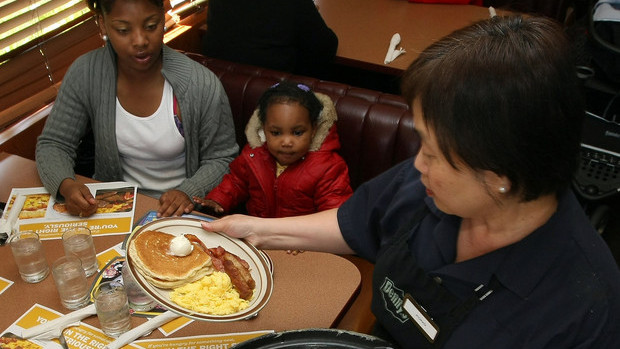
22 Years Later, Waiters Still Work for $2.13 a Hour

A recent article at Bloomberg highlighted a situation that has long irked me. And I’m part of the problem, and I’m groping for answers.
iu.8lN2Mgxws

One thing about the Bloomberg article that I’d change is “waitresses” -> “servers.” Obviously the problem is industry-wide, and not limited to those who are y-chromosome-challenged.  But whatever. That’s a subject for a different  essay.

I’ve written about tipping before. For reasons outlined there, it’s not optional. If you eat out, be prepared to tip, and tip well. The people who bring you your food depend on it, as do numerous others in the restaurant who don’t get tipped directly.

So here’s what I struggle with. While states can set their own minimum wage numbers, New Mexico and 12 other states use the federal level, which hasn’t been raised in 22 years. And even states that have raised the minimum for tipped employees tend to err on the side of parsimony. That means “being cheap.” I happen to think that paying a server $2.13 an hour (I only made less than this back in the 60’s and 70’s, when the minimum wage in Utah was $1.65) is an abomination and an affront to ethical business.

See, tips were never designed to be part of a server’s base wage… it’s just that employers saw a gold mine and took advantage of it. Restaurant owners justify their actions by saying that servers are making at least minimum wage with tips included and often more, and while this can happen, it’s the exception rather than the rule. Raising the base minimum would “also spur firings and reduced hours as thin-margin businesses grapple with higher costs, say some restaurant owners and economists.” And therein lies the rub.

According to the Houston Chronicle, in an article dealing with operating margins in the restaurant industry:

“Recent times have proven very difficult for the full-service restaurant industry. According to the NRA [National Restaurant Association, not the gun lobby], in 2010 the casual restaurants had an average operating margin of 3.0 percent with respect to gross sales. More formal $15 to $25 restaurants had an average operating margin of 3.5 percent. Fine dining establishments, costing $25 or more, had the worst margins of all, at 1.8 percent on average. Many such restaurants earned a loss, rather than a profit. Overall sales for the full-service restaurant industry came to $184 billion, a nominal increase over 2009.”

These razor-thin margins are built on the base + tip model, and if restaurant owners are required to quadruple their waitstaff’s wages and still keep the same pricing structure, the business goes under – which means loss of jobs for people and loss of tax revenues for localities, neither of which is a good thing. There’s no way to balance the equation without changing some variables, and the only one I can see that can change is price.

As Americans, we have developed a sense of entitlement regarding cheap eats, either in restaurants (supported on the backs of the servers), or in the grocery store (supported on the backs of low-paid migrant workers.) Raising prices for dining and groceries to give a fair living to the people who provide them would be the right thing to do… but would go over like a lead balloon with much of the public and would be a logistical nightmare – push over that domino and the whole house of cards would come tumbling dow, to mix metaphors.

You can see why I’m conflicted. I like eating out. Boycotting restaurants to make owners pay a living wage is the worst kind of self-spiting solution, because it would simply force many eateries out of business. The problem is multifaceted, and there are better minds than mine working on addressing it. One of them is Gina L. Darnell, a former server who authors Wiser Waitress. Here’s her wish list.  It’s not too much to ask.

In the meantime, all I can do is try to make a dining experience as pleasant for my server as they are trying to make it for me… and leave a decent tip.

The Old Wolf has spoken.

Alternatives to Amazon

In Germany, they’re fighting hard for the independent bookseller. Just found this German version over at Glaserei, noting that ZVAB and AbeBooks are both owned by Amazon, which I did not know.

For us English speakers, there’s this article over at Biblio.com, which includes a link to this New York Times article: Online Shoppers are Rooting for the Little Guy

The marrow of the article:

Try these independent companies:

Marketplaces: Biblio (of course), AntiqbookLivre Rare BookMaremagnumPowell’s BooksABAA.org*, Tomfolio*, andIOBAbooks.com*
Meta Searches: AddALLviaLibriMarelibri
Inventory Software: BookHoundBookTrakkerBiblioDirector
Website Providers: BibliopolisForeseeing Solutions
Book Order Management: Art of BooksIndaba

*These book searches  provide customers with books supplied only by bookseller members of those particular organizations.

For the record, I have nothing against Amazon as a consumer – mostly because they’re convenient, and often cheaper, and I get free shipping. But I shop the indies whenever I can find them as well. I think there’s room for everyone, and losing the neighborhood stores is always a loss. That reminds me, I need to watch “You’ve Got Mail” again.

For my friends in Salt Lake, I’ll recommend The King’s English bookshop.

The Old Wolf has spoken.

“After reading this blog, you’ll think Shakespeare was a penny dreadful hack!”

Yup, that’s a “blurb”. We see them everywhere, but tend to notice them most on movie advertisements. We ignore them or laugh at them, but for better or for worse they influence our consumption habits.

zwei-komplette-romane

Seeing the blurb on this dime store pulp made me chuckle – “damned with faint praise” is the first thing that came to mind. You’d think they might have come up with something a bit more riveting, but what it shows is the absolute necessity in some editor’s mind that a blurb – any blurb – must grace the cover.

The word “blurb” itself was coined by American humorist Gelett Burgess, author of Goops and How to Be Them (you can see a sample here.)

FileGelett_Burgess

Burgess handed out a limited run of his book Are You a Bromide?  to a trade organization dinner, and the dust jacket included this image:

Blurbing

Blurbs are everywhere, and well-known authors are often solicited for blurbs about other books. The New York Times published “Riveting!’: The Quandary of the Book Blurb,” a series of essays on blurbing including a piece by Stephen King; the upshot is that blurbs are a necessary evil, but they can have a certain value. On the other hand, however, sometimes the writers should probably have stayed in bed.

In their famous parody Bored of the Rings, Harvard Lampoon lost no opportunity to make fun of blurbs themselves, publishing this page of blurbs in the front of their book:


“Much have I travelled in the realms of gold, and many goodly states and kingdoms seen; round many western islands have I been, which bards in fealty to Apollo hold. Oft of one wide expanse had I been told, which deep browed Homer ruled as his demesne. Yet never did I breathe its pure serene, till I heard Bored of the Rings speak out loud and bold!…”
JOHN KEATS, Manchester Nightingale

“This book… tremor… Manichean guilt… existential… pleonastic… redundancy…”
ORLANDO DI BISCUIT, Hobnob

“A slightly more liberal reading of the leash-laws would keep books like this off the stands. I don’t know how you’ll fare, but my copy insists on long walks around suppertime, bays at the moon, and has spoiled every sofa cushion in the place,”
WILMOT PROVISO, The Rocky Mountain Literary Round-Up

“0ne of the two or three books…”
FRANK O’PRUSSIA, Dublin Gazette

“Truly a tale for our times … as we hang suspended over the brink on a Ring of our own, threatened by dragons and other evil people, and, like Frito and Good­gulf, fighting a cruel Enemy who will stop at nothing to get his way,”
ANN ALAGGI, The Old Flag

“Extremely interesting from almost every point of view.”
PROFESSOR HAWLEY SMOOT, Oer Loosely Enforced Libel Law! 


Scott Adams, author of Dilbert, sponsored a reader contest to provide a blurb for his book Stick to Drawing Comics, Monkey Brain!; the grand prize winner was Nicolas Feia who came up with this gem:

“‘What a perfect companion for my afternoon milk bath,” I thought while picking up this little gem on my way home from work. Within the hour I had laughed myself into a neck-deep tomb of butter. My wife came in, sipping her eggnog, and topped me with meringue.”

The others, however, are good for a laugh as well.

Anyway,

“Keep reading this blog and you’ll soon see that Mark Twain has met his match!”
SIMPLOT Q. ANALEMMAOn the Rising Value of Badgers, Mushrooms and Snakes in the Modern Commodity Market

The Old Wolf has spoken.

Reblog: Why Your Pointy Haired Boss Is A Mathematical Certainty

I found this blog entry the year Mr. Wieczorek created it, and felt moved to share it here for a couple of reasons. First, because it’s just as valid today as it was in 2005, and second, because the scatter chart says a lot about the overall state of our economy and the gap between the haves and the rest of us. The PDF file referenced below is an interesting read as well.

A web archive link to the original post is at https://web.archive.org/web/20050213014758/http://www.marktaw.com/blog/PointyHairedBoss.html

Why Your Pointy Haired Boss Is A Mathematical Certainty

We’ve all had one. That annoying boss who just doesn’t have a clue. A useless middle manager that can’t lead, can’t manage yet somehow manages to keep his job. Well, know you’ll know why he exists.


The Bureau of Labor Statistics (BLS) produces some interesting documents about things like the percentage of the population that can work, the percentage of that population that is employed and so on.

Well, one document they produce is the Occupational Employment and Wages report. Basically it says how many people have what job and what they get paid.

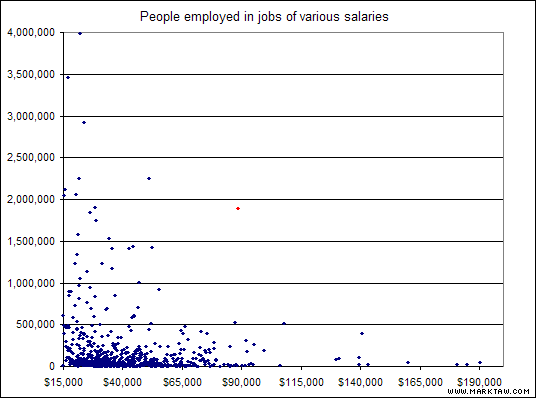
So I gathered the data from this chart and created this graph that shows how many people get paid what. Each dot represents a type of job.

employed

It’s pretty easy to tell from looking at it that lots of people have jobs that don’t pay a lot of money, and a few people have jobs that pay a lot of money. Nothing really unexpected here, I guess.

But what is that dot… that single, attractive dot that employs nearly 2 million people and pays nearly $90,000? Surely, if there was a job worth having, it would be that one. Lots of people do it, so it must not require a lot of skill, yet it pays better than the vast majority of other jobs out there.

What is that job? That sweet, sweet job that employs roughly 1,892,060 people and pays $88,700 annually (on average). Why it’s General and operations managers, of course.

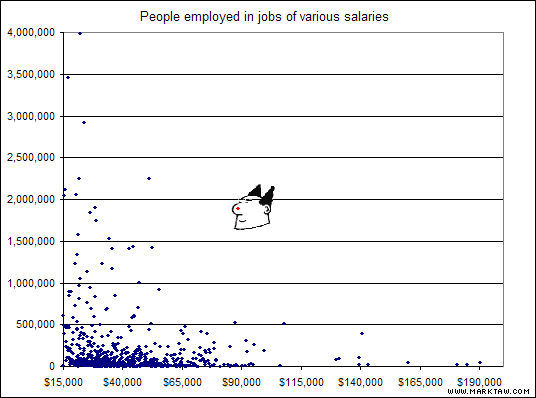
phb

And now you know why your pointy haired boss is an almost mathematical certainty. It’s an attractive, well-paying job, that doesn’t seem to be too discriminating about who gets hired.

Learn how to combat the Pointy Haired Boss! Buy Dilbert – The Complete Series on DVD today!


The U.S. Department of Labor, Bureau of Labor Statistics, Occupational Employment Statistics

  • Occupational Employment and Wages, May 2003 (PDF)

Dilbert.com – The Official Website by Scott Adams – Dilbert, Dogbert and Coworkers!

page first created on Wednesday, January 26, 2005

© Mark Wieczorek


Thanks, Mark, for a brilliant and insightful post.

The Old Wolf has spoken.

Missing the Storm

From the Weather Channel today for 84651

A WINTER WEATHER ADVISORY FOR SNOW REMAINS IN EFFECT UNTIL NOON MST MONDAY.

* AFFECTED AREA: THE SALT LAKE AND TOOELE VALLEYS ALONG WITH THE SOUTHERN WASATCH FRONT.

* SNOW ACCUMULATIONS: 2 TO 5 INCHES THROUGH MONDAY MORNING WITH LOCALLY HIGHER AMOUNTS.

* TIMING: SNOW… LOCALLY HEAVY AT TIMES… WILL CONTINUE ACROSS THE SALT LAKE AND TOOELE VALLEYS… AND SPREAD INTO UTAH COUNTY BY EARLY EVENING. SNOW WILL PERSIST OVERNIGHT BEFORE TAPERING OFF MONDAY MORNING.

* IMPACTS: WINTER DRIVING CONDITIONS CAN BE EXPECTED ON ALL AREA ROADWAYS THROUGH TONIGHT.

PRECAUTIONARY/PREPAREDNESS ACTIONS…

A WINTER WEATHER ADVISORY MEANS THAT SNOW ACCUMULATIONS WILL CAUSE PRIMARILY TRAVEL DIFFICULTIES. BE PREPARED FOR SNOW COVERED ROADS. USE CAUTION WHILE DRIVING.

Payson

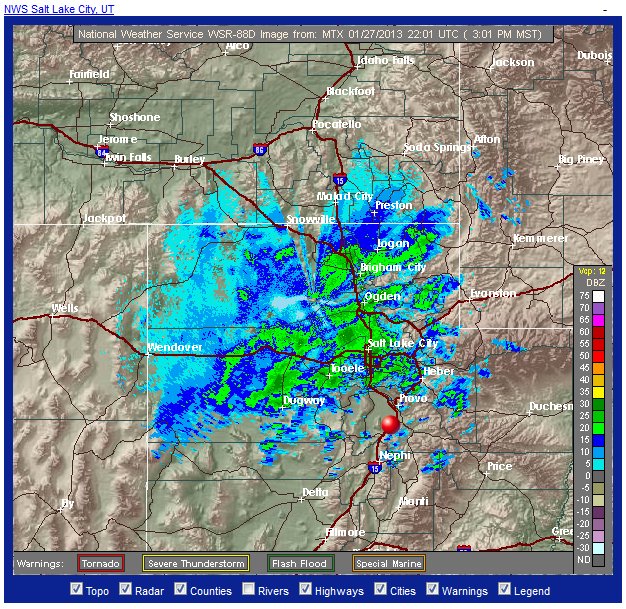
National Weather Service map. Payson is the red sphere – right in what seems to be the eye of a storm.

West

Clear to the West, but you can see heavy activity to the North of us.

East

Heavy snow to the North and East.

Us? 48 degrees, windy and sunny. We may get some activity later, but if we don’t I won’t complain – the mountains are picking up a good dose of moisture and I won’t have to shovel as much. The alert says we won’t get ours until early evening, but right now looking at the radar map, we’ll still be on the edge of it, unless the system is traveling southeast.

Edit: next morning – about 4 inches of fresh snow. Looks like the storm was indeed heading southeast. Now it’s partly sunny and colder, but I’m still grateful for the water!

Beware of Phishing – it’s still rampant

Be very careful about clicking links in emails, even if they seem to come from a legitimate source.

Notice the email below, which I received this morning – red flags are marked in color, with explanatory notes:

From: “Customer Central” <ycghjpn@comcast.com> [1]

Subject: Services Cancellation Notice ID:NNQMEYR on November 29, 2012

Dear Comcast Member,

The credit card we have on file for your Comcast Internet service was declined when we attempted to bill you on 11/29/2012 for your most recent service fees. For this reason, your service could be suspended.
Please visit our Account Information page:

bork://account.comcast.net.1r9.is-into-cars.com/bin/index.php?forceAuthn=1&continue=%2fSecure%2fHome.aspx&s=ccentral-cima&r=comcast.net [2]

Update your credit card information as soon as possible. Once your credit card information is updated, you will be charged immediately, as soon as payment is received. [3]

*************************

E-mail ID: 87326473233
Online Session PID: 8374334

*************************

Sincerely,

Comcast Customer Care

This email arrived the day before my actual credit card was set to expire. While the message looks convincing to the untrained eye, it’s phonier than a 7-dollar bill.

Things you can do to protect yourself:

  1. If you get an email like this, either call your supplier’s customer service number or go directly to their website.
  2. Never click embedded links in an email, it’s just not “safe computing.”
  3. Never open attachments in an email unless you know exactly what they are, even if they appear to come from your dearest friend.

There are countless scumbags out there, and they want your money and your information. Be safe, be careful, and watch out for your loved ones.

The Old Wolf has spoken.


Footnotes

[1] Email from a legitimate source will never have alphabet soup as part of the email address.
[2] Look at that URL up there: account.comcast.net.1r9.is-into-cars.com. A web address for a legitimate concern will not have jumbles of letters or numbers, or extraneous words in it. This website had been taken down by the evening, but I’m guessing the douchebags got a few uneducated people to enter their information with the millions of emails they sent out. The URL led to a very realistic-looking website with a login request. As is my wont, I went there and entered scathing obscenities for my username and password.
[3] This is lousy English. “you will be charged immediately, as soon as payment is received” makes no sense. If your payment is received, there is no need to charge you.

Amazon and the Dark Side of DRM

DRM: Digital Restrictions Management. Some people use the word “Rights,” but as the following incident shows, it has nothing at all to do with consumers’ rights, as it appears they have none.

Martin Bekkelund, a Norwegian IT director, planner and commentator, shares the story of Linn, whose Amazon account was blocked and her Kindle wiped with no warning and no explanation. When she inquired what was going on, she generated the following mail exchange:

Dear Linn [last name],

My name is Michael Murphy and I represent Executive Customer Relations within Amazon.co.uk. One of our mandates is to address the most acute account and order problems, and in this capacity your account and orders have been brought to my attention.

We have found your account is directly related to another which has been previously closed for abuse of our policies. As such, your Amazon.co.uk account has been closed and any open orders have been cancelled.

Per our Conditions of Use which state in part: Amazon.co.uk and its affiliates reserve the right to refuse service, terminate accounts, remove or edit content, or cancel orders at their sole discretion.

Please know that any attempt to open a new account will meet with the same action.

You may direct any questions to me at resolution-uk@amazon.co.uk.

Thank you for your attention to this email.

Regards

Michael Murphy
Executive Customer Relations
Amazon.co.uk

Linn responded thusly:

Dear Michael Murphy,

I am very surprised to read your email. What do you mean by “directly related to another which has been previously closed for abuse of our policies”. I can only remember ever having this one account, and I use it quite regularly to buy books for my Kindle, as you probably can see by my purchase history. How can there suddenly be a problem now? I use amazon.com and not co.uk for my Kindle, does that make any difference?

I sincerely hope you can help me solve this matter, because I would very much like to have my account reopened. And please let me know if there is any action I can take to help.

Best regards,
Linn [last name]
[Linn’s phone number]

All Linn got back was more corporate weasel-words:

Dear Linn [last name],

As previously advised, your Amazon.co.uk account has been closed, as it has come to our attention that this account is related to a previously blocked account. While we are unable to provide detailed information on how we link related accounts, please know that we have reviewed your account on the basis of the information provided and regret to inform you that it will not be reopened.

Please understand that the closure of an account is a permanent action. Any subsequent accounts that are opened will be closed as well. Thank you for your understanding with our decision.

I appreciate this is not the outcome you hoped for and apologise for any disappointment this may cause.

Regards,

Michael Murphy
Executive Customer Relations
Amazon.co.uk

Hoping for some clearer guidelines as to why her account was closed, Linn responded:

Dear Michael Murphy,

Is it correct that you cannot give me any information about
1. How my account is linked to the blocked account
2. The name/id of the related blocked account
3. What policy that was violated

I have no knowledge about any other account that could be related to mine, and cannot understand how I could have violated your policies in any way.

Br,
Linn [last name]

Murphy spouts the company line:

Dear Linn [last name],

We regret that we have not been able to address your concerns to your satisfaction. Unfortunately, we will not be able to offer any additional insight or action on these matters.

We wish you luck in locating a retailer better able to meet your needs and will not be able to offer any additional insight or action on these matters.

Thank you for your attention to this email.

Regards

Michael Murphy
Executive Customer Relations
Amazon.co.uk

So in the end, Amazon’s reasoned answer to a consumer who has bought their products and paid for them, and who now has had those products forcibly repossessed and her Kindle effectively bricked, is:

because, that’s why.

Nice, Amazon. I’ve had an account with your company for a long time. I’m thinking about whether I need to “locate another retailer better able to meet my needs,” and recommending to all my friends that they do the same. In the best-case scenario, Amazon will recognize that they cannot afford the firestorm of negative publicity they have unleashed with this  example of corporate douchebaggery and will either rectify the situation or give Linn a compelling reason for why her account was terminated.

Oh, and by the way – take note of that email address (resolution-uk@amazon.co.uk) and tell Michael what you think about all of this. I did.

The Old Wolf has spoken.

Government Douchebaggery: Get Informed

From the October 2012 issue of the AARP Bulletin, this outrage:

Carol and Paul Kurland of Leavittown, PA, both in their late 80’s, added their daughter’s name to their bank accounts to allow her access to funds if they faced a sudden health crisis. “Given our advanced age, we thought it was a good idea,” Carol Kurland says. “But we fell into a trap.” Sadly, their daughter Amy, 56, died last October. Two months later, the Kurlands got hit with a tax bill for several thousand dollars. They were amazed to discover that, under Pennsylvania law, a third of the money in their accounts was considered to be Amy’s. They had “inherited” it and now owed 4.5% as tax. “Our daughter had none of her own money in the accounts,” says Kurland, “and in fact, had never even visited that bank. The Pennsylvania Department of Revenue says it regularly hears from unhappy people in similar situations. Banks in the state are not required to inform customers who add names to accounts that they’ll owe taxes if the new person dies first.

Six other states – Indiana, Iowa, Kentucky, Maryland, Nebraska, and New Jersey – also tax inheritances. Four of them – Iowa, Kentucky, Maryland, and New Jersey – exempt parents of decedents, according to Jonathan Griffin at the National Conference of State Legislatures.

After the Kurlands’ tax bill arived, bank officials suggested that granting their daughter a power of attorney could have averted the liability.

“Why didn’t they tell us this before?” asks Carol Kurland. “You lose your daughter, and then you have to go through this. It’s been a bear.”

Takeaways:

  1. If you live in Pennsylvania or the above-mentioned states, be aware of the potential for government thuggery if you add a person to a bank account and that individual passes away before you do.
  2. Ask all the questions you can think of any time you deal with a bank. They have no vested interest in serving you – they only care about churning your worthless assets into valuable fees and commissions. Better yet, move your funds to a credit union, which at this point in time are still a better bet for consumers.
  3. Write your legislators and demand that banks be required to divulge all information pertaining to tax law that touches their sphere of influence. You may also want to tell them that laws like this are the pinnacle of stupidity, and that you’re ready to vote your opinion.

The Old Wolf has spoken.

How Software Companies Die

Almost 20 years on from when this was originally written by Orson Scott Card – one of my favorite writers, for what it’s worth – the hackneyed stereotype of programmers and hackers as brilliant but maladjusted Asperger-types persists… largely because there remains an element of truth in it, witness the smashing success of “Big Bang Theory.”

However, what remains true without question is how management and marketing continues to operate in the 21st century. Here then, for your gratuitous enjoyment, is a reprint from the March, 1995 issue of “Windows Sources.”

How Software Companies Die

By: Orson Scott Card

The environment that nurtures creative programmers kills management and marketing types – and vice versa. Programming is the Great Game. It consumes you, body and soul. When you’re caught up in it, nothing else matters. When you emerge into daylight, you might well discover that you’re a hundred pounds overweight, your underwear is older than the average first grader, and judging from the number of pizza boxes lying around, it must be spring already. But you don’t care, because your program runs, and the code is fast and clever and tight. You won.

You’re aware that some people think you’re a nerd. So what? They’re not players. They’ve never jousted with Windows or gone hand to hand with DOS. To them C++ is a decent grade, almost a B – not a language. They barely exist. Like soldiers or artists, you don’t care about the opinions of civilians. You’re building something intricate and fine. They’ll never understand it.

BEEKEEPING

Here’s the secret that every successful software company is based on: You can domesticate programmers the way beekeepers tame bees. You can’t exactly communicate with them, but you can get them to swarm in one place and when they’re not looking, you can carry off the honey.

You keep these bees from stinging by paying them money. More money than they know what to do with. But that’s less than you might think. You see, all these programmers keep hearing their fathers’ voices in their heads saying “When are you going to join the real world?” All you have to pay them is enough money that they can answer (also in their heads) “Geez, Dad, I’m making more than you.” On average, this is cheap.

And you get them to stay in the hive by giving them other coders to swarm with. The only person whose praise matters is another programmer. Less-talented programmers will idolize them; evenly matched ones will challenge and goad one another; and if you want to get a good swarm, you make sure that you have at least one certified genius coder that they can all look up to, even if he glances at other people’s code only long enough to sneer at it.

He’s a Player, thinks the junior programmer. He looked at my code. That is enough. If a software company provides such a hive, the coders will give up sleep, love, health, and clean laundry, while the company keeps the bulk of the money.

OUT OF CONTROL

Here’s the problem that ends up killing company after company. All successful software companies had, as their dominant personality, a leader who nurtured programmers. But no company can keep such a leader forever. Either he cashes out, or he brings in management types who end up driving him out, or he changes and becomes a management type himself. One way or another, marketers get control.

But…control of what? Instead of finding assembly lines of productive workers, they quickly discover that their product is produced by utterly unpredictable, uncooperative, disobedient, and worst of all, unattractive people who resist all attempts at management. Put them on a time clock, dress them in suits, and they become sullen and start sabotaging the product. Worst of all, you can sense that they are making fun of you with every word they say.

SMOKED OUT

The shock is greater for the coder, though. He suddenly finds that alien creatures control his life. Meetings, Schedules, Reports. And now someone demands that he PLAN all his programming and then stick to the plan, never improving, never tweaking, and never, never touching some other team’s code. The lousy young programmer who once worshipped him is now his tyrannical boss, a position he got because he played golf with some sphincter in a suit.

The hive has been ruined. The best coders leave. And the marketers, comfortable now because they’re surrounded by power neckties and they have things under control, are baffled that each new iteration of their software loses market share as the code bloats and the bugs proliferate. Got to get some better packaging. Yeah, that’s it.


OldWolf(Spoken) = 1;

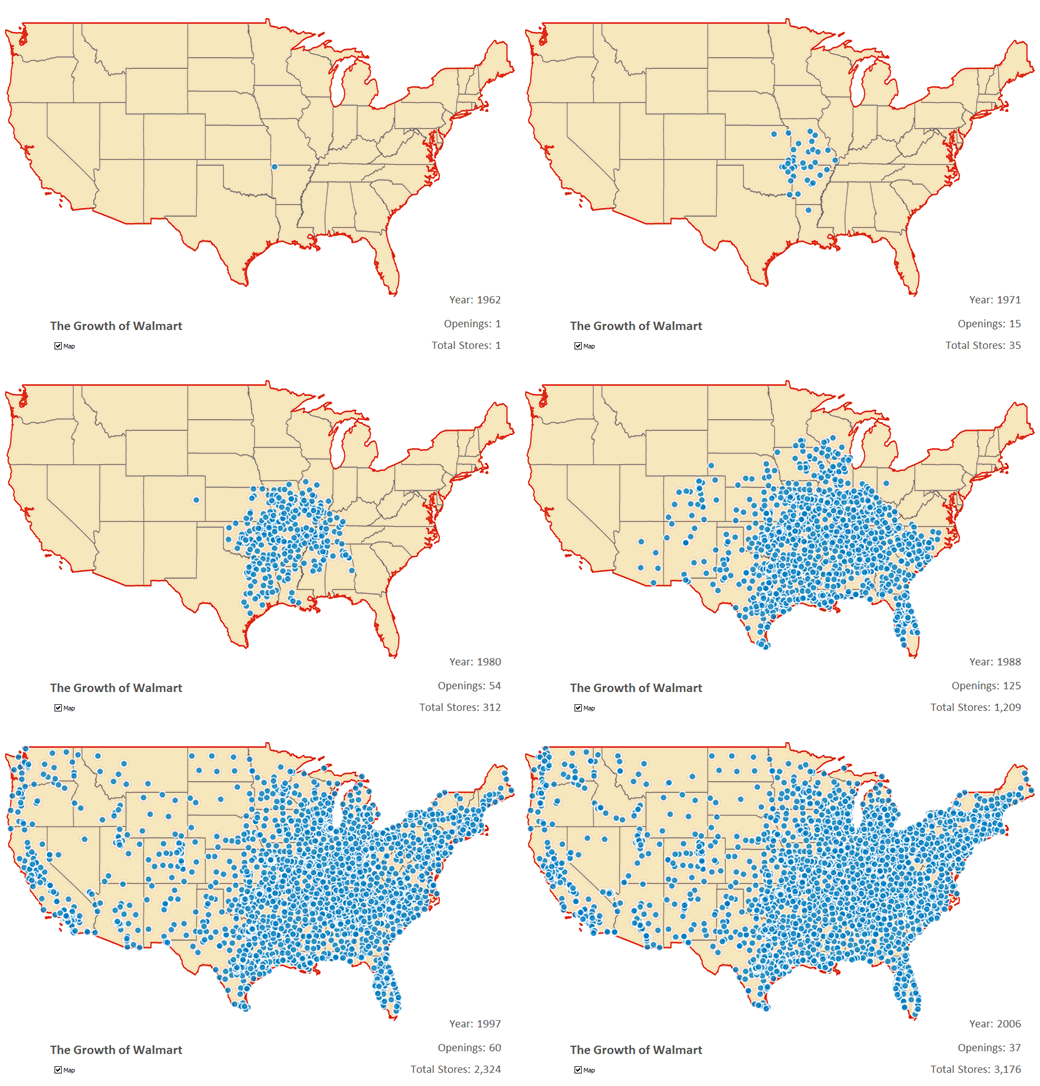
The Explosive Growth of Wal-Mart.

Started by Sam Walton in 1962 in Rogers, Arkansas, Walmart now has over 8,500 stores in 15 countries. In the animation above, one can see how the store opened in 1962 has exploded to 3,898 Walmarts as of May 2012.

Found at All that is Interesting.

Watching this map makes me think of some horror scenario that you might find in “Contagion” or some other disease-disaster movie. I wonder if the CDC could come up with a vaccine…

The Old Wolf has spoken.