“Who cares? It’s just blacks dying.”

The epic inside story of long-term criminal fraud at Ranbaxy, the Indian drug company that makes generic Lipitor for millions of Americans.

Dirty Medicine – The Ranbaxy drug debacle


TL;DR: If you use generic drugs, you may want to find out where they are from. If they’re from Ranbaxy or Dr. Reddy’s, both in India, find a different provider for your health’s sake.


CEO Singh of Ranbaxy

In a conference call with a dozen company executives, one brushed aside … fears about the quality of the AIDS medicine Ranbaxy was supplying for Africa. “Who cares?” he said, … “It’s just blacks dying.”

This is shocking enough, but you ain’t seen nothing yet.

This recent article over at CNN Money raised all sorts of red flags for me this morning. It’s fairly long, but I read every word, and what I read left me shaken, not stirred. I would recommend reading it in its entirety.

I take two generic drugs provided to me via Welldyne RX, my company’s bulk drug provider, and I started doing some research. I discovered that one was made by Sun Pharmaceuticals, and the other by Dr. Reddy’s Laboratories, both based in India.

After having read the Ranbaxy article, and digging in to the various generic manufacturers of the drugs I take, it became clear that it’s not just the Russian Business Network selling counterfeit or low-quality drugs, but the legitimate pharmaceutical providers, each of whom has a byzantine network of providers and producers which make guaranteeing quality extremely difficult.

drug

Here’s are the manufacturers I found at drugs.com for generic omeprazole 20mg, which I take for recurring GERD:

  • MYLAN 6150 MYLAN 6150 (Omeprazole 20 mg) – Mylan (USA)
    In 2007, Mylan acquired a controlling interest in India-based Matrix Laboratories Limited, a top producer of active pharmaceutical ingredients (APIs) for generic drugs, and the generics business of Germany-based Merck KGaA
  • OME 20 OME 20 (Omeprazole 20 mg) – Sandoz (Germany)
  • 20 (Omeprazole 20 mg) – Major Pharmaceuticals (USA?)
  • 082 IMPAX 20 (Omeprazole 20 mg) – Teva (Israel)
  • KU 118 (Omeprazole delayed release 20 mg) – Kremers Urban (USA)
  • APO 020 (Omeprazole delayed release 20 mg) – Apotex (Canada)
  • OMEPRAZOLE 20mg R158 (Omeprazole delayed release 20 mg) – Dr. Reddy’s (India) – this is the one dispensed to me by WellDyne RX.
  • 20 (Omeprazole Delayed Release 20 mg) – Perrigo
  • OMP 20 (Omeprazole magnesium delayed-release 20 mg (base)) – Dr. Reddy’s (India)
  • ZA 10 20 mg (Omeprazole delayed-release 20 mg) – Zydus (India)
  • P (Prilosec otc 20 mg) – AstraZeneca (UK)
  • 607 PRILOSEC 20 (Prilosec 20 mg) – Merck (Germany)
  • 742 PRILOSEC 20 (Prilosec 20 mg) – AstraZeneca (UK)

Looking at these manufacturers and their supply chains, it would be difficult to know whether any medication is actually made in the USA without further digging. Many, many paths lead to India, and given the mind-bending history of corruption, fraud, abuse, mismanagement and outright criminal skullduggery uncovered at Ranbaxy, I am very leery of any medications that come from over there, even in part. Ranbaxy is still in operation, controlled in large part by Japanese firm Daiichi Sankyo.

Some source articles:

For the Record, Sun Pharmaceuticals works out of India, but thus far seems free of complaints or black marks. But the entire landscape makes me nervous. Tomorrow I call WellDyne Rx to see if I can get my meds sourced from the USA.

The Old Wolf has Spoken.

For a smile that glows in the dark!

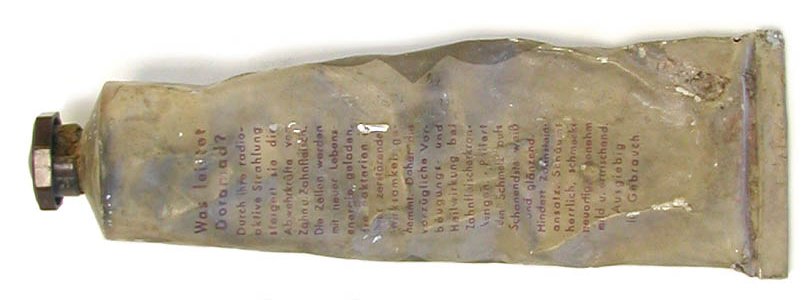
Doramad Radioactive Toothpaste (ca. 1940-1945)

nuclear-fisics

Found at the Health Physics Historical Instrumentation Collection

Doramad radioactive toothpaste was produced during World War II by Auergesellschaft of Berlin. The same company founded by Carl Auer von Welsbach who invented the gas lantern mantle!
A gamma spectroscopy analysis did reveal trace quantities of thorium, but the levels are too low to be detected with a simple hand-held survey meter.

——-

Tales from the Atomic Age

Paul W. Frame

Alsos and the Nazi Thorium

This story is adapted from the book Alsos, written by Samuel Goudsmit, H. Schuman Inc., New York, 1947. It appeared in the December 1996 issue of the Health Physics Society Newsletter.

In the early 1940s, the U.S. was at war and extraordinary efforts were underway to build an atomic bomb. The government even went so far as to confiscate the uranium oxides used by ceramics manufacturers to produce red/orange glazes. More than a few collectors must have been upset at the disruption in their supply of red dinnerware. Still, sacrifices were required. Similar confiscations occurred in occupied Europe to supply the Nazi A-bomb project, and keeping track of Germany’s atomic research was an allied intelligence effort code-named Alsos (the Greek word for grove, as in General Leslie Groves).

In the fall of 1944, the Alsos team learned that Auer Gesselshaft, a German chemical company involved in securing and processing uranium, had taken over the French company Terres-Rares during Nazi occupation. Ominously, Auer had shipped Terres-Rares’ massive supply of thorium to Germany. That the Germans wanted thorium suggested that their atomic research was further advanced than previously thought. Shortly after Paris was liberated, the Alsos team converged on the Terres-Rares office. They found it empty. Petersen, the Auer company chemist involved in securing the uranium and thorium supplies, had fled the allied advance (in Now It Can Be Told, Leslie Groves gives this man the name Jansen).

Petersen had gone to a town on the French-German border searching for some missing railroad cars carrying the thorium. And, as luck would have it, the area was captured by the allies shortly after Petersen arrived. Alsos had their first prisoner—and a suitcase bulging with documents! Among these was a dossier on a businesswoman who plied the world’s oldest profession sur les rues de Paris. Petersen’s explanation for having the dossier was that the woman had charged him an exorbitant 3000 francs although “in Berlin . . . it is only seven marks and a half per fling.” He said he was hoping to contact the proper authorities (whoever they would be) to recover some of his money. When the Alsos investigators took to the streets, they found that all aspects of Petersen’s implausible story proved true. However, the suitcase’s most shocking document revealed that Petersen had recently visited Hechingen, a town rumored to be a center for atomic research. Later it would be learned that the Germans had a lab there with an isotope separation unit and, in a nearby cave, an experimental pile. When the site was eventually captured, a ton and a half of metallic uranium cubes from the pile (likely produced by the Auer company) were found buried in a nearby field. Petersen’s explanation for his trip to Hechingen: he was visiting his mother (no doubt seeking advice on how to recover his 3000 francs). Darn thing was, his mother actually lived there.

Ultimately, Alsos’ hard work paid off and they discovered the true reason why Terres-Rares’ thorium supplies had been confiscated: the Auer Company, recognizing that the end of the war was near, and concerned about the consequent loss of business, concluded that there was no better future for their company than in cosmetics and related consumer products! Radium had already been used in toothpaste (Radiogen), why not use thorium instead? Auer had the patent, and with the thorium in hand they were ready to hit the ground running. They even formulated the following potential advertisement: “Use toothpaste with thorium! Have sparkling, brilliant teeth—radioactive brilliance!”

——-

toothpaste

Tube front:

Doramad
Radioaktive Zahncreme [Radioactive Toothpaste]
Biologisch wirksam [Biologically Effective]
Reinigend · Keimtötend · Erfrischend [Cleans – Kills bacteria – Refreshes]
Auergesellschaft Aktiengesellschaft [Auergesellschafft Inc.]
Abteilung Chemie · Berlin N 65. [Chemical Division – Berlin N 65]

toothpasteback

Tube back:

Was leistet Doramad?

Durch ihre radioaktive Strahlung steigert sie die Abwehrkräfte von Zahn u. Zahnfleisch. Die Zellen werden mit neuer Lebensenergie geladen, die Bakterien in ihrer zerstörenden Wirksamkeit gehemmt. Daher die vorzügliche Vorbeugungs- und Heilwirkung bei Zahnfleischerkrankungen. Poliert den Schmelz aufs Schonendste weiß und glänzend. Hindert Zahnsteinansatz. Schäumt herrlich, schmeckt neuartig, angenehm, mild u. erfrischend. Ausgiebig im Gebrauch.

What Does Doramad Do?

With its radioactive radiation, it enhances the defensive abilities of teeth and gums. The cells are charged with new life energy, and the destructive power of bacteria is blocked. This results in excellent preventative and healing effects in the case of gum disease. Enamel is gently polished to brilliant whiteness. 

ts radioactive radiation increases the defenses of teeth and gums. The cells are loaded with new life energy, the bacteria are hindered in their destroying effect. This explains the excellent prophylaxis and healing process with gingival diseases. It gently polishes the dental enamel so it turns white and shiny. Prevents plaque buildup. Foams wonderfully with a new, pleasant, mild and refreshing taste. Can be used sparingly.

Size: 4 3/4″ long

The following images are of a Doramad brochure.

doramadcover

doramad2

doramad3

doramad4

This is a good example of the kinds of radioactive quack cures which have been introduced over the years. If it had any effects at all, it would probably contribute to radium jaw.

The Old Wolf has spoken.

Hospital Charges Explained

Redditor “badengineer” gives a compelling and clear explanation of what’s going on with wildly-fluctuating hospital charges. Not a lot of mainstream folks read Reddit, so I thought this was worth cross-posting over here.


I work for a top tier academic medical center as a corporate strategist, so I’m at least aware of how the various hospitals in my state are doing, how pricing works and what the market dynamics are. There are a few things that should be pointed out….

First, you’re right. The charge rate certainly doesn’t correlate to quality metrics.

The charge rate listed in the data (available as an 11MB excel file at CMS.gov) has nothing to do with anything. It’s not a real price. It doesn’t correlate to the price anyone pays except for the extremely rare millionaire who doesn’t have insurance. Medicare doesn’t pay it, 95% of uninsured people can’t pay it, insurance companies don’t pay it.

It’s primarily a negotiating trick, with some accounting tricks thrown in for good measure.

People need to understand how pricing works, because it’s the cancer at the heart of healthcare.

At any given hospital, there are a hundred different prices for any given procedure. Medicare and Medicaid pay all hospitals the same amount for Procedure X. Most hospitals lose 20% (or more) on that Medicare price and make it up on the private companies.

Every single private health insurance company pays a different price, very often 150% of what Medicare is paying. Each plan negotiates prices all on its own, in secret. They have no idea what other insurance companies pay. It’s in no one’s interest to share that price. It hurts hospitals’ future negotiations if their lowest negotiated price is public and it hurts payers negotiations if it gets out that they overpay some hospitals.

The hospital says “X costs us $50K, Y costs $60K, $Z costs $20K.”

The insurance company they’re negotiating with says “we normally pay $25K, $35K and $9K for those procedures. How about we give you 50% of your charge rate?”

The hospital says “OK”.

As a result, at a single hospital there can literally be 100 plans paying different prices for your gall bladder removal. Multiply that by 3,000 hospitals in the country. There are maybe 3,000,000 different prices for that surgery out there. All completely secret. You can imagine how that might create problems.

So basically, this charge rate is nothing more than a bit of insight into a hospital’s chosen negotiating tactics. They either price high and discount a lot, or price low and discount a little.

Uninsured people are screwed no matter what. If you’re uninsured and land in the hospital, you’re likely going bankrupt. It’s almost irrelevant whether it’s a $200K bill or a $100K bill. You’re going bankrupt. You might think this pricing was designed to extract money from that uninsured population, but hospitals get so little money from them that most don’t think about trying to squeeze them more using this charge rate. A vast majority of that care is just written off.

If the charge rate doesn’t correlate to real prices, it definitely doesn’t correlate to quality. There’s very often an inverse relationship between cost and quality to begin with. Medical errors are expensive and the places that reduce them save a ton of cash in lawsuits, readmissions (in cases where they’re penalized for them), etc. For example, we’re an awesome hospital you’ve heard of, but some organ transplants cost 35% less at the best-of-the-best place, because they do it so frickin’ well. That’s real cost. Not fake charge book cost. Usually, the better the care, the cheaper it is.

The odd thing about this story is that it isn’t new. Dartmouth Health Atlas has been publishing similar data for decades. It’s great to see it being covered, because it’s insane and a clear symptom of a deeper problem, but I was surprised to see it on the front page of the Times.

And every time I write something about this, I have to add: neither insurance companies nor hospitals are (on the whole) getting particularly rich off of this. As crazy as it sounds, this is not the result of unusual greed or a morally corrupt industry. It’s a historical artifact more than anything. Non-profit hospitals (which is almost all of them) earn an average of 2.5% operating margin and that’s shrinking. I dunno about for-profit hospitals, but they’re still not raking it in like people think they are. Health insurance plans earn more like 3.5% on average. If you chart the most profitable sectors of the economy, that puts them pretty far down the list. Drug companies, in comparison, are deep into double digit margins.

Of course, that’s relatively small profit on a truly mind-boggling amount of money (17% of the american economy) so it has a gigantic effect. It also tends to concentrate a lot of pain on people who can’t afford to pay it.

Anyway, that low profit margin gets at why no one breaks out and tries to be more transparent. A tiny downtick in your reimbursement rates will sink you. As our contracting guy says, last time our main payer got slightly miffed and decided to throw some business across town, we laid off 500 people the next year.

This is just how the system works. It’s not a conspiracy. It’s a perfect example of how a a bad system forces a bunch of rational actors to do absolutely batshit crazy things. Everyone could stand to earn and do a lot more if things were rationalized and we did away with this system of invisible prices. That’s the tragedy of the commons for you.

All hospitals and insurers are forced to play this game. Whether that’s a big 100-facility for-profit chain, a gigantic charity-oriented catholic system, an academic research center or your community hospital. This is how money moves in the system. Any real fix stands to hurt so many players that it’s pretty unlikely we’ll see change from a political standpoint. I’m kind of hoping the whole thing just collapses under it’s own weight and something better can arise from the ashes.


The system seems beyond fixing to me, but for the sake of our conscience we must continue looking for solutions, because what we have now is an immoral cesspool.

The Old Wolf has spoken.

Übercrappy and Filth

Abercrombie CEO Mark Jeffries still only wants ‘thin, beautiful’ customers. There’s only one problem.

fitch


Gacked from Reddit

This kind of corporate douchebaggery is, unfortunately, legal… but it certainly doesn’t make for a responsible corporate image. But A&F has a long, long tradition of being shallow and exclusive; I present for your gratuitous enjoyment a cartoon by Al Frueh, published in The New Yorker in 1926 (click for a larger version)

Abercrombie and Fitch


I remember buying one of A&F’s lighter-fluid-fueled hand warmers in their NYC shop as a kid, because it looked cool:

Handwarmer


It’s basically just a slow-burning lighter, but it worked great. Aside from that, I don’t think I’ve ever purchased anything from them over the subsequent 50 years. But then, I’m not one of the “beautiful people,” so that’s OK according to them.

The Old Wolf has spoken.

22 Years Later, Waiters Still Work for $2.13 a Hour

A recent article at Bloomberg highlighted a situation that has long irked me. And I’m part of the problem, and I’m groping for answers.

iu.8lN2Mgxws

One thing about the Bloomberg article that I’d change is “waitresses” -> “servers.” Obviously the problem is industry-wide, and not limited to those who are y-chromosome-challenged.  But whatever. That’s a subject for a different  essay.

I’ve written about tipping before. For reasons outlined there, it’s not optional. If you eat out, be prepared to tip, and tip well. The people who bring you your food depend on it, as do numerous others in the restaurant who don’t get tipped directly.

So here’s what I struggle with. While states can set their own minimum wage numbers, New Mexico and 12 other states use the federal level, which hasn’t been raised in 22 years. And even states that have raised the minimum for tipped employees tend to err on the side of parsimony. That means “being cheap.” I happen to think that paying a server $2.13 an hour (I only made less than this back in the 60’s and 70’s, when the minimum wage in Utah was $1.65) is an abomination and an affront to ethical business.

See, tips were never designed to be part of a server’s base wage… it’s just that employers saw a gold mine and took advantage of it. Restaurant owners justify their actions by saying that servers are making at least minimum wage with tips included and often more, and while this can happen, it’s the exception rather than the rule. Raising the base minimum would “also spur firings and reduced hours as thin-margin businesses grapple with higher costs, say some restaurant owners and economists.” And therein lies the rub.

According to the Houston Chronicle, in an article dealing with operating margins in the restaurant industry:

“Recent times have proven very difficult for the full-service restaurant industry. According to the NRA [National Restaurant Association, not the gun lobby], in 2010 the casual restaurants had an average operating margin of 3.0 percent with respect to gross sales. More formal $15 to $25 restaurants had an average operating margin of 3.5 percent. Fine dining establishments, costing $25 or more, had the worst margins of all, at 1.8 percent on average. Many such restaurants earned a loss, rather than a profit. Overall sales for the full-service restaurant industry came to $184 billion, a nominal increase over 2009.”

These razor-thin margins are built on the base + tip model, and if restaurant owners are required to quadruple their waitstaff’s wages and still keep the same pricing structure, the business goes under – which means loss of jobs for people and loss of tax revenues for localities, neither of which is a good thing. There’s no way to balance the equation without changing some variables, and the only one I can see that can change is price.

As Americans, we have developed a sense of entitlement regarding cheap eats, either in restaurants (supported on the backs of the servers), or in the grocery store (supported on the backs of low-paid migrant workers.) Raising prices for dining and groceries to give a fair living to the people who provide them would be the right thing to do… but would go over like a lead balloon with much of the public and would be a logistical nightmare – push over that domino and the whole house of cards would come tumbling dow, to mix metaphors.

You can see why I’m conflicted. I like eating out. Boycotting restaurants to make owners pay a living wage is the worst kind of self-spiting solution, because it would simply force many eateries out of business. The problem is multifaceted, and there are better minds than mine working on addressing it. One of them is Gina L. Darnell, a former server who authors Wiser Waitress. Here’s her wish list.  It’s not too much to ask.

In the meantime, all I can do is try to make a dining experience as pleasant for my server as they are trying to make it for me… and leave a decent tip.

The Old Wolf has spoken.

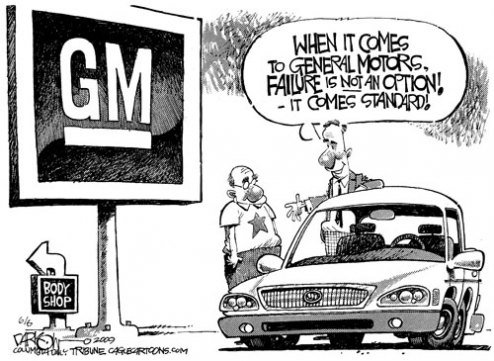
Auto Repair: It pays to shop around

We recently took my wife’s good old 97 Tercel, “Jack”, in for his yearly emissions test. Sadly, he failed – it seems that his catalytic converter had gracefully given up the ghost. After 15 years, that’s not unexpected. So we began to check local repair shops for a replacement. What I found was a real eye-opener.  Here are the quotes I was given from local service people. Prices reflect parts and labor.

Brent Brown Toyota, Orem, UT $1078.59
Larry Miller Toyota, Salt Lake City $973.00
Midas Salt Lake $300.00 to $350.00
Exhaust Unlimited $220.00 to $1000.00
Auto Performance Napa Autocare, Provo, UT $350.00
Autoworks Car Care, Payson, UT $220.00

Most places quoted me based on some ultra-special converter they said the car needed, which in itself cost around $800.00. We ended up going through Autoworks in Payson; they did a fine job, Jack passed his test, and off we went, happy at having saved significant money.

I have nothing against a business model based on honest markup for a fair profit, but some of these places definitely don’t have the customer’s best interest in mind.

Another story that I just happened to recall, since I’m on the subject.  Years ago, my first wife and our children took a trip to SoCal in our 1983 Buick Skylark. We had a wonderful time, and about 15 minute after we had gotten on the freeway in San Diego to head home, our transmission went out. I arranged a tow truck, and not knowing anyone in the area, had our car taken to AAMCO.

Big mistake.

They hauled our car in, took the transmission off, quoted us $1875 to repair it, and refused to put it back in unless we paid them to do it. Bastards. I later found out that nationwide, AAMCO is known for meaning “All Automatics Must Come Out.” I told them where they could stick their scam, and arranged for Interstate Transmissions to come get our car (and the tranny in a box). I sent my family home by air, rented a vehicle and stayed with my brother-in-law for a few days until the car was done, and Interstate charged me something like $1175, which included a lifetime warranty. And a good thing, too – because the transmission did go out again a year later, and they honored their warranty and fixed it at no additional cost.

Never take the first quote you get on something; always check around; and remember, a big name doesn’t guarantee honest or fair service. Be careful out there.

The Old Wolf has spoken.

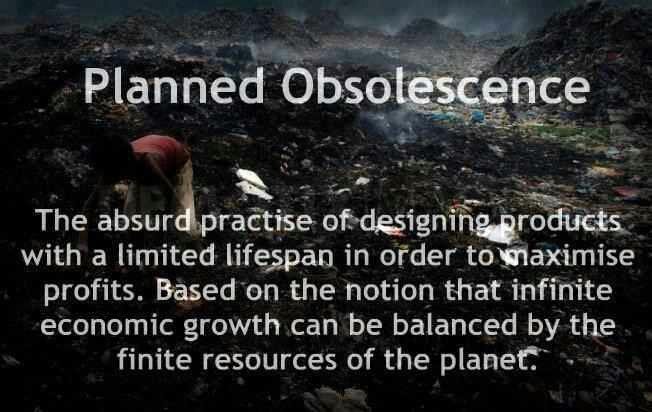
Planned Obsolescence

plannedobsolescence

It’s a conspiracy, right? We all know that cars, computers, printer cartridges, lightbulbs, and other consumables are now designed to fail sooner than they have to, in order to get us to buy more.

url

Well, wait just a minute.

I ripped this comment by redditor Fenwick23 in its entirety, because it’s the best analysis of the “planned obsolescence” issue I’ve ever read. I’ve only bowdlerized it a little, and corrected a couple of spelling issues.

I grow weary of this repeated conspiratorial usage of the phrase “planned obsolescence”. They would have you believe that there are engineers out there designing products with the intent of causing them to break down sooner. Ridiculous. People just don’t understand how competition in manufacturing has shaped consumer product design. One of the oft-cited examples is the venerable Hewlett-Packard LaserJet printer. Back in the early 90’s if you bought a low-end HP laser printer, you got a printer built like a tank. The damn things were slow, but they never wore out. Contrast with the low-end now, which are flimsy, come with 3/4 empty toner cartridges, and certainly won’t be functional in 10 years. “Planned obsolescence”, the conspiracy theorists conclude smugly. But wait… how much did you pay for that LaserJet 4 in 1993? Yeah, it was over $2000… in 1993 dollars. How much did that lousy HP P1600 printer you’re complaining about cost? Yeah, it was $200. If you spend the equivalent of two grand in 1993 dollars, which is over $3000 today, you get something like the HP M575c , which prints, copies, and faxes in color, and it’s built like a tank.

What people don’t realize is that in the “good old days” of a given product, a cheap version simply did not exist, so all products of that kind of that vintage were well built. This happens in every industry, at various rates. Engineers are under constant pressure to reduce manufacturing costs to widen the consumer base. Those $200 printers sell at far more than 10x the rate of $2000 printers, because every college freshman is buying one. To that end, certain parts must by necessity be less durable. Ikea isn’t making bookshelves out of particle board to sell more bookshelves when they break, they’re using particle board because not enough people can afford $500 oak book shelves to keep all those Ikea stores in business. (emphasis mine)

“But Fenwick23”, you ask, “What about that inkjet printer that had an expiration date coded into the inkjet cartridges?” Well, that one’s sadly all too easy to explain. Engineers, under the aforementioned pressure to cut costs, came up with a way to make inkjet systems for much cheaper. The only trade-off was that they had limited useful life before the ink dried out and clogged the nozzles. No big deal, just add an expiration system to the all-in-one nozzle-head-ink-tank package that lets the customer know that they need to buy a new one. This design is so much cheaper than the old design, they won’t mind buying it more often. But as so often happens in big corporations run by non-engineers, between the engineering department and the store shelves some upper-middle-manager looked at these cheaper ink jet cartridges and said “WOW WE CAN MAKE MOR PROFITZ IF WE SELL THEM SAME PRICE AS THE OLD KIND!” As a result, the anticipated reasonable trade-off intended by the engineers disappeared in a puff of pointy-haired logic, and six months later HP is stuck with a PR nightmare that looked like planned/programmed obsolescence, but which was in reality the result of managerial idiocy.

There are, of course, some real examples of planned obsolescence. The canonical example, from which the phrase was popularized, was Brooks Stevens use of it to describe 1950’s automotive marketing strategy. Brooks wasn’t talking about the cars breaking down, though. He was talking about aggressively marketing styling changes. The idea was to make last years model seem obsolete by changing the body designs. In essence, Brooks’ notion of planned obsolescence was nothing more than adopting the same strategy as the high fashion clothing industry. Sure, your car and your jacket work fine, but don’t you know that this year the cool people have wider lapels and round taillights?

url

The one place where planned obsolescence is a conspiracy to make you throw away perfectly serviceable items and buy new ones in order to prop up an industry is college textbooks. Renumbering pages and shifting end of chapter questions around is exactly the sort of sinister behavior people accuse HP of. The reasons educational publishers stoop to such tactics is quite clear, though. Their customer base is not expandable by making the product cheaper, so in order to maintain profits they have to make their otherwise durable product “expire” somehow. It’s evil, but understandable.

I applaud people repairing serviceable goods. Heck, I make a living repairing broken things. I just get sick of idiot “journalists” from places like Wired parroting the tired notion that the obsolescence of products in our cheap consumer society is the result of sinister motives, rather than the fact that we’re all bloody cheapskates.

Thank you, Fenwick23.

The Old Wolf has spoken.

The VFX dilemma: It’s not easy being green

524777_10151442044973851_1648463615_n

If it weren’t for VFX (visual effects) people, that’s just what Avatar and Lord of the Rings would look like.

There’s a lot of buzz on the internet right now about Bill Westenhofer’s suddenly-interrupted Oscar speech for “The Life of Pi.” Many people are interpreting this as a deliberate sabotage or a snub of VFX workers, but everything I have read seems to indicate that all participants were briefed early on about how much time they would have (one minute) and what would happen if they went overtime (the music from “Jaws”, followed by a cutaway.) It would seem that Mr. Westenhofer was simply not aware of how quickly one minute passes, and instead of jumping straight to his message, he exulted in the moment – which is what Oscar wins are for anyway.

I can’t speak to reality, because I just don’t have enough information. By Occam’s Razor it would indicate more happenstance than malice was at work here. But the more important point is that the event brought the entire issue of VFX studios into the public eye, and that’s a good thing.

Longtime critic and commentator Drew McWeeny published an open letter to Hollywood yesterday, and if you’re a consumer of films, either from Hollywood or independent producers, you would do a lot worse than to read this article – and the following commentary, which is just as enlightening.

The executive summary? Major studios are inserting hard objects into every possible orifice of VFX companies, who in turn are inserting hard objects into every possible orifice of those who work for them. And that’s the polite version. But read the letter, and the commentary, and then branch out and do your own research.

url

None of this is new, of course. “The Wizard of Speed and Time,” while a delightful and entertaining film in its own right, is essentially a rant by Mike Jittlov about having hard objects inserted into every possible orifice by the movie studios of his own time… and things have only gotten worse. Now, instead of creative geniuses like Jittlov working on their own and being screwed, we have entire stables of very talented people being worked insane hours without compensation (either not being paid overtime, or not being paid at all beyond their base wages), having no benefits, being classified as independent contractors despite working full-time for their companies, having no representation, simply seeing their jobs eliminated as studios outsource their work to places like India, having their whereabouts monitored, and even being threatened with physical abuse if they don’t perform like gods. Two other good reads are at the VFX Soldier and io9.

Granted, this is the outrage du jour. Public fickleness being what it is, the tempest will calm and people will go back to their lives as soon as yesterday… but for those working in the industry, the intolerable conditions will continue. But it raises a question in my own mind: as a consumer, what’s my responsibility?

Many people are up in arms about genetically modified foods, and consumers right and left are declining to shop at places that sell GMO’s; many people refuse to buy coffee that isn’t Fair Trade; Apple felt the pressure of public outrage and stepped up their game with their Chinese suppliers; even humble quinoa has raised a few eyebrows after it was found that increasing Western demand has so raised prices that local producers can no longer afford their own product. People get mad about stuff, and they do things.

It’s long been known that (with a few notable exceptions in cases of truly ethical companies), the only way to influence an industry is to hit it where it really hurts – in the wallet. Hollywood studios are interested in only one thing – maximizing dollars for themselves, and minimizing dollars spent on other people. Those dollars, however, come from us. You and me. The lovers of Avatar, The Lord of the Rings, The Avengers, you name it. If it were not for these talented people (and the writers, of course, but that’s another essay), I would not have been able to laugh myself silly watching Hulk toss Loki around like a rag doll – best moment in the whole film, if you ask me – these films would be worth less than nothing without the VFX people behind the visual magic.

It’s a tough issue, because good movies are a large part of my entertainment, and a great way to escape the daily grind, or to forget about the douchebaggery and unfairness that pervades 21st-Century society. Giving up all movies until the VFX people have fair and effective representation would be one solution, but would have little effect unless enough people chose this route to cut revenues for Hollywood, and the chances of that are… well, “snowball in Hell” is what comes to mind.

At the very least, I can contribute to raising the awareness of people about the issue. This article is a tiny drop in the ocean, but it’s a lot of tiny drops coming together that create a flood. I can also be more judicious about what I watch and when, and continue to think about the issue from the consumer side. The people who are at the heart of more and more movies at least deserve that much consideration.

The Old Wolf has spoken.

How hospital bills are killing us

Goodness, what a surprise.

Please read this article by Steven Brill from Time Magazine. It’s frightening.

Of course, it’s all about money and power. And people who have it will do anything – anything – to keep it that way, even if it means raping 99% of Americans in the wallet. And we wonder why healthcare in this country is so expensive and such a critical issue.

The Old Wolf has spoken.

Scott Adams: Clairvoyant.

On February 27, 1994, Scott Adams published this Dilbert strip:

23662.strip.sunday

Almost 20 years later, we have this news article about Tesco’s:

Work is Becoming More Like Prison As Some Workers Forced to Wear Electronic Bands That Track Everything They Do (Including Bathroom Breaks)

Grocery giant TESCO has strapped electronic armbands to their warehouse workers to measure their productivity.

The human body, with its need for rest, nutrition and hydration, is such an inefficient tool for capitalist production. But while machines are unlikely to replacehuman workers anytime soon, new technologies can deftly strip workers of their humanity!

The Irish Independent reports that grocery giant TESCO has strapped electronic armbands to their warehouse workers to measure their productivity, tracking their actions so closely that management knows when they briefly pause to drink from a water fountain or take a bathroom break. These unforgivable lapses in productivity impact workers’ performance score, which management then apparently uses to terrify them into working faster.

(Click through for the full article.)

The Dilbert cartoon seemed absolutely terrifying because of its impossibility… now that employers have begun stripping the last shred of dignity from their workers, I really don’t know how much lower humanity can sink.

I am beyond astonished. 

The Old Wolf has spoken.