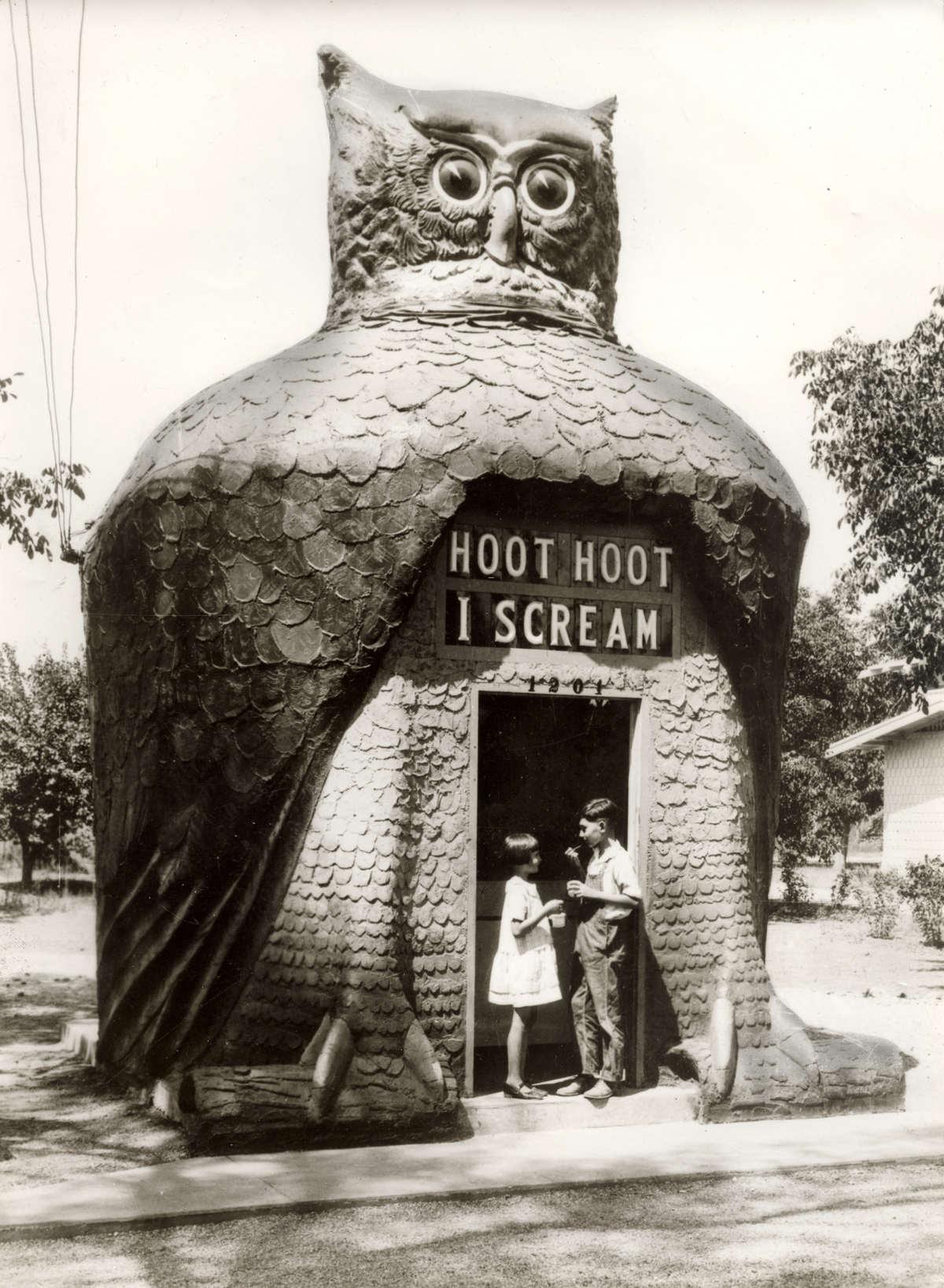
The Hoot Hoot Cafe was built in the shape of an owl. The head rotated; the eyes, made from Buick headlamps, blinked; the sign: Hoot hoot, I scream, used elements of a theater marquee. For over 50 years, Tillie Hattrup ran this L.A.-area refreshment spot designed and built by her husband, Roy in 1926-27. It was demolished in 1979.
The cafe was built at 1201 Valley Boulevard, Rosemead, CA and stayed there from around 1926-1928. The land was sold to a new owner, and the building relocated to 8404 Long Beach Boulevard, three blocks away. Information from the South Gate Directory, dated July 1st, 1945, shows the building at this address from 1928 – 1949. It relocated again in 1949 to 8711 Long Beach Boulevard, and remained there until its demolition in 1979.[1]
For what it’s worth, I loved this unusual aspect of America – many things of this nature still existed when I was a kid in the 50’s, and they were always great entertainment for motoring families. Another example is the Wigwam Motel in Arizona:
Dated and now somewhat politically incorrect, old motels like this were eye-catching and amusing.
The Old Wolf has spoken.
[1] Information regarding the two South Gate addresses was supplied courtesy of the South Gate Historical Museum.
Anyone who knows me at all probably knows that I have this love of Ireland and its language, Gailge.
Speak Irish to me or I’ll break your face
One day in New York, around 1969, I stopped to use the phone in a pub, and while there I struck up a conversation with the bartender. The conversation turned to languages, and when I told him that I enjoyed learning them he said to me, ” Well, don’t learn Gaelic “. This ominous warning piqued my curiosity, and that very day I went and found a copy of Teach Yourself Irish by Myles Dillon and Donncha Ó Cróinin. Unfortunately this volume was old in methodology and in orthography – it used a lot of words that had even more silent letters than today’s version uses, after a spelling reform. As a result, pronunciation was a problem; it would take a native speaker to help me understand that Dún Laoghaire, for instance, is pronounced Doon Leery.
So I set the book aside until about 1990, when I discovered an Irish course in my local library system, Cúrsa Gaeilge by the Linguaphone Institute. With the help of this “Rosetta Stone”, unfortunately out of print, I began making progress. Since then I have discovered numerous excellent courses both in print and on the net. If you’re interested in learning Irish, I would recommend Learning Irish by Michael Ó Siadhail; the new Teach Yourself Irish; Pimsleur Irish; or Buntús Cainte. Rosetta Stone announced their first-level Irish course in 2008.
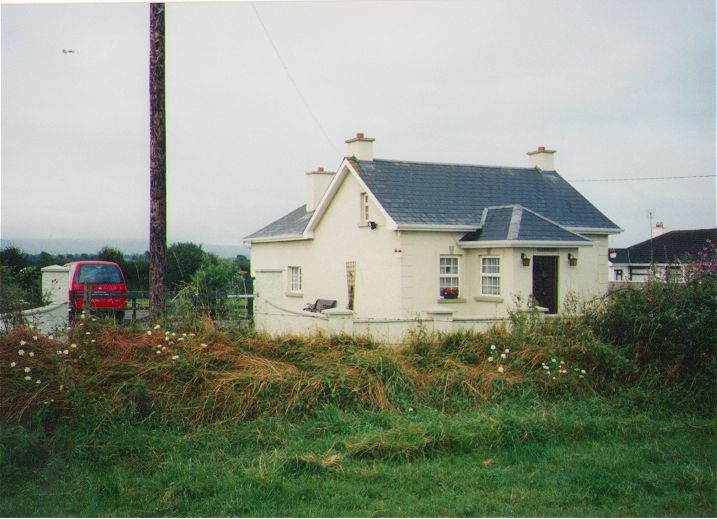
I have been enchanted by this intriguing language and its intriguing speakers. In 1998 I fulfilled a lifetime dream to visit Ireland with my family, and spent a week in Abbeyville Cottage in Cill Mocheallog (Kilmallock).
We explored the Dingle peninsula and stopped in the Gaeltacht (Irish-speaking) area of Baile an Fhirtéaraigh (Ballyferriter); nearly fell off the cliffs of Moher; saw Waterford crystal being made; experienced a medieval dinner at Bunratty Castle near Limerick as well as St. John’s Castle in the same town; explored the rock of Cashel; went horseback riding in a brisk Irish rain; attended church meetings in Tralee; kissed the Blarney stone and dined at the Deanery in Cork… I’m afraid all it did was whet my appetite for more. The reality far exceeded the expectation; fortunately I was able to make another trip back in 2001, to attend a translator’s conference in Trá Lí, but it’s still not enough. I’m greedy. I want to go back.
Cliffs of Moher
Irish Street Signs
A blessing on this lovely land and its equally lovely people.
No Bearla
Filmmaker and native Irish speaker Manchán Magan made a documentary in which he traveled through Ireland only speaking Irish, just to see how far he could get. People demanded he switch to English; shopkeepers told him to get lost; officials refused to help him; and people on the street ignored him. But he kept at it and found willing speakers here and there. (From The Week.) His video gives you a delightful glimpse into the struggles of the Irish-speaking community to keep their language alive.
The following two videos by Dough Productions are entertaining and full of pathos. To this day, Irish continues the Sysiphean task of defending itself against the onslaught of English. Whether the language will survive this century remains to be seen; I feel as though having learned a bit of it, I’m doing my part – however small – to stem the tide.
My Name is Yu Ming – Follow the adventures of Yu Ming, a young Chinese shopkeeper in a dead-end job, who moves to Ireland to start life anew… only to find out that the “old language” is no longer in use!
Fluent Dysphasia – Pity poor Michael Murphy! After a night of celebrating with a friend, he wakes up with a hangover and a problem: He no longer speaks or understands English, and can only speak Irish! How will he solve this difficult challenge?
With thanks to Colin Nelson for permission to spread this little bit of whimsy and delightful writing around. So here, for your gratuitous reading pleasure, is an account of an intriguing discovery. Original post here.
——————————————————————————–
Archaeological Find
In the County of Meath in Eastern Ireland lies the Boyne Valley. An area that has fascinated scholars and archaeologists for centuries. There you find Brú na Bóinne, the Palace of Boyne. There you find Dowth, Newgrange and Knowth; Dozens of burial tunnels criss-cross the area. They were built about 3200BC making them older than the Pyramids or Stonehenge.
Richard Watkins of Stanford University was part of a team that was investigating Tunnel 22 that runs north-south through Newgrange. About 122 metres down the tunnel, he discovered what appeared to be an ancient cave-in. After 3 days careful work, Watkins and his team discovered that the rocks concealed the entrance to a roughly circular chamber about four metres in diameter.
There were clear signs that this was not a burial chamber but had been inhabited at one time. There were the remains of a fire below a gap in the ceiling that was once, presumably, a primitive chimney and source of light. There were the tattered rags that may have been bedding or clothing and some artefacts (one of which was a knife dated about the eighth century AD).
An examination of the chamber provided evidence that the occupant was connected with a monastery near Drogheda on the River Mattock that pre-dated Mellifont Abbey built on the same site by some 200 years. Records discovered at the abbey site indicated a monk called Muireadhach was entrusted with a “Pagan relic so foul it must be forever banished from the world of the living.”
This reference led Watkins to re-examine the chamber, whereupon he found a hiding place cunningly carved into the chamber wall and hidden behind a close-fitting stone. There was a solid mass about one metre by one metre by 0.5 metre behind the stone, and great care had to be taken in order not to cause any undue damage.
The mass was packaged up and sent to Truro University where Professor John Dean led the team that was to analyse and preserve the find.
It was discovered that the outer part of the mass consisted of about five goat skins; each had to be removed separately. Within was an ancient book. The cover was made of wood and fastened with metal clasps. The pages were fastened to the covers with cords that had only survived because of the protection of the goatskins and the atmosphere of the cavern.
At last, the team could see the first few pages of the book. They contained drawings, now faded, but were once rich in colour. Alongside these drawings were the spidery writings of the scribe in an ancient version of Gaelic (it pre-dated the use of Roman letters).
The search was on for someone who could translate the book. That search ended in Adelaide, Australia with Bryan Tewkes. Tewkes had done extensive research on Pre-Roman Civilisations of the British Isles. It was he that finally identified the book that had filled the ancient monks with so much horror:
It’s a conspiracy, right? We all know that cars, computers, printer cartridges, lightbulbs, and other consumables are now designed to fail sooner than they have to, in order to get us to buy more.
Well, wait just a minute.
I ripped this comment by redditor Fenwick23 in its entirety, because it’s the best analysis of the “planned obsolescence” issue I’ve ever read. I’ve only bowdlerized it a little, and corrected a couple of spelling issues.
I grow weary of this repeated conspiratorial usage of the phrase “planned obsolescence”. They would have you believe that there are engineers out there designing products with the intent of causing them to break down sooner. Ridiculous. People just don’t understand how competition in manufacturing has shaped consumer product design. One of the oft-cited examples is the venerable Hewlett-Packard LaserJet printer. Back in the early 90’s if you bought a low-end HP laser printer, you got a printer built like a tank. The damn things were slow, but they never wore out. Contrast with the low-end now, which are flimsy, come with 3/4 empty toner cartridges, and certainly won’t be functional in 10 years. “Planned obsolescence”, the conspiracy theorists conclude smugly. But wait… how much did you pay for that LaserJet 4 in 1993? Yeah, it was over $2000… in 1993 dollars. How much did that lousy HP P1600 printer you’re complaining about cost? Yeah, it was $200. If you spend the equivalent of two grand in 1993 dollars, which is over $3000 today, you get something like the HP M575c , which prints, copies, and faxes in color, and it’s built like a tank.
What people don’t realize is that in the “good old days” of a given product, a cheap version simply did not exist, so all products of that kind of that vintage were well built. This happens in every industry, at various rates. Engineers are under constant pressure to reduce manufacturing costs to widen the consumer base. Those $200 printers sell at far more than 10x the rate of $2000 printers, because every college freshman is buying one. To that end, certain parts must by necessity be less durable. Ikea isn’t making bookshelves out of particle board to sell more bookshelves when they break, they’re using particle board because not enough people can afford $500 oak book shelves to keep all those Ikea stores in business. (emphasis mine)
“But Fenwick23”, you ask, “What about that inkjet printer that had an expiration date coded into the inkjet cartridges?” Well, that one’s sadly all too easy to explain. Engineers, under the aforementioned pressure to cut costs, came up with a way to make inkjet systems for much cheaper. The only trade-off was that they had limited useful life before the ink dried out and clogged the nozzles. No big deal, just add an expiration system to the all-in-one nozzle-head-ink-tank package that lets the customer know that they need to buy a new one. This design is so much cheaper than the old design, they won’t mind buying it more often. But as so often happens in big corporations run by non-engineers, between the engineering department and the store shelves some upper-middle-manager looked at these cheaper ink jet cartridges and said “WOW WE CAN MAKE MOR PROFITZ IF WE SELL THEM SAME PRICE AS THE OLD KIND!” As a result, the anticipated reasonable trade-off intended by the engineers disappeared in a puff of pointy-haired logic, and six months later HP is stuck with a PR nightmare that looked like planned/programmed obsolescence, but which was in reality the result of managerial idiocy.
There are, of course, some real examples of planned obsolescence. The canonical example, from which the phrase was popularized, was Brooks Stevens use of it to describe 1950’s automotive marketing strategy. Brooks wasn’t talking about the cars breaking down, though. He was talking about aggressively marketing styling changes. The idea was to make last years model seem obsolete by changing the body designs. In essence, Brooks’ notion of planned obsolescence was nothing more than adopting the same strategy as the high fashion clothing industry. Sure, your car and your jacket work fine, but don’t you know that this year the cool people have wider lapels and round taillights?
The one place where planned obsolescence is a conspiracy to make you throw away perfectly serviceable items and buy new ones in order to prop up an industry is college textbooks. Renumbering pages and shifting end of chapter questions around is exactly the sort of sinister behavior people accuse HP of. The reasons educational publishers stoop to such tactics is quite clear, though. Their customer base is not expandable by making the product cheaper, so in order to maintain profits they have to make their otherwise durable product “expire” somehow. It’s evil, but understandable.
I applaud people repairing serviceable goods. Heck, I make a living repairing broken things. I just get sick of idiot “journalists” from places like Wired parroting the tired notion that the obsolescence of products in our cheap consumer society is the result of sinister motives, rather than the fact that we’re all bloody cheapskates.
Advertising is insidious. For a perfect example, check the section on Salem cigarettes in this post. In the same way as my parents’ generation could not listen to the William Tell Overture without shouting “Hi-o Silver!”, I am unable to listen to the 1812 Overture by Tchaikovsky without thinking of Quaker Puffed Rice.
With thanks to Dave Berg
Sadly, no examples of the famous Quaker commercial appear to be extant on the internet. However, the ad featured music from the 1812 overture, of which some versions use actual cannon. The screen would be filled with images of puffed rice flying out of cannons as the music boomed in the background.
Here’s an older ad that highlighted the technique without the use of the music:
Just recently, I stumbled across this video of Lin Hai, an old vendor on the streets of China, using a rice cannon to create his own puffed rice and popcorn right on the street. It gives you an idea of how the Quaker product is made, something I had never really understood.
(Skip to 2:30 to watch the impressive part.)
Edit: I realized this discussion would be incomplete without showing what modern technology has done with this principle:
I saw one of these in operation at a local grocery store – the machine loads a scoop of rice into a press, and a few seconds later shoots out a perfectly-formed rice cake. Unfortunately, rice cakes still taste like styrofoam, but it was fun to watch.
Edit 2: For some odd reason, all the old Quaker commercials featuring the 1812 overture have been scrubbed from the Internet. I find this sad, and it’s not just this instance. A lot of the great old ads that had been captured are taken down by corporate attorneys in the name of “intellectual property protection” or some other nonsense. These ads belong to history and should be available to the public as a record of times and attitudes gone by, even if current marketings strategies have changed.
At one point there was an old commercial featuring the cast of “F Troop” singing about puffed wheat to the tune of the 1812 Overture, but it also has been scrubbed. The Old Wolf has spoken.
My previous post about Neapolitan Pizza reminded me that I’ve been thinking about Neapolitan Pizza. Having lived in Naples for a year and a half in 1970 and 1971, I may go on a Napoli jag here at the blog, and I hope I’ll be forgiven while I work out the feelings and memories that come flooding back unbidden on occasion. The following is a long ramble. Note: Some sections come from other sources, so don’t get too exited about the quality of writing throughout this post. The information is more important than the vehicle.
According to Wikipedia, pizza originated in Greece as bread coated with oils and herbs; modern pizza has its roots in Italy as the Neapolitan flatbread. Anyone can make pizza, and there are as many recipes as there are restaurants, but if you want to have “Real Neapolitan Pizza” on your window, you must be certified by the Verace Pizza Napoletana association.
The following section was written by VPN:
In 1984 a group of pizzaioli, led by Antonio Pace, sought to preserve the identity and integrity of Neapolitan pizza. From this struggle with the Italian government was born the association Verace Pizza Napoletana or Vera Pizza Napoletana (VPN). While forms of foccacia had been around for centuries, it was in Napoli where tomatoes were first placed on round discs of bread and cooked in brick wood fired ovens sometime in the late 1600’s. Mozzarella also made its debut on pizza in Napoli in the mid 1800’s if not earlier. While it is widely believed that the classic Napoli style pizza, the margherita, was invented by a pizzaiolo in 1889, there is written evidence that a pizza with tomatoes and mozzarella was already being made in Napoli much earlier.
It is this history that Signore Pace and others are trying to preserve through the VPN.
On May 16, 2007 Settebello Pizzeria was certified by the President of the US Chapter of the VPN, Peppe Miele, as only the 16th member in the United States. Settebello is the only certified member in the state of Utah, with branches in Salt Lake City and Farmington. We will always strive to preserve the art of pizza making as it has been done in Napoli for over 200 years.
Member Charter: ASSOCIATION OF “VERACE PIZZA NAPOLETANA”
“Verace Pizza Napoletana” is an international non-profit association. The objectives of the association are the following:
To cultivate the culinary discipline of the Neapolitan pizza, with its requisite preparation, ingredients and manner of cooking.
To protect and promote the authentic Neapolitan pizza and as a consequence, the association members who fulfill the culinary requirements and characteristics of the Neapolitan pizza.
To defend the origin of the authentic pizza and the tradition of the pizza as it began in Naples, Italy.
To designate by the Verace Pizza Napoletana certification mark those pizzerias which respect the culinary tradition of the Neapolitan pizza and where such pizza may be enjoyed.
THE CULINARY DISCIPLINE OF THE “VERACE PIZZA NAPOLETANA”
The certification is granted only to those establishments whose pizzas fulfill the following standards:
“Verace Pizza Napoletana” must be made from the following raw ingredients:
Flour
Natural Yeast, Yeast of Beer
Water
The pizza dough must be worked with the hands or with a mixer approved by the Association’s committee. After rising, the dough must be shaped with the hands and without a rolling pin or any mechanical means.
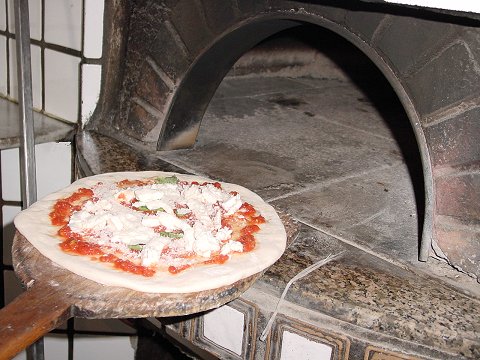
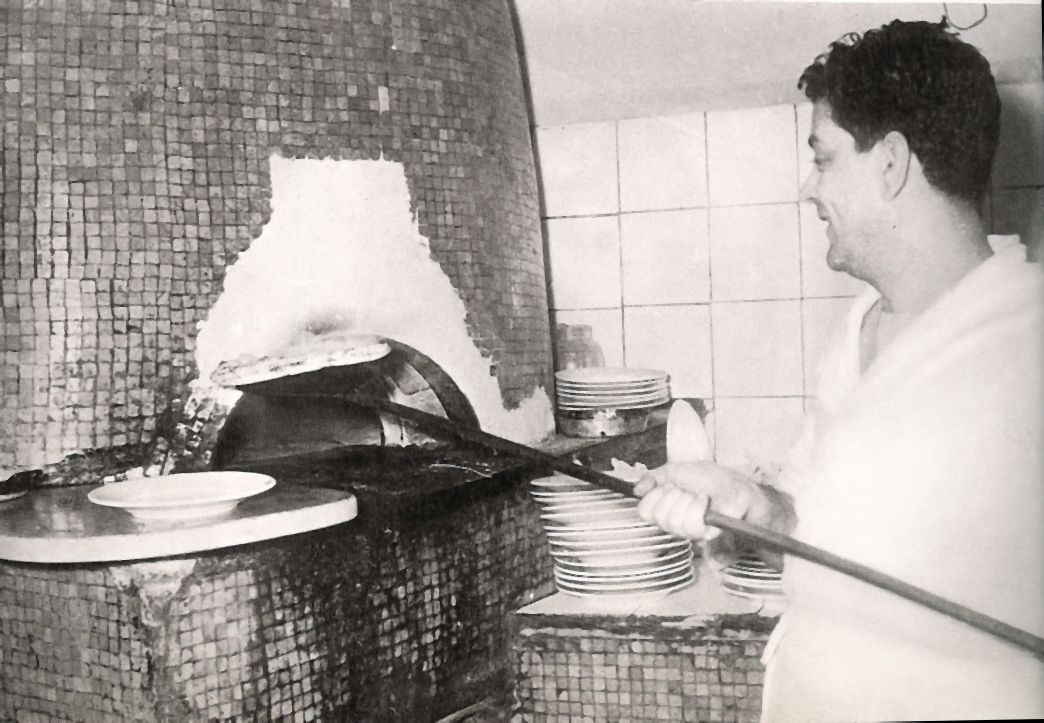
The cooking of the pizza must take place on the surface of the oven and not in any pan or container. The oven must be a wood burning oven and structured in a bell shape and of special brick with the floor of the pizza oven constructed of volcanic stone. The oven must be fired with only wood and kindling.
The classic pizzas and their respective basic ingredients are the following:
· Marinara (Napoletana): Tomato, olive oil, oregano, and garlic. · Margherita: Tomato, olive oil, grated Parmesan, and fior-di-latte or mozzarella. · Ripieno (Calzone): Ricotta, fior-di-latte or mozzarella, olive oil, and salami. · Formaggio e Pomodoro: Tomato, olive oil, and grated Parmesan
Basil leaves may be used on all types of pizza.
Variations of pizzas are recognized if they are in conformity with the Neapolitan tradition of pizzas and are not in contrast with the rules of gastronomy, with judgment reserved by the Association’s committee.
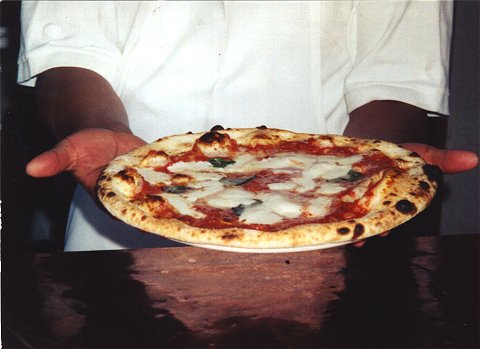
The pizza, when eaten, should present the following characteristics: soft, well cooked, fragrant and enclosed in a high, soft edge of crust.
The following section was posted by user SempreAngela at forum.literotica.com on July 23, 2003
The Origins of Pizza: Egypt, Greece, Rome.
Do you know that Pizza is three thousand years old?
Every civilization, we may say, has known different kinds of flat buns, pies or the like based on a dough made of cereal and water and various seasonings. It is a form of food that no doubt resembles pizza.
The ancient civilizations of the Mediterranean Sea offer a wide range of examples of those that can be considered the ancestors of the pizza as we moderns know it.
So from Egypt to Greece to Rome and Pompeii, we find many examples of dishes that remember pizza in their ingredients, composition and cooking.
In the ancient Egypt the custom was to celebrate the birthday of the Pharaoh by eating a flat bun seasoned with herbs, the greek historian Herodotus reports several Babylonian recipes while in VII B.C. Archilocus, the poet-soldier, in some lines informs us to have on his spear’s tip his “kneaded bun”, the typical food of the soldier.
The classic Greece shows to have known a wide range of examples that can be considered “archetipal” versions of pizza: flat pies or buns of all kinds appear to be very popular and widespread foods all over the classic age.
We find numerous testimonies of greek writers regarding these different kinds of “pizza”, the so called “maza” in ancient greek: testimonies that punctually we meet again in the Latin world and ancient Rome where, among other leavened or not versions of this bun, we find the “placenta” and the “offa”, prepared with water and barley, the cereal which the alimentation of the Latins was based on.
Pizza, without giving credence to other fanciful hypotheses about its origins, presents itself as a typical food of the civilizations blossomed on Mediterranean Sea’s basin. And in one of Mediterranean’s Queens, Naples, pizza will find its fatherland and the starting point of its worldwide diffusion.
The Middle Ages
We recover numerous clues of this food, in the course of centuries getting nearer to the form we know nowadays, also during the Middle Ages and the Renaissance, always wavering between aristocratic taste and popular consumption, between kingly banquets and the poor’s table; the term “pizza” is already testified at the beginnings of the Middle Ages and during the subsequent centuries several local forms of this word are to be recovered: they show different variations, from sweet to salty, and various ways of cooking this course.
In the meantime the Longobards, that invaded Southern Italy after the fall of the Roman Empire, had brought with them the buffalo that, once acclimatized between Lazio and Campania, would have provided the milk for the making of mozzarella.
And in the Modern Age, the discover of the New World will bring to Europe an element without which it is impossible to imagine pizza: tomato.
After initial suspicions, tomato entered triumphally Italian cuisine, and particularly neapolitan cuisine. The pizza will take its good advantage of it, getting nearer to the form we know.
Pizza between XVIII and XIX century.
In the decades between the XVIII and XIX century pizza confirms itself as one of the most favourite dishes of the neapolitan people, entering with full rights the tradition of neapolitan cuisine: and the features of pizza and of the places appointed to its making, the pizzerie, begin to be more and more distinct.
During XVIII century, pizza is baked in ovens and then sold in the streets of Naples: a boy, who balanced on his head the typical “stufa” (a tin stove to keep pizza warm), brings directly to his customers the pizza, already made with different seasonings, after attracting their attention with his loud and typical calls.
Between the XVIII and the XIX century starts the habit of eating pizza at these ovens as well as in the streets or at home, a sign of the growing favour known by this course, by then fully established in the alimentation of the neapolitan people: the pizzeria, in its modern sense, is born.
The oven, the marble bench where pizza is prepared, the shelf upon which the different ingredients of pizza are shown, the tables where customers ate pizza, the outer display where fried pizza is stored to be sold to the passers-by: all features still to be found in the modern neapolitan pizzeria.
The first dinasties of neapolitan pizzamakers originate in these years: in 1780 the pizzeria “Pietro… e basta Così” is established. After two hundred years, the tradition of this ancient and historical pizzeria is continued by the Ancient Pizzeria Brandi.
Between aristocratic taste (the King of Naples Ferdinando II of Borbone greatly enjoyed the pizza made by ‘Ntuono Testa at Salita S. Teresa) and an even more decided popular favour, pizza establishes itself as a daily course, dinner and supper of the neapolitans.
Throughout the XIX century the “pizzaiuoli”, whether itinerant or not, kept on supplying the neapolitans with all the different kinds of pizza, for all pockets, the pizza becoming definitely an icon in the folklore of neapolitan people.
Witnesses and memorialists, but also writers and musicians and poets as Matilde Serao, Salvatore Di Giacomo, Libero Bovio or Raffaele Viviani, didn’t fail to record and celebrate the presence of pizza in people’s everyday life.
After the Kings of Naples, the Borbone, also the new Kings of Italy, the Savoia, showed to appreciate the neapolitan pizza: not only, but they left a mark in the history of pizza.
The Ancient Pizzeria Brandi still retains a document signed “sincerely, Galli Camillo, head of the table of the Royal Household”, dated June 1889. It is an acknowledgement to S.G. Raffaele Esposito, of the then pizzeria “Pietro e Basta Così”, for the qualities of pizza, among which the celebrated one with pomodoro and mozzarella, he prepared for Her Majesty the Queen Margherita, that, as emphasized in this letter, were found to be excellent.
The pizza with pomodoro and mozzarella was so named “Pizza Margherita” by the pizzaiuolo Raffaele Esposito, and that is the name by which this pizza is still universally known .
The beginning of the new century sees the pizza ready for its national and worldwide diffusion, well beyond the boundaries of Naples: in the course of our century pizza has won approvals from Europe to America to Japan, becoming, and this not an exaggeration, patrimony of the whole mankind.
The following section was written by VPN
While certainly ancient, the earliest origins of pizza are not at all clear. One interesting legend recounts that the Roman soldiers returning from Palestina, where they had been compelled to eat matzoh among the Palestinian Jews, developed a dish called picea upon gratefully returning to the Italian peninsula.
Most sources, however, agree that an early form of pizza resembling what today is called focaccia was eaten by many peoples around the Mediterranean rim, e.g., by Greeks, Egyptians etc.
These dishes of round pita-like, cooked bread with oil and spices on top are the ancestors of pizza, but are not properly speaking pizza. The tomato was unknown and the Indian water buffalo had not yet been imported to Campania, the area around Naples.
With the discovery of the New World, the tomato made its way to Italy through Spain. It was considered a poisonous ornamental and so in the first centuries of its import was not eaten.
The Neapolitan people seem to be the first to wholeheartedly adopt the tomato into their cuisine, so that in our day the (plum) tomato is the most characteristic element of Neapolitan cuisine.
Over the centuries, a veritable tradition of pizza was developed among the Neapolitan poor. It is not surprising, then, that a modern pizza, that is, with mozzarella di bufala and tomato was made in 18711 in Naples for Princess Margherita of Savoia by Raffaele Esposito. This patriotic pizza, of basil, tomato and mozzarella, in honor of the new tricolor Italian flag’s red, green and white, became the pizza alla Margherita. This form of pizza was then made known, popularized and adapted in all the world through waves of emigration from Naples in the late 19th and early 20th centuries.
The History of the American style pizza pie.
The United States is among the most pizza enthusiastic countries one can find today. How did this come about?
Italian immigrants to New York City began making a version of pizza when they arrived in their new American home at the turn of the 20th century. The first pizzeria in the U.S. was opened by an Italian immigrant in 1905.
In addition, American GI’s returning from Italy gained a familiarity with the dish and it is in the post-WWII period that pizza really takes off in the United States.
1 Date per VPN Discipline and Specifications Manual.
‘A PIZZA per Lello Lupoli (in Neapolitan dialect)
Pizzaiuo’, m’he ‘a fa’ ‘na pizza muzzarella e pummarola… Ma ll’he ‘a fa’ cu ‘e mmane, ‘o core e.. ‘a fronna ‘e vasenicola, Falla bbona!
Mana grassa a muzzarella, miette ll’uoglio, miette ‘o sale… Falla fa’ cchiù arruscatella: quanno é cotta nun fa male… Cotta bbona!
E vullente, ‘a dint’ ‘o furno, nun l’he ‘a mettere ‘int’ ‘o piatto ca si no perde ‘o sapore… Io m’ ‘a piglio e ‘a chiejo a libretto… Quant’é bbona!
E cu famma e devuzzione magno primma ‘o curnicione… ‘O profumo é saporito! Mentre magno sto abbucato p’ ‘o… vestito.
Comme coce! E quant’é bella! Comme fila ‘a muzzarella! Muorzo a muorzo ‘haggio magnato… Pizzaiuo’ he ‘a campa’ cient’anne! Pizzaiuo’ me so’ sfizziato!!!…
Authentic Neapolitan Pizza is only cooked in a wood-burning oven at 825° F with oak or walnut wood as fuel. By way of contrast, American pizza is usually cooked in a gas oven in the range of 500-550° F degrees.
Only bufala mozzarella or fior-di-latte is used in Neapolitan pizza . This type of cheese is low fat, non-fermented and light. The finished Neapolitan pizza, therefore, is all natural, low fat, fragrant, and most importantly, supremely appetizing and satisfying. It has a smoky, sweet aspect that is not salty, oily or spicy.
Whereas, in the evaluation of the American pizza one often focuses on the cheese, with the Neapolitan Pizza the quality of the native ingredients means the pizza is as much about the tomato sauce and crust as it is the cheese. In general, less cheese is used in authentic Neapolitan pizza than in an American-style pie. In fact, with the Neapolitan pie, the surface of the pizza is usually not completely covered by cheese.
A pizza Margherita cooks in 1½ minutes.
The Associazone maintains the size of a true Neapolitan pizza – it can’t exceed 12 inches in diameter.
Neapolitan-Style Pizza Dough From Pizza Any Way You Slice It Copyright (c) 1999 by Charles and Michele Scicolone.
Makes enough for four 9- to 10-inch pizzas
In Naples the classic pizza measures about 9 to 10 inches and has a crust that is neither too thin nor too thick. The texture of the pie is soft and chewy. Neapolitans say the true test of a well-made pizza is whether it can be folded in half and then folded again, into quarters, without cracking or breaking the crust. Only the edge, called the cornicione, is crisp, though it too is chewy.
In Italy flour is softer than American flour because it is low in gluten, the protein that makes pizza dough and other baked goods chewy. Soft flour is great for making cakes and pastry, but not so good for pizza, so Italians blend their soft flour with hard American or Canadian flour, which they call Manitoba. This flour, which is higher in gluten, gives Italian pizza dough the desired chewiness.
On this side of the Atlantic, we need to soften our flour to make an authentic Neapolitan-style dough, so we combine cake flour with all-purpose flour. This tender dough stretches easily and has less of a tendency to spring back on itself, so it is easier to shape. Neapolitan dough is made with less yeast, so it rises a bit more slowly – perfect for a long, slow overnight refrigerator rise, or a more rapid rise at room temperature. The longer rising time makes a slightly better-tasting crust, too.
1 teaspoon active dry yeast
1 1/4 cups warm water (105 to 115 degrees F)
1 cup cake flour (not self-rising)
2 1/2 to 3 cups all-purpose flour
2 teaspoons salt
Olive oil for the bowl
1. Sprinkle the yeast over the water. Let stand 1 minute, or until the yeast is creamy. Stir until the yeast dissolves.
2. In a large bowl, combine the cake flour, 2 1/2 cups of the all-purpose flour, and the salt. Add the yeast mixture and stir until a soft dough forms. Turn the dough out onto a lightly floured surface and knead, adding more flour if necessary, until smooth and elastic, about 10 minutes.
3. Lightly coat a large bowl with oil. Place the dough in the bowl, turning it to oil the top. Cover with plastic wrap. Place in a warm, draft-free place and let rise until doubled in bulk, about 1 1/2 hours.
4. Flatten the dough with your fist. Cut the dough into 2 to 4 pieces and shape the pieces into balls. Dust the tops with flour.
5. Place the balls on a floured surface and cover each with plastic wrap, allowing room for the dough to expand. Let rise 60 to 90 minutes, or until doubled.
6. Thirty to sixty minutes before baking the pizzas, place a baking stone or unglazed quarry tiles on a rack in the lowest level of the oven. Turn on the oven to the maximum temperature, 500 or 550 degrees F.
7. Shape and bake the pizzas as described in the following recipe.
Tip: Pizzaiolo Umberto Damiano gave us this suggestion for making the crust of a homemade pizza taste toasty and charred as if it had been baked in a wood-fired oven: Sprinkle the preheated baking stone with flour a few minutes before placing the pizza in the oven. The flour will brown and give the pizza crust added flavor.
Simple Pizza Sauce – Salsa Semplice From Pizza Any Way You Slice It Copyright (c) 1999 by Charles and Michele Scicolone.
Makes about 2 1/2 cups
People are amazed when we tell them that Neapolitans do not put tomato sauce on pizza, but it’s true. Since commercial pizza ovens are so hot, a precooked sauce would burn and overcook while the pizza bakes. Instead, the typical tomato topping is nothing more than ripe, fresh crushed tomatoes or canned San Marzano tomatoes.
We find that while drained fresh, ripe tomatoes taste great, canned tomatoes cooked on a pizza in our home oven, no matter how good their quality, taste like canned tomatoes. The baking temperature in a home oven is not high enough so the tomatoes simply don’t cook enough to become sweet. To counteract this, we simmer canned tomatoes briefly first with some oil and salt.
If you prefer a smooth sauce or use anything other than canned San Marzano tomatoes, puree the tomatoes first by passing them through a food mill. Do not use a food processor, which only grinds up the seeds and makes the sauce bitter.
1 can (28 ounces) Italian peeled tomatoes, preferably San Marzano, with their juice*
4 tablespoons olive oil
Salt
1. In a large saucepan, combine the tomatoes, oil, and salt to taste. Bring to a simmer.
2. Cook, stirring occasionally, until thickened, 15 to 20 minutes. Let the sauce cool before spreading it on the pizza dough.
*Variation: When vine-ripened tomatoes are at their peak in our area, we use them instead of canned and freeze a big batch of pizza sauce. Prepare the tomatoes: Bring a medium saucepan of water to boiling. Add the tomatoes and leave them in the pan for 30 seconds. Remove the tomatoes with a slotted spoon. Cool them under running water. Cut the tomatoes in half through the core and cut away the stem ends. The skins should slip off easily. Squeeze the tomatoes to extract the juice and seeds. Chop the tomatoes coarsely. Follow the proceeding instructions. Refrigerate the sauce up to one week or freeze it in 1- to 2- cup containers up to 3 months.
Pizza Marinara From Pizza Any Way You Slice It Copyright (c) 1999 by Charles and Michele Scicolone.
Makes 1 pizza
Da Michele is one of the oldest and most famous pizzerias in Naples. Since it is located on a small street, we could not locate it on a street map, so we gave out hotel concierge the address and asked for directions. The concierge, a very haughty gentleman, took a look at the address and his eyebrows shot up. “I would not go there,” he sniffed, implying that it was not in a safe or classy neighborhood. We went anyway and found the place surrounded by late-model Mercedes and BMWs and the entrance crammed with well-to-do Italians dressed in designer clothes. Hardly a threat by anyone’s standards. The pizzeria was so crowded that we could not get in, so we returned the next day for an early lunch.
Simplicity is what makes Da Michele so special. The walls are white, simply decorated with a few poems and quotations about pizza. The menu is as basic as could be: Only pizza marinara and pizza margherita are served. No other toppings are available, no other kinds of pies are served, no appetizers, side dishes, or desserts. Ever. When you are that focused, you have to be good, and Da Michele’s pizzas are some of the best we have eaten. Light and tender, they seem to melt in your mouth.
The pizzaiolo, a fellow whose uniform was as white as the walls, looked as if he had been casually turning out perfect pies all his life. When they saw us taking his picture, his assistants who work the oven demanded we take their photo, too.
1. Place the dough on a floured surface. Holding your hands flat, pat the ball out evenly with your fingers, lifting it and turning it over several times, until it reaches a 9-inch circle. Do not handle the dough any more than is necessary. If the dough seems sticky, dust it lightly with flour.
2. Dust a pizza peel or rimless cookie sheet with flour. Carefully transfer the circle of dough to the peel. Shake the peel once or twice to make sure the dough does not stick. If it does, sprinkle the peel with more flour.
3. Quickly top the dough with the sauce, spreading it to within 1/2 inch of the edge using the back of a spoon. Scatter the garlic and oregano over the sauce. Drizzle with the oil.
4. To slide the pizza onto the prepared baking stone, line up the edge of the peel with the back edge of the stone, then tilt the peel, jerking it gently to start the pizza moving. Once the edge of the pizza touches the stone, carefully pull back on the peel until the pizza is completely off. Once the pizza is on the stone, do not attempt to move it until it firms up in 2 or 3 minutes.
5. Bake 6 to 7 minutes, or until the dough is crisp and browned. Serve immediately.
Here are some pizza marinara variations we sampled elsewhere in Naples:
Pizza alla romana: In step 3, in addition to the garlic and oregano, top the pizza with 4 to 6 drained anchovy fillets. In Rome this pizza is called all Napoletana. In Naples, where all pizzas are alla Napoletana, this variation is called alla Romana.
Old lady’s face (Faccia Di Vecchia): In step 3 substitute thin slices of onion for the garlic. Sprinkle with toasted bread crumbs and grated pecorino Romano.
Pizza inferno: In step 3, after adding the garlic and oregano, sprinkle the pizza with capers, crushed red pepper, and grated pecorino Romano.
Pizza forte: In step 3, after adding the garlic and oregano, sprinkle the pizza with spicy pepperoni and drained hot pickled peppers.
Pizza atomica: In step 3, after adding the garlic and oregano, sprinkle the pizza with crushed red pepper and black olives and layer with salami and mozzarella.
Pizza mergellina: In step 3, eliminate the garlic. Top the pizza with one dozen steamed mussels, shells removed.
Pizza all’ortolana (Recipe-Garden Style): In step 3, eliminate the garlic. Top the sauce with peeled roasted red, green, and yellow bell peppers and a handful of pitted and sliced green olives.
Pizza alla siracusana (Syracuse Style): In step 3, eliminate the garlic. Top the sauce with fried eggplant slices, mozzarella, oregano, roasted bell peppers, and green olives.
From “La Città Parla – Napoli” (1969, Casa Editrice A. Morano di Napoli)
La pizza è un pasto da poveri, una focaccia con olio e pomodoro. In tempi di benessere economico ogni trattore aggiunge il suo “segreto,” uno o più ingredienti. Ma il vero segreto sta nel modo di mangiare la pizza: ricco o povero, ogni napoletano avverte dinazi una pizza fragrante il morso della fame ancestrale, cronica della città. Il segreto e tutto lì.
Pizza is a poor man’s food, a crust with oil and tomato. When times are good, every chef adds his own “secret,” one or more ingredients. But the real secret is found in how the pizza is eaten: rich or poor, every Neapolitan with a fragrant pizza before him fends off the ancestral, chronic hunger of the city. That’s where the secret lies.
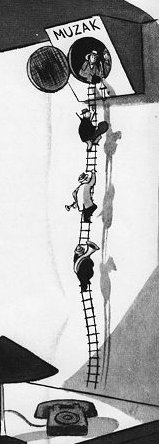
I love the work of Charles Addams. I grew up with it, as “The New Yorker” was an ever-present guest in our Manhattan home. The Tee and Charles Addams Foundation is very protective of Charles’ work, so I can’t post the full image I want to here: A receptionist, preparing to leave the office at 5:00, glances up from her powder mirror to the Muzak speaker above her desk. The speaker front is open, and down a tiny rope ladder are descending five miniscule musicians with various instruments. Time for them to head home, too. I hope the small snippet below will not offend anyone.
Since 1934, Muzak has been piping soft mood music into elevators, offices, and shopping centers everywhere. Now, the brand is finally being retired. Not, however, the music itself – those of you who hate the lilting re-craftings of “Hey Jude” will still have the genre to detest – the new portmanteau brand will be called “Mood.”
Me, I’ve always loved elevator music. I find it relaxing, lulling, peaceful, must… spend… money….
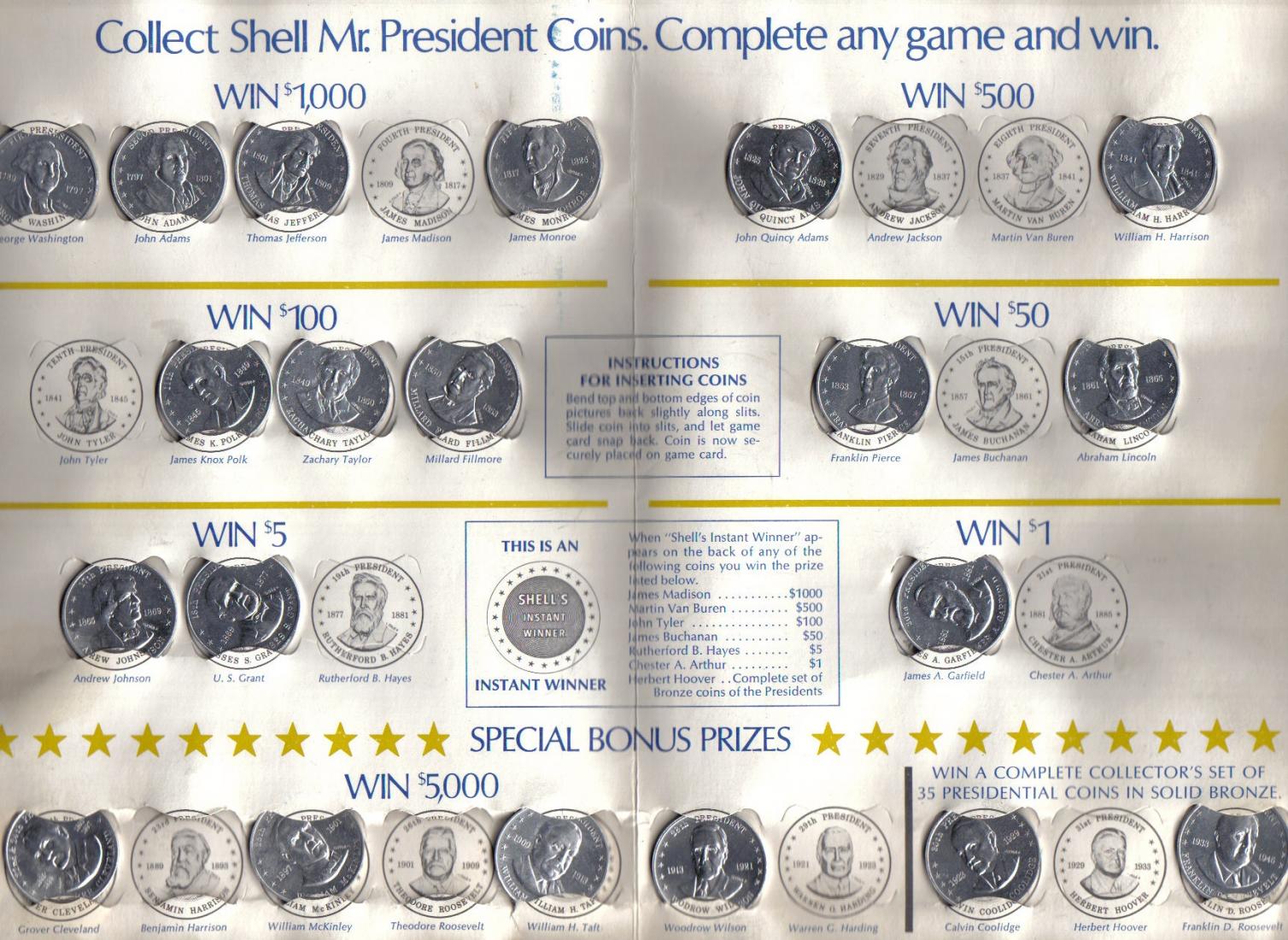
Back in the 60’s, gas stations did interesting things to get your business. One such promotion was the Shell Mr. President’s game. A playing card is shown below:
Naturally, some coin were extremely rare – the ones required to finish a winning set – as illustrated by the blank spots above, and those coins also sometimes bore the motto “instant winner”.
These two samples are, of course, neither rare nor instant winners, but still an interesting little bit of cultural history.
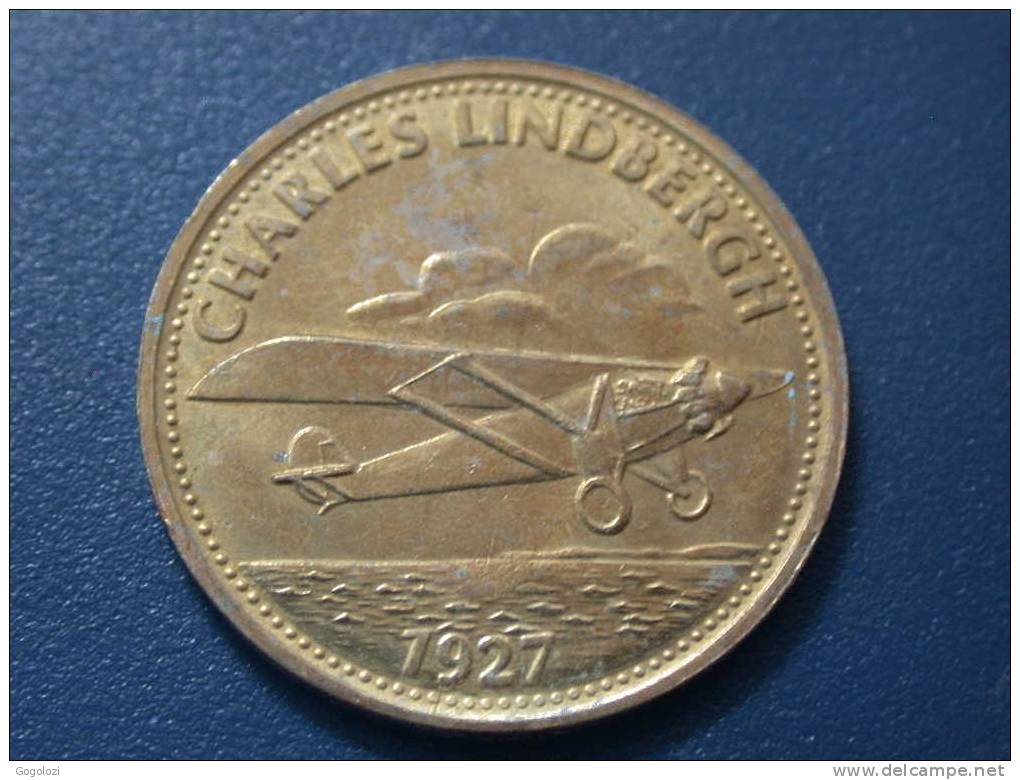
Another incentive was this token, given out as a collector’s item:
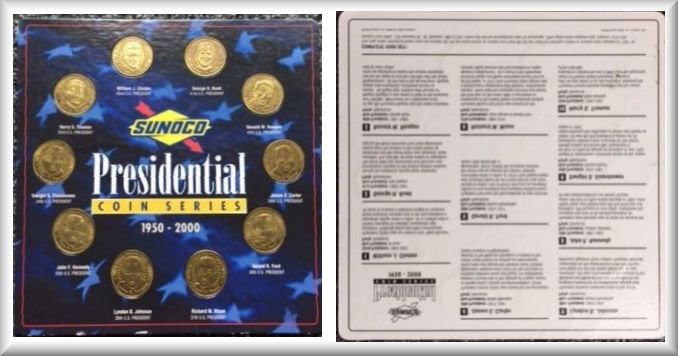
Then there was Sunoco’s presidential collection:
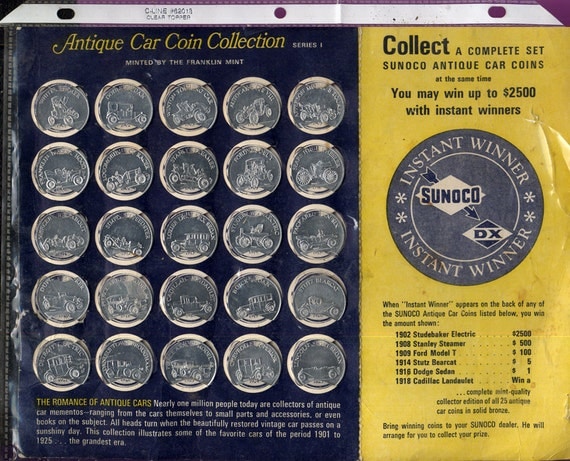
And their Antique Car collection:
In 1967, Union 76 in California begam the antenna topper craze with their orange balls:
Nowadays, it’s a rare thing for a gas station to offer any sort of incentive other than reward cards or fleet discounts.













 Playing in the World Game