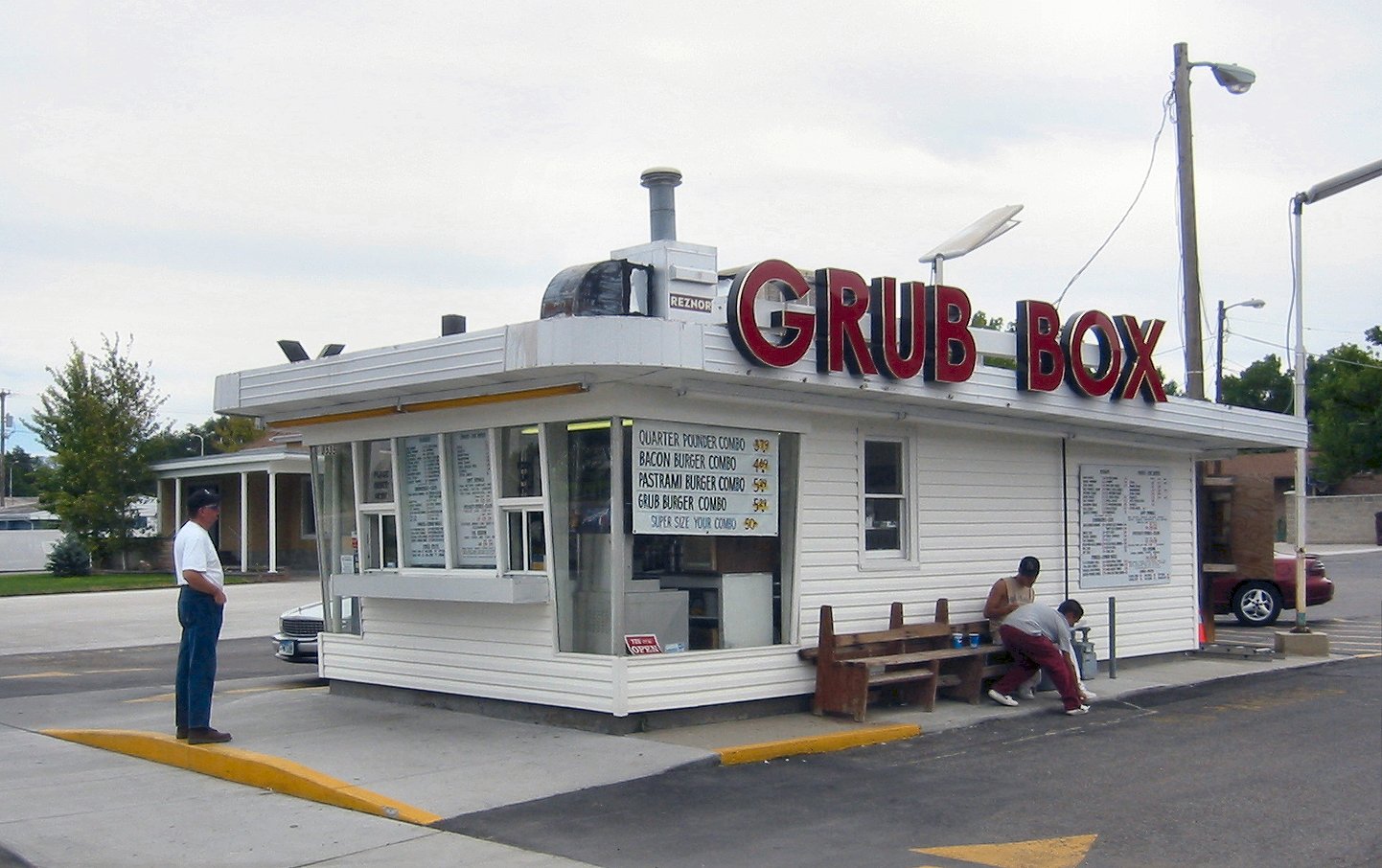
“I am the grub-man. Such gentlemen as have friends here, hire me to provide them with something good to eat.”
Melville, Herman – “Bartleby the Scrivener”
Killer pastrami sandwiches.
“I am the grub-man. Such gentlemen as have friends here, hire me to provide them with something good to eat.”
Melville, Herman – “Bartleby the Scrivener”
Killer pastrami sandwiches.
Found this recipe over on Reddit. *drool*

Cake
24 oz cream cheese
8 oz sour cream
3/4 c sugar
4 eggs
1 1/2 c mashed banana
Blend sugar and cream cheese. Add eggs one at a time, blending well in between. Add sour cream and banana. Blend well. Pour over crust. Bake at 350 for about an hour.
Crust
1 1/2 cup crushed cookies
6 T melted butter
1/4 c white sugar
Crush cookies in food processor, add sugar and butter, press into 9” springform pan. Bake 10 minutes, let cool.
Topping
1/2 c brown sugar
1/4 c butter
1-2 T water or dark rum
3 sliced bananas
Melt butter and brown sugar in a saucepan. Add water to thin to desired consistency. Add bananas, let cook for 1 minute. Cool slightly. Pour over chilled cheesecake.
Must… try… soon…
The Old Wolf has spoken


Mango. Doubtless the irresistible fruit that hung from the tree of knowledge. Delicious and desirable.

Fresh figs. Jesus was so torqued that he couldn’t get some of these that he went all medieval on the tree that wouldn’t pony up. The only figs I ever knew as a kid were the dried kind, and of course Fig Newtons. The fresh ones come close to ambrosia.
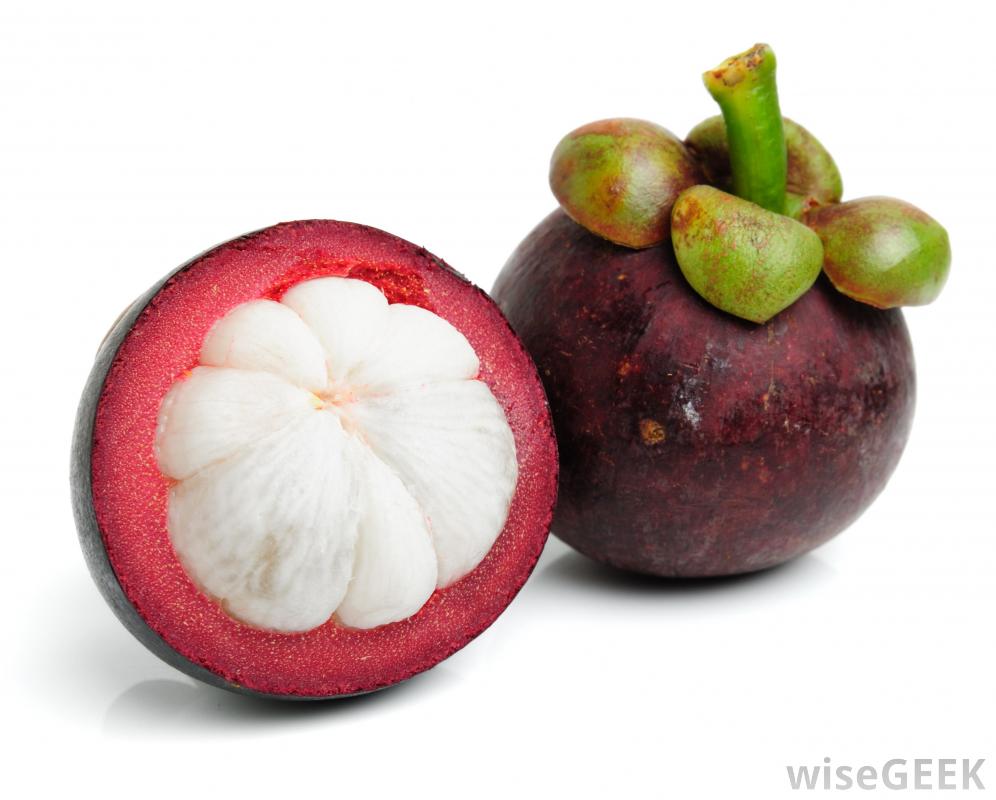
Mangosteen. Down in Kinshasa they call this “the most thrown fruit in the world.” The center is all sweetness and light, and they are just the right size for hucking at someone.
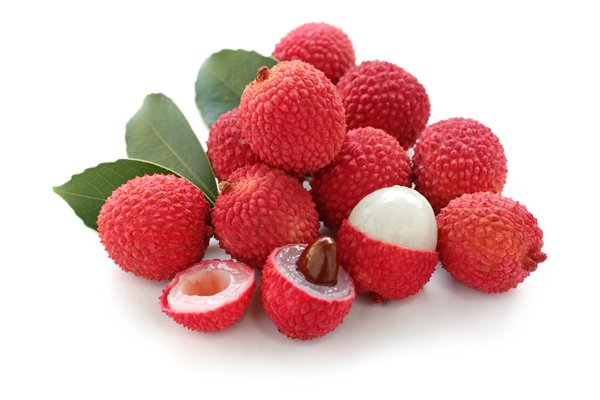
Lychee nuts. First experienced these in Chinatown in the 1950’s, in New York, but never had really good ones until I spent some time in Australia with a mate of mine – he picked up some fresh ones in the market. These fruits are extremely volatile – if you’re not careful, they will evaporate even before you can get them home.

Lastly, a fruit I have never tried, but would love to – the jabuticaba, a Brazilian tree that grows its fruit on its trunk. Supposedly wonderful for eating, for making wine (I’m told the fermentation begins three days after the fruit is picked), and with strong antioxidant and health properties.
The Old Wolf has spoken.
My previous post about Neapolitan Pizza reminded me that I’ve been thinking about Neapolitan Pizza. Having lived in Naples for a year and a half in 1970 and 1971, I may go on a Napoli jag here at the blog, and I hope I’ll be forgiven while I work out the feelings and memories that come flooding back unbidden on occasion. The following is a long ramble. Note: Some sections come from other sources, so don’t get too exited about the quality of writing throughout this post. The information is more important than the vehicle.

According to Wikipedia, pizza originated in Greece as bread coated with oils and herbs; modern pizza has its roots in Italy as the Neapolitan flatbread. Anyone can make pizza, and there are as many recipes as there are restaurants, but if you want to have “Real Neapolitan Pizza” on your window, you must be certified by the Verace Pizza Napoletana association.
The following section was written by VPN:
In 1984 a group of pizzaioli, led by Antonio Pace, sought to preserve the identity and integrity of Neapolitan pizza. From this struggle with the Italian government was born the association Verace Pizza Napoletana or Vera Pizza Napoletana (VPN).
While forms of foccacia had been around for centuries, it was in Napoli where tomatoes were first placed on round discs of bread and cooked in brick wood fired ovens sometime in the late 1600’s. Mozzarella also made its debut on pizza in Napoli in the mid 1800’s if not earlier. While it is widely believed that the classic Napoli style pizza, the margherita, was invented by a pizzaiolo in 1889, there is written evidence that a pizza with tomatoes and mozzarella was already being made in Napoli much earlier.
It is this history that Signore Pace and others are trying to preserve through the VPN.
On May 16, 2007 Settebello Pizzeria was certified by the President of the US Chapter of the VPN, Peppe Miele, as only the 16th member in the United States. Settebello is the only certified member in the state of Utah, with branches in Salt Lake City and Farmington. We will always strive to preserve the art of pizza making as it has been done in Napoli for over 200 years.
Member Charter: ASSOCIATION OF “VERACE PIZZA NAPOLETANA”
“Verace Pizza Napoletana” is an international non-profit association. The objectives of the association are the following:
THE CULINARY DISCIPLINE OF THE “VERACE PIZZA NAPOLETANA”
The certification is granted only to those establishments whose pizzas fulfill the following standards:
“Verace Pizza Napoletana” must be made from the following raw ingredients:
The pizza dough must be worked with the hands or with a mixer approved by the Association’s committee. After rising, the dough must be shaped with the hands and without a rolling pin or any mechanical means.
The cooking of the pizza must take place on the surface of the oven and not in any pan or container. The oven must be a wood burning oven and structured in a bell shape and of special brick with the floor of the pizza oven constructed of volcanic stone. The oven must be fired with only wood and kindling.
The classic pizzas and their respective basic ingredients are the following:
· Marinara (Napoletana): Tomato, olive oil, oregano, and garlic.
· Margherita: Tomato, olive oil, grated Parmesan, and fior-di-latte or mozzarella.
· Ripieno (Calzone): Ricotta, fior-di-latte or mozzarella, olive oil, and salami.
· Formaggio e Pomodoro: Tomato, olive oil, and grated Parmesan
Basil leaves may be used on all types of pizza.
Variations of pizzas are recognized if they are in conformity with the Neapolitan tradition of pizzas and are not in contrast with the rules of gastronomy, with judgment reserved by the Association’s committee.
The pizza, when eaten, should present the following characteristics: soft, well cooked, fragrant and enclosed in a high, soft edge of crust.
The following section was posted by user SempreAngela at forum.literotica.com on July 23, 2003
Do you know that Pizza is three thousand years old?
Every civilization, we may say, has known different kinds of flat buns, pies or the like based on a dough made of cereal and water and various seasonings. It is a form of food that no doubt resembles pizza.
The ancient civilizations of the Mediterranean Sea offer a wide range of examples of those that can be considered the ancestors of the pizza as we moderns know it.
So from Egypt to Greece to Rome and Pompeii, we find many examples of dishes that remember pizza in their ingredients, composition and cooking.
In the ancient Egypt the custom was to celebrate the birthday of the Pharaoh by eating a flat bun seasoned with herbs, the greek historian Herodotus reports several Babylonian recipes while in VII B.C. Archilocus, the poet-soldier, in some lines informs us to have on his spear’s tip his “kneaded bun”, the typical food of the soldier.
The classic Greece shows to have known a wide range of examples that can be considered “archetipal” versions of pizza: flat pies or buns of all kinds appear to be very popular and widespread foods all over the classic age.
We find numerous testimonies of greek writers regarding these different kinds of “pizza”, the so called “maza” in ancient greek: testimonies that punctually we meet again in the Latin world and ancient Rome where, among other leavened or not versions of this bun, we find the “placenta” and the “offa”, prepared with water and barley, the cereal which the alimentation of the Latins was based on.
Pizza, without giving credence to other fanciful hypotheses about its origins, presents itself as a typical food of the civilizations blossomed on Mediterranean Sea’s basin. And in one of Mediterranean’s Queens, Naples, pizza will find its fatherland and the starting point of its worldwide diffusion.
The Middle Ages
We recover numerous clues of this food, in the course of centuries getting nearer to the form we know nowadays, also during the Middle Ages and the Renaissance, always wavering between aristocratic taste and popular consumption, between kingly banquets and the poor’s table; the term “pizza” is already testified at the beginnings of the Middle Ages and during the subsequent centuries several local forms of this word are to be recovered: they show different variations, from sweet to salty, and various ways of cooking this course.
In the meantime the Longobards, that invaded Southern Italy after the fall of the Roman Empire, had brought with them the buffalo that, once acclimatized between Lazio and Campania, would have provided the milk for the making of mozzarella.
And in the Modern Age, the discover of the New World will bring to Europe an element without which it is impossible to imagine pizza: tomato.
After initial suspicions, tomato entered triumphally Italian cuisine, and particularly neapolitan cuisine. The pizza will take its good advantage of it, getting nearer to the form we know.
In the decades between the XVIII and XIX century pizza confirms itself as one of the most favourite dishes of the neapolitan people, entering with full rights the tradition of neapolitan cuisine: and the features of pizza and of the places appointed to its making, the pizzerie, begin to be more and more distinct.
During XVIII century, pizza is baked in ovens and then sold in the streets of Naples: a boy, who balanced on his head the typical “stufa” (a tin stove to keep pizza warm), brings directly to his customers the pizza, already made with different seasonings, after attracting their attention with his loud and typical calls.
Between the XVIII and the XIX century starts the habit of eating pizza at these ovens as well as in the streets or at home, a sign of the growing favour known by this course, by then fully established in the alimentation of the neapolitan people: the pizzeria, in its modern sense, is born.
The oven, the marble bench where pizza is prepared, the shelf upon which the different ingredients of pizza are shown, the tables where customers ate pizza, the outer display where fried pizza is stored to be sold to the passers-by: all features still to be found in the modern neapolitan pizzeria.
The first dinasties of neapolitan pizzamakers originate in these years: in 1780 the pizzeria “Pietro… e basta Così” is established. After two hundred years, the tradition of this ancient and historical pizzeria is continued by the Ancient Pizzeria Brandi.
Between aristocratic taste (the King of Naples Ferdinando II of Borbone greatly enjoyed the pizza made by ‘Ntuono Testa at Salita S. Teresa) and an even more decided popular favour, pizza establishes itself as a daily course, dinner and supper of the neapolitans.
Throughout the XIX century the “pizzaiuoli”, whether itinerant or not, kept on supplying the neapolitans with all the different kinds of pizza, for all pockets, the pizza becoming definitely an icon in the folklore of neapolitan people.
Witnesses and memorialists, but also writers and musicians and poets as Matilde Serao, Salvatore Di Giacomo, Libero Bovio or Raffaele Viviani, didn’t fail to record and celebrate the presence of pizza in people’s everyday life.
After the Kings of Naples, the Borbone, also the new Kings of Italy, the Savoia, showed to appreciate the neapolitan pizza: not only, but they left a mark in the history of pizza.
The Ancient Pizzeria Brandi still retains a document signed “sincerely, Galli Camillo, head of the table of the Royal Household”, dated June 1889. It is an acknowledgement to S.G. Raffaele Esposito, of the then pizzeria “Pietro e Basta Così”, for the qualities of pizza, among which the celebrated one with pomodoro and mozzarella, he prepared for Her Majesty the Queen Margherita, that, as emphasized in this letter, were found to be excellent.
The pizza with pomodoro and mozzarella was so named “Pizza Margherita” by the pizzaiuolo Raffaele Esposito, and that is the name by which this pizza is still universally known .
The beginning of the new century sees the pizza ready for its national and worldwide diffusion, well beyond the boundaries of Naples: in the course of our century pizza has won approvals from Europe to America to Japan, becoming, and this not an exaggeration, patrimony of the whole mankind.
The following section was written by VPN
While certainly ancient, the earliest origins of pizza are not at all clear. One interesting legend recounts that the Roman soldiers returning from Palestina, where they had been compelled to eat matzoh among the Palestinian Jews, developed a dish called picea upon gratefully returning to the Italian peninsula.
Most sources, however, agree that an early form of pizza resembling what today is called focaccia was eaten by many peoples around the Mediterranean rim, e.g., by Greeks, Egyptians etc.
These dishes of round pita-like, cooked bread with oil and spices on top are the ancestors of pizza, but are not properly speaking pizza. The tomato was unknown and the Indian water buffalo had not yet been imported to Campania, the area around Naples.
With the discovery of the New World, the tomato made its way to Italy through Spain. It was considered a poisonous ornamental and so in the first centuries of its import was not eaten.
The Neapolitan people seem to be the first to wholeheartedly adopt the tomato into their cuisine, so that in our day the (plum) tomato is the most characteristic element of Neapolitan cuisine.
Over the centuries, a veritable tradition of pizza was developed among the Neapolitan poor. It is not surprising, then, that a modern pizza, that is, with mozzarella di bufala and tomato was made in 18711 in Naples for Princess Margherita of Savoia by Raffaele Esposito. This patriotic pizza, of basil, tomato and mozzarella, in honor of the new tricolor Italian flag’s red, green and white, became the pizza alla Margherita. This form of pizza was then made known, popularized and adapted in all the world through waves of emigration from Naples in the late 19th and early 20th centuries.
The History of the American style pizza pie.
The United States is among the most pizza enthusiastic countries one can find today. How did this come about?
Italian immigrants to New York City began making a version of pizza when they arrived in their new American home at the turn of the 20th century. The first pizzeria in the U.S. was opened by an Italian immigrant in 1905.
In addition, American GI’s returning from Italy gained a familiarity with the dish and it is in the post-WWII period that pizza really takes off in the United States.
1 Date per VPN Discipline and Specifications Manual.
‘A PIZZA
per Lello Lupoli (in Neapolitan dialect)
Pizzaiuo’, m’he ‘a fa’ ‘na pizza
muzzarella e pummarola…
Ma ll’he ‘a fa’ cu ‘e mmane, ‘o core
e.. ‘a fronna ‘e vasenicola,
Falla bbona!
Mana grassa a muzzarella,
miette ll’uoglio, miette ‘o sale…
Falla fa’ cchiù arruscatella:
quanno é cotta nun fa male…
Cotta bbona!
E vullente, ‘a dint’ ‘o furno,
nun l’he ‘a mettere ‘int’ ‘o piatto
ca si no perde ‘o sapore…
Io m’ ‘a piglio e ‘a chiejo a libretto…
Quant’é bbona!
E cu famma e devuzzione
magno primma ‘o curnicione…
‘O profumo é saporito!
Mentre magno sto abbucato
p’ ‘o… vestito.
Comme coce! E quant’é bella!
Comme fila ‘a muzzarella!
Muorzo a muorzo ‘haggio magnato…
Pizzaiuo’ he ‘a campa’ cient’anne!
Pizzaiuo’ me so’ sfizziato!!!…
Styles of Pizza
Differences & Similarities among pizzas
From the VPN Newsletter
Authentic Neapolitan Pizza is only cooked in a wood-burning oven at 825° F with oak or walnut wood as fuel. By way of contrast, American pizza is usually cooked in a gas oven in the range of 500-550° F degrees.
Only bufala mozzarella or fior-di-latte is used in Neapolitan pizza . This type of cheese is low fat, non-fermented and light. The finished Neapolitan pizza, therefore, is all natural, low fat, fragrant, and most importantly, supremely appetizing and satisfying. It has a smoky, sweet aspect that is not salty, oily or spicy.
Whereas, in the evaluation of the American pizza one often focuses on the cheese, with the Neapolitan Pizza the quality of the native ingredients means the pizza is as much about the tomato sauce and crust as it is the cheese. In general, less cheese is used in authentic Neapolitan pizza than in an American-style pie. In fact, with the Neapolitan pie, the surface of the pizza is usually not completely covered by cheese.
A pizza Margherita cooks in 1½ minutes.
The Associazone maintains the size of a true Neapolitan pizza – it can’t exceed 12 inches in diameter.
Neapolitan-Style Pizza Dough
From Pizza Any Way You Slice It
Copyright (c) 1999 by Charles and Michele Scicolone.
Makes enough for four 9- to 10-inch pizzas
In Naples the classic pizza measures about 9 to 10 inches and has a crust that is neither too thin nor too thick. The texture of the pie is soft and chewy. Neapolitans say the true test of a well-made pizza is whether it can be folded in half and then folded again, into quarters, without cracking or breaking the crust. Only the edge, called the cornicione, is crisp, though it too is chewy.
In Italy flour is softer than American flour because it is low in gluten, the protein that makes pizza dough and other baked goods chewy. Soft flour is great for making cakes and pastry, but not so good for pizza, so Italians blend their soft flour with hard American or Canadian flour, which they call Manitoba. This flour, which is higher in gluten, gives Italian pizza dough the desired chewiness.
On this side of the Atlantic, we need to soften our flour to make an authentic Neapolitan-style dough, so we combine cake flour with all-purpose flour. This tender dough stretches easily and has less of a tendency to spring back on itself, so it is easier to shape. Neapolitan dough is made with less yeast, so it rises a bit more slowly – perfect for a long, slow overnight refrigerator rise, or a more rapid rise at room temperature. The longer rising time makes a slightly better-tasting crust, too.
1. Sprinkle the yeast over the water. Let stand 1 minute, or until the yeast is creamy. Stir until the yeast dissolves.
2. In a large bowl, combine the cake flour, 2 1/2 cups of the all-purpose flour, and the salt. Add the yeast mixture and stir until a soft dough forms. Turn the dough out onto a lightly floured surface and knead, adding more flour if necessary, until smooth and elastic, about 10 minutes.
3. Lightly coat a large bowl with oil. Place the dough in the bowl, turning it to oil the top. Cover with plastic wrap. Place in a warm, draft-free place and let rise until doubled in bulk, about 1 1/2 hours.
4. Flatten the dough with your fist. Cut the dough into 2 to 4 pieces and shape the pieces into balls. Dust the tops with flour.
5. Place the balls on a floured surface and cover each with plastic wrap, allowing room for the dough to expand. Let rise 60 to 90 minutes, or until doubled.
6. Thirty to sixty minutes before baking the pizzas, place a baking stone or unglazed quarry tiles on a rack in the lowest level of the oven. Turn on the oven to the maximum temperature, 500 or 550 degrees F.
7. Shape and bake the pizzas as described in the following recipe.
Tip: Pizzaiolo Umberto Damiano gave us this suggestion for making the crust of a homemade pizza taste toasty and charred as if it had been baked in a wood-fired oven: Sprinkle the preheated baking stone with flour a few minutes before placing the pizza in the oven. The flour will brown and give the pizza crust added flavor.
Simple Pizza Sauce – Salsa Semplice
From Pizza Any Way You Slice It
Copyright (c) 1999 by Charles and Michele Scicolone.
Makes about 2 1/2 cups
People are amazed when we tell them that Neapolitans do not put tomato sauce on pizza, but it’s true. Since commercial pizza ovens are so hot, a precooked sauce would burn and overcook while the pizza bakes. Instead, the typical tomato topping is nothing more than ripe, fresh crushed tomatoes or canned San Marzano tomatoes.
We find that while drained fresh, ripe tomatoes taste great, canned tomatoes cooked on a pizza in our home oven, no matter how good their quality, taste like canned tomatoes. The baking temperature in a home oven is not high enough so the tomatoes simply don’t cook enough to become sweet. To counteract this, we simmer canned tomatoes briefly first with some oil and salt.
If you prefer a smooth sauce or use anything other than canned San Marzano tomatoes, puree the tomatoes first by passing them through a food mill. Do not use a food processor, which only grinds up the seeds and makes the sauce bitter.
1. In a large saucepan, combine the tomatoes, oil, and salt to taste. Bring to a simmer.
2. Cook, stirring occasionally, until thickened, 15 to 20 minutes. Let the sauce cool before spreading it on the pizza dough.
*Variation: When vine-ripened tomatoes are at their peak in our area, we use them instead of canned and freeze a big batch of pizza sauce. Prepare the tomatoes: Bring a medium saucepan of water to boiling. Add the tomatoes and leave them in the pan for 30 seconds. Remove the tomatoes with a slotted spoon. Cool them under running water. Cut the tomatoes in half through the core and cut away the stem ends. The skins should slip off easily. Squeeze the tomatoes to extract the juice and seeds. Chop the tomatoes coarsely. Follow the proceeding instructions. Refrigerate the sauce up to one week or freeze it in 1- to 2- cup containers up to 3 months.
Pizza Marinara
From Pizza Any Way You Slice It
Copyright (c) 1999 by Charles and Michele Scicolone.
Makes 1 pizza
Da Michele is one of the oldest and most famous pizzerias in Naples. Since it is located on a small street, we could not locate it on a street map, so we gave out hotel concierge the address and asked for directions. The concierge, a very haughty gentleman, took a look at the address and his eyebrows shot up. “I would not go there,” he sniffed, implying that it was not in a safe or classy neighborhood. We went anyway and found the place surrounded by late-model Mercedes and BMWs and the entrance crammed with well-to-do Italians dressed in designer clothes. Hardly a threat by anyone’s standards. The pizzeria was so crowded that we could not get in, so we returned the next day for an early lunch.
Simplicity is what makes Da Michele so special. The walls are white, simply decorated with a few poems and quotations about pizza. The menu is as basic as could be: Only pizza marinara and pizza margherita are served. No other toppings are available, no other kinds of pies are served, no appetizers, side dishes, or desserts. Ever. When you are that focused, you have to be good, and Da Michele’s pizzas are some of the best we have eaten. Light and tender, they seem to melt in your mouth.
The pizzaiolo, a fellow whose uniform was as white as the walls, looked as if he had been casually turning out perfect pies all his life. When they saw us taking his picture, his assistants who work the oven demanded we take their photo, too.
1. Place the dough on a floured surface. Holding your hands flat, pat the ball out evenly with your fingers, lifting it and turning it over several times, until it reaches a 9-inch circle. Do not handle the dough any more than is necessary. If the dough seems sticky, dust it lightly with flour.
2. Dust a pizza peel or rimless cookie sheet with flour. Carefully transfer the circle of dough to the peel. Shake the peel once or twice to make sure the dough does not stick. If it does, sprinkle the peel with more flour.
3. Quickly top the dough with the sauce, spreading it to within 1/2 inch of the edge using the back of a spoon. Scatter the garlic and oregano over the sauce. Drizzle with the oil.
4. To slide the pizza onto the prepared baking stone, line up the edge of the peel with the back edge of the stone, then tilt the peel, jerking it gently to start the pizza moving. Once the edge of the pizza touches the stone, carefully pull back on the peel until the pizza is completely off. Once the pizza is on the stone, do not attempt to move it until it firms up in 2 or 3 minutes.
5. Bake 6 to 7 minutes, or until the dough is crisp and browned. Serve immediately.
Here are some pizza marinara variations we sampled elsewhere in Naples:

Uncooked Pizza Margherita
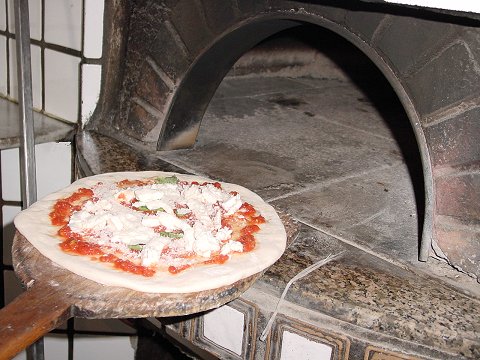
Into the Oven

A pizza cooking at Settebello in Salt Lake
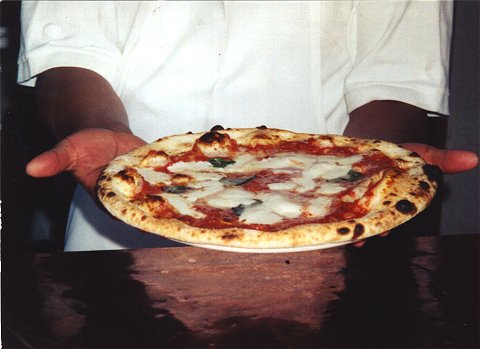
Mmm, delizioso!
For what it’s worth, Settebello in Salt Lake is one of my favorite restaurants. True to their certification, they really do Neapolitan pizza right.
The Old Wolf has spoken
From “La Città Parla – Napoli” (1969, Casa Editrice A. Morano di Napoli)

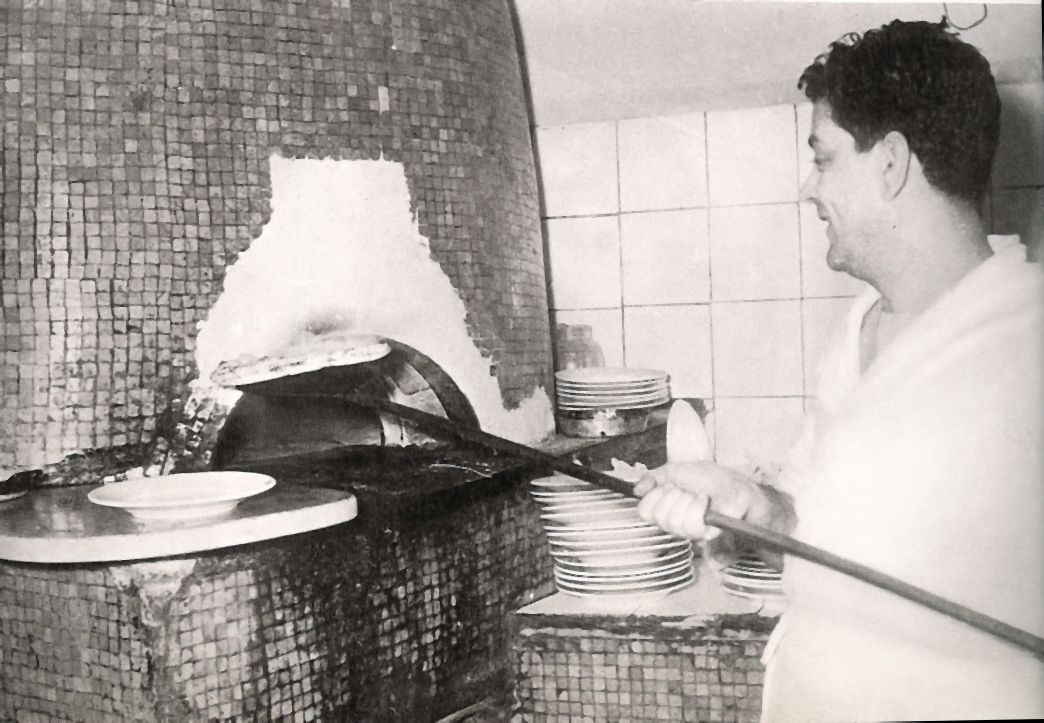
La pizza è un pasto da poveri, una focaccia con olio e pomodoro. In tempi di benessere economico ogni trattore aggiunge il suo “segreto,” uno o più ingredienti. Ma il vero segreto sta nel modo di mangiare la pizza: ricco o povero, ogni napoletano avverte dinazi una pizza fragrante il morso della fame ancestrale, cronica della città. Il segreto e tutto lì.
Pizza is a poor man’s food, a crust with oil and tomato. When times are good, every chef adds his own “secret,” one or more ingredients. But the real secret is found in how the pizza is eaten: rich or poor, every Neapolitan with a fragrant pizza before him fends off the ancestral, chronic hunger of the city. That’s where the secret lies.

Glom
Il vecchio lupo ha parlato.
Back on May 13, I posted this article about KFC’s “buttery spread” and “honey sauce,” which are neither butter nor honey. At that time I listed the ingredients on KFC’s honey substitute as:
High fructose corn syrup, sugar, honey, corn syrup, natural flavors, caramel color
However, the only thing that is constant is change, as we well know – at KFC, that change is not for the better. A packet of “honey sauce” that I brought home the other day contains:
High fructose corn syrup, corn syrup, sugar, honey, fructose, contains less than 2% of: caramel color, molasses, water, citric acid, natural and artificial flavor, malic acid.
So they’ve upped the percentage of corn syrup, decreased the percentage of honey (of which there is bound to be precious little in the first place) and added a bunch of other garbage to drive down the cost and make it taste (supposedly) more like the real thing. Given the effort of manufacturing the zombie sweetener, it makes me wonder if it would really be all that more expensive to go back to using the real thing?
The Old Wolf has spoken.
The Hotel Utah, now only a memory, was famous for its borscht.
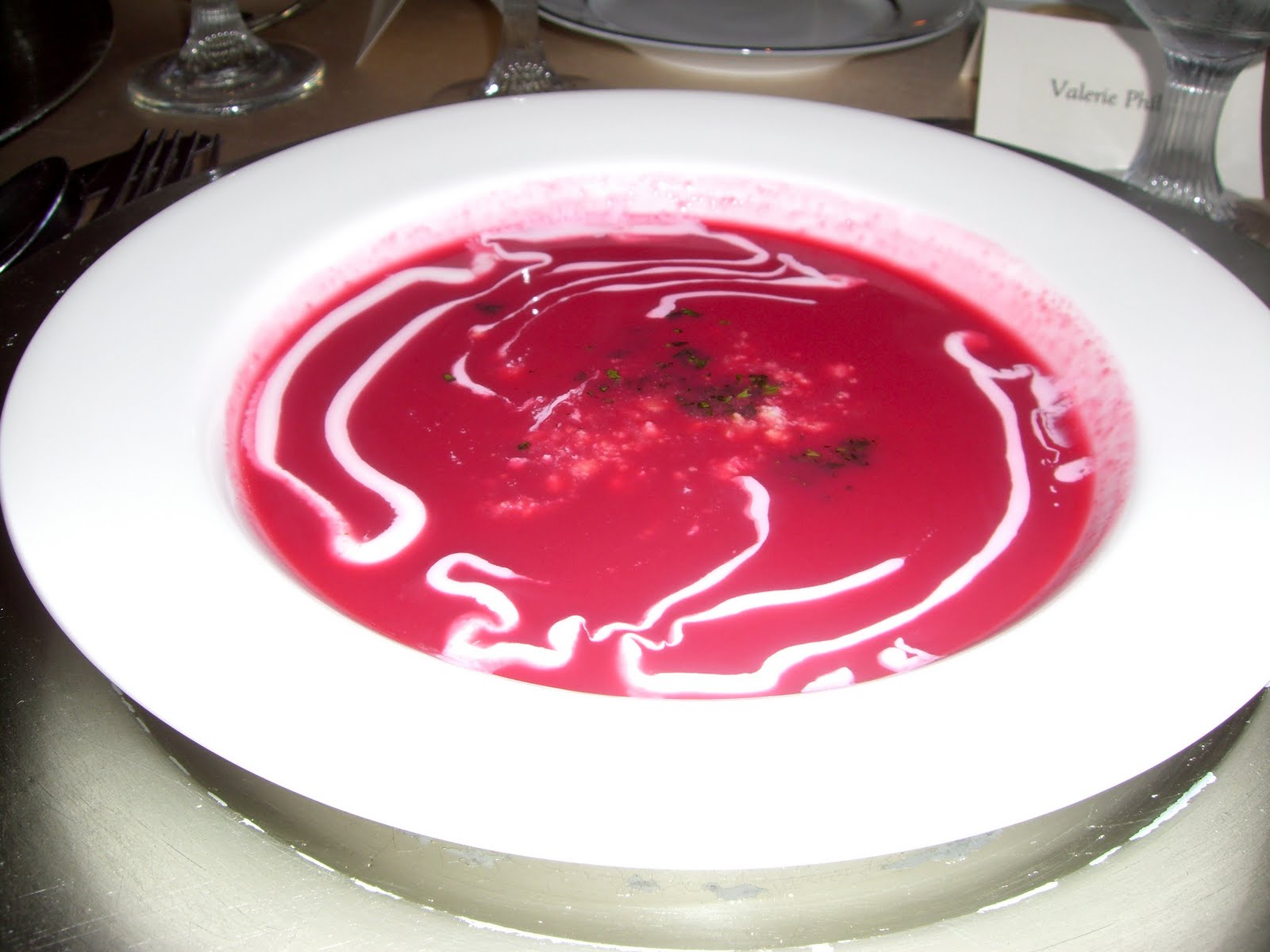
CHEF GIRARD’S HOTEL UTAH BORSCHT
Ingredients
4 cups beet juice
3 1/2 cups chicken or beef broth plus 1/2 cup
Juice of 1 lemon
Sugar to taste
Salt to taste
1/4 cup cornstarch
1 cup sour cream
1 or 2 egg yolks
Sour cream
Chopped parsley
Hard-cooked eggs, diced
Lemon wedges
Procedure
Serve hot or cold.
Garnish with sour cream, parsley and eggs. Serve with lemon wedges.
Makes 8 servings.
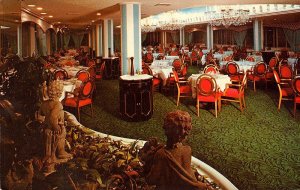
The Hotel Utah Sky Room
ASSUMPTION ABBEY BORSCHT

The cooks at Assumption Abbey in Richardton, ND make a borscht that is to die for. I know, for I’ve had it.
Ingredients
1/2 lb. ground bison (optional)
2 cup chopped fresh beets
1 cup chopped celery (optional)
1 cup chopped carrots
1 cup chopped onions
2 cup water
1/2 teaspoon salt
2 (14 1/2 oz.) cans beef broth (I used 1 can beef and 1 can vegetable, just because)
1 cup shredded cabbage
1 Tablespoon butter or margarine
1 Tablespoon lemon juice
sour cream or regular cream (optional)
Procedure
Makes 8 servings.
For perfection, serve with hot buttered scones and honey.

Despite the pervasive misconception that the now-defunct Sunshine Hydrox cookies were a cheap Oreo knock-off, they were the original sandwich cookie which came out in 1908, four years before Oreos did in 1912. Apparently they just didn’t do well against the Nabisco juggernaut, and also a lot of people were put off by the name, which sounded more like a bleach than a cookie.
I miss them.
The Old Wolf has spoken.
Currywurst! A famous Berlin specialty.
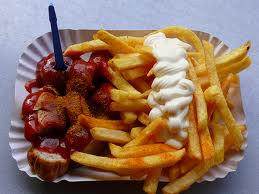
They write songs about it:
They have museums for it:
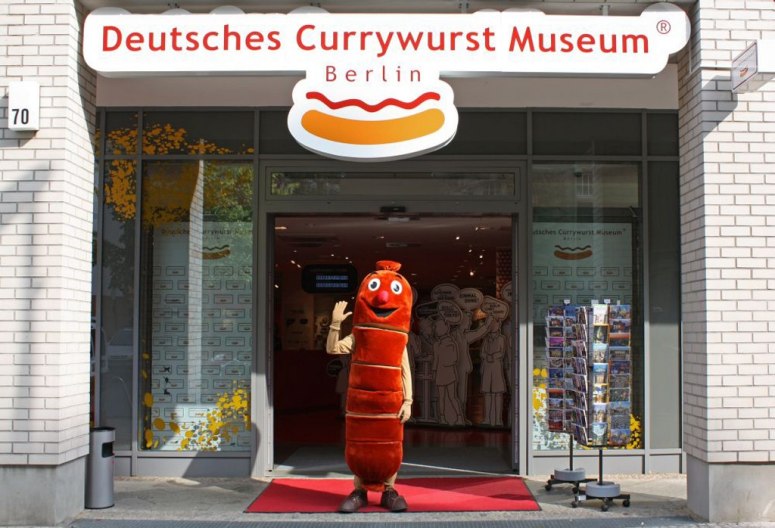
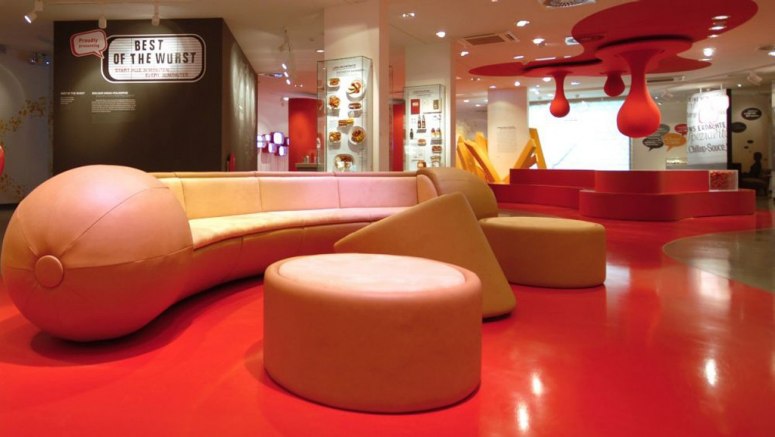
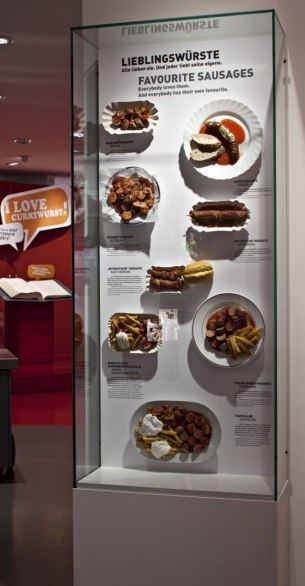
There are recipes for it:
Rezept für Soße:
Zutaten (für 6 Portionen)
200 g Tomatenmark
175 g Apfelmus
500 ml Wasser
15 g Meersalz
15 g Zwiebelpulver, fein
15 g Paprikapulver
25 g Currypulver
Zubereitung
Tomatenmark, Apfelmus und Wasser in einen Topf geben, verrühren und kurz aufkochen.
Gewürze dazu fügen, fertig.
Die Sauce warm über die Currywürste geben! (Für die Currywurst kann man jede Wurstart nehmen: Mettwürstchen, Nürnberger, normale Bratwurst, Siedwürstchen. Das hängt ganz von der jeweiligen Vorliebe ab.)
And we makes it at home, precious:

Currywurst!
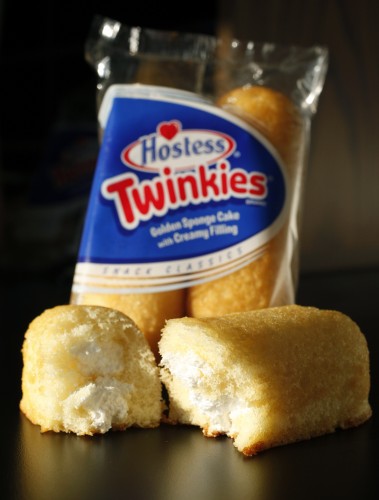
No, this does not refer to the fact that Twinkies, the iconic snack from Hostess, never go bad because they’re made of petroleum, portland cement and sodium stearoyl forhellsakedonteatthatalate; while that may be true to a certain extent, this post refers to the fact that you can make your own, and enjoy flogging your adrenals and punching holes in your arteries whether or not Hostess sells its recipe to another company [1].
First, let us pause for a moment of silence.

You see, I know as well as anyone that stuff like this is death distilled, but hey, yolo [2], right? And there’s something about a hyperinsulinemia-inducing Twinkie buzz that Little Debbie could never match. So let’s hope that some of the brands survive, if nothing else for the sake of the Texas State Fair.
In the sad event that this is not the case, Chef Todd Wilbur has come up with what seems to be a pretty respectable Twinkie clone which he shared here.
First, the recipe:
TWINKIE CLONES
Cake:
Non-stick spray
4 egg whites
One 16-ounce box golden pound cake mix
2/3 cup water
Filling:
2 teaspoons very hot water
1/4 teaspoon salt
2 cups marshmallow creme (one 7-ounce jar)
1/2 cup shortening 1/3 cup powdered sugar 1/2 teaspoon vanilla
Preparation:
Filling:
Serves 10.
From “Top Secret Recipes” by Todd Wilbur.
Here’s an amusing video by Wilbur illustrating the process. Skip to 1:11 for the good stuff.
Yes, I’m going to try this.

The Old Wolf has spoken.
1 Hostess is claiming that they were forced out of business by unreasonable labor demands; that they had reached agreement with several unions, including Teamsters, the largest, but that it was the baker’s union who drove them into closure because they had no more to give. However, Frank Hurt, president of BCTGM, stated “Our members were aware that while the company was descending into bankruptcy and demanding deep concessions, the top ten executives of the company were rewarding themselves with lavish compensation increases, with the then CEO receiving a 300 percent increase.” Some specific figures reported by Gawker were:
Driscoll was forced out by the Teamsters after that obscenity; raises like that when a company is proceeding with Chapter 11 fly in the face of common sense, unless you consider piracy to be subsumed under that head. Obscene executive pay has long been a subject for discussion in boardrooms and shareholder meetings – one example is an article from the Economist, reproduced on page 34 of this student manual entitled “The Rewards of Failure.”
There’s a lot of stuff out there on the Hostess closure. Do your own research, and draw your own conclusions.
2 You Only Live Once (things labeled with this acronym usually end up on YouTube with a title like “World’s Stupidest…” or “Massive Fail.”
 Playing in the World Game