Not Mickey D’s, this was long before that concern was a gleam in Ray Kroc’s eye.
Had to make a few edits when I found some updated information about the first photo.
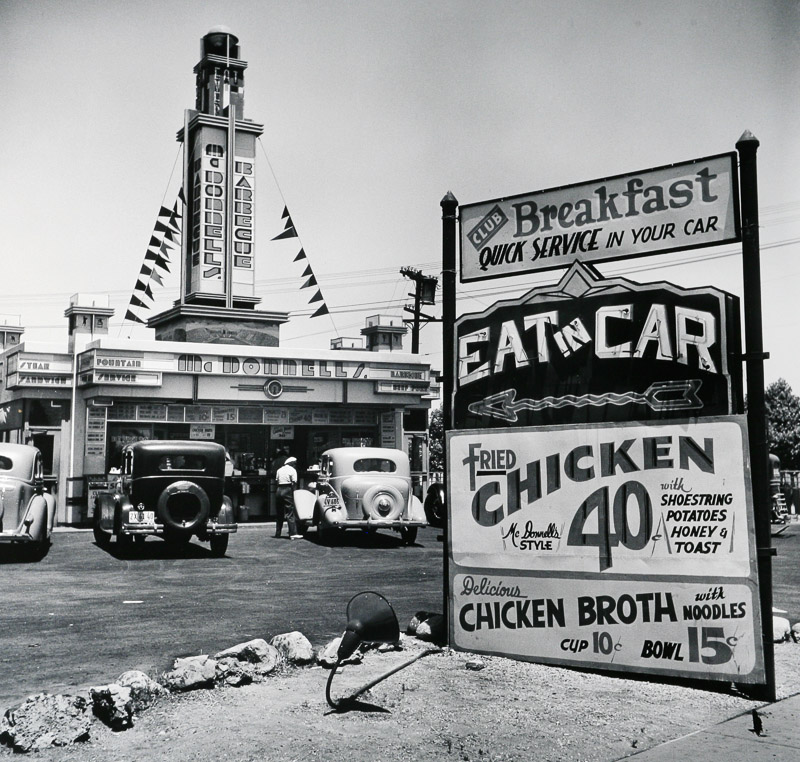
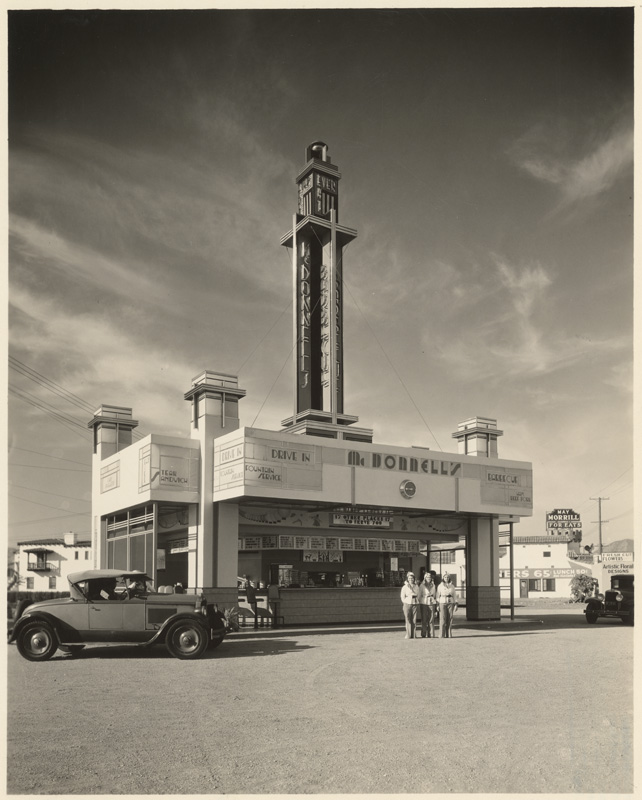
“Eat in Car” early drive-in at Beverly Boulevard and La Brea Avenue, Hollywood, California 1935. Photo by John Gutmann. The location looks a bit different than the two earlier photos below. This may have been after a remodel.
Having mentioned the Kiplinger Magazine in my previous post, I happened across this article in the same issue, and found it a fascinating look back to the year of my birth, six years after the end of World War II. An appliance most of us take for granted these days, and even consider when looking at a home to purchase, was at that time still a novelty. The article gives a look back through the chronoscope at what some people were thinking about this new-fangled device. From Changing Times, The Kiplinger Magazine, October 1951.
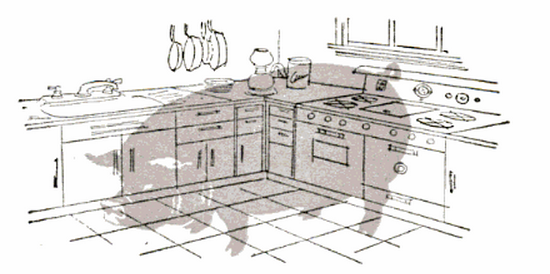
PRIVATE PIG IN THE KITCHEN
Almost a million electric garbage disposers are now in use, and they are putting the garbage man out of a job
GARBAGE is a nasty word. When fed to hogs, it was an even nastier name: “swill” or “slops.” The delicate refer to it as “food wastes.” Whatever you call it, it’s a mess when the bottom drops from a soggy paper bag as you rush the stuff to the kitchen door.
You may never face that domestic crisis again. A revolution is going on that may make the garbage can as outmoded as the privy.
Its successor will he the electric garbage disposer, that mechanical pig that sits under the kitchen sink, gobbling up your garbage and washing it down with cold water.
If you have a disposer now, you know why housewives love it. It ends a lot of fuss and muss. It eliminates smells and drippings. It speeds getting meals and cleaning up afterward. It’s self-c1eaning, and stray dogs can’t knock it over. It puts flies, roaches, rats and mice on a starvation diet.
If you still stick to the garbage can routine, you’ll probably switch to a disposer sooner or later. This gadget is catching on fast all over the country. In the Los Angeles area alone, 10,000 units are installed monthly. Home builders feature them in new houses. A Midwestern city installed them all over town and fired its garbage collector. Last year sales were nearly double those of the year before.
The mechanical pig was almost 20 years old before it began to go to town. General Electric put its Disposall on the market in the early 30’s. But by the time World War II came, only about 100,000 disposers were in use – not many for a nation that buys over 3 million vacuum cleaners a year.
One reason for its slow start was its price – well over $100. Housewives were skeptical, too. Could it really chew up their garbage like the ads said? Would it last? Some city officials, fearing ground garbage would clog sewer mains and overburden treatment plants, outlawed disposers.
An answer to the durability question came from Edward J. Zimmer of Chicago’s Plumbing Testing Laboratory. He ran a disposer for a year, cramming in as much waste as a family of eight would have in 25 years. For seasoning he fed in big helpings of ashes, sand, granite, paving blocks, glass, nail, even a few iron fittings. After a year his disposer was still grinding away. It was a little slower, but it continued to grind well.
Time has furnished another answer. The earliest disposers have now been in use for 15 years. They still work well. Apparently they will last 20 years, as their makers claim.
The disposer is not a hazard to sewer systems. In Zimmer’s test, the disposer scoured out sewer lines instead of clogging them. Experiments at the University of Texas and e1sewhere proved a reasonably well-built sewer could carry off with ease whatever the disposer sent its way.
Meanwhile, health officers have jumped on the disposer bandwagon. They have long opposed feeding garbage to pigs, because that may lead to trichinosis in people who eat garbage-fed pork. Besides, garbage cans are feeding stations for disease-spreading flies. The disposer can end both threats to health.
Prize exhibit in the disposer showcase is the little Indiana city of Jasper (pop. 6,000). Garbage was a headache there. The city paid farmers to collect it. People complained about the service. It was hard to get bidders for the job. It cost the city $6,000 a year. If Jasper were to set up its own collection and disposal system, the bill would be $13,000.
The city’s engineer-mayor, Herbert Thyen, thought city-wide installation of disposers would make Jasper a garbage-free city and save money, too. The city council agreed. It got the state legislature to pass a law permitting Indiana cities to use home disposer garbage systems and to float a bond issue to pay for them.
But Jasper decided not to force a disposer on anyone who didn’t want one. So it passed up the bond issue idea in favor of asking each householder to buy a disposer for a bargain $75. Local banks made loans to those who needed time to pay. Soon 1,000 families-enough to set the plan going-signed up. The mayor estimates Jasper will save $13,000 a year on garbage collection, plus $6,000 it used to spend spraying garbage cans.
Some authorities question these savings.
Garbage is only 10% of a city’s refuse, they say. The other 90% must still he collected. Also, the extra flow from universal use of disposers would up the cost of sewage treatment by about 60 cents per person per year. Jasper’s new plant is bigger than what would have been needed for garbage-free sewage alone. Nevertheless, 156 cities are considering following Jasper’s lead.
In a few cities, you still can’t have a disposer because local ordinances forbid them. Some bans exist where sewage systems are inadequate, or so close to it that they can’t handle even a small additional load. Others are holdovers from the days when the effect of disposers on sewers was unknown.
But the price of the disposer plus the cost of installation is still the biggest hobble on the mechanical pig. The average unit sold last year cost $135. Some installations cost more than the disposer itself, up to $150. The average is $65. It adds up to an investment most families think about twice.
Even so, the industry is doing nicely. It’s not big time yet, but ifs on its way. In 1949, 175,000 disposers were installed. In 1950 the total was 300,000. At the first of this year 775,000 were in use, 87% of them having been installed in the last four years.
There’s more competition now, too. One manufacturer had almost all the prewar business. Today, 15 makers are in the field, including a healthy proportion of small outfits.
At 300,000 units a year, the disposer business is still in its infancy. When it hits a million a year, it will be grown up. How soon that day comes depends on how much steel can he spared from defense. Right now, shortages are in prospect. But when the million mark is reached, the garbage can will be on its way to the museum.
HOW TO RETIRE YOUR GARBAGE CAN
In the market for a garbage disposer? Follow these steps:
Consider your sewer system. If you use regular city-type sewers, you can probably use a disposer. They’ll work with septic tanks, too, if the tank is big enough. Minimum size is 500 gallons. Larger sizes arc recommended if you have more than two bedrooms. If you use a cesspool, better forget the whole thing.
Check local laws. Before you commit yourself, be sure your town permits disposers. There may be special installation requirements, too. Your dealer will know.
Measure your sink.. If the drain opening is 3 1/2 to 4 inches across, a disposer will fit. An adapter fits some disposers to larger openings. It is possible to enlarge small openings.
Get the Installation costs. It takes both au electrician and a plumber to do the job. It may run you 20% to 150% of the cost of the disposer itself. So find out what it will cost in your particular case.
Pick your disposer. There are just two types. In one, you open the top and put in garbage as it grinds. In the other, you fill the hopper, close the top, and then switch on the unit. With 15 makes on the market, there are price differences. So shop around.
Add up the costs. Price of the disposer plus installation is what you pay. Figure it will last 20 veers and cost about 5 cents a month to operate. Don’t forget you’ll still need trash collection for metal, glass, seafood shells, paper, rubber, large bones. But you may not need a pickup as often as before.
Treat It fairly. Follow directions on what to put in and what to keep out. Learn to tell, by the sound, when the grinding is done. Switch off promptly to save money.
In 1951, if your disposer cost $150 and you were socked $135.00 to install it, that would come to equivalent value today of about $2,600, definitely not chump change. But given some of the problems mentioned in the article, which were pretty endemic to society in those days, it’s easy to see why the idea caught on, especially as prices dropped.
From Mad’s Dave Berg Looks at the USA, illustrating another common theme in the 50s and 60s. Some of us are still looking for Bolsheviks under our beds at night…
Of course, as we were reliably told by Hefty, you don’t necessarily need a disposer to handle that problem:
Nowadays you can find a serviceable model at a home-improvement store for about $100.00 and install it yourself. There are more expensive models, of course, but the cheaper ones work well and usually last around 10 years.
But now, the pendulum is beginning to swing the other way. An interesting article over at Remodelista covers pros and cons and gives tips on composting for those who are able to do it. As for us, we are fortunate enough to live in an area that permits backyard hens, which means we put almost nothing down the disposal and virtually nothing compostable into the landfill, and it comes back to us in the form of eggs. (The girls are taking a break at the moment, but if they don’t get with it our garbage will come back to us in the form of chicken enchiladas, which puts me in mind of this cartoon by Adrian Raeside:
Some older homes can’t handle a disposal well, and this should be taken into consideration. We bought a home that was built in 1950, before disposals were a household word. The downstairs kitchen was added later, and the contractor didn’t provide a big enough rise-over-run ratio from the new plumbing to the sewer main, so the long run of pipe would fill up with sludge which had to be rooted out from time to time. New construction should never have that problem.
In the end, the less we put down the pipes the better. it’s convenient and the technology allows for it, but there are increased costs in terms of sewage treatment, and if one can recycle, compost, or reduce waste in any way, then that’s the best way to go if we’re wanting to reduce our impact on island earth.
Edit: If you’re just chancing across this post, be sure to read the delightful comments below by Janet Warner Reid, the oldest daughter of Clarence Warner.
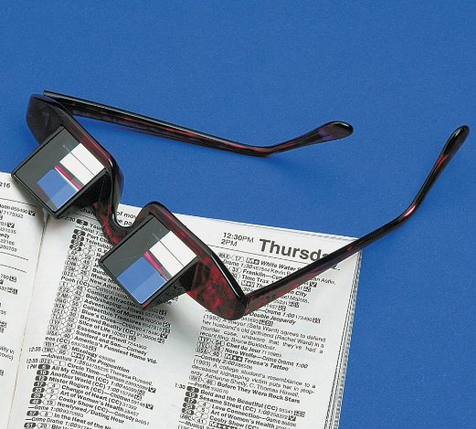
This image has been propagated all over the net by various content aggregators whom I will not mention here; I saw it in a collection of interesting tidbits shared with me by my good wife. At the New York Daily News I was able to find an attribution:
Caters News./ Published: 04/28/2014 12:58:23
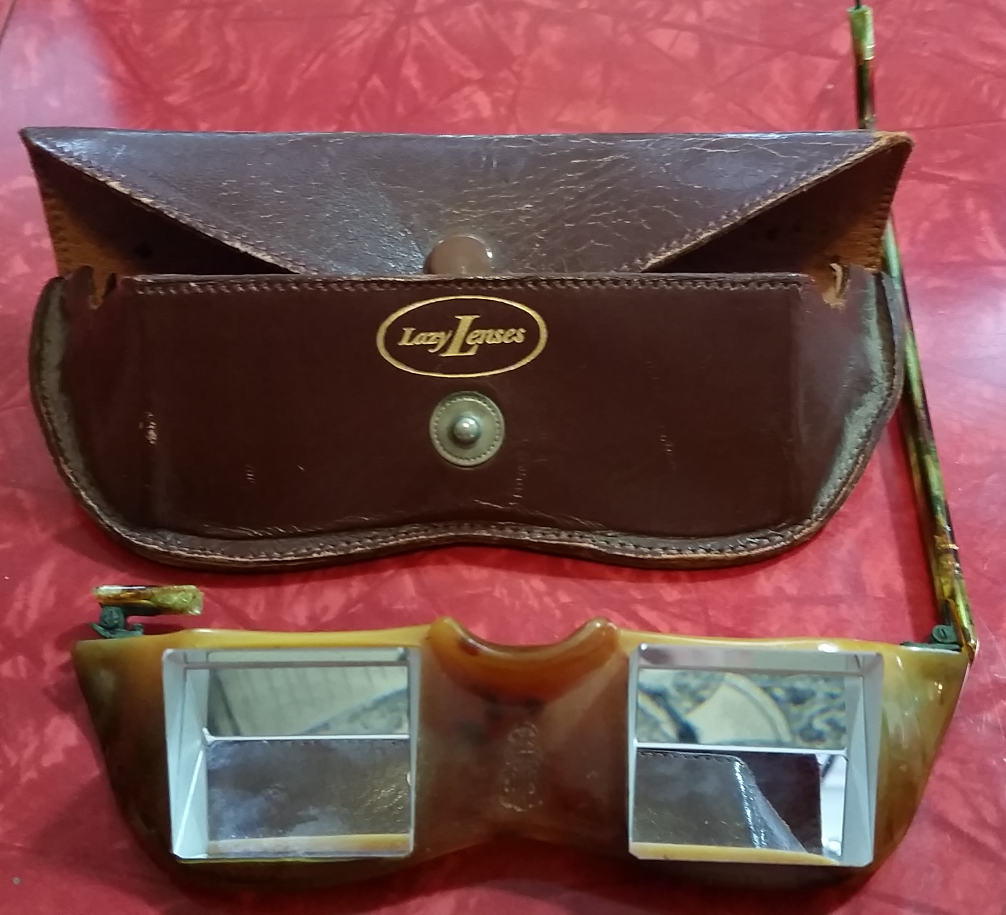
What intrigued me about this image is that I have a pair made in 1951 which I inherited from my dad. One temple is missing and the remaining hinge is corroded closed, but these are the real McCoy.
Look closely between the lenses and you’ll see this logo:
Mark Cross is a premier luxury leather goods company, and still going strong. If you want a $2500.00 fine leather men’s travel bag about the size of a laptop case, they’re just the company for you. Armed with the brand, I was able to come up with this:
Changing Times, The Kiplinger Magazine, October 1951, Page 38. For what it’s worth, Kiplinger is still in business as well.
Naturally, if there’s a good idea, you can be sure someone in China will make it for cheap.
This pair is called Bed Prism Spectacles, made by a Chinese outfit and for sale via Amazon.com for $13.05. Given that the original set by Clarence S. Warner sold in 1951 for $19.95, the equivalent of $182.00 today, I’d say that’s a pretty good deal. Of course, it’s hard to tell the quality of these new knockoffs (and there are many, many versions out there), but I know the ones sold by Mark Cross were top-drawer.
The idea is great, but there are some drawbacks. If you’re nearsighted like me and wear glasses, they don’t work all that well. Contacts would be an obvious answer, but then one would need reading glasses for close-up work if you’re farsighted as well. Like me.
But I’ve had these in my treasure collection since 1989 when dad passed away, and it’s nice to know I have a pair of the originals, made by a company that makes only the best.
I remember hearing this phrase many times when I was growing up, and always wondered why it was held up as an example of something to be feared.
This recently-found cartoon backs me up.
Then I had one.
The procedure was not really that horrid from the “sitting in the chair” standpoint, because I couldn’t see what was going on, but I remember that it just took a long time. I think if I had seen this animation (the Internet didn’t exist back then), I might have had even more reservations about going. Ow ow ow…
Now, I already had a crown on the affected tooth, so the last bit wasn’t necessary, but I had no idea this process was so involved.
The biggest challenge was the fact that I ached for three months after I had it done. It was insane. I wondered if I was going to have to have the thing done again, but eventually the pain subsided.
And thinking about this whole thing brought up a whole raft of memories about dental work… and I had a lot of it done as a kid.
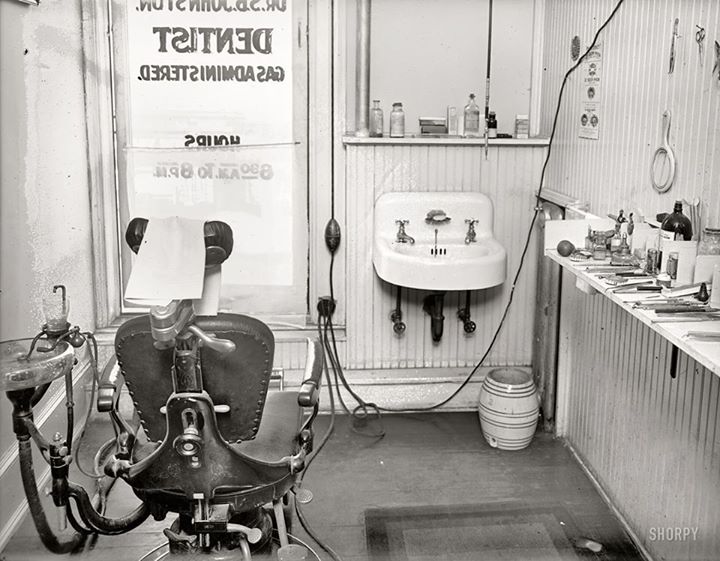
See, the thing of it was, I was terrified of needles. I started getting cavities in my teeth before I was 8, and had a lot of my baby teeth filled, and I refused to let the dentist give me anæsthetic… so I endured countless sessions in a setup that looked a lot like this:
This may be a bit older than the 50s, but the basic setup looked the same as the one Dr. Glick used on me. No high-speed drills here, just that belt-powered grinder, and despite the agony I still refused the Novocaine.
I found out how foolish I had been when I broke a tooth or lost a filling or something when I was at summer camp in Maine, sometime around 1963. They ferried me to a dentist in town, and I told him that I didn’t want anæsthesia. “Mhm,” the dentist responded. “Open.” And then the son of a bitch stuck me.
The blessed son of a bitch. Sheesh. If only I had known. Dental work still isn’t fun, but a little pain up front is certainly worth a lot less torment for a couple of hours.
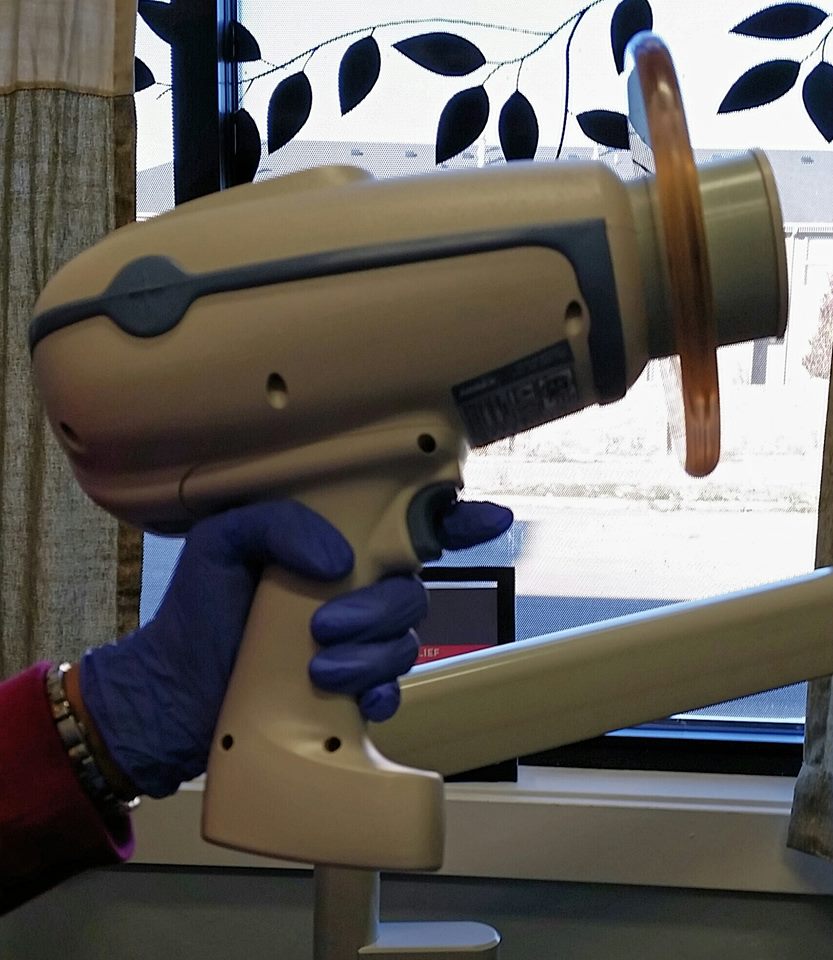
A few weeks ago I went to a local dentist for the repair of a broken tooth. I thought for sure I’d have to get a crown on it, because the entire inside surface of the tooth snapped off – but I was pleasantly surprised. A tiny bit of drilling, two applications of bonding, and I was as good as new – at least for this time. The whole thing took about 10 minutes. I mentioned to the dentist that the advances in dental technology were astonishing, and he said that not much had really changed in the tools, but the materials were where the miracles were taking place. I can’t help but agree, with the exception of the digital x-rays that they do these days.
First they put me in this contraption that whirred all around my head and did a complete 360° scan, and then the technician put me in the chair and zapped me a couple of times with this baby:
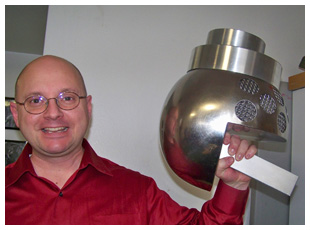
Handheld, she didn’t even have to leave the room. No developing time to speak of – all digital. I couldn’t help but be reminded of this:
Howard Tayler, author of Schlock Mercenary, holding a replica of Sergeant Schlock’s plasma gun manufactured by Doc Nickel, who in his own right not only manufactures some really awesome paintball stuff but also draws The Whiteboard, a webcomic vaguely about paintball.
It’s funny, but with all the advances, I still miss the old rinse-and-spit routine so common in the old days; you can see the cup and spit bowl in the office picture above. It may not have been as hygienic, but I could get a lot cleaner than the spray/suction routine they use today. And, I got sprayed with Lavoris™, a cinnamon-flavored mouthwash that seems to have vanished from store shelves, only to be replaced by foul-tasting chemical ersatz copies which taste like camel piss.
Imagine my delight when I found out that this wonderful stuff is still available online:
I scored some at Drugstore.com, it was a bit cheaper than Amazon’s offerings, and it was every bit as pleasant as I had remembered it. Now that’s cinnamon.
I’ve had a lot of dental work done in my life. Almost all my teeth are filled, and a number have been capped. I have all my wisdom teeth, and even they have been filled. I just have soft teeth, I guess. But I have all 32, and I’m grateful for the technology that has helped me preserve them. I still don’t like that accursed needle, but as I learned long, long ago, there are prices and benefits to that choice, and the benefits far outweigh the price.
And, I still hope I don’t ever have to have another root canal.
This article was originally published in the NMU Pilot, the official organ of the National Maritime Union of America, AFL-CIO, June, 1970. As for why I’m republishing it here? Maggie was my mother, and I interfaced with the USS for a couple of years in the 70s at their club in Naples, Italy.
Margaret Draper makes good under fire with United Seamen’s Service Center in Cam Ranh Bay
WHAT do you mean, “whatever became of Margaret Draper?” Why, she is working at the most interesting job she ever had in her life and enjoying every minute of it. Margaret is Assistant Director of the United Seamen’s Service Center in Cam Ranh Bay, South Vietnam. She has been on the job for a year, putting up with all sorts of inconveniences like running out of her favorite visual aid-lipstick, getting her hair mussed in helicopter downdrafts and sweating out occasional Vietcong alerts-all this so she can give the best of service to ship crews and military personnel in that godforsaken corner of the globe.
In the year she has been out there in Vietnam she’s due to be reassigned soon – Miss Draper has shared a lifetime of experiences, some good, some bad, and has profited from a new and deeper understanding of the men she went to Vietnam to serve. “1 am constantly meeting the same diversity of purpose and attitudes in people that one finds anywhere el se in the world and that, of course, makes each day stimulating. I have met men here who were formerly ranchers, hotel owners, stunt men, actors, sailboat racers, PhD’s, floaters, students and lost souls,” she wrote in one report.
Her presence in the Cam Ranh Bay Center provides the men with a most photogenic reminder of home. Working closely with USS Director John Chambers, she performs a multitude of services running from arranging outdoor barbecues to shopping at the local Post Exchange to clearing away military red tape so a seaman can have a reunion at the Center with a son fighting nearby with the Marines. “Margie Draper is always ready to help or assist you while you are there and there are many ways that a worldly seaman needs help and assistance,” one crew member wrote The PILOT recently from Vietnam.
The United Seamen’s Service opened the Center in Cam Ranh Bay late in 1966 at the height of the Vietnam sealift when sometimes as many as 100 ships waited in the harbor to discharge cargo. NMU used its influence to virtually move mountains of red tape so that the Center could open. The National Office sent Vice President Mel Barisic to confer in Washington with Maritime Administration, Navy, MSTS and Department of Defense officials on the project.
Barisic and Assistant Contract Enforcement Officer T. J. Walker made a total of three trips to Vietnam to expedite construction of the Center and otherwise improve mail service, shipboard conditions and shore leave privileges for merchant seamen in the area. The Union also backed construction of the Center in Qui Nhon.
Indoctrination course. Like all USS club personnel from the States, Margie underwent a brie but thorough indoctrination before departing for her post in Vietnam. This included a tour of the hiring hall in New York, a visit to the Upgrading and Retraining School and talks with NMU officials at the National Office and port levels. “You have no idea,” she says, “How much easier it is to hit it off with the seamen when they find I know what a ‘killer card’ is, and what goes on at sign-on and pay-off’, and which end is up on a console in the engine room of an automated ship.”
Miss Draper’s arrival in Cam Ranh Bay last June was made less traumatic when she was greeted by Vietnam veteran Elmira Liebau whom she was replacing. Miss Liebau, known as “Lee,” was very helpful in getting the neophyte settled in surroundings that were different, to say the least. A “must” for the newcomer were instructions in the protocol for a woman living on a military base, a compendium of delicate do’s and don’t’s laid down by men, who else?
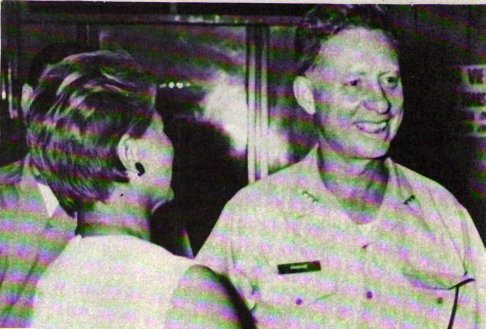
On inspection trip to Cam Ranh Bay last year, Vice Admiral Lawson P. Ramage, then commander of the military Sea Transportation Service, tells Margaret Draper how delighted he is with the facilities of the USS.
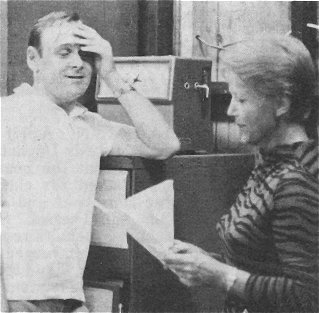
A simple plumbing job can take weeks in Vietnam. Just like home, as USS Director John Chambers and Miss Draper find in business huddle above.
After giving Margaret an appropriate introduction to the mysterious workings of the ice-making machine and how best to coax the Vietnamese employees of the Center to give their all to their jobs, “Lee” went on to begin the second year of her tour of duty at a new post at Qui Nhon, leaving the “new girl” a full set of instructions on the care and feeding of a new cat family.
Some routine. After the first few weeks in Vietnam, the days began to fall into a routine. That is, if you can call “routine” the explosion of bombs at the Convalescent Hospital last August 7. At that time security was tightened and everyone was instructed to keep their eyes peeled for VC terrorists. After that scare, a steady round of visiting ships in the harbor to pay respects to the Captains and to leave notices of activities at the Center proved to be one of the more pleasant of Margaret’s varied duties.
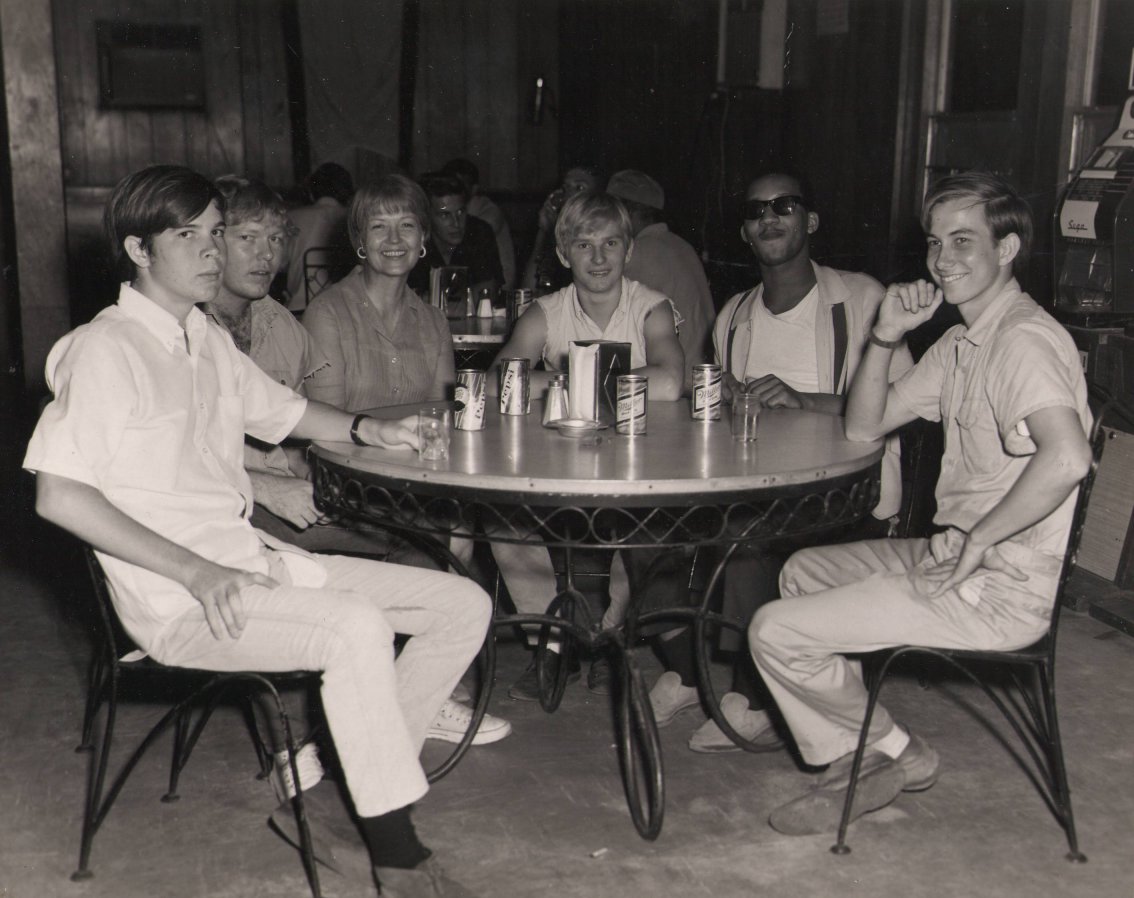
An average of 10,000 seamen visit the Cam Ranh Bay Center each month. Among them were these SS Britain Victory crewmen, (L-R) Cadet Kenneth Carden, Norman Leon,Jr., Miss Draper, Larry McCain, Roy Russel, Ricky Dermody. Taken in 1969.
At the Center her time is well spent meeting and greeting a succession of visiting brass from the American community. A lot of hard work goes into preparing special buffets for the merchant seamen and soldiers, but the reward of seeing the delighted smiles of the visitors more than compensates for the days and sometimes weeks of planning necessary to make these affairs successful.
The Center at Cam Ranh Bay never lets a traditional holiday such as the Fourth of July, Thanksgiving and Christmas go by without making a special effort to bring a touch of home to the men out there. USS Executive Director Ed Sette was a special guest at last year’s Thanksgiving dinner and dined well on a turkey and all the trimmings donated from the freezer of the SS Rider Victory.
They also serve. People like Margaret Draper and John Chambers at Cam Ranh Bay, and Elmira Liebau and Bob Sprague at Qui Nhon, and other USS personnel in Centers around the world come into daily contact with the seamen who show their appreciation for their services in many ways. But back on the home front, a lot of hard work also is being done to get more funds from the seamen’s unions, from the shipping industry and from the various community funds with which to carry on their work in Vietnam and in other ports around the world. Not the least important aspect of the work of the staff here in the States is keeping open the lines of communication with the Department of Defense in Washington so that the Centers in Cam Ranh Bay and Quin Nhon can continue to render their much needed services. The United Seamen’s Service, in case you did not know, operates on military premises in Vietnam under an agreement with the Military Sea Transportation Service which states, in part:
“The United Seamen’s Service is a non-profit welfare agency, international in scope, established for the purpose of serving the American merchant marine, military personnel, members of the United States Department of State, and other authorized contract workers with the services-” The agreement goes on to list 24 different services, some of which USS cannot render in a war zone and some of which are improvised as the need arises. But without these services, and without the zeal of dedicated people like Margaret Draper, morale among merchant seamen in Vietnam would be low indeed, so low as to seriously hinder the job of supplying our fighting men in Southeast Asia.
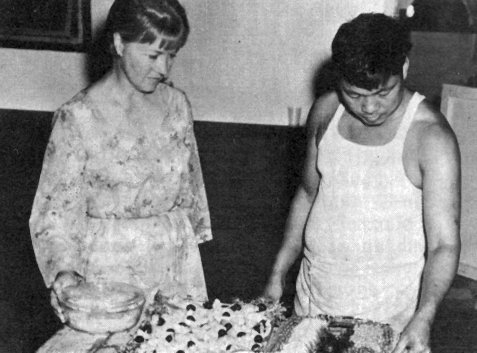
Dressed for party, Miss Draper gives final approval to trays of canapés fashioned by the chef, Mr. Do.
Despite the worldwide decline in merchant seamen (the huge computer-controlled cargo behemoths require ever-fewer humans to run them), the United Seamen’s Service still functions in seven centers around the world, providing necessary services to seafarers.
As I gradually work through mom’s papers, I know there are other photos and tales from this era, and I’ll do my best to get them up here as time permits.
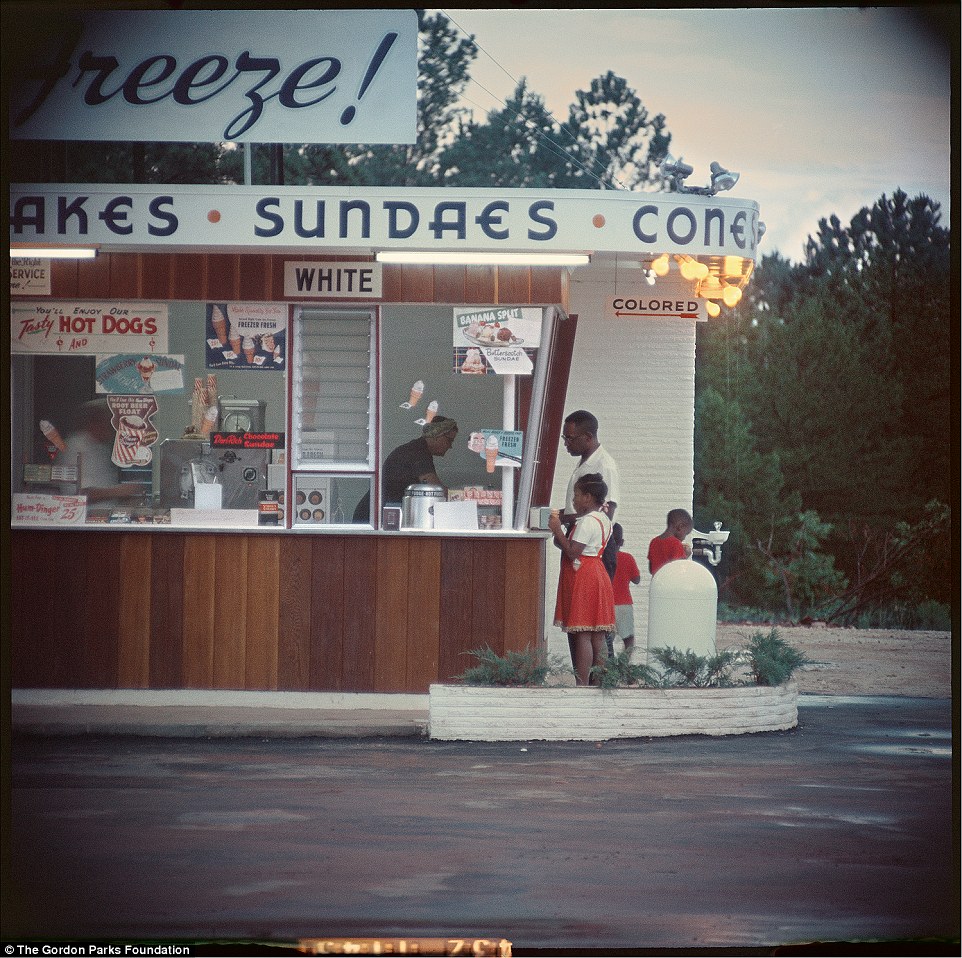
This beautiful picture by Gordon Parks is one of a series of 40 that will be on display at the High Museum of Art in Atlanta, Georgia. I had posted another image from this series here without attribution, which has now been rectified.
There is very little to say about this era of our history that has not already been said, and better, by other historians and sociologists. Yet this particular image strikes me with the sheer insanity of the entire proposition. Same restaurant, same server, same product, yet a separate window six feet away from the “White” one. None of it makes any sense, and as I take a long view of our nation, I realize that although superficial progress has been made, there is still far too much bigotry alive and well.
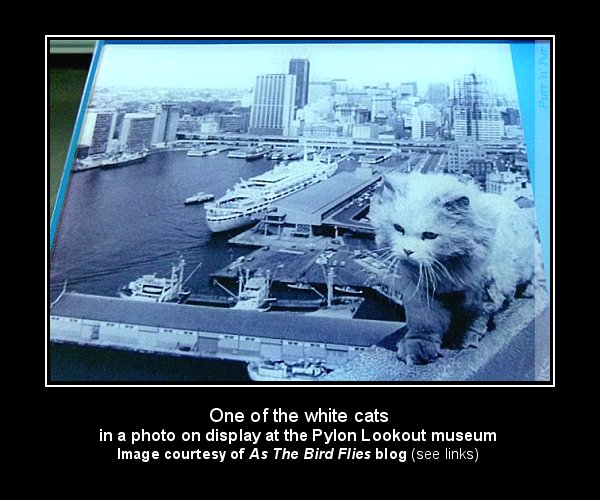
I happened across this picture on reddit today and wondered about the backstory:
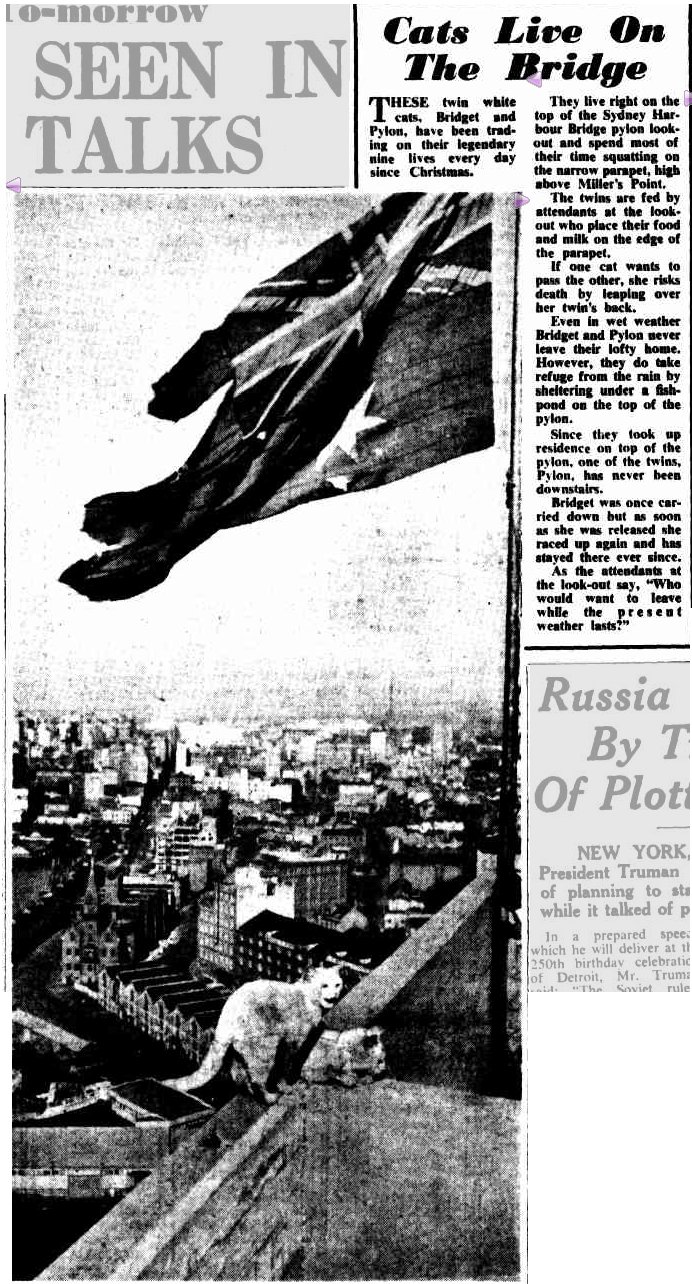
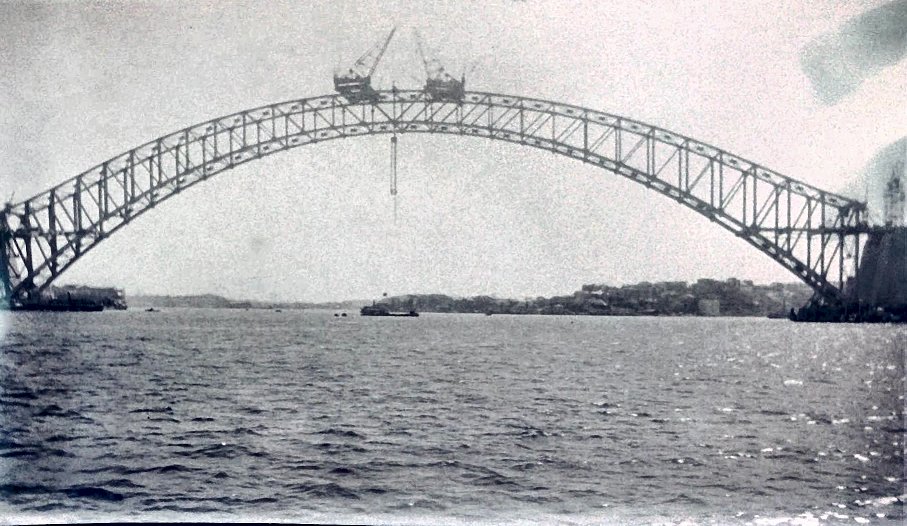
The post intimated that this cat was named George. A little digging intimates that it’s not impossible, but that there were several cats who lived on or around the bridge, some of which never came down. I find that a bit hard to believe, but you can judge for yourself.
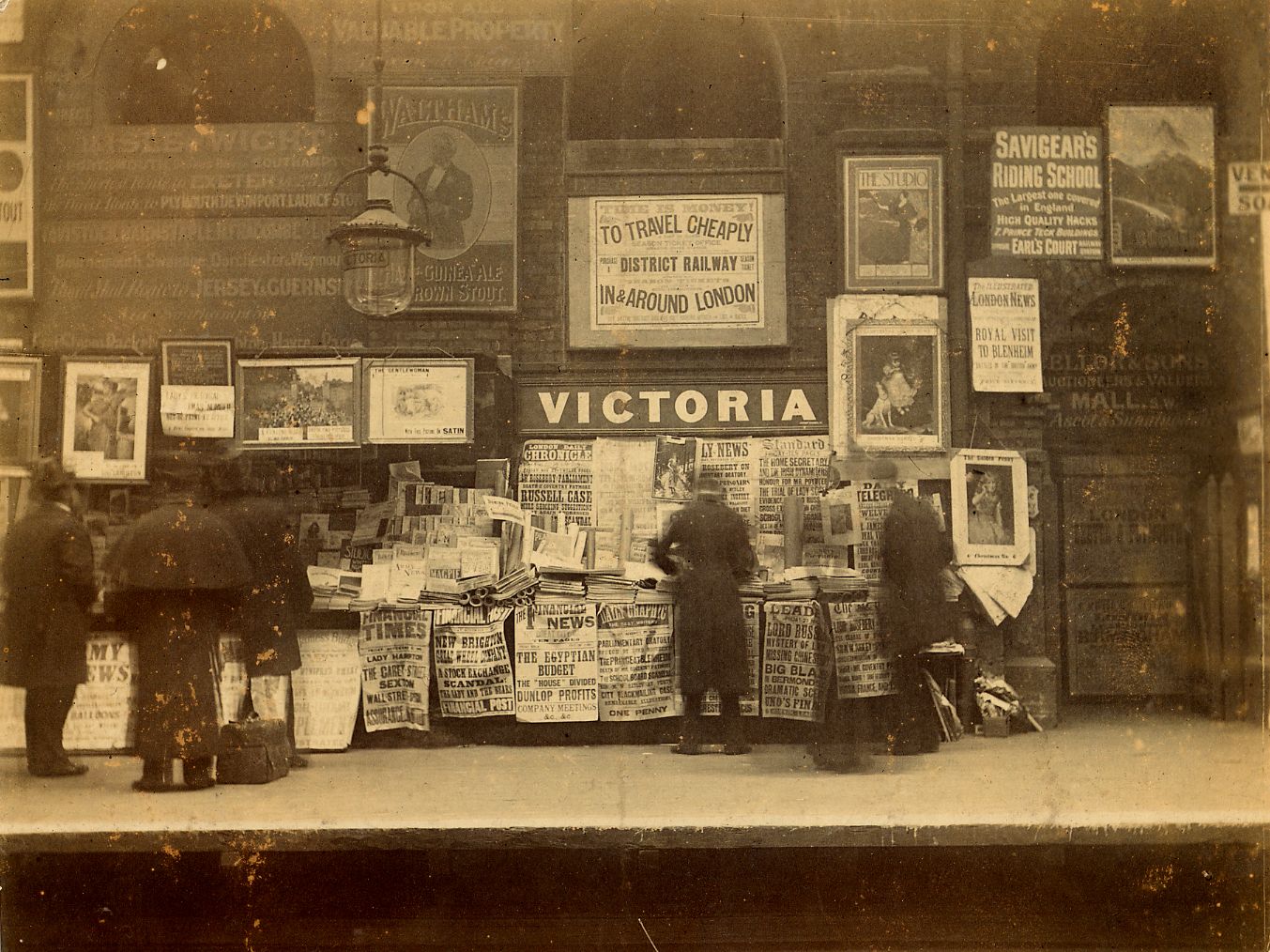
I love old pictures like this. It’s intriguing to see the headlines, and also to realize that London had a functional and practical underground before the turn of the 1900s.
I wonder if this was before or after the great market crash? A friend much smarter than I just pointed out that the crash was in 1929, not 1939. I was never very good at historical dates.
Newsboys and girls in New York, 1910. Much more history about New York’s Newspaper Row can be seen at 6sqft.com.
I loved the movie Newsies, but photos from the era give the lie to all the song and dance. It was, doubtlessly, a dog-eat-dog, uncomfortable, tiring, dangerous and difficult world for the children who hit the streets selling papers for the newspaper barons.
Headlines like this were a newsie’s dream – everyone wanted to find out what was happening. The newspapers were the Internet of the early 20th Century.
Unfortunately, most daily headlines were usually boring, so embellishing the truth a bit would help move a few more papers:
‘Trash fire near immigration building frightens seagulls’ —> ”Terrified flight from flaming inferno!” (From “Newsies”)
Thus the seeds were sown for later generations of tabloid journalism:
Which, of course, were inevitably made fun of:
This collection of politically-incorrect satire is one of my most treasured possessions. It’s sheer brilliance.
Now, of course, newspapers are almost extinct, and struggling for survival. Most of us have to depend on the responsible journalism of television, cable, and the internet:




















 Playing in the World Game