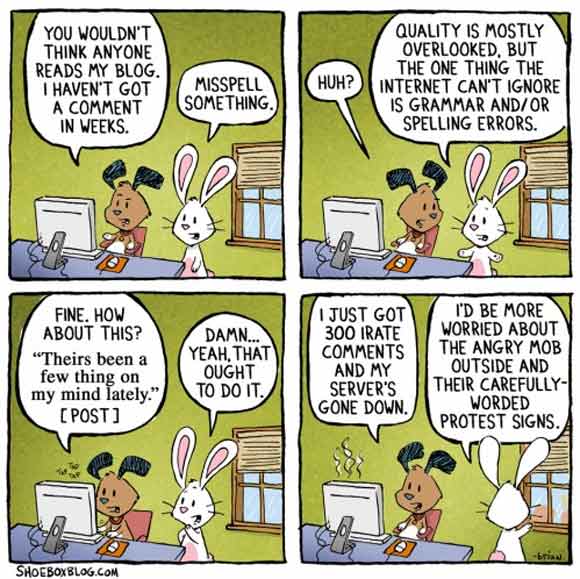
Their. That should dew it. Courtesy of the inimitable Shoebox Blog.
Their. That should dew it. Courtesy of the inimitable Shoebox Blog.
Translation can be funny. Spend a career in and around the industry, and you hear all the jokes. The disasters. The catastrophes.
Translation students invariably hear the story of the interpreter (or the computer, depending on which version of the apocryphal story is told) who rendered “The spirit is willing, but the flesh is weak” into Russian as “The wine is good, but the meat is rotten.”
Some bad translations have long passed into legend: “The lift is being repaired today. During this time we regret you will be unbearable.” – supposedly seen on an elevator in Hungary, or Japan, or any number of other places. One can find endless lists of these on the internet, and while some are obvious fabrications, others are true because one does see such abominations out there; assembly instructions for products from the Orient used to be notoriously bad back in the 70’s, and engrish.com is still a font of amusement if you want to see bad translation work.
Let a computer do your translation for you, and you can embarrass yourself and your entire nation:

If you don’t understand the results you’re getting, it’s dangerous to use automated translation – what the original restaurant name was supposed to be, no one will ever know.
The same goes for emails, if you don’t speak the language you’re dealing with:

This particular sign didn’t last long, as soon as the city council members discovered what had happened.
And then, in the midst of all the hilarity, one encounters brilliance.
Now, since I use Firefox with Adblock Plus and F.B. Purity, I never see ads on the Internet, but many folks aren’t so lucky.

I’ve got more to say about the Açaí berry scam (stay tuned), but you still see these ads, and thousands like them, all over the internet. And, these ads need to be translated for other language markets. Given that the preponderance of these Facebook and Google ads are 100% bullcrap, it’s easy to see why an ethical individual would soon tire of committing electronic fraud. One Finnish translator decided to go out in a blaze of glory.
Here’s what the ad looked like:

But if you’re Finnish, this is what you’d be seeing:

Like a boss!
The Old Wolf has spoken.
Happened all the time. Skating, climbing trees, those deadly playground implements of destruction. And depending on what was in mom’s medicine cabinet (or even worse, if I was visiting my cousins in the country,) the cure was often worse than the injury.
Mom used Mercurochrome, until I begged her to start using Bactine™ (“Psst! Goes the Bactine™, and down go the mean old germs,” said the TV commercial, and I was all over anything that was pain-free.)
But Aunt June, for all her sweet kindness, was a closet sadist: she used merthiolate in her home, and woe unto the child who came in with a cut.
The chart below shows my impressions as a child of what various remedies were like; the pain scale images are from the inimitable Hyperbole and a Half.

Nowadays, I just wash an owie with soap and water (yeah, it stings a bit, but suck it up), slather on some Neosporin™ or other antibiotic cream, and call it good. But as a kid, my pain threshold was lot lower. Sucks to be a kid.
The Old Wolf has  spoken.
On occasion I stumble across things on Facebook or reddit or elsewhere that are relevant and which deserve to be shared. Here is one such example:

The Old Wolf has edited.
Posting this for no other reason than I love it.

I especially like the lava floor. 
©Unknown
Steve Mann, called by some “The Father of Wearable Technology,” was hungry in Paris. Instead of stopping in at a local boîte, he and his family (inexplicably – this is Paris, after all) chose to dine at McDonald’s. It turned into something of an incident, which he also reported on his blog. Despite being shown a doctor’s note that explained his wearable eyepiece (a PARC1-esque precursor to Google Glass,) the staff at McDo had reservations.

Steve Mann with his EyeTap device
I imagine something like this taking place:
Staffer 1: Excusez-moi, monsieur, qu’est-ce que c’est on your face there?
Mann: It’s a wearable eyepiece. I need it. Here’s a note from my doctor.
Staffer 1: (reads.) (sniffs.) Hmp. D’accord, monsieur. For now. (Returns to work, muttering Gallic imprecations under his breath.)
[In the kitchen]
Staffer 2: What did he say?
Staffer 1: He says it’s technology. He says he needs it. He showed me a note from his doctor.
Staffer 2: And you believed him? Crétin! All américains sont des liars! He is doubtless a spy for le Wendy’s, or un Borg, or un observeur from the 7th dimension, or worse, from le CIA!
Staffer 3: Oui! We must throw him out before he begins to throw caca on les clients of our fine establishment!
All: Allons, enfants de la patrie!
Staffer 1: Monsieur! You must leave! You may not wear Borg technology in our store!
Mann: But it’s just an eyepiece…
Staffers (together): Non! Hérétique! You will burn for your blasphemy! Away avec toi! (staff hustles Mann and his family out of the restaurant, trying to rip off his eyepiece which is rather bolted to his head)
Staffers: Voila! The pûreté of our établissement has been restored! Vive la France! And stay out, or next time we will not be so charitable, cochon américain!
Of course, all révolutions begin en France, and then migrate to other shores. Perhaps a dark time will fall upon our own nation, with gangs of thugs roving the streets yanking hearing aids out of the ears of the elderly, but after the population has been decimated by the technology wars which ensue, equilibrium will be established, and portable technology will be accepted by the remainder.
Now if you’ll excuse me, I need to go polish my optical implants.
The Old Wolf has spoken.
1PARC, or the Palo Alto Research Center of XEROX, developed the technology that has now become ubiquitous as the Macintosh, and marketed it as the 8010 STAR system and the subsequent 6085 Desktop Publishing System. They invented the desktop metaphor, with documents, folders, trashcans, windows, raster font design, and a whole host of other things… and did it in 1985, long before Windows was even a bad mushroom dream in Bill Gates’ mind.
Webcomics have been good to me.
They found me my eternal sweetheart, kept me sane in the midst of storms, and filled my circle of friends and acquaintances with some of the best people I’ll ever know. There are thousands of them out there, so I’ve had to be selective; they can also be a terrible time-sink.
That said, I’d like to periodically recommend the strips that have meaning for me in one way or another. Today, one that sits at the top of my must-read list: Wapsi Square, by Paul Taylor.

From Wikipedia, “Wapsi Square is a slice of life/fantasy webcomic set in modern Minneapolis, “a world almost exactly like the one you want to believe you live in.” It also includes multiple supernatural elements, including a psychic and a god, which contrasts with its soap opera nature.The name derives from the Wapsipinicon River.
The story starts following the mundane life of main character Monica Villarreal and focuses prominently on her interactions with her friends. She works as an anthropologist dealing with artifacts for museum and the strips are mostly of the gag-a-day form. This changes, however, with the introduction of the character Tepoztecal, an Aztec deity, which marks the beginning of a change in tone, including longer story arcs involving mythological creatures, forgotten civilizations, gods and the end of the world.
What I love about Wapsi is more than just the stunning artwork and the captivating storyline – it’s about the inner journey of discovery that each of his dominant characters is taking. Whether the interactions are the day-to-day ones with friends and associates, or the “holy crap it’s a sphinx get in the car!” ones that happen along the way, these people fight every day with those internal demons that live within each of us: doubt, shame, guilt, insecurity, fear, prejudice, Harry the Worm, you name it. And sometimes they win, and sometimes they lose, and it’s a wonderful romp; even the demons have demons – nobody in this strip is exempt from the struggle.
Prominent among the issues Paul’s characters deal with is body image; Monica is a tiny Latina with a brobdingnagian bustline, and this provides ample fodder for both humor and introspection. Paul will often step outside the fourth wall on his blog to spotlight real-life women who personify the essence of a “Wapsi Girl”: strong, feisty, accomplished, and full of can-do attitude. If you’re wondering where the strong men are in the Wapsi World, they are there, but they tend to hide in the shadows for the most part. I for one would love to know more about Daren the bartender and his background – he reminds me a lot of Star Trek’s Guinan… a wise listener who somehow has a way of seeing into the soul.

Outside of the strip, Paul does some really nice artwork – you can see many of his pieces here, and most of these have been offered for sale at eBay, along with the original bristol-board artwork for the daily strips as well. I confess to having a rather substantial collection.
Wapsi can be lighthearted, but it can also be very dark. It would get at least a PG-13 rating, with an occasional “R” word thrown in, but adult themes are never tossed around gratuitously.
As long as it’s around, I’ll be reading Wapsi; it’s more than just entertainment for me, but also a daily reminder that all of us are fighting an uphill battle, and that we need to be there for one another. It has evolved mightily since it was started, both in storyline and artwork; the only thing I can guarantee is that nobody knows what is waiting around the next corner.
The Old Wolf has spoken.

When the San Diego Zoo opened a second, larger branch called the San Diego Wild Animal Park, built around an enormous open-field enclosure where the animals roam free, visitors would ride on a monorail called the Wgasa Bush Line which circles the enclosure.
They wanted to give the monorail a jazzy, African sounding name. So they sent out a memo to a bunch of zoo staffers saying, “What shall we call the monorail at the Wild Animal Park?” One of the memos came back with “WGASA” written on the bottom. The planners loved it and the rest is history. What the planners didn’t know was that the zoo staffer had not intended to suggest a name. He was using an acronym which was popular at the time. It stood for “Who Gives A Shit Anyhow?”
Bohica!
The Old Wolf has spoken.
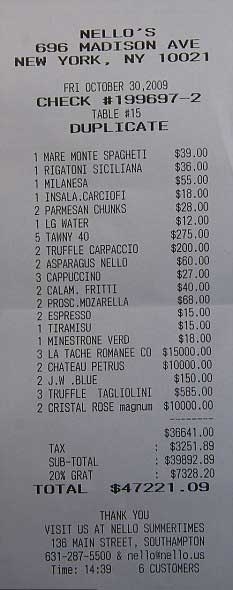
On November 2, 2009, Business Insider published a picture of this receipt, claiming that Russian Billionaire Roman Abramovic had dropped the price of a nice SUV on dinner, including a few bottles of rawther pricey wine. Abramovic’s agent soon came forth with a rebuttal, implying that Nello Balan was up to his usual antics.
Cityfile published this piece on May 15, 2010 – the original page is now gone, and I had to dig it up from the Wayback machine:
Nello Balan is the owner of Nello, the exceedingly mediocre Italian restaurant on the Upper East Side. He’s also one of the city’s most shameless—and most notorious—publicity hounds. Balan’s latest attempt at drumming up attention, however, now appears to be exploding in his face. Last week, a receipt “surfaced” indicating that Russian oligarch Roman Abramovich had spent $52,000 on lunch. (The bill was for $47,000, but TMZ, which first reported the story, said the billionaire had tacked on a $5,000 tip.) But a spokesman for Abramovich tells us the bill wasn’t his and the mogul may pursue legal action against Balan for suggesting otherwise.
Last week’s report—which TMZ has since scrubbed from its website—followed two other recent cases where massive bills magically made their way into the hands of the media. First there was fellow Russian billionaire Mikhail Prokhorov, who allegedly spent $19,000 on lunch two weeks ago. Then there was Jay-Z and Beyoncé, who supposedly spent $1,200 on Dom Perignon, truffles and lobster salad last week.
Naturally, these bills don’t make the news because some absent-minded waiter keeps dropping the receipts at the feet of tabloid reporters. They’re fed to the media by Balan himself. (Amusingly, when the details of Prokhorov’s meal were reported in the pages of the Post, Rich Calder wrote that Balan had “declined to disclose Prokhorov’s exact tab,” but a “source” had provided the paper with a copy.)
But is Balan just concocting these receipts out of thin air? Abramovich’s rep says that the the Russian mogul was, in fact, at Nello’s on the date in question. But he didn’t spend anything close to what the receipt indicated and he may now take legal action against Balan for spreading the lie. (It would have been a bit of a waste to order all that expensive wine anyway; Abramovich was accompanied by his girlfriend, Dasha Zhukova, who is seven months pregnant.) Here’s what John Mann, who heads up corporate communications for Abramovich’s London-based holding company, had to say when we asked about the bill:
The $47,000 check for lunch at Nello’s in New York on Friday, October 30, 2009, published by various media outlets over the weekend, is in no way connected to Mr. Roman Abramovich. While Mr. Abramovich and five others did dine at Nello’s on that date, their total bill amounted to only a couple of percent of that amount. The assertion that they ran up a bill of any greater magnitude is entirely false.
We are in the process of investigating the origins of this inaccurate story, which we have been told was perpetuated by people connected to the restaurant. Our legal counsel has been instructed to review any appropriate action to rectify this situation.
It wouldn’t be beyond Balan to make this up. He’s tried to bribe reporters in the past, he was once arrested for choking his girlfriend, and he’s been investigated for tax evasion. And he might just be desperate enough to conjure up fake receipts considering the financial problems he’s had in recent months.
We reached out to Balan for comment, but the normally chatty restaurateur didn’t feel like talking. The receptionist who answered the phone said she “didn’t think” Balan was there at the moment, then put us on hold for a minute before returning to the line. “Can you call back on Monday? He’s in Europe until then.” Then she hung up.
Who’s telling the real story? Uncertain. No one has claimed the receipt, and Nello’s isn’t talking. Just another everyday tale from the Big Apple.
The Old Wolf has spoken.
This article by Art Buchwald appeared in various forms in various newspapers. In honor of a young acquaintance of mine who has been living and studying in France, I reproduce here a version that was published in the Pennsylvania Observer-Reporter on August 1, 1977.
During the past eight years I have made a scientific study of the attitude of European sales people toward a foreign customer. They vary in each country according to temperament and while it isn’t fair to generalize that’s exactly what I’m going to do.
In Italy when a customer walks into a store he is greeted like a long-lost brother.
“Welcome signor; welcome signor. Please come into the shop where it is nice and cool. You do not have to buy anything, you can just look.”
“I would like a poplin shirt. Do you have any?”
“Do we have any? That’s all we have is poplin shirts. We specialize in poplin shirts. Mama, give me the best quality poplin shirts for these nice people.”
While Mama is dragging out the shirts the man says, “Are you from America?”
You say you are.
“I have relatives in Chicago. You know them? The Qualliteris? Look, here is their picture! My cousin has seven children! Please do look, that is Rosita, Antonio, Carlotta, Alfredo, Giuseppe, Charles, and Thomaso. Rosita is seven, Antonio is…”
The shirts finally come. The man says, “Beautiful Egyptian cotton. Notice the pearl-like quality of the buttons, how the tail of the shirt is rounded gently, the pleated pocket and the firm rich feel of the collar. Please to touch it yourself. Where else in the world can you find a shirt like this? Take a dozen. In America you will thank me for selling you these shirts.”
You are touched by his kindness. You buy a dozen. His wife gives your wife a bouquet of flowers. They both escort you to the door You shake hands with them. They shake hands with you. They ask you to come back soon. They tell you not to miss a visit to St Peter’s and they give you the names of a trattoria in Rome and friends in Florence. There are tears in their eyes as you walk away. Everybody is happy.
In London you walk into a store and you are greeted by a man in a tail coat who bows and asks if he can be of help. You ask for the shirt counter. He clicks his fingers and calls for a salesman who rushes up and stands at attention as the man in the tail coat snaps, “Shirts for this gentleman.”
[Editor’s note: In the back of my mind I can hear Captain Peacock calling, “Mr. Humphries, are you free?”]
The salesman says, “Right this way,” and takes you to the counter. “What size and what colour,” he asks.
You tell him you want a poplin and a button-down collar if possible.
He looks down embarrassed as if you had just asked him how much salary he makes. “Is there anything wrong with a button-down shirt?”
“To be frank, Sir, in England we don’t think too much of the button-down collar. Of course you Americans like that sort of thing but we consider it rather iffy, if you know what I mean. It’s just not the sort of thing you would wear except to a very bad cricket match. Of course if you want a button-down shirt I’d be very happy…”
“Heavens, no,” you say, “What is the proper shirt to wear?”
“Ah, the proper shirt,” he smiles. “This is the style now. You will notice the Duke of Norfolk wears only this type of shirt. It is worn by men of distinction of every profession. I’m sure a person like yourself would wear only the latest attire.” He shames you into buying a dozen.
But in France, everything is different. You walk into a shop which is quite empty with six or seven salespeople standing around.
You wait 15 minutes and finally someone comes up to you and speaking in the tone that a Poujadist would use on a tax collector says, “What do you want?” You tell him you want a shirt. “What size?” he says sneeringly.
“Size 17.”
“Ha!” he shouts. “We don’t have your size. Do you think we carry everyone’s size? How much place do you think we have here? The largest size we have is 16½.”
You tell him you’d like to see it.
A look of disappointment comes over his face.
“What color,” he says.
“White.”
“Ha!” he shouts. “We don’t have white. We only have them in colors. Do you think we can stock both white and colored shirts?”
Another salesman comes over and asks in French what the trouble is. The fellow salesman tells him in French, “This idiot wants a white shirt. First he asks for a size 17 and now he wants it in a 16½. What kind of store does he think we run?”
“These Americans are all crazy.”
You say you’ll take a colored one. The salesman is furious. He shoves the box of shirts in front of you and says, “Please don’t touch them or you’ll have to pay for them.”
You select one and he throws it into a bag. “Four thousand francs,” he says.
You give him a five-thousand franc note.
“Don’t you have change? Do you think we can make change for everyone who comes into the store?”
Everyone looks at you as if you had just slapped the man in the face.
You say you have no change, and there is a conference of the salesman, the manager and the cashier. They keep looking at you and whispering to each other. Finally, the cashier, who writes the entire transaction in a large ledger, produces the thousand franc note.
The salesman slaps the purchase into your hand and throws the change down on the counter. As you walk out of the door you hear him saying to the other people, “C’est incroyable. Incroyable.”
©1977, Los Angeles Times Syndicate
Having lived in Europe in a number of different countries, I can vouch for the fact that this is just barely satire.
The Old Wolf has spoken (but Art Buchwald has spoken better.)

 Playing in the World Game