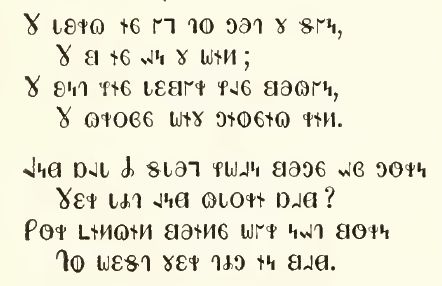
I have written about the Deseret Alphabet before, in a somewhat unusual context – today I came across a nostalgic article at the Deseret News commemorating this bit of linguistic whimsy. It appears to have begun development as early as 1847, which would make it closer to 170 years old.
The poem above, from the Deseret Second Book (page 31), reads as follows:
The lark is up to meet the sun,
The bee is on the wing;
The ant its labor has begun,
The woods with music ring.
And shall I sleep while beams of morn
Their light and glory shed?
For thinking beings were not born
To waste their time in bed.
Clearly the authors of these primers were not above a bit of plagiarism; the first stanza of this poem is by William Holmes McGuffey (1800–73)
The original second stanza reads,
Shall birds, and bees, and ants, be wise,
While I my moments waste?
O let me with the morning rise,
And to my duty haste.
McGuffey’s Eclectic Primer, newly rev., lesson 81, p. 54 (1849).
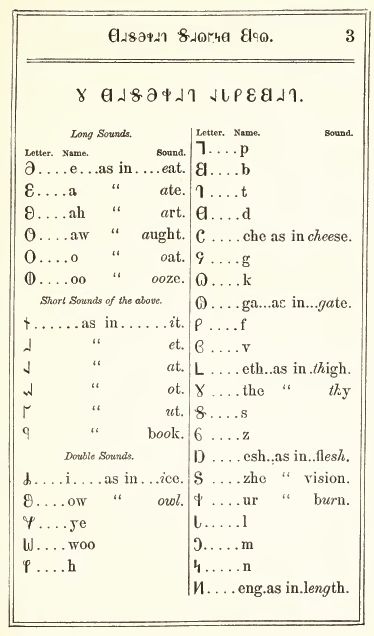
The transliteration of the Deseret Alphabet:
In the course of a study of Deseret as part of my MA in linguistics, I discovered that it had an added and unplanned benefit; reading the journals of Brigham Young, some of which had been transcribed into Deseret Alphabet during the days of enthusiasm for the project, I discovered that these manuscripts served as a window into the dialect and pronunciation of the scribes of the day. Since people transcribed the English they way they pronounced it, one could not only determine that various volumes were transcribed by different people, but also have a fair idea of what they sounded like when they spoke.
“A malapropism (also called a malaprop or Dogberryism) is the use of an incorrect word in place of a word with a similar sound, resulting in a nonsensical, often humorous utterance… The word “malapropism” (and its earlier variant “malaprop”) comes from a character named “Mrs. Malaprop” in Richard Brinsley Sheridan’s 1775 play The Rivals.” (Wikipedia)
Some examples of malapropisms are:
“illiterate him quite from your memory” (instead of “obliterate”)
“she’s as headstrong as an allegory” (instead of alligator).
A friend of mine recently posted this gem on Facebook; I had seen it before, but yesterday it rang a bell and I thought I’d just get it out here with its corrected version for future reference.
TRIGGER WARNING: If bad English offends you, look away now!
Ow! Ow! Ow!
In text format, the monstrosity reads:
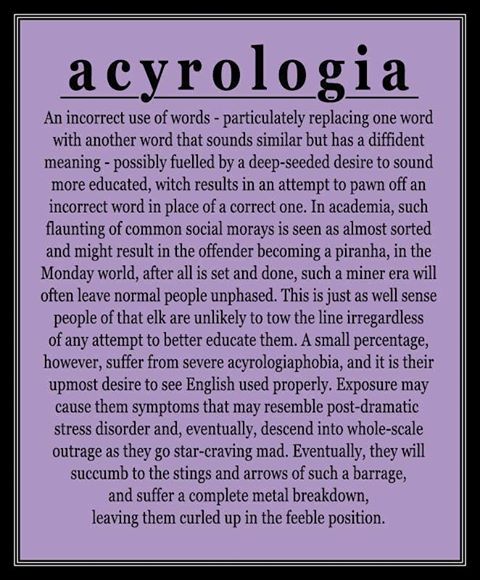
Acyrologia is the incorrect use of words – particularly replacing one word with another word that sounds similar but has a diffident meaning – possibly fueled by a deep-seeded desire to sound more educated, witch results in an attempt to pawn off an incorrect word in place of a correct one. In academia, such flaunting of common social morays is seen as almost sorted and might result in the offender becoming a piranha, in the Monday world, after all is set and done, such a miner era will often leave normal people unphased. This is just as well sense people of that elk are unlikely to tow the line irregardless of any attempt to better educate them. A small percentage, however, suffer from severe acryrologiaphobia, and it is their upmost desire to see English used properly. Exposure may cause them symptoms that may resemble post-dramatic stress disorder and, eventually, descend into whole-scale outrage as they go star-craving mad. Eventually, they will succumb to the stings and arrows of such barrage, and suffer a complete metal breakdown , leaving them curled up in a feeble position.
The only way to stop the pain is to read the paragraph in its proper form:
Acyrologia is the incorrect use of words – particularly replacing one word with another word that sounds similar but has a different meaning – possibly fueled by a deep-seated desire to sound more educated, which results in an attempt to pawn off an incorrect word in place of a correct one. In academia, such flaunting of common social mores is seen as almost sordid and might result in the offender becoming a pariah; in the mundane world, after all is said and done, such a minor error will often leave normal people unfazed. This is just as well since people of that ilk are unlikely to toe the line, regardless of any attempt to better educate them. A small percentage, however, suffer from severe acryrologiaphobia, and it is their utmost desire to see English used properly. Exposure may cause them symptoms that may resemble post-traumatic stress disorder and, eventually, descend into full-scale outrage as they go stark-raving mad. Eventually, they will succumb to the slings and arrows of such barrage, and suffer a complete mental breakdown , leaving them curled up in a fetal position.
I’ve written before about “Word Crimes” – one of Weird Al’s best efforts ever, and that’s saying something because just about everything he does is delightful.
From a recent Facebook post. Having worked as a freelance translator, these responses spoke to my soul. Yes, a few of them are more than four words, but they’re all good – and they’re all real. I have seen many of these myself.
For what it’s worth, I no longer do this sort of work. The reasons will become obvious. I’ve included a bit of commentary here and there.
Cheap bastards
Agencies make money by charging high rates to clients and paying low rates to translators, reviewers, and proofreaders. They’re always jockeying for a better deal. That’s the nature of business, but when you’re an independent contractor, and your standard rate (calculated to earn you a living) is always being undercut, it’s frightfully annoying. The global access of the Internet means that professional, trained, educated translators must now compete with millions of people in India, China, and elsewhere who “speak a little English” and who are willing to work for 1¢ per word or less.
Best lowest rate required.
What’s your best rate?
Make your best rate.
Make me (a) good price.
Send your best rate.
We pay in visibility. (Visibility and $7.95 will get you a coffee at Starbucks.)
Our budget is limited. (So I’m supposed to subsidize your profit, right?)
Special rates apply to this client. (He’s paying us less, so we’re going to pay you less.)
A discount for volume. (We’re paying less because there’s a lot of work).
It’s the market rate. (Take it or leave it.)
5¢ is not bad. (5¢ per word is shit.)
The others charge less. (Good, feel free to use them.)
Someone charges way less.
Our budget is only …
National Agreement Rate Please.
Could you proofread instead? (Read: Your rate is too high).
Cheaper bastards
Machine translation used to be cumbersome, expensive, and not very effective. Now it’s quick, easy, free, and only a bit more effective. While statistical translation models have made some exciting progress, people who don’t understand the intricacies of language assume that online translation is both free and reliable. Similarly, your neighbor may speak a bit of German, but don’t expect your translation to do well in the commercial arena. In the translation world, you still get what you pay for, and if you go cheap, you’re likely to get crap.
Google Translate is cheaper.
We will Google translate.
I’ll do it myself.
I can do it myself.
Neighbour can do it.
Will it cost anything?
Is it for free?
That much? No way!
The font was wrong. (Followed by “Will you accept 50%?”)
I could do it, but…
Could do it myself, but…
You’re overpaid.
Cheapest bastards
It’s not uncommon for an unethical agency to get a job, break it up into 20 segments, offer the job to 20 translators and have them each do part of the work as a “test,” then award the bid to nobody.
Please do this test.
Please complete test assignment.
We require (a) free test.
Test translation without charge.
Download the test translation.
It’s for a tender. (We need your free translation to make the bid.)
Scheduling headaches
Contractors spend a lot of time juggling their resources against customer needs. Agencies don’t care.
We’d like it for tomorrow.
Have you begun yet?
Great, don’t proceed yet.
Client brought deadlines forward.
The client sent changes.
The client made changes.
6000 words for tomorrow.
20,000 words of light postediting.
We need it yesterday.
Can you deliver early?
Sorry, client cancelled assignment.
End client just cancelled.
Please send your invoice (then we’re going to have minor changes).
File should arrive midnight. (Deadline in 8:00 AM, of course.)
We have a glossary (10 minutes before deadline).
That didn’t need translating… (After you’ve spent a day and a half on “that.”)
Please use US English. (Halfway through a huge project meant to be in UK English!).
Please deliver tomorrow morning.
Translate in real time! (What does this even mean?)
Client isn’t in a hurry (Followed, 2 months later, by “Client needs it ASAP”).
The project is cancelled (in the morning of due date!).
Your skills are worthless!
Anyone can translate. It’s just typing in another language.
(It doesn’t need to be translated,) just type this in Portuguese
Everyone can do it!
So you teach English?
You’re a translator? Then why don’t you give English courses?
What is your work?
Please do the shopping.
Go get the kids.
Don’t think, just translate!
What’s your real job?
Do you also teach?
You have done nothing.
Technical Headaches
“You need to use our tools, yours are garbage.”
Trados is a must.
TRANSIT is a must.
Across is a must.
[Insert CAT tool name of choice] is a must.
Use our online TM-tool.
We only use Excel. (Translating in Excel is a nightmare, if you were wondering.)
Please translate into Excel.
Your file doesn’t open.
Not only that, in the world of translation, these CAT (Computer-assisted translation tools) are de rigeur. They can be useful in speeding up translation and improving terminological consistency, but agencies routinely take advantage of this and pay less than the full rate for things that the software has translated for you. This ignores the fact that the translator is responsible for the coherence of the entire job and must read and evaluate every bit and piece of the work for accuracy. This alone is the major reason I stepped out of the freelance translation world. My rate per target word is X¢, period. Pay it or go somewhere else. Translators who survive in the industry pretty much have to suck it up, but I wasn’t willing.
We don’t pay repetitions.
Pro-rated for fuzzy match.
100% matches for free.
Discount for fuzzies applied.
Fractional Payment for Repetitions.
Payment Headaches
In the US, standard terms are 30 days net. Around the world, it’s not uncommon for translation agencies to expect translators to wait 60, 90, or even up to 180 days for payment of invoices (they usually claim that they’re waiting for their clients to pay them.) This is unethical in the extreme, but not an uncommon strategy in the business world.
We forgot your payment.
Did you send your invoice? (Yes, I did, 60 days ago.)
Net forty-five days.
The payment will delay.
Thanks for your patience. (After payment was delayed for a month).
Check’s in the mail. (Yes, people still use this one.)
Our accountant on vacation.
We know better than you.
Never mind your skills, the next person is always smarter.
Reviewer says you failed.
Is “the” necessary here?
Let me correct that.
I speak two languages.
(S)he knows better.
(S)he is a [language] teacher.
Proofreader does not agree. (Proofreaders know bupkis about translation.)
Changes made by proofreader.
My secretary edited it.
This translation is bad.
But Google translate says…
Creepy Clients
There is always one.
What are you wearing?
General Lies
“I have read and agree to the terms of service”
It’s a straightforward text.
It’s a piece of cake.
It’s short and easy.
It is not technical.
It’s not very technical.
Help me, it’s quick.
It only needs editing.
Just a quick question.
Translation Requirements, and Stupid Questions
Things that don’t fall into easily-defined categories.
Do you translate books?
Is Brexit affecting business?
Source text is JPG. (This means you can’t use your CAT tools for the job.)
Added to our database. (Don’t call us, we’ll call you.)
Read 50 pages of instructions (for a 100-word job)
Keep the original format.
You have to cook.
It’s a doctor’s prescription.
Don’t go into details.
Thanks for sharing.
Are you still translating?
Complete our six forms.
There’s no source text. (When proofreading a translation, you need to see the original text. If it’s not there, you’re just basically making wild guesses in the dark.)
About 30 years ago, an ad appeared on the bulletin board of the translation software company I was working at. It probably came from one of the trade publications, and showed a boss ripping an employee a new one. The text read, “Because you had your brother-in-law do the translation, our ad says that our new camera exposes itself automatically!”
I’ve dealt with the risks of translation on the cheap before, and in this one thing has not changed: If you want good translations for your business, use a professional and pay them well – otherwise your product may just bite the wax tadpole.
Academic symposia are great fun if you don’t have a reputation to defend. Listening to a presentation can be informative, but the true entertainment value arises when you watch numerous ivory-tower types begin to shred one another’s theories.
This bit of doggerel has been floating around in my humor files since the 70s (first pulled off a chain printer), and deserves to be appreciated by a new generation of linguists.
With no further ado, I present to you a collection of (allegedly) real interactions documented at early gatherings of linguists. First up:
A Taxonomy of Argument Schemata in Metatheoretic Discussions of Syntax or Name That Tune
I. Logical Argumentation
If A = ¬A, then my position is true.
Therefore, since A = ¬A, …
A: ¬p.
B: Since you agree that p, …
P is absurd, therefore q.
II. Now you see it, now...
Your argument supports my position.
I’m aware of these putative counter-arguments, but…
Let me rephrase that so that it agrees with my position…
I think that is true, but I’m not sure it means anything.
III. The Reasoned Response
I don’t see the argument.
I don’t like your example.
That’s not a problem in my theory.
It’s my opinion, and it’s very true.
I still say that…
IV. Papa Knows Best
You say that, but you don’t believe it.
You believe this, but you won’t say it.
What you really believe is ____, and I agree with you.
Our disagreement is merely semantic.
Don’t be misled by the similarity between A and A. It’s merely a superficial identity.
V. Audience Participation: Let’s take a vote!
VI. The Pre-emption
You’re right, but I said it first!
What you say is wrong, and I said it first!
VII. The Putdown
You can’t do it either
That’s true, but uninteresting in the ____ sense!
VIII. Advancing to the rear
I knew that analysis was wrong before I proposed it.
Of course my analysis is wrong in detail – *all* analyses are wrong in detail.
IX. The Principled Argument
A: Shut up!
B: No, *you* shut up!
A: No, *YOU* shut up!
But wait, there’s more!
An Ancillary Guide To Understanding a Syntax Conference
What the Speaker Says
What the Speaker Means
These examples are from Dyirbal, a widely discussed language, so I will assume familiarity.
I don’t know the language well enough to answer questions, so don’t ask any.
When you stop to think about what you said, it doesn’t say anything.
I don’t understand it.
Some examples are vague; the others are simply wrong.
I can’t quite put an argument together, but I still want to attack yours.
No one has ever studied “X”.
I haven’t studied it, and neither have my friends.
I may have to retreat (there is a possibility), which is a wise thing to do when you are wrong.
I assure you that you are a good guy if you say that you are wrong.
Nobody is going to be converted to another side at this conference. This is not a tournament in which someone will win the main prize.
This is my excuse for not accepting anyone else’s argument, regardless of how valid it may be.
It is significant in an “interesting” way.
I could possible squeeze an article or two out of it.
It’s been a long time since I’ve attended one of these conclaves, but I have no doubt that such things are still heard if you listen closely.
OK, caveat here: it’s may not be Native American counting, but that’s how it was presented to me by my math teacher (Mr. Sommerville, go ndéanai Dia trócaire air) in high school, around 1967. On the other hand, maybe it is.
Being testosterone-soaked boys, everyone laughed at hearing the word “dick” used as a number, and then life went on. I had heard it once, and remembered fragments of it forever.
Then came the Internet, where almost everything arcane has a tendency to show up if you wait long enough. I would search occasionally, and over time, bits and pieces appeared; now there is a full-blown Wikipedia article entitled “Yan tan tethera,” and the real story becomes quite complicated.
Over at Wovember Words, the matter is treated thusly (the whole page is worth a read):
The only reference we could find anywhere confirming connections between the counting words of Native Americans with those used in the North of England is in a musical written in 1957, called The Music Man. There is a scene in this play where the wife of the Mayor exclaims “I will now count to twenty in the Indian tongue! Een teen tuther featherfip!” Is this line in the play responsible for the idea that Native American peoples were using these old counting words with their Gaelic origins, or does it reflect that through the dark mechanisms of Imperialism the counting words were imposed onto Native American culture by the time the play was written?
At the same time, around 1890, Native Americans were also using:
Een, teen, thuther, futher, fipps,
Suther, luther, uther, duther, dix,
Een-dix, teen-dix, tuther-dix, futher-dix, bumpit,
Anny-bumpit, tanny-bumpit, tuther-bumpit, futher-bumpit, giggit, Anny-gigit.
If you listen to the soundtrack of the movie version of “The Music Man” carefully, there’s a bit more:
Eulalie begins: Een teen tuther feather fip! The chorus chants: Sakey, Lakey, Corey Ippy Gip (This may not be 100% accurate as these words do not appear in the screenplay) Eulalie continues: Eendik Teendik Tetherdik Fethertik … (she is interrupted by a firecracker)
So we can see that it’s entirely possible that these counters, very similar to the Brythonic counting systems – too close to be coincidental – may have been transmitted very early by some oral channel to Native Americans, and that by folklore tradition a knowledge of these counters worked their way down cultural pathways to be included in the play and movie.
Language and its history are curious things, with enough puzzles and questions for lifetimes of study – even the whimsical bits.
When I purchased the relatively recent remake of “The Day the Earth Stood Still”, it included a nice remastered copy of the 1950 original so my money wasn’t a total waste.
If you’ve never seen it (Ai! What rock have you been living under?) it is based on the timeless story by Harry Bates, “Farewell to the Master,” which is worth a read all by itself.
Long seared having been seared into my mind since the first time I saw it as a child, I’m gratified that this film ranks 7th on Arthur C. Clarke’s top-10 science fiction film list, because even 65 years later – coincidentally my age – it’s just as relevant now as it was then. It’s a tight film, without a second wasted, and made with the intention that it would:
a) be as realistic as the technology allowed, and
b) transmit the message that mankind needs to get rid of its violent nature if it cares to survive.
Having spent a career as a linguist, I some time ago watched the film again with the intent of listening to Klaatu’s language, and transcribing what he said as accurately as possible. There is so little dialog that it can’t really be considered a conlang, but it was interesting to me nonetheless.
“Klaatu barada nikto!” is one of the most famous lines ever uttered in a science-fiction film, but was not the only thing that Klaatu said. The remainder of the dialog is:
Gort! Deglet ovrosco! (Said after Klaatu is shot the first time)
Imray Klaatu naruwak.
Makro [pluvau|pluval], baratu lokdeniso impeklis.
Yavo tari [axo|axel] bugletio barengi degas. (Klaatu’s instructions – ostensibly to his Federation – for his “demonstration of power”; this linguist’s best transcription. Two words are nearly impossible to pinpoint without a script or screenplay. You can listen to the dialog here.)
Klaatu barada nikto! (Probably something like “Klaatu needs help!”)
Gort, berengo. Probably much like “Mirab, his sails unfurled,” i.e. Gort, let’s blow this bait shack.
I never tire of watching this film – its value to the human condition, and as an early example of outstanding science fiction cinematography, will never diminish.
Here is the text of Klaatu’s speech, for your consideration:
“I am leaving soon, and you will forgive me if I speak bluntly. The universe grows smaller every day, and the threat of aggression by any group, anywhere, can no longer be tolerated. There must be security for all, or no one is secure. Now, this does not mean giving up any freedom, except the freedom to act irresponsibly. Your ancestors knew this when they made laws to govern themselves and hired policemen to enforce them. We, of the other planets, have long accepted this principle. We have an organization for the mutual protection of all planets and for the complete elimination of aggression. The test of any such higher authority is, of course, the police force that supports it. For our policemen, we created a race of robots. Their function is to patrol the planets in spaceships like this one and preserve the peace. In matters of aggression, we have given them absolute power over us. This power cannot be revoked. At the first sign of violence, they act automatically against the aggressor. The penalty for provoking their action is too terrible to risk. The result is, we live in peace, without arms or armies, secure in the knowledge that we are free from aggression and war. Free to pursue more… profitable enterprises. Now, we do not pretend to have achieved perfection, but we do have a system, and it works. I came here to give you these facts. It is no concern of ours how you run your own planet, but if you threaten to extend your violence, this Earth of yours will be reduced to a burned-out cinder. Your choice is simple: join us and live in peace, or pursue your present course and face obliteration. We shall be waiting for your answer. The decision rests with you.”
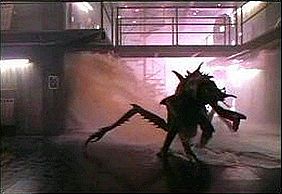
Nah, that’s the xenomorph from the almost-forgotten TV drama, “Something is Out There.” For what it’s worth, it was quite terrifying at times, but noteworthy as it used this term long before the “Alien” franchise was born.
This is a skeuomorph:
It will be easily recognized as the universal “save” icon in many computer programs. But floppy disks are no longer used for saving things (for the most part,) and many young people have probably never even seen or held one.
Wikipedia defines a skeuomorph thusly:
[It] is a derivative object that retains ornamental design cues from structures that were necessary in the original.Examples include pottery embellished with imitation rivets reminiscent of similar pots made of metaland a software calendar that imitates the appearance of binding on a paper desk calendar.The term ‘skeuomorph’ is compounded from the Greek: skéuos, σκεῦος (container or tool), and morphḗ, μορφή (shape). It has been applied to material objects since 1890and is now also used to describe computer and mobile interfaces.
Webster’s 3rd International Dictionary contains 472,000 words, of which I know but a fraction. Despite the fact that my education has not been wanting and it takes a concerted effort to get me scurrying to the dictionary, this was a new one on me and I learned it over at reddit. It’s kind of like octothorpe, the ten-dollar word for the hash mark, number sign, or pound sign (#) now so commonly used at Twitter and elsewhere. #insanity
Some other examples of skeuomorphs:
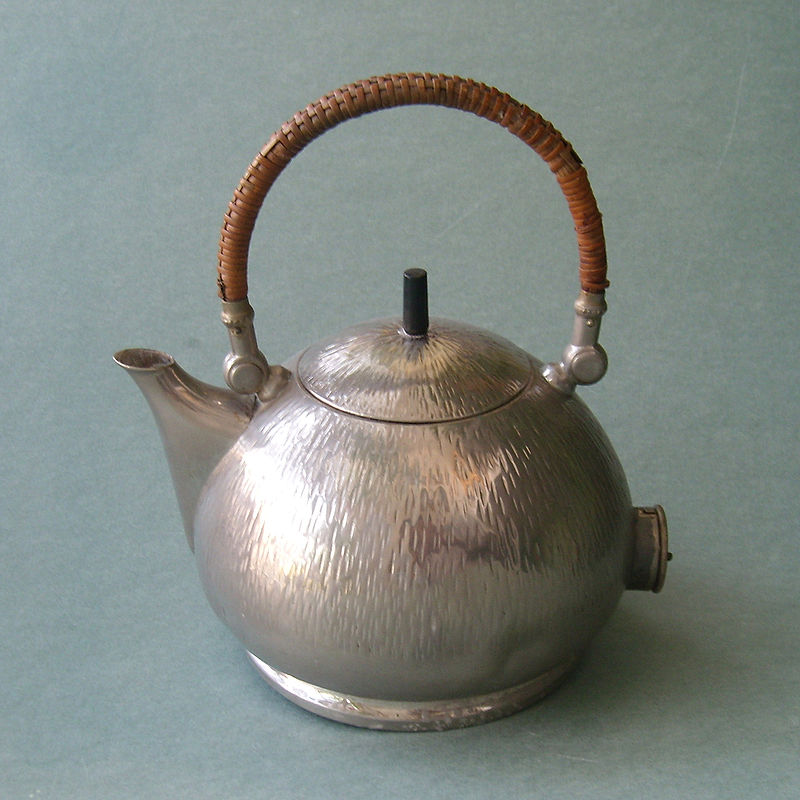
An electric kettle in the form of a stove-top kettle.
This woody-style car, where the false wood grain is not part of the vehicle’s structure.
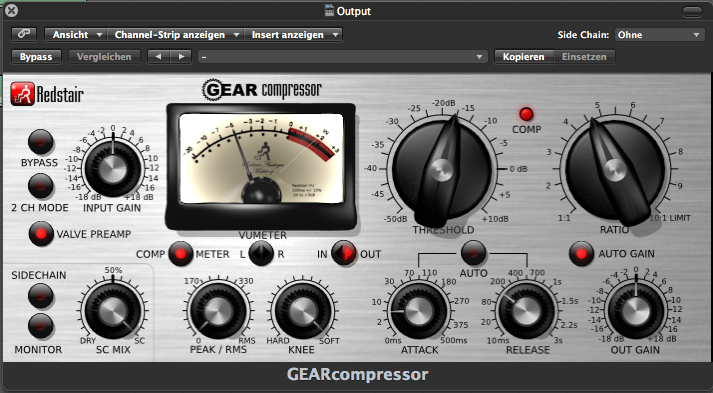
Sofware interface for an audio program, designed to look like a physical device.
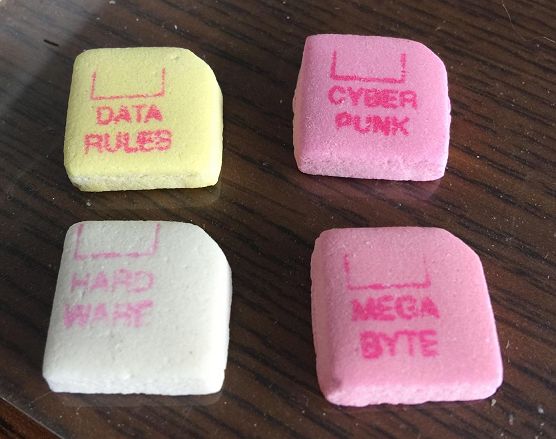
What got me thinking about this is a picture of some really old candy-heart type floppy disks that must have been manufactured in the 80s or thereabouts:
Back then, these would have been much more recognizable than they are today.
So remember that the next time you click on the little disk icon to save your document, you’re using a skeuomorph.
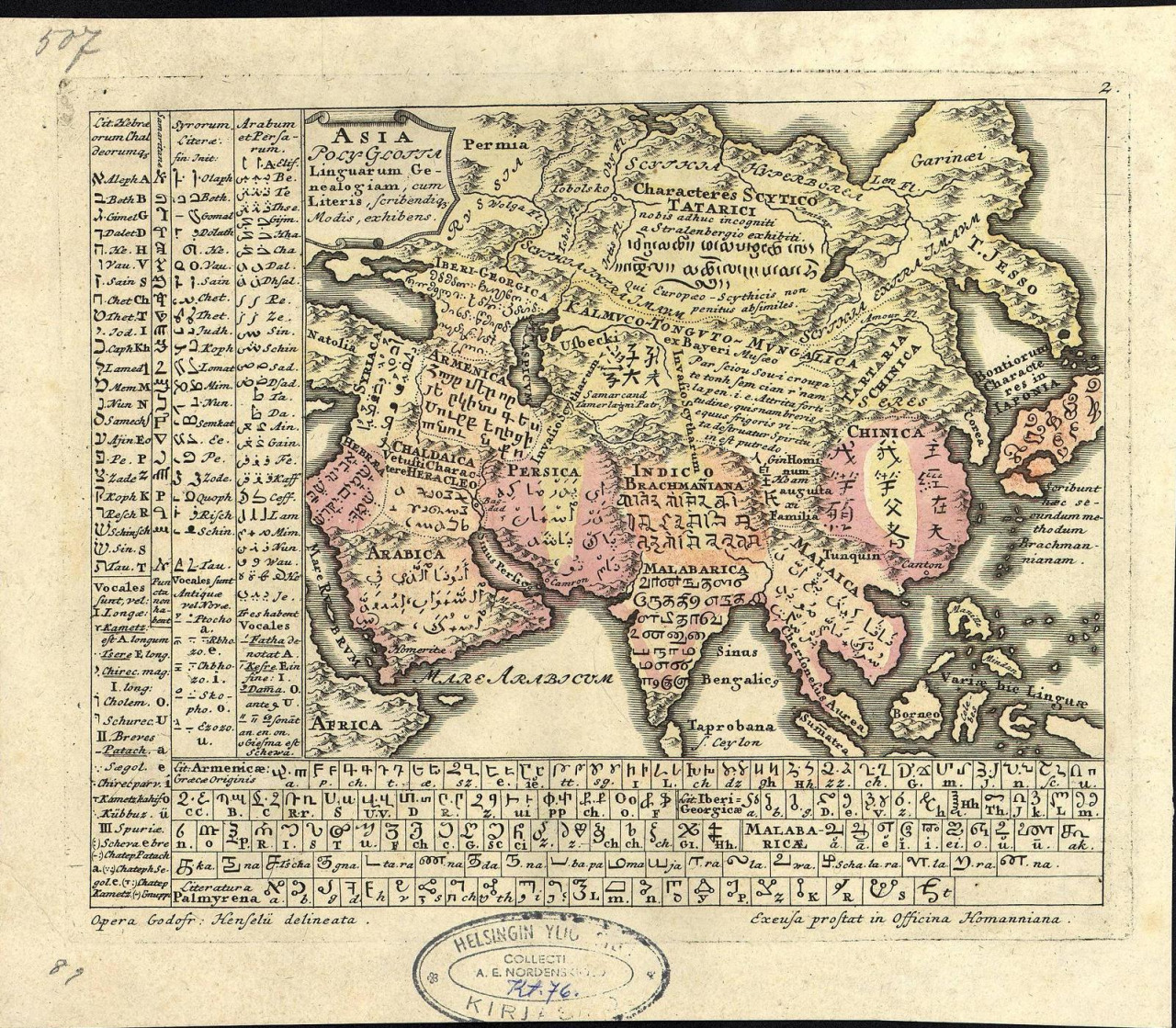
This intriguing linguistic map of Asia by Gottfried Hensel (Asia Poly-Glotta Linguarum Genealogiam, 1741) was found at Maps on the Web.
“The map presents the Lords Prayer in Asian languages and attempts to trace each back to Hebrew as was common at the time. Some interesting items are the scripts of Japan, Siberia, Mesopotamia, and eastern Anatolia. Also Southeast Asia using the Arabic script and Uzbeks using Chinese logographs is a unique sight.”
Now, I’m no linguist, but… oh, wait, I *am* a linguist… that “Japanese” script looks like sheer garbage. The only clue is the Latin inscription below it, which reads “these are written using the Brachmann method.” I have found no modern references to this. It could be some sort of phonetic transcription, which is odd given that various Chinese scripts are represented and the author of the map is no stranger to ideographic writing.
Recognizable are old variants of Hindi (again, a “Brachmann” version), Dravidian script (called “Malabar” here), Hebrew, Arabic, Chaldaic, Chinese, Georgian, Syriac, Farsi, and Armenian.
If you’ve ever heard that hollered by an overworked server to a harried cook at your local greasy spoon, you might have just ordered a pair of franks with baked beans.
Welcome to my stream of consciousness morning.
A recent article at the Sydney Morning Herald provided a fascinating insight into coded language used by healthcare professionals, flight attendants, butchers, and others. (For example, COPD can not only stand for Chronic Obstructive Pulmonary Disease, but also “Chronic Old Person’s Disease.”) The article is a fascinating read.
That led me to think of diner slang, a subject lovingly researched by John Clarke, the husband of a dear friend of mine whom I knew for over 60 years and who recently left this world (far too soon, I might add.) I’m not sure where his research is at the moment, but I know John has dedicated a good bit of time to exploring the ins and outs of this fine art of colorful communication.
America’s original quick-bite places – the main-street soda fountain, the corner lunchionette, and the roadside diner – shared a special, often secret, culture of language. During the Golden Age of slinging slang from 1925 to 1945, waitstaff and kitchen workers communicated in colorful shorthand.
How good is your slang? See if you can match the twelve sassy term in Column A with the classic American home-style desserts in Column B.
Bonus Question: “Give me Eve with the roof on, a crow slab covered in spla, maiden and tar, plus a stretch with frost and sissy sticks!” What’s being ordered?
Bonus Question: Apple pie with a top crust, chocolate pie covered with whipped cream, cherry pie and a mug of coffee, and a large Coke™ with crushed ice and two straws!
Thanks to the wonders of the Internet which rarely forgets, here’s a list of diner slang assembled by Dave Hutchins over at Discuss Cooking – the list has been alphabetized and edited a bit for clarity:
A blond with sand: Coffee with cream and sugar An MD: Dr Pepper A spot with a twist: Cup of tea with lemon Adam & Eve on a raft: Two poached eggs on toast And cinnamon: Dropped in a bowl of milk Angel: Sandwich man Baled hay: Shredded wheat Balloon juice: Seltzer or soda water Belch water: Alka Seltzer Billiard: Buttermilk Bird seed: Breakfast Black and white: Chocolate soda with vanilla ice cream Blood hounds in the hay: Hot dogs and sauerkraut Blow out patches: Pancakes Blue plate special: a dish of meat, potato, vegetable also daily special Boiled leaves: Tea Bossy in a bowl: Beef stew Bow Wow, Ground hog: A hot dog Bowl of Red: Chili con carne Break it and shake it: Add egg to a drink Breath: Onion Bridge Party: Four of any thing (from the bridge game) Bubble dancer: Dish washer Bullets or whistleberries: Baked beans (because of supposed flatulence) Burn one: Fry a hamburger Burn one, take it through the garden: Hamburger with lettuce tomato, onion Burn the British: Toasted English muffin Cackle fruit: Eggs Canned cow: Evaporated milk Chopper: Table knife CJ: Boston Cream cheese and Jelly Cowboy or western: A western omelet or sandwich Cow paste, Skid grease, Axle grease: Butter Creep: Draft beer Crowd: Three of any thing (as in, “Two is company three is a crowd”) Customer will take a chance: Hash Dead eye: Poached eggs Dough well done with cow: Buttered toast Drag one through Georgia: Cola with Chocolate syrup Draw one in the dark: A Black coffee Draw one or a cup of mud: Cup of coffee Eighty Six: The kitchen is out of the item ordered Fifty-five: A glass of root beer Flop two fry: Two eggs any style Frenchman’s delight: Pea soup Frog sticks: French Fries Fry two, let the sun shine: 2 eggs with unbroken yolks GAC: Grilled American cheese sandwich Gallery: Booth Go for a walk or on wheels: it’s to go Grave yard stew: Milk toast buttered toast sprinkled with sugar Gravel train: Sugar bowl Hail: Ice Hemorrhage: Ketchup High and dry: A plain sandwich with nothing on it Hockey Puck: A hamburger well done Hold the hail: No ice Hot top: Hot Chocolate Hug one or squeeze one: Orange juice In the alley: Served as a side dish Jack Benny: Cheese with bacon )Named after Jack Benny) Java or Joe: Cup of coffee Keep off the grass: No Lettuce Lady Bug: Fountain man Life preserver: Doughnut Light House: Ketchup bottle Looseners: Prunes Lumber: tooth pick Machine oil: Syrup Mike & Ike or the twins: salt & pepper shakers Million on a platter: Plate of baked beans Mississippi mud or yellow paint: Mustard Moo juice, Baby juice, Sweet Alice: Milk Mystery in the alley: Side order of hash No cow: without milk Noah’s boy on bread: Ham sandwich Noah’s son: Slice of ham (Noah’s second son) One from the Alps: A Swiss cheese sandwich Paint it Red: Put ketchup on it Pair of drawers: two cups of coffee Pin a rose on it: Add Onion to a order Put out the lights and cry: Liver and onions Rabbit food: Lettuce Radio: Tuna salad sandwich Sea Dust: Salt Shake one in the hay: Strawberry milk shake Shingle with a shimmy and a shake: Buttered toast with jam or jelly Shoot from the south: Coca Cola™ Smear: Margarine Soup Jockey: Waitress Stack or short stack: Order of pancakes Sun kiss or oh gee: Orange juice Sweep the kitchen: Hash Throw it in the mud: Add Chocolate syrup Two cows, make them cry: two hamburgers with onion Vermont: Maple syrup Warts: Olives Wax: American cheese Whisky down: rye toast Whisky: Rye bread White cow: Vanilla milk shake Wind mill, Adams ale, city juice, dog soup: A glass of water Yum yum or sand: Sugar Zeppelin: Sausage
I got a big kick out of “Put out the lights and cry” – I’m a big fan of liver and onions, but apparently many others are not.
These terms can be very regional and original, so there were likely to be many terms for the same item around the country. A more comprehensive list should be forthcoming when I have the time.
I’ve always been a word person, since my earliest memories. I’ve always enjoyed playing with language, Odd that I hated my 7th-grade linguistics class… clearly I was not emotionally or intellectually ready for it. Or else my teacher was a dried-up, boring old pedant. Whatever.
I remember about 20 years ago I was sitting in my office while recovering from a fall in the which I had cracked three ribs. Things were quite uncomfortable, when I happened to run across the following sniglets:
ARACHNOLEPTIC FIT (n.) The frantic dance performed just after you’ve accidentally walked through a spider web.
ECNALUBMA (ek na lub’ ma) n. A rescue vehicle which can only be seen in the rearview mirror.
LACTOMANGULATION (lak’ to man gyu lay’ shun) n. Manhandling the “open here” spout on a milk container so badly that one has to resort to the ‘illegal’ side.
These, along with a few others, struck me as so funny at the moment that I was overcome by paroxysmic fits of giggling, punctuated with “Ow! Ow! Ow!” from the rib injuries. The episode must have lasted more than 15 minutes, and the tears streaming down my face were a mixture of mirth and pain.
So yesterday I stumbled across the following sign over at reddit, seen somewhere in Taiwan:
I fear that this sophomoric bit of humor affected me in the same way; “hell all your family” strikes me as excruciatingly funny. This time I was not suffering from broken ribs so the laughter only resulted in odd looks from my wife as I thrashed helplessly on the couch.
I note with interest that hella has become, in recent days, an acceptable adverb, as in “that movie was hella good;” I am pleased to see that Hell has now become a verb. As Calvin remarked to Hobbes, “Verbing weirds language,” and the weirder language is, the better I like it.





 Playing in the World Game